
Automated and Emerging Technologies
Artificial intelligence
In this note
- 6.3.1Understand what is meant by artificial intelligence (AI): a branch of computer science dealing with the simulation of intelligent behaviours by computers.
- 6.3.2Describe the main characteristics of AI: the collection of data and the rules for using that data; the ability to reason; it can include the ability to learn and adapt.
- 6.3.3Explain the basic operation and components of AI systems: expert systems (knowledge base, rule base, inference engine, interface) and machine learning (a program that can automatically adapt its own processes and/or data).
Before this: Robotics. This is the last note of Paper 1 theory.
The notes: every idea from the start, with our own examples.
What you should already know
Robots
Mechanical structure + electrical components + programmable. A robot does not have to be intelligent.
Quick check: does every robot have AI?
No: AI is something extra some robots have.
What is AI?
| Characteristic | What it means | Example |
|---|---|---|
| Collection of data and the rules for using that data | it holds facts and rules that say what to do with them | a medical system stores symptoms and IF … THEN rules |
| Ability to reason | it can work out a conclusion or make a decision from the data | decides the most likely illness |
| Ability to learn and adapt (can be included) | it can change its own processes / data from experience, so it improves | a game character learns how a player moves |
The syllabus covers two kinds of AI system: expert systems and machine learning.
Expert systems
An expert system copies the knowledge of a human expert (a doctor, a mechanic, a geologist) so that someone else can get an expert answer: a diagnosis, a fault, a decision. It has four components:
| Component | Its job |
|---|---|
| Knowledge base | a database of facts about the subject (collected from experts) |
| Rule base | the rules (IF … THEN) for using the facts; links the facts in the knowledge base so the inference engine can use them |
| Inference engine | the part that makes decisions: it applies the rule base to the knowledge base and the user's answers to reach a diagnosis; it also decides which question to ask next based on the previous answers |
| Interface | how the user inputs data (answers questions) and sees the output (the questions and the diagnosis) |
General methodHow an expert system works (e.g. diagnosing a car fault)
- The user enters data through the interface (or plugs the car into it), e.g. "the brakes squeak".
- The inference engine compares the data with the knowledge base …
- … and applies the rule base to the knowledge base.
- It decides which question to ask next, based on the previous answers, and shows it on the interface.
- When it has enough data it decides the diagnosis (the most likely one if there are several).
- The interface outputs the diagnosis (often with how it was reached).
Machine learning
General methodHow a system uses machine learning (any scenario)
- It collects / gathers data as it works (e.g. where obstacles are, how a user speaks, which results were clicked).
- It analyses the data to find patterns.
- It stores successful and unsuccessful results / actions.
- It adapts its own processes, rules or data using this.
- So next time it makes fewer mistakes / gives more accurate results (say what improves in the scenario).
| Scenario | What it learns | So … |
|---|---|---|
| robot vacuum cleaner | the shape of the room, where obstacles and dirtier areas are | it takes the most efficient route |
| smart speaker | the user's voice, accent and different ways of asking | it understands voice commands better, ignores background noise |
| search engine | which results users clicked or ignored (feedback) | it changes its rules to give more relevant results |
| game character | patterns in the player's movements | it predicts and reacts to the player's next move |
| weather system | patterns in past weather data, feedback on its forecasts | it makes more accurate predictions |
Try it yourself
Show answer
Answer The inference engine
Show answer
Answer The knowledge base
Show answer
Answer Machine learning
Show answer
Answer Knowledge base, rule base, inference engine, interface
Summary
- AI: the simulation of intelligent behaviours by computers.
- Characteristics: data + rules for using it; ability to reason; can learn and adapt.
- Expert system: knowledge base (facts) · rule base (rules) · inference engine (applies rules to facts, decides next question and diagnosis) · interface.
- Machine learning: automatically adapts its own processes / data: gathers data → patterns → stores results → adapts → fewer mistakes.
If you see …
- "explain how an expert system operates" [5-6]interface input · inference engine · knowledge base · rule base · applies rules to facts · decides next question · outputs diagnosis
- "explain how X can make use of machine learning" [3-4]gathers data · patterns · adapts own processes · so … (scenario) · fewer mistakes
Question types, what the examiner gives marks for, and real past-paper questions solved.
Ways they test it
Type 1 Define / characteristics
"Describe what is meant by AI" [2-3]; "identify three other characteristics of AI" [3]
Spot it "what is meant by".
- simulation of intelligent behaviour · data + rules · reason · learn / adapt
Type 2 Components
"Identify the three other components in an expert system" [3]; "circle three components" [3]
Spot it one component already named.
- From knowledge base, rule base, inference engine, interface: leave out the one given.
Type 3 Operation
"Explain how the expert system operates and how it is used to diagnose the problem" [5-6]
Spot it "operate / diagnose".
- Follow the method; say "inference engine" for every decision.
Type 4 Cloze
"Complete the paragraph using terms from the list" [5-7]
Spot it a word list.
- Facts → knowledge base; decides → inference engine; links / applies → rule base; types / output → interface.
Type 5 Machine learning in a scenario
"Explain how the robot vacuum cleaner can make use of machine learning" [3-4]
Spot it a named device.
- Method + what it learns in that device.
What the examiner looks for
"Explain how an expert system operates" [6]
Marking points (one mark each, up to the marks shown)
- It has an interface …
- … used to input data / view output
- It has a knowledge base
- It has a rule base
- It has an inference engine
- Applies the rule base to the knowledge base to provide the output / diagnosis
- Decides what to ask next based on the data input
Keywords interface knowledge base rule base inference engine applies diagnosis
Too vague "the knowledge base decides"; "it thinks like a human"
Past-paper questions, solved
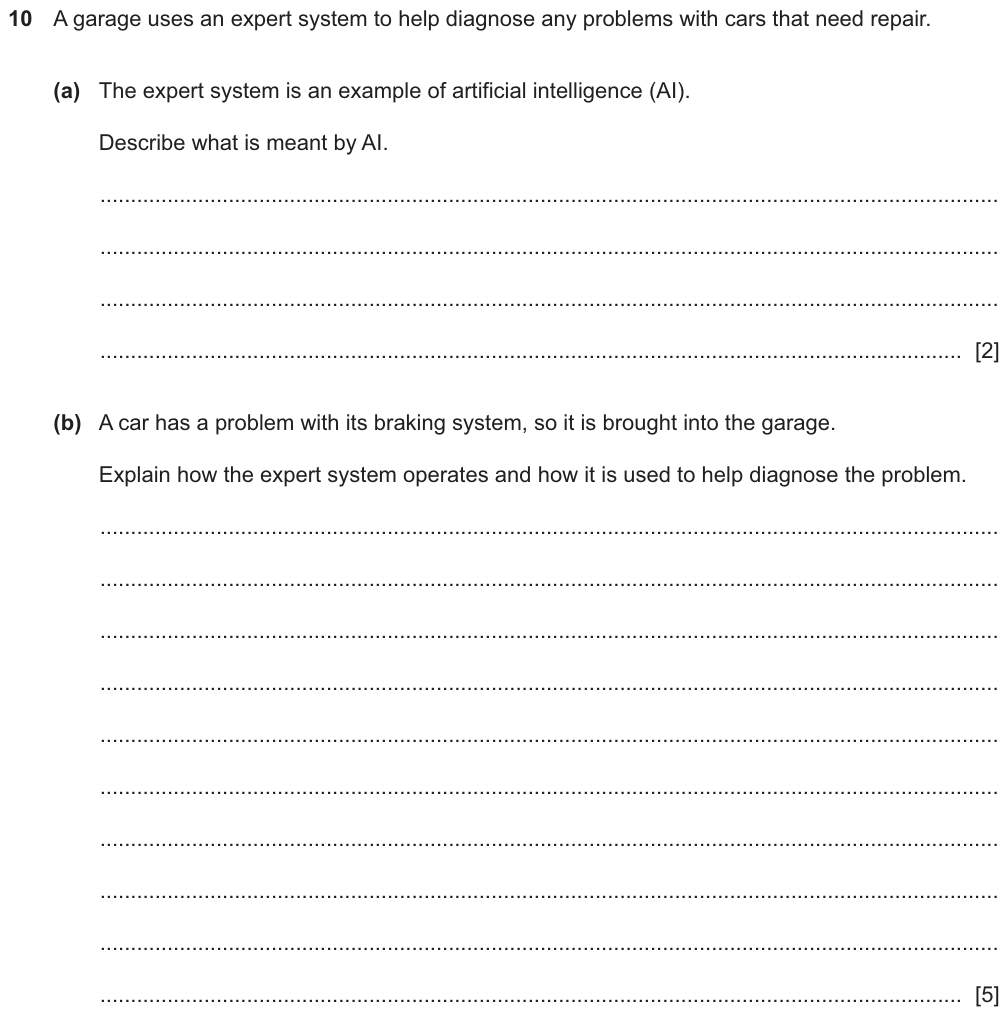
How to start (a) two characteristics [2]. (b) the operation method, in the garage’s words [5].
Show a full-mark answer and the mark scheme
(a) The simulation of intelligent behaviours by computers. It has the ability to reason.
(b) The mechanic enters data about the brakes into the interface. The inference engine decides which questions to ask, using the previous answers given. It compares the answers entered with the knowledge base and the rule base. It decides on the most likely diagnosis and the interface outputs it.
| Part | Answer / working | Marks | Guidance |
|---|---|---|---|
| 10(a) | Any two: simulation of intelligent behaviour · data + rules for using it · ability to reason · ability to learn / adapt | B2 | |
| 10(b) | Any five: data entered via interface · inference engine decides which questions · … using previous answers · decides diagnosis · … comparing with knowledge base and rule base · most likely option · interface outputs diagnosis · explanation system | B5 | |
| Total: 7 marks | |||
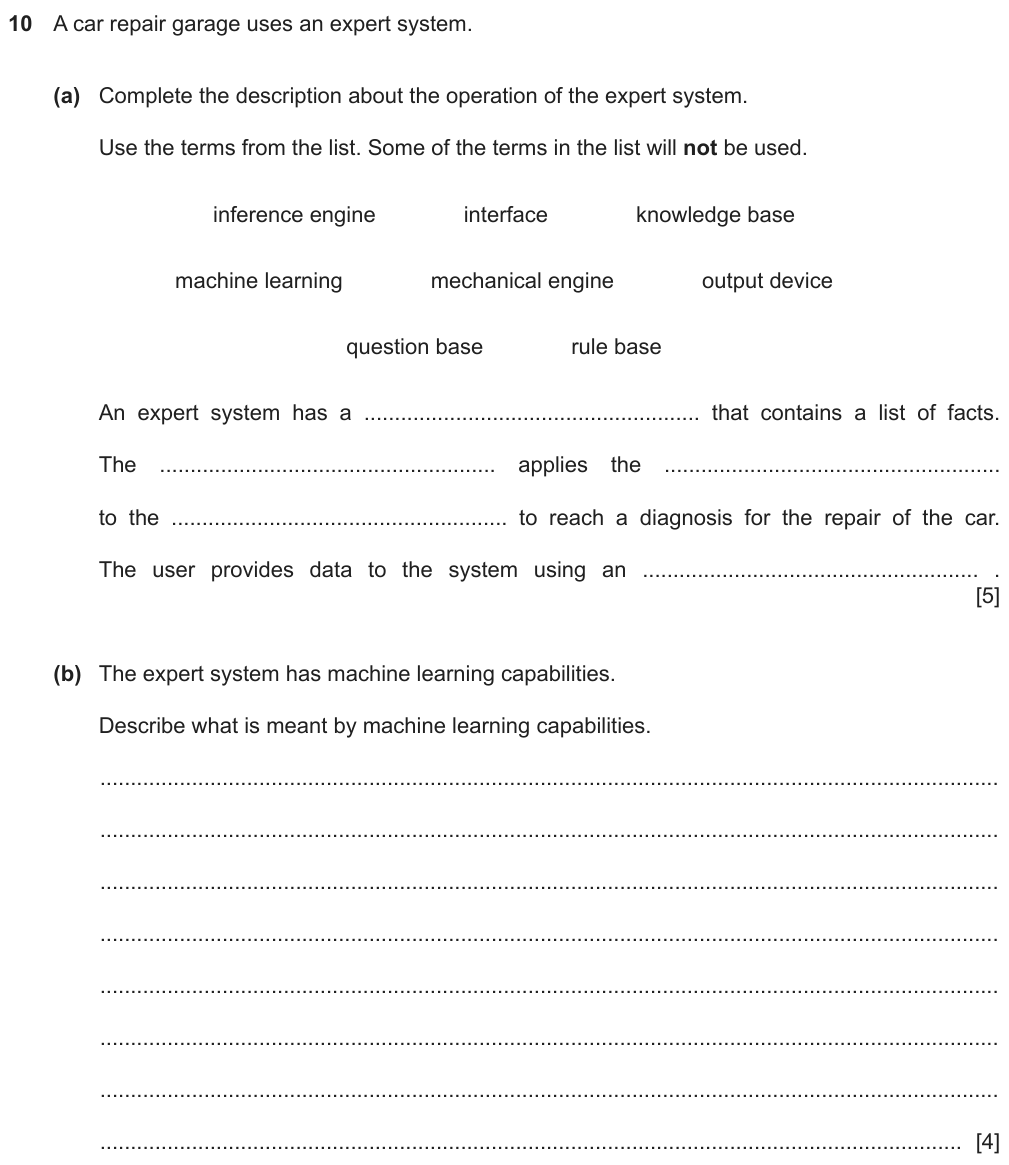
How to start (a) five gaps: match each gap to a component’s job. (b) four points about machine learning.
Show a full-mark answer and the mark scheme
(a) An expert system has a knowledge base that contains a list of facts. The inference engine applies the rule base to the knowledge base to reach a diagnosis for the repair of the car. The user provides data to the system using an interface.
(b) It is a form of AI that can adapt its own processes and edit its own data. It analyses patterns and stores successful and unsuccessful results, to influence future decisions. It can be trained, supervised or unsupervised.
| Part | Answer / working | Marks | Guidance |
|---|---|---|---|
| 10(a) | knowledge base · inference engine · rule base // knowledge base · knowledge base // rule base · interface | B5 | |
| 10(b) | Any four: form of AI · adapts own processes · edits own data · can be trained · supervised / unsupervised · analyses patterns, stores results · to influence future decisions | B4 | |
| Total: 9 marks | |||
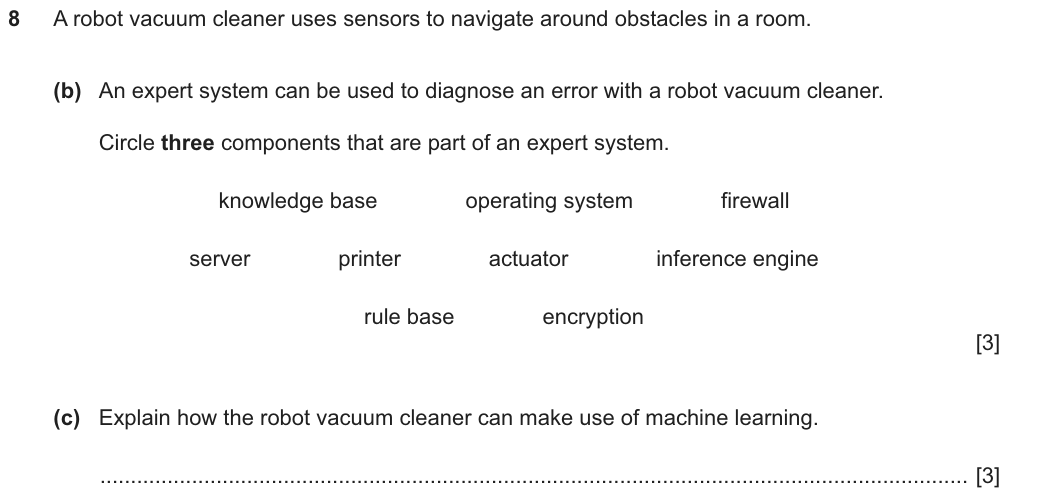
How to start (b) circle exactly three. (c) machine learning in this device: say what it learns.
Show a full-mark answer and the mark scheme
(b) Knowledge base, rule base, inference engine.
(c) It gathers data while vacuuming, such as where obstacles are and where the dirtier areas are. It adapts its own processes using this data, so it knows the most efficient route to vacuum the room and which areas to concentrate on.
| Part | Answer / working | Marks | Guidance |
|---|---|---|---|
| 8(b) | knowledge base · rule base · inference engine | B3 | |
| 8(c) | Any three: gathers data · adapts own processes · … obstacles · dirtier areas · path / shape of room · most efficient route · areas to avoid | B3 | |
| Total: 6 marks | |||
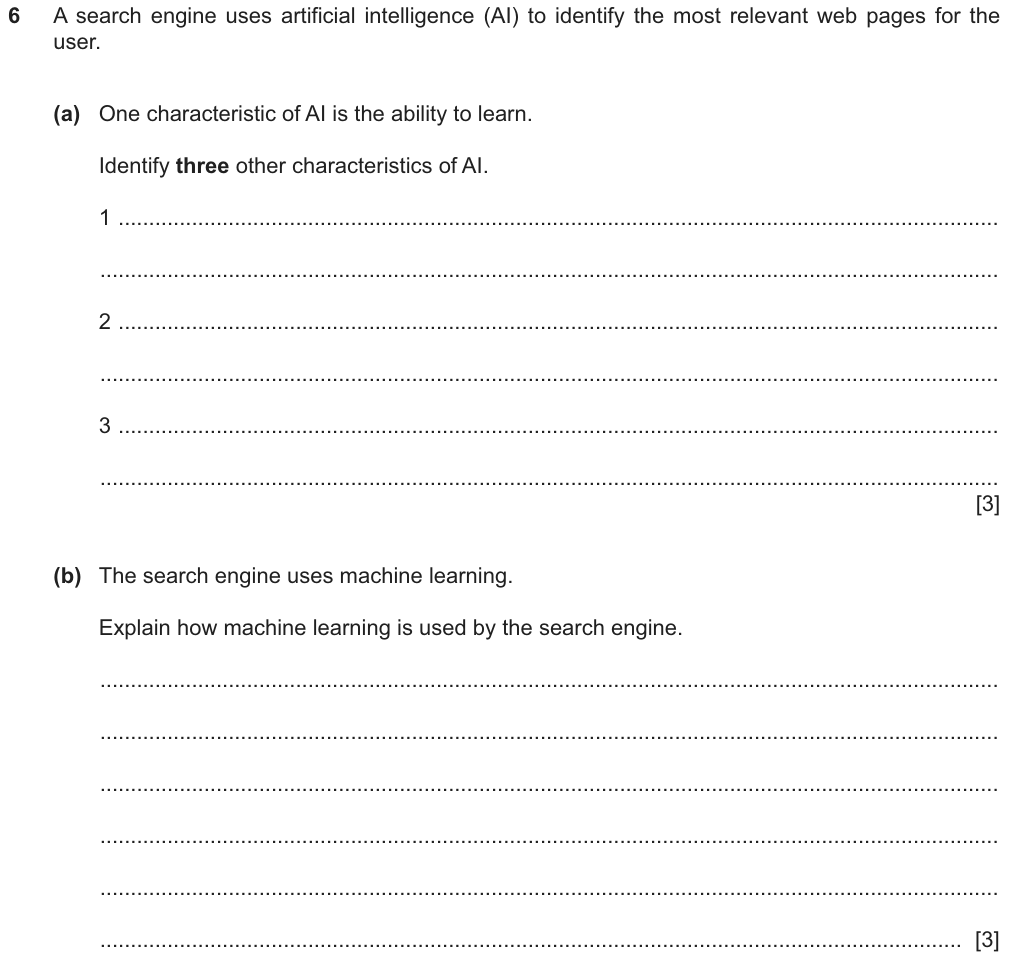
How to start (a) the question gives "learn": give three other characteristics. (b) how the search engine changes from feedback.
Show a full-mark answer and the mark scheme
(a) The collection of data; rules for using the data; the ability to reason.
(b) If a result does not give a suitable response, this is recorded. The search engine changes its own data and rules according to this feedback, so next time it provides more relevant results.
| Part | Answer / working | Marks | Guidance |
|---|---|---|---|
| 6(a) | Any three: collection of data · rules for data · ability to reason · ability to adapt | B3 | |
| 6(b) | Any three: changes its data / rules · according to feedback · unsuitable result recorded · result changed next time · more accurate / relevant | B3 | |
| Total: 6 marks | |||
How to start Four marks: name machine learning, then what it gathers and what improves.
Show a full-mark answer and the mark scheme
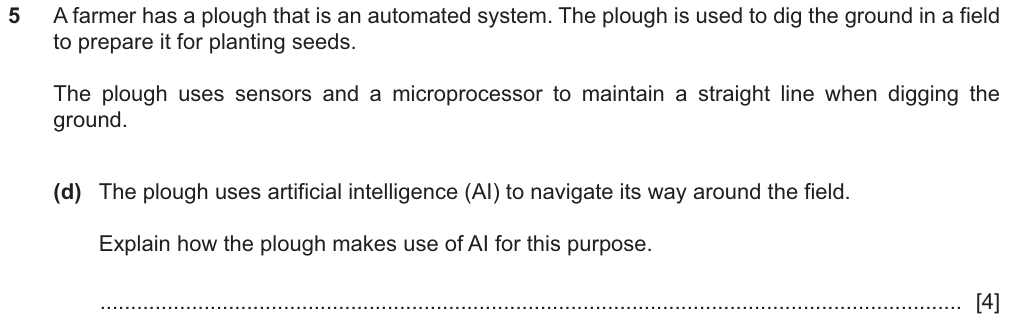
It could use machine learning. It gathers data while ploughing, such as the dimensions of the field and where obstacles are, and uses this data to adapt its own process, creating a map of the field and the most efficient route, so it makes fewer mistakes in future.
| Part | Answer / working | Marks | Guidance |
|---|---|---|---|
| 5(d) | Any four: machine learning · gathers data from ploughing · adapts own process · fewer mistakes · … dimensions / landscape / obstacles · map of field · most efficient route · knows what to avoid | B4 | |
| Total: 4 marks | |||
Common mistakes
- ✗ "The knowledge base makes the diagnosis"✓ "The inference engine applies the rule base to the knowledge base to make the diagnosis"
- ✗ "AI is a robot"✓ "AI is the simulation of intelligent behaviour by computers"Robots and AI are separate topics.
- ✗ "Machine learning means it learns"✓ "It automatically adapts its own processes and data"Don't define a word with itself.
- ✗ Generic machine-learning answers✓ Say what this device learns (route, voice, obstacles…)Scenario marks need the scenario.
Practice
Practice: easy, medium, hard
Easy
Show answer
Answer Knowledge base
Show answer
Answer e.g. collection of data and rules for using it · ability to reason · ability to learn / adapt
Medium
Show answer
Answer Stores the rules (IF … THEN) · used by the inference engine · to link the facts in the knowledge base
Show answer
Answer Makes decisions · by applying the rules to the facts / knowledge · to give a result / diagnosis
Hard
Show answer
Answer Collects data about each game / the opponent’s moves · finds patterns · stores successful and unsuccessful moves · adapts its own processes · so it chooses better moves and makes fewer mistakes next time
Can I do this?
- I can define AI and give its characteristics.
- I can name the four components of an expert system and explain how it reaches a diagnosis.
- I can explain machine learning in a given scenario.
Anything unticked: revise that section first. All ticked: take the quiz.
Quiz
The multiple-choice and guided questions need JavaScript. The concept checks and exam practice below work without it.
Your progress on this note is saved when JavaScript is on.
⬇️ Download this chapter as a PDF: Full notes