
Information representation
Character sets: ASCII and Unicode
What you need to be able to do
- 1.1Explain what a character set is and how text is represented in binary, character by character.
- 1.1Describe ASCII, extended ASCII and Unicode: bits per character, how many characters, what they can represent.
- 1.1Compare the character sets (similarities and differences) and justify using one.
- 1.1Work with character codes: convert a given code between denary, binary and hex, and find a neighbouring character's code.
You need: binary, denary and hex conversions from Number bases, prefixes and BCD. You will not be asked to remember any particular code: the question always gives you one to work from.
What a character set is
Text is stored by replacing every character, including spaces and punctuation, with its code. For the word “Cat” in ASCII:
| Character | C | a | t |
|---|---|---|---|
| Denary code | 67 | 97 | 116 |
| Binary (stored) | 0100 0011 | 0110 0001 | 0111 0100 |
| Hex | 43 | 61 | 74 |
- Each character has its own unique code in the character set.
- Each character in the text is replaced by its code (stored in binary).
- The codes are stored in sequence, in the same order as the characters in the text.
Those three points are exactly how the mark scheme words “explain how the word … is represented”. The examiner's comment (June 2021): the two ideas that were needed are uniqueness and order; “each character has a code” is not precise enough.
ASCII and extended ASCII
| ASCII | Extended ASCII | |
|---|---|---|
| Bits per character | 7 (usually stored in an 8-bit byte with the extra bit 0) | 8 |
| Number of characters | \(2^7=128\) (codes 0-127) | \(2^8=256\) (codes 0-255) |
| What it covers | English letters (upper and lower case), digits, punctuation, and non-printing control codes (e.g. 13 = carriage return) | all of ASCII (codes 0-127 are identical) plus 128 more: accented letters (é, ü), extra symbols, line-drawing characters |
| Limitation | English (Latin alphabet) only | still only 256 characters: not enough for Chinese, Arabic, Urdu, emoji …; different “code pages” used the top 128 codes differently |
Codes for letters and digits run in order, so one given code lets you work out its neighbours:
| Group | Pattern (example codes - you won't need to memorise them) |
|---|---|
| Upper-case letters | A = 65, B = 66 … Z = 90 (consecutive) |
| Lower-case letters | a = 97 … z = 122: each is 32 more than its capital (one bit different: 0100 0001 vs 0110 0001) |
| Digits | '0' = 48 … '9' = 57: the character '5' (code 53) is not the number 5 |
| Space | 32 |
Unicode
Unicode was designed to give every character in every language its own unique code, plus symbols and emoji, so that text looks the same on every computer in every country.
| Unicode | |
|---|---|
| Bits per character | 16 or 32 (the common encodings use 8, 16 or 32 bits per character: UTF-8, UTF-16, UTF-32) |
| Number of characters | 65 536 or more (16 bits); over a million possible codes in all |
| What it covers | characters from (almost) all languages, mathematical and other symbols, emoji |
| Link with ASCII | the first 128 Unicode codes are the ASCII codes: ASCII is a subset of Unicode |
ASCII vs Unicode
| ASCII / extended ASCII | Unicode | |
|---|---|---|
| Bits per character | 7 / 8 | up to 32 (16 or 32 commonly) |
| Characters | 128 / 256 | 65 536+ |
| Languages | English / Western European only | virtually all languages |
| Storage per character | less (1 byte) | more (2-4 bytes), so text files are larger |
Similarities to quote
Both represent each character using a unique code; both can use 8 bits; Unicode contains all the ASCII characters (ASCII is a subset).
Why choose Unicode
A wider range of characters, so text in more languages (and emoji / symbols) can be represented, and shared internationally without garbling.
Why choose ASCII
Fewer bits per character, so a smaller file, when only English characters are needed.
Working with character codes
1 A neighbouring code
In a character set the code for 'D' is 68. What is the code for 'H'?
Askedcode of HKnowletters are consecutiveRoutecount on from D
- D, E, F, G, H: 4 letters later
- 68 + 4 = 72
2 Digit character from a given one
The code for the character '1' is 49 (denary). Give the code for '7' in hexadecimal.
Askedhex code of '7'Knowdigits are consecutiveRoute49 + 6, then hex
- '7' is 6 after '1': 49 + 6 = 55
- 55 = 3 × 16 + 7 = 37 hex
3 Lower case from upper case
The code for 'M' is 0100 1101. Give the code for 'm' in binary.
Askedbinary code of 'm'Knowlower case = upper case + 32Routeset the 32s bit
- 32 = 0010 0000
- 0100 1101 + 0010 0000 = 0110 1101
Adding 32 just switches on the 32s bit, because that bit is 0 in every capital letter.
4 A Unicode code in hex to denary
A Unicode character has the code 03A9 (hex). What is it in denary?
AskeddenaryKnowhex place valuesRoute0 × 4096 + 3 × 256 + 10 × 16 + 9
- 768 + 160 + 9 = 937
5 Storage for some text
How many bytes does the 20-character text “Topical past papers!” take in extended ASCII and in 16-bit Unicode?
AskedbytesKnow8 bits vs 16 bits per characterRoutecharacters × bits ÷ 8
- Extended ASCII: 20 × 8 bits = 160 bits = 20 bytes
- 16-bit Unicode: 20 × 16 bits = 320 bits = 40 bytes
Spaces and punctuation are characters too: count them.
Mark-scheme focus
“Describe what is meant by a character set” (2 marks)
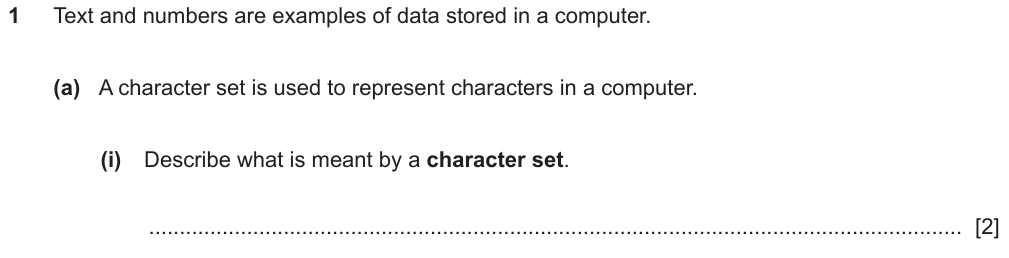
- All of the characters / symbols that the computer can use / represent B1
- Each character has a unique number / binary number / hexadecimal number B1
- “A character set is a set of characters” (repeats the question)
- “Each character has a code” (not unique)
Two marks need two different points: what the set contains, and the one-to-one link between each character and its code (June 2022 report).
From: 9618/13/M/J/22 Q1(a)(i)
“Explain how the word ‘Clock’ is represented by a character set” (2 marks)

- Each character has a unique binary code B1
- The binary code for each character is stored in sequence (in the order of the word) B1
- “Clock is converted into binary” (how?)
- “Each letter has a code” (unique is missing)
- Listing ASCII codes you can't be sure of
The scheme wants the mechanism: unique code per character, codes stored in the word's order. You never need the actual codes.
From: 9618/13/M/J/24 Q1(d)(ii)
“Give one similarity and two differences between ASCII and Unicode” (3 marks)
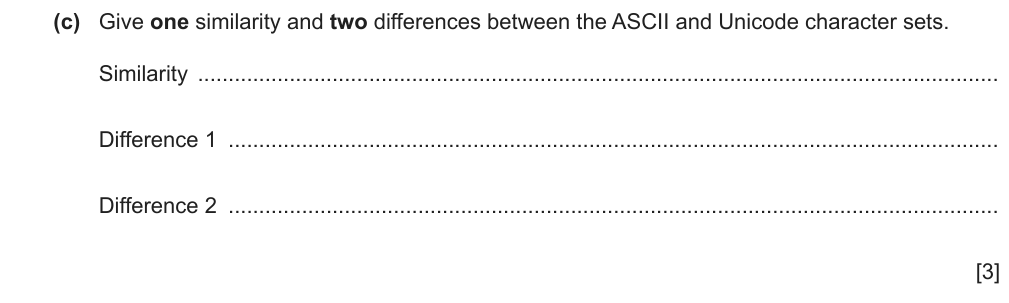
- Similarity: both represent each character using a unique code // both can use 8 bits // ASCII is a subset of Unicode B1
- Difference: Unicode can use up to 32 bits per character, ASCII 7 or 8 B1
- Difference: Unicode can represent a wider range of characters / different languages; ASCII only one language B1
- “Unicode is better” / “ASCII is older”
- Two differences that say the same thing (more bits AND more characters can count as one idea if not expanded - give two distinct points)
Each difference must compare both sets on one feature: bits per character, number of characters, languages covered.
From: 9618/11/O/N/22 Q1(c)
- One character-set question in most papers: 1-5 marks, often attached to a file or a multimedia question.
- Commonest asks: describe a character set (2), how a word is stored (2), ASCII vs Unicode (2-3), bits / characters in each (1-2).
- Code arithmetic: a given code → a neighbour's code, or the code converted to hex / binary / BCD (1 mark each).
Worked examples
Example 1 · ASCII, a word, and Unicode codes (Paper 1, 6 marks) ★ Easy
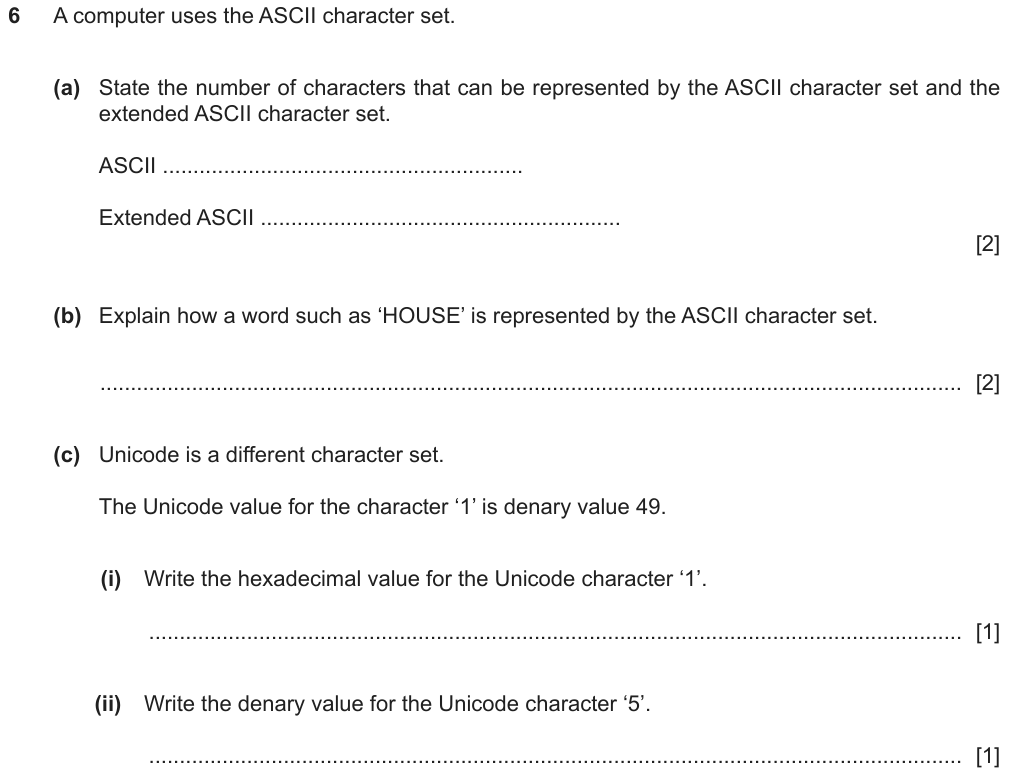
Three skills in one question: facts about ASCII, how text is stored, and code arithmetic from one given code.
- number of characters\(2^{\text{bits}}\)
- explain how … representedunique code + in sequence
- hexadecimal valueconvert 49
- denary value for '5'count on from '1'
- (a)128 and 256
- (b)how HOUSE is stored
- (c)(i)49 in hex
- (c)(ii)code of '5'
- ASCII 7 bits, extended 8
- '1' = 49
- digit characters have consecutive codes
- (c)(ii)'5'
- Consecutive'5' is 4 after '1'
- Trapanswering in binary
49 in hex?
49 = 3 × 16 + 1 → 31.
Which answers are in which base?
(c)(i) hex, (c)(ii) denary: the report saw binary answers to both.
5 Now solve it have a go on paper first, then open the worked solution
- (a) ASCII: 128 // \(2^7\) B1; extended ASCII: 256 // \(2^8\) B1
- (b) Each character has its own unique code B1; each character in the word is replaced by its code / the codes are stored in the order in the word B1
- (c)(i) 49 = 3 × 16 + 1 → 31 B1
- (c)(ii) 49 + 4 = 53 B1
'5' must have a bigger code than '1' and the digits run in order: 53 = 49 + 4 ✓. The report: “a common incorrect answer for extended ASCII was 255”.
Example 2 · Unicode characteristics and an extended ASCII table (Paper 1, 5 marks) ★ Easy
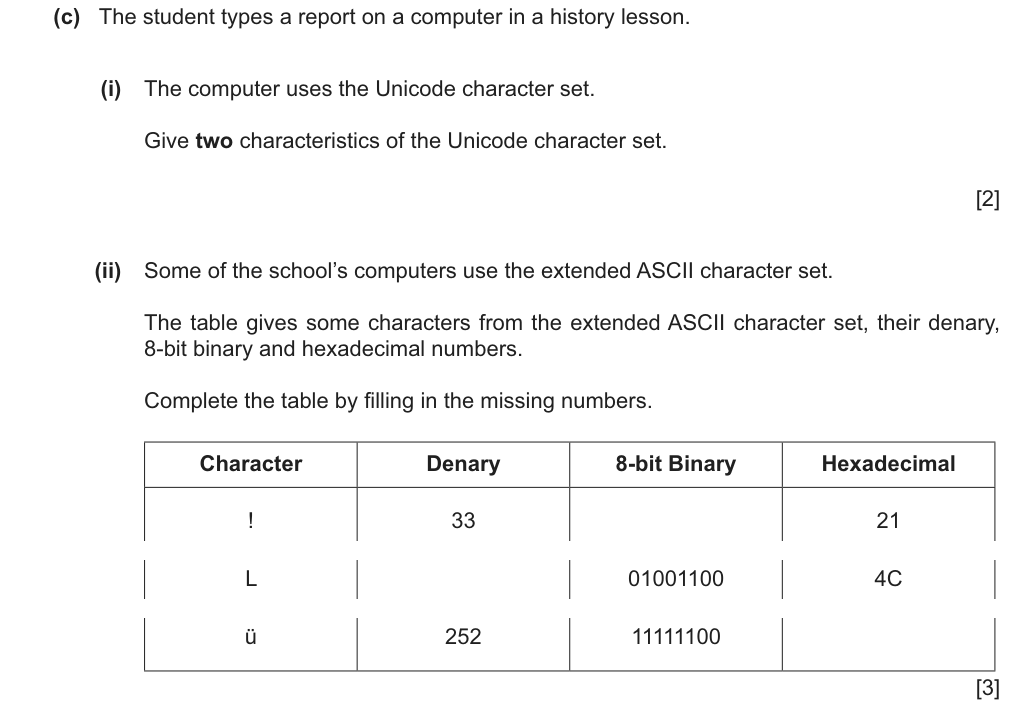
(i) wants two facts about Unicode. (ii) is a table: each row gives you one or two forms of the same code and you fill the gap.
- characteristicsfeatures of Unicode: bits, how many characters, what it covers
- 8-bit binarypad to 8 bits
- (c)(i)two characteristics
- (c)(ii)three missing values
- ! = 33, hex 21
- L = 0100 1100, hex 4C
- ü = 252 = 1111 1100
- (ii)missing values
- !33 → 8-bit binary
- Lbinary → denary
- übinary → hex
Quick check for 33 in binary?
33 = 32 + 1 → 0010 0001, and hex 21 = 0010 0001 too ✓.
5 Now solve it have a go on paper first, then open the worked solution
- (i) 8 / 16 / 32 bits per character B1; represents \(2^{16}\) / \(2^{32}\) etc. characters // every language and other characters such as emojis B1
- (ii) ! : 33 → 0010 0001 B1
- L: 0100 1100 = 64 + 8 + 4 = 76 B1
- ü: 1111 1100 → FC B1
Each row now has three forms that agree: 4C = 4 × 16 + 12 = 76 ✓, FC = 252 ✓.
Example 3 · Unicode advantages and two code conversions (Paper 1, 4 marks) ★★ Medium
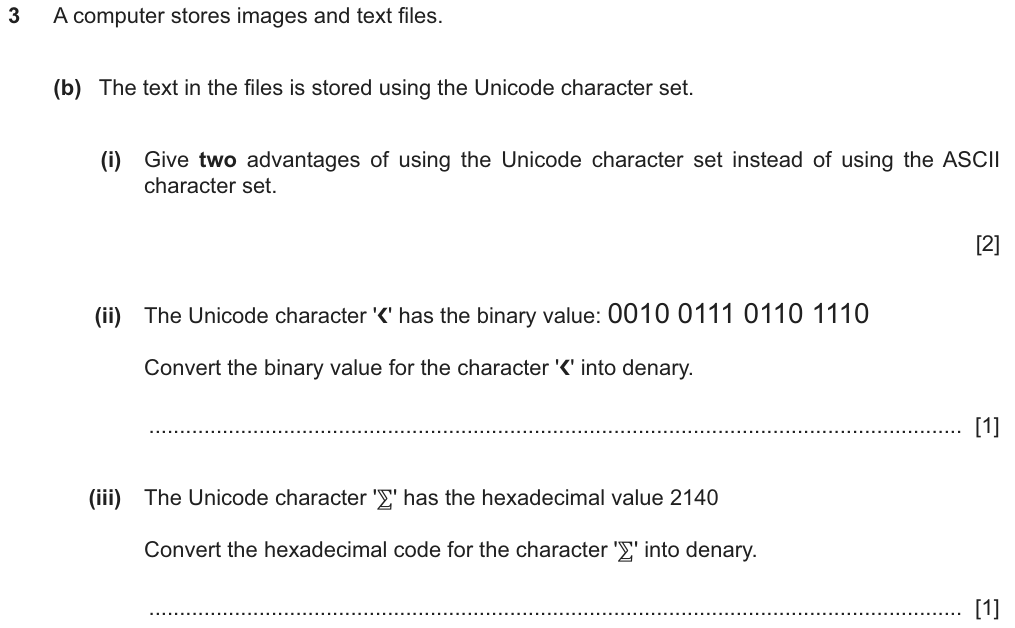
16-bit codes this time. The fastest route for both conversions goes through hex place values (4096, 256, 16, 1).
- advantages … instead of ASCIIcompare: what can Unicode do that ASCII can't
- 16 bitsfour hex digits
- (b)(i)two advantages
- (b)(ii)binary → denary
- (b)(iii)hex → denary
- 0010 0111 0110 1110(ii)
- 2140 hex(iii)
- (ii)denary
- Hex first2 7 6 E
- Place values2×4096 + 7×256 + 6×16 + 14
- (iii)denary
- Place values2×4096 + 1×256 + 4×16 + 0
Why go through hex for (ii)?
Adding 16 binary place values is slow and error-prone; four hex digits are quicker.
Is the answer to (ii) bigger than 8192?
Yes: the first hex digit is 2 (2 × 4096 = 8192).
5 Now solve it have a go on paper first, then open the worked solution
- (i) A wider range of characters can be represented B1 … so characters from more languages can be represented // and symbols such as emojis B1
- (ii) 0010 0111 0110 1110 = 276E hex = 2 × 4096 + 7 × 256 + 6 × 16 + 14 = 8192 + 1792 + 96 + 14 = 10 094 B1
- (iii) 2 × 4096 + 1 × 256 + 4 × 16 + 0 = 8192 + 256 + 64 = 8512 B1
Both are between 8192 (2000 hex) and 12 288 (3000 hex), as their first hex digit 2 says ✓.
Example 4 · Unicode bits, then one ASCII code in BCD and hex (Paper 1, 3 marks) ★★ Medium
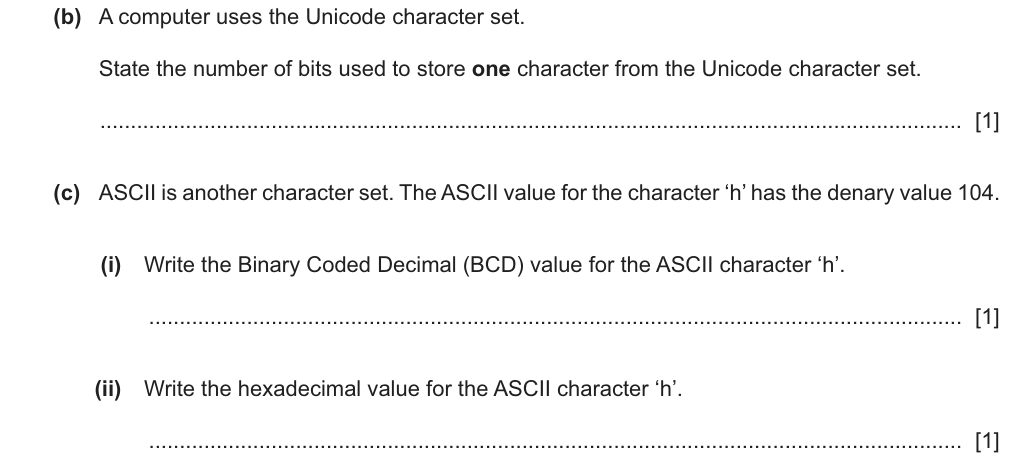
(c) mixes this page with page 1: the code 104 is just a number, so put it into BCD (digit by digit) and into hex.
- BCD value1, 0, 4 → three nibbles
- hexadecimal value104 = ? × 16 + ?
- (b)bits per Unicode character
- (c)(i)104 in BCD
- (c)(ii)104 in hex
- 'h' = 104
- (c)(i)BCD
- Trap0110 1000 is plain binary, not BCD
- (c)(ii)hex
- ÷ 16104 = 6 × 16 + 8
How many nibbles does BCD of 104 need?
Three: 1, 0 and 4.
5 Now solve it have a go on paper first, then open the worked solution
- (b) 8 // 16 // 32 (also 64 was accepted) B1
- (c)(i) 1 → 0001, 0 → 0000, 4 → 0100: 0001 0000 0100 B1
- (c)(ii) 104 = 6 × 16 + 8 → 68 B1
Check (ii) via binary: 104 = 0110 1000 → 6, 8 ✓.
Summary
- Character set: all the characters a computer can represent, each with a unique code.
- Text: each character replaced by its code, codes stored in sequence.
- ASCII 7 bits, 128 characters; extended ASCII 8 bits, 256; Unicode 16/32 bits, 65 536+ characters, all languages, emoji. ASCII is a subset of Unicode.
- Codes are consecutive within letters and digits: count on from a given code; lower case = upper case + 32.
| If you see… | do this |
|---|---|
| “describe a character set” | all characters it can represent + unique code each |
| “explain how the word … is represented” | unique code per character + stored in sequence |
| “difference(s) between ASCII and Unicode” | bits per character / number of characters / languages, each comparing both |
| a code for one character, asked for another | count on (letters and digits are consecutive) |
| “give the code in hex / BCD / binary” | it is just a number: use the page 1 conversions |
Can I do this?
- I can describe a character set and explain how text is stored, using “unique” and “in sequence”.
- I know ASCII (7 bits, 128) and extended ASCII (8 bits, 256) and what each covers.
- I know Unicode (16/32 bits, 65 536+ characters, all languages, emoji) and that ASCII is a subset of it.
- I can give similarities, differences and reasons to choose ASCII or Unicode.
- I can work out a neighbouring code and convert a code into binary, hex or BCD.
Anything unticked: revise that section first. All ticked: take the quiz.
Quiz
The multiple-choice and guided questions need JavaScript. The concept checks and exam practice below work without it.
Concept checks
Answer each one in your head first, then open it.
1Why must every character's code be unique?Show answer
If two characters shared a code, the computer reading the text back could not tell which one was meant.
2Why can't ASCII store a message in Urdu?Show answer
ASCII has only 128 (or 256) codes, all used for English letters, digits and symbols; there are no codes left for Urdu letters.
3A file written in extended ASCII on one computer shows wrong symbols on another. Why?Show answer
Different computers used different meanings (code pages) for codes 128-255. Unicode fixed this by giving every character one code everywhere.
4Is the character '7' stored as 0000 0111?Show answer
No: that is the number 7. The character '7' is stored as its code (55 in ASCII = 0011 0111).
Exam-style practice
New questions, not used above. Do them on paper, then mark your work against the official mark scheme.
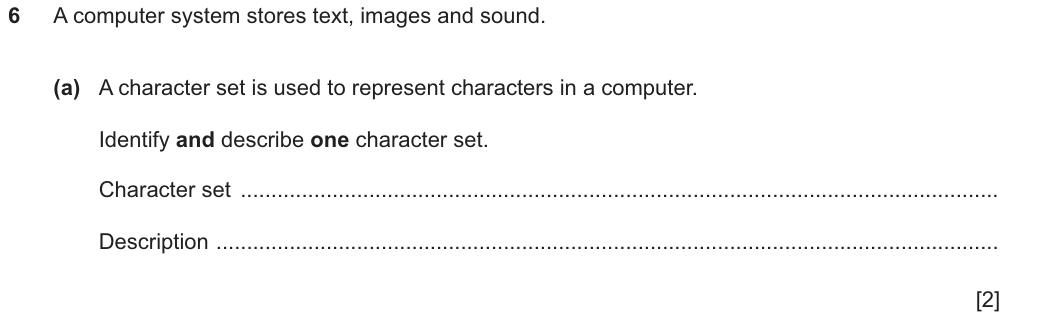
Show the mark scheme
| Part | Answer / working | Marks | Guidance |
|---|---|---|---|
| (a) | ASCII // UNICODE | B1 | identification |
| ASCII: 7/8 bits per character // represents 128/256 characters // all characters from the Latin alphabet. Unicode: 8/16/32 bits per character // represents 256/65 536+ characters // all characters in all languages | B1 | description must match the set named | |
| Total: 2 marks | |||
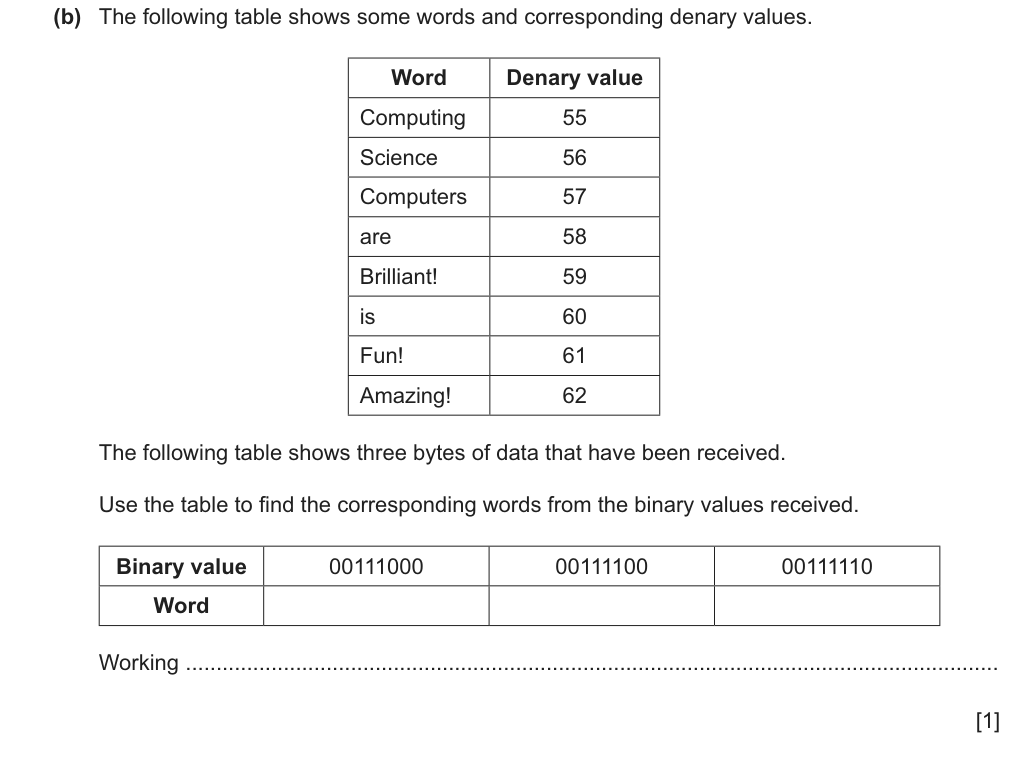
Show the mark scheme
| Part | Answer / working | Marks | Guidance |
|---|---|---|---|
| (b) | Science, is, Amazing! | B1 | all three in the correct order: 56, 60, 62 |
| Total: 1 mark | |||
Examiner tip Convert each byte to denary first, then look it up; keep the order of the bytes.
A text message contains 160 characters.
- (a)Calculate the size of the message in bytes if it is stored using 16-bit Unicode.[1]
- (b)The code for 'K' in this character set is 004B (hexadecimal). Give the code for 'M' in hexadecimal.[1]
- (c)State one reason for using Unicode instead of extended ASCII for text messages.[1]
Show the mark scheme
| Part | Answer / working | Marks | Guidance |
|---|---|---|---|
| (a) | 160 × 16 ÷ 8 = 320 bytes | B1 | |
| (b) | 004D | B1 | K, L, M: 4B + 2 = 4D |
| (c) | Can represent a wider range of characters, e.g. other languages / emojis | B1 | |
| Total: 3 marks | |||
Your progress on this note is saved when JavaScript is on.