
Information representation
Sound: sampling rate and resolution
What you need to be able to do
- 1.2Describe how sound is represented and encoded, using sampling, sampling rate, sampling resolution, analogue data and digital data.
- 1.2Explain the impact of changing the sampling rate and the sampling resolution on file size and accuracy.
- 1.2Calculate the size of a sound file.
You need: binary prefixes and bits per value from Number bases, prefixes and BCD; the same “more bits = more data” logic as Bitmap images.
Analogue and digital
A sound is a vibration: the air pressure goes up and down smoothly, and a microphone turns that into a smoothly changing voltage. Its height at any moment is its amplitude. A computer can only store a limited list of binary numbers, so the smooth wave has to be measured at moments in time and each measurement rounded to a number.
Sampling: turning the wave into numbers
- The amplitude of the analogue sound wave is measured at set (regular) time intervals: each measurement is a sample.
- Each sample is given the nearest binary value: the number of bits for each one is the sampling resolution.
- The binary values are stored in sequence (in time order).
- On playback, the values are turned back into a voltage, step by step: an approximation of the original wave.
| Term | Credited definition |
|---|---|
| Sampling | taking measurements (of the amplitude) at regular intervals and storing the values |
| Sampling rate | the number of samples taken per second (per unit time), measured in hertz: 44.1 kHz = 44 100 samples every second |
| Sampling resolution | the number of bits used to store each sample: n bits give \(2^n\) possible amplitude values (16 bits → 65 536) |
| Quantisation error | the difference between the real amplitude and the value it is rounded to (the gap between grey and pink) |
Changing the sampling rate and resolution
| Change | Effect on accuracy (how close to the original) | Effect on file size (and why) |
|---|---|---|
| Increase sampling rate | smaller time gaps between samples; the digital wave is closer to the analogue wave; smaller quantisation errors; more detail (higher frequencies) captured | larger: more samples are taken, so more bits are stored |
| Decrease sampling rate | bigger gaps, less like the original | smaller: fewer samples stored per second |
| Increase sampling resolution | more bits per sample, so more amplitude values available; each sample is closer to the analogue amplitude; smaller quantisation errors | larger: more bits for every sample |
| Decrease sampling resolution | fewer values available, each sample further from the real amplitude; bigger quantisation errors | smaller: fewer bits are used to store each sample |
| Increase the duration | no change to accuracy | larger: more seconds of samples |
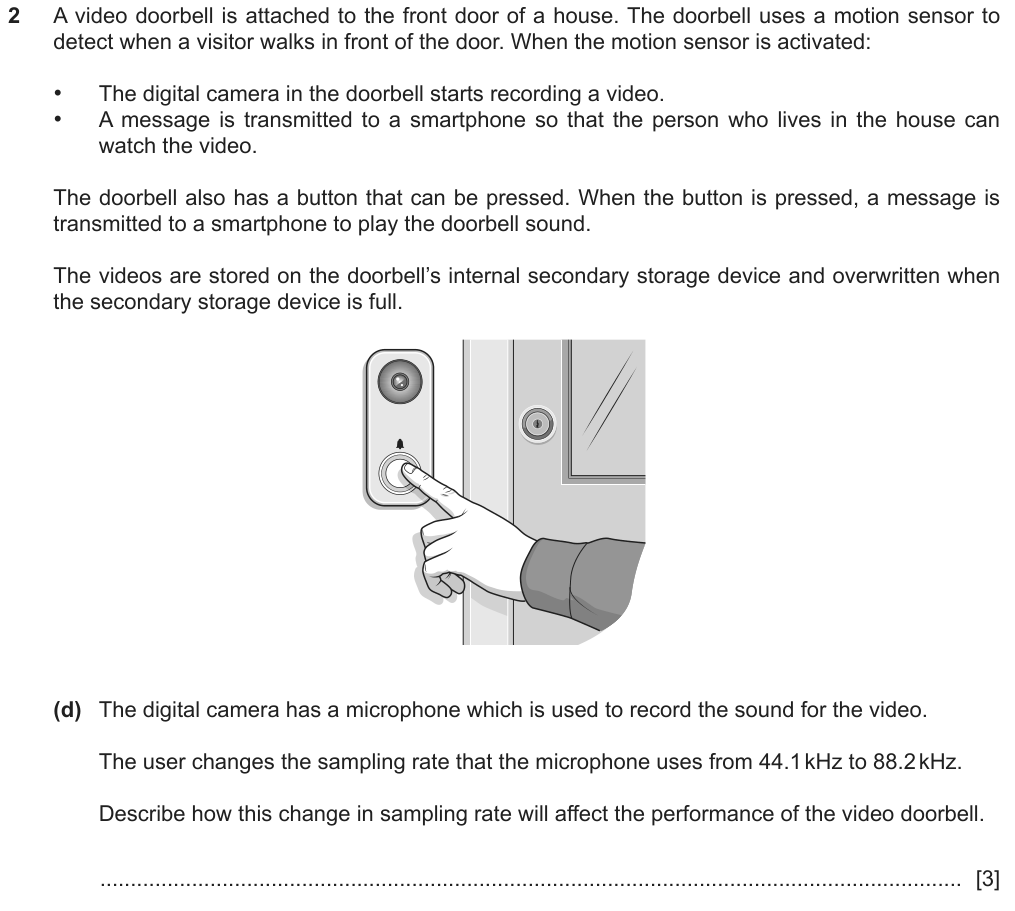
A bigger file has knock-on effects in context: it takes longer to transmit (e.g. to a smartphone), uses more bandwidth, and fills the storage faster, so fewer recordings fit (June 2024, the video doorbell).
Sound file size
- Change the rate to samples per second: 44.1 kHz = 44 100, 50 kHz = 50 000 (kilo = 1000 here).
- Change the duration to seconds: 20 minutes = 1200 s.
- Multiply rate × resolution × seconds → bits; ÷ 8 → bytes; then ÷ 1000s (kB, MB) or 1024s (KiB, MiB).
1 Megabytes
A 3-minute recording uses a sampling rate of 40 kHz and a resolution of 16 bits. Size in MB?
AskedMBKnow40 000 samples/s, 16 bits, 180 sRouterate × bits × seconds ÷ 8 ÷ 10⁶
- 40 000 × 16 × 180 = 115 200 000 bits
- ÷ 8 = 14 400 000 bytes = 14.4 MB
2 Halving the rate
The same recording is re-sampled at 20 kHz. What happens to the file size and why?
Askednew sizeKnowhalf as many samplesRoutesize ∝ rate
- Half the samples → half the bits: 7.2 MB
- but the recording is less accurate (bigger gaps between samples)
3 Resolution from the number of levels
A sensor records sound with 1024 possible amplitude values. What is the sampling resolution?
Askedbits per sampleKnowlevels = 2^bitsRoutefind n
- \(2^{10}=1024\) → 10 bits
4 Mebibytes
A 10-second clip: 32 768 Hz, 16-bit. Size in MiB?
AskedMiBKnow÷ 1024 ÷ 1024Routecancel powers of 2
- \(\dfrac{32\,768\times16\times10}{8\times1024\times1024}=\dfrac{2^{15}\times2^{4}\times10}{2^{23}}=\dfrac{10}{16}=\)0.625 MiB
Mark-scheme focus
Sampling rate, then the effect of a higher sampling resolution (3 marks)
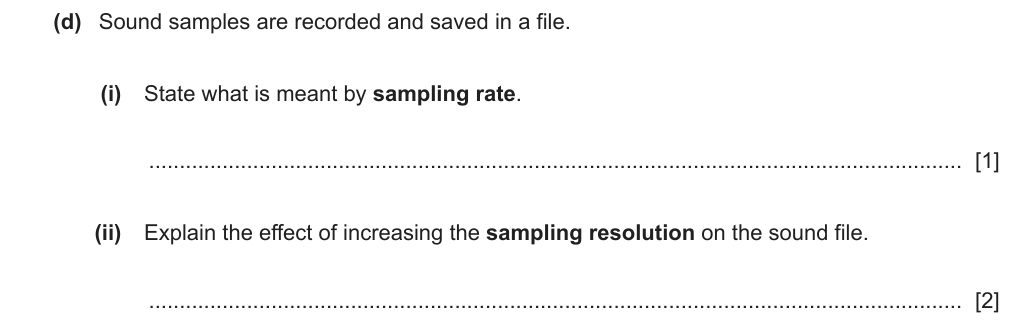
- (i) the number of samples taken per unit time / per second B1
- (ii) increases the number of bits per sample // larger range of values B1; which means that the file size increases B1
- or: makes the sound file more accurate // digital waveform closer to the analogue waveform // smaller quantisation errors B1
- (i) “the rate of taking samples” (repeats the term)
- (ii) answers about taking more samples (that is the sampling rate)
The report: in (ii) “a popular incorrect answer explained the effect of increasing the sampling rate … rather than the sampling resolution”.
From: 9618/11/O/N/22 Q1(d)
“Explain how an analogue sound wave is converted into digital data” (2 marks)

- Value / magnitude of the analogue wave is measured a set number of times each second / at set intervals B1
- Each sample is given the binary number and stored in sequence B1
- “The sound is converted to binary” (how?)
- “It is sampled” with no mention of measuring at intervals
The two marks are the two halves of the process: measure at intervals, then a binary value per sample in order.
From: 9618/13/O/N/24 Q6(c)(i)
“Explain the impact of changing the sampling resolution on the accuracy of a sound recording” (3 marks)

- Increase: the number of bits used for each sample is increased B1
- more values available to represent each sample // more amplitudes can be represented B1
- each binary amplitude is closer to the analogue amplitude // quantisation errors are reduced // the digital wave is closer to the original B1
- “It sounds better” (not technical)
- Points about file size (the question asks about accuracy)
- Mixing increase and decrease in one answer
Pick one direction (increase or decrease) and follow it through: more bits → more values → closer to the real amplitude.
The same three steps for a decrease, each reversed.
From: 9618/12/O/N/23 Q6(b)
- One sound question in about half the papers: 2-7 marks.
- Most asked: effect of rate / resolution on accuracy and file size (2-4 marks), how sound is represented (2-3), the terms (match or define).
- Calculation: rarer (once in 2021-25): rate × resolution × seconds, with the kHz → Hz trap.
Worked examples
Example 1 · Three sound terms (Paper 1, 3 marks) ★ Easy
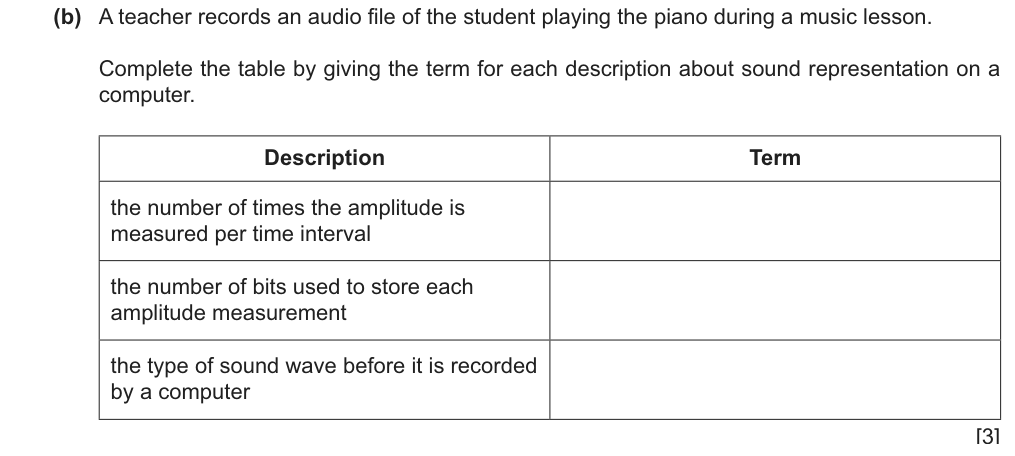
Three definitions given, you supply the term. Watch the wording: “how many times” vs “how many bits”.
- number of times … per time intervalhow often → rate
- number of bits … each measurementhow precisely → resolution
- before it is recordedcontinuous → analogue
- (b)three terms
- Terms
- Ratetimes per second
- Resolutionbits per sample
- Analoguecontinuous wave
Is “frequency” acceptable for the first?
The scheme's term is sampling rate: use it.
5 Now solve it have a go on paper first, then open the worked solution
- the number of times the amplitude is measured per time interval → sampling rate B1
- the number of bits used to store each amplitude measurement → sampling resolution B1
- the type of sound wave before it is recorded → analogue B1
Rate ↔ times, resolution ↔ bits ✓.
Example 2 · Duration, rate and resolution: two effects each (Paper 1, 3 marks) ★★ Medium
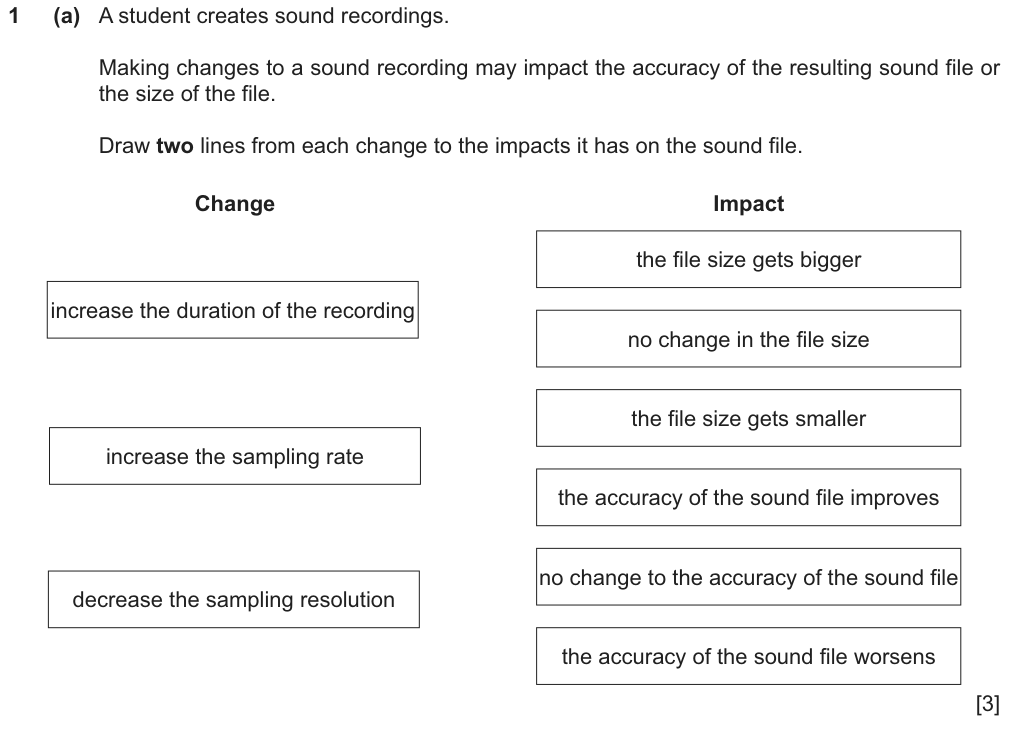
Each change gets two lines: one to a file-size box and one to an accuracy box.
- two lines from each changeone size effect + one accuracy effect
- durationlength of the recording
- (a)six lines
- Each change
- Sizemore data? fewer bits?
- Accuracycloser to the analogue wave?
- Traplonger = more accurate
Does a longer recording sound more accurate?
No: every second is sampled the same way; there are just more seconds.
5 Now solve it have a go on paper first, then open the worked solution
- increase the duration → file size gets bigger and no change to the accuracy B1
- increase the sampling rate → file size gets bigger and accuracy improves B1
- decrease the sampling resolution → file size gets smaller and accuracy worsens B1
Each change has exactly one size line and one accuracy line ✓.
Example 3 · Accuracy ticks, then a file size (Paper 1, 4 marks) ★★ Medium
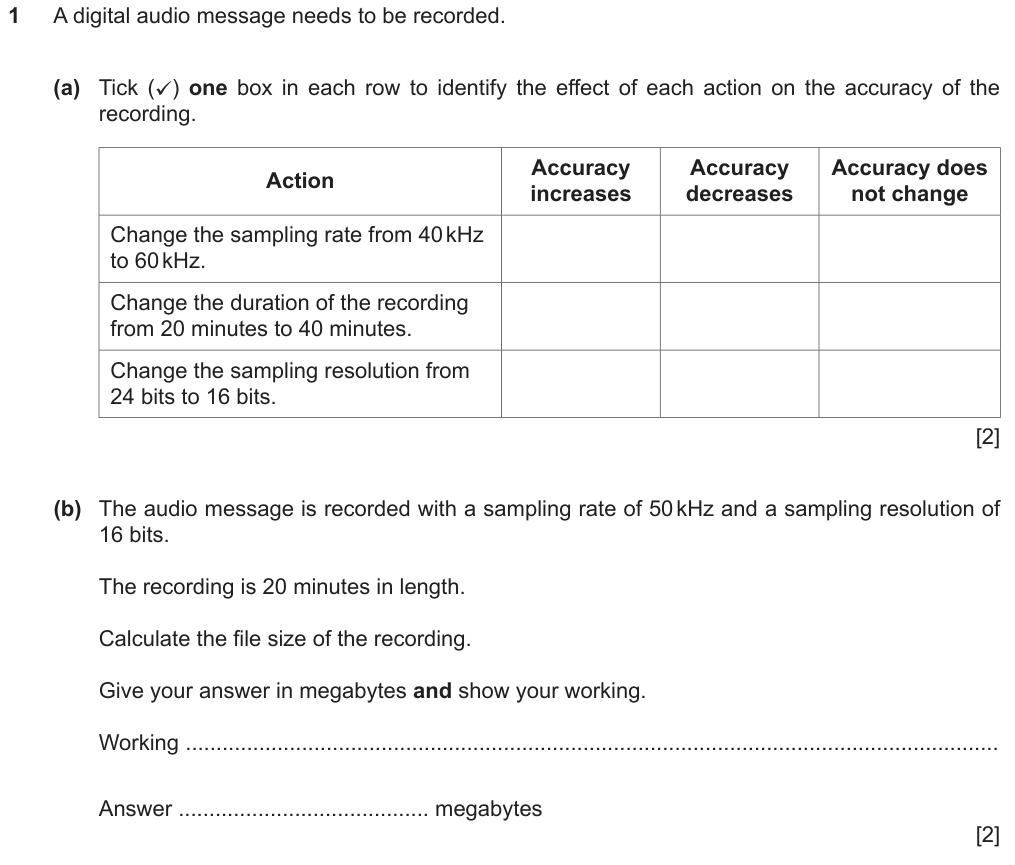
(a) uses the effects table. (b) is the size formula with two unit changes hidden in it: kHz → Hz and minutes → seconds.
- 50 kHz50 000 samples per second
- 20 minutes1200 s
- megabytes÷ 8 ÷ 1000 ÷ 1000
- (a)three ticks
- (b)size in MB
- 40 → 60 kHz
- 20 → 40 min
- 24 → 16 bits
- 50 kHz, 16 bits, 20 min(b)
- (b)MB
- Hz50 × 1000
- Seconds20 × 60
- Multiply× 16 bits ÷ 8 ÷ 10⁶
What was the reported error?
Multiplying by 50 instead of 50 000.
How many bytes per sample?
16 bits = 2 bytes.
5 Now solve it have a go on paper first, then open the worked solution
- (a) 40 → 60 kHz: accuracy increases; 20 → 40 minutes: does not change; 24 → 16 bits: decreases B2
- (b) 50 000 × (20 × 60) × 16 bits = 960 000 000 bits M1
- ÷ 8 = 120 000 000 bytes = 120 megabytes A1
2 bytes × 50 000 × 1200 = 120 million bytes ✓. (a): 2 marks for three ticks, 1 for one or two.
Example 4 · Describe how sound is represented; then why rate and resolution improve precision (Paper 1, 7 marks) ★★★ Hard
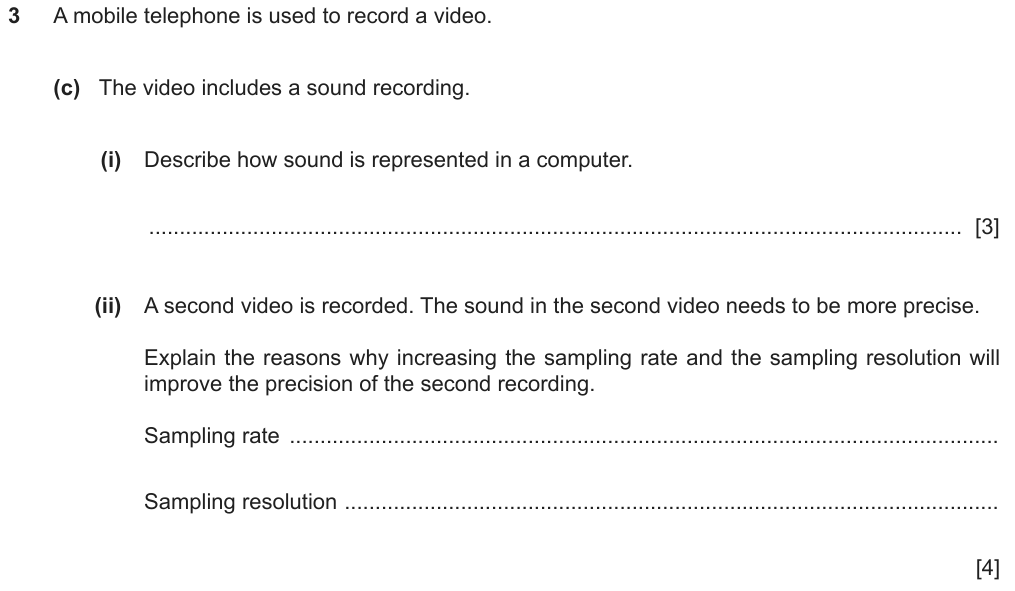
Why it is hard: the June 2023 report: (i)'s third point (limited binary values stored in sequence) was rarely given, and (ii) was answered with definitions instead of reasons.
(i) is the sampling process in three steps. (ii) asks for reasons why each change improves precision: two reasons for the rate, two for the resolution.
- describe how … representedmeasure, give a binary number, store in sequence
- explain the reasons whycause → effect, not definitions
- (c)(i)the process
- (c)(ii)2 reasons for rate + 2 for resolution
- (ii) rate
- Causesamples more often → smaller gaps
- Effectdigital wave closer to analogue
- (ii) resolution
- Causemore bits → more amplitude values
- Effecteach sample closer, smaller quantisation error
- Trapjust defining rate and resolution
What did most candidates do wrong in (ii)?
The report: they “saw the two terms and simply wrote down the definitions without answering the question”.
5 Now solve it have a go on paper first, then open the worked solution
- (i) The amplitude is recorded a set number of times a second B1; each amplitude is given a corresponding binary number B1; the binary numbers are saved in sequence B1
- (ii) Rate: smaller ‘gaps’ in the sound wave // recorded more often B1; the digital waveform is closer to the analogue waveform // smaller quantisation errors B1
- Resolution: more bits per sample // a wider range of amplitudes can be stored B1; each binary amplitude is closer to the analogue amplitude // smaller quantisation errors B1
Every (ii) point is a reason (cause → closer to the original), none is just a definition ✓.
Summary
- Analogue: continuously changing. Sampling: measure the amplitude at regular intervals, give each sample a binary value, store in sequence.
- Sampling rate = samples per second; sampling resolution = bits per sample.
- Higher rate or resolution: more accurate (closer to the analogue wave, smaller quantisation errors) and a bigger file. Longer duration: bigger file, same accuracy.
- Size (bits) = rate (Hz) × resolution (bits) × time (s).
| If you see… | do this |
|---|---|
| “kHz” | × 1000 to get samples per second |
| “minutes” | × 60 to get seconds |
| “effect of the sampling rate” | gaps between samples / how often |
| “effect of the sampling resolution” | bits per sample / amplitude values |
| “accuracy” | closer to the analogue wave, quantisation errors |
| “performance” in a context | more data → slower transmission, storage fills faster |
Can I do this?
- I can describe how sound is sampled and stored, in mark-scheme steps.
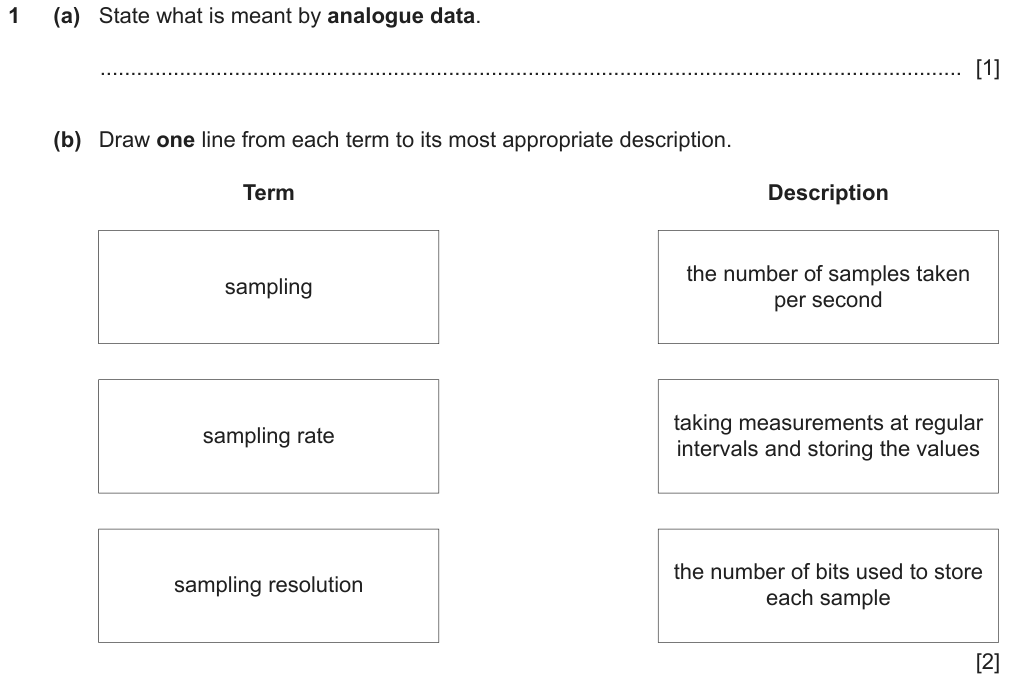
- I can define analogue data, sampling, sampling rate and sampling resolution.
- I can explain the effect of changing the rate, the resolution or the duration on accuracy and file size.
- I can calculate a sound file's size, converting kHz and minutes.
Anything unticked: revise that section first. All ticked: take the quiz.
Quiz
The multiple-choice and guided questions need JavaScript. The concept checks and exam practice below work without it.
Concept checks
Answer each one in your head first, then open it.
1Why can a digital recording never be a perfect copy of the analogue sound?Show answer
Between samples nothing is recorded, and each sample is rounded to one of a limited number of values: both lose a little information.
2Why do CDs use 44.1 kHz?Show answer
To capture a frequency you need more than two samples per wave. Human hearing reaches about 20 kHz, so just over twice that (44.1 kHz) captures everything we can hear.
3Doubling the resolution from 8 to 16 bits doubles the file. Does it double the number of levels?Show answer
No: it multiplies the levels by \(2^8=256\) (256 → 65 536), but the bits, and so the size, only double.
Exam-style practice
New questions, not used above. Do them on paper, then mark your work against the official mark scheme.
Show the mark scheme
| Part | Answer / working | Marks | Guidance |
|---|---|---|---|
| (a) | Data values that are continuously changing // variable // any value | B1 | |
| (b) | sampling → taking measurements at regular intervals and storing the values; sampling rate → the number of samples taken per second; sampling resolution → the number of bits used to store each sample | B2 | 1 mark for 1 correct line, 2 for all 3 |
| Total: 3 marks | |||
Show the mark scheme
| Part | Answer / working | Marks | Guidance |
|---|---|---|---|
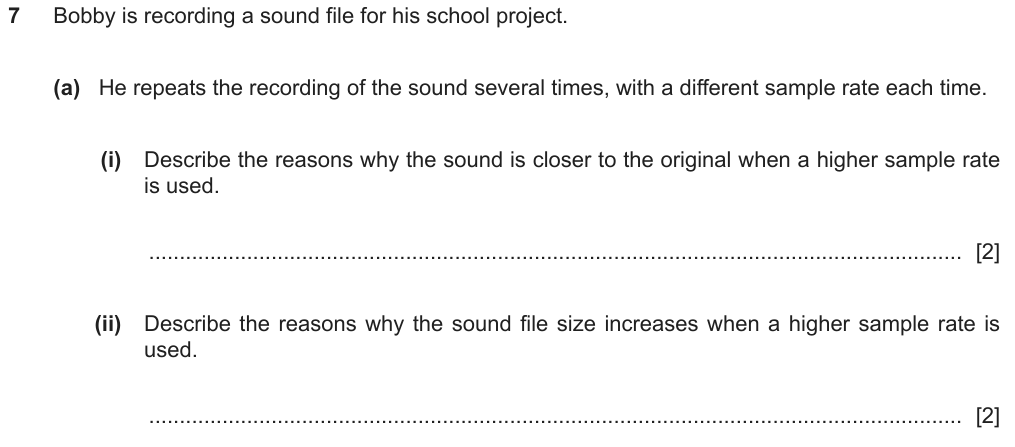
| (a)(i) | Smaller time gaps between the samples | B1 | |
| Makes the digital sound wave more accurate // smaller quantisation errors | B1 | ||
| (a)(ii) | More samples / data are taken / recorded | B1 | |
| … so more bits are stored altogether | B1 | ||
| Total: 4 marks | |||
Examiner tip The report: (ii) was often answered with bit depth (resolution). A higher sample rate means more samples, not more bits per sample.
Show the mark scheme
| Part | Answer / working | Marks | Guidance |
|---|---|---|---|
| (d) | Data transmission to the user's smartphone will take longer | B1 | |
| … because there is more data to transmit | B1 | ||
| The secondary storage device will fill faster // fewer videos can be stored long-term // videos are overwritten more often | B1 | max 3 | |
| Total: 3 marks | |||
Examiner tip “Performance” in a context: talk about what the bigger file does to that system (transmission, storage), not just “better sound”.
Your progress on this note is saved when JavaScript is on.