
Calculus
Areas under curves
In this note
- 14.13Find the area between a curve, the x-axis and two lines \(x=a\), \(x=b\).
- 14.13Deal with a region below the x-axis, and a curve that crosses it (a sum of two areas).
- 14.13Find an unknown limit when the area is given.
Before you start: Definite integrals; finding where a curve meets the x-axis. Next: Areas between lines and curves.
Formula bank
Area above the x-axis
The definite integral adds up thin strips of height y and width dx, so it measures the area between the curve and the x-axis. \(\int_1^3(x^{2}+1)\,dx=\big[\tfrac{x^{3}}{3}+x\big]_1^3=12-\tfrac43=\tfrac{32}{3}\).
General methodHow to find any area under a curve
- Sketch it. Find where the curve meets the x-axis if the limits are not given.
- Check whether the region is above or below the axis (or both).
- Integrate between the limits (split at every root inside the interval).
- Area = the SIZE of each piece; add them. Area is never negative.
Try it yourself
Hint
Show answer
Answer 36
Show answer
Answer 3
Below the axis, and crossing it
Below the x-axis y is negative, so the integral is negative: \(\int_0^4(x^{2}-4x)\,dx=-\tfrac{32}{3}\), area \(\tfrac{32}{3}\). If the curve crosses the axis, one integral over the whole range lets the pieces cancel. For \(y=x^{2}-1\) from 0 to 2: \(\int_0^2=\tfrac23\), but the real area is \(\tfrac23+\tfrac43=2\).
Example Find the total area between \(y=x^{2}-1\), the x-axis and \(x=0\), \(x=2\).
Root at x = 1: split there.
- \(\int_0^1(x^{2}-1)dx=-\tfrac23\) → area \(\tfrac23\)
- \(\int_1^2(x^{2}-1)dx=\tfrac43\)
Answer 2
Example The area under \(y=\frac3x\) from \(x=1\) to \(x=k\) is 6. Find k.
Integrate, set equal to 6.
- \(\big[3\ln x\big]_1^k=3\ln k=6\)
- \(\ln k=2\)
Answer \(k=e^{2}\)
Try it yourself
Show answer
Answer 0.5
Ways they test it
Type 1 Area under a curve
"Find the area enclosed by the curve, the x-axis and the lines x = 1 and x = 3." (4 marks)
Spot it two vertical lines.
- Integrate between the lines.
Type 2 Find the limits first
"The curve meets the x-axis at A… find the shaded area." (6 marks)
Spot it a root or a turning point labelled.
- Solve y = 0 (or dy/dx = 0).
- Then integrate.
Type 3 Two curves meeting the axis
"Find the area of the shaded region." (5-7 marks)
Spot it the top boundary changes at an intersection.
- Find the meeting point.
- One integral for each part; add.
For example \(y=4x^{2/3}\), \(y=(x-3)^{2}\)
- \(\tfrac{12}{5}+\tfrac83\)
Answer \(\tfrac{76}{15}\)
Type 4 Area given
"The area is 6. Find k." (3-5 marks)
Spot it an area value and a letter.
- Integrate with the letter as a limit.
- Set equal; solve.
From the past papers
Past paper 1
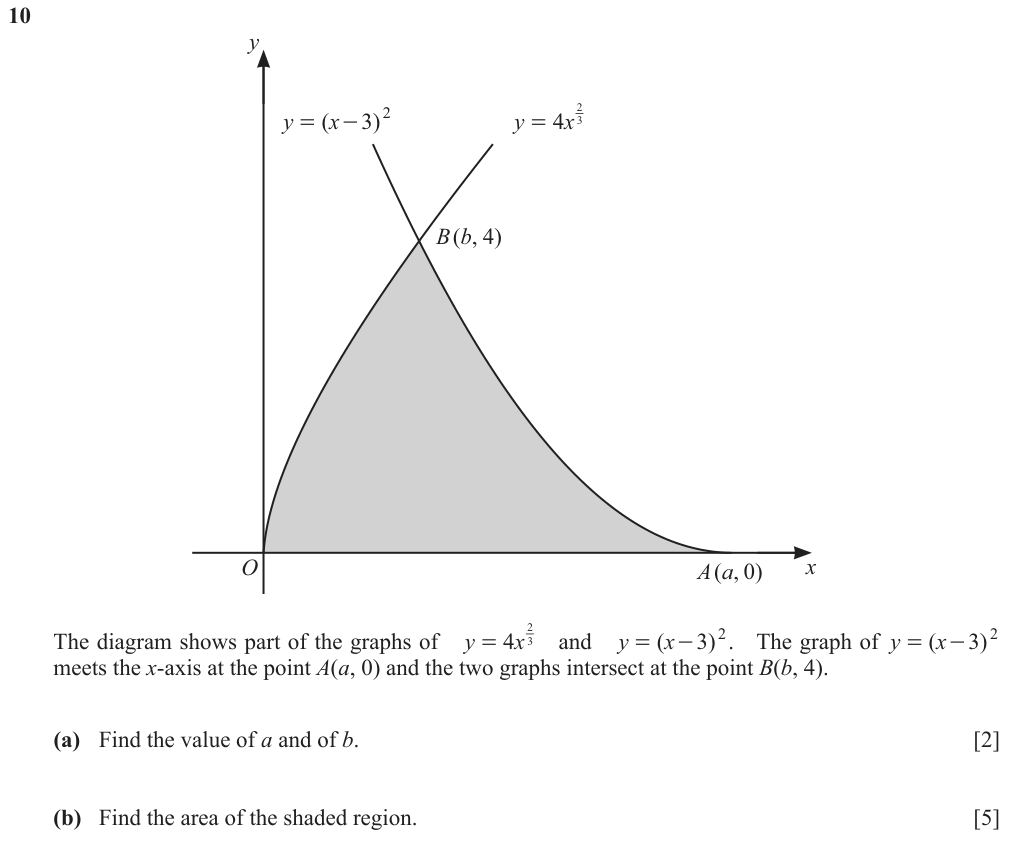
How to start: The top boundary is \(4x^{2/3}\) from O to B, then \((x-3)^{2}\) from B to A. Find a and b, then add two integrals.
✓ Show the solution have a go on paper first
- (a) \((x-3)^{2}=0\Rightarrow a=3\). \(4x^{2/3}=4\Rightarrow x=1\), and \((1-3)^{2}=4\) ✓, so \(b=1\).
- (b) \(\int_0^1 4x^{2/3}dx=\big[\tfrac{12}{5}x^{5/3}\big]_0^1=\tfrac{12}{5}\).
- (b) \(\int_1^3(x-3)^{2}dx=\big[\tfrac{(x-3)^{3}}{3}\big]_1^3=0-\big(-\tfrac83\big)=\tfrac83\).
- (b) area \(=\tfrac{12}{5}+\tfrac83=\tfrac{76}{15}\) (≈ 5.07).
| Part | Answer / working | Marks | Guidance |
|---|---|---|---|
| (a) | \(a=3\), \(b=1\) | B2 | B1 for each |
| (b) | splitting into two integrals with their limits | M1 | |
| \(\tfrac{12}{5}x^{5/3}\) and \(\tfrac{(x-3)^{3}}{3}\) | M2 | M1 for each | |
| correct use of both sets of limits | M1 | ||
| \(\tfrac{76}{15}\) or 5.07 | A1 | ||
| Total: 7 marks | |||
Examiner tip Integrating \((x-3)^{2}\) as a bracket (no expanding) is fastest; at the lower limit \((1-3)^{3}=-8\).
Past paper 2
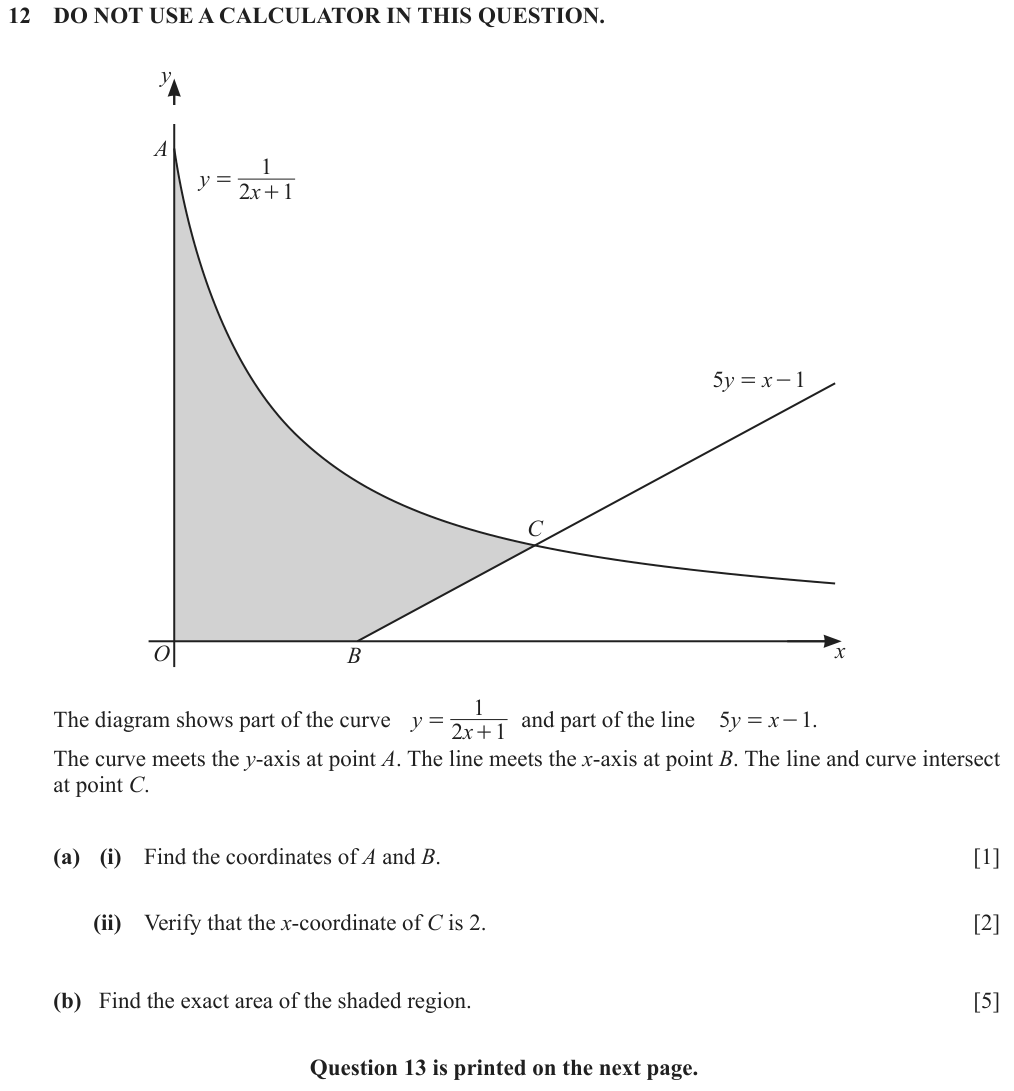
How to start: The shaded region = area under the curve from 0 to 2, MINUS the triangle under the line from B to C.
✓ Show the solution have a go on paper first
- (a)(i) \(A(0,1)\) (curve at x = 0); \(B(1,0)\) (line at y = 0).
- (a)(ii) At \(x=2\): curve \(y=\tfrac15\), line \(y=\tfrac{2-1}{5}=\tfrac15\) - the same, so C has \(x=2\).
- (b) \(\int_0^2\frac{1}{2x+1}dx=\big[\tfrac12\ln(2x+1)\big]_0^2=\tfrac12\ln5\).
- (b) triangle BC and the axis: \(\tfrac12\times1\times\tfrac15=0.1\).
- (b) area \(=\tfrac12\ln5-0.1\).
| Part | Answer / working | Marks | Guidance |
|---|---|---|---|
| (a)(i) | \(A(0,1)\), \(B(1,0)\) | B1 | |
| (a)(ii) | both y-values shown to be 1/5 | B2 | |
| (b) | triangle \(=\tfrac12\times1\times0.2\) | B1 | |
| \(\tfrac12\ln(2x+1)\) | B2 | B1 for \(k\ln(2x+1)\) | |
| F(2) − F(0) − their 0.1 | M1 | ||
| \(\tfrac12\ln5-0.1\) | A1 | ||
| Total: 8 marks | |||
Examiner tip Read the region carefully: it is bounded by the curve, the axes AND the line, so a triangle comes off.
Mistakes to avoid
- ✗ A negative area✓ take the size of a below-axis integral
- ✗ One integral across a root✓ split at the rootThe pieces cancel.
- ✗ Limits from the wrong curve✓ find where EACH boundary starts and stops
Summary
- Area under a curve \(=\int_a^b y\,dx\).
- Below the axis: the integral is negative; use its size.
- Crossing the axis or changing boundary: split and add.
If you see …
- shaded region on a sketchfind the limits first.
- part below the axissplit at the root.
Practice
Practice: easy, medium, hard
Easy
Show answer
Answer 32/3
Show answer
Answer 1
Show answer
Answer 18
Medium
Guide me
What is it asking? an area
What do we know? roots 0 and 4
Plan integral \(-\tfrac{32}{3}\)
Show working
- \(\tfrac{32}{3}\)
Answer 32/3
Guide me
What is it asking? an area
What do we know? split at 1
Plan \(\tfrac23+\tfrac43\)
Show working
- 2
Answer 2
Guide me
What is it asking? a limit
What do we know? \(k^{2}+k=20\)
Plan \((k+5)(k-4)=0\)
Show working
- 4
Answer 4
Hard
Guide me
What is it asking? a limit
What do we know? \(3\ln k=6\)
Plan \(k=e^{2}\)
Show working
- \(e^{2}\)
Answer \(e^{2}\)
| Part | Answer / working | Marks | Guidance |
|---|---|---|---|
| \(3\ln x\) | B1 | ||
| = 6 | M1 | ||
| \(e^{2}\) | A1 | ||
| Total: 3 marks | |||
Guide me
What is it asking? an area
What do we know? \(\tfrac{12}{5}\)
Plan \(+\tfrac83\)
Show working
- \(\tfrac{76}{15}\)
Answer 76/15
| Part | Answer / working | Marks | Guidance |
|---|---|---|---|
| split | M1 | ||
| two integrals | M2 | ||
| limits | M1 | ||
| 76/15 | A1 | ||
| Total: 5 marks | |||
Guide me
What is it asking? an area
What do we know? \(\tfrac12\ln(2x+1)\)
Plan \(\tfrac12\ln5\)
Show working
- \(\tfrac12\ln5-0.1\)
Answer \(\tfrac12\ln5-0.1\)
| Part | Answer / working | Marks | Guidance |
|---|---|---|---|
| triangle 0.1 | B1 | ||
| \(\tfrac12\ln(2x+1)\) | B2 | ||
| limits − 0.1 | M1 | ||
| answer | A1 | ||
| Total: 5 marks | |||
Can I do this?
- I can find the area under a curve.
- I can handle regions below the axis and split at roots.
- I can find an unknown limit from a given area.
Anything unticked: revise that section first. All ticked: take the quiz.
Quiz
The multiple-choice and guided questions need JavaScript. The concept checks and exam practice below work without it.
Your progress on this note is saved when JavaScript is on.