
Calculus
Differentiate, then integrate ('hence')
In this note
- 14.10Use a derivative you have just found to integrate something you have no rule for.
- 14.10Handle a multiple of the derivative, and rearrange when the derivative has extra terms.
- 14.10Use the result with limits for an exact value.
Before you start: the product rule and chain rule, and e and trig integrals. Next: Finding a curve from its gradient.
Formula bank
Integrals like \(\int x\ln x\,dx\) or \(\int xe^{2x}\,dx\) have no rule in this syllabus. The exam always gives you a way in: first differentiate something, then 'hence' integrate. This page is the method for that.
When the integrand is the derivative (or a multiple)
General methodHow to answer a 'hence' question
- Do part (a): differentiate (product rule or chain rule). Simplify.
- Compare the integral you want with the derivative. Is it exactly the derivative, a multiple of it, or the derivative minus some easy terms?
- Integrate both sides of '\(\frac{d}{dx}F=\ldots\)': \(F=\int(\ldots)\,dx\).
- Rearrange so the integral you want is on its own; integrate any easy terms left; add + c.
Example Differentiate \((x^{2}+1)^{4}\). Hence find \(\int x(x^{2}+1)^{3}\,dx\).
Chain rule, then match the multiple.
- \(\frac{d}{dx}(x^{2}+1)^{4}=8x(x^{2}+1)^{3}\)
- so \(\int 8x(x^{2}+1)^{3}dx=(x^{2}+1)^{4}\)
- divide by 8
Answer \(\tfrac18(x^{2}+1)^{4}+c\)
Try it yourself
Show answer
Answer \(3\sqrt{x^{2}+5}+c\)
Show answer
Answer \(\tfrac12(\ln x)^{2}+c\)
When the derivative has extra terms
Product-rule derivatives come in two pieces. \(\frac{d}{dx}(xe^{3x})=e^{3x}+3xe^{3x}\). The piece you want (\(xe^{3x}\)) is stuck to a piece you CAN integrate (\(e^{3x}\)). Integrate the whole line, then move the easy piece across.
Example Given \(\frac{d}{dx}(xe^{3x})=e^{3x}+3xe^{3x}\), find \(\int xe^{3x}\,dx\).
Integrate both sides, then rearrange.
- \(xe^{3x}=\int e^{3x}dx+3\int xe^{3x}dx\)
- \(3\int xe^{3x}dx=xe^{3x}-\tfrac13e^{3x}\)
Answer \(\tfrac13xe^{3x}-\tfrac19e^{3x}+c\)
Example Differentiate \(x\ln x\). Hence find \(\int\ln x\,dx\).
\(\frac{d}{dx}(x\ln x)=\ln x+1\).
- \(x\ln x=\int\ln x\,dx+\int1\,dx\)
Answer \(\int\ln x\,dx=x\ln x-x+c\)
Try it yourself
Show answer
Answer \(\sin x-x\cos x+c\)
Ways they test it
Type 1 Exact multiple
"Find \(\frac{d}{dx}(x^{2}+5)^{3/2}\). Hence find \(\int x\sqrt{x^{2}+5}\,dx\)." (4 marks)
Spot it chain rule in (a).
- Spot the number you must divide by.
- + c.
Type 2 Product rule, rearrange
"Given \(y=x^{2}\ln x\), find \(\frac{dy}{dx}\). Hence find \(\int x\ln x\,dx\)." (5 marks)
Spot it product rule in (a).
- Integrate the whole derivative.
- Move the easy integral across.
For example \(2x\ln x+x\)
- \(x^{2}\ln x=2\int x\ln x+\int x\)
Answer \(\tfrac12x^{2}\ln x-\tfrac14x^{2}+c\)
Type 3 Then a definite integral
"Use your answer to (a) to find the exact value of \(\int_0^{\pi/6}2x\cos2x\,dx\)." (5 marks)
Spot it 'use your answer' + limits.
- Find the indefinite version first.
- Top − bottom, exact values.
From the past papers
Past paper 1

How to start: (a) product rule with \(u=x^{2}\), \(v=\ln x\). (b) your derivative contains \(2x\ln x\): that's 2 × what you want.
✓ Show the solution have a go on paper first
- (a) \(\frac{dy}{dx}=2x\ln x+x^{2}\cdot\frac1x=2x\ln x+x\).
- (b) Integrate: \(x^{2}\ln x=2\int x\ln x\,dx+\int x\,dx\).
- (b) \(2\int x\ln x\,dx=x^{2}\ln x-\tfrac12x^{2}\).
- (b) answer: \(\tfrac12x^{2}\ln x-\tfrac14x^{2}+c\).
| Part | Answer / working | Marks | Guidance |
|---|---|---|---|
| (a) | \(2x\ln x+x\) | M1A1 | M1 for an attempt at the product rule |
| (b) | \(2\int x\ln x\,dx=x^{2}\ln x-\int x\,dx\) | M1 | dep on M1 in (a) |
| \(\tfrac12x^{2}\ln x\) | A1 | ||
| \(-\tfrac14x^{2}+c\) | A1 | ||
| Total: 5 marks | |||
Examiner tip Keep the derivative from (a) in front of you and integrate EVERY term of it - leaving the 'x' behind loses the last two marks.
Past paper 2
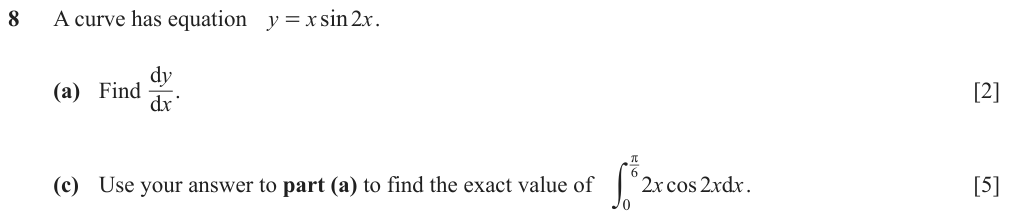
How to start: (a) product rule. (c) your derivative is \(\sin2x+2x\cos2x\): integrate it, move the \(\sin2x\) part across.
✓ Show the solution have a go on paper first
- (a) \(\frac{dy}{dx}=\sin2x+2x\cos2x\).
- (c) \(x\sin2x=\int\sin2x\,dx+\int2x\cos2x\,dx\), so \(\int2x\cos2x\,dx=x\sin2x+\tfrac12\cos2x\).
- (c) \(\big[x\sin2x+\tfrac12\cos2x\big]_0^{\pi/6}=\tfrac{\pi}{6}\cdot\tfrac{\sqrt3}{2}+\tfrac12\cdot\tfrac12-\tfrac12\).
- (c) answer: \(\dfrac{\pi\sqrt3}{12}-\dfrac14\).
| Part | Answer / working | Marks | Guidance |
|---|---|---|---|
| (a) | derivative of \(\sin2x\) is \(2\cos2x\) | B1 | |
| \(2x\cos2x+\sin2x\) | B1 | FT their 2cos2x | |
| (c) | \(x\sin2x+\tfrac12\cos2x\) | M3 | M2 for \(x\sin2x+k\cos2x\); M1 for the rearranged integral |
| \(\tfrac{\pi}{6}\sin\tfrac{\pi}{3}+\tfrac12\cos\tfrac{\pi}{3}-\tfrac12\cos0\) | A1 | ||
| \(\tfrac{\pi\sqrt3}{12}-\tfrac14\) | A1 | ||
| Total: 7 marks | |||
Examiner tip The lower limit is NOT zero here: \(\tfrac12\cos0=\tfrac12\) must be subtracted.
Mistakes to avoid
- ✗ Integrating only the term you want✓ integrate the WHOLE derivative, then rearrange
- ✗ Forgetting to divide by the multiple✓ \(\int8g=F\Rightarrow\int g=\tfrac18F\)
- ✗ Lower limit taken as 0 when it isn't✓ evaluate \(F(0)\): \(\cos0=1\), \(e^{0}=1\)
Summary
- \(\frac{d}{dx}F=g\Rightarrow\int g\,dx=F+c\).
- Multiple: divide by the number.
- Extra terms: integrate the whole derivative, move the easy integral across.
If you see …
- 'hence' after a derivativereverse it.
- x ln x, x e^(kx), x sin kxonly ever via 'hence'.
Practice
Practice: easy, medium, hard
Easy
Show answer
Answer \(\tfrac18(x^{2}+1)^{4}+c\)
Show answer
Answer \(x\ln x-x+c\)
Show answer
Answer \(xe^{3x}+c\)
Medium
Guide me
What is it asking? an integral
What do we know? \(xe^{-x}=\int e^{-x}-\int xe^{-x}\)
Plan rearrange
Show working
- \(-xe^{-x}-e^{-x}+c\)
Answer \(-xe^{-x}-e^{-x}+c\)
Guide me
What is it asking? an integral
What do we know? \(x\cos x=\sin x-\int x\sin x\)
Plan rearrange
Show working
- \(\sin x-x\cos x+c\)
Answer \(\sin x-x\cos x+c\)
Guide me
What is it asking? an integral
What do we know? \(x\sin\tfrac x2=-2\cos\tfrac x2+\tfrac12\int x\cos\tfrac x2\)
Plan × 2
Show working
- \(2x\sin\tfrac x2+4\cos\tfrac x2+c\)
Answer \(2x\sin\tfrac x2+4\cos\tfrac x2+c\)
Hard
Guide me
What is it asking? a value
What do we know? \(\tfrac13xe^{3x}-\tfrac19e^{3x}\)
Plan top − bottom
Show working
- \(\tfrac13e^{3}-\tfrac19e^{3}+\tfrac19\)
Answer \(\tfrac{2e^{3}+1}{9}\)
| Part | Answer / working | Marks | Guidance |
|---|---|---|---|
| indefinite integral | M1A1 | ||
| limits | M1 | ||
| answer | A1 | ||
| Total: 4 marks | |||
Guide me
What is it asking? an integral
What do we know? \(\frac{dy}{dx}=2x\ln x+x\)
Plan integrate, rearrange, ÷ 2
Show working
- \(\tfrac12x^{2}\ln x-\tfrac14x^{2}+c\)
Answer \(\tfrac12x^{2}\ln x-\tfrac14x^{2}+c\)
| Part | Answer / working | Marks | Guidance |
|---|---|---|---|
| rearranged | M1 | ||
| each term | A1A1 | ||
| Total: 3 marks | |||
Guide me
What is it asking? a value
What do we know? \(x\sin2x+\tfrac12\cos2x\)
Plan at \(\tfrac{\pi}{6}\) minus at 0
Show working
- \(\tfrac{\pi\sqrt3}{12}-\tfrac14\)
Answer \(\tfrac{\pi\sqrt3}{12}-\tfrac14\)
| Part | Answer / working | Marks | Guidance |
|---|---|---|---|
| integral | M3 | ||
| limits | A1 | ||
| answer | A1 | ||
| Total: 5 marks | |||
Can I do this?
- I can reverse a derivative, including a multiple of it.
- I can rearrange when the derivative has an extra term.
- I can use the result with limits.
Anything unticked: revise that section first. All ticked: take the quiz.
Quiz
The multiple-choice and guided questions need JavaScript. The concept checks and exam practice below work without it.
Your progress on this note is saved when JavaScript is on.