
Data Transmission
Error detection: parity, checksum, echo check, ARQ, check digit
In this note
- 2.2.1Understand the need to check for errors after transmission and how errors can occur.
- 2.2.2Describe parity check (odd / even, parity byte, parity block), checksum and echo check.
- 2.2.3Describe how a check digit detects errors in data entry.
- 2.2.4Describe how an automatic repeat query (ARQ) checks that data is received without error.
Before this: Serial, parallel and duplex. Next: Encryption.
The notes: every idea from the start, with our own examples.
What you should already know
Odd and even
Count the 1s in a byte: 3 ones is odd, 4 ones is even.
Quick check: is 1011 0010 odd or even?
Four 1s: even.
Packets
Data is sent in packets, each with a header, payload and trailer.
Quick check: which section holds error checking data?
The trailer.
Why errors happen and why we check
Data can be correct when it leaves the sender but wrong when it arrives. During transmission, data can be lost, gained (extra bits added) or changed (a 1 becomes a 0). Causes:
| Cause | What happens |
|---|---|
| Interference | electrical noise from other devices disturbs the signal and flips bits |
| Crosstalk | signals in wires next to each other interfere (worse in parallel cables) |
| Skewing | bits sent together in parallel arrive at different times and are read in the wrong order |
| Data collisions / lost packets | two signals meet, or a packet is dropped or times out on its way |
A file with even one wrong bit can be useless (a program that crashes, a wrong bank amount). So the receiver checks the data, and asks for it again if it is wrong.
Parity check
Sender and receiver agree on odd parity or even parity. Each byte has 7 data bits and one parity bit (usually the leftmost bit). The parity bit is set so the number of 1s in the byte is odd (odd parity) or even (even parity).
General methodParity byte check
- Before sending, count the 1s in the 7 data bits.
- Set the parity bit to 0 or 1 so the byte's total number of 1s matches the agreed parity (odd or even).
- Send the byte.
- After transmission, the receiver counts the 1s in each byte again.
- If the count does not match the agreed parity, an error is detected and the data is sent again.
Example Add the parity bit to the data 110 1001 for even parity, then for odd parity.
Count the 1s in the 7 data bits.
- 1101001 has four 1s: already even.
- Even parity: parity bit 0 → 0110 1001 (four 1s).
- Odd parity: parity bit 1 → 1110 1001 (five 1s).
Answer even: 0, odd: 1
Parity block check
A parity block check sends several bytes together, each with a parity bit, plus an extra parity byte at the end. Each bit of the parity byte makes its column match the parity. The receiver checks every row and every column: the wrong bit is where the bad row and bad column cross, so it can be located and corrected.
Four bytes sent with even parity:
| Parity bit | bit 1 | bit 2 | bit 3 | bit 4 | bit 5 | bit 6 | bit 7 | 1s | |
|---|---|---|---|---|---|---|---|---|---|
| Byte 1 | 0 | 1 | 0 | 1 | 1 | 0 | 0 | 1 | 4 |
| Byte 2 | 0 | 0 | 1 | 1 | 0 | 1 | 0 | 1 | 4 |
| Byte 3 | 0 | 1 | 1 | 0 | 0 | 0 | 1 | 1 | 4 |
| Byte 4 | 1 | 0 | 0 | 0 | 1 | 1 | 1 | 0 | 4 |
| Parity byte | 1 | 0 | 0 | 0 | 0 | 0 | 0 | 1 | 2 |
After transmission one bit has changed:
| Parity bit | bit 1 | bit 2 | bit 3 | bit 4 | bit 5 | bit 6 | bit 7 | 1s | |
|---|---|---|---|---|---|---|---|---|---|
| Byte 1 | 0 | 1 | 0 | 1 | 1 | 0 | 0 | 1 | 4 |
| Byte 2 | 0 | 0 | 1 | 1 | 0 | 1 | 0 | 1 | 4 |
| Byte 3 | 0 | 1 | 1 | 0 | 0 | 1 | 1 | 1 | 5 |
| Byte 4 | 1 | 0 | 0 | 0 | 1 | 1 | 1 | 0 | 4 |
| Parity byte | 1 | 0 | 0 | 0 | 0 | 0 | 0 | 1 | 2 |
Byte 3 now has 5 ones (odd), and column bit 5 has an odd number of 1s. The error is the bit where byte 3 meets bit 5, so the receiver can flip it back.
Try it yourself
Show answer
Answer 1 (three 1s, so add a 1 to make four)
Show answer
Answer 0 (three 1s is already odd)
Show answer
Answer No: the number of 1s is still odd / even, so it still matches the parity
Checksum
General methodChecksum
- Before sending, a checksum value is calculated from the data using an algorithm (e.g. adding up the byte values).
- The checksum is sent with the data (in the packet trailer).
- The receiver recalculates the checksum from the data it received, using the same algorithm.
- The two checksums are compared: if they are different, an error is detected and the data is requested again; if they match, no error.
Example Bytes with the values 200, 150, 90 and 37 are sent. The checksum algorithm adds the values and keeps the remainder after dividing by 256. Find the checksum.
Add, then find the remainder after 256.
- 200 + 150 + 90 + 37 = 477
- 477 − 256 = 221
Answer checksum = 221
Echo check
General methodEcho check
- The data is sent to the receiver.
- The receiver sends a copy of the data it received back to the sender.
- The sender compares the original data with the copy.
- If they do not match, an error has occurred and the data is sent again.
Automatic repeat query (ARQ)
An ARQ (automatic repeat query / request) uses acknowledgements and a timeout so that each packet is received without error. The receiver checks each packet with an error detection method (e.g. a checksum).
General methodARQ with a positive acknowledgement
- The sender sends a packet and starts a timer.
- The receiver checks the packet for errors.
- If it is error free, the receiver sends a positive acknowledgement back; the sender then sends the next packet.
- If the sender does not receive an acknowledgement before the timer ends, a timeout occurs …
- … and the packet is resent, until an acknowledgement arrives (or a set number of attempts is reached).
With a negative acknowledgement the receiver instead sends a message back when a packet has an error, asking for it to be resent.
Check digit
A check digit finds errors in data entry (typing or scanning a number), not in transmission. It is an extra digit added to the end of a code such as a barcode or an ISBN (book number).
General methodCheck digit
- The check digit is calculated from the other digits using an algorithm and added to the end of the code.
- When the code is entered or scanned, the check digit is recalculated using the same algorithm.
- If the calculated digit does not match the check digit in the code, an error has occurred (e.g. a digit typed wrongly, or two digits swapped).
Example Find the check digit for the ISBN 978030640615. Multiply the digits by 1, 3, 1, 3 …, add them, then the check digit is the number that makes the total up to the next multiple of 10.
Weights 1 and 3 alternate.
- 9×1 + 7×3 + 8×1 + 0×3 + 3×1 + 0×3 + 6×1 + 4×3 + 0×1 + 6×3 + 1×1 + 5×3
- = 9 + 21 + 8 + 0 + 3 + 0 + 6 + 12 + 0 + 18 + 1 + 15 = 93
- next multiple of 10 is 100: 100 − 93 = 7
Answer check digit 7: ISBN 9780306406157
Try it yourself
Show answer
Answer Check digit
Show answer
Answer Echo check
Show answer
Answer A timeout occurs and the packet is resent
Summary
- Errors: data lost, gained or changed, by interference, crosstalk, skewing, collisions.
- Parity: parity bit makes the number of 1s odd / even; receiver recounts. Misses even numbers of flips and transpositions.
- Parity block: parity bit per byte + parity byte per column; the bad row and column locate (and correct) the bit.
- Checksum: value calculated by an algorithm, sent with the data, recalculated and compared.
- Echo check: receiver sends a copy back; sender compares.
- ARQ: acknowledgement + timer; no acknowledgement → timeout → resend.
- Check digit: data ENTRY; calculated from the digits, recalculated on entry, compared.
If you see …
- "an odd or even process"parity check
- "a value calculated … before and after transmission"checksum
- "a copy is sent back"echo check
- "acknowledgement and timeout"ARQ
- "a value appended … checked on data entry"check digit
Question types, what the examiner gives marks for, and real past-paper questions solved.
Ways they test it
Type 1 How errors occur
"Describe how an error can occur in the data during transmission" [2-3]
Spot it "how errors occur".
- A cause (interference / crosstalk / skewing) AND its effect (data lost, gained or changed).
Type 2 Name the method
a table of statements to name [5]; "tick the method that does not use a calculated value" [1]
Spot it "identify".
- Use the trigger phrases in the summary. The echo check is the one with no calculated value.
Type 3 Describe a method
"Explain how the odd parity check detects errors" [4]; "describe the checksum process" [5]; "explain how ARQ operates using positive acknowledgement" [5]
Spot it "explain how … detects".
- Write the method steps in order: before sending, during, after, compare, what happens if wrong.
Type 4 Parity bits
"Give the parity bit for each byte" [3]; "identify the byte with an error"
Spot it a byte table.
- Count the 1s in the data bits; for odd parity add a bit so the total is odd.
Type 5 Limits of parity
"Explain why the error may not be detected" [2]
Spot it "not detected".
- Two bits flipped / swapped (transposition) → the number of 1s is still odd / even → it still meets the parity.
What the examiner looks for
"Explain how the odd parity check detects errors" [4]
Marking points (one mark each, up to the marks shown)
- The number of 1s / 0s is counted
- A parity bit is added to each byte / 7 bits before transmission …
- … to make the number of 1s in each byte odd
- After transmission, if the number is odd no error is detected
- After transmission, if the number is even an error is detected
Keywords parity bit count the 1s odd after transmission
"Describe the process of the checksum error detection method" [5]
Marking points (one mark each, up to the marks shown)
- The checksum is calculated from the data …
- … using an algorithm
- The checksum value is transmitted with the data
- The checksum is recalculated after transmission / by the receiver
- If the values do not match an error is detected // if they match no error
- … the data is requested to be resent if there is an error
Keywords algorithm transmitted with the data recalculated compared
Check digit vs transmission
- Parity block check
- Checksum
- Echo check
- ARQ
- check digit
A check digit is for data ENTRY. This question is about transmission, so it is not accepted.
From: 0478/12/M/J/26 Q4(b)(ii) mark scheme
Past-paper questions, solved
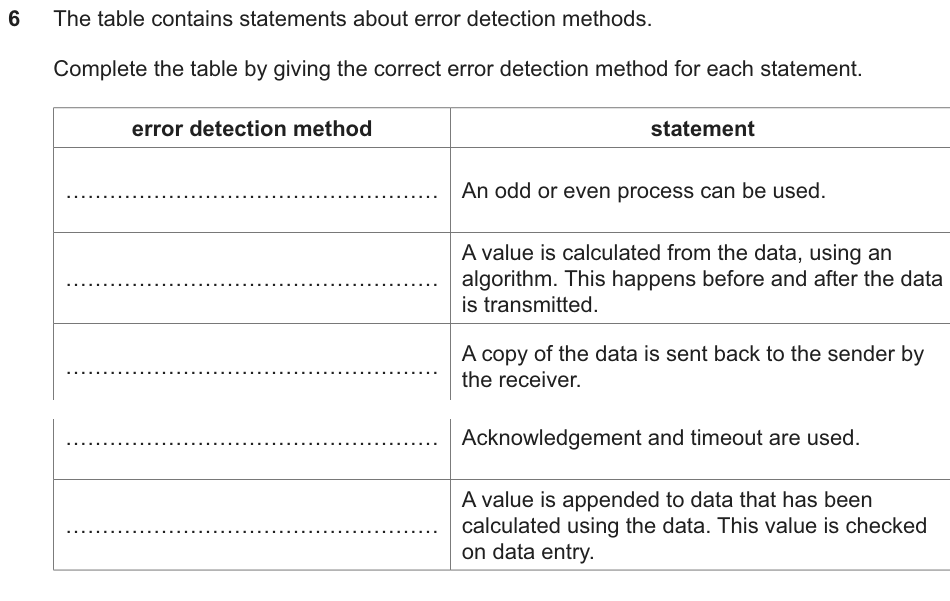
How to start Match each statement to its trigger phrase: odd or even, value calculated before and after, copy sent back, acknowledgement and timeout, value appended and checked on data entry.
Show a full-mark answer and the mark scheme
parity check · checksum · echo check · automatic repeat query (ARQ) · check digit
| Part | Answer / working | Marks | Guidance |
|---|---|---|---|
| 6 | parity (check / bit / byte / block) · checksum · echo check · ARQ · check digit, one mark each | B5 | |
| Total: 5 marks | |||
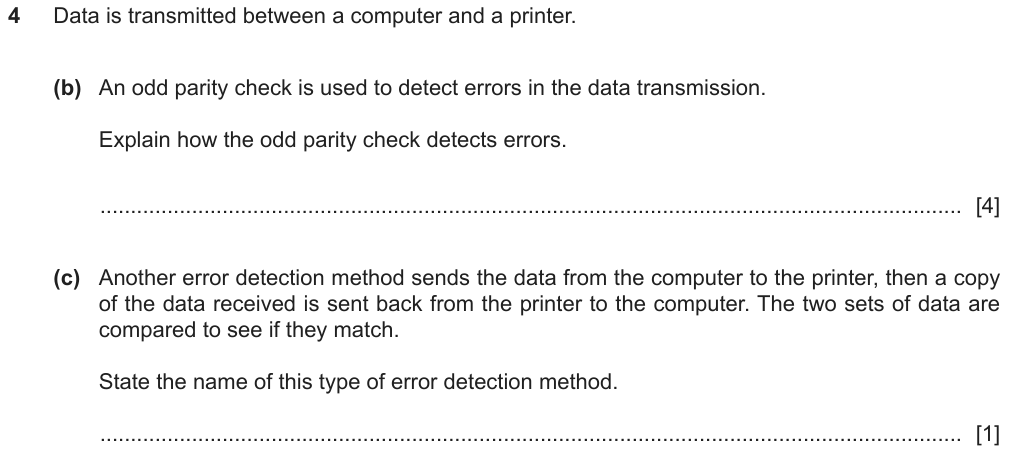
How to start (b) is the five steps of the parity method; four of them earn the marks. (c) "a copy … sent back" = echo check.
Show a full-mark answer and the mark scheme
(b) Before transmission the number of 1s in each 7 bits is counted, and a parity bit is added to each byte to make the number of 1s odd. After transmission the receiver counts the 1s in each byte. If the number is odd, no error is detected; if it is even, an error is detected.
(c) Echo check.
| Part | Answer / working | Marks | Guidance |
|---|---|---|---|
| 4(b) | Any four: number of 1s counted · parity bit added to each byte before transmission · … to make the number of 1s odd · after transmission odd = no error · even = error detected | B4 | |
| 4(c) | Echo (check) | B1 | |
| Total: 5 marks | |||
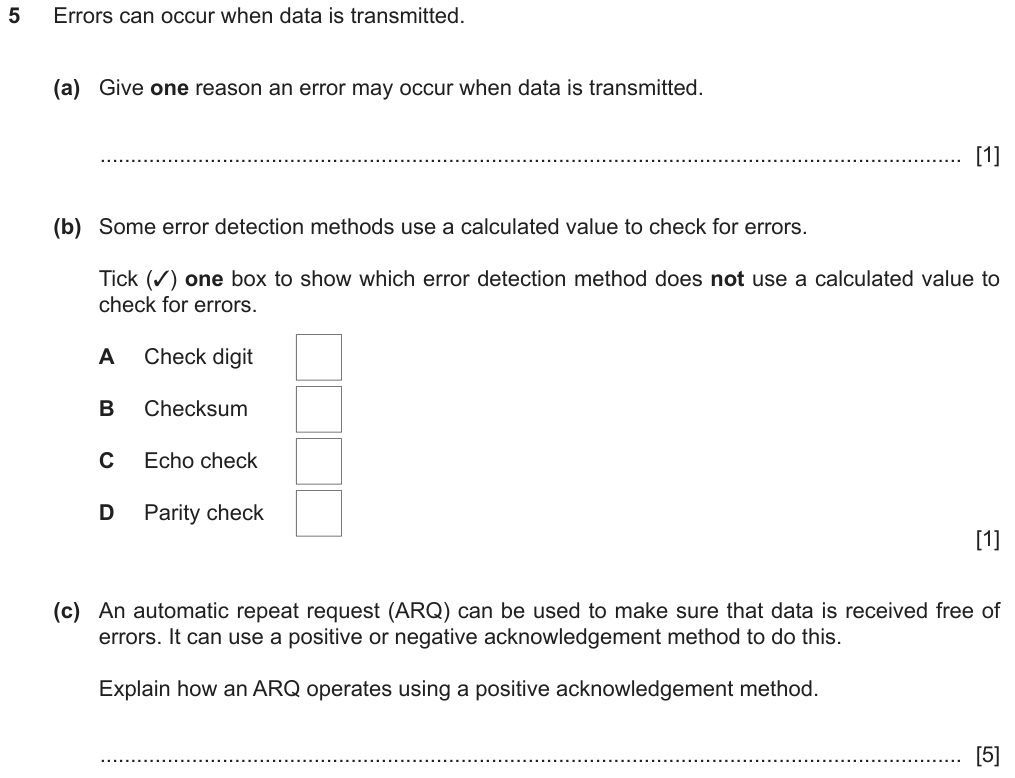
How to start (c) is the ARQ method: timer, check, acknowledgement, next packet, timeout, resend.
Show a full-mark answer and the mark scheme
(a) Interference.
(b) C (echo check).
(c) When the sender transmits a packet it starts a timer. The receiver checks the packet for errors. If it is error free, the receiver sends an acknowledgement back to the sender, and the next packet is sent. If the sender does not receive an acknowledgement before the timer ends, a timeout occurs and the packet is resent, until an acknowledgement is received.
| Part | Answer / working | Marks | Guidance |
|---|---|---|---|
| 5(a) | interference // crosstalk | B1 | |
| 5(b) | C | B1 | |
| 5(c) | Any five: timer started on sending · receiver checks for errors · acknowledgement sent if error free · next packet sent · no acknowledgement before timer ends … · timeout · packet resent · until acknowledged / max attempts | B5 | |
| Total: 7 marks | |||

How to start Follow the method: calculated, added, recalculated on scanning with the same algorithm, compared.
Show a full-mark answer and the mark scheme
A check digit is calculated from the barcode digits using an algorithm (e.g. modulo 11) and added to the end of the barcode. When the barcode is scanned, the check digit is recalculated using the same algorithm. If the recalculated digit does not match the check digit, an error has occurred in scanning; if they match, there is no error.
| Part | Answer / working | Marks | Guidance |
|---|---|---|---|
| 5(a) | Any four: calculated from the barcode data · using an algorithm (e.g. modulo 11) · added to the barcode · recalculated when scanned · same algorithm · do not match = error / match = no error | B4 | |
| Total: 4 marks | |||
Common mistakes
- ✗ "The parity bit makes the byte odd"✓ "… makes the NUMBER OF 1s in the byte odd"
- ✗ "A checksum is the number of 1s"✓ "A value calculated from the data using an algorithm"Counting 1s is parity.
- ✗ Check digit for a transmission question✓ Parity, checksum, echo check or ARQCheck digit = data entry only.
- ✗ "ARQ checks the data" and nothing else✓ Timer · acknowledgement · timeout · resendThe marks are for the process.
Practice
Practice: easy, medium, hard
Easy
Show answer
Answer 1 (three 1s, add one to make four)
Show answer
Answer ARQ (automatic repeat query)
Show answer
Answer Two of: lost, gained, changed
Medium
Show answer
Answer Receiver sends a copy of the data back; sender compares it with the original; if they don't match an error is detected
Show working
- 120 + 64 + 100 = 284
- 284 − 256 = 28
Answer 28
Show answer
Answer It cannot detect two bits changing / a transposition; it cannot locate which bit is wrong
Hard
Show answer
Answer Each byte has a parity bit; a parity byte is added for each column; the receiver checks every row and column; the bad row and bad column cross at the wrong bit, which is flipped
| Part | Answer / working | Marks | Guidance |
|---|---|---|---|
| parity bit per byte | B1 | ||
| parity byte / column parity | B1 | ||
| row and column checked | B1 | ||
| bit where they cross is the error → corrected | B1 | ||
| Total: 4 marks | |||
Show answer
Answer The check digit is recalculated from the typed digits with the same algorithm; it no longer equals 7, so an error is detected
Can I do this?
- I can say how errors occur in transmission.
- I can add parity bits and explain parity byte and parity block checks.
- I can describe checksum and echo check.
- I can describe ARQ with positive acknowledgement and timeout.
- I can describe how a check digit works and calculate one.
Anything unticked: revise that section first. All ticked: take the quiz.
Quiz
The multiple-choice and guided questions need JavaScript. The concept checks and exam practice below work without it.
Your progress on this note is saved when JavaScript is on.
⬇️ Download this chapter as a PDF: Full notes