
Calculus
Areas between lines and curves
In this note
- 14.13Find the area between a line and a curve, or two curves, using top − bottom.
- 14.13Use a triangle or trapezium together with an integral when that is quicker.
- 14.5, 14.13Handle regions bounded by a tangent or normal: find the line first.
Before you start: Areas under curves; solving simultaneous equations; tangents and normals. This is the last integration page.
Formula bank
Top minus bottom
The area under the top graph minus the area under the bottom graph is the area between them, so you can do it in one integral of (top − bottom). This works even if part of the region is below the x-axis.
General methodHow to find the area between two graphs
- Find where they meet: set the equations equal and solve. These are the limits.
- Decide which graph is on top between them (sketch, or test one x value).
- Integrate \((\text{top}-\text{bottom})\) between the limits.
- Or: area under one graph ± a triangle or trapezium, when the other boundary is a straight line.
Example Find the area enclosed by \(y=4x-x^{2}\) and \(y=x\).
Meet: 4x − x² = x.
- \(x^{2}-3x=0\Rightarrow x=0,\ 3\)
- \(\int_0^3(3x-x^{2})\,dx=\big[\tfrac32x^{2}-\tfrac13x^{3}\big]_0^3=\tfrac{27}{2}-9\)
Answer \(\tfrac92\)
Example Find the area enclosed by \(y=x^{2}\) and \(y=8-x^{2}\).
Two curves: meet where 2x² = 8.
- \(x=\pm2\)
- \(\int_{-2}^{2}(8-2x^{2})\,dx=32-\tfrac{32}{3}\)
Answer \(\tfrac{64}{3}\)
Try it yourself
Hint
Show answer
Answer 4.5
Show answer
Answer \(\sqrt3-\tfrac{\pi}{3}\)
Regions with a tangent or normal
Here the line is not given: you build it. The tangent to \(y=x^{2}\) at \((2,4)\) has gradient 4, so \(y=4x-4\); it meets the x-axis at \(x=1\). The region is the area under the curve from 0 to 2 MINUS the triangle (base 1, height 4): \(\tfrac83-2=\tfrac23\).
General methodHow to answer a tangent/normal area question
- Differentiate; find the gradient at the point; for a normal use −1/m.
- Write the line's equation; find where it meets the x-axis (or the curve again).
- Split the region into 'area under the curve' and a triangle/trapezium under the line.
- Add or subtract the pieces as the diagram shows.
Try it yourself
Show answer
Answer 16/3
Ways they test it
Type 1 Line and curve
"The line and curve intersect at P and Q. Find the shaded area." (8 marks)
Spot it a line crossing a curve twice.
- Solve for P and Q.
- ∫(top − bottom), or trapezium − area under the curve.
For example y = 2x + 5, y = 3x² − 2x + 1
- meet at \(-\tfrac23\), 2
Answer \(\tfrac{256}{27}\)
Type 2 Two curves
"Find the area enclosed by the two curves." (7 marks)
Spot it two curves on one diagram.
- Meeting points.
- ∫(top − bottom).
Type 3 Tangent or normal
"…the tangent to the curve at A… Find the area of the shaded region." (9-11 marks)
Spot it 'tangent' or 'normal' in a region question.
- Build the line.
- Curve area ± triangle.
Type 4 Line from a special point
"…the line AB, where B is the maximum point…" (9-11 marks)
Spot it a line through a root or turning point.
- Find the points first (dy/dx = 0, y = 0).
- Then the area.
From the past papers
Past paper 1
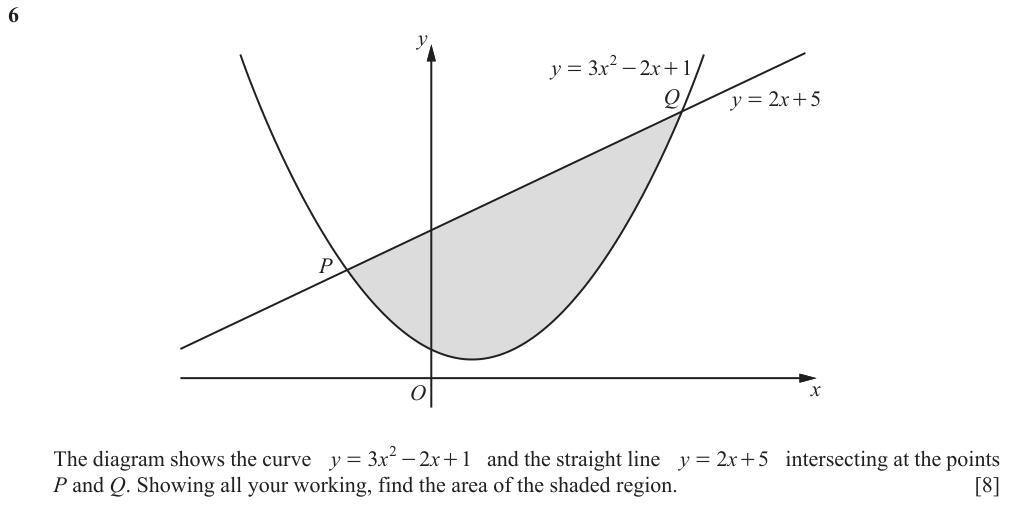
How to start: The line is on top between P and Q. Find P and Q by solving, then integrate (line − curve).
✓ Show the solution have a go on paper first
- \(3x^{2}-2x+1=2x+5\Rightarrow3x^{2}-4x-4=0\Rightarrow(3x+2)(x-2)=0\), so \(x=-\tfrac23,\ 2\).
- \(\int_{-2/3}^{2}\big[(2x+5)-(3x^{2}-2x+1)\big]dx=\int_{-2/3}^{2}(-3x^{2}+4x+4)\,dx\).
- \(=\big[-x^{3}+2x^{2}+4x\big]_{-2/3}^{2}=8-\big(-\tfrac{40}{27}\big)\).
- Area \(=\tfrac{256}{27}\) (≈ 9.48).
| Part | Answer / working | Marks | Guidance |
|---|---|---|---|
| equate and rearrange to a 3-term quadratic | M1 | ||
| \(3x^{2}-4x-4=0\) | A1 | ||
| \(x=-\tfrac23\) and \(x=2\) | A1 | ||
| subtraction (either way round) | M1 | ||
| integration | M1 | ||
| \(-x^{3}+2x^{2}+4x\) | A1 | ||
| correct use of limits | M1 | dep | |
| \(\tfrac{256}{27}\) or 9.48 | A1 | ||
| Total: 8 marks | |||
Examiner tip Alternative route in the scheme: trapezium under the line minus the area under the curve - same answer, same marks.
Past paper 2
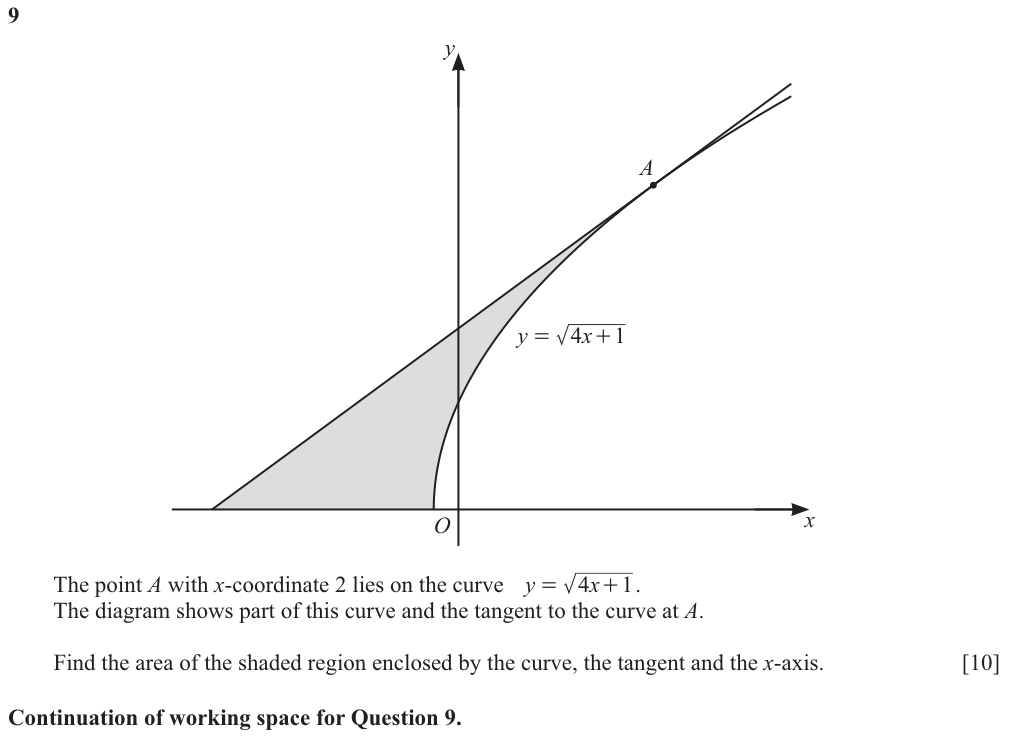
How to start: Build the tangent at A, find where it meets the x-axis, then: triangle under the tangent MINUS the area under the curve (which starts at \(x=-\tfrac14\)).
✓ Show the solution have a go on paper first
- At \(x=2\): \(y=3\). \(\frac{dy}{dx}=\tfrac12(4x+1)^{-1/2}\times4=\dfrac{2}{\sqrt{4x+1}}=\tfrac23\).
- Tangent: \(y-3=\tfrac23(x-2)\); at \(y=0\): \(x=-\tfrac52\).
- Triangle: \(\tfrac12\times\big(2+\tfrac52\big)\times3=\tfrac{27}{4}\).
- Curve meets the axis at \(x=-\tfrac14\). \(\int_{-1/4}^{2}(4x+1)^{1/2}dx=\big[\tfrac16(4x+1)^{3/2}\big]_{-1/4}^{2}=\tfrac{27}{6}=\tfrac92\).
- Shaded area \(=\tfrac{27}{4}-\tfrac92=\tfrac94\).
| Part | Answer / working | Marks | Guidance |
|---|---|---|---|
| \(y=3\) | B1 | ||
| \(\frac{dy}{dx}=\tfrac12(4x+1)^{-1/2}\times4\) | M1 | ||
| gradient \(\tfrac23\) | M1 | ||
| tangent equation | M1 | dep | |
| x-intercept \(-\tfrac52\) | A1 | ||
| triangle \(\tfrac{27}{4}\) | B1 | ||
| curve meets axis at \(-\tfrac14\) | B1 | ||
| \(\tfrac16(4x+1)^{3/2}\) | M1 | ||
| limits | M1 | dep | |
| \(\tfrac94\) | A1 | ||
| Total: 10 marks | |||
Examiner tip The curve's area starts where the CURVE meets the axis \(\big(-\tfrac14\big)\), not where the tangent does.
Mistakes to avoid
- ✗ bottom − top✓ top − bottom (or take the size)
- ✗ Limits taken from the axis instead of the intersections✓ solve the equations together
- ✗ Curve area started at the tangent's intercept✓ each piece has its own limits
- ✗ Normal gradient = m✓ normal gradient \(=-\tfrac1m\)
Summary
- Area between graphs \(=\int(\text{top}-\text{bottom})dx\) between the meeting points.
- A straight boundary can be a triangle or trapezium instead.
- Tangent/normal regions: build the line, then curve area ± triangle.
If you see …
- a line and a curvemeeting points, top − bottom.
- 'tangent' or 'normal'find the line first.
Practice
Practice: easy, medium, hard
Easy
Show answer
Answer 32/3
Show answer
Answer 3
Show answer
Answer 4.5
Medium
Guide me
What is it asking? an area
What do we know? meet at \(\pm2\)
Plan \(\int(8-2x^{2})\)
Show working
- \(\tfrac{64}{3}\)
Answer 64/3
Guide me
What is it asking? an area
What do we know? line \(y=4x-1\)
Plan \(\int_1^3(-x^{2}+4x-3)\)
Show working
- \(\tfrac43\)
Answer 4/3
Guide me
What is it asking? an area
What do we know? tangent \(y=4x-4\) meets the axis at 1
Plan \(\tfrac83-2\)
Show working
- \(\tfrac23\)
Answer 2/3
Hard
Guide me
What is it asking? an area
What do we know? meet at \(-\tfrac23\) and 2
Plan \(\int(-3x^{2}+4x+4)\)
Show working
- \(\tfrac{256}{27}\)
Answer 256/27
| Part | Answer / working | Marks | Guidance |
|---|---|---|---|
| limits | M1A1A1 | ||
| top − bottom, integrate | M1M1A1 | ||
| limits, answer | M1A1 | ||
| Total: 8 marks | |||
Guide me
What is it asking? an area
What do we know? triangle \(\tfrac{27}{4}\)
Plan curve area \(\tfrac92\)
Show working
- \(\tfrac94\)
Answer 9/4
| Part | Answer / working | Marks | Guidance |
|---|---|---|---|
| tangent | B1M1M1M1A1 | ||
| triangle, curve | B1B1M1M1 | ||
| answer | A1 | ||
| Total: 10 marks | |||
Guide me
What is it asking? an area
What do we know? \(\int(\cos x-\tfrac12)\)
Plan \(2\sin\tfrac{\pi}{3}-\tfrac{\pi}{3}\)
Show working
- \(\sqrt3-\tfrac{\pi}{3}\)
Answer 0.685
| Part | Answer / working | Marks | Guidance |
|---|---|---|---|
| \(\sin x-\tfrac12x\) | M1A1 | ||
| limits | M1 | ||
| answer | A1 | ||
| Total: 4 marks | |||
Can I do this?
- I can find the area between a line and a curve, or two curves.
- I can use triangles or trapezia with an integral.
- I can do regions bounded by a tangent or normal.
Anything unticked: revise that section first. All ticked: take the quiz.
Quiz
The multiple-choice and guided questions need JavaScript. The concept checks and exam practice below work without it.
Your progress on this note is saved when JavaScript is on.