
Automated and Emerging Technologies
Robotics
In this note
- 6.2.1Understand what is meant by robotics: a branch of computer science that incorporates the design, construction and operation of robots, e.g. factory equipment, domestic robots, drones.
- 6.2.2Describe the characteristics of a robot: a mechanical structure or framework, electrical components, programmable.
- 6.2.3Understand the roles that robots can perform and describe the advantages and disadvantages of their use in industry, transport, agriculture, medicine, domestic and entertainment.
Before this: Automated systems. Next: Artificial intelligence.
The notes: every idea from the start, with our own examples.
What you should already know
Automated systems
Sensor → microprocessor compares with a stored value → signal to an actuator → repeats.
Quick check: which part decides?
The microprocessor.
Firmware
Permanent instructions stored in ROM that control the hardware.
Quick check: where is a robot's program kept?
In ROM, as firmware.
What is robotics?
Examples you can quote: factory equipment (welding and painting arms on a car production line), domestic robots (robot vacuum cleaners, lawn mowers) and drones (delivery, filming, crop spraying).
The characteristics of a robot
A machine is only a robot if it has all three of these:
| Characteristic | What it means | Example |
|---|---|---|
| Mechanical structure / framework | a physical body, often with wheels, arms, joints or grippers, so it can move and do a physical task | the arm and base of a welding robot |
| Electrical components | sensors (to collect data), a microprocessor (to process it) and actuators (motors to move) | a proximity sensor, a microprocessor, joint motors |
| Programmable | it is controlled by a program that can be written or changed, so it can be given a new task | reprogrammed to weld a new car model |
Try it yourself
Show answer
Answer A mechanical structure / framework (or electrical components)
Show answer
Answer Operation
Show answer
Answer Sensors and actuators (or a microprocessor)
How a robot reacts to its surroundings
A robot is an automated system, so the same method earns the marks when a question asks how it avoids an obstacle, stops for a person or turns at a fence.
General methodExplain how a robot uses its sensor and microprocessor
- A proximity / infra-red sensor (or the sensor that fits) is used.
- The sensor continuously sends digitised data to the microprocessor.
- The microprocessor compares the data with the stored value (e.g. 10 cm, 3 m).
- If the object is at or within the value, it sends a signal to an actuator to stop / turn / brake.
- Otherwise it sends a signal to carry on (move forward) or takes no action.
- This repeats until the robot is turned off.
Roles robots perform
| Area | Roles | Advantages | Disadvantages |
|---|---|---|---|
| Industry | welding, painting, assembling, moving heavy parts, packing | works 24/7; consistent quality; workers do no heavy lifting or dangerous work | expensive to buy and maintain; job losses; stops production if it breaks |
| Transport | driverless cars, trains and delivery vehicles; warehouse robots | fewer accidents from human error; works without breaks | can fail to recognise a hazard; can be hacked; job losses for drivers |
| Agriculture | planting seeds, ploughing, harvesting, weeding, crop-spraying drones | more accurate planting; 24/7; farmer is free for other jobs | expensive; needs maintenance; can't adapt to an unexpected event; farmer needs training |
| Medicine | surgery controlled by a doctor (even from far away); dispensing medicine | more precise, so smaller cuts and faster recovery; a specialist anywhere can operate without travelling | connection can be lost or delayed; can be hacked; very expensive |
| Domestic | robot vacuum cleaners, lawn mowers, pool cleaners | saves people time on repetitive chores | expensive; can get stuck; may not clean as thoroughly |
| Entertainment | theme-park rides, animatronics, camera robots and drones for filming | repeats a show exactly; films shots a person can't | expensive; can malfunction mid-show; less of a human touch |
Summary
- Robotics: the design, construction and operation of robots (factory equipment, domestic robots, drones).
- A robot: mechanical structure / framework + electrical components (sensors, microprocessor, actuators) + programmable.
- It reacts using the automated-system loop: sensor → microprocessor compares → actuator → repeat.
- Roles in industry, transport, agriculture, medicine, domestic, entertainment, each with advantages and disadvantages.
If you see …
- "give three characteristics of a robot" [3]mechanical structure / framework · electrical components · programmable · (can move)
- "explain why X is not a robot" [3]no mechanical structure · no actuators · so it cannot move itself
Question types, what the examiner gives marks for, and real past-paper questions solved.
Ways they test it
Type 1 Characteristics
"One characteristic is that it is programmable. State two other characteristics" [2]
Spot it a characteristic already given.
- Don't repeat the one in the question.
Type 2 Robot or not?
"Explain why the smart speaker is not a robot" [3]
Spot it "not a robot".
- Say which characteristic is missing and what it means.
Type 3 Sensor process
"Explain how the robot uses sensors and a microprocessor to know it has reached a fence" [6-7]
Spot it a distance or event.
- The method above, with the value from the question.
Type 4 Advantages / disadvantages
"Give two advantages to the farmer…" [2]; "explain the advantages of using the robot to perform surgery" [4]
Spot it whose and how many.
- For "explain", each point + its "so…".
What the examiner looks for
"Describe the characteristics of a robot" [3]
Marking points (one mark each, up to the marks shown)
- A mechanical structure / framework
- Electrical components
- … such as sensors / microprocessor / actuators
- Programmable
- Has the ability to move
Keywords mechanical structure framework electrical components programmable
Too vague "it is intelligent" (that is AI, not a characteristic of a robot); "it is automatic"
Past-paper questions, solved
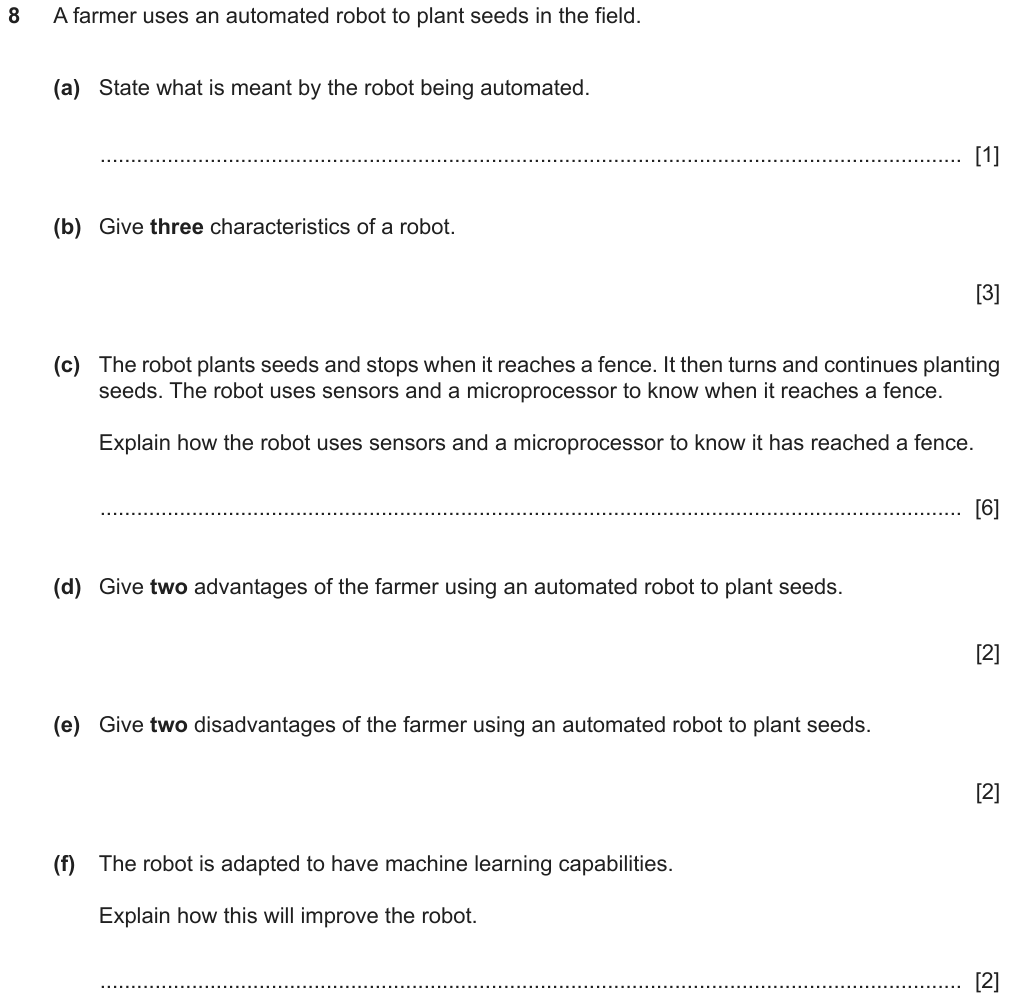
How to start Six parts: (a) automated [1], (b) characteristics [3], (c) the sensor process [6], (d)/(e) for the farmer [2+2], (f) machine learning (next note) [2].
Show a full-mark answer and the mark scheme
(a) The robot can perform actions without human intervention.
(b) It has a mechanical structure / framework; it has electrical components; it is programmable.
(c) A proximity sensor is used. It continuously sends digitised data to the microprocessor. The microprocessor compares the data with a stored range of values. If the value is within the range, the robot carries on planting. If it is outside the range (the fence is reached), the microprocessor sends a signal to an actuator to stop and turn the robot. This repeats until the robot is turned off.
(d) It is more accurate when planting seeds; it does not need breaks, so it can work 24/7.
(e) It is expensive to buy; it needs maintenance, which may be costly.
(f) It can change its own rules and data, so it remembers where the fence and obstacles are and makes fewer errors.
| Part | Answer / working | Marks | Guidance |
|---|---|---|---|
| 8(a) | Performs actions without human intervention | B1 | |
| 8(b) | Any three: mechanical structure / framework · electrical components · programmable · can move | B3 | |
| 8(c) | proximity sensor · sends digitised data continuously · compares with stored value / range · within range → continues · outside → signal to turn / stop · using an actuator · repeats | B6 | |
| 8(d) | Any two: more accurate · 24/7 · not bored · farmer does other tasks · faster · safer · no wages | B2 | |
| 8(e) | Any two: expensive · maintenance cost · job losses · deskilling · training · manual if it breaks · damage if faulty · can't adapt | B2 | |
| 8(f) | adapts its own rules / data / processes · more efficient · … e.g. remembers where the fence / obstacles are · fewer errors | B2 | |
| Total: 16 marks | |||
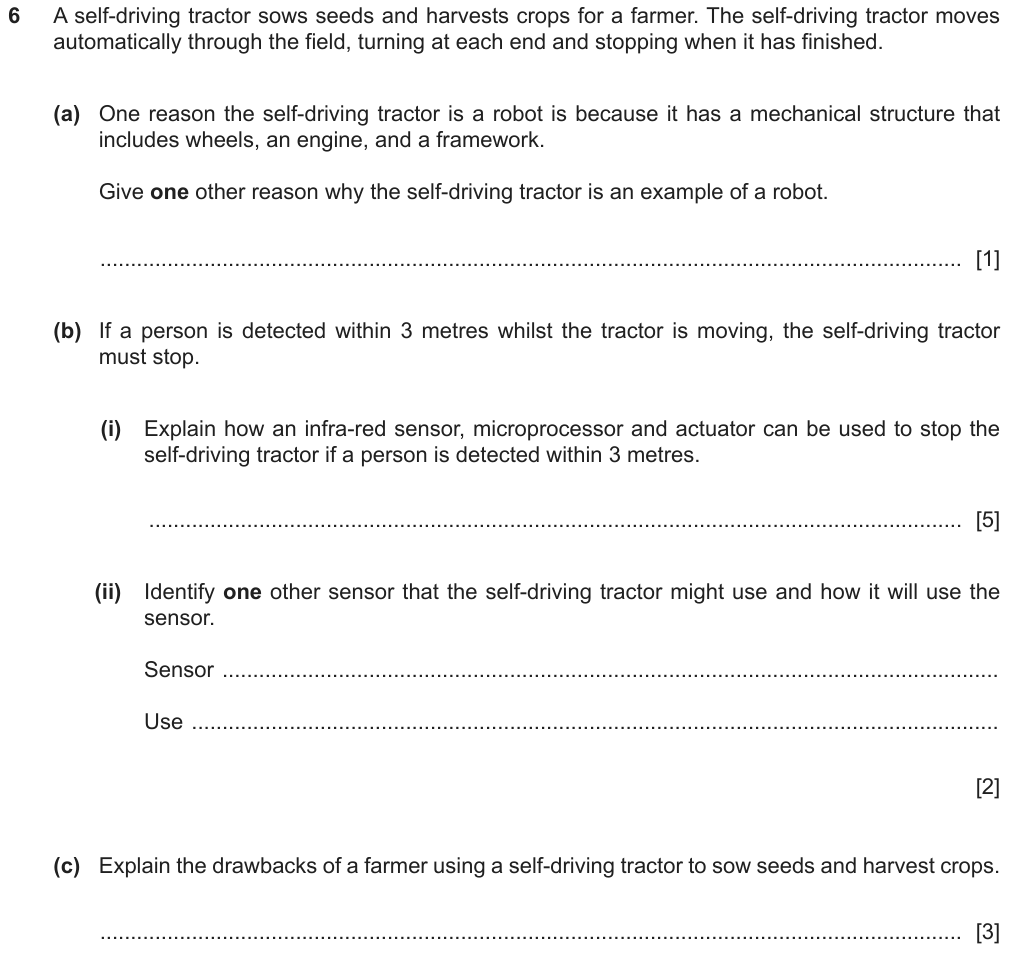
How to start (b)(i) needs all three named parts; (c) says explain the drawbacks: points with reasons. (d) and (e) are expert systems and error checking.
Show a full-mark answer and the mark scheme
(a) It is programmable (or: it has electrical components).
(b)(i) The infra-red sensor continuously sends the digitised readings to the microprocessor. The microprocessor compares the data with the stored data for a person and the distance of 3 m. If a person is within 3 m, it sends a signal to the actuator to apply the brakes and stop the tractor. If not, no action is taken. The process repeats until the tractor is turned off.
(b)(ii) A proximity sensor, to detect when it is near the end of the field so it can turn.
(c) The set-up cost may be high. Maintenance needs skilled experts, which is costly. It can malfunction and fail to recognise a person, so it does not stop.
| Part | Answer / working | Marks | Guidance |
|---|---|---|---|
| 6(a) | Any one: electrical components · programmable | B1 | |
| 6(b)(i) | Any five: sensor sends data continuously · microprocessor compares with stored data / 3 m · if person within 3 m · signal to actuator to stop / brake · if more than 3 m no action · restart when clear · repeats | B5 | |
| 6(b)(ii) | Sensor + matching use, e.g. accelerometer → uneven ground / crash; proximity → end of field; light → headlights | B2 | |
| 6(c) | Any three: set-up cost · maintenance cost · needs experts · retraining · deskilling · fewer employees · malfunction → fails to stop | B3 | |
| Total: 11 marks | |||
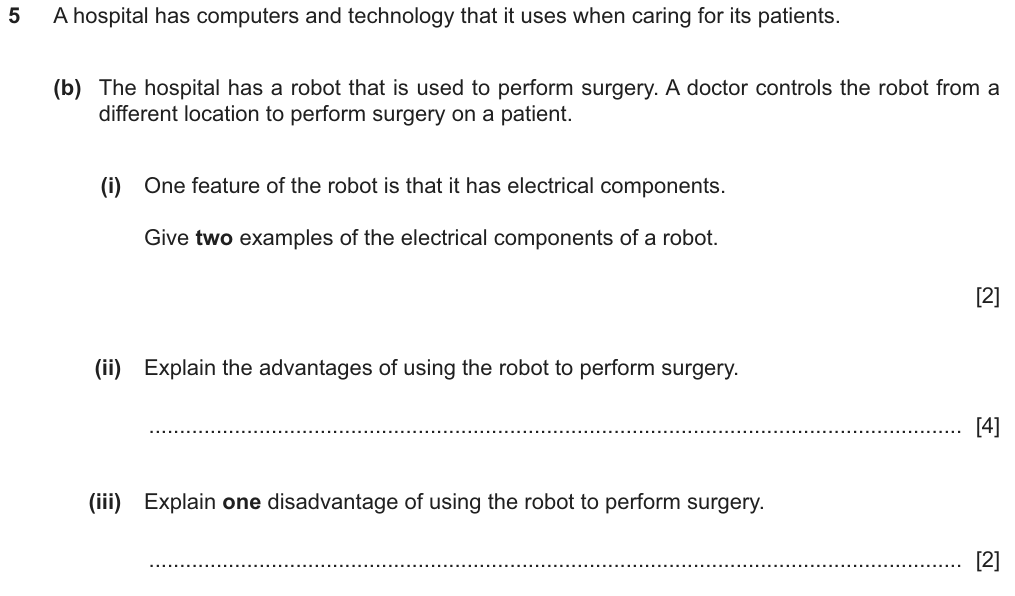
How to start (ii) explain the advantages [4]: two advantages, each with its "so…". (iii) one disadvantage + its consequence [2].
Show a full-mark answer and the mark scheme
(b)(i) Sensors; actuators (or a microprocessor).
(ii) The doctor does not need to travel to the hospital, so any specialist in the world can do the surgery and it can be done immediately. The robot is more precise, so a smaller incision can be made and the recovery time is shorter.
(iii) The internet connection could be lost or delayed, so the surgery may not be able to continue.
| Part | Answer / working | Marks | Guidance |
|---|---|---|---|
| 5(b)(i) | Any two: sensors · microprocessors · actuators | B2 | |
| 5(b)(ii) | no travel · … any specialist · … done immediately · … not tired · precision · … smaller incision · … shorter recovery · safer | B4 | |
| 5(b)(iii) | Point + expansion, e.g. connection lost → surgery stops; hacked → endangers patient; malfunction → cannot continue | B2 | |
| Total: 8 marks | |||
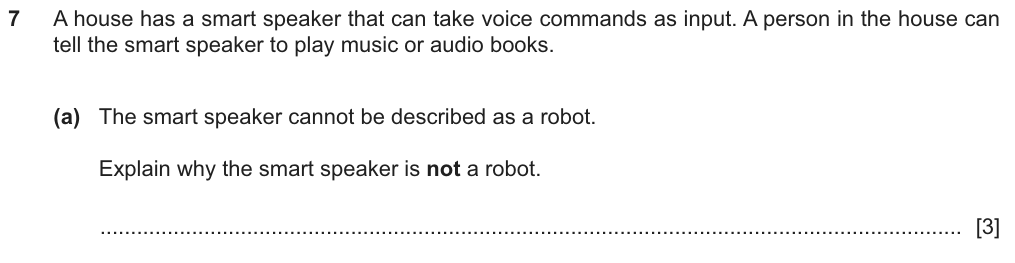
How to start Use the three characteristics: which ones are missing?
Show a full-mark answer and the mark scheme
It does not have a mechanical structure. It does not have any actuators, so it cannot move itself.
| Part | Answer / working | Marks | Guidance |
|---|---|---|---|
| 7(a) | no mechanical structure · no actuators · so it cannot move itself | B3 | |
| Total: 3 marks | |||
Common mistakes
- ✗ "A robot is intelligent"✓ "A robot has a mechanical structure, electrical components and is programmable"AI is a separate idea; not every robot has it.
- ✗ "It has a sensor" as the characteristic✓ "It has electrical components, such as sensors"Name the characteristic first.
- ✗ Repeating the characteristic given in the question✓ Give the other onesNo mark for the one they gave you.
- ✗ "The robot is cheaper"✓ "The company does not need to pay wages to workers"Explain the point.
Practice
Practice: easy, medium, hard
Easy
Show answer
Answer Mechanical structure / framework · electrical components · programmable
Show answer
Answer e.g. robot vacuum cleaner · robot lawn mower
Medium
Show answer
Answer e.g. no driver wages · faster deliveries (not stuck in traffic) · works 24/7
Show answer
Answer It has a mechanical structure (body, wheels, brushes) so it can move · it has electrical components (sensors, microprocessor, motors) · it is programmable
Hard
Show answer
Answer Proximity / infra-red sensor · continuously sends digitised data to the microprocessor · compares with 15 cm · if greater than 15 cm, signal to actuator to move forward · if 15 cm or less, signal to actuator to turn left · repeats until turned off
Can I do this?
- I can say what robotics is, with examples.
- I can give the three characteristics of a robot and say why something is not a robot.
- I can explain how a robot reacts using its sensor, microprocessor and actuator.
- I can give roles, advantages and disadvantages in the six areas.
Anything unticked: revise that section first. All ticked: take the quiz.
Quiz
The multiple-choice and guided questions need JavaScript. The concept checks and exam practice below work without it.
Your progress on this note is saved when JavaScript is on.
⬇️ Download this chapter as a PDF: Full notes