
Automated and Emerging Technologies
Automated systems
In this note
- 6.1.1Describe how sensors, microprocessors and actuators can be used in collaboration to create automated systems.
- 6.1.2Describe the advantages and disadvantages of an automated system used for a given purpose: industry, transport, agriculture, weather, gaming, lighting, science.
The notes: every idea from the start, with our own examples.
What you should already know
Sensors
A sensor is an input device that measures a physical property (temperature, light, distance…) and sends the reading as data, after an ADC turns it into digital form.
Quick check: does a sensor make decisions?
No: the microprocessor does.
Microprocessor
An integrated circuit that processes data: here it runs the control program.
Quick check: where is the control program kept?
In ROM, as firmware.
What is an automated system?
| Part | Its job |
|---|---|
| Sensor | measures something in the environment and sends the reading (data) to the microprocessor |
| Microprocessor | receives the data, compares it with a stored / preset value or range, decides what to do and sends a signal to the actuator |
| Actuator | a component that makes something move or happen when it gets a signal: a motor, a valve, a pump, a heater, a light, a buzzer |
How it works, step by step
General methodDescribe how an automated system works (any scenario)
- Name the sensor that fits (e.g. temperature, proximity / infra-red, light, moisture, pressure).
- The sensor continuously sends digitised data (readings) to the microprocessor.
- The microprocessor compares the data with the stored value (give the number from the question, e.g. 40 °C, 10 cm).
- If the reading is outside the range / past the value, the microprocessor sends a signal to the actuator to act (name the action).
- If it is within the range, no action is taken (or the current action carries on).
- The process repeats continuously until the system is switched off.
Example: smart heating A room is kept at 21 °C. Describe how the heating system works. [5]
Follow the method: sensor → microprocessor compares → actuator → repeat.
- A temperature sensor continuously sends digitised readings to the microprocessor.
- The microprocessor compares each reading with the stored value of 21 °C.
- If the reading is below 21 °C, it sends a signal to an actuator to switch the heater on.
- If the reading is 21 °C or above, it sends a signal to switch the heater off.
- This repeats until the system is switched off.
Answer Sensor → microprocessor compares with stored value → signal to actuator → repeat.
Try it yourself
Show answer
Answer The microprocessor
Show answer
Answer Actuator
Show answer
Answer Light sensor
Where automated systems are used
The syllabus names seven settings. In the exam you get a scenario and must give advantages and disadvantages for that scenario and for the person named (the employees, the owner, the farmer, the customer).
| Setting | Example | Sensors → actuator |
|---|---|---|
| Industry | a bottling line fills and caps bottles | level / proximity → valve, motor |
| Transport | a driverless train stops at the platform; car parking sensors | proximity / infra-red → brakes, buzzer |
| Agriculture | automatic irrigation; a self-driving plough or tractor | moisture, proximity → pump, motor |
| Weather | a weather station records and alerts | temperature, humidity, pressure, light → stored data, alert |
| Gaming | a motion controller or VR headset reacts to movement | accelerometer, gyroscope → screen, vibration motor |
| Lighting | street lights or room lights switch themselves on | light, infra-red (motion) → lights |
| Science | a lab experiment logs readings overnight | temperature, pH, gas → stored readings, heater |
Advantages and disadvantages
| Advantages | Disadvantages |
|---|---|
| faster and more accurate / consistent than a person | expensive to set up (buy, install) |
| works 24/7, no breaks, no tiredness | ongoing maintenance / repair costs; needs skilled people to fix |
| safer: people don’t go into dangerous places or handle heavy loads | can malfunction: production stops, or it fails to act (e.g. doesn’t stop) |
| takes over boring, repetitive tasks; staff can do more skilled work | deskilling and job losses; staff need training |
| saves labour costs over time | can’t adapt to an unexpected event it wasn’t programmed for |
| creates new maintenance jobs | can be hacked if it is connected to a network |
Summary
- Automated system: performs actions without human intervention.
- Sensor sends data → microprocessor compares with stored value → signal to actuator → repeats.
- Settings: industry, transport, agriculture, weather, gaming, lighting, science.
- Advantages: 24/7, accurate, safer, no repetitive work. Disadvantages: cost, maintenance, malfunction, deskilling, job loss.
If you see …
- "explain how the sensor and the microprocessor are used to automate this" [5-7]name sensor · continuously sends data · microprocessor compares with stored value · if… signal to actuator · if not… · repeats
- "give two advantages to the employees" [2]safety · no repetitive tasks · no heavy lifting · no night work · new maintenance jobs
Question types, what the examiner gives marks for, and real past-paper questions solved.
Ways they test it
Type 1 Explain the process
"Explain how the sensor, microprocessor and actuator are used to stop the tractor" [5-7]
Spot it a scenario with a number (3 m, 40 °C, 10 cm).
- Follow the method; repeat the number from the question.
Type 2 Role of a part
"Describe the role of the microprocessor in this process" [3]
Spot it "role".
- receives data · compares / checks the range · sends signals to trigger actions
Type 3 Advantages / disadvantages
"Give two advantages to the employees…" [2]; "Explain one disadvantage to the owner" [2]
Spot it who it is for.
- Point for that person + its matching explanation.
Type 4 Definition / components
"State what is meant by an automated system" [1]; "give one other component" [1]
Spot it "what is meant by".
- without human intervention; microprocessor · actuator · storage
What the examiner looks for
"Explain how the sensor and microprocessor are used to automate the system" [5-7]
Marking points (one mark each, up to the marks shown)
- Names a suitable sensor (e.g. infra-red / proximity)
- Sensor continuously sends the digitised value to the microprocessor
- Microprocessor compares the data with the stored value (the number given)
- If past the value, a signal is sent to the actuator to act
- If not, no action / carries on
- The process repeats until switched off
Keywords continuously digitised compares stored value signal actuator repeats
Too vague "the sensor decides"; "the sensor tells the motor"
Past-paper questions, solved
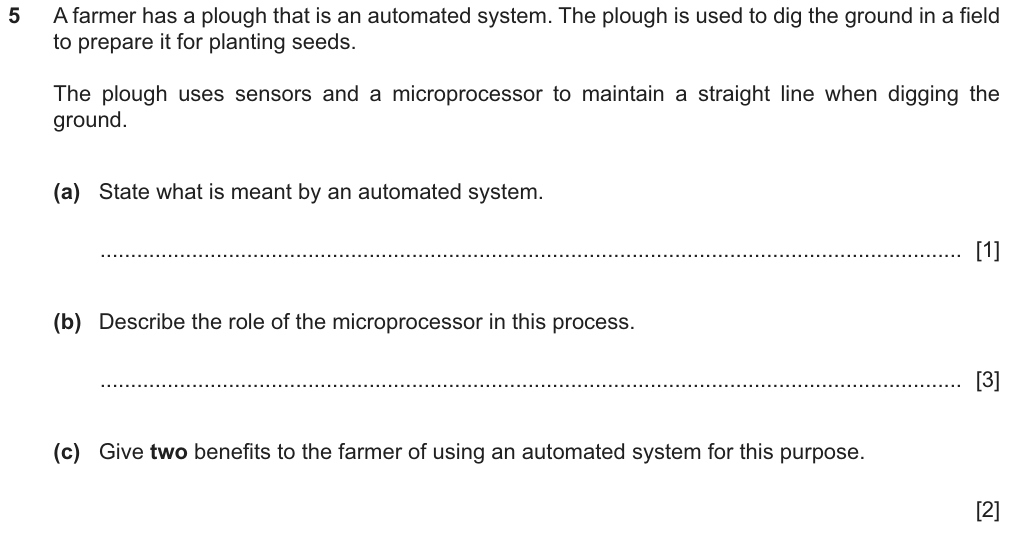
How to start (a) a definition [1]; (b) three things the microprocessor does [3]; (c) two benefits for the farmer [2]. Part (d), on AI, is solved on the AI page.
Show a full-mark answer and the mark scheme
(a) A system that can perform actions without human intervention.
(b) It receives data from the sensors. It checks whether the data is within the range for a straight line. If it is out of range, it sends signals to trigger an action to steer the plough back.
(c) The farmer doesn’t have to handle heavy equipment; it can work 24/7 without breaks.
| Part | Answer / working | Marks | Guidance |
|---|---|---|---|
| 5(a) | Performs actions without human intervention | B1 | |
| 5(b) | receives data from sensor · analyses / checks if within range · sends signals to trigger actions | B3 | |
| 5(c) | Any two: no heavy equipment · frees farmer for other jobs · 24/7 · repetitive tasks · saves labour · more accurate / efficient | B2 | |
| Total: 6 marks | |||
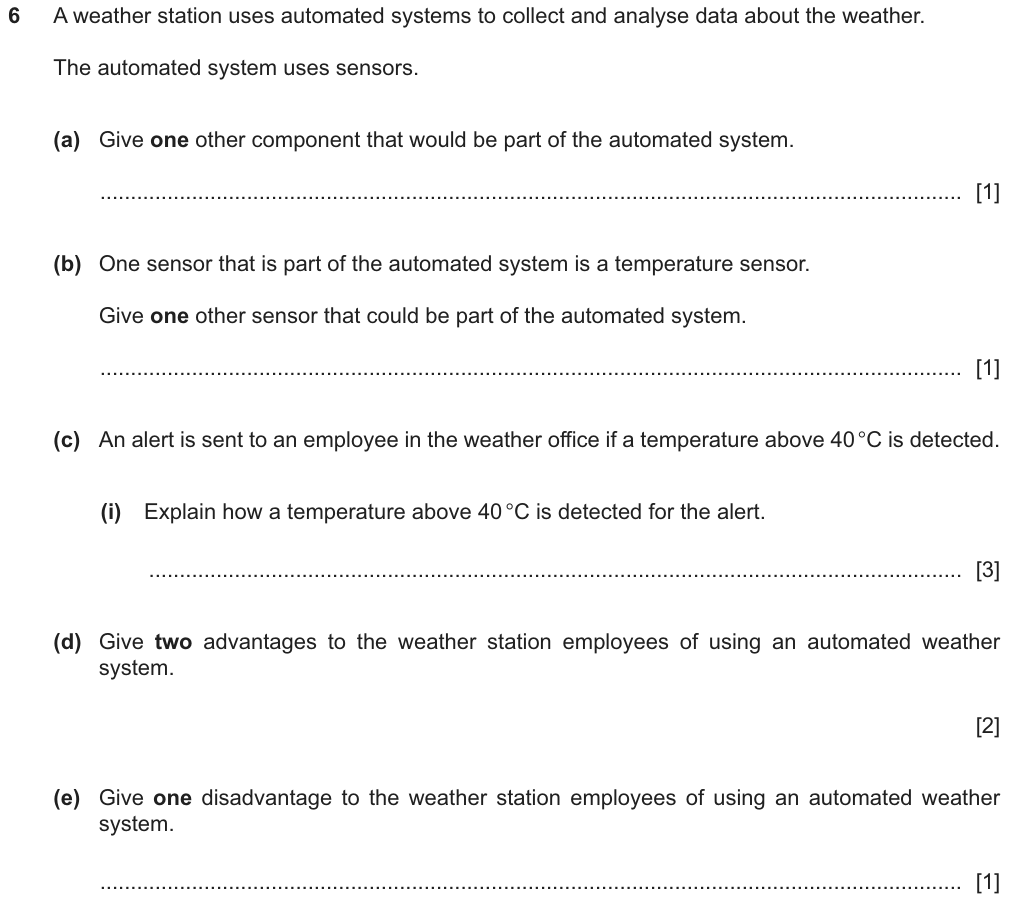
How to start (a) a part other than sensors; (b) another sensor; (c)(i) the process with 40; (d) and (e) for the employees. (c)(ii) is data transmission (chapter 2).
Show a full-mark answer and the mark scheme
(a) A microprocessor (or an actuator).
(b) Humidity sensor.
(c)(i) The microprocessor receives data from the temperature sensor. It compares the data with the preset value of 40. If the data is greater than 40, it sends a signal to trigger the alert.
(d) Employees don’t need to work outside in bad weather; they don’t need to work overnight.
(e) It may replace employees and take their jobs.
| Part | Answer / working | Marks | Guidance |
|---|---|---|---|
| 6(a) | Any one: microprocessor · actuator · storage | B1 | |
| 6(b) | Any one: humidity · light · level · infra-red | B1 | |
| 6(c)(i) | microprocessor used · receives data from sensor · compares with 40 · greater than 40 → signal to trigger alert | B3 | |
| 6(d) | Any two: no repetitive task · no overnight work · not outside in bad weather · maintenance jobs | B2 | |
| 6(e) | Any one: deskilling · replaces employees | B1 | |
| Total: 8 marks | |||
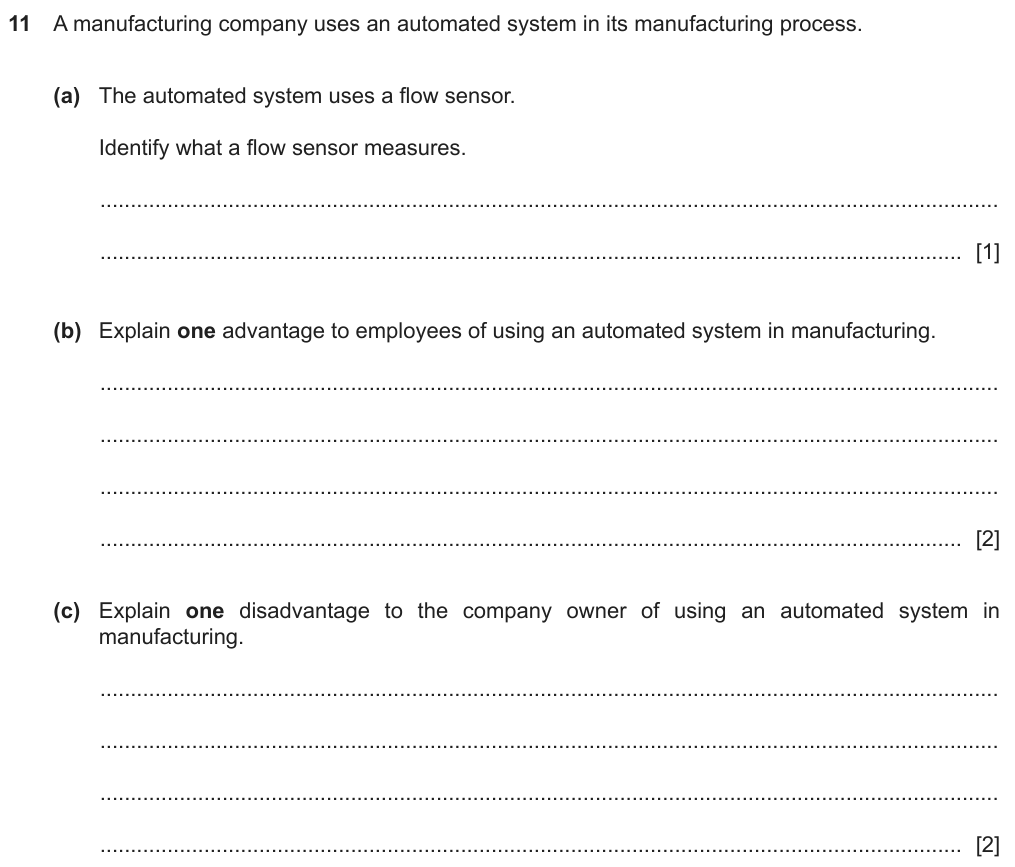
How to start (b) and (c) say explain one: a point + its matching explanation, 2 marks each.
Show a full-mark answer and the mark scheme
(a) The amount of liquid or gas flowing through a pipe.
(b) It increases safety, because workers don’t need to go into dangerous areas to take readings or make checks.
(c) High set-up cost, so the owner must find a lot of money up front to pay for the equipment and train employees.
| Part | Answer / working | Marks | Guidance |
|---|---|---|---|
| 11(a) | Amount of liquid / gas / steam flowing | B1 | |
| 11(b) | Benefit + matching explanation, e.g. safety → no need to enter dangerous areas; no repetitive tasks → more skilled work | B2 | |
| 11(c) | Drawback + matching explanation, e.g. high set-up cost → money up front; maintenance cost → skilled staff needed | B2 | |
| Total: 5 marks | |||
Common mistakes
- ✗ "The sensor checks if it is too hot"✓ "The microprocessor compares the reading with the stored value"Sensors only measure.
- ✗ "The sensor sends a signal to the motor"✓ "The microprocessor sends a signal to the actuator"
- ✗ "It is cheaper" (one-word answers)✓ "It saves labour costs because no workers need to be paid to …"Explain = point + reason.
- ✗ Forgetting the loop✓ "This repeats until the system is switched off"It is a mark on most schemes.
Practice
Practice: easy, medium, hard
Easy
Show answer
Answer A system that performs actions without human intervention
Show answer
Answer e.g. motor · valve · pump · heater · buzzer
Medium
Show answer
Answer Infra-red / proximity sensor continuously sends data to the microprocessor · compares with stored 2 m · if within 2 m, signal to actuator (motor) to open · if not, door stays shut / closes · repeats
Show answer
Answer e.g. high set-up cost · maintenance cost · production stops if it malfunctions
Hard
Show answer
Answer Temperature sensor sends data continuously · microprocessor compares with 60 and 65 · below 60 → signal to heater on · above 65 → heater off · repeats · advantage: scientists needn’t stay overnight to check readings, and readings are taken more accurately
Can I do this?
- I can say what each of the sensor, microprocessor and actuator does.
- I can explain step by step how an automated system works in a scenario.
- I can give advantages and disadvantages for the person named.
Anything unticked: revise that section first. All ticked: take the quiz.
Quiz
The multiple-choice and guided questions need JavaScript. The concept checks and exam practice below work without it.
Your progress on this note is saved when JavaScript is on.
⬇️ Download this chapter as a PDF: Full notes