
Data Transmission
Encryption: symmetric and asymmetric
In this note
- 2.3.1Understand the need for and purpose of encryption when transmitting data.
- 2.3.2Understand how data is encrypted using symmetric and asymmetric encryption.
Before this: Error detection. Next chapter: Hardware.
The notes: every idea from the start, with our own examples.
What you should already know
Packets travel through many devices
A packet passes through many routers on the internet. Any of them, or a hacker listening on the network, could read it.
Quick check: can a packet be intercepted on its way?
Yes.
Why data is encrypted
Data sent across a network can be intercepted: a third party captures it on the way (e.g. with packet sniffing software). Encryption does not stop the interception, but it makes the data meaningless to anyone who does not have the key.
Encryption uses an algorithm and a key to scramble the plain text (the readable data) into cipher text (scrambled, meaningless data). Decryption uses a key to turn the cipher text back into plain text.
Example A very simple encryption algorithm shifts each letter along the alphabet. The key is 3. Encrypt SEND HELP.
Move each letter 3 places on: S → V, E → H …
- S E N D → V H Q G
- H E L P → K H O S
Answer VHQG KHOS
Anyone who intercepts VHQG KHOS sees nonsense. The receiver, who knows the key is 3, shifts each letter back 3 places to read it. Real encryption algorithms use keys that are hundreds of bits long, so they cannot be guessed.
Symmetric encryption
In symmetric encryption the same key is used to encrypt and decrypt the data.
General methodHow symmetric encryption works
- A key is generated (using an algorithm).
- The sender uses the key and an encryption algorithm to turn the plain text into cipher text.
- The cipher text is transmitted.
- The key is also sent to the receiver (separately).
- The receiver uses the same key to decrypt the cipher text back into plain text.
Asymmetric encryption
Asymmetric encryption uses two different keys that are a matched pair: a public key and a private key. Data encrypted with the public key can only be decrypted with the matching private key.
General methodHow asymmetric encryption works
- The receiver has a key pair. The public key is given to anyone who asks; the private key is kept secret and never sent.
- The sender gets the receiver's public key and uses it to encrypt the plain text into cipher text.
- The cipher text is transmitted. The public key cannot decrypt it.
- The receiver uses their private key to decrypt the cipher text.
| Symmetric | Asymmetric | |
|---|---|---|
| Keys | one key, shared | two keys: public and private |
| Encrypt with | the shared key | the public key |
| Decrypt with | the same shared key | the private key |
| Who knows the keys | sender and receiver both know the key | anyone can know the public key; only the receiver knows the private key |
| Security | the key must be sent, so it could be intercepted | more secure: the private key is never sent (no key exchange) |
| Speed | faster | slower (more complex) |
Try it yourself
Show answer
Answer Cipher text
Show answer
Answer The private key
Show answer
Answer If the data is intercepted it cannot be understood / is meaningless
Summary
- Purpose: if data is intercepted, it is meaningless / cannot be understood. Encryption does not stop interception.
- Encryption: algorithm + key turn plain text into cipher text; decryption turns it back.
- Symmetric: one shared key encrypts and decrypts; the key must be sent, so it could be intercepted.
- Asymmetric: public key encrypts, private key decrypts; the private key is never sent, so it is more secure.
If you see …
- "purpose of encryption"if intercepted · cannot be understood / meaningless
- "how symmetric works"same key encrypts and decrypts · plain → cipher · algorithm · key sent to receiver
- "differences symmetric / asymmetric"one shared key vs public + private · public encrypts, private decrypts · who knows them
Question types, what the examiner gives marks for, and real past-paper questions solved.
Ways they test it
Type 1 Purpose
"State the purpose of encrypting data" [1]
Spot it "purpose".
- "If it is intercepted, it cannot be understood." Not "to stop hackers" (it does not stop interception).
Type 2 Describe a type
"Explain how data is encrypted using symmetric encryption" [4]
Spot it "symmetric" or "asymmetric".
- Start with the key fact (same key / public + private), then the method steps.
Type 3 Differences
"Describe the differences between symmetric and asymmetric encryption" [4]
Spot it "differences".
- Points from both columns of the comparison table.
Type 4 Cloze
"Complete the paragraph about asymmetric encryption" [4-8]
Spot it a word list.
- Words to expect: algorithm, plain text, cipher text, meaningless, public, private.
Type 5 Why asymmetric
"Give one reason a person would use asymmetric instead of symmetric" [1]
Spot it "instead of".
- More secure // no need to exchange (send) the key.
What the examiner looks for
"Describe the differences between symmetric and asymmetric encryption" [4]
Marking points (one mark each, up to the marks shown)
- Symmetric has a shared key …
- … to encrypt and decrypt
- Both the sender and receiver know the key
- Asymmetric has different keys // a public key and a private key
- … the public key encrypts the data and the private key decrypts it
- … anyone can know the public key but only the intended receiver knows the private key
Keywords same key public key private key encrypt decrypt
"Explain how data is encrypted using symmetric encryption" [4]
Marking points (one mark each, up to the marks shown)
- The data is encrypted and decrypted using the same key (1 mark), then any three:
- Plain text is encrypted into cipher text // cipher text is decrypted into plain text
- Data is encrypted using an algorithm …
- … that uses a key
- The key can be generated using an algorithm
- The key is transmitted to the receiver
Keywords same key plain text cipher text algorithm
Purpose of encryption
- If the data is intercepted, it cannot be understood
- to make the data meaningless (to a third party)
- to stop the data being intercepted
- to stop hackers
- to keep it safe (alone)
Encryption does not prevent interception; it makes intercepted data useless.
From: 0478/12/F/M/24 Q7(a)(i) mark scheme
Past-paper questions, solved
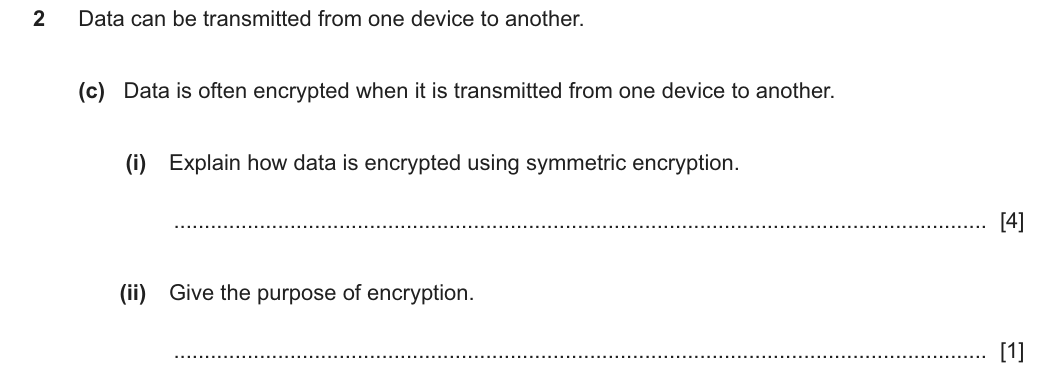
How to start (i) One mark is reserved for "same key": say it first. Then three steps of the method.
Show a full-mark answer and the mark scheme
(c)(i) The data is encrypted and decrypted using the same key. The plain text is encrypted into cipher text using an encryption algorithm that uses the key. The key is generated using an algorithm and is transmitted to the receiver, who uses it to decrypt the cipher text back into plain text.
(c)(ii) To make the data meaningless if it is intercepted.
| Part | Answer / working | Marks | Guidance |
|---|---|---|---|
| 2(c)(i) | same key to encrypt and decrypt (1) + any three: plain text → cipher text · algorithm … · … that uses a key · key generated by an algorithm · key transmitted to the receiver | B4 | |
| 2(c)(ii) | to help keep the data secure // to make the data meaningless | B1 | |
| Total: 5 marks | |||
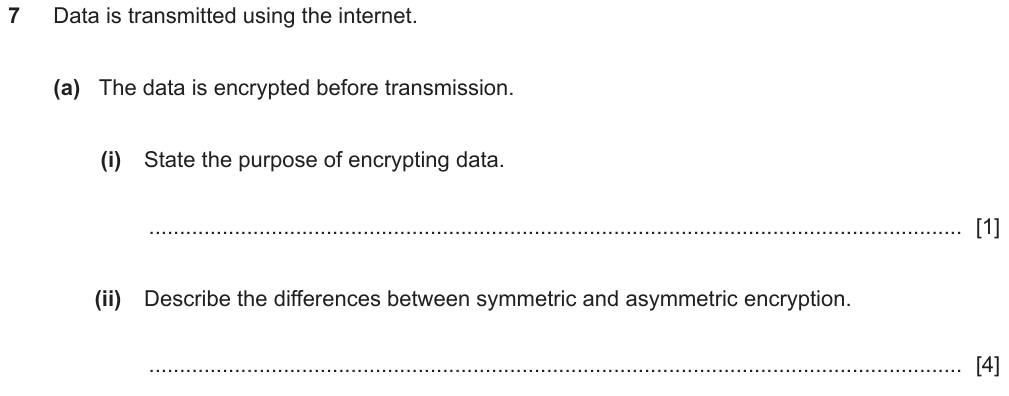
How to start (ii) needs points about BOTH types. Two about symmetric, two about asymmetric is a safe plan.
Show a full-mark answer and the mark scheme
(a)(i) If the data is intercepted, it cannot be understood.
(a)(ii) Symmetric encryption uses one shared key to both encrypt and decrypt, and both the sender and receiver know it. Asymmetric encryption uses two different keys, a public key and a private key: the public key encrypts the data and the private key decrypts it. Anyone can know the public key, but only the receiver knows the private key.
| Part | Answer / working | Marks | Guidance |
|---|---|---|---|
| 7(a)(i) | if intercepted, it cannot be understood | B1 | |
| 7(a)(ii) | Four from: shared key … · … to encrypt and decrypt · both know the key · public and private key · public encrypts, private decrypts · anyone can know the public key, only the intended receiver the private key | B4 | |
| Total: 5 marks | |||
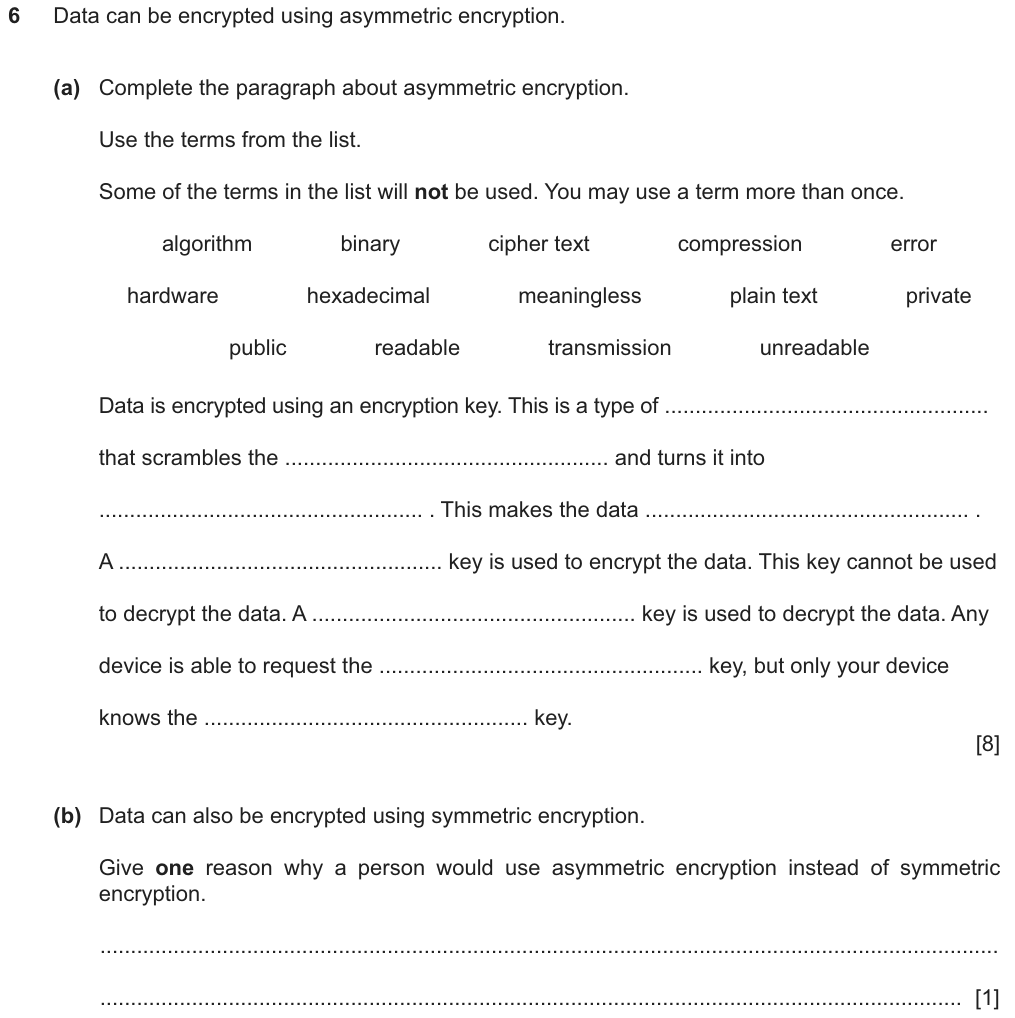
How to start Read the whole paragraph first. Two gaps must be opposite keys (public / private). The last sentence tells you which key anyone can request.
Show a full-mark answer and the mark scheme
(a) algorithm · plain text · cipher text · meaningless · public · private · public · private
(Data is encrypted using an encryption key. This is a type of algorithm that scrambles the plain text and turns it into cipher text. This makes the data meaningless. A public key is used to encrypt the data … A private key is used to decrypt the data. Any device is able to request the public key, but only your device knows the private key.)
(b) It is more secure, because the private key is never sent.
| Part | Answer / working | Marks | Guidance |
|---|---|---|---|
| 6(a) | algorithm · plain text · cipher text · meaningless · public/private · private/public (opposite) · public · private | B8 | |
| 6(b) | more secure // no need to worry about key exchange | B1 | |
| Total: 9 marks | |||
Common mistakes
- ✗ "Encryption stops data being intercepted"✓ "Intercepted data cannot be understood"
- ✗ "Asymmetric: the private key encrypts"✓ "The public key encrypts, the private key decrypts"For sending data to someone.
- ✗ "Encryption is a key"✓ "An algorithm that uses a key"
- ✗ "Coded" instead of "cipher text"✓ "Cipher text"Use the exact term.
Practice
Practice: easy, medium, hard
Easy
Show answer
Answer Plain text
Show answer
Answer One (the same key encrypts and decrypts)
Show answer
Answer FDW
Medium
Show answer
Answer The key has to be sent to the receiver, so it could be intercepted; the private key in asymmetric is never sent
Show answer
Answer Sender encrypts with the receiver's public key; cipher text sent; only the receiver's private key can decrypt it
Show answer
Answer HELLO
Hard
Show answer
Answer The data could be intercepted; encryption makes it meaningless to a third party; asymmetric is more suitable: the public key encrypts, only the private key decrypts and it is never sent, so no key exchange can be intercepted
| Part | Answer / working | Marks | Guidance |
|---|---|---|---|
| data could be intercepted | B1 | ||
| meaningless / cannot be understood | B1 | ||
| asymmetric | B1 | ||
| private key never sent // no key exchange | B1 | ||
| Total: 4 marks | |||
Can I do this?
- I can state the purpose of encryption correctly.
- I can explain symmetric encryption.
- I can explain asymmetric encryption and compare it with symmetric.
Anything unticked: revise that section first. All ticked: take the quiz.
Quiz
The multiple-choice and guided questions need JavaScript. The concept checks and exam practice below work without it.
Your progress on this note is saved when JavaScript is on.
⬇️ Download this chapter as a PDF: Full notes