
Circular Measure
Composite shapes: shaded regions with arcs, sectors and triangles
What you need to be able to do
- 1.4Break a shaded region into sectors, triangles and segments that add or subtract to give it.
- 1.4Find the angles you need: right-angled trigonometry (tangent ⟂ radius), isosceles triangles, the cosine rule, equilateral triangles (\(\tfrac\pi3\)).
- 1.4Give perimeters and areas to 3 s.f. or exactly, without losing accuracy on the way.
Before you start: Radians, arcs, sectors and segments.
How to break any shaded region into sectors, triangles and segments, and how to find the angles you need, with our own examples. Past-paper questions come in Part 2.
What you should already know
Sector, arc, segment
\(s=r\theta\), \(A=\tfrac12r^2\theta\), segment \(=\tfrac12r^2(\theta-\sin\theta)\) (previous page).
Quick check: sector area, \(r=6\), \(\theta=\tfrac\pi4\)?
\(\tfrac{9\pi}2\)
Tangent ⟂ radius
A tangent meets the radius at its point of contact at 90°, which gives right-angled triangles.
Quick check: tangent from a point 13 from the centre, \(r=5\): its length?
\(\sqrt{169-25}=12\)
Isosceles triangles
Two radii and a chord: the base angles are equal, each \(\tfrac{\pi-\theta}2\).
Quick check: base angles when the apex is \(\tfrac\pi2\)?
\(\tfrac\pi4\) each
The cosine rule for an angle
\(\cos A=\dfrac{b^2+c^2-a^2}{2bc}\).
Quick check: angle opposite 7 in a 5, 6, 7 triangle?
\(\cos A=\tfrac{25+36-49}{60}=0.2\): \(1.369\) rad
The idea: every region is built from three shapes
However complicated a shaded region looks, its curved edges are arcs of circles and its straight edges are lines. So its area is always some combination of sectors, triangles and segments (a segment is itself sector − triangle), added or subtracted, and its perimeter is a sum of arcs and straight lengths. The work is in spotting which pieces, and finding the angle at the centre of each arc.
Example: the overlap of two circles. Two circles of radius 6 have their centres 6 apart. Each centre lies on the other circle, so the two centres and either crossing point form an equilateral triangle: the angle at each centre is \(2\times\tfrac\pi3=\tfrac{2\pi}3\). The overlap is two equal segments: \(2\times\tfrac12(36)\left(\tfrac{2\pi}3-\sin\tfrac{2\pi}3\right)=24\pi-18\sqrt3\approx44.2\).
A strategy for any shaded region
- Label the diagram: every centre, every radius ("which circle is this arc part of, and what is its radius?"), every right angle and every equal length.
- Write the plan in words before any numbers: "shaded = sector \(ADC\) − triangle \(ABC\)". It stops you computing pieces you don't need.
- Find the angles you need at the centres of the arcs, in radians (next section). Never guess an angle from the look of the diagram.
- Perimeter = each arc (\(r\theta\) with its own \(r\) and \(\theta\)) + each straight edge (often a difference of lengths, e.g. \(BD=AD-AB\)).
- Area = add and subtract sector areas \(\tfrac12r^2\theta\), triangles \(\tfrac12ab\sin C\), segments.
- Keep accuracy: store angles in the calculator; round only the final answer.
Finding the angle at the centre
Tangent ⟂ radius: right-angled triangles
A tangent meets a radius at 90°, so \(\sin\), \(\cos\), \(\tan\) of the angle come from two known lengths. If \(OT=5\) is a radius and \(OC=10\), the angle at \(C\) has \(\sin=\tfrac5{10}\), so it is \(\tfrac\pi6\).
Isosceles triangles
Two radii make an isosceles triangle: the base angles are \(\tfrac{\pi-\theta}{2}\). Not \(\pi-2\theta\): that is the apex when the base angles are \(\theta\).
The cosine rule
Three known sides: \(\cos A=\dfrac{b^2+c^2-a^2}{2bc}\). In an isosceles triangle, half the base over the side is quicker: \(OA=OB=10\), \(AB=12\) gives \(\cos OAB=\tfrac6{10}\), so \(0.9273\) rad.
Equilateral triangles
Three equal lengths (radii of equal circles through each other's centres) mean \(\tfrac\pi3\). Reuleaux-type shapes, coins and plates all use this.
- A sector has \(r=10\) cm and \(\theta=0.8\) rad. Find the area and perimeter of the segment cut off by its chord.
Answer
area \(50(0.8-\sin0.8)=4.13\) cm²; perimeter \(8+20\sin0.4=15.8\) cm
Case by case
1 Sector minus a triangle
Right-angled triangle \(ABC\) (right angle at \(B\)) with \(AB=18\), \(BC=12\). \(D\) is on \(AB\) with \(AD=13\), and arc \(AC\) has centre \(D\). Find the perimeter and area of the region between the arc \(AC\) and the chord \(AC\).
Askedperimeter and area of the regionKnow\(DB=5\), so \(DC=\sqrt{5^2+12^2}=13\) (= DA, a radius)Routeangle ADC = π − angle BDC
- \(\angle BDC=\tan^{-1}\tfrac{12}5=1.1760\Rightarrow\angle ADC=\pi-1.1760=1.9656\)
- arc \(AC=13\times1.9656=25.55\); chord \(AC=\sqrt{18^2+12^2}=\sqrt{468}=21.63\)
- perimeter \(=47.2\); area \(=\tfrac12(169)(1.9656)-\tfrac12(13)(12)=166.09-78=88.1\)
2 An arc with a different centre
\(AB=BC=5\), \(\angle ABC=2\) rad; arc \(CD\) has centre \(A\) and \(ABD\) is straight. Find the perimeter and area of the region \(BCD\).
Askedperimeter and areaKnowthe arc's radius is AC, not 5RouteAC by trig, angle CAB = (π − 2)/2
- \(AC=2\times5\sin1=8.415\); \(\angle CAB=\tfrac{\pi-2}{2}=0.5708\)
- arc \(CD=8.415\times0.5708=4.803\); \(BD=8.415-5=3.415\)
- perimeter \(=4.803+3.415+5=13.2\); area \(=\tfrac12(8.415)^2(0.5708)-\tfrac12(25)\sin2=20.21-11.37=8.84\)
3 Exact answers with an equilateral triangle
Plate \(ABC\): \(AB=4\); arcs \(AC\) (centre \(B\)) and \(BC\) (centre \(A\)), radius 4. Find the exact perimeter and area.
Askedexact perimeter and areaKnowABC is equilateralRouteangle π/3; area = 2 sectors − triangle
- each arc \(=4\times\tfrac\pi3=\tfrac{4\pi}3\); perimeter \(=4+\tfrac{8\pi}3\)
- area \(=2\times\tfrac12(16)\tfrac\pi3-\tfrac12(16)\sin\tfrac\pi3=\tfrac{16\pi}3-4\sqrt3\)
Two sectors overlap in the triangle, so subtract the WHOLE triangle once, not half of it.
4 Two arcs from one tangent
A circle, centre \(O\), radius 3, sits inside sector \(CAB\) (centre \(C\)) touching \(CA\), \(CB\) and the arc; \(\angle ACO=\tfrac\pi6\). Find the perimeter of the sector and the area between the circle and the angle at \(C\).
AskedCD, then perimeter and areaKnowthe radius to a point of contact F is ⟂ CARoutesin θ = r/OC; kite OECF minus sector FOE
- \(OC=\tfrac{3}{\sin(\pi/6)}=6\Rightarrow\) sector radius \(CD=3+6=9\)
- angle \(ACB=\tfrac\pi3\): perimeter \(=9+9+9\times\tfrac\pi3=18+3\pi\)
- \(CF=6\cos\tfrac\pi6=3\sqrt3\); kite \(OECF=2\times\tfrac12(3)(3\sqrt3)=9\sqrt3\); sector \(FOE\) (angle \(\tfrac{2\pi}3\)) \(=3\pi\): shaded \(=9\sqrt3-3\pi\)
Key facts at a glance
- Every region = sectors, triangles and segments added or subtracted; every perimeter = arcs + straight lengths.
- Label every centre and radius; write the plan in words; then find each angle at a centre.
- Angles: tangent ⟂ radius (right triangles), isosceles base angles \(\tfrac{\pi-\theta}2\), the cosine rule, equilateral \(\tfrac\pi3\).
- Store values in the calculator; round only the final answer.
How shaded regions are examined, what the mark scheme wants, then real Paper 1 questions worked through slowly.
How this is examined
The June 2021 report: "candidates would be helped by writing down an overall strategy first". Schemes give M0 for assuming a triangle is equilateral, and for using \(180-2\theta\) as a base angle when the base angle is \(\theta\). The November 2021 report on a two-sector plate: "a common error was to calculate half the area of the triangle rather than the whole area".
Mark-scheme focus
Find the area of the shaded region (exact)
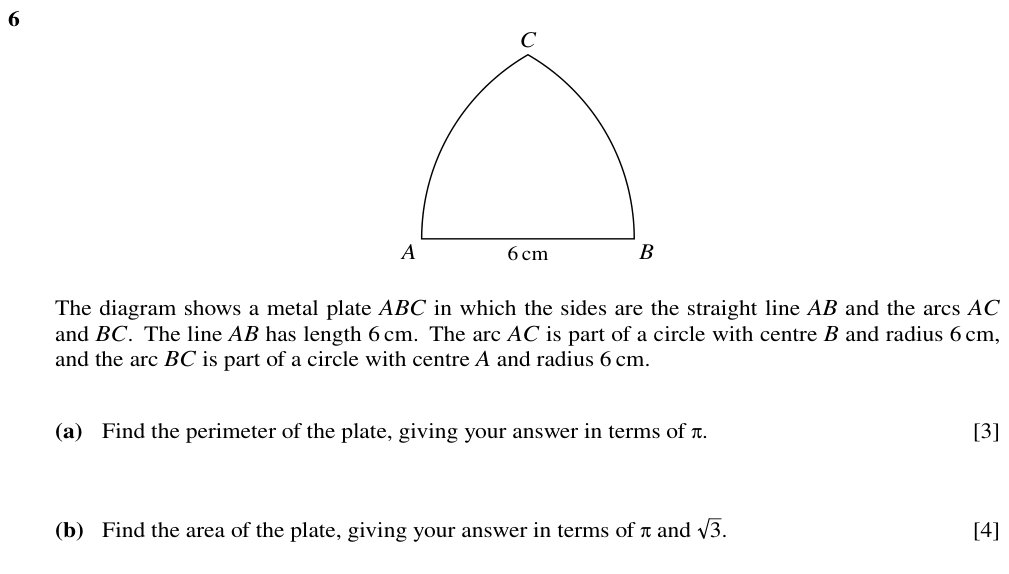
- angle \(\tfrac\pi3\) seen B1
- sector \(\tfrac12\times36\times\tfrac\pi3\) M1
- a correct strategy with values: 2 sectors − triangle, or sector + segment, or triangle + 2 segments M1 A1
- \(12\pi-9\sqrt3\): "must be simplified exact value" A1
- decimals (25.1)
- \(\tfrac12\times\tfrac12\times36\sin\tfrac\pi3\) (half the triangle)
- \(6\pi-9\sqrt3+6\pi\) left unsimplified for the final mark
From: 9709/11/O/N/21 Q6(b) and the November 2021 report.
- Composite shapes: the second half of the circular-measure question most years (5-11 marks).
- M marks for each correct formula with a correct angle and radius; one for a correct overall plan; A marks for 3 s.f. or exact answers.
- Common losses: wrong radius for an arc, wrong angle (degrees, or guessed), premature rounding.
Worked examples
Example 1 · An arc centred at a vertex of a square (Paper 1, 8 marks) ★★ Medium
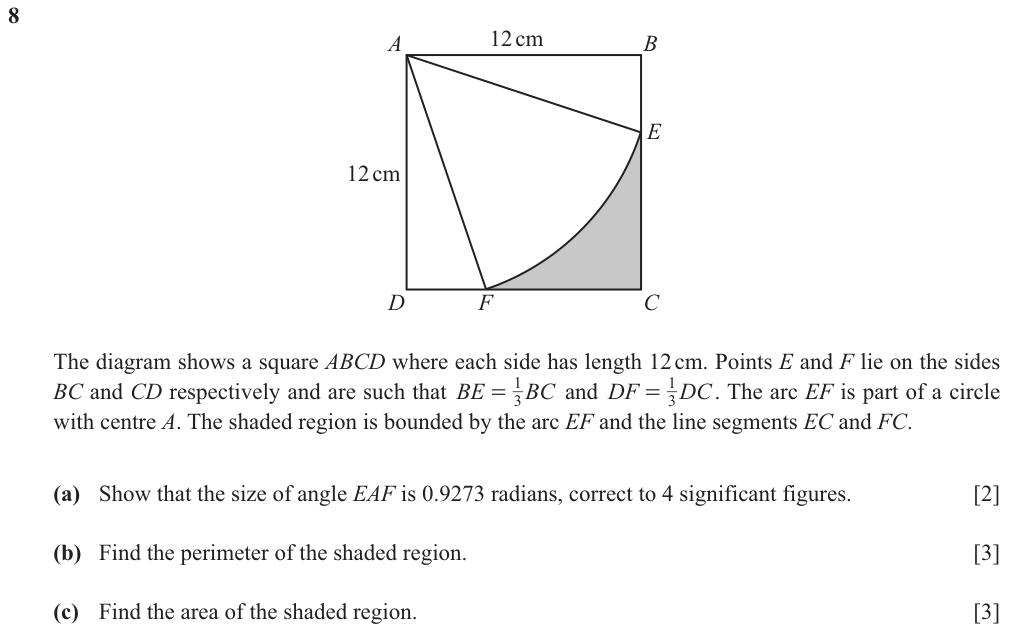
The arc has centre \(A\), so its radius is \(AE\), not 12. Angle \(EAF\) is what is left of the right angle at \(A\) after the two small angles \(BAE\) and \(DAF\). The shaded region is the square minus two triangles minus the sector.
- centre Aradius \(AE=\sqrt{12^2+4^2}\)
- Show that … 4 s.f.show more figures than 0.9273
- (a)angle EAF
- (b)perimeter
- (c)area
- side 12
- BE = DF = 4EC = FC = 8
- (a)angle
- Use\(\tfrac\pi2-2\tan^{-1}\tfrac4{12}\)
- (b)perimeter
- r\(\sqrt{160}\)
- Usearc + 8 + 8
- (c)area
- Use144 − 24 − 24 − ½(160)(0.9273)
- Trapr = 12 (scores M0)
tan⁻¹(4/12) in radians?
0.32175…
Area of triangle ABE?
\(\tfrac12\times12\times4=24\).
5 Now solve it have a go on paper first, then open the worked solution
- (a) \(\tfrac\pi2-2\tan^{-1}\tfrac13=1.570796-0.643501=0.927295\ldots=0.9273\) M1 A1
- (b) \(AE=\sqrt{160}=12.65\) B1; arc \(=12.65\times0.9273=11.73\) M1; perimeter \(=11.73+8+8=27.7\) cm A1
- (c) sector \(=\tfrac12(160)(0.9273)=74.18\) M1; shaded \(=144-24-24-74.18=21.8\) cm² M1 A1
21.8 cm² is about 15% of the square: about right for the small corner region in the diagram.
Example 2 · Two circles: a crescent in terms of r (Paper 1, 9 marks) ★★★ Hard
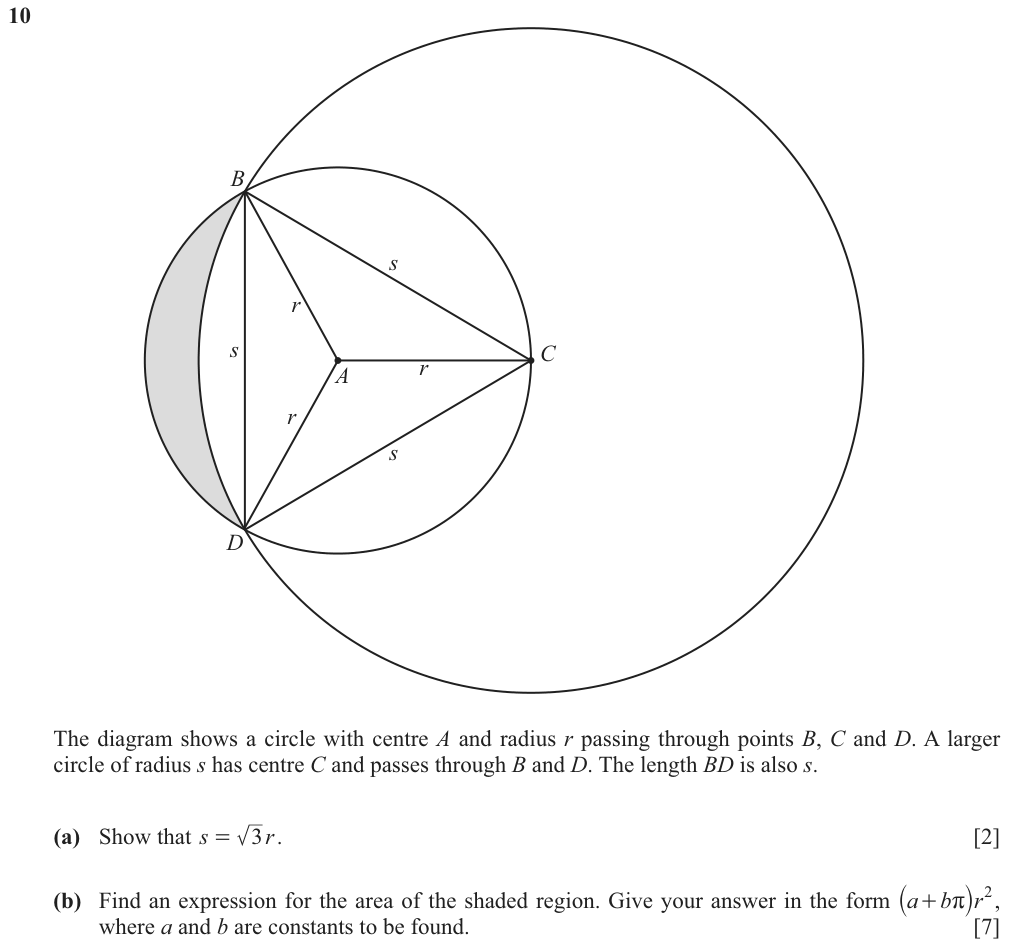
Why it is hard: you have to see the equilateral triangle, find two different centre angles, and organise four areas into one plan.
\(BC=CD=s\) (radii of the big circle) and \(BD=s\): triangle \(BCD\) is equilateral, so \(\angle BCD=\tfrac\pi3\). \(A\) is the centre of the circle through \(B,C,D\), so \(\angle BAD=2\times\tfrac\pi3=\tfrac{2\pi}3\). The shaded crescent is the small circle's segment beyond \(BD\) minus the big circle's segment beyond \(BD\).
- in the form (a + bπ)r²exact: everything in terms of r, special angles
- Show that s = √3ra convincing proof with exact trig values
- (a)s = √3 r
- (b)shaded area
- small circle: centre A, r
- big circle: centre C, s
- BD = s
- (a)s
- Usecosine rule in ABD with angle \(\tfrac{2\pi}3\)
- (b)crescent
- Small seg.\(\tfrac12r^2(\tfrac{2\pi}3-\sin\tfrac{2\pi}3)\)
- Big seg.\(\tfrac12s^2(\tfrac\pi3-\sin\tfrac\pi3)\)
- Shadedsmall − big
Why is angle BAD = 2π/3?
By symmetry \(A\) is the centre of equilateral triangle \(BCD\); the three angles at \(A\) are equal and sum to \(2\pi\).
s² in terms of r?
\(3r^2\).
5 Now solve it have a go on paper first, then open the worked solution
- (a) \(s^2=r^2+r^2-2r^2\cos\tfrac{2\pi}3=3r^2\Rightarrow s=\sqrt3r\) M1 A1
- (b) small segment \(=\tfrac12r^2\left(\tfrac{2\pi}3-\tfrac{\sqrt3}2\right)=\left(\tfrac\pi3-\tfrac{\sqrt3}4\right)r^2\) B1 B1 B1
- big segment \(=\tfrac12(3r^2)\left(\tfrac\pi3-\tfrac{\sqrt3}2\right)=\left(\tfrac\pi2-\tfrac{3\sqrt3}4\right)r^2\) DB1 DB1
- shaded \(=\left(\tfrac\pi3-\tfrac{\sqrt3}4-\tfrac\pi2+\tfrac{3\sqrt3}4\right)r^2=\left(\tfrac{\sqrt3}2-\tfrac\pi6\right)r^2\) B1
\(\tfrac{\sqrt3}2-\tfrac\pi6\approx0.342\), positive and smaller than the small segment (0.614): the crescent is thin ✓.
Example 3 · Arc from the other end of an isosceles triangle (Paper 1, 8 marks) ★★ Medium
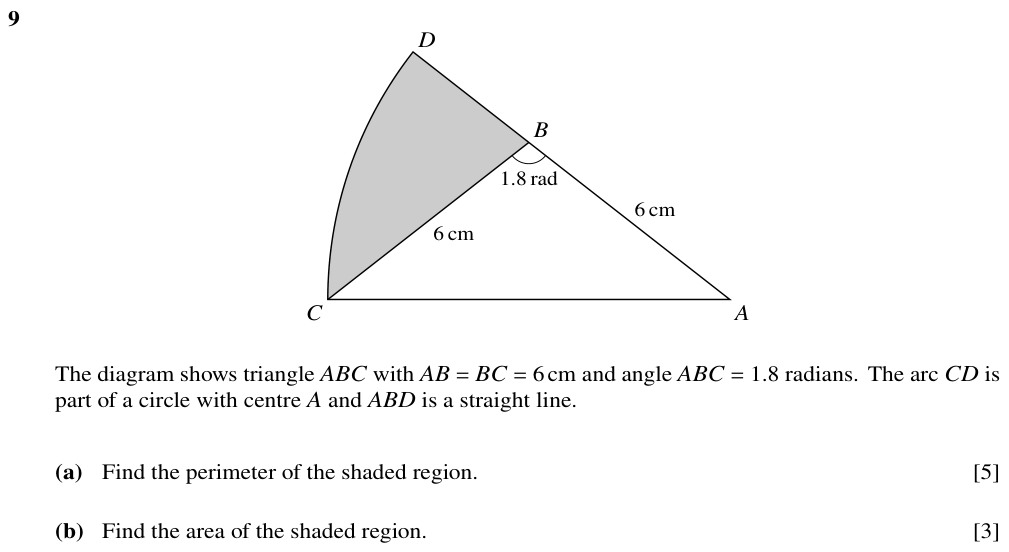
Arc \(CD\) is centred at \(A\), so its radius is \(AC\) and its angle is \(\angle CAB\). Find both from the isosceles triangle. The shaded region is sector \(ACD\) minus triangle \(ABC\).
- centre Aradius AC, angle CAB
- ABD straightBD = AD − AB = AC − 6
- (a)perimeter
- (b)area
- AB = BC = 6
- angle ABC = 1.8
- (a)perimeter
- AC\(2\times6\sin0.9\)
- angle\(\tfrac{\pi-1.8}2\)
- Sumarc CD + BD + BC
- (b)area
- Usesector ACD − triangle ABC
Why 6 sin 0.9?
Drop the perpendicular from B: it halves AC and the 1.8 angle.
Base angle?
\(\tfrac{\pi-1.8}2=0.6708\).
5 Now solve it have a go on paper first, then open the worked solution
- \(AC=12\sin0.9=9.40\) M1 A1; \(\angle CAB=0.6708\) M1
- arc \(CD=9.40\times0.6708=6.306\) M1; perimeter \(=6+3.40+6.306=15.7\) cm A1
- (b) \(\tfrac12(9.40)^2(0.6708)-\tfrac12(36)\sin1.8=29.64-17.53=12.1\) cm² M1 M1 A1
Using 6 for the arc's radius would give a much smaller sector than the triangle: impossible, since the sector contains the triangle.
Summary
- Label centres and radii; write the plan (add/subtract) in words first.
- Angles: tangent ⟂ radius, isosceles base angles (π − θ)/2, cosine rule, equilateral π/3. Never guess from the picture.
- Each arc uses its own radius and angle; straight edges are often differences.
- Store values; 3 s.f. or exact at the end.
| If you see… | think |
|---|---|
| a circle touching lines | radius ⟂ tangent: right-angled triangles |
| three equal lengths | equilateral: π/3 |
| an arc centred elsewhere | radius = distance from THAT centre |
| "in terms of π and √3" | special angles, exact sin/cos |
Can I do this?
- I can plan a shaded area or perimeter as sums and differences of sectors, triangles and segments.
- I can find the angles at the centres using right-angled trig, isosceles triangles, the cosine rule or equilateral triangles.
- I give 3 s.f. or exact answers without premature rounding.
Anything unticked: revise that section first. All ticked: take the quiz.
Quiz
The multiple-choice and guided questions need JavaScript. The concept checks and exam practice below work without it.
Concept checks
Answer each one in your head first, then open it.
1Why is the angle subtended at the centre of an arc the one you need, not an angle elsewhere?Show answer
s = rθ and A = ½r²θ measure θ at the arc's own centre.
2How can you check a composite area answer?Show answer
Compare with an obvious bound: it must be less than the surrounding square/sector, more than an inscribed piece.
3When should you use \(\tfrac12ab\sin C\) instead of \(\tfrac12bh\)?Show answer
Whenever two sides and the included angle are known: one step, no extra rounding (the reports say it was more accurate).
Exam-style practice
New questions, not used above. Do them on paper, then mark your work against the official mark scheme.
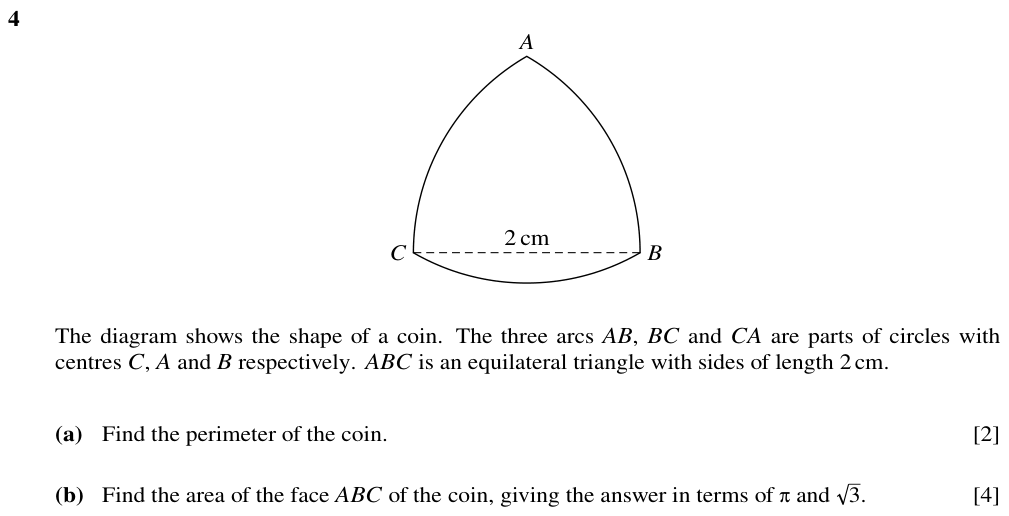
Show the mark scheme
| Part | Answer / working | Marks | Guidance |
|---|---|---|---|
| (a) | each arc \(2\times\tfrac\pi3\) | B1 | |
| perimeter \(=2\pi\) cm | B1 | ||
| (b) | sector \(\tfrac12(4)\tfrac\pi3=\tfrac{2\pi}3\) | B1 | |
| triangle \(\tfrac12(4)\sin\tfrac\pi3=\sqrt3\) | B1 | ||
| a correct plan: triangle + 3 segments, or 3 sectors − 2 triangles | M1 | ||
| \(2\pi-2\sqrt3\) cm² | A1 | exact, simplified | |
| Total: 6 marks | |||
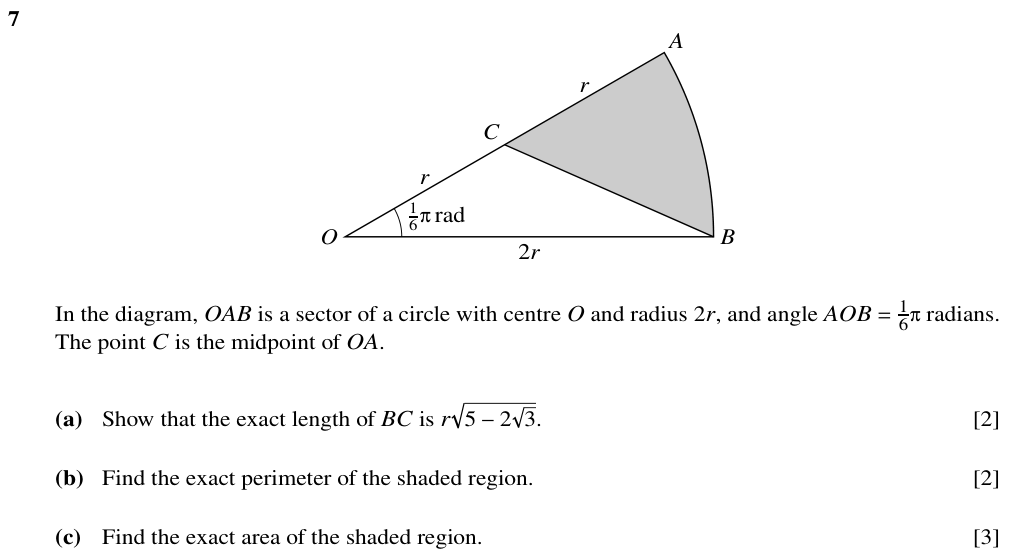
Show the mark scheme
| Part | Answer / working | Marks | Guidance |
|---|---|---|---|
| (a) | \(BC^2=r^2+(2r)^2-2(r)(2r)\cos\tfrac\pi6\) | M1 | cosine rule |
| \(=5r^2-2\sqrt3r^2\Rightarrow BC=r\sqrt{5-2\sqrt3}\) | A1 | given answer: every step seen | |
| (b) | arc \(=2r\times\tfrac\pi6=\tfrac{\pi r}3\) | M1 | |
| \(\tfrac{\pi r}3+r+r\sqrt{5-2\sqrt3}\) | A1 | ||
| (c) | sector \(\tfrac12(2r)^2\tfrac\pi6\) | M1 | |
| triangle \(\tfrac12(r)(2r)\sin\tfrac\pi6\) | M1 | ||
| \(r^2\left(\tfrac\pi3-\tfrac12\right)\) | A1 | exact | |
| Total: 7 marks | |||
Your progress on this note is saved when JavaScript is on.