
Circular Measure
Radians, arc length, sectors and segments
What you need to be able to do
- 1.4Understand the radian and convert between radians and degrees; know the common angles as multiples of \(\pi\).
- 1.4Use \(s=r\theta\) and \(A=\tfrac12r^2\theta\) (\(\theta\) in radians) for arcs, sectors and perimeters.
- 1.4Combine them with triangles: chord length, triangle area \(\tfrac12ab\sin C\), segment area; find \(r\) and \(\theta\) from given facts; give exact answers when asked.
You need: right-angled trigonometry, the sine and cosine rules and \(\tfrac12ab\sin C\) (IGCSE / O Level). Next: Composite shapes.
What a radian is, why arc and sector formulas look the way they do, and how to use them with triangles, with our own examples. Past-paper questions come in Part 2.
What you should already know
Circumference and area
A circle of radius \(r\): circumference \(2\pi r\), area \(\pi r^2\).
Quick check: circumference and area when \(r=3\)?
\(6\pi\) and \(9\pi\)
Sectors in degrees
A sector with angle \(\theta°\) is the fraction \(\tfrac{\theta}{360}\) of the circle: arc \(=\tfrac\theta{360}\times2\pi r\), area \(=\tfrac\theta{360}\times\pi r^2\).
Quick check: area of a 90° sector, \(r=4\)?
\(\tfrac14\times16\pi=4\pi\)
Area of a triangle
\(\tfrac12ab\sin C\): two sides and the angle between them.
Quick check: area with sides 6, 5 and included angle 30°?
\(\tfrac12(6)(5)(\tfrac12)=7.5\)
Sine and cosine rules
\(a^2=b^2+c^2-2bc\cos A\); \(\tfrac a{\sin A}=\tfrac b{\sin B}\). Right-angled triangles: SOH CAH TOA.
Quick check: third side when \(b=c=5\), \(A=60°\)?
\(a^2=25+25-25=25\): \(a=5\) (equilateral)
The radian
- One radian is the angle at the centre of a circle that cuts off an arc equal in length to the radius.
- The whole circumference is \(2\pi r\), i.e. \(2\pi\) radii, so a full turn is \(2\pi\) rad: \(\pi\) rad = 180°.
- Degrees → radians: \(\times\dfrac{\pi}{180}\). Radians → degrees: \(\times\dfrac{180}{\pi}\).
- In this topic your calculator must be in radian mode (sin 1.2 means 1.2 rad).
Why another unit? 360 is an arbitrary number (it divides nicely, that's all). The radian measures an angle by the circle itself: how many radii of arc it cuts off. With that choice the formulas lose their \(\tfrac{\theta}{360}\) clutter, and later in the course calculus of \(\sin x\) only works neatly in radians.
| Degrees | 30° | 45° | 60° | 90° | 120° | 135° | 150° | 180° | 270° | 360° |
|---|---|---|---|---|---|---|---|---|---|---|
| Radians | \(\tfrac\pi6\) | \(\tfrac\pi4\) | \(\tfrac\pi3\) | \(\tfrac\pi2\) | \(\tfrac{2\pi}3\) | \(\tfrac{3\pi}4\) | \(\tfrac{5\pi}6\) | \(\pi\) | \(\tfrac{3\pi}2\) | \(2\pi\) |
- Convert \(75°\) and \(210°\) to radians.
Answer
\(\tfrac{5\pi}{12}\) and \(\tfrac{7\pi}6\) - Convert \(2.5\) rad and \(\tfrac{5\pi}9\) rad to degrees.
Answer
\(143.2°\) and \(100°\)
Arc length and sector area
- Arc length \(s=r\theta\): the arc is the fraction \(\tfrac{\theta}{2\pi}\) of \(2\pi r\).
- Sector area \(A=\tfrac12r^2\theta\): the fraction \(\tfrac{\theta}{2\pi}\) of \(\pi r^2\).
- Perimeter of a sector \(=2r+r\theta\) (two radii + the arc).
- Triangle \(OAB\): area \(\tfrac12r^2\sin\theta\); chord \(AB=2r\sin\tfrac\theta2\) (or the cosine rule \(AB^2=2r^2-2r^2\cos\theta\)).
- Segment = sector − triangle \(=\tfrac12r^2(\theta-\sin\theta)\).
Where the formulas come from. A sector with angle \(\theta\) radians is the fraction \(\tfrac{\theta}{2\pi}\) of the whole circle. Its arc is \(\tfrac{\theta}{2\pi}\times2\pi r=r\theta\), and its area is \(\tfrac{\theta}{2\pi}\times\pi r^2=\tfrac12r^2\theta\). They are the degree formulas with \(360°\) replaced by \(2\pi\).
Example. \(r=5\) cm, \(\theta=1.2\) rad. Arc \(=5\times1.2=6\) cm; area \(=\tfrac12(25)(1.2)=15\) cm²; perimeter \(=5+5+6=16\) cm. The chord: \(2\times5\sin0.6=5.65\) cm; triangle \(\tfrac12(25)\sin1.2=11.65\) cm²; segment \(=15-11.65=3.35\) cm².
Radians only
\(s=r\theta\) and \(A=\tfrac12r^2\theta\) are only true with \(\theta\) in radians. Degrees work with \(\tfrac{\theta}{360}\times2\pi r\), but converting back and forth loses accuracy. Don't mix the two in one formula.
Major sector / segment
The reflex angle is \(2\pi-\theta\). Major segment = major sector + triangle (the triangle is on the other side of the chord).
Accuracy
Final answers to 3 s.f.; keep 4+ s.f. (or the calculator memory) in every intermediate step. For "show that \(\theta=0.9273\)", show a value with more figures (0.92729…) first.
Exact answers
"Exact" = in terms of \(\pi\) and surds, e.g. \(\tfrac{32\pi}3+4\sqrt3\). Use the exact trig values: \(\sin\tfrac\pi3=\tfrac{\sqrt3}2\). "Like terms must be collected."
- A sector has \(r=8\) cm and \(\theta=0.9\) rad. Find its arc length, area and perimeter.
Answer
\(7.2\) cm, \(28.8\) cm², \(23.2\) cm - Find the exact area of the segment cut off by a chord subtending \(\tfrac\pi3\) in a circle of radius 4.
Answer
\(\tfrac12(16)\left(\tfrac\pi3-\tfrac{\sqrt3}2\right)=\tfrac{8\pi}3-4\sqrt3\)
Case by case
1 Two facts give r and θ
A sector has arc length 6 cm and area 24 cm². Find \(r\) and \(\theta\).
Askedr and θKnowrθ = 6 and ½r²θ = 24Routedivide: ½r = 24/6
- \(\dfrac{\tfrac12r^2\theta}{r\theta}=\dfrac{24}{6}\Rightarrow\tfrac12r=4\Rightarrow r=8\)
- \(\theta=\tfrac{6}{8}=0.75\)
2 A reflex sector: reject a root
A reflex sector has perimeter 40 cm and area 75 cm². Find \(r\) and \(\theta\).
Askedr and θKnow2r + rθ = 40, ½r²θ = 75Routerθ = 40 − 2r into the area: a quadratic in r
- \(\tfrac12r(40-2r)=75\Rightarrow r^2-20r+75=0\Rightarrow(r-5)(r-15)=0\)
- \(r=5\Rightarrow\theta=\tfrac{30}{5}=6\) (reflex: between π and 2π ✓); \(r=15\Rightarrow\theta=\tfrac{10}{15}=\tfrac23\) (not reflex: reject)
3 Exact angle from a chord
A chord of length \(6\sqrt2\) in a circle of radius 6 subtends \(\theta\) at the centre. Find \(\theta\) exactly.
Askedexact θKnowisosceles triangle, half-chord 3√2Routesin(θ/2) = 3√2 / 6
- \(\sin\tfrac\theta2=\tfrac{3\sqrt2}{6}=\tfrac{\sqrt2}2\Rightarrow\tfrac\theta2=\tfrac\pi4\)
- \(\theta=\tfrac{\pi}{2}\)
4 Segment perimeter
A sector has arc 9 cm and perimeter 21 cm. Find the perimeter of the segment.
Askedarc + chordKnow2r + 9 = 21Router, then θ = 9/r, then the chord
- \(r=6\), \(\theta=\tfrac96=1.5\)
- chord \(=2\times6\sin0.75=8.18\)
- Perimeter \(=9+8.18=17.2\) cm
θ = 1.5 rad is not π/3, so the triangle is NOT equilateral: work the angle out, never read it off the diagram.
Key facts at a glance
- 1 radian: the arc equals the radius. \(\pi\) rad \(=180°\).
- Arc \(s=r\theta\); sector \(A=\tfrac12r^2\theta\); perimeter \(2r+r\theta\) (\(\theta\) in radians).
- Triangle \(\tfrac12r^2\sin\theta\); chord \(2r\sin\tfrac\theta2\); segment \(\tfrac12r^2(\theta-\sin\theta)\).
- Calculator in radian mode; keep 4+ s.f. until the end; exact = \(\pi\) and surds.
How circular measure is examined, what the mark scheme wants, then real Paper 1 questions worked through slowly.
How this is examined
One circular-measure question on every Paper 1 (5-8 marks), almost always a shaded region. The reports say candidates who converted to degrees "often lost accuracy", and the November 2022 report asked candidates to "evaluate angles rather than guess them by looking at the diagram" after many assumed a triangle was equilateral. "Exact" answers need like terms collected.
Mark-scheme focus
Show that … is approximately … (a given answer)
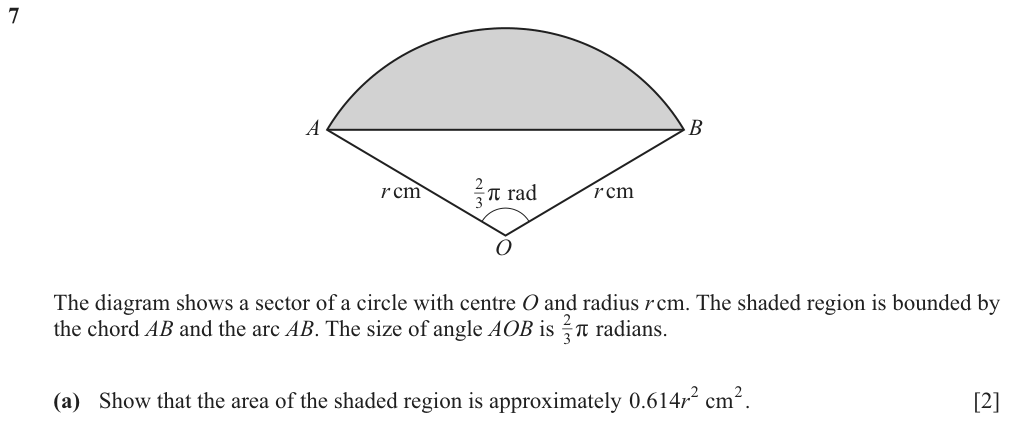
- \(\tfrac12r^2\left(\tfrac{2\pi}3\right)-\tfrac12r^2\sin\tfrac{2\pi}3\), sector minus triangle, written out M1
- \(=0.61418\ldots r^2\approx0.614r^2\), more accurate than the given value {A1 AG}
- \(\tfrac12r^2(\theta-\sin\theta)=0.614r^2\) with no evaluation shown
- \(\sin\tfrac{2\pi}3\) worked out in degrees (\(\sin120\) is fine; \(\sin2.09\) on a degree calculator is not)
- working backwards from 0.614
With a given answer (AG) every step must be seen, and the number you reach should be more accurate than the one printed (0.61418…), so the examiner can see you did not copy it.
From: 9709/11/O/N/25 Q7(a).
- One circular-measure question per paper: 4-10 marks, nearly always with a triangle.
- Typical split: M1 for each correct formula used with the right angle, A1 for each 3 s.f. or exact answer.
- Lost marks: premature rounding, degrees in rθ, guessing an angle from the picture.
Worked examples
Example 1 · Arc and area given: segment area and perimeter (Paper 1, 7 marks) ★ Easy
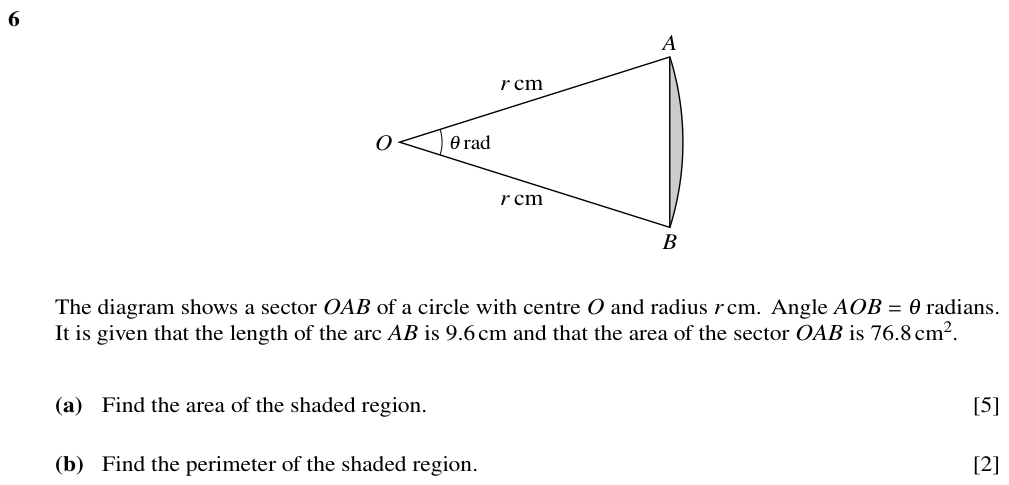
The shaded part is the segment: sector minus triangle. We don't know \(r\) or \(\theta\), but two facts (arc, area) give both.
- shaded regionthe segment between chord AB and the arc
- θ radiansuse s = rθ and A = ½r²θ directly
- (a)segment area
- (b)segment perimeter
- arc 9.6rθ
- area 76.8½r²θ
- (a)segment
- r, θdivide the two equations
- Use76.8 − ½r² sin θ
- (b)perimeter
- Usearc + chord, chord = 2r sin(θ/2)
½r²θ ÷ rθ = ?
\(\tfrac12r\): so \(\tfrac12r=8\), \(r=16\).
Triangle area?
\(\tfrac12\times256\times\sin0.6=72.27\).
5 Now solve it have a go on paper first, then open the worked solution
- \(\tfrac12r=\tfrac{76.8}{9.6}=8\Rightarrow r=16\) M1 A1; \(\theta=0.6\) A1
- triangle \(=\tfrac12\times16^2\times\sin0.6=72.27\) M1
- segment \(=76.8-72.27=4.53\) cm² A1
- (b) \(AB=2\times16\sin0.3=9.46\) M1; perimeter \(=9.6+9.46=19.1\) cm A1
The segment (4.53) is a small part of the sector (76.8), as the thin sliver in the diagram suggests ✓.
Example 2 · Perimeter and area of a reflex sector (Paper 1, 6 marks) ★★ Medium
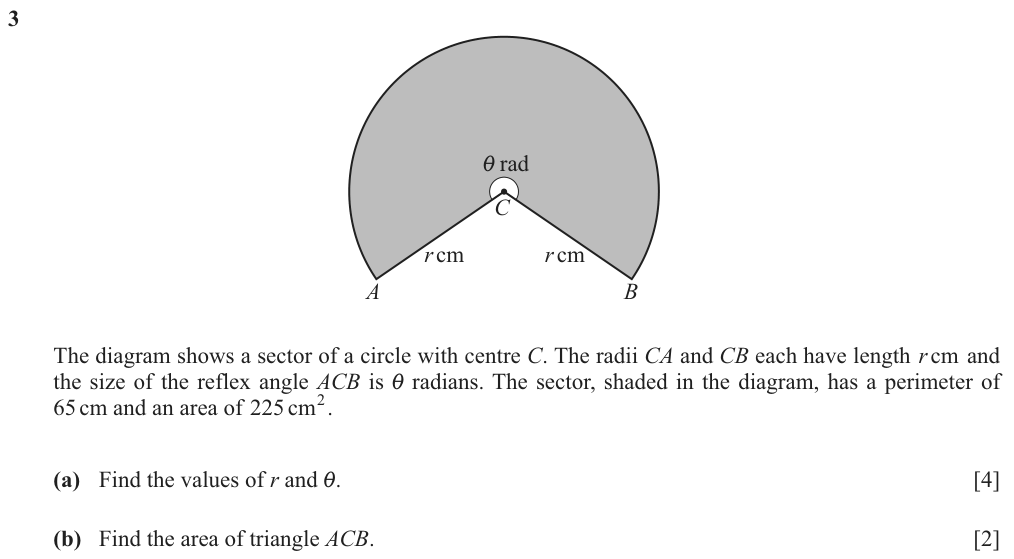
Two equations in \(r\) and \(\theta\). Make \(r\theta\) the subject of the perimeter equation and substitute: you get a quadratic in \(r\). Two roots, but the angle must be reflex.
- reflex angleθ > π
- triangle ACBuses the non-reflex angle 2π − θ
- (a)r, θ
- (b)triangle
- 2r + rθ = 65
- ½r²θ = 225
- (a)r, θ
- Use\(2r^2-65r+450=0\)
- Trapkeeping r = 22.5, θ = 8/9
- (b)triangle
- Use\(\tfrac12r^2\sin(2\pi-4.5)\)
Factorise 2r² − 65r + 450.
\((2r-45)(r-10)\).
Is 8/9 rad reflex?
No: 0.89 < π.
5 Now solve it have a go on paper first, then open the worked solution
- \(2r+r\theta=65\), \(\tfrac12r^2\theta=225\) B1
- \(\tfrac12r(65-2r)=225\) *M1 \(\Rightarrow(2r-45)(r-10)=0\) DM1
- \(r=10,\ \theta=4.5\) A1
- (b) \(\tfrac12\times10^2\times\sin(2\pi-4.5)\) M1 \(=48.9\) cm² A1
Perimeter \(20+45=65\) ✓; area \(\tfrac12(100)(4.5)=225\) ✓.
Example 3 · Two triangle facts: exact segment, then a 3 s.f. one (Paper 1, 8 marks) ★★★ Hard
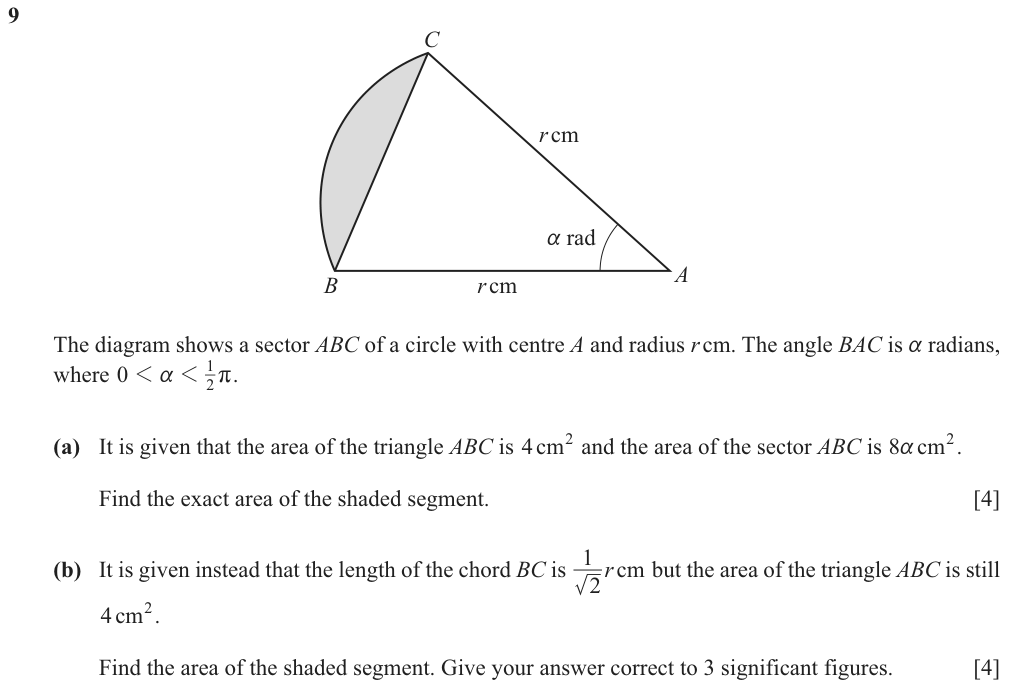
Why it is hard: two different routes to the angle, and (b) has to be recognised as a cosine-rule start.
(a): the sector area \(\tfrac12r^2\alpha=8\alpha\) gives \(r\) straight away; the triangle area then gives \(\sin\alpha\). (b) is a fresh start: the chord and the cosine rule give \(\cos\alpha\) without knowing \(r\).
- exactα will be a special angle (π/6)
- given instead(a)'s r and α no longer apply
- (a)exact segment
- (b)segment to 3 s.f.
- ½r²α = 8α(a)
- ½r² sin α = 4both
- BC = r/√2(b)
- (a)segment
- rr² = 16
- α\(8\sin\alpha=4\)
- (b)segment
- Cosine rule\(\tfrac{r^2}2=2r^2-2r^2\cos\alpha\Rightarrow\cos\alpha=\tfrac34\)
- r²from \(\tfrac12r^2\sin\alpha=4\)
In (b), why does r cancel?
Every term in the cosine rule has \(r^2\).
sin α when cos α = 3/4?
\(\tfrac{\sqrt7}{4}\approx0.661\).
5 Now solve it have a go on paper first, then open the worked solution
- (a) \(\tfrac12r^2\alpha=8\alpha\Rightarrow r=4\) B1; \(\tfrac12(16)\sin\alpha=4\Rightarrow\alpha=\tfrac\pi6\) B1
- segment \(=8\alpha-4=\tfrac{4\pi}3-4\) M1 A1
- (b) \(\tfrac12r^2=2r^2-2r^2\cos\alpha\Rightarrow\cos\alpha=\tfrac34\), \(\alpha=0.7227\) *M1
- \(\tfrac12r^2\sin\alpha=4\Rightarrow r^2=12.10\), \(r=3.478\) DM1 A1
- segment \(=\tfrac12(12.10)(0.7227-0.6614)=0.371\) cm² A1
Scheme: "Fraction must be simplified. Allow \(\tfrac{4\pi-12}{3}\)."
(a): 4π/3 − 4 ≈ 0.19 > 0 ✓, small as a thin segment should be.
Summary
- \(\pi\) rad = 180°; radian mode.
- \(s=r\theta\), \(A=\tfrac12r^2\theta\), triangle \(\tfrac12r^2\sin\theta\), segment \(\tfrac12r^2(\theta-\sin\theta)\).
- Chord \(2r\sin\tfrac\theta2\). Reflex/major: \(2\pi-\theta\).
- 3 s.f. answers from 4+ s.f. working; exact when asked.
| If you see… | do this |
|---|---|
| arc and area both given | divide them: \(\tfrac12r\) |
| perimeter and area given | substitute rθ: quadratic in r; check the angle |
| "segment" | sector − triangle |
| "exact" | special angles, π and surds; no decimals |
| "show that θ = 0.9273" | show more figures first; work in radians |
Can I do this?
- I can convert between radians and degrees and know the common angles in radians.
- I can use s = rθ, A = ½r²θ, the triangle area and the chord length.
- I can find a segment (minor or major) area and perimeter.
- I can find r and θ from two given facts, rejecting impossible roots.
- I keep accuracy and give exact answers when asked.
Anything unticked: revise that section first. All ticked: take the quiz.
Quiz
The multiple-choice and guided questions need JavaScript. The concept checks and exam practice below work without it.
Concept checks
Answer each one in your head first, then open it.
1Why is \(A=\tfrac12r^2\theta\) only true in radians?Show answer
It comes from \(\tfrac{\theta}{2\pi}\times\pi r^2\): the \(2\pi\) means a full turn measured in radians.
2Which is bigger, the arc or the chord?Show answer
The arc: the chord is the straight (shortest) path between its ends.
3How do you get the major segment area?Show answer
Whole circle − minor segment, or major sector (\(2\pi-\theta\)) + triangle.
Exam-style practice
New questions, not used above. Do them on paper, then mark your work against the official mark scheme.
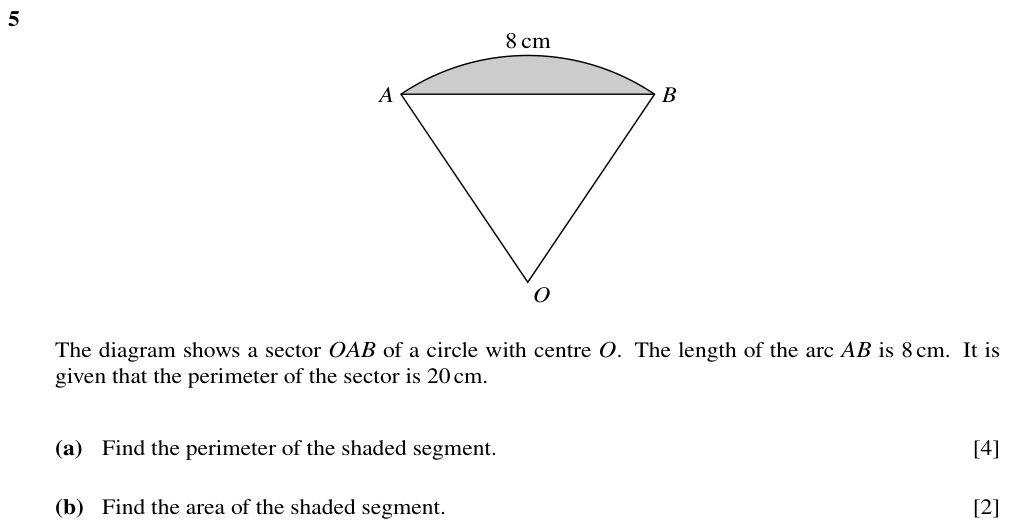
Show the mark scheme
| Part | Answer / working | Marks | Guidance |
|---|---|---|---|
| (a) | \(r=6\) | B1 | |
| \(\theta=\tfrac86=\tfrac43\) | *M1 | ||
| \(AB=2\times6\sin\tfrac23=7.42\) | DM1 | or the cosine rule | |
| perimeter \(=8+7.42=15.4\) cm | A1 | ||
| (b) | \(\tfrac12(36)\tfrac43-\tfrac12(36)\sin\tfrac43\) | M1 | sector minus triangle |
| \(24-17.49=6.51\) cm² | A1 | ||
| Total: 6 marks | |||
Examiner tip Don't assume the triangle is equilateral from the picture: work the angle out (4/3 rad is not π/3).
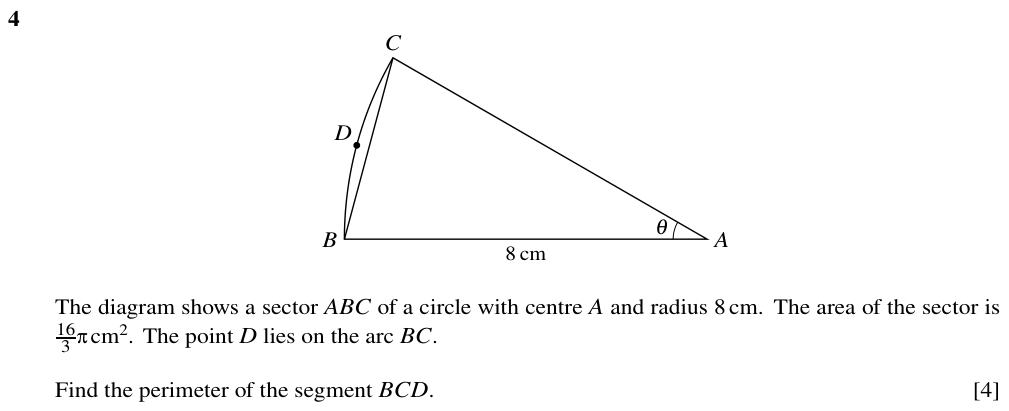
Show the mark scheme
| Part | Answer / working | Marks | Guidance |
|---|---|---|---|
| \(\tfrac12(64)\theta=\tfrac{16\pi}3\Rightarrow\theta=\tfrac\pi6\) | B1 | ||
| arc \(=8\times\tfrac\pi6\) | M1 | ||
| \(BC=2\times8\sin\tfrac{\pi}{12}=4.141\) | M1 | or the cosine rule | |
| perimeter \(=8.33\) cm | A1 | ||
| Total: 4 marks | |||
Your progress on this note is saved when JavaScript is on.