
Quadratics
Where a line meets a curve: intersections, tangents and the discriminant
On this page
- What you need to be able to do
- What you should already know
- What "where they meet" means
- Solving a linear and a quadratic equation together
- Intersect, touch or miss: the discriminant again
- Case by case
- Tangents: the calculus route
- Key facts at a glance
- How this is examined
- Mark-scheme focus
- Worked examples
- Summary
- Can I do this?
- Quiz
What you need to be able to do
- 1.1Solve by substitution a pair of simultaneous equations of which one is linear and one is quadratic.
- 1.3Use the link between points of intersection and the roots of an equation: find the set of values of \(k\) for which a line intersects, touches or does not meet a curve.
- 1.3Find a tangent (the value of the constant and the point of contact), and prove that a line meets a curve for all values of a constant.
Before you start: The discriminant and Quadratic inequalities. The same method works for lines and circles: see Coordinate geometry.
What it means for a line to meet a curve, how to find the meeting points, and how the discriminant counts them, with our own examples. Past-paper questions come in Part 2.
What you should already know
Simultaneous linear equations
Two equations, two unknowns: make one letter the subject of one equation and substitute into the other. \(y=x+1\) and \(2x+y=7\): \(2x+x+1=7\Rightarrow x=2,\ y=3\).
Quick check: solve \(y=3x-1,\ x+y=7\)
\(4x-1=7\Rightarrow x=2,\ y=5\)
Solving a quadratic
Factorise, complete the square or use the formula: Solving quadratic equations.
Quick check: solve \(x^2-x-12=0\)
\((x-4)(x+3)=0\): \(x=4,\ -3\)
The discriminant
\(b^2-4ac>0\): two roots; \(=0\): one repeated root; \(<0\): none (previous pages).
Quick check: how many roots has \(x^2+2x+5=0\)?
\(4-20<0\): none
A point lies on a graph
A point is on a graph exactly when its coordinates satisfy the equation. \((2,\,7)\) is on \(y=x^2+3\) because \(2^2+3=7\).
Quick check: is \((-1,\,4)\) on \(y=x^2+3\)?
\((-1)^2+3=4\): yes
What "where they meet" means
A meeting point of a line and a curve lies on both graphs, so its coordinates satisfy both equations at once. Finding the meeting points is therefore the same as solving the two equations simultaneously.
When you substitute the line into the curve you get one equation in \(x\). Each root of that equation is the \(x\)-coordinate of a meeting point. That single fact explains everything on this page: two roots means two meeting points, a repeated root means the line just touches (a tangent), no real roots means the line misses the curve.
Solving a linear and a quadratic equation together
The points where a line and a curve meet satisfy both equations. Make one letter the subject of the linear equation, substitute into the quadratic one, and you get a quadratic in a single letter.
- Rearrange the linear equation for the letter that is easiest to substitute (no fractions if possible).
- Substitute into the other equation, with brackets round the whole expression: \(x(3-x)+(3-x)^2\), not \(x\cdot3-x+3-x^2\).
- Expand and collect to a 3-term quadratic \(=0\).
- Solve it.
- Find the other coordinate from the linear equation (quicker and safer than the quadratic), and pair the values: \((x_1,\ y_1)\) and \((x_2,\ y_2)\).
Example. Find where the line \(y=2x-2\) meets the curve \(y=x^2-3x+4\).
- The line already gives \(y\). Substitute: \(x^2-3x+4=2x-2\)
- Collect: \(x^2-5x+6=0\Rightarrow(x-2)(x-3)=0\), so \(x=2\) or \(x=3\)
- From the line: \(x=2\Rightarrow y=2\); \(x=3\Rightarrow y=4\)
- Meeting points \((2,\,2)\) and \((3,\,4)\). Check in the curve: \(9-9+4=4\) ✓
Example where the curve is not \(y=\dots\): solve \(x+y=3\) and \(x^2+xy+y^2=7\). From the line \(y=3-x\): \(x^2+x(3-x)+(3-x)^2=7\Rightarrow x^2-3x+2=0\), so \(x=1,\ y=2\) or \(x=2,\ y=1\).
Which letter to eliminate? The one the line gives most simply. If the curve is written \(y=\dots\), eliminate \(y\): substituting \(x\) instead usually creates fractions and a much messier quadratic.
- Find where \(y=x+3\) meets \(y=x^2+1\).
Answer
\(x^2-x-2=0\): \(x=2,\ -1\); points \((2,\,5)\) and \((-1,\,2)\) - Solve \(y=2x+1\) and \(x^2+y^2=2\).
Answer
\(5x^2+4x-1=0\Rightarrow(5x-1)(x+1)=0\): \(\left(\tfrac15,\tfrac75\right)\) and \((-1,-1)\)
Intersect, touch or miss: the discriminant again
- Equate the curve and the line and rearrange to \(ax^2+bx+c=0\). Each root is the \(x\)-coordinate of a meeting point.
- Two distinct points (cuts the curve): \(b^2-4ac>0\).
- One point, a tangent (touches): \(b^2-4ac=0\). The repeated root is the point of contact.
- Does not meet: \(b^2-4ac<0\).
- Meets / intersects (at least once): \(b^2-4ac\ge0\).
So every "set of values of \(k\)" question is the same three-stage job: form the quadratic (equate and collect, with \(k\) in the coefficients) → apply the condition → solve the inequality in \(k\). The first stage is where most slips happen: move every term to one side and keep the signs.
Case by case
1 Two distinct points: set of k
Line \(y=2x+k\), curve \(y=x^2+kx+5\). Find the values of \(k\) for which they meet at two distinct points.
Askedset of kKnowk in both equationsRouteequate, collect, D > 0, outside
- \(x^2+(k-2)x+(5-k)=0\)
- \((k-2)^2-4(5-k)>0\Rightarrow k^2-4k+4-20+4k>0\Rightarrow k^2-16>0\)
- \((k+4)(k-4)>0\Rightarrow\mathbf{k<-4,\ k>4}\)
2 Does not meet: set of k
Curve \(y=kx^2+3x-k\), line \(y=kx-3\). Find the values of \(k\) for which they do not intersect.
Askedset of kKnowk in a, b and cRouteD < 0, between
- \(kx^2+(3-k)x+(3-k)=0\)
- \((3-k)^2-4k(3-k)<0\Rightarrow(3-k)(3-5k)<0\)
- \(\mathbf{\tfrac35<k<3}\)
Factor out (3 − k) instead of expanding: (3 − k)[(3 − k) − 4k]. Less algebra, fewer slips.
3 Tangent: the constant and the point
\(y=mx-3\) is a tangent to \(y=x^2+2x+1\). Find \(m\) and the points of contact.
Askedm and (x, y)Knowtangent: one repeated rootRouteD = 0 gives m; put each m back to get x, then y
- \(x^2+(2-m)x+4=0\); \((2-m)^2-16=0\Rightarrow2-m=\pm4\)
- \(m=6\): \(x^2-4x+4=0\Rightarrow x=2,\ y=9\)
- \(m=-2\): \(x^2+4x+4=0\Rightarrow x=-2,\ y=1\)
Each value of m gives its own tangent and its own point of contact. Pair them up.
4 Meet for all values of k
Show that \(y=x+k\) and \(y=x^2+kx\) meet for all values of \(k\).
Askeda proofKnowthe discriminant will be an expression in kRouteshow D ≥ 0 whatever k is, and say so
- \(x^2+(k-1)x-k=0\)
- \(b^2-4ac=(k-1)^2+4k=k^2+2k+1=(k+1)^2\)
- \((k+1)^2\ge0\) for all \(k\), so the line and curve meet for all values of \(k\)
Finding the perfect square is not the end: say what it means. A square is never negative, so D ≥ 0, so the line always meets the curve.
5 Two distinct points for all values of m
Show that \(y=x^2+m(x+1)\) and \(y=x+3\) meet at two distinct points for all \(m\).
Askeda proofKnowD is a quadratic in m that doesn't factoriseRoutecomplete the square on D, show it is always positive
- \(x^2+(m-1)x+(m-3)=0\)
- \(b^2-4ac=(m-1)^2-4(m-3)=m^2-6m+13=(m-3)^2+4\)
- \((m-3)^2+4>0\) for all \(m\), so \(b^2-4ac>0\): two distinct points for all values of m
"For all m" means you cannot pick a value of m or solve D = 0. Complete the square on D to show it can never be zero or negative.
Tangents: the calculus route
For a tangent to \(y=f(x)\) there is a second method (on Paper 1 once you know differentiation): the gradient of the curve at the point of contact equals the gradient of the line. Both methods are correct.
Both methods on one question: \(y=mx+1\) is a tangent to \(y=x^2-2x+5\). Find \(m\) and the points of contact.
Method 1: discriminant = 0
- \(x^2-2x+5=mx+1\Rightarrow x^2-(2+m)x+4=0\)
- Tangent: \((2+m)^2-4(1)(4)=0\Rightarrow(2+m)^2=16\)
- \(m=2\) or \(m=-6\)
- Substitute each m back: \(x^2-4x+4=0\Rightarrow x=2\); \(x^2+4x+4=0\Rightarrow x=-2\). Then \(y\) from the line: \((2,5)\), \((-2,13)\)
Works for any curve whose equation gives a quadratic, including circles and xy = k.
Method 2: gradients equal
- \(\dfrac{dy}{dx}=2x-2\), and the line's gradient is \(m\): \(2x-2=m\)
- At the contact point the line and curve also meet: \(x^2-2x+5=(2x-2)x+1\)
- \(x^2-2x+5=2x^2-2x+1\Rightarrow x^2=4\Rightarrow x=\pm2\)
- \(x=2\): \(m=2,\ y=5\); \(x=-2\): \(m=-6,\ y=13\)
Often the more direct route: the quadratic you solve (here x² = 4) is simpler.
- Find \(k\) for which \(y=x+k\) is a tangent to \(y=x^2-3x+5\), and the point of contact.
Answer
\(x^2-4x+5-k=0\); \(16-4(5-k)=0\Rightarrow k=1\); \(x=2,\ y=3\) - Find the set of values of \(k\) for which \(y=kx-1\) does not meet \(y=x^2+3\).
Answer
\(x^2-kx+4=0\); \(k^2-16<0\): \(-4<k<4\)
Key facts at a glance
- Meeting points satisfy both equations: substitute the line into the curve.
- Each root of the resulting quadratic is the \(x\)-coordinate of a meeting point; find \(y\) from the line.
- \(b^2-4ac>0\) cuts twice; \(=0\) tangent (touches); \(<0\) misses; \(\ge0\) meets.
- Tangent questions: \(D=0\) gives the constant, the repeated root gives the point.
- "For all values of \(k\)": show \(D\) is a square (\(\ge0\)) or a completed square plus a positive (\(>0\)), and say so.
How lines and curves are examined, what the mark scheme wants, then real Paper 1 questions worked through slowly.
How this is examined
Some 14 questions since 2020 ask for the set of \(k\) for which a line meets, touches or misses a curve (3-7 marks), and about 6 more for a tangent's constant and point of contact. The marks: M1 for substituting to form the quadratic, DM1 for collecting it to \(=0\) and using \(b^2-4ac\), A1 A1 for the values. The November 2021 report: "sign errors were common, leading to the wrong quadratic equation".
"Show that ... for all values of \(k\)": the March 2023 report found the perfect square often appeared, but "the correct interpretation of this was rarely seen"; the November 2020 report praised candidates who "realised the need to use completing the square ... and were then able to explain". The June 2021 report noted that the differentiation route to a tangent "resulted in a more direct route to the answers".
Mark-scheme focus
Show that the line and curve meet for all values of k

- 3-term quadratic M1; \(b^2-4ac=(k+3)^2-4(2+2k)\) DM1
- \(=(k-1)^2\) A1
- "\(\ge0\). Hence will meet for all values of k" - a clear conclusion A1
- \((k-1)^2\) with no comment
- "\(>0\)" (it equals 0 when \(k=1\): there they touch)
- checking a few values of k
calculus to show the minimum of \(k^2-2k+1\) is 0, or a sketch of \(f(k)=k^2-2k+1\).
From: 9709/12/F/M/23 Q1 and the March 2023 report.
A tangent: find the constant AND the point of contact

- \(kx-k=-\dfrac1{2x}\Rightarrow2kx^2-2kx+1=0\), all terms on one side *M1
- \(b^2-4ac=4k^2-8k=0\), the discriminant used on its own DM1
- \(k=2\) only: \(k=0\) is rejected because \(k\) is positive A1
- \(4x^2-4x+1=0\Rightarrow x=\tfrac12\) B1; \(y=-1\) B1
- \(k=0\) or \(k=2\) left as the answer
- stopping at \(k\): the point of contact is 2 of the 5 marks
- \(b^2-4ac\) only inside the quadratic formula (with \(x\) still present: DM0)
"Tangent" gives one equation for k, but the question also wants where it touches. Put k back into the quadratic: its repeated root is the x-coordinate.
Calculus: \(\dfrac{dy}{dx}=\dfrac1{2x^2}=k\), then solve with the line and curve together.
From: 9709/11/M/J/23 Q5.
- Set of k for a line and a curve: about one paper in two, 4-5 marks 9709/12/F/M/25 Q1, 9709/11/O/N/21 Q2, 9709/13/O/N/20 Q4.
- Tangent: constant and point: 5-7 marks 9709/13/O/N/23 Q6, 9709/13/M/J/21 Q3, 9709/12/F/M/24 Q7.
- Meet for all k: 4-5 marks, the conclusion is a mark on its own.
- Coordinates of intersection: 4 marks, often part (a) before an area or a circle question.
Worked examples
Example 1 · Intersection of a line and a curve (Paper 1, 4 marks) ★ Easy

The curve isn't in \(y=\dots\) form, so look at the line: \(y=-2x-4\) has no fractions. Substitute that into the curve and you get a quadratic in \(x\).
- coordinatespairs (x, y): find both coordinates of each point
- 2x + y + 4 = 0\(y=-2x-4\)
- two points (x, y)
- \(2xy+5y^2=24\)curve
- \(2x+y+4=0\)line
- Findboth points
- Use\(y=-2x-4\) into the curve
- Then\(16x^2+72x+56=0\), ÷8: \(2x^2+9x+7=0\)
- Backy from the line
- Use\(y=-2x-4\) into the curve
Expand 5(−2x − 4)².
\(5(4x^2+16x+16)=20x^2+80x+80\).
Why find y from the line, not the curve?
The line gives one y for each x; the curve might give two, and it's more work.
5 Now solve it have a go on paper first, then open the worked solution
- \(2x(-2x-4)+5(-2x-4)^2=24\) *M1
- \(-4x^2-8x+20x^2+80x+80=24\Rightarrow16x^2+72x+56=0\Rightarrow2x^2+9x+7=0\) DM1
- \((2x+7)(x+1)=0\Rightarrow x=-1,\ -\tfrac72\) B1
- \(y=-2x-4\): \(\mathbf{(-1,\ -2)}\) and \(\mathbf{\left(-\tfrac72,\ 3\right)}\) B1
\((-1,-2)\) in the curve: \(2(-1)(-2)+5(4)=4+20=24\) ✓. \((-\tfrac72,3)\): \(-21+45=24\) ✓.
Example 2 · Coordinates, then a set of k (Paper 1, 9 marks) ★★ Medium
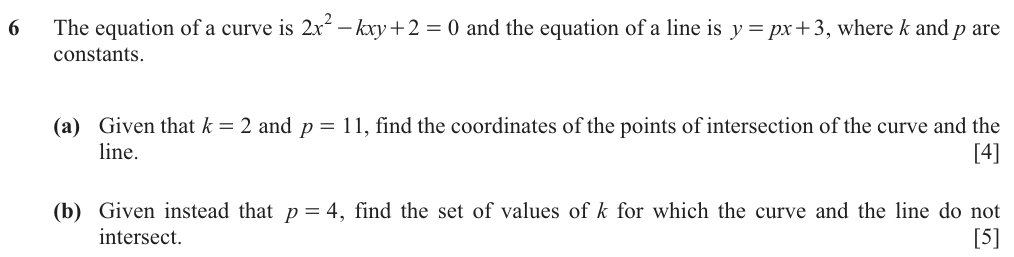
Same pair of equations, two different jobs. In (a) all the constants are known: solve. In (b) \(k\) is unknown and we want no intersection: discriminant \(<0\). "Given instead" means (a)'s numbers do not carry over.
- Given insteadstart (b) afresh with p = 4; k is unknown
- do not intersect\(b^2-4ac<0\)
- −kxyafter substituting \(y\), this term has \(x^2\) in it: it joins the \(x^2\) coefficient
- (a)both points
- (b)set of k
- \(2x^2-kxy+2=0\)curve
- \(y=px+3\)line
- in (b) the \(x^2\) coefficient is \(2-4k\): it has two parts
- (a)points
- Use\(2x^2-2x(11x+3)+2=0\Rightarrow10x^2+3x-1=0\)
- (b)set of k
- Form\((2-4k)x^2-3kx+2=0\)
- Use\(9k^2-8(2-4k)<0\)
- Regionbetween
In (b), what is a, the coefficient of x²?
\(2-4k\): from \(2x^2\) and from \(-kx\cdot4x\).
Solve 9k² + 32k − 16 = 0.
\((9k-4)(k+4)=0\Rightarrow k=\tfrac49\) or \(-4\).
5 Now solve it have a go on paper first, then open the worked solution
- (a) \(2x^2-2x(11x+3)+2=0\Rightarrow-20x^2-6x+2=0\) *M1 \(\Rightarrow(5x-1)(2x+1)=0\) DM1
- \(\left(\tfrac15,\ \tfrac{26}{5}\right)\) and \(\left(-\tfrac12,\ -\tfrac52\right)\) A1 A1
- (b) \(2x^2-kx(4x+3)+2=0\Rightarrow(2-4k)x^2-3kx+2=0\) *M1 A1
- \(b^2-4ac=9k^2-8(2-4k)<0\) DM1 \(\Rightarrow9k^2+32k-16<0\Rightarrow(9k-4)(k+4)<0\) M1
- \(\mathbf{-4<k<\tfrac49}\) A1
(a): \(y=11(\tfrac15)+3=\tfrac{26}5\) ✓. (b): \(k=0\) (inside) gives \(2x^2+2=0\), no real roots ✓.
Example 3 · Tangent: two values of c and two points (Paper 1, 7 marks) ★★ Medium

The constant \(c\) appears in both equations. Tangent means the equation for the meeting points has one repeated root. That gives an equation in \(c\) with two answers - and each answer has its own point \(P\).
- tangent\(b^2-4ac=0\)
- corresponding coordinatesone P for each value of c, paired
- values of c and P for each
- \(y=6x-c\)line
- \(y=cx^2+2x-3\)curve
- Findc and P
- Form\(cx^2-4x+(c-3)=0\)
- Use\(16-4c(c-3)=0\Rightarrow c^2-3c-4=0\)
- Thenput each c back, solve the (perfect square) quadratic, y from the line
What are the two values of c?
\((c-4)(c+1)=0\): \(c=4\) or \(c=-1\).
Why is the quadratic a perfect square when you put c back?
D = 0 by construction, so it has one repeated root.
5 Now solve it have a go on paper first, then open the worked solution
- \(cx^2+2x-3=6x-c\Rightarrow cx^2-4x+(c-3)=0\) B1
- \(16-4c(c-3)=0\) *M1 \(\Rightarrow c^2-3c-4=0\Rightarrow c=4,\ -1\) A1
- \(c=4\): \(4x^2-4x+1=0\Rightarrow(2x-1)^2=0\), \(x=\tfrac12,\ y=-1\) DM1 A1
- \(c=-1\): \(-x^2-4x-4=0\Rightarrow(x+2)^2=0\), \(x=-2,\ y=-11\) DM1 A1
Alternative on the scheme: \(\tfrac{dy}{dx}=2cx+2=6\Rightarrow c=\tfrac2x\); substitute into the meeting equation to get \(2x^2+3x-2=0\Rightarrow x=\tfrac12\) or \(-2\).
\(c=4\): curve at \(x=\tfrac12\): \(1+1-3=-1\) ✓ matches the line \(3-4=-1\).
Example 4 · A line touching an ellipse-shaped curve (Paper 1, 6 marks) ★★ Medium

"A single point" for a line and a curve means the line touches it: a repeated root. Substitute the line into the curve, set the discriminant to zero, find \(k\), then the point.
- single point\(b^2-4ac=0\)
- 2x² + 3y² = ka curve (an ellipse); substitute \(y=x+5\)
- (a)k
- (b)P
- \(y=x+5\)line
- \(2x^2+3y^2=k\)curve
- (a)k
- Form\(5x^2+30x+75-k=0\)
- Use\(900-20(75-k)=0\)
- (b)P
- Use\(k=30\): \(5x^2+30x+45=0\Rightarrow(x+3)^2=0\)
Expand 3(x + 5)².
\(3x^2+30x+75\).
What is x at the repeated root?
\(x=-\tfrac{b}{2a}=-\tfrac{30}{10}=-3\).
5 Now solve it have a go on paper first, then open the worked solution
- \(2x^2+3(x+5)^2=k\Rightarrow5x^2+30x+75-k=0\) *M1 A1
- \(900-20(75-k)=0\) DM1 \(\Rightarrow k=30\) A1
- (b) \(5x^2+30x+45=0\Rightarrow x=-3\) M1, \(y=2\): \(\mathbf{P(-3,\ 2)}\) A1
\(2(9)+3(4)=30=k\) ✓.
Summary
- Substitute the line into the curve (usually eliminate y), collect to ax² + bx + c = 0.
- Two points: D > 0; tangent: D = 0; misses: D < 0; meets: D ≥ 0.
- Tangent questions: D = 0 for the constant, then put each value back for its point; or use dy/dx = gradient of the line.
- "For all values of k": write D as a perfect square or a completed square and conclude in words.
| If you see… | do this |
|---|---|
| "points of intersection" | substitute, solve, pair the coordinates |
| "tangent", "touches", "single point" | D = 0 (then put the constant back for the point) |
| "does not meet / intersect" | D < 0 then an inequality |
| "two distinct points" | D > 0 then an inequality |
| "meet for all values of k" | D = (…)² ≥ 0 or (…)² + positive > 0, and say so |
| "given instead" | start again: earlier answers do not apply |
Can I do this?
- I can solve a linear and a quadratic equation together and pair the coordinates.
- I know which discriminant condition matches intersect / touch / miss.
- I can find the set of values of k for which a line and a curve meet twice or not at all.
- I can find the constant and the point of contact for a tangent, by the discriminant or by calculus.
- I can prove that a line meets a curve for all values of k, with a conclusion.
Anything unticked: revise that section first. All ticked: take the quiz.
Quiz
The multiple-choice and guided questions need JavaScript. The concept checks and exam practice below work without it.
Concept checks
Answer each one in your head first, then open it.
1A line meets a curve where \(3x^2+bx+c=0\) has a negative discriminant. Can the line and curve still cross somewhere?Show answer
No. The roots of that equation are exactly the \(x\)-coordinates of the meeting points; none exist.
2Why must you put the value of \(k\) back in a tangent question?Show answer
\(b^2-4ac=0\) only tells you \(k\). The point of contact comes from the repeated root \(x=-\tfrac{b}{2a}\) of the equation with that \(k\).
3Is a line that meets a curve exactly once always a tangent?Show answer
For a quadratic curve and a non-vertical line, yes (a repeated root). But a vertical line \(x=a\) meets \(y=x^2\) once without touching: that is why Paper 1 lines are given as \(y=mx+c\).
Exam-style practice
New questions, not used above. Do them on paper, then mark your work against the official mark scheme.

Show the mark scheme
| Part | Answer / working | Marks | Guidance |
|---|---|---|---|
| \(kx^2+(2-k)x+(2-k)=0\) | *M1 | eliminate y, 3-term quadratic; allow 1 error | |
| \((2-k)^2-4k(2-k)\) | DM1 | \(b^2-4ac\) with their \(a,b,c\) | |
| \(5k^2-12k+4\) or \((2-k)(2-k-4k)\) | A1 | ||
| \((5k-2)(k-2)\) | DM1 | solve the 3-term quadratic in k: factors must expand back | |
| \(\tfrac25<k<2\) | A1 | two separate correct inequalities also accepted | |
| Total: 5 marks | |||

Show the mark scheme
| Part | Answer / working | Marks | Guidance |
|---|---|---|---|
| \(2x^2+(2m-6)x+(m-4)=0\) | *M1 | y eliminated, all terms on one side | |
| \((2m-6)^2-8(m-4)\) | DM1 | discriminant with their coefficients | |
| \(4m^2-32m+68\) (or \(m^2-8m+17\)) | A1 | ||
| \(4[(m-4)^2+1]\), or the minimum point \((4,1)\) | DM1 | any valid method to show the sign | |
| always \(>0\), so two distinct points for all values of m | A1 | clear reasoning and conclusion, no wrong working | |
| Total: 5 marks | |||
Examiner tip The last mark is the sentence. A completed square with no conclusion, or a few trial values of m, does not get it.
Your progress on this note is saved when JavaScript is on.