
Quadratics
Solving quadratic equations, including disguised quadratics
On this page
- What you need to be able to do
- What you should already know
- What a quadratic equation is
- Why we make one side zero: the zero-product rule
- Method 1: factorising
- Method 2: completing the square
- Method 3: the quadratic formula, and where it comes from
- Which method should I use?
- Equations that turn into quadratics
- Disguised quadratics: substitute, solve, then undo
- Key facts at a glance
- The rule that decides the marks: show your method
- Mark-scheme focus
- Worked examples
- Summary
- Can I do this?
- Quiz
What you need to be able to do
- 1.1Solve quadratic equations by factorising, by completing the square and by the formula, and show the method each time.
- 1.1Give exact answers (surds, fractions) when asked, and use a completed square to solve when the question says "hence".
- 1.1Recognise and solve equations that are quadratic in some function of x: \(x^4\), \(x^6\) and \(x^3\), \(\sqrt x\), \((2x-3)^2\), \(\tfrac1x\), and later \(\sin x\), \(\tan x\).
Before you start: Completing the square. Next: The discriminant and the nature of roots.
Everything in the syllabus for this page, from the basics, with our own examples. Past-paper questions come in Part 2.
What you should already know
This page builds on four O Level skills. Do the quick check on each card; if one feels shaky, fix it first, because every method below uses it.
Expanding brackets
Every term in the first bracket multiplies every term in the second: \((2x+3)(x-4)=2x^2-8x+3x-12=2x^2-5x-12\).
Quick check: expand \((x-5)(3x+2)\)
\(3x^2+2x-15x-10=3x^2-13x-10\)
Factorising
The reverse of expanding. Take out a common factor first (\(6x^2-9x=3x(2x-3)\)); then look for two brackets, or a difference of two squares \(a^2-b^2=(a-b)(a+b)\).
Quick check: factorise \(x^2-49\) and \(x^2+2x-15\)
\((x-7)(x+7)\) and \((x+5)(x-3)\)
Surds
\(\sqrt{ab}=\sqrt a\sqrt b\), so pull out the largest square factor: \(\sqrt{48}=\sqrt{16}\sqrt3=4\sqrt3\). Like surds add: \(2\sqrt3+5\sqrt3=7\sqrt3\).
Quick check: simplify \(\sqrt{72}\) and \(\tfrac{6+\sqrt{20}}{2}\)
\(6\sqrt2\) and \(\tfrac{6+2\sqrt5}{2}=3+\sqrt5\)
Square roots come in pairs
Both \(5^2\) and \((-5)^2\) are 25, so \(x^2=25\) means \(x=\pm5\). A square can never be negative, so \(x^2=-9\) has no real solution.
Quick check: solve \((x-1)^2=16\)
\(x-1=\pm4\), so \(x=5\) or \(x=-3\)
What a quadratic equation is
\(a\), \(b\) and \(c\) are the coefficients; read them with their signs. In \(3x^2-x+5=0\): \(a=3,\ b=-1,\ c=5\). In \(4-x^2=0\): \(a=-1,\ b=0,\ c=4\). If an equation isn't in this shape yet (\(x^2=3x+10\), \(x(x+2)=8\)), rearrange it first: everything on one side, \(0\) on the other.
Solving \(x^2-2x-3=0\) is the same as asking: where does the curve \(y=x^2-2x-3\) cross the \(x\)-axis (where \(y=0\))? Here it crosses at \(x=-1\) and \(x=3\).
This picture explains why there are at most two roots: a U-shaped (or ∩-shaped) curve can cross a horizontal line at most twice. It can also just touch the axis (one repeated root) or miss it completely (no real roots). Which one happens is decided by the discriminant, the next page but one.
Why we make one side zero: the zero-product rule
So once \(x^2-7x+12=0\) is written as \((x-3)(x-4)=0\), one bracket must be zero: \(x=3\) or \(x=4\). The rule does not work for any other number. \((x-3)(x-4)=2\) does not mean \(x-3=2\) or \(x-4=2\) (try \(x=5\): \(2\times1=2\) ✓, but \(x=6\): \(3\times2=6\) ✗). Expand and rearrange first: \(x^2-7x+10=0\), so \(x=2\) or \(5\).
Method 1: factorising
Factorising is the quickest method when it works, and it works whenever the roots are whole numbers or fractions. There are four shapes to recognise.
When the \(x^2\) has no number in front
Find two numbers that multiply to \(c\) and add to \(b\). For \(x^2-7x+12=0\): multiply to \(+12\), add to \(-7\). Both must be negative: \(-3\) and \(-4\).
- \(x^2-7x+12=(x-3)(x-4)=0\)
- \(x=3\) or \(x=4\)
- Check one: \(3^2-7(3)+12=9-21+12=0\) ✓
Signs: if \(c\) is positive both numbers have the sign of \(b\); if \(c\) is negative they have opposite signs.
When there is a number in front of \(x^2\): split the middle term
Solve \(2x^2-x-6=0\). Multiply \(a\times c=2\times(-6)=-12\). Find two numbers that multiply to \(-12\) and add to \(b=-1\): \(-4\) and \(3\).
- Split \(-x\) into \(-4x+3x\): \(2x^2-4x+3x-6=0\)
- Factor in pairs: \(2x(x-2)+3(x-2)=0\)
- The brackets match, so \((2x+3)(x-2)=0\)
- \(2x+3=0\Rightarrow x=-\tfrac32\), or \(x=2\)
If the two brackets don't match after pairing, the split is wrong; check the pair multiplies to \(ac\).
When \(c=0\): take out \(x\)
Solve \(x^2-5x=0\): \(x(x-5)=0\), so \(x=0\) or \(x=5\).
When \(b=0\): a difference of two squares
Solve \(4x^2-36=0\). Divide by 4: \(x^2-9=0\Rightarrow(x-3)(x+3)=0\Rightarrow x=\pm3\). Or directly: \(x^2=9\Rightarrow x=\pm3\).
\(x^2+9=0\) has no real roots: \(x^2=-9\) is impossible. A sum of two squares never factorises.
A repeated root. \(x^2-6x+9=(x-3)^2=0\) gives \(x=3\) twice. The graph touches the \(x\)-axis at one point instead of crossing it. You will meet this again with the discriminant.
- Solve \(x^2+x-20=0\).
Answer
\((x+5)(x-4)=0\): \(x=-5\) or \(x=4\) - Solve \(3x^2+10x-8=0\).
Answer
\(ac=-24\): \(12\) and \(-2\). \(3x^2+12x-2x-8=3x(x+4)-2(x+4)=(3x-2)(x+4)\): \(x=\tfrac23\) or \(-4\) - Solve \(2x^2=7x\).
Answer
\(2x^2-7x=0\Rightarrow x(2x-7)=0\): \(x=0\) or \(\tfrac72\)
Method 2: completing the square
Every quadratic can be written as a perfect square plus a number (the page Completing the square teaches it in full). Once it is in that form, you solve it by isolating the square and taking a square root with \(\pm\).
- Solve \(x^2+6x-4=0\). Half of \(6\) is \(3\): \(x^2+6x=(x+3)^2-9\).
- So \((x+3)^2-9-4=0\Rightarrow(x+3)^2=13\)
- Square-root both sides, with \(\pm\): \(x+3=\pm\sqrt{13}\)
- \(x=-3+\sqrt{13}\) or \(x=-3-\sqrt{13}\)
Completing the square also shows at a glance when there are no real roots. \(x^2+4x+7=(x+2)^2+3\). Setting it to zero needs \((x+2)^2=-3\), and a square is never negative, so there are no real roots.
- Solve \(x^2-10x+18=0\) by completing the square.
Answer
\((x-5)^2-25+18=0\Rightarrow(x-5)^2=7\Rightarrow x=5\pm\sqrt7\) - Show that \(x^2-2x+5=0\) has no real roots.
Answer
\((x-1)^2+4=0\Rightarrow(x-1)^2=-4\), impossible
Method 3: the quadratic formula, and where it comes from
Completing the square on the general equation \(ax^2+bx+c=0\) gives a formula that solves every quadratic. Follow the derivation once; it shows why the formula works and where the \(\pm\) comes from.
- Divide by \(a\): \(x^2+\dfrac bax+\dfrac ca=0\)
- Complete the square (half of \(\tfrac ba\) is \(\tfrac b{2a}\)): \(\left(x+\dfrac b{2a}\right)^2-\dfrac{b^2}{4a^2}+\dfrac ca=0\)
- Isolate the square, over a common denominator: \(\left(x+\dfrac b{2a}\right)^2=\dfrac{b^2-4ac}{4a^2}\)
- Square-root with \(\pm\): \(x+\dfrac b{2a}=\pm\dfrac{\sqrt{b^2-4ac}}{2a}\)
- So \(x=\dfrac{-b\pm\sqrt{b^2-4ac}}{2a}\)
\[x=\frac{-b\pm\sqrt{b^2-4ac}}{2a}\]
The part under the root, \(b^2-4ac\), is the discriminant. If it is negative there is nothing to square-root: no real roots. That is the whole idea of the page The discriminant.
Using it. Solve \(3x^2-4x-2=0\): \(a=3,\ b=-4,\ c=-2\).
- \(x=\dfrac{-(-4)\pm\sqrt{(-4)^2-4(3)(-2)}}{2(3)}\) (brackets round every negative)
- \(=\dfrac{4\pm\sqrt{16+24}}{6}=\dfrac{4\pm\sqrt{40}}{6}\)
- \(\sqrt{40}=2\sqrt{10}\), so \(x=\dfrac{4\pm2\sqrt{10}}{6}=\dfrac{2\pm\sqrt{10}}{3}\)
- As decimals (only if asked): \(x\approx1.72\) or \(x\approx-0.387\)
Exact answers
"Exact" means keep the surds and fractions: \(\tfrac{2\pm\sqrt{10}}3\), not \(1.72\). Decimals can be added afterwards, never instead.
Simplify fully
Simplify the surd, then cancel a common factor from every term: \(\tfrac{4\pm2\sqrt{10}}6=\tfrac{2(2\pm\sqrt{10})}{6}=\tfrac{2\pm\sqrt{10}}3\). Cancelling only the 4 and 6 is wrong.
Sign slips
\(-b\) when \(b=-4\) is \(+4\). \((-4)^2=+16\). \(-4ac\) with \(c\) negative is positive. Write the brackets and the signs look after themselves.
- Solve \(x^2-4x-1=0\), giving exact answers.
Answer
\(x=\tfrac{4\pm\sqrt{20}}2=2\pm\sqrt5\) - Solve \(2x^2+3x-4=0\), to 3 significant figures.
Answer
\(x=\tfrac{-3\pm\sqrt{41}}4\): \(0.851\) or \(-2.35\)
Which method should I use?
| Situation | Best method | Why |
|---|---|---|
| small numbers, roots look like whole numbers or fractions | factorising | fastest; try for about 20 seconds |
| no constant (\(c=0\)) or no \(x\) term (\(b=0\)) | take out \(x\) / square root | one line |
| "exact", "in the form \(a\pm\sqrt b\)", or it won't factorise | formula | always works, gives surds directly |
| the question has just completed the square ("hence") | completing the square | the work is already done |
Equations that turn into quadratics
An equation with \(x\) in a denominator is often a quadratic in disguise. Multiply every term by the denominator(s) to clear the fractions, rearrange to \(=0\), then solve. Finally check that no answer makes a denominator zero.
1 One fraction
Solve \(x-2=\dfrac{15}{x}\).
AskedxKnowa fraction with x underneathRoutemultiply every term by x, collect, solve
- \(x^2-2x=15\)
- \(x^2-2x-15=0\Rightarrow(x-5)(x+3)=0\)
- \(x=5\) or \(x=-3\); neither is \(0\), so both stand
2 Two fractions
Solve \(\dfrac{3}{x+1}+\dfrac{2}{x}=2\).
AskedxKnowdenominators \(x+1\) and \(x\)Routemultiply every term by \(x(x+1)\)
- \(3x+2(x+1)=2x(x+1)\)
- \(5x+2=2x^2+2x\Rightarrow2x^2-3x-2=0\)
- \((2x+1)(x-2)=0\Rightarrow x=-\tfrac12\) or \(x=2\)
- Neither makes \(x\) or \(x+1\) zero ✓
The usual slip is forgetting to multiply the right-hand side: \(2\) becomes \(2x(x+1)\), not \(2\).
Disguised quadratics: substitute, solve, then undo
An equation is a disguised quadratic when one power is the square of another: \(x^4\) and \(x^2\); \(x^6\) and \(x^3\); \(x\) and \(\sqrt x\); \(u^2\) and \(u\) for any expression \(u\). Replace the smaller one with a new letter and it becomes an ordinary quadratic.
For example \(x^4-13x^2+36=0\). Since \(x^4=(x^2)^2\), let \(u=x^2\): \(u^2-13u+36=0\Rightarrow(u-4)(u-9)=0\), so \(u=4\) or \(9\). But \(u\) was \(x^2\): \(x^2=4\Rightarrow x=\pm2\) and \(x^2=9\Rightarrow x=\pm3\). Four solutions: \(-3,-2,2,3\).
- Spot the pair: which expression, squared, gives the other? Call it \(u\) (or \(y\), \(k\): not \(x\)).
- Rewrite the equation in \(u\) and rearrange to \(au^2+bu+c=0\). Multiply out any fractions first.
- Solve for \(u\) with any of the three methods.
- Undo the substitution: each value of \(u\) gives an equation in \(x\) (\(x^2=5\), \(x^3=-27\), \(\sqrt x=\tfrac12\), …). Solve each one.
- Reject impossible values and say why: \(x^2=-1\) and \(\sqrt x=-2\) have no real solutions. Keep negative values that are possible: \(x^3=-27\) gives \(x=-3\).
| Equation | Let | Quadratic in u | Back to x |
|---|---|---|---|
| \(2x^4-7x^2-4=0\) | \(u=x^2\) | \(2u^2-7u-4=0\) | \(u=4\Rightarrow x=\pm2\); \(u=-\tfrac12\) impossible |
| \(x^6-7x^3-8=0\) | \(u=x^3\) | \(u^2-7u-8=0\) | \(u=8,\ -1\Rightarrow x=2,\ -1\) |
| \(3\sqrt y+\dfrac{4}{\sqrt y}-8=0\) | \(u=\sqrt y\) | \(3u^2-8u+4=0\) (× \(u\)) | \(u=\tfrac23,\ 2\Rightarrow y=\tfrac49,\ 4\) |
| \(x-6\sqrt x+4=0\) | \(u=\sqrt x\) | \(u^2-6u+4=0\) | \(u=3\pm\sqrt5\) (both positive) \(\Rightarrow x=14\pm6\sqrt5\) |
| \((x+1)^2-\dfrac{6}{(x+1)^2}+1=0\) | \(u=(x+1)^2\) | \(u^2+u-6=0\) (× \(u\)) | \(u=2\Rightarrow x=-1\pm\sqrt2\); \(u=-3\) impossible |
| \(4\cos\theta=3+\dfrac{1}{\cos\theta}\) | \(u=\cos\theta\) | \(4u^2-3u-1=0\) | \(\cos\theta=1\) or \(-\tfrac14\) (Trigonometry) |
- Solve \(x^4-10x^2+9=0\).
Answer
\(u=x^2\): \((u-1)(u-9)=0\), so \(x=\pm1,\ \pm3\) - Solve \(x-5\sqrt x+6=0\).
Answer
\(u=\sqrt x\): \((u-2)(u-3)=0\), \(\sqrt x=2,3\), so \(x=4\) or \(9\) - Solve \(x^6+7x^3-8=0\).
Answer
\(u=x^3\): \((u+8)(u-1)=0\), so \(x=-2\) or \(x=1\)
Key facts at a glance
- A quadratic equation \(ax^2+bx+c=0\) has at most two real roots: where \(y=ax^2+bx+c\) meets the \(x\)-axis.
- Get \(0\) on one side before factorising (zero-product rule). Never divide by \(x\).
- Three methods: factorise, complete the square, formula. The formula is completing the square done once in general.
- \(b^2-4ac<0\) or \((x+p)^2=\) negative: no real roots.
- Fractions: multiply every term by the denominators. Disguised: substitute, solve, undo, reject the impossible.
How this topic is examined, what the mark scheme wants, then real Paper 1 questions worked through slowly.
The rule that decides the marks: show your method
Every examiner report since 2020 repeats this. 9709/11/M/J/24 Q1(b): "Use of calculator with no working scores 0/3." Factors must also be real factors: the June 2021 report saw candidates get the roots from a calculator and then write "factors" that did not expand back to the quadratic, and lost the method mark.
"Hence" after a completed square is a hint to use it: the June 2022 report noted that most candidates ignored "hence" and used the formula. It still scored there, but on harder questions ignoring "hence" costs marks. A fraction equation is usually an opening 3-mark question; the November 2022 report saw candidates fail to multiply out fully, or add a number instead of subtracting it.
- Disguised quadratic (x⁴, x⁶, √x, a bracket): about one question in three papers, 3-5 marks, often part (b) after a completed square.
- Rearrange then solve (fractions): an opening 3-mark question on several papers.
- Every quadratic inside a bigger question (intersections, stationary points, trig equations): the method mark for solving it is always there.
Mark-scheme focus
Solve … (clear the fraction, then a quadratic in x³)

- multiply by \(x^3\) and recognise a quadratic in \(x^3\): \(u^2-28u+27=0\) M1*
- a seen method to solve it: \((x^3-1)(x^3-27)=0\) DM1
- \(x=1,\ 3\) B1
- \(x^3=1,\ 27\) given as the answer (the substitution not undone)
- \(x=\pm1,\ \pm3\): a cube root has one real value
- solutions from a calculator with no factorising or formula
Two steps students skip: clear the fraction first (×\(x^3\)), and at the end take the cube root of BOTH values of \(u\).
From: 9709/15/O/N/25 Q5.
Solve … with a square root: undo the substitution

- \((4x^{\frac12}-3)(x^{\frac12}-2)=0\), or \(u=x^{\frac12}\) and \(4u^2-11u+6=0\) solved M1
- \(x^{\frac12}=\tfrac34\) or \(2\) A1
- squared: \(x=\tfrac9{16}\) or \(4\) A1
- \(x=\tfrac34,\ 2\) (the values of \(\sqrt x\), not \(x\)): M1 A0 A0
- spotting one solution by trial
- "showing all necessary working" ignored
The letter you solved for is \(\sqrt x\). The question asks for \(x\), so square each value. Both are positive, so both are kept.
From: 9709/11/O/N/18 Q1.
Worked examples
Example 1 · Completed square, then a quartic (Paper 1, 5 marks) ★★ Medium

Part (a) is a normal completed square, but in the letter \(y\). Part (b) has \(x^4\) and \(x^2\): it is the same quadratic with \(y=x^2\). So (a) already did most of the work.
- Henceuse (a): the quartic is (a) with \(y\) replaced by \(x^2\)
- exactanswers as surds: \(\pm\sqrt5\)
- \(x^4\)\(x^4=(x^2)^2\): a quadratic in \(x^2\)
- (a)\(a\) and \(b\)
- (b)all real \(x\)
- \(3y^2-12y-15\)(a)
- \(3x^4-12x^2-15=0\)(b)
- \(x^2\) can never be negative: any negative value of \(x^2\) gives no real \(x\)
- (a)\(3(y+a)^2+b\)
- Use\(3(y^2-4y)-15\), half of −4 is −2
- (b)exact \(x\)
- Use\(y=x^2\) in (a): \(3(x^2-2)^2-27=0\)
- Then\((x^2-2)^2=9\Rightarrow x^2-2=\pm3\)
- Trap\(x^2=5\) gives TWO values, \(\pm\sqrt5\)
- Use\(y=x^2\) in (a): \(3(x^2-2)^2-27=0\)
Why is x² = −1 thrown away?
No real number squares to a negative. It gives no real solutions, so the only answers come from \(x^2=5\).
How many real solutions does the quartic have?
Two: \(\sqrt5\) and \(-\sqrt5\).
5 Now solve it have a go on paper first, then open the worked solution
- (a) \(3(y^2-4y)-15=3[(y-2)^2-4]-15=\mathbf{3(y-2)^2-27}\): \(a=-2,\ b=-27\) B1 B1
- (b) With \(y=x^2\): \(3(x^2-2)^2-27=0\Rightarrow(x^2-2)^2=9\Rightarrow x^2-2=\pm3\) M1
- \(x^2=5\) or \(x^2=-1\) (no real solutions) M1
- \(x=\pm\sqrt5\) A1
\(x^2=5\): \(3(25)-12(5)-15=75-60-15=0\) ✓.
Example 2 · A sixth power and a cube (Paper 1, 3 marks) ★★ Medium

\(x^6=(x^3)^2\), so this is a quadratic in \(x^3\). Solve for \(x^3\), then take cube roots.
- \(x^6\) and \(x^3\)one is the square of the other: let \(u=x^3\)
- Solveshow the factorisation or the formula: 3 marks for working
- every real \(x\)
- \(8x^6+215x^3-27=0\)
- cube roots of negative numbers exist: \(\sqrt[3]{-27}=-3\)
- Findx
- Use\(u=x^3\): \(8u^2+215u-27=0\)
- Factorise\(8\times(-27)=-216\): \(216\) and \(-1\)
- Trapthrowing away \(x^3=-27\)
- Use\(u=x^3\): \(8u^2+215u-27=0\)
Which two numbers multiply to −216 and add to 215?
216 and −1, so \(8u^2+216u-u-27=8u(u+27)-(u+27)=(8u-1)(u+27)\).
Is \(\sqrt[3]{1/8}=\pm\tfrac12\)?
No. Cube roots have one real value: \(\tfrac12\). Only even roots come with ±.
5 Now solve it have a go on paper first, then open the worked solution
- Let \(u=x^3\): \(8u^2+215u-27=0\Rightarrow(8u-1)(u+27)=0\) M1
- \(u=\tfrac18\) or \(u=-27\) A1
- \(x^3=\tfrac18\Rightarrow x=\tfrac12\); \(x^3=-27\Rightarrow x=-3\) A1
\(x=-3\): \(8(729)+215(-27)-27=5832-5805-27=0\) ✓.
Example 3 · Substitution for a whole bracket (Paper 1, 4 marks) ★★ Medium

The bracket \((2x-3)^2\) appears twice, once on top of a fraction. Calling it \(u\) turns the equation into \(u-\tfrac4u-3=0\), which becomes a quadratic once you multiply by \(u\).
- suitable substitutionlet \(u=(2x-3)^2\) (or \(u=2x-3\), then it is a quartic in \(u\))
- 4/(2x − 3)²multiply every term by \(u\) to clear it
- all values of \(x\)
- \((2x-3)^2-\dfrac{4}{(2x-3)^2}-3=0\)
- \(u=(2x-3)^2\) is a square, so it can't be negative
- Findx
- Use\(u^2-3u-4=0\)
- Then\(u=4\) or \(u=-1\)
- Undo\((2x-3)^2=4\Rightarrow2x-3=\pm2\)
- Trap\((2x-3)^2=-1\) has no real solution
- Use\(u^2-3u-4=0\)
What do you get when you multiply u − 4/u − 3 = 0 by u?
\(u^2-4-3u=0\), i.e. \(u^2-3u-4=0\).
Why are there two answers for x from u = 4?
\(2x-3\) can be \(+2\) or \(-2\).
5 Now solve it have a go on paper first, then open the worked solution
- \(u=(2x-3)^2\): \(u^2-3u-4=0\) M1
- \((u-4)(u+1)=0\Rightarrow u=4\) (\(u=-1\) rejected) M1
- \(2x-3=\pm2\) A1
- \(x=\tfrac52\) or \(x=\tfrac12\) only A1
\(x=\tfrac52\): \((2)^2-\tfrac44-3=4-1-3=0\) ✓. \(x=\tfrac12\): \((-2)^2-\tfrac44-3=0\) ✓.
Example 4 · A square root and its reciprocal (Paper 1, 4 marks) ★★ Medium

\(\sqrt y\) and \(\tfrac{1}{\sqrt y}\): multiply every term by \(\sqrt y\) and you get \(y\), a constant and \(\sqrt y\). Since \(y=(\sqrt y)^2\), that is a quadratic in \(\sqrt y\).
- \(\tfrac{2}{\sqrt y}\)multiply through by \(\sqrt y\): \(\tfrac{2}{\sqrt y}\times\sqrt y=2\)
- Solve4 marks: two for the values of √y, two for y
- (a)both values of \(y\)
- \(6\sqrt y+\dfrac2{\sqrt y}-7=0\)
- \(\sqrt y\) must be positive (both roots here are)
- Findy
- Use× \(\sqrt y\): \(6y-7\sqrt y+2=0\)
- Let\(u=\sqrt y\): \(6u^2-7u+2=0\)
- Undosquare each \(u\)
- Use× \(\sqrt y\): \(6y-7\sqrt y+2=0\)
6 × 2 = 12: which two numbers multiply to 12 and add to −7?
\(-3\) and \(-4\): \(6u^2-3u-4u+2=3u(2u-1)-2(2u-1)=(3u-2)(2u-1)\).
If \(\sqrt y=\tfrac23\), what is \(y\)?
\(\tfrac49\): square both sides.
5 Now solve it have a go on paper first, then open the worked solution
- \(\times\sqrt y\): \(6y+2-7\sqrt y=0\), a 3-term quadratic in \(\sqrt y\) M1
- \((2\sqrt y-1)(3\sqrt y-2)=0\) DM1
- \(\sqrt y=\tfrac12\) or \(\tfrac23\) A1
- \(y=\tfrac14\) or \(y=\tfrac49\) A1
Part (b) then solves \(6\sqrt{\tan x}+\tfrac{2}{\sqrt{\tan x}}-7=0\): the same equation with \(y=\tan x\), so \(\tan x=\tfrac14\) or \(\tfrac49\) (see Trigonometry).
\(y=\tfrac14\): \(6(\tfrac12)+\tfrac{2}{1/2}-7=3+4-7=0\) ✓.
Example 5 · Surd answers from a square-root equation (Paper 1, 4 marks) ★★★ Hard
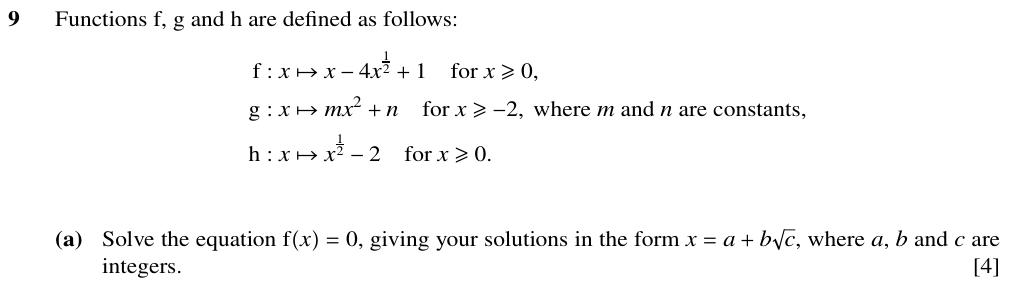
Why it is hard: the March 2022 report: many found only one value, and the answer must come from the formula or completing the square, not a calculator.
\(x-4x^{1/2}+1=0\) is a quadratic in \(\sqrt x\). It doesn't factorise, so the formula (or completing the square) gives \(\sqrt x\) as a surd; squaring that gives \(x\).
- \(x^{1/2}\)\(\sqrt x\); and \(x=(\sqrt x)^2\)
- \(a+b\sqrt c\)integers: you must square the surd and simplify
- (a)both values of \(x\)
- \(x-4\sqrt x+1=0\)\(x\ge0\)
- both values of \(\sqrt x\) must be checked: \(\sqrt x\) cannot be negative
- Find\(x=a+b\sqrt c\)
- Use\(u=\sqrt x\): \(u^2-4u+1=0\)
- Formula\(u=\tfrac{4\pm\sqrt{12}}{2}=2\pm\sqrt3\)
- Undo\(x=(2\pm\sqrt3)^2\)
- Trapdiscarding \(2-\sqrt3\): it is positive (0.27)
- Use\(u=\sqrt x\): \(u^2-4u+1=0\)
Expand \((2+\sqrt3)^2\).
\(4+4\sqrt3+3=7+4\sqrt3\).
Is \(2-\sqrt3\) an allowed value of \(\sqrt x\)?
Yes: \(\sqrt3\approx1.73\), so \(2-\sqrt3>0\). Both roots are valid.
5 Now solve it have a go on paper first, then open the worked solution
- \(u=\sqrt x\): \(u^2-4u+1=0\Rightarrow u=\dfrac{4\pm\sqrt{16-4}}{2}=2\pm\sqrt3\) M1 A1
- \(x=(2\pm\sqrt3)^2\) M1
- \(x=7+4\sqrt3\) or \(x=7-4\sqrt3\) A1
Alternative on the scheme: isolate the root, \(x+1=4\sqrt x\), square: \(x^2+2x+1=16x\Rightarrow x^2-14x+1=0\), \(x=7\pm4\sqrt3\). (Squaring can create false roots, so check both: here both work.)
\(7-4\sqrt3\approx0.072\): \(0.072-4(0.268)+1\approx0\) ✓.
Summary
- Solve by factorising, the formula (substitution shown) or completing the square; never by calculator alone.
- Rearrange to = 0 first; clear fractions by multiplying through.
- Exact = surds and fractions; ± gives two answers.
- Disguised quadratic: let \(u\) = the smaller power, solve for \(u\), undo, reject impossible values (\(x^2<0\), \(\sqrt x<0\)).
| If you see… | do this |
|---|---|
| \(x^4\) and \(x^2\) | let \(u=x^2\); \(u<0\) gives no real \(x\) |
| \(x^6\) and \(x^3\) | let \(u=x^3\); keep negative \(u\): one real cube root |
| \(x\) and \(\sqrt x\) (or \(\sqrt x\) and \(\tfrac{1}{\sqrt x}\)) | let \(u=\sqrt x\) (multiply by \(\sqrt x\) first); \(u\) must be \(\ge0\) |
| the same bracket twice | let u = the bracket |
| "exact" | surds/fractions; decimals only after them |
| "hence" after a completed square | isolate the square, ± |
Can I do this?
- I always show a method for solving a quadratic (factors, formula with numbers, or completing the square).
- I know why one side must be 0 before factorising, and never divide by x.
- I can solve the same quadratic by factorising, by completing the square and by the formula.
- I can derive the quadratic formula and give exact, simplified surd answers.
- I can turn an equation with fractions into a quadratic and solve it.
- I can spot a disguised quadratic, substitute, solve and undo the substitution.
- I know which values to reject (x² < 0, √x < 0) and which to keep (x³ < 0).
Anything unticked: revise that section first. All ticked: take the quiz.
Quiz
The multiple-choice and guided questions need JavaScript. The concept checks and exam practice below work without it.
Concept checks
Answer each one in your head first, then open it.
1Why does \(x^2=-4\) have no real solutions but \(x^3=-8\) has one?Show answer
Any real number squared is \(\ge0\); a cube keeps the sign, so \((-2)^3=-8\).
2A student squares both sides of \(x+1=4\sqrt x\). Why must they check their answers afterwards?Show answer
Squaring can create solutions of \(x+1=-4\sqrt x\) too. Substituting back shows which are real solutions.
3When is the formula better than factorising?Show answer
When the roots aren't rational (\(b^2-4ac\) isn't a perfect square), or exact surd answers are asked for.
Exam-style practice
New questions, not used above. Do them on paper, then mark your work against the official mark scheme.

Show the mark scheme
| Part | Answer / working | Marks | Guidance |
|---|---|---|---|
| \((3x+2)(x-1)=2\) | M1 | multiply through by \(x-1\) | |
| \(3x^2-x-4=0\Rightarrow(3x-4)(x+1)=0\) | M1 | 3-term quadratic solved by a seen method | |
| \(x=\tfrac43\) or \(x=-1\) | A1 | both | |
| Total: 3 marks | |||

Show the mark scheme
| Part | Answer / working | Marks | Guidance |
|---|---|---|---|
| \(x^{\frac23}-x^{\frac13}-2=0\), or \(u^2-u-2=0\) with \(u=x^{\frac13}\) | M1 | eliminate y: a 3-term quadratic | |
| \(x^{\frac13}=2,\ -1\) | *A1 | both; stopping at \(x=2,-1\) scores A0 | |
| \(x=8,\ -1\) | DM1 | cube both | |
| \((8,\,3)\) and \((-1,\,0)\) | A1 | y from either curve | |
| Total: 4 marks | |||
Examiner tip Also on the scheme: eliminate \(x\) instead. \(x^{\frac13}=y-1\), so \(x^{\frac23}=(y-1)^2\) and \(y=(y-1)^2-1\Rightarrow y^2-3y=0\Rightarrow y=0\) or \(3\).
Your progress on this note is saved when JavaScript is on.