
Quadratics
Completing the square, the vertex and sketching
On this page
- What you need to be able to do
- What you should already know
- The graph of a quadratic: the parabola
- Three ways to write the same quadratic
- Why completing the square works
- Completing the square: the method, case by case
- Two methods on the same question
- Reading the vertex, the least or greatest value and the line of symmetry
- Sketching a quadratic
- Using the completed square to prove something is always positive
- Key facts at a glance
- How this is examined
- Mark-scheme focus
- Worked examples
- Summary
- Can I do this?
- Quiz
What you need to be able to do
- 1.1Carry out the process of completing the square for \(ax^2+bx+c\), whatever the sign or size of \(a\), and in whatever form the question asks for.
- 1.1Use the completed-square form to find the vertex (the maximum or minimum point), the line of symmetry and the least or greatest value.
- 1.1Use it to sketch the graph, and to prove that an expression is always positive (or always above some value).
You need: expanding \((x+a)^2 = x^2+2ax+a^2\). Next: Solving quadratic equations, where the completed square becomes a solving method.
The whole syllabus content for this page from the basics, with our own examples. Past-paper questions come in Part 2.
What you should already know
Squaring a bracket
\((x+a)^2=(x+a)(x+a)=x^2+2ax+a^2\). The middle term is twice the number in the bracket; the last term is that number squared. \((x-5)^2=x^2-10x+25\).
Quick check: expand \((x+4)^2\) and \((x-\tfrac32)^2\)
\(x^2+8x+16\) and \(x^2-3x+\tfrac94\)
A square is never negative
\(3^2=9\), \((-3)^2=9\), \(0^2=0\). So \((\text{anything})^2\ge0\), and it is \(0\) only when the thing inside is \(0\).
Quick check: what is the smallest value of \((x-7)^2\), and when?
\(0\), when \(x=7\)
Halving and squaring fractions
Half of \(5\) is \(\tfrac52\); squared it is \(\tfrac{25}4\). Half of \(-\tfrac23\) is \(-\tfrac13\); squared \(\tfrac19\).
Quick check: half of \(-7\), squared?
\(\left(-\tfrac72\right)^2=\tfrac{49}4\)
The graph of y = x²
A ∪-shaped curve through \((0,0)\), symmetric about the \(y\)-axis: \(x=2\) and \(x=-2\) both give \(4\). Its lowest point is the origin.
Quick check: which points on \(y=x^2\) have \(y=9\)?
\((3,9)\) and \((-3,9)\)
The graph of a quadratic: the parabola
The graph of every quadratic \(y=ax^2+bx+c\) is a parabola. Four features describe it completely:
- Shape: \(a>0\) gives a ∪ (it opens upwards); \(a<0\) gives a ∩. The bigger \(|a|\), the narrower the curve.
- Vertex (turning point): the lowest point of a ∪, the highest point of a ∩.
- Line of symmetry: the vertical line through the vertex. Points the same distance either side of it have the same \(y\).
- Intercepts: it crosses the \(y\)-axis at \((0,\,c)\), and the \(x\)-axis at the roots (if there are any).
Here is the idea this whole page rests on. \(y=(x-2)^2-3\) is the graph of \(y=x^2\) moved 2 right and 3 down: the bracket shifts it sideways, the number outside shifts it up or down. So its vertex is where the vertex of \(y=x^2\) lands: \((2,\,-3)\). If we can rewrite any quadratic in that shape, the vertex is in front of us. Rewriting it is called completing the square. (Moving graphs in general is on the page Transformations in the Functions chapter.)
- How is \(y=(x+1)^2+4\) related to \(y=x^2\)? Where is its vertex?
Answer
moved 1 left and 4 up; vertex \((-1,\,4)\) - Is \(y=3-2x^2\) a ∪ or a ∩? Where does it cross the \(y\)-axis?
Answer
\(a=-2<0\): a ∩; it crosses at \((0,\,3)\)
Three ways to write the same quadratic
Every quadratic can be written in three forms. They are the same curve; each form makes a different fact easy to read off.
| Form | Example | What you can read straight off |
|---|---|---|
| Standard \(ax^2+bx+c\) | \(y = x^2-4x+1\) | the \(y\)-intercept (put \(x=0\)): \((0,\,1)\); the shape: \(a>0\) is ∪, \(a<0\) is ∩ |
| Completed square \(a(x+p)^2+q\) | \(y = (x-2)^2-3\) | the vertex \((-p,\,q)\), the line of symmetry \(x=-p\), the least (or greatest) value \(q\) |
| Factorised (root) form \(a(x-\alpha)(x-\beta)\) | \(y = (x-1)(x-3)\) (a different curve) | the roots \(x=\alpha\) and \(x=\beta\), where the curve crosses the \(x\)-axis |
Not every quadratic factorises with whole numbers (\(x^2-4x+1\) doesn't), but every quadratic can be completed. That is why Paper 1 leans on completing the square so heavily: it turns up inside functions (range, inverse), coordinate geometry (circles) and transformations questions as well.
Why completing the square works
- Expand a perfect square: \((x+3)^2 = x^2+6x+9\).
- So \(x^2+6x\) is the perfect square minus the 9: \(x^2+6x = (x+3)^2-9\).
- The number in the bracket is half the coefficient of \(x\) (half of 6 is 3). The number you take away is that half, squared.
- In general: \(x^2+bx = \left(x+\tfrac{b}{2}\right)^2-\left(\tfrac{b}{2}\right)^2\). This one line is the whole method; everything else is tidying up the other terms.
Completing the square: the method, case by case
The method changes slightly with the form of the quadratic. Learn the general steps, then the seven forms Paper 1 actually uses.
- Make the \(x^2\) coefficient 1 inside a bracket: if \(a\ne1\), take \(a\) out of the \(x^2\) and \(x\) terms only (not the constant).
- Halve the coefficient of \(x\) (inside the bracket). That half goes in the square: \((x+\text{half})^2\).
- Subtract the half squared, because \((x+\text{half})^2\) has added it.
- Multiply back out by \(a\) and collect the numbers: you get \(a(x+p)^2+q\).
- Check by expanding your answer: it must give back the original quadratic. This takes 20 seconds and catches every sign slip.
1 \(a = 1\)
Express \(x^2-10x+18\) in the form \((x+p)^2+q\).
Askedp and qKnow\(a=1\), coefficient of \(x\) is \(-10\)Routehalf of −10 is −5; subtract 25
- Half of \(-10\) is \(-5\): \(x^2-10x = (x-5)^2-25\)
- \(x^2-10x+18 = (x-5)^2-25+18 = \mathbf{(x-5)^2-7}\)
- Check: \((x-5)^2-7 = x^2-10x+25-7 = x^2-10x+18\) ✓
2 \(a > 1\): take \(a\) out
Express \(3x^2+12x-4\) in the form \(p(x+q)^2+r\).
Askedp, q, rKnow\(a = 3\)Routetake 3 out of the first two terms only, then complete inside
- \(3x^2+12x-4 = 3(x^2+4x)-4\) (the −4 stays outside)
- \(x^2+4x = (x+2)^2-4\), so \(3[(x+2)^2-4]-4\)
- \(= 3(x+2)^2-12-4 = \mathbf{3(x+2)^2-16}\) (the −4 inside is multiplied by 3!)
The classic slip is writing \(3(x+2)^2-4-4\): the −4 is inside the 3[ ] bracket, so it becomes −12.
3 \(a < 0\)
Express \(-3x^2+18x-5\) in the form \(-a(x-b)^2+c\).
Askeda, b, c (positive)Know\(x^2\) coefficient is \(-3\)Routetake out −3: the sign of the x-term flips inside
- \(-3x^2+18x-5 = -3(x^2-6x)-5\) (\(18x \div -3 = -6x\))
- \(= -3[(x-3)^2-9]-5 = -3(x-3)^2+27-5\)
- \(= \mathbf{-3(x-3)^2+22}\), so \(a=3,\ b=3,\ c=22\)
4 \(a - (x+b)^2\)
Express \(7-4x-x^2\) in the form \(a-(x+b)^2\).
Askeda and bKnowthe \(x^2\) term is negativeRoutetake out −1 from the x terms, complete inside
- \(7-4x-x^2 = 7-(x^2+4x)\)
- \(x^2+4x = (x+2)^2-4\), so \(7-[(x+2)^2-4] = 7-(x+2)^2+4\)
- \(= \mathbf{11-(x+2)^2}\): \(a = 11,\ b = 2\)
5 \((px+q)^2+r\)
Express \(9x^2+30x+20\) in the form \((3x+a)^2+b\).
Askeda and bKnowthe bracket must start with \(3x\)Route\((3x+a)^2 = 9x^2+6ax+a^2\): match the \(x\) term
- \((3x+a)^2 = 9x^2+6ax+a^2\)
- Match the \(x\) terms: \(6a = 30\), so \(a = 5\)
- \((3x+5)^2 = 9x^2+30x+25\), so \(9x^2+30x+20 = \mathbf{(3x+5)^2-5}\)
Do not take 9 out here: the question wants (3x + a)², and 9(x + 5/3)² − 5 is a different form. k(3x + 5)² with k ≠ 1 is not the form asked for.
6 \(a[(x+c)^2+d]\)
Express \(3x^2-6x+15\) in the form \(3[(x+c)^2+d]\).
Askedc and dKnowthe 3 is outside a square bracket that holds everythingRoutetake 3 out of ALL three terms
- \(3x^2-6x+15 = 3[x^2-2x+5]\)
- \(x^2-2x+5 = (x-1)^2-1+5 = (x-1)^2+4\)
- \(= \mathbf{3[(x-1)^2+4]}\): \(c = -1,\ d = 4\)
Read the form carefully: here the 3 multiplies the constant too, unlike case 2. 3(x − 1)² + 12 is equal, but it is not this form (see the mark-scheme card below).
7 an odd coefficient: fractions
Express \(2x^2+6x+1\) in the form \(a(x+b)^2+c\).
Askeda, b, cKnowafter taking 2 out, the \(x\) coefficient is 3 (odd)Routehalf of 3 is \(\tfrac32\): fractions are fine
- \(2x^2+6x+1 = 2(x^2+3x)+1\)
- \(x^2+3x = \left(x+\tfrac32\right)^2-\tfrac94\)
- \(2\left[\left(x+\tfrac32\right)^2-\tfrac94\right]+1 = 2\left(x+\tfrac32\right)^2-\tfrac92+1 = \mathbf{2\left(x+\tfrac32\right)^2-\tfrac72}\)
- Express \(x^2+8x+5\) in the form \((x+p)^2+q\).
Answer
\((x+4)^2-16+5=(x+4)^2-11\) - Express \(2x^2-12x+11\) in the form \(a(x+b)^2+c\).
Answer
\(2[(x-3)^2-9]+11=2(x-3)^2-7\) - Express \(5-6x-x^2\) in the form \(a-(x+b)^2\).
Answer
\(5-[(x+3)^2-9]=14-(x+3)^2\)
Two methods on the same question
There are two standard ways to complete the square, and both are correct. The second, expanding and comparing coefficients, makes fewer slips with awkward forms like \((4x+a)^2+b\). Here is one question done both ways: express \(3x^2-12x+7\) in the form \(p(x+q)^2+r\).
Method A: take \(a\) out, then complete the square
- Take 3 out of the \(x^2\) and \(x\) terms: \(3(x^2-4x)+7\)
- Complete inside: \(x^2-4x = (x-2)^2-4\)
- Put it back: \(3[(x-2)^2-4]+7 = 3(x-2)^2-12+7\)
- Collect: \(3(x-2)^2-5\), so \(p=3,\ q=-2,\ r=-5\) B2
Best when the form is a(x + q)² + r and a divides the x coefficient neatly.
Method B: expand the form and compare coefficients
- Expand the target form: \(p(x+q)^2+r = px^2+2pqx+pq^2+r\)
- Compare \(x^2\): \(p = 3\)
- Compare \(x\): \(2pq = -12\Rightarrow 6q = -12\Rightarrow q=-2\)
- Compare constants: \(pq^2+r = 7\Rightarrow 3(4)+r = 7\Rightarrow r = -5\) B2
Best for awkward forms: (3x + a)² + b, a − (x + b)², 3[(x + c)² + d]. You never have to guess where the numbers go: the algebra tells you.
Reading the vertex, the least or greatest value and the line of symmetry
Once you have \(y = a(x+p)^2+q\), everything about the turning point is visible. The key fact: a square is never negative, \((x+p)^2 \ge 0\), and it equals 0 only when \(x = -p\).
\(y = a(x+p)^2+q\) with \(a>0\)
∪ shape. Minimum point \((-p,\ q)\). Least value of \(y\) is \(q\), so \(y \ge q\).
\(y = a(x+p)^2+q\) with \(a<0\)
∩ shape. Maximum point \((-p,\ q)\). Greatest value of \(y\) is \(q\), so \(y\le q\).
The sign trap
\((x-2)^2\) is zero when \(x = +2\). The vertex of \(y=(x-2)^2-3\) is \((2,-3)\), not \((-2,-3)\). Ask "what makes the bracket zero?"
Other routes to the vertex
\(x = -\dfrac{b}{2a}\), or \(\dfrac{dy}{dx}=0\) (Paper 1 differentiation). Both are accepted, but if the question says "by completing the square" or "hence", you must use the completed square.
- Find the vertex of \(y=x^2-6x+11\) and the least value of \(y\).
Answer
\((x-3)^2+2\): vertex \((3,\,2)\), least value \(2\) - Find the greatest value of \(4+2x-x^2\) and the value of \(x\) where it happens.
Answer
\(5-(x-1)^2\): greatest value \(5\) when \(x=1\)
Sketching a quadratic
- Shape: \(a>0\) gives ∪, \(a<0\) gives ∩.
- Vertex from the completed square: label its coordinates on the sketch. B1FT
- \(y\)-intercept: put \(x=0\); for \(y = ax^2+bx+c\) it is \((0,\,c)\).
- \(x\)-intercepts only if the question asks (solve \(y=0\)). If \(a>0\) and \(q>0\), the curve never reaches the \(x\)-axis.
- Symmetry: the curve must be symmetric about \(x=-p\) and seen on both sides of the vertex. Draw a smooth curve, not two straight lines.
- Sketch \(y=x^2-2x-8\): give the vertex and every intercept.
Answer
\((x-1)^2-9\): vertex \((1,-9)\); \(y\)-intercept \(-8\); roots \((x-4)(x+2)=0\): \(x=4,\ -2\)
Using the completed square to prove something is always positive
Because \((x+p)^2\ge0\) for every \(x\), \(a(x+p)^2+q\) with \(a>0\) is always \(\ge q\). If \(q>0\), the expression is always positive: it never equals zero, so the equation has no real roots.
1 Find c so that f(x) > 3 for all x
\(f(x) = x^2+8x+c\). Find the set of values of \(c\) for which \(f(x) > 3\) for all \(x\).
Askedthe set of values of cKnowf(x) > 3 must hold even at the lowest pointRoutecomplete the square, make the least value > 3
- \(x^2+8x+c = (x+4)^2-16+c\)
- The least value of \(f(x)\) is \(c-16\) (when \(x=-4\))
- Need \(c-16 > 3\), so \(\mathbf{c > 19}\) (strict: at \(c=19\) the least value is exactly 3)
2 A quartic that is always positive
Show that \(3x^4-12x^2+20>0\) for every \(x\).
Askedwhy it is positive for every xKnowit is a quadratic in \(x^2\)Routecomplete the square in \(x^2\)
- \(3x^4-12x^2+20 = 3(x^4-4x^2)+20 = 3[(x^2-2)^2-4]+20\)
- \(= 3(x^2-2)^2+8\)
- \(3(x^2-2)^2\ge0\), so the whole expression is \(\ge 8 > 0\) for every \(x\)
Trying a few values of x proves nothing: there are infinitely many x. The completed square proves it for every x at once.
- Show that \(x^2-4x+7>0\) for every \(x\).
Answer
\((x-2)^2+3\ge3>0\) - Find the values of \(k\) for which \(x^2+6x+k>0\) for all \(x\).
Answer
\((x+3)^2+k-9\): need \(k-9>0\), so \(k>9\)
Key facts at a glance
- Every quadratic graph is a parabola: ∪ if \(a>0\), ∩ if \(a<0\).
- \(x^2+bx=\left(x+\tfrac b2\right)^2-\left(\tfrac b2\right)^2\): halve, square, subtract.
- \(a(x+p)^2+q\): vertex \((-p,\,q)\), line of symmetry \(x=-p\), least (\(a>0\)) or greatest (\(a<0\)) value \(q\).
- A square is \(\ge0\), so \(a(x+p)^2+q\) with \(a>0\) and \(q>0\) is always positive.
- Always expand your answer to check it.
How completing the square is examined, what the mark scheme wants, then real Paper 1 questions worked through slowly.
How this is examined
Completing the square turns up in almost every Paper 1, often inside a Functions question (range, inverse) or a circle. The June 2021 report found that candidates who expanded and compared coefficients made fewer slips with forms like \((4x+a)^2+b\). Proving an expression is always positive by trying values earns nothing (November 2021 report).
Schemes award B2 for all three values (B1 for two). They also say "condone correct values in an expression of the correct form, even if missing the square on the bracket", so if the question lists \(p, q, r\), state them as well as writing the expression.
The November 2022 report on a sketch like this: weaker answers "plotted points, plotted a graph with a maximum point or thought that the coordinates of the stationary point were where the graph crossed the axes". A sketch is a shape plus labelled key points, not a plot.
Mark-scheme focus
Express … in the form … (the form decides the marks)

- \(2[(x-2)^2+3]\) B1 B1: one mark for \(a=2\), one for \(b=3\)
- \(2(x-2)^2+6\): equal to the quadratic, but not the form asked for: scores B1 B0
- \(2[(x+2)^2+3]\): the sign in the bracket
Read the brackets in the question before you start. Here the 2 multiplies everything, so it comes out of all three terms: 2[x² − 4x + 7].
From: 9709/12/F/M/22 Q5(a).
Find the coordinates of the minimum point

- completing the square as far as \((x-4)^2+\dots\) M1, or \(\dfrac{dy}{dx}=2x-8=0\), or \(x=-\dfrac{b}{2a}\)
- \((4,\ -11)\) A1
- using the quadratic formula: \(\dfrac{8\pm\sqrt{64-20}}{2}\) then averaging the roots: M0 A0
- \((-4,\ -11)\): the sign trap
Any of the three methods for the turning point is accepted, but the roots of \(y=0\) are not a method for the vertex. If a question says "by completing the square", only the completed square earns the M1.
From: 9709/12/O/N/23 Q6(a).
Increasing for all x: argue from the completed square

- (a) \(5(y-3)^2+5\) B1 B1
- (b) \(f'(x)=5x^4-30x^2+50\) B1
- \(=5(x^2-3)^2+5\), using (a) with \(y=x^2\) M1
- \(>0\) for all \(x\), so f is increasing A1
- checking \(f'(x)>0\) at a few values of \(x\)
- "increasing" with no reason, or the reason with no conclusion
The November 2021 report: "showing a function is positive for a selection of x values does not prove it is positive for all values of x." The square is never negative, so 5(x² − 3)² + 5 ≥ 5 > 0 covers every x.
\(b^2-4ac<0\) for \(5y^2-30y+50\) together with one value of \(f'(x)\) that is positive.
From: 9709/13/O/N/21 Q3.
- Complete the square: in some form on almost every Paper 1 (2-3 marks), often as part (a) of a functions or curve question.
- Vertex / greatest or least value from the completed square: 1-3 marks, frequently feeding a range or an inverse function.
- "Hence" use the completed square (solve, find a range, describe a translation): the June 2022 report says most candidates ignored "hence" and used the formula.
- Sketch: rare 9709/12/O/N/22 Q6, 3 marks: right shape, both sides of the vertex, vertex labelled.
Worked examples
Example 1 · Completed square, then no real roots, then exact roots (Paper 1, 5 marks) ★★ Medium
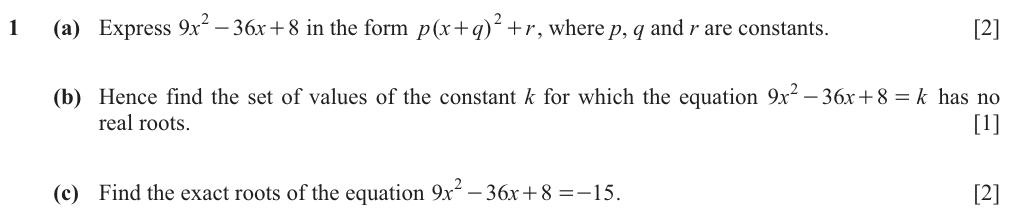
One quadratic, three jobs. First rewrite it in completed-square form. Then use that form twice: to see which values of \(k\) the quadratic can never reach, and to solve an equation exactly.
- Hencepart (b) must use part (a): the completed square shows the least value straight away
- no real rootsthe equation \(9x^2-36x+8=k\) has no solution: \(k\) is below every value the quadratic can take
- exact rootsleave surds in: \(2+\frac{\sqrt{13}}{3}\), not 3.20
- (a)\(p,\ q,\ r\)
- (b)set of values of \(k\)
- (c)exact roots
- \(9x^2-36x+8\)the quadratic
- \(=k\)(b)
- \(=-15\)(c)
- in completed-square form, the least value of the quadratic is the constant at the end
- (a) Find\(p(x+q)^2+r\)
- Usetake 9 out of the x terms, halve −4, subtract, multiply back
- (b) Find\(k\) with no real roots
- Use\(9(x-2)^2\ge0\), so the quadratic is never below \(r\)
- Needsr from (a)
- Use\(9(x-2)^2\ge0\), so the quadratic is never below \(r\)
- (c) Findexact roots
- Useset \(9(x-2)^2-28=-15\), isolate the square, square-root (±)
- Trapforgetting ± gives only one root
Why is the answer to (b) a range of k, not one value?
Every \(k\) below the least value \(-28\) is unreachable, so there are infinitely many: \(k<-28\).
Should (b) be k < −28 or k ≤ −28?
At \(k=-28\) there IS a root (\(x=2\)), a repeated one. "No real roots" needs strictly below: \(k<-28\).
5 Now solve it have a go on paper first, then open the worked solution
- (a) \(9(x^2-4x)+8 = 9[(x-2)^2-4]+8 = \mathbf{9(x-2)^2-28}\) B2
- (b) \(9(x-2)^2\ge0\), so \(9x^2-36x+8\ge-28\). No real roots when \(\mathbf{k<-28}\) B1FT
- (c) \(9(x-2)^2-28 = -15\Rightarrow (x-2)^2 = \tfrac{13}{9}\) M1
- \(x-2 = \pm\tfrac{\sqrt{13}}{3}\Rightarrow x = \mathbf{2\pm\tfrac{\sqrt{13}}{3}}\) (or \(\tfrac{6\pm\sqrt{13}}{3}\)) A1
The scheme also accepts the formula in (c): \(x = \tfrac{36\pm\sqrt{36^2-4\times9\times23}}{18}\). It allows "ISW if decimals given after the exact answers", but decimals alone lose the A1.
Expand (a): \(9(x^2-4x+4)-28 = 9x^2-36x+8\) ✓. In (c), \(-15 > -28\), so roots must exist ✓; \(2\pm1.20\) gives 3.20 and 0.80, and \(9(3.2)^2-36(3.2)+8 \approx -15\) ✓.
Example 2 · A negative x² coefficient and the vertex (Paper 1, 3 marks) ★ Easy

The curve is an upside-down parabola (the \(x^2\) term is negative). We rewrite it so the turning point can be read off, then state that point.
- −a(x − b)²the form already has the minus outside; \(a\), \(b\), \(c\) are positive
- vertexthe turning point: here a maximum, because the curve is ∩
- (a)\(a,\ b,\ c\) and the vertex
- \(-2x^2+8x+11\)the quadratic
- Findthe vertex
- Use\(-a(x-b)^2+c\) has vertex \((b,\ c)\)
- Firstcomplete the square with \(-2\) taken out
- Trap\(8x\div(-2) = -4x\): the sign flips
- Use\(-a(x-b)^2+c\) has vertex \((b,\ c)\)
When you take −2 out of 8x, what is left inside?
\(-4x\). Check: \(-2\times(-4x) = 8x\).
Is the vertex a maximum or a minimum?
A maximum: the squared term is multiplied by \(-2\), so it can only pull \(y\) down from 19.
5 Now solve it have a go on paper first, then open the worked solution
- \(-2x^2+8x+11 = -2(x^2-4x)+11\) M1
- \(= -2[(x-2)^2-4]+11 = -2(x-2)^2+19\) DM1
- So \(a=2,\ b=2,\ c=19\); vertex \(\mathbf{(2,\ 19)}\) A1
Put \(x=2\) into the original: \(-8+16+11 = 19\) ✓. Expanding \(-2(x-2)^2+19\) gives \(-2x^2+8x-8+19\) ✓.
Example 3 · Completed square, "hence" solve, then sketch (Paper 1, 9 marks) ★★ Medium
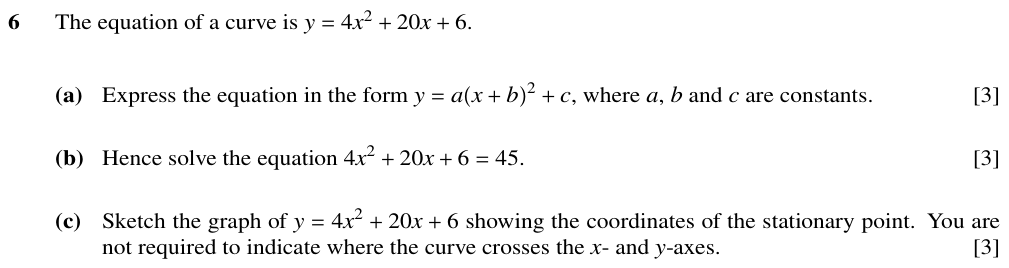
A three-part question where each part feeds the next. Part (a) is completing the square with \(a=4\) and an odd \(x\)-coefficient after dividing, so expect fractions. Part (b) says "hence": solve using the form from (a). Part (c) wants the shape and the turning point.
- Henceuse (a): isolate the bracket, then square-root - no quadratic formula
- stationary pointthe vertex - read it from the completed square
- not required to indicate where the curve crosses the axesso don't waste time on intercepts
- (a)\(a,\ b,\ c\)
- (b)both values of \(x\)
- (c)a sketch with the vertex labelled
- \(y=4x^2+20x+6\)the curve
- \(=45\)for (b)
- \(b = \tfrac52\) is a fraction: keep it as a fraction, not 2.5 rounded later
- (a)\(a(x+b)^2+c\)
- Usetake 4 out: \(x^2+5x\), half of 5 is \(\tfrac52\)
- (b)solve = 45
- Use\(4\left(x+\tfrac52\right)^2-19=45\Rightarrow\left(x+\tfrac52\right)^2=16\)
- Trap±4: there are two answers
- Use\(4\left(x+\tfrac52\right)^2-19=45\Rightarrow\left(x+\tfrac52\right)^2=16\)
- (c)sketch
- Vertex\(\left(-\tfrac52,\ -19\right)\) from (a)
- Shape\(a=4>0\): ∪
Why is the vertex at x = −5/2 and not +5/2?
The bracket \(x+\tfrac52\) is zero when \(x=-\tfrac52\).
Once (x + 5/2)² = 16, what is the next line?
\(x+\tfrac52 = \pm4\). Taking only +4 loses an answer.
5 Now solve it have a go on paper first, then open the worked solution
- (a) \(4(x^2+5x)+6 = 4\left[\left(x+\tfrac52\right)^2-\tfrac{25}{4}\right]+6 = \mathbf{4\left(x+\tfrac52\right)^2-19}\) B1 B1 B1
- (b) \(4\left(x+\tfrac52\right)^2-19 = 45\Rightarrow\left(x+\tfrac52\right)^2 = 16\) M1
- \(x+\tfrac52 = \pm4\) DM1 \(\Rightarrow x = \mathbf{\tfrac32}\) or \(\mathbf{-\tfrac{13}{2}}\) A1
- (c) ∪-shaped curve, seen on both sides of the vertex B1; minimum point \(\left(-\tfrac52,\ -19\right)\) labelled B1FT B1FT
Substitute \(x=\tfrac32\): \(4(2.25)+30+6 = 45\) ✓. Both roots are equally far (4) from \(-\tfrac52\): symmetry ✓.
Example 4 · f(x) > 2 for every x (Paper 1, 4 marks) ★★ Medium

The graph of \(y = x^2-6x+c\) is a ∪ shape. "\(f(x)>2\) for all \(x\)" means the whole curve sits above the line \(y=2\) - in particular its lowest point does.
- for all values of xit must be true at the worst point: the minimum
- set of possible valuesthe answer is an inequality in \(c\)
- the set of values of \(c\)
- \(f(x) = x^2-6x+c\)\(c\) unknown
- \(f(x)>2\)for every x
- the least value of \(f(x)\) must be more than 2
- Findthe set of \(c\)
- Useleast value of f > 2
- Needsthe least value: complete the square, \((x-3)^2-9+c\)
- Trap\(c\ge11\): at \(c=11\) the least value equals 2, which is not \(>2\)
- Useleast value of f > 2
Where is f(x) smallest?
At \(x=3\), where \((x-3)^2=0\); the least value is \(c-9\).
Could you use the discriminant instead?
Yes: \(x^2-6x+c-2>0\) for all \(x\) means no real roots, so \(36-4(c-2)<0\). Same answer, \(c>11\).
5 Now solve it have a go on paper first, then open the worked solution
- \(x^2-6x+c = (x-3)^2-9+c\), so \((x-3)^2-9+c>2\) M1 A1
- \((x-3)^2\ge0\), so the condition is \(-9+c>2\) M1
- \(\mathbf{c>11}\) A1
Alternative 1 (calculus): \(f'(x)=2x-6=0\Rightarrow x=3\), \(f(3)=c-9>2\Rightarrow c>11\). Alternative 2 (discriminant): \(x^2-6x+(c-2)>0\) always, so \(b^2-4ac = 36-4(c-2)<0\Rightarrow c>11\). All three are on the scheme.
Try \(c=12\): \(f(x)=(x-3)^2+3\ge3>2\) ✓. Try \(c=11\): \(f(3)=2\), not \(>2\) ✓ so 11 itself is excluded.
Example 5 · A bracket starting 4x, and the one root (Paper 1, 4 marks) ★★★ Hard

Why it is hard: the June 2021 report says most candidates found k and stopped, or never linked (b) to (a).
Part (a) is completing the square in an unusual form. Part (b) is the clever bit: "exactly one root" means the line \(y=k\) just touches the curve - at its vertex.
- (4x + a)²the bracket starts with 4x; do not take 16 out
- exactly one roota repeated root: \(k\) is the least value, and the root is where the square is zero
- (a)\(a\) and \(b\)
- (b)the root (x)
- \(16x^2-24x+10\)
- \(=k\)exactly one root
- the question asks for the root (an \(x\)-value), not for \(k\)
- (a)\((4x+a)^2+b\)
- Useexpand: \(16x^2+8ax+a^2+b\), compare
- (b)the single root
- Use\((4x-3)^2+1=k\) has one root only when \((4x-3)^2=0\)
- So\(k=1\) and \(4x-3=0\)
- Trapstopping at k = 1: the question wants x
- Use\((4x-3)^2+1=k\) has one root only when \((4x-3)^2=0\)
Why does 'exactly one root' happen at the vertex?
The line \(y=k\) cuts a ∪ twice, misses it, or touches it once - at the lowest point.
What if you used the discriminant instead?
\(24^2-4(16)(10-k)=0\) gives \(k=1\); you then still need the root, \(x = -\tfrac{b}{2a} = \tfrac{24}{32} = \tfrac34\).
5 Now solve it have a go on paper first, then open the worked solution
- (a) \((4x+a)^2+b = 16x^2+8ax+a^2+b\): \(8a=-24\Rightarrow a=-3\); \(9+b=10\Rightarrow b=1\). \(\mathbf{(4x-3)^2+1}\) B1 B1
- (b) One root when \((4x-3)^2+1=k\) has a repeated root: \(k=1\) B1FT
- \((4x-3)^2=0\Rightarrow x = \mathbf{\tfrac34}\) B1
The June 2021 report: most candidates "did not see the connection between the two parts" and used the discriminant; "only the strongest responses realised that this value of k needed to be used to find the value of the root."
\(16\left(\tfrac34\right)^2-24\left(\tfrac34\right)+10 = 9-18+10 = 1 = k\) ✓.
Summary
- \(x^2+bx = \left(x+\tfrac b2\right)^2-\left(\tfrac b2\right)^2\). If \(a\ne1\), take \(a\) out of the \(x\) terms first; multiply the subtracted number by \(a\) when you put it back.
- \(y=a(x+p)^2+q\): vertex \((-p,\ q)\); minimum if \(a>0\), maximum if \(a<0\); line of symmetry \(x=-p\).
- Match the exact form the question asks for; compare coefficients when the form is unusual.
- A square is never negative: that proves "always positive" / "for all \(x\)" statements.
| If you see… | do this |
|---|---|
| "express in the form \(a(x+b)^2+c\)" | take a out of the x terms, halve, subtract the square, multiply back, check by expanding |
| an unusual form: \((4x+a)^2+b\), \(a-(x+b)^2\), \(2[(x+c)^2+d]\) | expand the form and compare coefficients |
| "hence" after a completed square | use it: isolate the bracket, square-root with ± |
| "vertex", "stationary point", "greatest/least value" | read (−p, q) from the completed square |
| "for all values of \(x\)", "always positive" | complete the square and argue from (bracket)² ≥ 0 |
| "exactly one root" / "repeated root" | the line touches the vertex: the square bracket is 0 |
Can I do this?
- I know what each of the three forms of a quadratic shows.
- I can complete the square when \(a=1\), \(a>1\), \(a<0\), and in the forms \(a-(x+b)^2\), \((px+q)^2+r\) and \(a[(x+c)^2+d]\).
- I can complete the square by expanding and comparing coefficients.
- I can read the vertex, the least/greatest value and the line of symmetry, without the sign trap.
- I can sketch a quadratic with the right shape and the vertex labelled.
- I can prove an expression is always positive (or always above a value) from its completed square.
Anything unticked: revise that section first. All ticked: take the quiz.
Quiz
The multiple-choice and guided questions need JavaScript. The concept checks and exam practice below work without it.
Concept checks
Answer each one in your head first, then open it.
1Why does \(x^2+6x+20\) have no real roots, without using the discriminant?Show answer
\(x^2+6x+20 = (x+3)^2+11\ge11>0\): it can never equal 0.
2Can a quadratic with \(a<0\) have a minimum point?Show answer
No. \(a(x+p)^2\) with \(a<0\) is never positive, so \(q\) is the greatest value: the turning point is a maximum.
3Two students write \(2x^2-12x+1\) as \(2(x-3)^2-17\) and as \((\sqrt2x-3\sqrt2)^2-17\). Are both right?Show answer
Both are equal to the quadratic, but only the first is in the form \(a(x+b)^2+c\) with a number outside. Always match the requested form.
4The vertex of \(y=a(x+p)^2+q\) is \((-p,\,q)\). What is the vertex of \(y=a(x+p)^2+q\) after the curve is moved 3 units right?Show answer
\((-p+3,\ q)\). (Transformations are on the Functions pages; the completed square shows the shift directly.)
Exam-style practice
New questions, not used above. Do them on paper, then mark your work against the official mark scheme.

Show the mark scheme
| Part | Answer / working | Marks | Guidance |
|---|---|---|---|
| (a) | \(10-(x+3)^2\) | B1B1B1 | one mark each for the \(10\), the \(+\) sign in the bracket and the \(3\) |
| Total: 3 marks | |||
Examiner tip Working: \(1-(x^2+6x)=1-[(x+3)^2-9]=10-(x+3)^2\). Expanding your answer back to \(1-6x-x^2\) is the 20-second check.
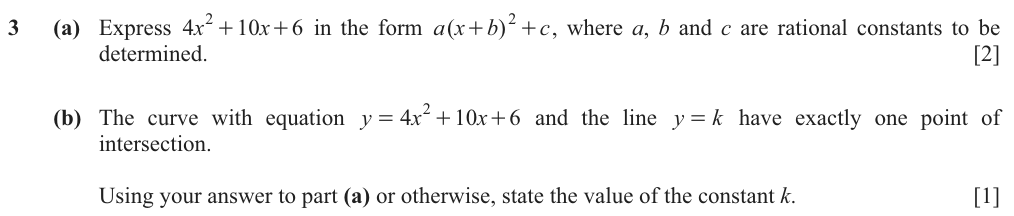
Show the mark scheme
| Part | Answer / working | Marks | Guidance |
|---|---|---|---|
| (a) | \(4\left(x+\tfrac54\right)^2-\tfrac14\) | B2 | B1 for any two of \(a=4,\ b=\tfrac54,\ c=-\tfrac14\); decimals allowed |
| (b) | \(k=-\tfrac14\) | B1FT | follow through their \(c\); not \(x=-\tfrac54\) |
| Total: 3 marks | |||
Examiner tip Exactly one meeting point with a horizontal line means the line passes through the vertex, so \(k\) is the least value: the constant from (a).
Your progress on this note is saved when JavaScript is on.