
Coordinate Geometry
Lines and circles: intersections, chords and tangents
What you need to be able to do
- 1.3Find where a line meets a circle (substitution), and the length of a chord.
- 1.3Use the discriminant: the line cuts, touches (tangent) or misses the circle; find tangents with a given gradient or through a given point.
- 1.3Use geometry and symmetry: where two tangents meet, two circles, distances from a centre to a line.
Before you start: Circles and Where a line meets a curve (the same discriminant method).
Where a line meets a circle, how the discriminant counts the meeting points, tangents and two circles, with our own examples. Past-paper questions come in Part 2.
What you should already know
The circle equation
\((x-a)^2+(y-b)^2=r^2\): centre \((a,b)\), radius \(r\) (Circles).
Quick check: centre and radius of \(x^2+(y+3)^2=16\)?
\((0,\,-3)\), \(4\)
Line meets curve
Substitute the line into the curve; each root of the quadratic is a meeting point (Where a line meets a curve).
Quick check: where does \(y=x\) meet \(y=x^2-2\)?
\(x^2-x-2=0\): \((2,2)\), \((-1,-1)\)
The discriminant
\(b^2-4ac>0\) two roots, \(=0\) one repeated root, \(<0\) none.
Quick check: \(x^2+4x+4=0\)?
\(16-16=0\): one repeated root
Tangent ⟂ radius
A tangent meets the radius at the point of contact at right angles.
Quick check: radius gradient \(\tfrac12\); tangent gradient?
\(-2\)
Where a line meets a circle
- Make \(y\) (or \(x\)) the subject of the line.
- Substitute into the circle equation, with brackets round the whole expression.
- Expand and collect to a 3-term quadratic \(=0\).
- Solve it; then get the other coordinate from the line.
- Chord length \(AB\) = distance between the two points (\(\sqrt{(x_2-x_1)^2+(y_2-y_1)^2}\)).
Example. Where does \(y=x+1\) meet \(x^2+y^2=13\)? Substitute: \(x^2+(x+1)^2=13\Rightarrow2x^2+2x-12=0\Rightarrow x^2+x-6=0\Rightarrow(x+3)(x-2)=0\). So \(x=2,\ y=3\) and \(x=-3,\ y=-2\). The chord from \((2,3)\) to \((-3,-2)\) has length \(\sqrt{25+25}=5\sqrt2\).
Two points
discriminant \(>0\): the line is a secant, \(AB\) is a chord.
One point
discriminant \(=0\): the line is a tangent; the repeated root is the point of contact.
No points
discriminant \(<0\): the line misses the circle.
Geometry check
Same three cases by distance: the perpendicular distance from the centre to the line is \(<r\), \(=r\), \(>r\). Useful for "a circle with centre C that touches the line".
- Is \(y=x+4\) a tangent to \(x^2+y^2=8\)?
Answer
\(2x^2+8x+8=0\Rightarrow(x+2)^2=0\): yes, touching at \((-2,\,2)\) - Find the values of \(c\) for which \(y=x+c\) meets \(x^2+y^2=8\).
Answer
\(2x^2+2cx+c^2-8=0\); \(4c^2-8(c^2-8)\ge0\): \(-4\le c\le4\)
Finding tangents: three situations
1 Tangent at a known point on the circle
At \(P\) on the circle: use the radius (previous page).
Askedtangent at PKnowP and the centreRoutegradient −1/m_CP through P
- \(m_{CP}\), then \(-\dfrac1{m_{CP}}\)
- line through \(P\)
2 Tangents with a given gradient
\((x+1)^2+(y-2)^2=45\). Find the \(x\)-coordinates where the tangents with gradient 2 touch.
Askedx-coordinates of contactKnowcontact points are at the ends of the diameter perpendicular to the tangentsRoutenormal through the centre with gradient −½; meet the circle
- Normal through \(C(-1,2)\) with gradient \(-\tfrac12\): \(y-2=-\tfrac12(x+1)\)
- \((x+1)^2+\tfrac14(x+1)^2=45\Rightarrow\tfrac54(x+1)^2=45\Rightarrow(x+1)^2=36\)
- \(x=5\) or \(x=-7\)
Alternatively: y = 2x + c into the circle and discriminant = 0 gives c, then the points. The normal route is quicker (see Circles, tangents case 3).
3 Tangents from a point outside
Tangents from \(A(0,5)\) to \(x^2+y^2=5\): find their gradients.
Askedm (two values)Knowthe tangent is y = mx + 5, m unknownRoutesubstitute, discriminant = 0, solve for m
- \(x^2+(mx+5)^2=5\Rightarrow(1+m^2)x^2+10mx+20=0\)
- \((10m)^2-4(1+m^2)(20)=0\Rightarrow20m^2-80=0\)
- \(m=\pm2\)
4 An unknown in the circle
\((x-a)^2+y^2=5\) has \(y=2x\) as a tangent. Find \(a\).
Askeda (two values)Knowtangent: one repeated rootRoutesubstitute, discriminant = 0 gives an equation in a
- \((x-a)^2+4x^2=5\Rightarrow5x^2-2ax+a^2-5=0\)
- \(4a^2-20(a^2-5)=0\Rightarrow16a^2=100\)
- \(a=\tfrac52\) or \(a=-\tfrac52\)
Check with distances: the centre \((a,0)\) is \(\tfrac{|2a|}{\sqrt5}\) from \(2x-y=0\); that equals \(r=\sqrt5\) when \(|a|=\tfrac52\) ✓
Two tangents meeting: use symmetry
- Find \(A\) and \(B\): \(x^2+y^2-4x+6y-12=0\) with \(y=0\) gives \(x^2-4x-12=0\Rightarrow x=-2,\ 6\).
- Centre \(C(2,-3)\). Gradient \(CA=\tfrac{0+3}{-2-2}=-\tfrac34\) ⇒ tangent at \(A\): gradient \(\tfrac43\), \(y=\tfrac43(x+2)\).
- Gradient \(CB=\tfrac34\) ⇒ tangent at \(B\): gradient \(-\tfrac43\), \(y=-\tfrac43(x-6)\).
- Solve, or use symmetry: they meet on \(x=2\) (the line through the centre perpendicular to \(AB\)): \(y=\tfrac43(4)=\tfrac{16}3\). Point \(\left(2,\tfrac{16}3\right)\).
The sketch shows the symmetry at once. Note that both points on the \(x\)-axis have \(y=0\), which is how they were found.
Two circles
- Distance between centres \(d\) (distance formula).
- Greatest distance between points on the circles: \(d+r_1+r_2\); least: \(d-r_1-r_2\) (if the circles are separate).
- Touching externally: \(d=r_1+r_2\); internally: \(d=|r_1-r_2|\).
- Common chord: subtract the two expanded equations (the \(x^2\) and \(y^2\) cancel) to get the straight line through both intersection points.
Example. \(x^2+y^2=25\) and \((x-4)^2+(y-2)^2=5\), i.e. \(x^2+y^2-8x-4y+15=0\). Subtracting: \(-25-15+8x+4y=0\Rightarrow2x+y=10\), the line through both meeting points. Putting \(y=10-2x\) into the first circle: \(x^2-8x+15=0\), so the circles meet at \((3,4)\) and \((5,0)\).
- Circles: centre \((0,0)\) radius 3, and centre \((5,0)\) radius 2. How are they placed?
Answer
\(d=5=3+2\): they touch externally - Greatest distance between a point on \(x^2+y^2=1\) and a point on \((x-6)^2+(y-8)^2=4\)?
Answer
\(d=10\): \(10+1+2=13\)
Key facts at a glance
- Substitute the line into the circle; each root is a meeting point; take the other coordinate from the line.
- Discriminant \(>0\) chord, \(=0\) tangent, \(<0\) misses. Or compare the centre-to-line distance with \(r\).
- Tangents with a known gradient: the normal through the centre meets the circle at the contact points.
- Tangents from an outside point: \(y-y_1=m(x-x_1)\), substitute, discriminant \(=0\), solve for \(m\).
- Two circles: compare \(d\) with \(r_1+r_2\) and \(|r_1-r_2|\); subtracting the equations gives the common chord.
How lines and circles are examined, what the mark scheme wants, then real Paper 1 questions worked through slowly.
How this is examined
Usually the second half of a circle question: M1 substitute the line, M1 A1 A1 solve and pair the coordinates, then a chord length, a tangent condition or a meeting point of two tangents. Past examples on these ideas: a circle touching a line 9709/12/F/M/22 Q6(b), an unknown centre from a tangent 9709/12/M/J/23 Q10(a), a common chord 9709/12/F/M/20 Q12(c).
The June 2021 report on this kind of question: "Not all candidates realised that the two points found in part (a) had y-coordinates of 0", and sign errors in the centre spoilt many. Draw the sketch: it shows the symmetry at once.
Mark-scheme focus
Find the set of values of k for which the line intersects the circle at two distinct points
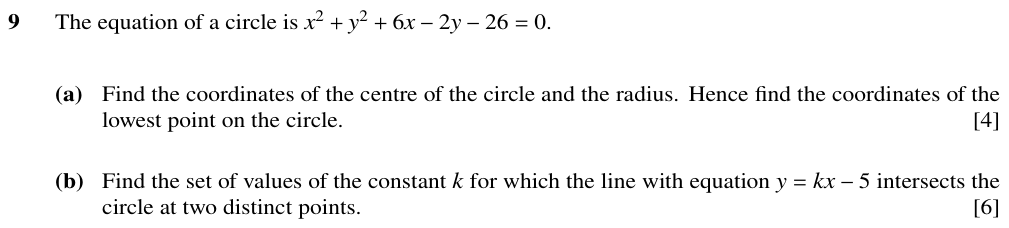
- substitute \(y=kx-5\) *M1; 3-term quadratic \((k^2+1)x^2+(6-12k)x+9=0\) DM1 A1
- \(b^2-4ac>0\) DM1; \(k=0,\ \tfrac43\) A1
- \(k<0,\ k>\tfrac43\) A1
- \(\tfrac43<k<0\) ("do not accept")
- an inside region
- using the original circle with slips in collecting terms (the June 2022 report: "slips in expanding brackets and collecting terms were very common")
From: 9709/11/M/J/22 Q9(b).
- Line ∩ circle (points, chord): 4-7 marks on most papers.
- Tangent conditions with an unknown (m, c, k or a): 4-8 marks; discriminant = 0.
- Intersection of two tangents: 6-8 marks; symmetry saves time.
- Two circles: occasional, 3-7 marks.
Worked examples
Example 1 · Intersection points and the circle on AB as diameter (Paper 1, 7 marks) ★ Easy

Substitute the line into the circle to get the two meeting points. Then a brand new circle: its centre is the midpoint of \(AB\), its radius half of \(AB\).
- intersects at A and Btwo roots of the substituted quadratic
- diameter ABcentre = midpoint, r = ½AB
- (a)A and B
- (b)new circle
- \((x-1)^2+(y+4)^2=40\)
- \(y=x-9\)
- (a)points
- Use\((x-1)^2+(x-5)^2=40\)
- (b)circle
- Centremidpoint (3, −6)
- r²CA² = 16 + 16 = 32
y + 4 becomes?
\(x-9+4=x-5\).
Why not leave r = √32?
The equation needs \(r^2=32\).
5 Now solve it have a go on paper first, then open the worked solution
- \((x-1)^2+(x-5)^2=40\) M1 \(\Rightarrow x^2-6x-7=0\Rightarrow(x+1)(x-7)=0\) M1
- \((-1,-10)\) and \((7,-2)\) A1 A1
- (b) centre \((3,-6)\) M1; \(r^2=(7-3)^2+(-2+6)^2=32\) M1; \((x-3)^2+(y+6)^2=32\) A1
\((7,-2)\): \(36+4=40\) ✓ and \(-2=7-9\) ✓.
Example 2 · Tangents from an outside point (Paper 1, 8 marks) ★★★ Hard

Why it is hard: heavy algebra with m in every coefficient, then two separate back-substitutions.
A line through \((0,-9)\) is \(y=mx-9\). Some slopes miss the circle, some cut it; exactly two touch it. Substitute, set the discriminant to 0, solve for \(m\), then go back for each point of contact.
- passes through (0, −9)c = −9
- tangentdiscriminant = 0
- for each value of mtwo points, paired
- m and the points of contact
- \((x-3)^2+y^2=18\)
- \(y=mx-9\)
- Findm
- Form\((1+m^2)x^2-(6+18m)x+72=0\)
- Use\((6+18m)^2-288(1+m^2)=0\)
- Thenpoints
- Useeach m back into the quadratic: a perfect square
Expand (mx − 9)².
\(m^2x^2-18mx+81\).
Simplify 36 + 216m + 324m² − 288 − 288m².
\(36m^2+216m-252=0\Rightarrow m^2+6m-7=0\).
5 Now solve it have a go on paper first, then open the worked solution
- \((x-3)^2+(mx-9)^2=18\) M1
- \((m^2+1)x^2-(6+18m)x+72=0\) M1
- \((6+18m)^2-4(m^2+1)(72)=0\) *M1 \(\Rightarrow m^2+6m-7=0\) DM1
- \(m=1\) or \(m=-7\) A1
- \(m=1\): \(2x^2-24x+72=0\Rightarrow x=6\), point \((6,-3)\) DM1
- \(m=-7\): \(50x^2+120x+72=0\Rightarrow x=-\tfrac65\), point \(\left(-\tfrac65,-\tfrac35\right)\) DM1 A1
Alternative on the scheme: the distance from the centre \((3,0)\) to the line \(mx-y-9=0\) equals the radius: \(\dfrac{|3m-9|}{\sqrt{m^2+1}}=\sqrt{18}\).
\((6,-3)\): \(9+9=18\) ✓, on \(y=x-9\) ✓.
Example 3 · Tangents at the axis points meet (Paper 1, 8 marks) ★★ Medium

Put \(y=0\) for \(A\) and \(B\). The tangents at \(A\) and \(B\) are mirror images in the vertical line through the centre, so they meet on that line.
- intersects the x-axisy = 0
- tangents at A and Beach ⟂ its radius
- (a)x-coordinates
- (b)intersection
- \(x^2+y^2-4x+6y-77=0\)
- centre (2, −3)
- (b)meeting point
- Centre(2, −3)
- Tangentsgradients 3 and −3
- Symmetrymeet on x = 2
Gradient of CA, A(−7, 0)?
\(\tfrac{0+3}{-7-2}=-\tfrac13\).
Tangent at A?
\(y=3(x+7)\).
5 Now solve it have a go on paper first, then open the worked solution
- (a) \(y=0\): \(x^2-4x-77=0\Rightarrow(x+7)(x-11)=0\): \(-7,\ 11\) M1 A1
- (b) centre \((2,-3)\) B1; \(m_{CA}=-\tfrac13\) M1
- tangents \(y=3x+21\) and \(y=-3x+33\) M1 A1
- meet at \((2,27)\) M1 A1
\(3(2)+21=27\) and \(-6+33=27\) ✓.
Example 4 · Two circles: greatest and least distance (Paper 1, 7 marks) ★★ Medium
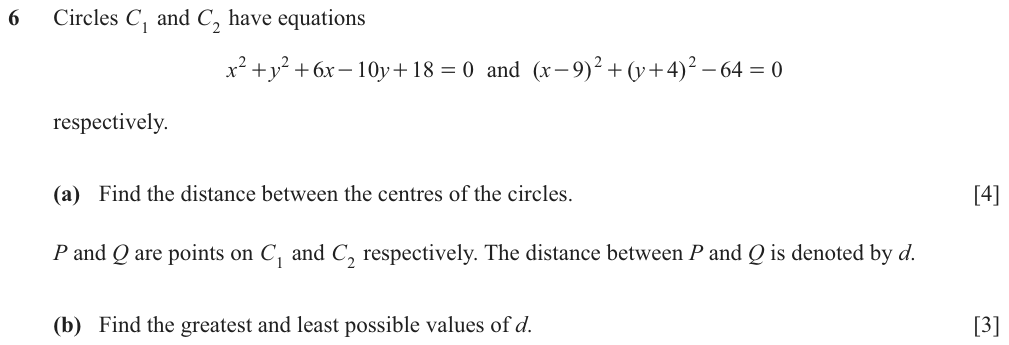
Find both centres and radii. The furthest two points are on the line through both centres, on the far sides; the closest are on that line, on the near sides.
- greatest / leastalong the line of centres: \(d\pm(r_1+r_2)\)
- (a)distance
- (b)greatest, least
- \(C_1\)expanded
- \(C_2\)centre (9, −4), r = 8
- (a)d
- C1(x + 3)² + (y − 5)² = 16
- (b)PQ
- Use15 ± (4 + 8)
Radius of C1?
\(9+25-18=16\Rightarrow r=4\).
Do the circles overlap?
\(15>4+8\): no, they are separate.
5 Now solve it have a go on paper first, then open the worked solution
- \(C_1\): centre \((-3,5)\) B1; \(C_2\): \((9,-4)\) B1
- \(d=\sqrt{12^2+9^2}=15\) M1 A1
- \(r_1=4,\ r_2=8\) B1; greatest 27, least 3 B1FT B1FT
Least 3: 3 + 4 + 8 = 15 = d ✓. Greatest 27 = 15 + 4 + 8 ✓.
Summary
- Line ∩ circle: substitute, quadratic, solve; other coordinate from the line.
- Discriminant > 0, = 0, < 0: cuts, touches, misses.
- Given gradient: normal through the centre meets the circle at the contact points. From a point: y = mx + c, discriminant = 0.
- Two tangents from symmetric points meet on the line of symmetry; two circles: d ± (r₁ + r₂).
| If you see… | do this |
|---|---|
| "points of intersection" of a line and a circle | substitute the line |
| "tangent" with an unknown | discriminant = 0 |
| "tangents with gradient m" | normal (gradient −1/m) through the centre |
| "tangents from the point …" | y − y₀ = m(x − x₀), discriminant = 0 |
| "tangents at A and B meet at P" | two tangent equations; use symmetry |
| two circles | centres, radii, distance between centres |
Can I do this?
- I can find where a line meets a circle and the length of the chord.
- I can use the discriminant for cut / touch / miss, with an unknown constant.
- I can find tangents with a given gradient, from an outside point, and with an unknown in the circle.
- I can find where two tangents meet, using symmetry.
- I can find greatest and least distances between two circles.
Anything unticked: revise that section first. All ticked: take the quiz.
Quiz
The multiple-choice and guided questions need JavaScript. The concept checks and exam practice below work without it.
Concept checks
Answer each one in your head first, then open it.
1Why do the two tangents from an outside point have equal lengths?Show answer
The figure is symmetric about the line from the point through the centre (each tangent length is \(\sqrt{d^2-r^2}\) by Pythagoras).
2How can you tell, without solving, that \(y=x\) cuts the circle \(x^2+y^2=4\)?Show answer
It passes through the centre \((0,0)\), which is inside the circle, so it must cut it twice.
3What does subtracting two circle equations give?Show answer
A straight line: the common chord through their intersection points (if they meet).
Exam-style practice
New questions, not used above. Do them on paper, then mark your work against the official mark scheme.
Show the mark scheme
| Part | Answer / working | Marks | Guidance |
|---|---|---|---|
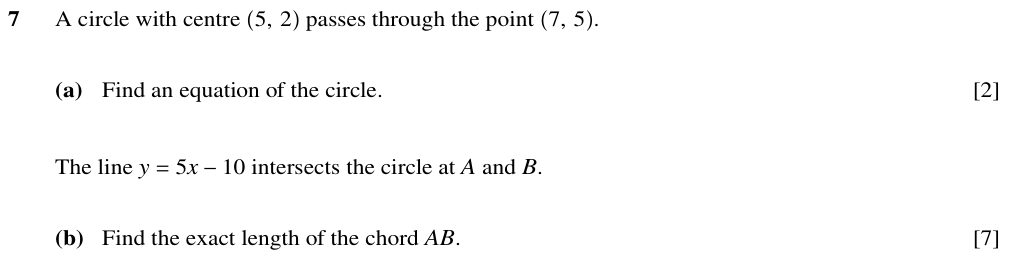
| (a) | \(r^2=(7-5)^2+(5-2)^2=13\) | B1 | |
| \((x-5)^2+(y-2)^2=13\) | B1FT | their \(r^2\) | |
| (b) | \((x-5)^2+(5x-10-2)^2=13\) | M1 | substitute the line into the circle |
| \(26x^2-130x+156=0\) (or \(x^2-5x+6=0\)) | A1 | ||
| \((x-2)(x-3)=0\) | M1 | a seen method | |
| \(A(2,0)\), \(B(3,5)\) | A1A1 | one mark for each point | |
| \(AB=\sqrt{(3-2)^2+(5-0)^2}\) | M1 | ||
| \(=\sqrt{26}\) | A1 | exact | |
| Total: 9 marks | |||
Show the mark scheme
| Part | Answer / working | Marks | Guidance |
|---|---|---|---|
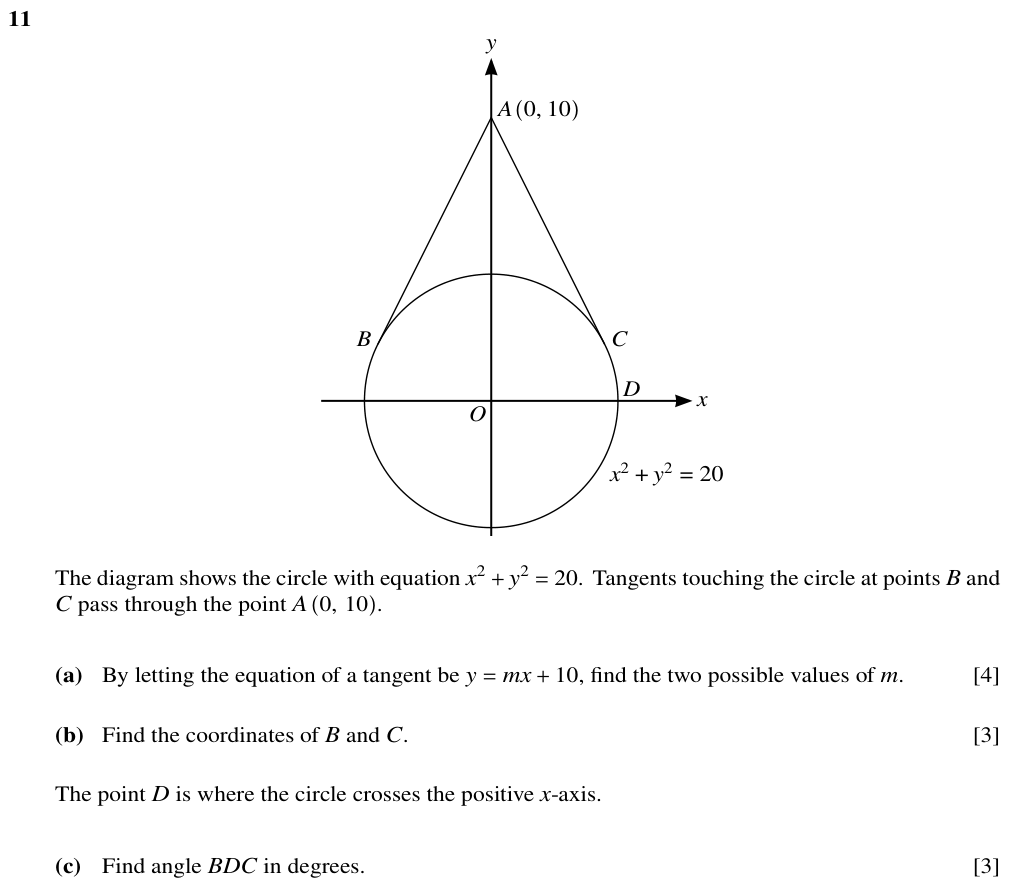
| (a) | \(x^2+(mx+10)^2=20\) | *M1 | substitute |
| \((1+m^2)x^2+20mx+80=0\) | A1 | ||
| \(400m^2-320(1+m^2)=0\) | DM1 | discriminant = 0 | |
| \(m=\pm2\) | A1 | ||
| (b) | \(5x^2\pm40x+80=0\) | M1 | each value of m put back |
| \(x=\pm4\) | A1 | ||
| \(B(-4,2)\), \(C(4,2)\) | A1 | either order | |
| Total: 7 marks | |||
Examiner tip The two points of contact are mirror images in the \(y\)-axis (the line through \(A\) and the centre), so once you have one, the other follows.
Your progress on this note is saved when JavaScript is on.