
Coordinate Geometry
Perpendicular bisectors and coordinate problems
What you need to be able to do
- 1.3Find the perpendicular bisector of a line segment, and use it (where it meets an axis or another line; finding the other end of a segment).
- 1.3Find an unknown coordinate from a condition: a right angle, equal lengths, a point on a line.
- 1.3Solve multi-step problems with triangles and quadrilaterals, using midpoints, gradients and distances.
Before you start: Straight lines. Next: Circles (the centre of a circle is on the perpendicular bisector of every chord).
The perpendicular bisector and the standard conditions (right angle, equal lengths, a point on a line), from the basics, with our own examples. Past-paper questions come in Part 2.
What you should already know
Midpoint and gradient
Midpoint = average of the coordinates; gradient = \(\tfrac{\text{change in }y}{\text{change in }x}\) (Straight lines).
Quick check: midpoint and gradient of \((0,\,4)\) and \((6,\,0)\)?
\((3,\,2)\); \(-\tfrac23\)
Perpendicular gradients
\(m_1m_2=-1\): flip the fraction and change the sign. \(\tfrac25\to-\tfrac52\).
Quick check: perpendicular to gradient \(-4\)?
\(\tfrac14\)
Equation of a line
\(y-y_1=m(x-x_1)\) through a known point.
Quick check: line through \((3,\,5)\), gradient 2
\(y=2x-1\)
Simultaneous linear equations
Two lines meet where both equations hold: substitute one into the other.
Quick check: where do \(y=x+1\) and \(y=-x+5\) meet?
\((2,\,3)\)
The perpendicular bisector
- Midpoint \(M\) of \(AB\).
- Gradient of \(AB\), then the perpendicular gradient \(-\dfrac{1}{m_{AB}}\).
- Line through the midpoint \(M\) (not \(A\), not \(B\)) with that gradient.
That last fact is why it matters: the centre of any circle through \(A\) and \(B\) lies on it (a circle's centre is equidistant from every point on the circle). So "show that the centre lies on the line …" is a perpendicular-bisector question.
Why every point on it is equidistant. Take any point \(P\) on the bisector. Triangles \(PMA\) and \(PMB\) share the side \(PM\), have \(MA=MB\) (\(M\) is the midpoint) and both have a right angle at \(M\). So they are congruent, and \(PA=PB\). Conversely, the set of all points equidistant from \(A\) and \(B\) is exactly this line.
- Find the perpendicular bisector of \((1,\,3)\) and \((5,\,7)\).
Answer
\(M(3,5)\), \(m=1\), so gradient \(-1\): \(y=-x+8\) - Check that \((4,\,4)\) on that line is equidistant from both points.
Answer
\(\sqrt{9+1}=\sqrt{10}\) and \(\sqrt{1+9}=\sqrt{10}\) ✓
Finding unknowns: the standard conditions
A right angle at R
\(m_{PR}\times m_{RQ}=-1\), or Pythagoras \(PR^2+RQ^2=PQ^2\), or (circle questions) \(R\) is on the circle with diameter \(PQ\). Any of the three works.
Equal lengths
\(AC=BC\): write both squared distances and equate (no square roots needed). Or: \(C\) is on the perpendicular bisector of \(AB\).
A point on a line
Substitute its coordinates into the line's equation. \(C(2p,\ p)\) is on \(y=\tfrac12x\) for every \(p\): a hint that one unknown is enough.
The other end of a segment
If \(M\) is the midpoint of \(AB\): \(B=2M-A\), i.e. \((2m_x-a_x,\ 2m_y-a_y)\). Same for reflecting a point through a point.
1 Find B from the perpendicular bisector
\(A(6,1)\), \(B(p,q)\); the perpendicular bisector of \(AB\) is \(y=-3x+9\). Find \(p\) and \(q\).
Askedp and qKnowthe bisector has gradient −3, so AB has gradient ⅓Routeline AB through A; meet the bisector at M; double the step from A to M
- \(m_{AB}=\tfrac13\): \(y-1=\tfrac13(x-6)\)
- Meet \(y=-3x+9\): \(-3x+9=\tfrac13x-1\Rightarrow\tfrac{10}3x=10\Rightarrow x=3\), \(y=0\): \(M(3,0)\)
- \(B=2M-A=(6-6,\ 0-1)=(0,-1)\)
B is NOT on the perpendicular bisector, and the meeting point is the midpoint, not B. A sketch prevents both mistakes.
2 Find B from A and the bisector's equation
\(A(-1,7)\); the perpendicular bisector of \(AB\) is \(y=2x+4\). Find \(B\).
AskedAB, then BKnowbisector gradient 2RouteAB gradient −½ through A; meet; double
- \(AB\): \(y-7=-\tfrac12(x+1)\), i.e. \(2y=-x+13\)
- With \(y=2x+4\): \(2(2x+4)=-x+13\Rightarrow x=1,\ y=6\): \(M(1,6)\)
- \(B=(2-(-1),\ 12-7)=(3,5)\)
3 C on the bisector and on a parallel line
\(A(1,2)\), \(B(7,6)\). \(C\) is on the perpendicular bisector of \(AB\) and on the line through \((5,9)\) parallel to \(AB\).
AskedCKnowtwo lines, both through known pointsRoutewrite both lines, solve simultaneously
- \(M(4,4)\), \(m_{AB}=\tfrac23\): bisector \(y-4=-\tfrac32(x-4)\), i.e. \(y=-\tfrac32x+10\)
- parallel line: \(y-9=\tfrac23(x-5)\)
- solve: \(-\tfrac32x+10=\tfrac23x+\tfrac{17}3\Rightarrow\tfrac{13}6x=\tfrac{13}3\Rightarrow x=2\): \(C(2,7)\)
4 Right angle: an unknown coordinate
\(P(-3,1)\), \(Q(7,1)\), \(R(5,k)\); angle \(PRQ=90°\). Find \(k\).
Askedk (two values)KnowPR ⟂ RQRoutegradients in k, product −1, quadratic
- \(m_{PR}=\dfrac{k-1}{8}\), \(m_{RQ}=\dfrac{1-k}{2}\)
- \(\dfrac{(k-1)(1-k)}{16}=-1\Rightarrow(k-1)^2=16\)
- \(k-1=\pm4\): \(k=5\) or \(-3\)
Same answer by the circle route: R is on the circle with diameter PQ, centre \((2,1)\), radius 5: \((5-2)^2+(k-1)^2=25\).
5 Equal lengths: an unknown coordinate
\(A(1,4)\), \(B(7,2)\), \(C(p,2p)\); \(AC=BC\). Find \(p\).
AskedpKnowtwo distances equalRouteequate the squared distances; the squares cancel
- \((p-1)^2+(2p-4)^2=(p-7)^2+(2p-2)^2\)
- \(5p^2-18p+17=5p^2-22p+53\Rightarrow4p=36\)
- \(p=9\): \(C(9,18)\). Check: \(AC^2=64+196=260=BC^2\) ✓
- \(A(2,\,1)\), \(B(6,\,k)\). \(AB\) is perpendicular to \(y=2x\). Find \(k\).
Answer
\(\tfrac{k-1}4=-\tfrac12\Rightarrow k=-1\) - \(M(3,\,-2)\) is the midpoint of \(A(-1,\,4)\) and \(B\). Find \(B\).
Answer
\(B=2M-A=(7,\,-8)\) - \(A(0,\,0)\), \(B(4,\,0)\), \(C(2,\,c)\) with \(AC=BC=\sqrt{13}\). Find \(c\).
Answer
\(4+c^2=13\): \(c=\pm3\)
Key facts at a glance
- Perpendicular bisector of \(AB\): through the midpoint, gradient \(-\tfrac1{m_{AB}}\). Every point on it is equidistant from \(A\) and \(B\).
- Right angle at \(R\): \(m_{PR}m_{RQ}=-1\), or Pythagoras, or \(R\) on the circle with diameter \(PQ\).
- Equal lengths: equate squared distances. A point on a line: substitute it in.
- Other end of a segment: \(B=2M-A\).
- Sketch every problem first and label what you know.
How these problems are examined, what the mark scheme wants, then real Paper 1 questions worked through slowly.
How this is examined
A perpendicular bisector is worth about 5 marks: B1 midpoint, B1 *M1 gradient and its negative reciprocal, DM1 A1 the line through the midpoint. The November 2022 report on 9709/12/O/N/22 Q1(a) named the two errors: using \(A\) or \(B\) instead of the midpoint, and forgetting the negative reciprocal. When \(B\) has to be found from the bisector, the June 2021 report saw candidates assume \(B\) lies on the bisector, or take the meeting point as \(B\). Schemes accept all three right-angle methods 9709/13/M/J/25 Q9(a), and "show the centre lies on …" is a bisector question 9709/13/O/N/24 Q10(a).
Mark-scheme focus
Find the equation of the perpendicular bisector of AB

- midpoint \(\left(\tfrac{15}2,\ \tfrac12\right)\) (accept unsimplified) B1
- \(m_{AB}=-\tfrac35\Rightarrow\) perpendicular \(\tfrac53\) M1
- \(y-\tfrac12=\tfrac53\left(x-\tfrac{15}{2}\right)\), "any correct version", e.g. \(5x-3y=36\) A1
- a line through \(A\) or \(B\) with gradient \(\tfrac53\)
- gradient \(-\tfrac35\) (that is \(AB\) itself)
- \(\tfrac{\text{change in }x}{\text{change in }y}\)
From: 9709/12/O/N/22 Q1(a) and the November 2022 report.
- Perpendicular bisector: 3-5 marks, often (a) of a circle question.
- Unknown coordinate from a right angle / equal lengths: 3-4 marks; the resulting quadratic needs a seen method.
- Multi-step coordinate problems (pre-2020 style, still possible): 6-8 marks.
Worked examples
Example 1 · Perpendicular bisector meeting an axis (Paper 1, 5 marks) ★ Easy

Build the perpendicular bisector (midpoint + perpendicular gradient), then put \(x=0\) to see where it crosses the \(y\)-axis.
- perpendicular bisectorthrough the midpoint, at right angles
- y-axisx = 0
- coordinates of C
- \(A(1,3)\)
- \(B(9,-1)\)
- FindC
- LineM(5, 1), gradient 2
- Thenx = 0
Gradient of AB?
\(\tfrac{-1-3}{9-1}=-\tfrac12\).
Perpendicular gradient?
2.
5 Now solve it have a go on paper first, then open the worked solution
- \(M(5,1)\) B1
- \(m_{AB}=-\tfrac12\) B1; perpendicular gradient 2 *M1
- \(y-1=2(x-5)\Rightarrow y=2x-9\) DM1
- \(C(0,-9)\) A1
\(CA^2=1+144=145\), \(CB^2=81+64=145\): C is equidistant from A and B ✓.
Example 2 · The other end of a segment (Paper 1, 4 marks) ★★ Medium

We know one end, \(A\), and the bisector. The bisector tells us the gradient of \(AB\) (perpendicular to −2: \(\tfrac12\)) and contains the midpoint. So draw line \(AB\), find where it hits the bisector: that's \(M\). Then \(B\) is as far beyond \(M\) as \(A\) is before it.
- perpendicular bisector y = −2x + 4gradient −2; contains the midpoint of AB
- p and q
- \(A(8,3)\)
- \(y=-2x+4\)bisector
- B is NOT on the bisector; M is
- FindB
- ABgradient ½ through A
- MAB ∩ bisector
- ThenB = 2M − A
Solve −2x + 4 = ½x − 1.
\(5=\tfrac52x\Rightarrow x=2\), \(y=0\).
From A(8, 3) to M(2, 0) is a step of?
\((-6,-3)\); repeat it: \(B(-4,-3)\).
5 Now solve it have a go on paper first, then open the worked solution
- \(m_{AB}=\tfrac12\) B1
- \(-2x+4=\tfrac12(x-8)+3\Rightarrow x=2\) *M1
- \(\tfrac{8+p}2=2\), \(\tfrac{3+q}2=0\) DM1
- \(p=-4,\ q=-3\) A1
Midpoint of \((8,3)\) and \((-4,-3)\) is \((2,0)\), on \(y=-2x+4\) ✓; \(m_{AB}=\tfrac{6}{12}=\tfrac12\) ✓.
Example 3 · Equal lengths, then a right angle (Paper 1, 7 marks) ★★★ Hard
Why it is hard: two different conditions on the same point, a quadratic that must be solved with method shown, and a root to reject.
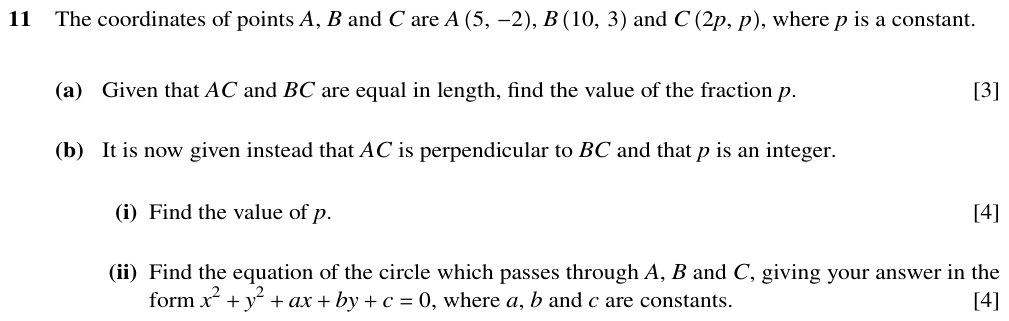
Two separate conditions on the same unknown point \(C(2p,p)\). (a) equal lengths: equate squared distances. (b) a right angle at \(C\): gradients multiply to −1. "Instead" means (a)'s answer doesn't carry over.
- equal in lengthAC² = BC²
- perpendicular\(m_{AC}m_{BC}=-1\)
- p is an integerreject the fraction root
- insteadstart again
- (a)p
- (b)(i)integer p
- \(A(5,-2)\), \(B(10,3)\)
- \(C(2p,p)\)
- (a)p
- Use\((5-2p)^2+(p+2)^2=(10-2p)^2+(3-p)^2\)
- (b)p
- Use\(\tfrac{p+2}{2p-5}\cdot\tfrac{p-3}{2p-10}=-1\)
- Trapequating the gradients instead of multiplying to −1
In (a), what happens to the p² terms?
\(5p^2\) on both sides: they cancel, leaving a linear equation.
Factorise 5p² − 31p + 44.
\((p-4)(5p-11)\): \(p=4\) (integer) or \(\tfrac{11}5\).
5 Now solve it have a go on paper first, then open the worked solution
- (a) \(25-20p+5p^2+4p+4=100-40p+5p^2-6p+9\) M1 A1 \(\Rightarrow30p=80\Rightarrow p=\tfrac83\) A1
- (b)(i) \(m_{AC}=\dfrac{p+2}{2p-5}\), \(m_{BC}=\dfrac{p-3}{2p-10}\) M1; product \(=-1\) M1
- \(p^2-p-6=-(4p^2-30p+50)\Rightarrow5p^2-31p+44=0\) A1
- \((p-4)(5p-11)=0\Rightarrow p=4\) A1
The November 2022 report: common errors were "to merely let the expressions for the gradients of AC and BC equal each other or to multiply one of the gradient expressions by –1 and then equate"; Pythagoras was a reliable alternative.
\(C(8,4)\): \(m_{AC}=\tfrac63=2\), \(m_{BC}=\tfrac{1}{-2}\); product \(-1\) ✓.
Summary
- Perpendicular bisector = midpoint + negative reciprocal gradient.
- Right angle: m₁m₂ = −1 (or Pythagoras). Equal lengths: equate squared distances.
- Midpoint M of AB: B = 2M − A.
- Draw a sketch: it stops you confusing B with M.
| If you see… | do this |
|---|---|
| "perpendicular bisector" | midpoint, −1/m, line through the midpoint |
| "equidistant from A and B" | on the perpendicular bisector of AB |
| "angle ABC = 90°" | \(m_{AB}m_{BC}=-1\) |
| "AC = BC" | squared distances equal |
| "M is the mid-point", find B | B = 2M − A |
Can I do this?
- I can find the equation of a perpendicular bisector and use it.
- I can find an unknown coordinate from a right angle or from equal lengths.
- I can find the other end of a segment from a midpoint or a bisector.
Anything unticked: revise that section first. All ticked: take the quiz.
Quiz
The multiple-choice and guided questions need JavaScript. The concept checks and exam practice below work without it.
Concept checks
Answer each one in your head first, then open it.
1Why does the centre of a circle through \(A\) and \(B\) lie on the perpendicular bisector of \(AB\)?Show answer
The centre is the same distance (the radius) from A and from B, and the perpendicular bisector is exactly the set of such points.
2Can you find the circumcentre of a triangle with perpendicular bisectors?Show answer
Yes: it is where any two of the three perpendicular bisectors meet.
3Why is equating squared distances safer than equating distances?Show answer
No square roots to handle, and the equations are equivalent because distances are positive.
Exam-style practice
New questions, not used above. Do them on paper, then mark your work against the official mark scheme.

Show the mark scheme
| Part | Answer / working | Marks | Guidance |
|---|---|---|---|
| (i) | bisector gradient \(\tfrac32\), so \(m_{AB}=-\tfrac23\) | B1 | |
| \(y-6=-\tfrac23(x+2)\) | M1 | line through A with their perpendicular gradient | |
| \(3y+2x=14\) (or any correct form) | A1 | ||
| (ii) | solve with \(2y=3x+5\): midpoint \((1,4)\) | M1 | |
| \(B=2M-A\) | M1 | or vector steps from A to M, twice | |
| \(B(4,2)\) | A1 | ||
| Total: 6 marks | |||
Show the mark scheme
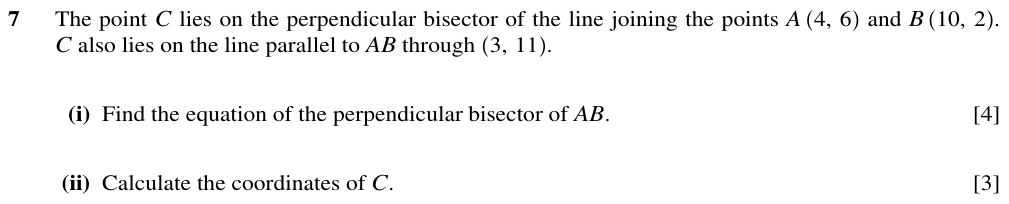
| Part | Answer / working | Marks | Guidance |
|---|---|---|---|
| (i) | midpoint \(M(7,4)\) | B1 | |
| \(m_{AB}=-\tfrac23\) | B1 | ||
| perpendicular gradient \(\tfrac32\) | M1 | \(m_1m_2=-1\) | |
| \(y-4=\tfrac32(x-7)\) | A1 | through the midpoint | |
| (ii) | \(y-11=-\tfrac23(x-3)\) | M1 | the parallel line |
| solve the two equations together | DM1 | ||
| \(C(9,7)\) | A1 | ||
| Total: 7 marks | |||
Your progress on this note is saved when JavaScript is on.