
Coordinate Geometry
Circles: equations, centre and radius, tangents
On this page
- What you need to be able to do
- What you should already know
- The equation of a circle
- Where is the centre? Five facts that find it
- Finding the equation of a circle, case by case
- Tangents and normals, case by case
- Key facts at a glance
- How this is examined
- Mark-scheme focus
- Worked examples
- Summary
- Can I do this?
- Quiz
What you need to be able to do
- 1.3Understand that \((x-a)^2+(y-b)^2=r^2\) is the circle with centre \((a,b)\) and radius \(r\), and use the expanded form \(x^2+y^2+2gx+2fy+c=0\).
- 1.3Find a circle's equation from whatever you are given: a centre and a point, a diameter, three points, two points and a line or a radius, a tangent, or unknown coefficients.
- 1.3Use circle geometry: tangent ⟂ radius, angle in a semicircle = 90°, the perpendicular bisector of a chord passes through the centre, symmetry; find tangents and normals.
Before you start: Perpendicular bisectors and completing the square. Next: Lines meeting circles.
Where the circle equation comes from, every way to find a centre and radius, and tangents and normals, with our own examples. Past-paper questions come in Part 2.
What you should already know
Distance between two points
\(d=\sqrt{(x_2-x_1)^2+(y_2-y_1)^2}\) (Pythagoras). From \((1,\,2)\) to \((4,\,6)\): \(\sqrt{9+16}=5\).
Quick check: distance from \((0,\,0)\) to \((5,\,12)\)?
\(13\)
Completing the square
\(x^2-8x=(x-4)^2-16\); \(y^2+6y=(y+3)^2-9\) (Completing the square).
Quick check: complete the square on \(x^2+10x\)
\((x+5)^2-25\)
Perpendicular bisectors
Through the midpoint, perpendicular to the chord; every point on it is equidistant from the two ends (previous page).
Quick check: bisector of \((0,\,0)\) and \((4,\,0)\)?
\(x=2\)
Circle facts from O Level
Tangent ⟂ radius at the point of contact; the angle in a semicircle is 90°; the perpendicular from the centre bisects a chord.
Quick check: angle between a tangent and the radius at the contact point?
\(90°\)
The equation of a circle
A point \((x,y)\) is on the circle with centre \(C(a,b)\) and radius \(r\) exactly when its distance from \(C\) is \(r\). Square the distance formula and you have the equation:
Write r², not r
A circle with \(r^2=34\): \((x-5)^2+(y-2)^2=34\). Not \(=\sqrt{34}\), not \(=(\sqrt{34})^2\), not \(5.83^2\): the right-hand side is the number \(r^2\).
Expanded form
\(x^2+y^2+2gx+2fy+c=0\) has centre \((-g,\ -f)\) and \(r^2=g^2+f^2-c\). Safer: complete the square on \(x\) and on \(y\); the \(g,f,c\) formula is easy to get the signs wrong in.
- From an expanded equation: group the \(x\) terms and the \(y\) terms; complete the square on each; move the numbers to the right.
- \(x^2+y^2-10x+4y+20=0\Rightarrow(x-5)^2-25+(y+2)^2-4+20=0\Rightarrow(x-5)^2+(y+2)^2=9\).
- Centre \((5,\,-2)\), radius 3. If the right-hand side comes out negative or zero, it is not a circle.
- Centre and radius of \((x-4)^2+(y+1)^2=49\)?
Answer
\((4,\,-1)\), \(r=7\) - Centre and radius of \(x^2+y^2+6x-8y=0\)?
Answer
\((x+3)^2+(y-4)^2=25\): \((-3,\,4)\), \(r=5\) (it passes through the origin) - Is \(x^2+y^2-2x+4y+9=0\) a circle?
Answer
\((x-1)^2+(y+2)^2=-4\): no, the right-hand side is negative
Where is the centre? Five facts that find it
Almost every circle question is really the question "where is the centre?". Once you have the centre, the radius is one distance away. These are the facts that pin the centre down; learn why each one is true, because the exam often wants the reason written down.
1 · The perpendicular bisector of any chord passes through the centre
The centre is the same distance \(r\) from both ends \(A\) and \(B\) of a chord. The points that are equally far from \(A\) and \(B\) are exactly the points on the perpendicular bisector of \(AB\). So the centre is on it. Two chords give two bisectors, and they cross at the centre.
2 · A diameter's midpoint is the centre
A diameter passes through the centre with a radius on each side, so the centre is its midpoint, and \(r\) is half its length.
3 · A right angle on the circle stands on a diameter
If \(A\), \(B\), \(C\) are on the circle and \(\angle ABC=90°\), then \(AC\) is a diameter (the angle in a semicircle, used backwards). Why: in a right-angled triangle the midpoint of the hypotenuse is the same distance from all three corners, so it is the centre, and \(AC\) passes through it.
4 · Tangent ⟂ radius, so the normal goes through the centre
At the point of contact \(P\), the tangent is perpendicular to \(CP\). The normal at \(P\) (the line through \(P\) perpendicular to the tangent) is therefore the line \(CP\): it always passes through the centre.
5 · Touching an axis fixes the radius
A circle with centre \((a,b)\) that touches the \(x\)-axis has \(r=|b|\); one that touches the \(y\)-axis has \(r=|a|\). The radius to the point of contact is perpendicular to the axis.
- Horizontal chord (both ends have the same \(y\)): its perpendicular bisector is vertical, \(x=\) the midpoint's \(x\). Example: \((-1,7)\) and \((5,7)\) give \(x=2\).
- Vertical chord (same \(x\)): its perpendicular bisector is horizontal, \(y=\) the midpoint's \(y\). Example: \((6,-1)\) and \((6,7)\) give \(y=3\).
- Sloping chord: midpoint, gradient \(m\), then the line through the midpoint with gradient \(-\dfrac1m\).
- Horizontal and vertical chords need no gradients at all: the bisector is read straight from the midpoint.
Finding the equation of a circle, case by case
Look at what the question gives you, find the case below, and follow its steps. (The numbers here are our own; the past-paper versions are in the worked examples further down.)
1 Centre and a point on the circle
Centre \((3,-2)\), passing through \((7,1)\).
Askedthe equationKnowthe centreRouter² = (distance from centre to the point)²
- \(r^2=(7-3)^2+(1+2)^2=16+9=25\)
- \((x-3)^2+(y+2)^2=25\)
No square root needed: the equation wants \(r^2\).
2 The two ends of a diameter
\((-1,5)\) and \((7,-1)\) are the ends of a diameter.
Askedthe equationKnowtwo ends of a diameterRoutecentre = midpoint (fact 2); r² = (centre to either end)²
- Centre \(=\left(\tfrac{-1+7}{2},\ \tfrac{5-1}{2}\right)=(3,\,2)\)
- \(r^2=(7-3)^2+(-1-2)^2=25\)
- \((x-3)^2+(y-2)^2=25\)
Never use an end of the diameter as the centre, or the full diameter as the radius: the two classic slips.
3 Three points, two of the chords horizontal and vertical
\(A(-2,1)\), \(B(-2,7)\), \(C(6,7)\) lie on a circle.
Askedthe equationKnow\(AB\) is vertical (\(x=-2\) for both), \(BC\) is horizontal (\(y=7\) for both)Routeeither a right angle → diameter, or two easy bisectors
- Say why it is a right angle: \(AB\) is vertical and \(BC\) is horizontal, so \(AB\perp BC\) and \(\angle ABC=90°\).
- Name the property: the angle in a semicircle is 90°, so the side opposite the right angle, \(AC\), is a diameter (fact 3).
- Centre \(=\) midpoint of \(AC=\left(\tfrac{-2+6}{2},\ \tfrac{1+7}{2}\right)=(2,\,4)\); \(r^2=(6-2)^2+(7-4)^2=25\).
- Check it a second way (fact 1): the bisector of the vertical chord \(AB\) is horizontal through its midpoint, \(y=4\); the bisector of the horizontal chord \(BC\) is vertical through its midpoint, \(x=2\). They meet at \((2,4)\) ✓.
- \((x-2)^2+(y-4)^2=25\)
If the right angle is not horizontal-and-vertical, prove it with gradients: \(m_{AB}\times m_{BC}=-1\). Then use fact 3 in the same way.
4 Three points, no right angle
\(P(6,6)\), \(Q(-1,7)\), \(R(5,-1)\) lie on a circle (the figure above).
Askedthe equationKnowthree chords, none perpendicularRoutebisectors of two chords; solve them together for the centre
- Chord \(PQ\): midpoint \(\left(\tfrac52,\tfrac{13}2\right)\), \(m_{PQ}=\tfrac{7-6}{-1-6}=-\tfrac17\); bisector gradient \(7\): \(y=7x-11\)
- Chord \(QR\): midpoint \((2,3)\), \(m_{QR}=\tfrac{-1-7}{5+1}=-\tfrac43\); bisector gradient \(\tfrac34\): \(y=\tfrac34x+\tfrac32\)
- Solve: \(7x-11=\tfrac34x+\tfrac32\Rightarrow\tfrac{25}{4}x=\tfrac{25}{2}\Rightarrow x=2,\ y=3\). Centre \((2,3)\)
- \(r^2=(6-2)^2+(6-3)^2=25\): \((x-2)^2+(y-3)^2=25\). Check \(R\): \(9+16=25\) ✓
You could also substitute all three points into \(x^2+y^2+2gx+2fy+c=0\) and solve three equations, but that is far more algebra and far more room for slips.
5 Two points and a line the centre lies on
A circle passes through \(A(1,5)\) and \(B(8,4)\); its centre lies on \(y=x-3\).
Askedthe equationKnowone chord AB, and a line through the centreRoutebisector of AB meets the given line at the centre
- Bisector of \(AB\): midpoint \(\left(\tfrac92,\tfrac92\right)\), \(m_{AB}=-\tfrac17\), so gradient \(7\): \(y=7x-27\)
- Centre: \(7x-27=x-3\Rightarrow x=4,\ y=1\)
- \(r^2=(1-4)^2+(5-1)^2=25\): \((x-4)^2+(y-1)^2=25\)
Another route: call the centre \((h,\ h-3)\) and set \(CA^2=CB^2\). The \(h^2\) terms cancel and \(h=4\).
6 Two points and the radius: two circles
A circle of radius 5 passes through \(A(1,5)\) and \(B(8,4)\).
Askedboth possible equationsKnowthe centre is on the bisector of AB, and 5 from ARouteput the centre on the bisector, then use CA² = 25
- Centre on the bisector \(y=7x-27\): call it \((h,\ 7h-27)\)
- \(CA^2=25\): \((h-1)^2+(7h-32)^2=25\Rightarrow50h^2-450h+1000=0\Rightarrow h^2-9h+20=0\)
- \(h=4\) or \(h=5\): centres \((4,1)\) and \((5,8)\)
- \((x-4)^2+(y-1)^2=25\) and \((x-5)^2+(y-8)^2=25\)
Two answers is right: the two centres are reflections of each other in the chord \(AB\), one on each side.
7 A circle that touches an axis
Centre \((-3,4)\); the circle touches the \(x\)-axis.
Askedthe equationKnowtouching the \(x\)-axis means the radius is the height of the centreRouter = |b| (fact 5)
- The lowest point is on the \(x\)-axis, straight below the centre: \(r=4\)
- \((x+3)^2+(y-4)^2=16\)
Touching the \(y\)-axis instead would give \(r=|-3|=3\). Touching both axes needs \(|a|=|b|=r\).
8 The other end of a diameter
Centre \((2,3)\); one end of a diameter is \(A(5,7)\). Find the other end \(B\).
AskedBKnowthe centre is the midpoint of ABRoutestep from A to the centre, then the same step again
- From \(A\) to \(C\): \(x\) goes down 3, \(y\) goes down 4
- Same step again: \(B=(2-3,\ 3-4)=(-1,-1)\)
- Quick form: \(B=2C-A=(4-5,\ 6-7)=(-1,-1)\)
- Find the circle with diameter from \((2,\,1)\) to \((8,\,9)\).
Answer
centre \((5,5)\), \(r^2=9+16=25\): \((x-5)^2+(y-5)^2=25\) - A circle has centre \((5,\,-2)\) and touches the \(y\)-axis. Find its equation.
Answer
\(r=5\): \((x-5)^2+(y+2)^2=25\)
Tangents and normals, case by case
1 Tangent at a known point
\((x-3)^2+(y+2)^2=25\). Find the tangent at \(P(7,1)\).
Askedthe tangent at PKnowthe centre (3, −2) and PRouteradius gradient, then the negative reciprocal through P
- Gradient of the radius \(CP=\tfrac{1-(-2)}{7-3}=\tfrac34\)
- Tangent gradient \(-\tfrac43\) (tangent ⟂ radius)
- \(y-1=-\tfrac43(x-7)\Rightarrow4x+3y=31\). Check \(P\): \(28+3=31\) ✓
2 Normal at a known point
Same circle: the normal at \(P(7,1)\).
Askedthe normal at PKnowthe normal is the line CPRouteline through P and the centre
- Gradient \(\tfrac34\) (the radius itself)
- \(y-1=\tfrac34(x-7)\Rightarrow3x-4y=17\). The centre fits: \(9+8=17\) ✓
This is how to find an unknown centre when you are told the tangent at a point: the normal at that point passes through the centre (Example 4).
3 Tangents with only the gradient known
\((x-1)^2+(y+2)^2=20\). Find the tangents with gradient 2.
Askedboth tangentsKnowthe gradient, but not the points of contactRoutethe radius to each point of contact is the normal: gradient −½ through C
- The radius to a point of contact is ⟂ the tangent, so it has gradient \(-\tfrac12\) and goes through \(C(1,-2)\): \(y+2=-\tfrac12(x-1)\)
- Where this normal meets the circle: \((x-1)^2+\tfrac14(x-1)^2=20\Rightarrow(x-1)^2=16\Rightarrow x=5\) or \(x=-3\)
- Points of contact \((5,-4)\) and \((-3,0)\): the two ends of a diameter
- Tangents: \(y+4=2(x-5)\Rightarrow y=2x-14\), and \(y=2(x+3)\Rightarrow y=2x+6\)
Second route (from Quadratics): substitute \(y=2x+c\) into the circle, set the discriminant to 0, and get \(c^2+8c-84=0\), so \(c=6\) or \(-14\). The normal route gives the points of contact as well, which questions often ask for.
4 Tangents from a point outside the circle
See Lines and circles.
Askedthe gradients of both tangentsKnowa point the tangents pass throughRoutey − y₁ = m(x − x₁) into the circle, discriminant = 0
- Write the line through the outside point with unknown gradient \(m\)
- Substitute into the circle; one point of contact means \(b^2-4ac=0\)
- Solve the quadratic in \(m\): two tangents
- Point of contact first: the tangent's gradient gives the normal's gradient, \(-\dfrac1m\).
- The normal goes through the centre (fact 4), so you can write its equation straight away.
- Intersect the normal with the circle: two points, at the ends of a diameter.
- Tangents through those points with the given gradient. Shortcut for the second point: \(2C-P\).
Inside, on or outside?
Compare \(CT^2\) with \(r^2\): \(CT^2>r^2\) outside, \(=\) on, \(<\) inside. Write the inequality sign and the conclusion: "so T is outside the circle".
Highest, lowest, leftmost, rightmost points
Straight above / below / left / right of the centre, one radius away: highest \((a,\ b+r)\), lowest \((a,\ b-r)\). A quick sketch stops the coordinates going the wrong way.
- Find the tangent to \(x^2+y^2=25\) at \((3,\,4)\).
Answer
radius gradient \(\tfrac43\), tangent \(-\tfrac34\): \(3x+4y=25\) - Is \((6,\,2)\) inside, on or outside \((x-2)^2+(y-1)^2=16\)?
Answer
\(16+1=17>16\): outside - Highest point of \((x+1)^2+(y-3)^2=4\)?
Answer
\((-1,\,5)\)
Key facts at a glance
- \((x-a)^2+(y-b)^2=r^2\): centre \((a,b)\), radius \(r\). It is the distance formula, squared.
- Expanded form: complete the square on \(x\) and \(y\). A negative right-hand side means no circle.
- The centre: on the bisector of every chord; midpoint of a diameter; a right angle on the circle stands on a diameter; on the normal at any point.
- Tangent at \(P\): perpendicular to the radius \(CP\). Normal at \(P\): the line \(CP\).
- Compare \(CT^2\) with \(r^2\) to place a point inside, on or outside.
How circles are examined, what the mark scheme wants, then real Paper 1 questions worked through slowly.
How this is examined
A circle question is on almost every Paper 1 (6-10 marks over several parts). Schemes say "Must use \(r^2\) not \(r\)" and "do not allow \((\sqrt{34})^2\) or \(5.83^2\)"; the June 2023 report: "r would not be left in surd form". The March 2021 report found the three-equations \(g, f, c\) route "often chosen with less success because of algebraic errors". The November 2021 report saw the origin used instead of the centre for the radius gradient; the March 2021 report saw a chord assumed parallel to the tangent.
- Gradient of the radius from the centre to the point: \(m_{CQ}=\dfrac{11-6}{7-4}=\dfrac53\). B1
- Perpendicular gradient: \(-\dfrac35\). M1
- Line through the point \(Q(7,11)\): \(y-11=-\tfrac35(x-7)\). A1
- (Implicit differentiation also works, but is not on the P1 syllabus; the geometry is quicker.)
Mark-scheme focus
Find the equation of the circle

- centre \((2,-1)\) B1
- \(r^2=(2+3)^2+(-1+5)^2\) or \(\tfrac14\left[(7+3)^2+(3+5)^2\right]\) M1
- \((x-2)^2+(y+1)^2=41\) A1 ("must not involve surd form")
- \((\sqrt{41})^2\) or \(6.40^2\) as the right-hand side
- an end-point used as the centre
- the whole diameter used as \(r\)
\((x+3)(x-7)+(y+5)(y-3)=0\): a special case worth all 3 marks (it is the circle on that diameter).
From: 9709/12/F/M/20 Q12(a).
Show that the point T is outside the circle
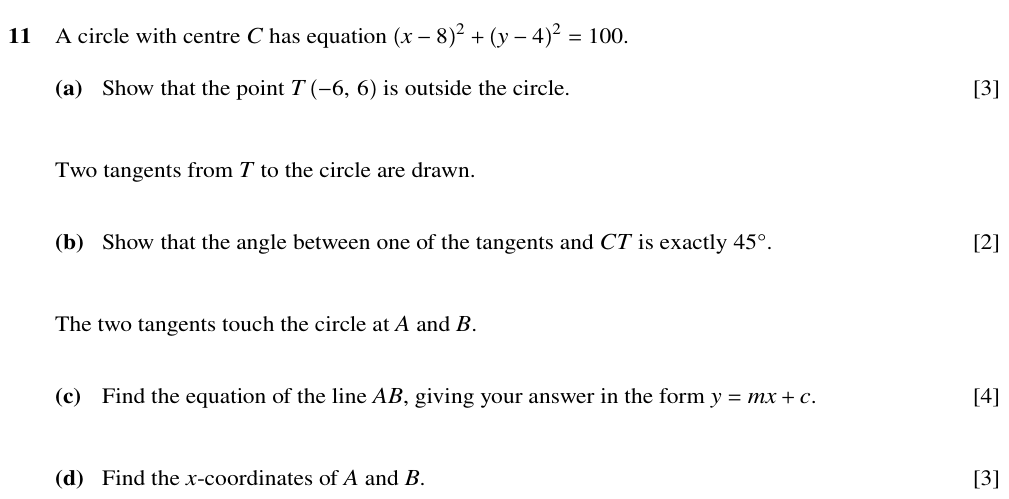
- \(CT^2=(-6-8)^2+(6-4)^2=200\) M1 A1
- \(\sqrt{200}>10\), hence outside A1
- \(200\ne100\) (only shows T is not ON the circle)
- "Shown" with no comparison or conclusion
The November 2020 report: "It was necessary to use the symbol > and to state the conclusion that T lies outside the circle."
From: 9709/13/O/N/20 Q11(a).
Show that a line is a tangent
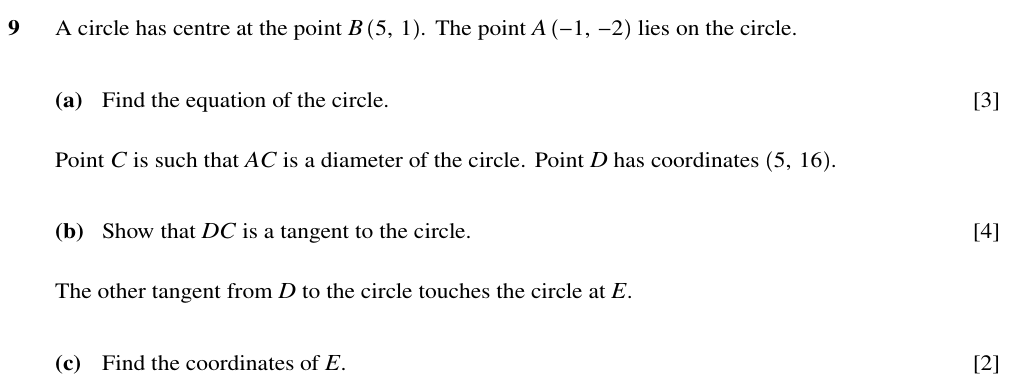
- (b) \(C=2B-A=(11,4)\) B1; gradient of the diameter \(AC=\tfrac12\) B1
- gradient of \(CD=\tfrac{16-4}{5-11}=-2\), working shown M1
- \(\tfrac12\times(-2)=-1\), so CD ⟂ the radius at C: CD is a tangent A1
- (c) by symmetry in the vertical line \(x=5\) through \(B\) and \(D\): \(E(-1,4)\) B1 B1
- gradients found but no statement that they are perpendicular, or no "hence tangent"
- a quadratic with a repeated root, without saying "repeated root, so tangent"
Both facts must be there: C is on the circle, and CD is perpendicular to the radius BC. The scheme asks for "clear reasoning" for the last mark.
Substituting the line \(CD\) into the circle and getting \((x-11)^2=0\) (a repeated root); Pythagoras \(BD^2=BC^2+CD^2\); or a zero scalar product.
From: 9709/12/O/N/20 Q9.
- Circle equation (centre + point, diameter, three points, two points + a condition): almost every paper, 2-5 marks.
- Centre and radius by completing the square: 2-4 marks.
- Tangent at a point / tangents with a given gradient: 2-5 marks; often in the form ax + by + c = 0.
- Show that a line is a tangent / a point is outside: 2-4 marks, conclusion required.
Worked examples
Example 1 · Centre, radius and the lowest point (Paper 1, 4 marks) ★ Easy
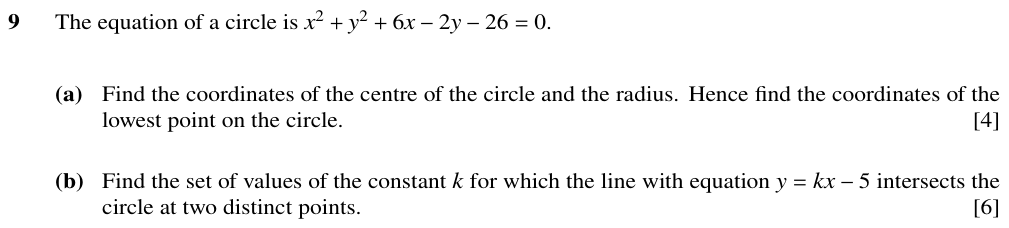
Complete the square in \(x\) and in \(y\) to see the centre and radius. The lowest point is straight below the centre, one radius down.
- Henceuse the centre and radius
- lowest pointsame x as the centre, y = centre's y − r
- (a)centre, radius, lowest point
- \(x^2+y^2+6x-2y-26=0\)
- Findlowest point
- Centre, r\((x+3)^2+(y-1)^2=36\)
- Thengo down r from the centre
Complete the square on x² + 6x.
\((x+3)^2-9\).
Lowest point?
\((-3,\ 1-6)=(-3,-5)\).
5 Now solve it have a go on paper first, then open the worked solution
- \((x+3)^2+(y-1)^2=26+9+1=36\) M1
- centre \((-3,1)\) B1, radius 6 B1
- lowest point \((-3,-5)\) A1FT
The June 2022 report: the lowest point was often given as \((-9,1)\) or \((-3,7)\); "candidates who sketched a diagram could deduce the lowest point efficiently".
\((-3,-5)\): \(9+25-18+10-26=0\) ✓ on the circle.
Example 2 · Three points on a circle, then a tangent (Paper 1, 7 marks) ★★ Medium

Plot the three points. \(A\) and \(B\) have the same \(x\) (7), so \(AB\) is vertical. \(B\) and \(C\) have the same \(y\) (9), so \(BC\) is horizontal. A vertical line and a horizontal line meet at 90°, so \(\angle ABC=90°\). A 90° angle with its corner on the circle stands on a diameter, so \(AC\) is a diameter.
- on the circumferenceall three are on the circle
- tangent at Bperpendicular to the radius to B
- (a)equation
- (b)tangent at B
- \(A(7,1)\), \(B(7,9)\), \(C(1,9)\)
- angle ABC = 90°, so AC is a diameter (angle in a semicircle)
- AB vertical → its bisector is horizontal; BC horizontal → its bisector is vertical
- (a)circle
- Route 1AC is a diameter: centre = midpoint of AC
- Route 2bisectors y = 5 and x = 4 cross at the centre
- r²(7 − 4)² + (1 − 5)² = 25
- (b)tangent
- Radius\(m_{CB}=\tfrac{9-5}{7-4}=\tfrac43\)
- Tangent\(-\tfrac34\) through B
- Trapassuming the tangent is parallel to AC
How do you justify that AC is a diameter in the exam?
Write: "\(AB\) is vertical and \(BC\) is horizontal, so \(\angle ABC=90°\). The angle in a semicircle is 90°, so \(AC\) is a diameter." Two short sentences, and the method is clear.
Why is the bisector of AB the line y = 5?
\(AB\) is vertical, so anything perpendicular to it is horizontal. The bisector goes through the midpoint \((7,5)\), so it is \(y=5\).
Is the tangent at B parallel to AC?
No: \(m_{AC}=-\tfrac43\), but the tangent has gradient \(-\tfrac34\). The report warns about this assumption.
5 Now solve it have a go on paper first, then open the worked solution
- \(AB\) vertical, \(BC\) horizontal \(\Rightarrow\angle ABC=90°\Rightarrow AC\) is a diameter (angle in a semicircle)
- Centre \(=\) midpoint of \(AC=\left(\tfrac{7+1}{2},\ \tfrac{1+9}{2}\right)=(4,5)\) B1 B1
- Same centre from the bisectors: \(AB\) has midpoint \((7,5)\), bisector \(y=5\); \(BC\) has midpoint \((4,9)\), bisector \(x=4\); they meet at \((4,5)\).
- \(r^2=(7-4)^2+(1-5)^2\) M1 \(=25\) A1
- \((x-4)^2+(y-5)^2=25\) A1
- (b) gradient of radius to \(B\): \(\tfrac43\) B1FT; tangent \(y-9=-\tfrac34(x-7)\) B1
The March 2021 report: candidates who substituted all three points into the general equation "often" made algebraic errors; spotting the right angle (or the two easy bisectors) is much quicker.
\(B(7,9)\): \(9+16=25\) ✓ on the circle; \(C(1,9)\): \(9+16=25\) ✓.
Example 3 · A circle through two points with a given radius (Paper 1, 9 marks) ★★★ Hard
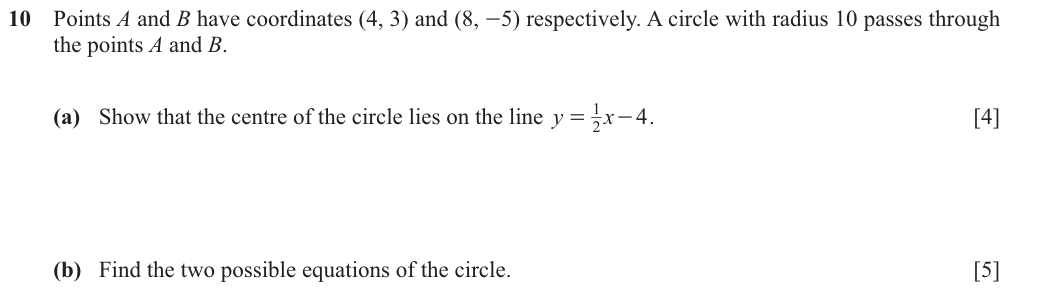
Why it is hard: nothing gives the centre directly: you build it from the chord, then a quadratic gives two circles.
Two points on a circle make a chord. The centre is equally far from both ends, so it is on the chord's perpendicular bisector: that is part (a). The radius then says how far along that line the centre is, and there are two places, one on each side of \(AB\).
- passes through A and B\(AB\) is a chord
- show thatthe answer is given: every step must be seen, ending in the given line
- two possible equationsexpect a quadratic with two roots
- (a)the line the centre is on
- (b)both circles
- \(A(4,3)\), \(B(8,-5)\)
- \(r=10\)
- the centre is on the perpendicular bisector of the chord AB (fact 1)
- (a)bisector of AB
- Midpoint(6, −1)
- Gradient\(m_{AB}=-2\Rightarrow\) perpendicular \(\tfrac12\)
- (b)the centres
- Usecentre \(\left(a,\ \tfrac12a-4\right)\) and \(CA^2=100\)
- Trapgiving only one circle
Why must the centre be on the bisector of AB?
It is 10 from \(A\) and 10 from \(B\): equally far from both, and those points form the perpendicular bisector.
What equation do you get in (b)?
\((a-4)^2+\left(\tfrac12a-7\right)^2=100\Rightarrow a^2-12a-28=0\).
5 Now solve it have a go on paper first, then open the worked solution
- (a) \(m_{AB}=\tfrac{-5-3}{8-4}=-2\) M1; midpoint \((6,-1)\) M1
- perpendicular gradient \(\tfrac12\): \(y+1=\tfrac12(x-6)\) DM1 \(\Rightarrow y=\tfrac12x-4\) A1 (working with the bisector must be seen)
- (b) centre \(\left(a,\ \tfrac12a-4\right)\) M1; \((a-4)^2+\left(\tfrac12a-7\right)^2=100\) M1
- \(\tfrac54a^2-15a-35=0\Rightarrow a^2-12a-28=0\) DM1; \((a-14)(a+2)=0\), \(a=14\) or \(-2\) A1
- \((x-14)^2+(y-3)^2=100\) and \((x+2)^2+(y+5)^2=100\) A1
\((14,3)\) to \(B(8,-5)\): \(36+64=100\) ✓. \((-2,-5)\) to \(A(4,3)\): \(36+64=100\) ✓. The two centres are reflections in \(AB\) (their midpoint is \((6,-1)\), the midpoint of \(AB\)) ✓.
Example 4 · A tangent is given: find the centre from the normal (Paper 1, 10 marks) ★★★ Hard
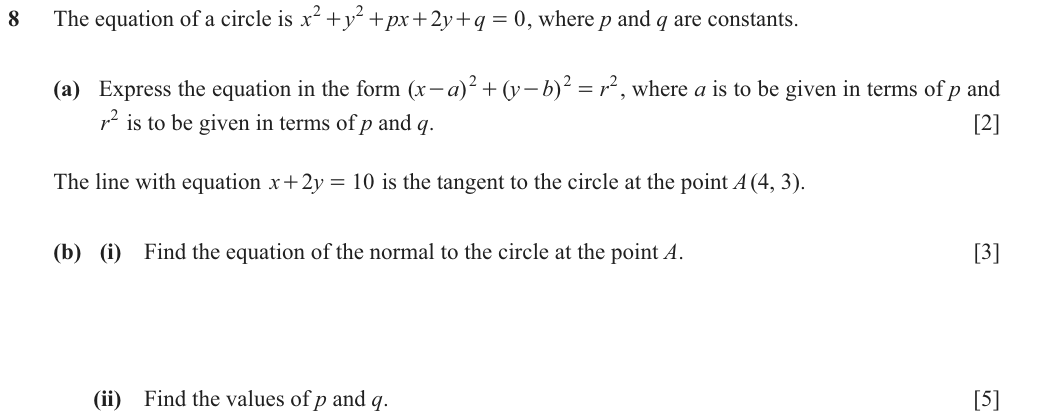
Why it is hard: the centre is unknown; the normal is the only way to it, and part (a) must be kept in terms of p.
We don't know the centre, because \(p\) is unknown. But we know a tangent and its point of contact. The normal at \(A\) is perpendicular to the tangent and passes through the centre (fact 4), so the centre is where the normal meets the line the centre must be on.
- tangent at Aperpendicular to the radius \(CA\)
- normal at Athe line \(CA\): it goes through the centre
- in terms of pkeep \(p\) as a letter in (a)
- (a)centre and \(r^2\) in terms of \(p\), \(q\)
- (b)(i)the normal at A
- (b)(ii)\(p\) and \(q\)
- \(x^2+y^2+px+2y+q=0\)
- \(x+2y=10\)tangent at A
- \(A(4,3)\)
- the centre \(\left(-\tfrac p2,\ -1\right)\) lies on the normal
- (b)(i)normal
- Tangent gradient\(-\tfrac12\)
- Normalgradient 2 through \((4,3)\)
- (b)(ii)p, q
- Usecentre on the normal → p
- Then\(r^2=CA^2\) → q
What is the centre from (a)?
\(\left(-\tfrac p2,\ -1\right)\): complete the square, \(\left(x+\tfrac p2\right)^2+(y+1)^2=\tfrac{p^2}4+1-q\).
Put the centre into y = 2x − 5.
\(-1=-p-5\Rightarrow p=-4\), so the centre is \((2,-1)\).
5 Now solve it have a go on paper first, then open the worked solution
- (a) \(\left(x+\tfrac p2\right)^2+(y+1)^2=\tfrac{p^2}{4}+1-q\) B1 B1
- (b)(i) tangent gradient \(-\tfrac12\) B1; normal gradient \(2\) M1; \(y-3=2(x-4)\Rightarrow y=2x-5\) A1
- (ii) centre on the normal: \(-1=2\left(-\tfrac p2\right)-5\) M1 \(\Rightarrow p=-4\) A1; centre \((2,-1)\)
- \(r^2=(4-2)^2+(3+1)^2=20\) M1; \(\tfrac{16}{4}+1-q=20\) DM1 \(\Rightarrow q=-15\) A1
Also accepted for \(q\): substitute \(A(4,3)\) into the circle with \(p=-4\): \(16+9-16+6+q=0\). Quicker, and on the scheme.
Put \(A(4,3)\) into \(x^2+y^2-4x+2y-15\): \(16+9-16+6-15=0\) ✓ on the circle. Radius gradient \(\tfrac{3+1}{4-2}=2\), tangent \(-\tfrac12\) ✓ perpendicular.
Example 5 · Unknown coefficients, then a tangent in integer form (Paper 1, 8 marks) ★★ Medium
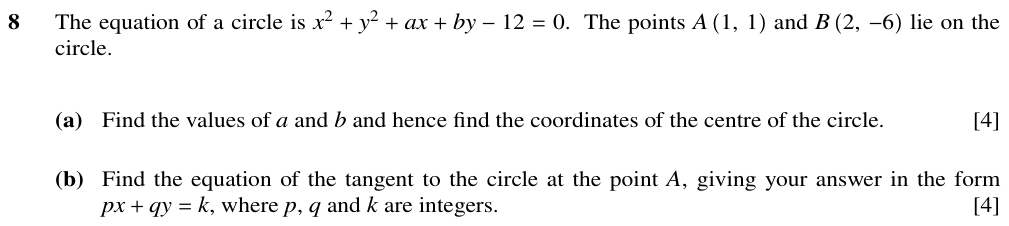
Two points on the circle give two equations in \(a\) and \(b\). Then the centre is \(\left(-\tfrac a2,-\tfrac b2\right)\) (or complete the square). The tangent at \(A\) is perpendicular to \(CA\).
- lie on the circlesubstitute each point
- px + qy = k, integersclear fractions at the end
- (a)a, b, centre
- (b)tangent at A
- \(x^2+y^2+ax+by-12=0\)
- \(A(1,1)\), \(B(2,-6)\)
- (a)a, b
- Usetwo linear equations
- (b)tangent
- m\(m_{CA}=\tfrac43\Rightarrow-\tfrac34\)
- Form3x + 4y = 7
What does B give?
\(4+36+2a-6b-12=0\Rightarrow2a-6b=-28\).
Is AB a diameter?
No reason to think so: the report names that assumption as a weak response.
5 Now solve it have a go on paper first, then open the worked solution
- \(a+b=10\), \(2a-6b=-28\) B1 B1
- \(a=4,\ b=6\) B1; centre \((-2,-3)\) B1FT
- (b) \(m_{CA}=\tfrac{1+3}{1+2}=\tfrac43\) *M1; tangent gradient \(-\tfrac34\) A1FT
- \(y-1=-\tfrac34(x-1)\) DM1 \(\Rightarrow3x+4y=7\) A1
\(A(1,1)\): \(3+4=7\) ✓.
Example 6 · A circle placed by its distances from the axes (Paper 1, 6 marks) ★★★ Hard
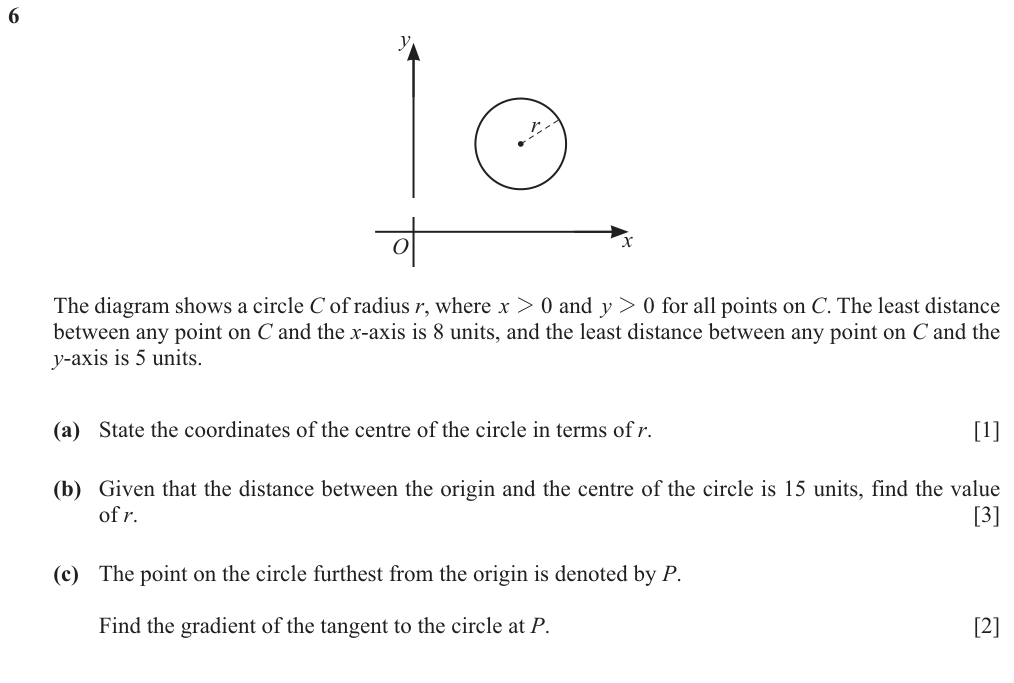
Why it is hard: nothing is given as coordinates: you have to turn distances into a centre.
The closest point of the circle to the \(x\)-axis is straight below the centre, \(r\) away from it, and 8 above the axis. So the centre is \(8+r\) high. Same idea horizontally: \(5+r\).
- least distance … is 8lowest point of the circle is at height 8
- furthest from the originon the line from O through the centre
- (a)centre
- (b)r
- (c)tangent gradient at P
- 8 and 5least distances
- OC = 15
- (a)centre
- Use(5 + r, 8 + r)
- (b)r
- Use\((r+5)^2+(r+8)^2=225\)
- Trapkeeping r = −17
- (c)gradient
- UseOP passes through C; tangent ⟂ OC
Expand (r + 5)² + (r + 8)² = 225.
\(2r^2+26r-136=0\Rightarrow r^2+13r-68=0\).
Gradient of OC when r = 4?
\(\tfrac{12}{9}=\tfrac43\).
5 Now solve it have a go on paper first, then open the worked solution
- (a) \((r+5,\ r+8)\) B1
- (b) \((r+5)^2+(r+8)^2=15^2\) B1FT; \((r+17)(r-4)=0\) M1; \(r=4\) A1
- (c) \(C(9,12)\), \(m_{OC}=\tfrac{12}{9}=\tfrac43\) M1; tangent gradient \(-\tfrac34\) A1FT
The March 2025 report: "a large number had the coordinates in the wrong order" in (a); almost all correctly rejected the negative \(r\).
\(OC=\sqrt{81+144}=15\) ✓; lowest point \(12-4=8\) ✓, leftmost \(9-4=5\) ✓.
Summary
- \((x-a)^2+(y-b)^2=r^2\): centre \((a,b)\) (signs changed), right-hand side \(r^2\).
- Expanded form: complete the square on x and y.
- The centre is on the perpendicular bisector of every chord. Horizontal chord → vertical bisector; vertical chord → horizontal bisector.
- Diameter: centre = midpoint. Right angle on the circle: the side opposite it is a diameter.
- Tangent at P: perpendicular to CP. Normal at P: the line CP, through the centre.
- Tangent with only a gradient: the normal through the centre meets the circle at the points of contact.
| If you see… | do this |
|---|---|
| x² + y² + … = 0 | complete the square → centre, radius |
| "diameter AB" | centre = midpoint of AB |
| three points, one angle 90° | say why it is 90°; the opposite side is a diameter |
| three points, no right angle | bisectors of two chords; solve for the centre |
| two points + "centre on the line …" | bisector of the chord meets the line |
| two points + the radius | centre on the bisector, CA² = r²: two circles |
| "touches the x-axis" | r = |y-coordinate of the centre| |
| "tangent at P" | gradient −1/m_CP through P |
| "normal at P" | the line through P and the centre |
| "tangents with gradient m" | normal through C with gradient −1/m; meet the circle |
| tangent given at a point, centre unknown | the normal there passes through the centre |
| "outside / inside" | compare CT² with r², use > or <, conclude |
Can I do this?
- I can read the centre and radius from either form of a circle's equation.
- I can explain why the centre is on the perpendicular bisector of a chord, and why a right angle on the circle gives a diameter.
- I can find a circle from a centre and point, a diameter, three points (with or without a right angle), two points and a line or a radius, or a touching axis.
- I can find the tangent and the normal at a point, and the tangents with a given gradient.
- I can decide whether a point is inside or outside, and show that a line is a tangent with a conclusion.
Anything unticked: revise that section first. All ticked: take the quiz.
Quiz
The multiple-choice and guided questions need JavaScript. The concept checks and exam practice below work without it.
Concept checks
Answer each one in your head first, then open it.
1Why does the perpendicular bisector of a chord pass through the centre?Show answer
The centre is \(r\) from both ends of the chord. Every point equally far from two points lies on their perpendicular bisector, so the centre does too.
2Why is the centre the midpoint of a diameter?Show answer
A diameter passes through the centre and both ends are a radius away from it, in opposite directions.
3Can \(x^2+y^2+4x+6y+20=0\) be a circle?Show answer
\((x+2)^2+(y+3)^2=-7\): a negative \(r^2\), so no real points. Not a circle.
4Why do two tangents with the same gradient touch a circle at the two ends of a diameter?Show answer
Both radii to the points of contact are perpendicular to the same direction, so they lie on one line through the centre: together they make a diameter.
Exam-style practice
New questions, not used above. Do them on paper, then mark your work against the official mark scheme.
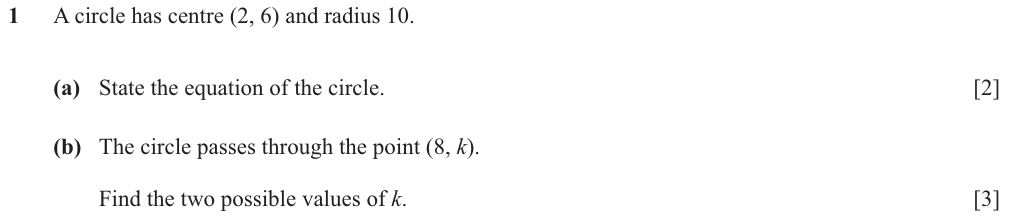
Show the mark scheme
| Part | Answer / working | Marks | Guidance |
|---|---|---|---|
| (a) | \((x-2)^2+(y-6)^2=100\) | B2 | B1 for any two of the three parts correct |
| (b) | \((8-2)^2+(k-6)^2=100\) or \(k^2-12k-28=0\) | M1 | substitute the point to get an equation in \(k\) |
| \(k-6=\pm8\) or \((k-14)(k+2)=0\) | DM1 | allow one sign error | |
| \(k=14\) or \(k=-2\) | B1 | both answers with no working: special case B2 only | |
| Total: 5 marks | |||
Show the mark scheme
| Part | Answer / working | Marks | Guidance |
|---|---|---|---|
| (a) | centre \((2,4)\) | B1 | |
| \(r^2=(6-2)^2+(1-4)^2\) or half the diameter, squared | M1 | ||
| \((x-2)^2+(y-4)^2=25\) | A1 | or the expanded form | |
| (b) | gradient of the normal through the centre \(=2\) | B1 | seen or implied |
| normal: \(y-4=2(x-2)\), i.e. \(y=2x\) | M1 | must use the normal's gradient, not \(-\tfrac12\) | |
| \((x-2)^2+(2x-4)^2=25\) | DM1 | substitute into the circle | |
| \(5(x-2)^2=25\Rightarrow(x-2)^2=5\) | A1 | ||
| \(x=2\pm\sqrt5\) | A1 | exact values only | |
| Total: 8 marks | |||
Examiner tip The discriminant route is also on the scheme: \(y=-\tfrac12x+c\) into the circle, \(b^2-4ac=0\) gives \(c\), then \(x\). The normal route is shorter and gives \(x\) at once.
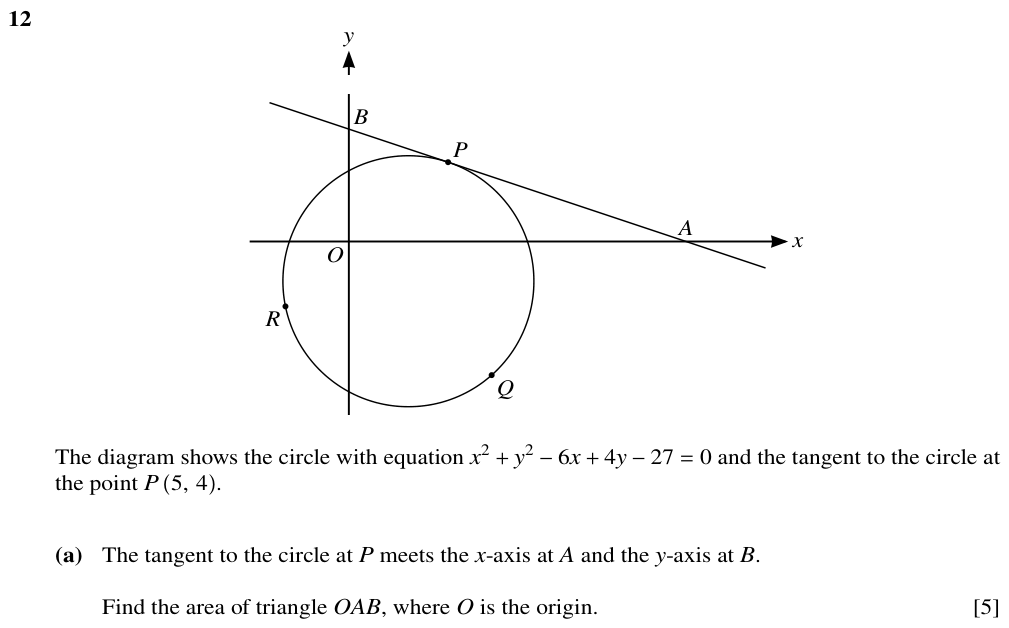
Show the mark scheme
| Part | Answer / working | Marks | Guidance |
|---|---|---|---|
| (a) | centre \((3,-2)\) | B1 | |
| gradient of radius \(CP=\tfrac{4+2}{5-3}=3\) | M1 | using the centre (not the origin) and \(P\) | |
| tangent \(y-4=-\tfrac13(x-5)\) | DM1 | through \(P\) with the negative reciprocal | |
| \(A(17,0)\) and \(B\left(0,\tfrac{17}{3}\right)\) | A1 | ||
| area \(=\tfrac12\times17\times\tfrac{17}{3}=\tfrac{289}{6}\) (48.2) | A1 | ||
| Total: 5 marks | |||
Your progress on this note is saved when JavaScript is on.