
Coordinate Geometry
Straight lines: gradient, length, midpoint and equations
What you need to be able to do
- 1.3Find the gradient, length and midpoint of a line segment, and the point where two lines meet.
- 1.3Find the equation of a line from two points, or from a point and a gradient, and use the forms \(y=mx+c\), \(y-y_1=m(x-x_1)\), \(ax+by+c=0\).
- 1.3Use parallel (equal gradients) and perpendicular (\(m_1m_2=-1\)) lines, and the link between gradient and angle.
Next: Perpendicular bisectors and coordinate problems. These tools turn up in tangents and normals (Differentiation) and circles.
Gradient, distance, midpoint and the equation of a line, from the basics, with our own examples. Past-paper questions come in Part 2.
What you should already know
Coordinates
\((x,\,y)\): across first, then up. Points on the \(x\)-axis have \(y=0\); points on the \(y\)-axis have \(x=0\).
Quick check: where does \(y=2x-6\) cross the \(x\)-axis?
\(0=2x-6\): at \((3,\,0)\)
Pythagoras
In a right-angled triangle, \(c^2=a^2+b^2\) with \(c\) the hypotenuse. Sides 6 and 8 give \(c=10\).
Quick check: hypotenuse of a triangle with sides 5 and 12?
\(\sqrt{169}=13\)
Rearranging a linear equation
\(3x+2y=12\Rightarrow2y=12-3x\Rightarrow y=6-\tfrac32x\).
Quick check: write \(4x-5y=10\) as \(y=\dots\)
\(y=\tfrac45x-2\)
Tangent in a right-angled triangle
\(\tan\theta=\dfrac{\text{opposite}}{\text{adjacent}}\). A slope that rises 3 for every 3 across makes \(45°\).
Quick check: angle whose tangent is 1?
\(45°\)
Gradient, length and midpoint
- Gradient = rise ÷ run: \(m=\dfrac{y_2-y_1}{x_2-x_1}\). Keep the same order top and bottom (B − A over B − A).
- Length (Pythagoras on the triangle): \(AB=\sqrt{(x_2-x_1)^2+(y_2-y_1)^2}\).
- Midpoint = the average of the coordinates: \(M=\left(\dfrac{x_1+x_2}{2},\ \dfrac{y_1+y_2}{2}\right)\).
- Intersection of two lines: solve their equations simultaneously.
What gradient means. Gradient is the steepness: how far the line rises for each 1 unit across. Gradient 3 climbs 3 for every 1 to the right; gradient \(-\tfrac12\) falls half a unit for every 1 to the right; gradient 0 is flat. A line has the same gradient everywhere, which is why any two of its points give the same answer.
Example. \(A(1,\,2)\) and \(B(7,\,10)\). Gradient \(=\dfrac{10-2}{7-1}=\dfrac86=\dfrac43\). Length \(=\sqrt{6^2+8^2}=\sqrt{100}=10\). Midpoint \(=\left(\dfrac{1+7}2,\ \dfrac{2+10}2\right)=(4,\,6)\).
- \(P(-3,\,5)\), \(Q(1,\,-3)\). Find the gradient, length and midpoint of \(PQ\).
Answer
\(m=\tfrac{-8}4=-2\); \(\sqrt{16+64}=\sqrt{80}=4\sqrt5\); \((-1,\,1)\) - The midpoint of \(A(2,\,k)\) and \(B(m,\,7)\) is \((5,\,4)\). Find \(k\) and \(m\).
Answer
\(\tfrac{2+m}2=5\Rightarrow m=8\); \(\tfrac{k+7}2=4\Rightarrow k=1\)
The equation of a straight line
| Form | Use it when | Example |
|---|---|---|
| \(y-y_1=m(x-x_1)\) | you know a point and the gradient (the fastest route) | through \((3,4)\), \(m=-\tfrac43\): \(y-4=-\tfrac43(x-3)\) |
| \(y=mx+c\) | you want to read off the gradient and y-intercept | \(y=-\tfrac43x+8\) |
| \(ax+by+c=0\) | the question asks for it ("integers") | \(4x+3y-24=0\) |
- From two points: gradient first, then \(y-y_1=m(x-x_1)\) with either point.
- To \(ax+by+c=0\) with integers: multiply out, clear fractions (×3 here), collect every term on one side. Any whole-number multiple is the same line.
- Gradient from \(ax+by+c=0\): rearrange to \(y=\dots\): \(m=-\tfrac ab\). E.g. \(\tfrac x3+\tfrac y2=1\Rightarrow y=2-\tfrac23x\), \(m=-\tfrac23\).
- Where a line meets the axes: put \(x=0\) (y-intercept) or \(y=0\) (x-intercept).
Where the point-gradient form comes from. Take any point \((x,\,y)\) on the line through \((x_1,\,y_1)\) with gradient \(m\). The gradient between the two points is \(m\): \(\dfrac{y-y_1}{x-x_1}=m\). Multiply up and you have \(y-y_1=m(x-x_1)\).
- Find the equation of the line through \((2,\,-1)\) and \((6,\,7)\).
Answer
\(m=2\): \(y+1=2(x-2)\), i.e. \(y=2x-5\) - Write the line through \((-3,\,4)\) with gradient \(-\tfrac23\) in the form \(ax+by+c=0\).
Answer
\(y-4=-\tfrac23(x+3)\Rightarrow3y-12=-2x-6\Rightarrow2x+3y-6=0\)
Parallel and perpendicular lines
- Parallel lines have equal gradients.
- Perpendicular lines: \(m_1\times m_2=-1\), so \(m_2=-\dfrac{1}{m_1}\) (flip and change sign): \(\tfrac34\to-\tfrac43\); \(-2\to\tfrac12\).
- Horizontal (\(m=0\)) and vertical (\(x=k\)) lines are perpendicular too: the formula can't handle them, a sketch can.
- To show an angle is a right angle: \(m_1m_2=-1\), or Pythagoras on the three lengths. Both are accepted.
- Find the line through \((1,\,3)\) perpendicular to \(y=4x-1\).
Answer
\(m=-\tfrac14\): \(y-3=-\tfrac14(x-1)\) - Are \(2x+3y=5\) and \(3x-2y=1\) perpendicular?
Answer
gradients \(-\tfrac23\) and \(\tfrac32\); product \(-1\): yes
Gradient and angle
- A line making angle \(\theta\) with the positive \(x\)-axis has gradient \(m=\tan\theta\). (\(\theta=45°\Rightarrow m=1\).)
- Angle between two lines with gradients \(m_1>m_2>0\): \(\tan^{-1}m_1-\tan^{-1}m_2\). Gradients 2 and \(\tfrac13\): \(63.43°-18.43°=45°\).
- Exact lengths from an angle: a line through \(B(0,3)\) meets the \(x\)-axis at \(A\) with angle \(BAO=\tfrac\pi3\) ⇒ \(\tan\tfrac\pi3=\tfrac{3}{OA}\Rightarrow OA=\tfrac{3}{\sqrt3}=\sqrt3\), and \(m_{AB}=-\sqrt3\).
Case by case
1 Midpoint, then a parallel line
\(M\) is the midpoint of \((5,1)\) and \((-1,7)\). Find the line through \(M\) parallel to \(\tfrac x4+\tfrac y2=1\).
AskedequationKnowparallel: same gradient as the given lineRoutemidpoint, gradient from the given line, point-gradient form
- \(M=\left(\tfrac{5-1}{2},\ \tfrac{1+7}{2}\right)=(2,4)\)
- \(\tfrac x4+\tfrac y2=1\Rightarrow y=2-\tfrac12x\): \(m=-\tfrac12\)
- \(y-4=-\tfrac12(x-2)\), i.e. \(x+2y=10\)
2 A perpendicular line and where it meets the axis
\(A(-2,-1)\), \(B(4,3)\). \(BC\perp AB\) meets the \(x\)-axis at \(C\). Find \(C\) and the length \(AC\).
AskedBC, C and ACKnow\(m_{AB}=\tfrac{4}{6}=\tfrac23\)Routeperpendicular gradient −3/2 through B, then y = 0
- \(m_{BC}=-\tfrac32\): \(y-3=-\tfrac32(x-4)\)
- \(y=0\): \(-3=-\tfrac32(x-4)\Rightarrow x=6\), \(C(6,0)\)
- \(AC=\sqrt{8^2+1^2}=\sqrt{65}=8.062\) (3 d.p.)
3 Letters for coordinates
\(A(4a,a)\), \(B(-a,-11a)\), \(a>0\). Find the line through \(O\) parallel to \(AB\), and \(a\) if \(AB=6\tfrac12\).
Askedthe line and aKnoweverything in terms of aRoutethe a's cancel in the gradient; Pythagoras for the length
- \(m_{AB}=\dfrac{-11a-a}{-a-4a}=\dfrac{-12a}{-5a}=\tfrac{12}5\): \(y=\tfrac{12}5x\)
- \(AB^2=(5a)^2+(12a)^2=169a^2\Rightarrow AB=13a=\tfrac{13}2\)
- \(a=\tfrac12\) (\(a>0\))
The a's cancel, so the gradient is a plain number and the line's equation must not contain a.
4 Area of a triangle with the axes
The line with gradient \(-3\) through \(P(2t,3t)\) meets the axes at \(A\) and \(B\). Find the area of triangle \(AOB\).
Askedarea in terms of tKnowa right-angled triangle at ORoutefind both intercepts, then ½ × base × height
- \(y-3t=-3(x-2t)\)
- \(x=0\Rightarrow y=9t\); \(y=0\Rightarrow x=3t\)
- Area \(=\tfrac12(3t)(9t)=\tfrac{27}2t^2\)
- Find where \(y=2x+1\) and \(x+y=7\) meet.
Answer
\(x+2x+1=7\Rightarrow x=2\): \((2,\,5)\) - A line makes \(60°\) with the positive \(x\)-axis and passes through the origin. Find its equation.
Answer
\(m=\tan60°=\sqrt3\): \(y=\sqrt3x\)
Key facts at a glance
- Gradient \(\dfrac{y_2-y_1}{x_2-x_1}\); length \(\sqrt{(x_2-x_1)^2+(y_2-y_1)^2}\); midpoint = average of the coordinates.
- Line through \((x_1,y_1)\) with gradient \(m\): \(y-y_1=m(x-x_1)\).
- Parallel: equal gradients. Perpendicular: \(m_1m_2=-1\).
- \(m=\tan\theta\) from the positive \(x\)-direction. Lines meet where their equations are solved together.
- Sketch first: none of these formulas is given in the exam.
How straight-line work is examined, what the mark scheme wants, then real Paper 1 questions worked through slowly.
How this is examined
Straight-line work is in nearly every Paper 1 coordinate geometry question, usually as the first step of a longer problem. The June 2021 report: "the use of a diagram for coordinate geometry questions is always recommended". For an answer "in the form \(ax+by+c=0\)" schemes want "all correct terms on one side ... allow multiples of this format by an integer only", and an equation that should be numeric "must not include a".
Mark-scheme focus
Give the equation in the form ax + by + c = 0 (integers)
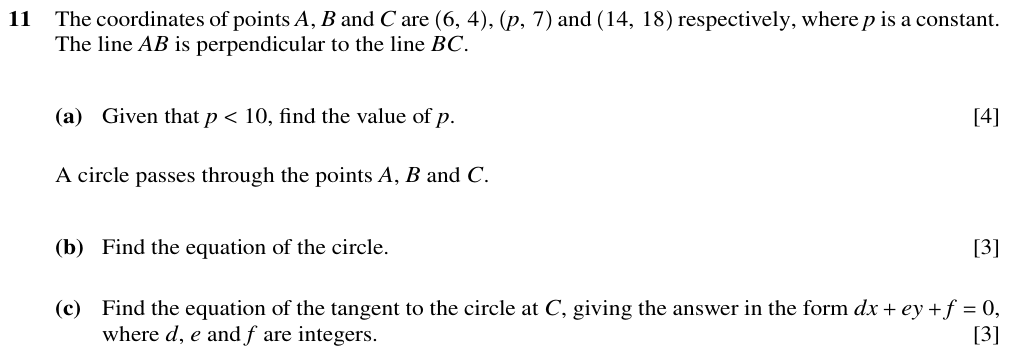
- \(4x+7y-182=0\): "all terms on one side in any order"; "allow multiples of this format by an integer only" A1
- \(y-18=-\tfrac47(x-14)\) left as it is ("correct equation but not stated in the required form")
- \(\tfrac47x+y-26=0\) (fractions)
- \(7y=-4x+182\) (not \(=0\))
The method marks are for the gradient and the point; the final A1 is only for the requested form.
- Straight-line skills inside other questions: tangents/normals (Differentiation), perpendicular bisectors, circles - on every paper.
- Pure straight-line questions (common before 2020, rarer now): 4-7 marks, B1 for gradient, M1 for m₁m₂ = −1, M1 for the line, A1.
- Form of the answer: read it (y = mx + c, ax + by + c = 0 with integers, or "exact").
Worked examples
Example 1 · Midpoint and a parallel line (Paper 1, 4 marks) ★ Easy

Two small jobs joined together: find the point \(M\) (average the coordinates), find the gradient (rearrange the given line), then write the line through \(M\).
- mid-pointaverage the x's, average the y's
- parallelsame gradient as the given line
- equation of the line
- \((3,7)\), \((-1,1)\)ends
- \(\tfrac x3+\tfrac y2=1\)parallel to this
- Findthe line
- Point\(M=(1,4)\)
- Gradientrearrange: \(y=2-\tfrac23x\)
What is the gradient of x/3 + y/2 = 1?
Multiply by 6: \(2x+3y=6\Rightarrow y=-\tfrac23x+2\): \(-\tfrac23\).
Which form is quickest to finish with?
\(y-y_1=m(x-x_1)\): \(y-4=-\tfrac23(x-1)\).
5 Now solve it have a go on paper first, then open the worked solution
- \(M=(1,4)\) M1 A1
- gradient \(-\tfrac23\) M1
- \(y-4=-\tfrac23(x-1)\) (any equivalent) A1
\(M\) satisfies it ✓; the gradient matches \(2x+3y=6\) ✓.
Example 2 · Perpendicular line, an intercept and a distance (Paper 1, 6 marks) ★ Easy

Sketch \(A\), \(B\) and a line through \(B\) at right angles to \(AB\), sloping down to the \(x\)-axis. The gradient of \(AB\) flips to give the gradient of \(BC\).
- perpendicular\(m_{BC}=-\dfrac{1}{m_{AB}}\)
- intersects the x-axisy = 0
- 3 decimal placesAC = 7.071, not 7.07
- (i)BC and C
- (ii)AC
- \(A(-1,1)\)
- \(B(3,4)\)
- (i)BC
- m\(m_{AB}=\tfrac34\Rightarrow m_{BC}=-\tfrac43\)
- Usethrough B (not A!)
- (ii)AC
- Usedistance formula
Why through B and not A?
The line is BC: it starts at B.
Solve 0 − 4 = −4/3(x − 3).
\(x-3=3\Rightarrow x=6\).
5 Now solve it have a go on paper first, then open the worked solution
- \(m_{AB}=\tfrac{4-1}{3+1}=\tfrac34\) B1
- \(BC\): \(y-4=-\tfrac43(x-3)\) M1 A1
- \(y=0\Rightarrow x=6\) A1
- (ii) \(AC^2=(6+1)^2+(0-1)^2=50\) M1 \(\Rightarrow AC=7.071\) A1
\(m_{AB}\times m_{BC}=\tfrac34\times(-\tfrac43)=-1\) ✓; C is right of B, as the sketch shows ✓.
Example 3 · Coordinates in terms of a (Paper 1, 5 marks) ★★ Medium
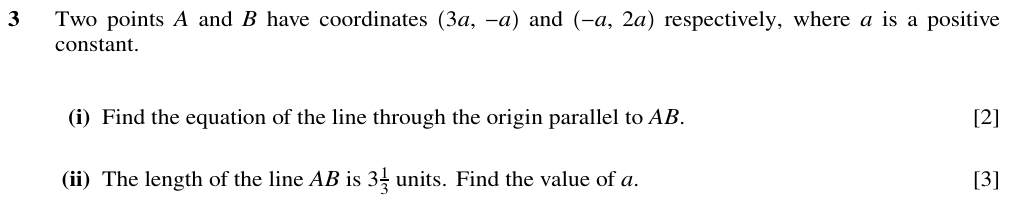
The coordinates contain \(a\), but the method is the usual one. In the gradient the \(a\)'s cancel. In the length you get \(a^2\), which you solve.
- through the originc = 0: \(y=mx\)
- a is a positive constantreject the negative root
- (i)the line
- (ii)a
- \(A(3a,-a)\)
- \(B(-a,2a)\)
- \(AB=\tfrac{10}{3}\)
- (i)line
- Use\(m=\tfrac{3a}{-4a}\)
- (ii)a
- Use\(AB^2=(4a)^2+(3a)^2\)
Change in x from A to B?
\(-a-3a=-4a\).
25a² = 100/9 gives a = ?
\(a^2=\tfrac{4}{9}\), \(a=\tfrac23\).
5 Now solve it have a go on paper first, then open the worked solution
- (i) \(m=-\tfrac34\) B1; \(y=-\tfrac34x\) B1FT
- (ii) \((4a)^2+(3a)^2=\left(\tfrac{10}{3}\right)^2\) M1
- \(25a^2=\tfrac{100}{9}\) A1 \(\Rightarrow a=\tfrac23\) A1
With \(a=\tfrac23\): \(A(2,-\tfrac23)\), \(B(-\tfrac23,\tfrac43)\); \(AB=\sqrt{(\tfrac83)^2+2^2}=\sqrt{\tfrac{100}{9}}\) ✓.
Summary
- \(m=\dfrac{y_2-y_1}{x_2-x_1}\); length by Pythagoras; midpoint = averages.
- Line: \(y-y_1=m(x-x_1)\); convert to the form asked.
- Parallel: equal \(m\). Perpendicular: \(m_1m_2=-1\).
- \(m=\tan\theta\); angle between lines = difference of the \(\tan^{-1}\) values.
| If you see… | do this |
|---|---|
| "parallel to" | same gradient |
| "perpendicular to" | negative reciprocal |
| "meets the x-axis" | y = 0 |
| "in the form ax + by + c = 0" | integers, all on one side |
| "angle the line makes" | \(\tan\theta=m\) |
Can I do this?
- I can find a gradient, a length and a midpoint, and where two lines meet.
- I can find the equation of a line and write it in the form the question asks for.
- I can use parallel and perpendicular gradients.
- I can use m = tan θ and find the angle between two lines.
Anything unticked: revise that section first. All ticked: take the quiz.
Quiz
The multiple-choice and guided questions need JavaScript. The concept checks and exam practice below work without it.
Concept checks
Answer each one in your head first, then open it.
1Why does \(m_1m_2=-1\) fail for a horizontal and a vertical line?Show answer
A vertical line has no gradient (division by zero), but they are perpendicular. Use a sketch.
2Does it matter which point is \((x_1,y_1)\)?Show answer
No, as long as you take both coordinates from the same point, top and bottom.
3How can you check a line equation you've found?Show answer
Substitute the given point(s): they must satisfy it; and read off its gradient.
Exam-style practice
New questions, not used above. Do them on paper, then mark your work against the official mark scheme.
Show the mark scheme
| Part | Answer / working | Marks | Guidance |
|---|---|---|---|
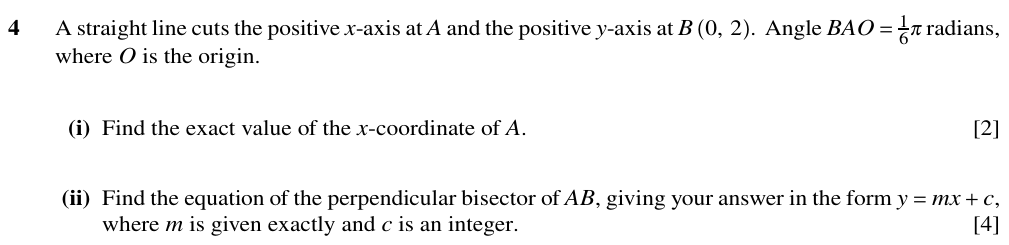
| (i) | \(\tan\tfrac\pi6=\tfrac{2}{x}\) | M1 | an exact value of \(\tan\tfrac\pi6\) is needed: \(\tfrac1{\sqrt3}\) |
| \(x=2\sqrt3\) | A1 | ||
| (ii) | midpoint \((\sqrt3,\ 1)\) | B1FT | half their (i) |
| \(m_{AB}=-\tfrac1{\sqrt3}\Rightarrow\) bisector gradient \(\sqrt3\) | M1 | ||
| \(y-1=\sqrt3(x-\sqrt3)\) | DM1 | through the midpoint | |
| \(y=\sqrt3x-2\) | A1 | ||
| Total: 6 marks | |||

Show the mark scheme
| Part | Answer / working | Marks | Guidance |
|---|---|---|---|
| (i) | \(m_{AB}=-\tfrac12\) | B1 | |
| \(y=-\tfrac12x+7\) | M1 | an equation from A or B | |
| \(k=-\tfrac12(3k)+7\) | M1 | C substituted | |
| \(k=\tfrac{14}5\) (2.8) | A1 | equal gradients \(m_{AC}=m_{AB}\) is also on the scheme | |
| (ii) | midpoint \(M(4,5)\) | B1 | |
| perpendicular gradient \(2\) | M1 | \(m_1m_2=-1\) | |
| \(y-5=2(x-4)\) with \(x=3k,\ y=k\) | M1 | ||
| \(k=\tfrac35\) | A1 | or from \(AC^2=BC^2\): \(40k=24\) | |
| Total: 8 marks | |||
Examiner tip Two different conditions on one point: (i) on a line means substitute into its equation; (ii) on the perpendicular bisector also means equally far from A and B, which is the quicker Pythagoras route.
Your progress on this note is saved when JavaScript is on.