
Trigonometry
Exact values, any angle and inverse trig functions
On this page
- What you need to be able to do
- What you should already know
- Exact values from two triangles
- Beyond 90°: sin and cos on a circle
- Any angle: the related angle and CAST
- Inverse functions and principal values
- Given one ratio, find the others
- Case by case
- Key facts at a glance
- How this is examined
- Mark-scheme focus
- Worked examples
- Summary
- Can I do this?
- Quiz
What you need to be able to do
- 1.5Know the exact values of sin, cos and tan of 30°, 45°, 60° (\(\tfrac\pi6,\tfrac\pi4,\tfrac\pi3\)) and use them for related angles such as \(\cos150°=-\tfrac{\sqrt3}2\).
- 1.5Find the sin, cos and tan of any angle from its acute related angle and the quadrant (CAST).
- 1.5Use \(\sin^{-1}\), \(\cos^{-1}\), \(\tan^{-1}\) and their principal values; given one ratio, find the others exactly.
You need: SOH CAH TOA and Pythagoras (IGCSE / O Level); radians from Circular measure. Next: Trigonometric graphs.
Where the exact values come from, how sin, cos and tan work for any angle, and what the inverse functions give, with our own examples. Past-paper questions come in Part 2.
What you should already know
SOH CAH TOA
In a right-angled triangle: \(\sin=\tfrac{\text{opp}}{\text{hyp}}\), \(\cos=\tfrac{\text{adj}}{\text{hyp}}\), \(\tan=\tfrac{\text{opp}}{\text{adj}}\).
Quick check: sides 3, 4, 5: \(\sin\) and \(\tan\) of the angle opposite 3?
\(\tfrac35\) and \(\tfrac34\)
Pythagoras
Find the third side of a right-angled triangle from two others.
Quick check: legs 1 and \(\sqrt3\): hypotenuse?
\(\sqrt{1+3}=2\)
Radians
\(\pi\) rad \(=180°\): \(\tfrac\pi6=30°\), \(\tfrac\pi4=45°\), \(\tfrac\pi3=60°\) (Circular measure).
Quick check: \(\tfrac{5\pi}4\) in degrees?
\(225°\)
Simplifying surds
\(\tfrac1{\sqrt2}=\tfrac{\sqrt2}2\) (multiply top and bottom by \(\sqrt2\)); \(\tfrac{1}{\sqrt3}=\tfrac{\sqrt3}3\).
Quick check: rationalise \(\tfrac{3}{\sqrt3}\)
\(\sqrt3\)
Exact values from two triangles
- 45° triangle: legs 1 and 1, hypotenuse \(\sqrt2\) (Pythagoras). So \(\sin45°=\cos45°=\tfrac1{\sqrt2}=\tfrac{\sqrt2}2\), \(\tan45°=1\).
- 30°/60° triangle: half of an equilateral triangle of side 2: sides 1, \(\sqrt3\), 2.
- Read off with SOH CAH TOA: \(\sin30°=\tfrac12\), \(\cos30°=\tfrac{\sqrt3}2\), \(\tan30°=\tfrac1{\sqrt3}\); \(\sin60°=\tfrac{\sqrt3}2\), \(\cos60°=\tfrac12\), \(\tan60°=\sqrt3\).
- Notice \(\sin30°=\cos60°\): sin of an angle = cos of its complement.
| θ | 0 | 30° = \(\tfrac\pi6\) | 45° = \(\tfrac\pi4\) | 60° = \(\tfrac\pi3\) | 90° = \(\tfrac\pi2\) |
|---|---|---|---|---|---|
| \(\sin\theta\) | 0 | \(\tfrac12\) | \(\tfrac{\sqrt2}2\) | \(\tfrac{\sqrt3}2\) | 1 |
| \(\cos\theta\) | 1 | \(\tfrac{\sqrt3}2\) | \(\tfrac{\sqrt2}2\) | \(\tfrac12\) | 0 |
| \(\tan\theta\) | 0 | \(\tfrac{1}{\sqrt3}=\tfrac{\sqrt3}3\) | 1 | \(\sqrt3\) | undefined |
- Without a calculator, find \(\sin60°\cos30°+\cos60°\sin30°\).
Answer
\(\tfrac{\sqrt3}2\cdot\tfrac{\sqrt3}2+\tfrac12\cdot\tfrac12=\tfrac34+\tfrac14=1\) - Find \(\tan^2\tfrac\pi6+\cos^2\tfrac\pi4\) exactly.
Answer
\(\tfrac13+\tfrac12=\tfrac56\)
Beyond 90°: sin and cos on a circle
A right-angled triangle can only hold angles below 90°, so for larger angles we need a better definition. Put a point \(P\) on a circle of radius 1, centred at the origin, and turn the radius \(OP\) anticlockwise from the positive \(x\)-axis through the angle \(\theta\). Then
For acute angles this is SOH CAH TOA with hypotenuse 1. But it works for every angle, and it explains everything that follows: at \(90°\), \(P=(0,1)\) so \(\cos90°=0\), \(\sin90°=1\) and \(\tan90°\) is undefined (dividing by 0); at \(180°\), \(P=(-1,0)\); in the 2nd quadrant \(x<0\) and \(y>0\), so cos is negative and sin positive. The signs in each quadrant are just the signs of the coordinates.
Any angle: the related angle and CAST
- Every angle makes an acute related angle \(\alpha\) with the x-axis. The ratio has the same size as \(\sin\alpha\), \(\cos\alpha\) or \(\tan\alpha\).
- The sign comes from the quadrant: All in the 1st, Sin in the 2nd, Tan in the 3rd, Cos in the 4th.
- So \(\cos150°\): related angle 30°, 2nd quadrant (only sin +), so \(\cos150°=-\cos30°=-\tfrac{\sqrt3}2\).
- Negative angles turn clockwise: \(-30°\) is in the 4th quadrant, so \(\sin(-30°)=-\tfrac12\).
| Quadrant | angle (degrees) | angle (radians) | positive |
|---|---|---|---|
| 1st | \(\alpha\) | \(\alpha\) | all |
| 2nd | \(180°-\alpha\) | \(\pi-\alpha\) | \(\sin\) |
| 3rd | \(180°+\alpha\) | \(\pi+\alpha\) | \(\tan\) |
| 4th | \(360°-\alpha\) | \(2\pi-\alpha\) | \(\cos\) |
Exact value of any angle
1 Find the quadrant. 2 Find the related angle \(\alpha\). 3 Write the exact value of \(\alpha\). 4 Put on the sign from CAST.
\(\sin\tfrac{3\pi}4=+\sin\tfrac\pi4=\tfrac{\sqrt2}2\); \(\tan\tfrac{7\pi}6=+\tan\tfrac\pi6=\tfrac{1}{\sqrt3}\).
Same value, two angles
In 0°-360° each value of sin, cos or tan (other than 0, ±1) appears at two angles: the two quadrants with that sign. This is where every "second solution" in an equation comes from.
- Find the exact value of \(\cos315°\).
Answer
4th quadrant, related 45°, cos positive: \(\tfrac{\sqrt2}2\) - Find the exact value of \(\tan(-120°)\).
Answer
\(-120°\) is in the 3rd quadrant (tan +), related 60°: \(\sqrt3\) - Find the exact value of \(\sin\tfrac{5\pi}6\).
Answer
2nd quadrant, related \(\tfrac\pi6\): \(\tfrac12\)
Inverse functions and principal values
\(\sin^{-1}x\) means "the angle whose sine is \(x\)". Many angles have the same sine, so the calculator gives just one, the principal value, from a fixed range:
| \(\sin^{-1}x\) | \(\cos^{-1}x\) | \(\tan^{-1}x\) | |
|---|---|---|---|
| accepts | \(-1\le x\le1\) | \(-1\le x\le1\) | any x |
| gives (degrees) | \(-90°\le\theta\le90°\) | \(0°\le\theta\le180°\) | \(-90°<\theta<90°\) |
| gives (radians) | \(-\tfrac\pi2\le\theta\le\tfrac\pi2\) | \(0\le\theta\le\pi\) | \(-\tfrac\pi2<\theta<\tfrac\pi2\) |
- \(\cos^{-1}\!\left(\tfrac{\sqrt3}2\right)=\tfrac\pi6\), so \(-\cos^{-1}\!\left(\tfrac{\sqrt3}2\right)=-\tfrac\pi6\) (the minus is outside).
- \(\tan^{-1}(\text{something})=-\tfrac\pi4\) means \(\text{something}=\tan\!\left(-\tfrac\pi4\right)=-1\): take tan of both sides.
- \(\cos^{-1}(-\tfrac12)=\tfrac{2\pi}3\) (2nd quadrant, inside \(0\) to \(\pi\)); \(\sin^{-1}(-\tfrac12)=-\tfrac\pi6\) (not \(\tfrac{7\pi}6\): outside the range).
- Find \(\sin^{-1}\!\left(-\tfrac{\sqrt3}2\right)\) and \(\cos^{-1}\!\left(-\tfrac{\sqrt2}2\right)\) in radians.
Answer
\(-\tfrac\pi3\) and \(\tfrac{3\pi}4\)
Given one ratio, find the others
- Draw the right-angled triangle for the acute related angle: e.g. \(\cos\alpha=\tfrac5{13}\) gives adjacent 5, hypotenuse 13, opposite \(\sqrt{13^2-5^2}=12\).
- Or use the identity \(\sin^2\theta+\cos^2\theta=1\): \(\sin\alpha=\sqrt{1-\tfrac{25}{169}}=\tfrac{12}{13}\). Either way is fine; show one of them.
- Fix the sign from the quadrant: if \(90°<\beta<180°\) and \(\sin\beta=a\), then \(\cos\beta=-\sqrt{1-a^2}\) (cos is negative in the 2nd quadrant) and \(\tan\beta=\dfrac{a}{-\sqrt{1-a^2}}\).
- Letters work the same way: \(\tan^2\beta=\dfrac{\sin^2\beta}{\cos^2\beta}=\dfrac{a^2}{1-a^2}\).
- \(\sin\theta=\tfrac35\) and \(\theta\) is obtuse. Find \(\cos\theta\) and \(\tan\theta\).
Answer
\(\cos\theta=-\tfrac45\), \(\tan\theta=-\tfrac34\) - \(\tan\beta=2\), \(\beta\) acute. Find \(\sin\beta\) and \(\cos\beta\) exactly.
Answer
triangle 1, 2, \(\sqrt5\): \(\sin\beta=\tfrac2{\sqrt5}\), \(\cos\beta=\tfrac1{\sqrt5}\)
Case by case
1 Exact value of an obtuse or reflex angle
Find the exact value of \(\sin\tfrac{4\pi}3\).
Askedexact sin 4π/3Know4π/3 = π + π/3: 3rd quadrantRouterelated angle π/3, sign from CAST
- 3rd quadrant: only tan is positive, so sin is negative
- \(\sin\tfrac{4\pi}3=-\sin\tfrac\pi3=-\tfrac{\sqrt3}2\)
2 An equation with inverse functions
\(\tfrac\pi2-\tan^{-1}(3x)=\cos^{-1}\!\left(\tfrac12\right)\): find the exact solution.
Askedexact xKnowcos⁻¹(½) = π/3Routetan⁻¹(3x) on its own, then tan both sides
- \(\tan^{-1}(3x)=\tfrac\pi2-\tfrac\pi3=\tfrac\pi6\)
- \(3x=\tan\tfrac\pi6=\tfrac1{\sqrt3}\Rightarrow x=\tfrac1{3\sqrt3}=\tfrac{\sqrt3}9\)
A decimal (0.192) is not exact: leave it as √3/9.
3 tan⁻¹ of an expression
Solve \(\tan^{-1}(2x-5)=-\tfrac14\pi\).
AskedxKnowtan(−π/4) = −1Routetake tan of both sides
- \(2x-5=\tan(-\tfrac\pi4)=-1\)
- \(x=2\)
The angle is in radians: tan in degree mode gives −0.0137…, which is wrong.
4 Exact solution in a small interval
\(\sin\tfrac16\pi+\tan2x=\tfrac32\) for \(-\tfrac14\pi<x<\tfrac14\pi\).
Askedexact xKnowsin(π/6) = ½; 2x lies in (−π/2, π/2)Routemake tan 2x the subject
- \(\tan2x=\tfrac32-\tfrac12=1\)
- \(2x=\tfrac\pi4\Rightarrow x=\tfrac\pi8\)
With −π/2 < 2x < π/2, tan takes each value once, so there is only one solution.
5 Mixed inverses
\(2\sin^{-1}(2t)+3\cos^{-1}\!\left(\tfrac12\right)=\tfrac{4\pi}3\): exact t.
Askedexact tKnowcos⁻¹(½) = π/3Routeisolate sin⁻¹(2t)
- \(2\sin^{-1}(2t)=\tfrac{4\pi}3-\pi=\tfrac\pi3\Rightarrow\sin^{-1}(2t)=\tfrac\pi6\)
- \(2t=\tfrac12\Rightarrow t=\tfrac14\)
Key facts at a glance
- Exact values come from two triangles: 1, 1, \(\sqrt2\) and 1, \(\sqrt3\), 2.
- On the unit circle \(\cos\theta=x\), \(\sin\theta=y\): this defines them for every angle.
- Any angle: related acute angle for the size, CAST for the sign.
- Principal values: \(\sin^{-1}\) in \([-\tfrac\pi2,\tfrac\pi2]\), \(\cos^{-1}\) in \([0,\pi]\), \(\tan^{-1}\) in \((-\tfrac\pi2,\tfrac\pi2)\).
- Given one ratio: a right-angled triangle or \(\sin^2+\cos^2=1\), then the sign from the quadrant.
How exact values are examined, what the mark scheme wants, then real Paper 1 questions worked through slowly.
How this is examined
"Exact" and "without using the trigonometric functions on your calculator" mean the working must be seen: "Correct answer with no working shown scores 0". Schemes give the method mark for a decimal but the A1 only for the exact form, and condone a degree-mode value for the method mark only.
Mark-scheme focus
Show, without using a calculator, that …

- multiply through by \(\cos x\): \(4\sin x+3\cos^2x+1=0\) M1
- \(\cos^2x=1-\sin^2x\) and simplify to a 3-term quadratic: \(3\sin^2x-4\sin x-4=0\) M1
- \((3\sin x+2)(\sin x-2)=0\Rightarrow\sin x=-\tfrac23\) (\(\sin x=2\) impossible) {A1 AG}
- finding \(x\) on a calculator and checking it
- \(\sin x=-\tfrac23\) stated after the quadratic with no factorising or reason to reject 2
- \(\tan x\) left in the equation (it must become \(\tfrac{\sin x}{\cos x}\))
"Show" and "without a calculator" mean every algebraic step is marked. The answer is given (AG), so the marks are all for the route; rejecting sin x = 2 completes it.
From: 9709/11/O/N/19 Q5(i).
- Exact values show up inside bigger questions: exact solutions of equations, exact areas in circular measure, exact coordinates.
- The method must be visible when the calculator is banned: a triangle, an identity, or a stated exact value such as cos⁻¹(½√3) = π/6.
- Signs: an obtuse angle has a negative cos and tan - the mark scheme writes \(\cos\beta=-\sqrt{1-a^2}\) as its own B1.
Worked examples
Example 1 · Exact value without a calculator (Paper 1, 5 marks) ★ Easy

\(\alpha\) is an angle whose cosine is \(\tfrac8{17}\). It lies between 0 and 90° (principal value, positive cos). We need its sin and tan as fractions, then add two fractions.
- cos⁻¹(8/17)an acute angle with cos α = 8/17
- without using the trigonometric functionsevery value must come from a triangle or an identity
- exacta fraction, not a decimal
- \(\tfrac1{\sin\alpha}+\tfrac1{\tan\alpha}\) exactly
- \(\cos\alpha=\tfrac8{17}\)adjacent 8, hypotenuse 17
- 8, 15, 17 is a Pythagorean triple: \(8^2+15^2=17^2\).
- Find\(\tfrac1{\sin\alpha}+\tfrac1{\tan\alpha}\)
- sin αtriangle or sin² + cos² = 1
- tan αopposite ÷ adjacent
What is the missing side?
\(\sqrt{289-64}=15\).
Is sin α positive?
Yes: \(\alpha\) is acute (cos⁻¹ of a positive number).
5 Now solve it have a go on paper first, then open the worked solution
- \(\sin\alpha=\sqrt{1-\tfrac{64}{289}}=\tfrac{15}{17}\) *M1 A1
- \(\tan\alpha=\tfrac{15/17}{8/17}=\tfrac{15}8\) A1
- \(\tfrac1{\sin\alpha}+\tfrac1{\tan\alpha}=\tfrac{17}{15}+\tfrac8{15}=\tfrac{25}{15}\) DM1
- \(=\tfrac53\) A1
Calculator check (allowed now that we're done): \(\alpha=61.9°\), \(1/\sin\alpha+1/\tan\alpha=1.133+0.533=1.667\) ✓.
Example 2 · A ratio given as a letter, angle obtuse (Paper 1, 3 marks) ★★ Medium

\(\beta\) is obtuse, so it's in the 2nd quadrant: sin positive, cos negative. Write everything in terms of \(\sin\beta=a\) and \(\cos\beta\), then replace \(\cos\beta\) using the identity, with the right sign.
- between 90° and 180°2nd quadrant: cos β < 0
- in terms of athe answer contains only a
- (a)\(\tan^2\beta-3\sin\beta\cos\beta\)
- \(\sin\beta=a\)
- \(\cos\beta=-\sqrt{1-a^2}\): the minus sign is a mark on its own.
- Findthe expression in a
- Use\(\tan^2\beta=\tfrac{\sin^2\beta}{\cos^2\beta}\)
- cos β\(-\sqrt{1-a^2}\)
- Trap\(+\sqrt{1-a^2}\)
What is \(\cos^2\beta\)?
\(1-a^2\) (the sign doesn't matter once it is squared).
What is \(-3\sin\beta\cos\beta\)?
\(-3a\cdot(-\sqrt{1-a^2})=+3a\sqrt{1-a^2}\).
5 Now solve it have a go on paper first, then open the worked solution
- \(\tan^2\beta=\dfrac{\sin^2\beta}{\cos^2\beta}=\dfrac{a^2}{1-a^2}\) B1
- \(\cos\beta=-\sqrt{1-a^2}\) B1
- \(\tan^2\beta-3\sin\beta\cos\beta=\dfrac{a^2}{1-a^2}+3a\sqrt{1-a^2}\) B1
Try \(\beta=150°\), \(a=\tfrac12\): \(\tan^2150°=\tfrac13\) and \(-3\sin150°\cos150°=\tfrac{3\sqrt3}4\). Formula: \(\tfrac{1/4}{3/4}+\tfrac32\cdot\tfrac{\sqrt3}2=\tfrac13+\tfrac{3\sqrt3}4\) ✓.
Example 3 · Coordinates on a cosine curve, then an inverse equation (Paper 1, 5 marks) ★★ Medium
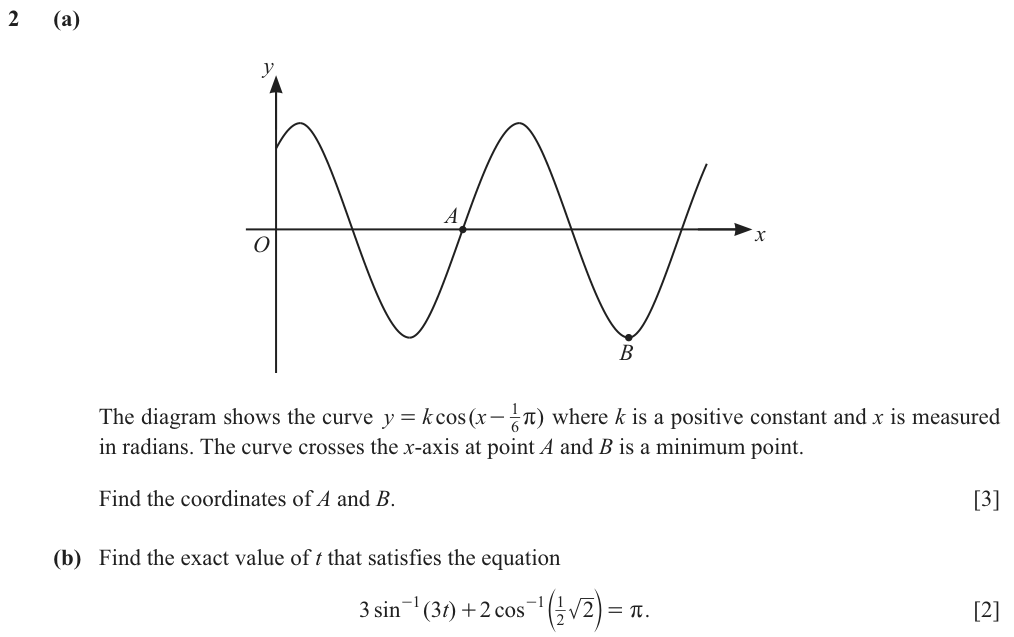
The curve is \(y=k\cos x\) moved \(\tfrac\pi6\) to the right. Count along the picture: max, zero, min, zero (A), max, zero, min (B). Zeros of cos are at \(\tfrac\pi2,\tfrac{3\pi}2,\ldots\); minima at \(\pi,3\pi,\ldots\). Then add \(\tfrac\pi6\).
- crosses the x-axis at Ay = 0: the 2nd zero after the start
- B is a minimum pointy = −k, the 2nd minimum
- exactmultiples of π
- (a)A and B
- (b)exact t
- \(y=k\cos(x-\tfrac\pi6)\)k > 0
- A is the zero where the curve goes up: after the first minimum.
- (a)A, B
- Zeros\(x-\tfrac\pi6=\tfrac{3\pi}2\Rightarrow x=\tfrac{5\pi}3\)
- 2nd minimum\(x-\tfrac\pi6=3\pi\Rightarrow x=\tfrac{19\pi}6\)
- (b)t
- Known\(\cos^{-1}\tfrac{\sqrt2}2=\tfrac\pi4\)
Which zero is A?
The curve starts near a max, falls through \(x=\tfrac{2\pi}3\), reaches a min at \(\tfrac{7\pi}6\) and rises through A.
What is the y-coordinate of B?
\(-k\): the least value of \(k\cos(\ldots)\).
5 Now solve it have a go on paper first, then open the worked solution
- (a) \(A=\left(\tfrac53\pi,\ 0\right)\) B1
- \(B\): \(x=\tfrac{19}6\pi\) B1, \(y=-k\) B1
- (b) \(3\sin^{-1}(3t)=\pi-2\cdot\tfrac\pi4=\tfrac\pi2\), \(\sin^{-1}(3t)=\tfrac\pi6\) M1
- \(3t=\tfrac12\Rightarrow t=\tfrac16\) A1
\(\tfrac{19\pi}6-\tfrac{5\pi}3=\tfrac{9\pi}6=\tfrac{3\pi}2\): from a rising zero to the next-but-one minimum is ¾ of a period (2π) ✓.
Summary
- Two triangles (1, 1, √2 and 1, √3, 2) give every exact value of 30°, 45°, 60°.
- Any angle: related acute angle + sign from CAST (All, Sin, Tan, Cos).
- Principal values: \(\sin^{-1}\) and \(\tan^{-1}\) give \(-\tfrac\pi2\) to \(\tfrac\pi2\); \(\cos^{-1}\) gives \(0\) to \(\pi\).
- Given one ratio: triangle or \(\sin^2+\cos^2=1\), then the sign from the quadrant.
| If you see… | do this |
|---|---|
| "exact" / "without a calculator" | triangle or identity, shown in writing |
| an obtuse angle, \(\sin\beta=a\) | \(\cos\beta=-\sqrt{1-a^2}\) |
| \(\tan^{-1}(\ldots)=\) a number | take tan of both sides |
| \(\cos^{-1}\!\left(\tfrac{\sqrt3}2\right)\) etc. | replace it by its exact angle first |
Can I do this?
- I can draw the two special triangles and write the exact values of 30°, 45°, 60° in degrees and radians.
- I can find the exact sin, cos or tan of any angle using the related angle and CAST.
- I know the principal-value ranges of sin⁻¹, cos⁻¹ and tan⁻¹ and can solve equations containing them.
- Given one ratio (a number or a letter) and the quadrant, I can find the others with the right sign.
- I show where every exact value comes from when the calculator is not allowed.
Anything unticked: revise that section first. All ticked: take the quiz.
Quiz
The multiple-choice and guided questions need JavaScript. The concept checks and exam practice below work without it.
Concept checks
Answer each one in your head first, then open it.
1Why is \(\tan90°\) undefined?Show answer
\(\tan=\tfrac{\sin}{\cos}\) and \(\cos90°=0\): you would divide by zero.
2Why does \(\cos^{-1}\) use the range \(0\) to \(\pi\) and not \(-\tfrac\pi2\) to \(\tfrac\pi2\)?Show answer
Cos is the same for \(\theta\) and \(-\theta\), so \(-\tfrac\pi2\) to \(\tfrac\pi2\) would give every positive value twice and never a negative one. \(0\) to \(\pi\) gives every value from 1 down to −1 exactly once.
3Is \(\sin^{-1}x\) the same as \(\tfrac1{\sin x}\)?Show answer
No. \(\sin^{-1}x\) is an angle; \(\tfrac1{\sin x}=(\sin x)^{-1}\) is a ratio. Only \(\sin^2x\) means \((\sin x)^2\).
Exam-style practice
New questions, not used above. Do them on paper, then mark your work against the official mark scheme.

Show the mark scheme
| Part | Answer / working | Marks | Guidance |
|---|---|---|---|
| (a) | \(5x-3=\tan\left(-\tfrac\pi4\right)=-1\) | M1 | degree-mode values condoned for this mark only |
| \(x=\tfrac25\) | A1 | ||
| (b) | \(5-5\sin^2\theta=4\sin\theta+4\) | *M1 | \(\cos^2\theta=1-\sin^2\theta\) |
| \(5\sin^2\theta+4\sin\theta-1=0\Rightarrow(5\sin\theta-1)(\sin\theta+1)=0\) | DM1 | ||
| \(\sin\theta=\tfrac15\) or \(-1\) | A1 | ||
| \(\theta=2.94,\ 4.71\) | A1 | \(\tfrac{3\pi}2\) accepted; 0.201 is outside the range | |
| Total: 6 marks | |||

Show the mark scheme
| Part | Answer / working | Marks | Guidance |
|---|---|---|---|
| \(\tan2x=-\sqrt3\) | M1 | \(\tan2x=0\) scores M0 | |
| \(2x=-\tfrac\pi3\Rightarrow x=-\tfrac\pi6\) | A1 | exact; only one solution in the interval | |
| Total: 2 marks | |||
Your progress on this note is saved when JavaScript is on.