
Trigonometry
Solving trigonometric equations
On this page
- What you need to be able to do
- What you should already know
- Why a trig equation has many solutions
- One equation, two solutions
- A changed range: solve for the whole bracket first
- Quadratics in sin, cos or tan
- Factorise - never divide by sin θ
- Case by case
- Key facts at a glance
- How this is examined
- Mark-scheme focus
- Worked examples
- Summary
- Can I do this?
- Quiz
What you need to be able to do
- 1.5Find all the solutions of a trigonometric equation in a given interval, in degrees or radians.
- 1.5Deal with a changed range: \(\sin2x=k\), \(\cos(\tfrac12x-30°)=k\), …
- 1.5 + 1.1Use \(\tan\theta\equiv\tfrac{\sin\theta}{\cos\theta}\) and \(\sin^2\theta+\cos^2\theta\equiv1\) to reach a quadratic in sin, cos or tan; factorise instead of dividing by \(\sin\theta\).
You need: CAST and principal values, Solving quadratic equations. Next: Identities.
Why a trig equation has many solutions, how to find all of them in an interval, and how to handle brackets, quadratics and common factors, with our own examples. Past-paper questions come in Part 2.
What you should already know
CAST and related angles
Each quadrant makes one family positive; the related angle gives the size (Exact values).
Quick check: in which quadrants is \(\cos\) negative?
2nd and 3rd
Principal values
\(\sin^{-1}\) gives \(-90°\) to \(90°\); \(\cos^{-1}\) gives \(0°\) to \(180°\); \(\tan^{-1}\) gives \(-90°\) to \(90°\).
Quick check: \(\cos^{-1}(-0.5)\)?
\(120°\)
The graphs
sin and cos repeat every 360°, tan every 180° (Trig graphs).
Quick check: how many times does \(y=\sin x\) reach \(0.8\) in \(0°\)-\(720°\)?
4 (twice per cycle)
Solving quadratics
Factorise, complete the square or use the formula; \(u^2\) and \(u\) for any \(u\) (Solving quadratic equations).
Quick check: solve \(2u^2-u-1=0\)
\((2u+1)(u-1)=0\): \(u=1,\ -\tfrac12\)
Why a trig equation has many solutions
\(x^2=4\) has two solutions. \(\sin x=0.5\) has infinitely many: \(30°,\ 150°,\ 390°,\ 510°,\ \dots\) and \(-210°,\ -330°,\ \dots\), because the graph repeats forever and a horizontal line crosses every cycle twice. So a trig equation always comes with an interval ("for \(0°\le x\le360°\)"), and the job is to find every solution inside it and no others. The calculator gives just one of them, the principal value; the graph's symmetry gives the rest.
One equation, two solutions
- Get the equation to one ratio = a number: \(\sin x=0.6\).
- Use the calculator for the principal value: \(\sin^{-1}0.6=36.9°\).
- Find the second solution from the symmetry of the graph (table below). Both must be in the interval.
- Add or subtract 360° (2π) - or 180° (π) for tan - until you have every solution in the interval, and no others.
| Equation | principal value α | second solution | then add / subtract |
|---|---|---|---|
| \(\sin x=k\) | \(\sin^{-1}k\) | \(180°-\alpha\) (\(\pi-\alpha\)) | 360° (\(2\pi\)) |
| \(\cos x=k\) | \(\cos^{-1}k\) | \(360°-\alpha\) (\(2\pi-\alpha\)), or \(-\alpha\) | 360° (\(2\pi\)) |
| \(\tan x=k\) | \(\tan^{-1}k\) | \(\alpha+180°\) (\(\alpha+\pi\)) | 180° (\(\pi\)) |
Accuracy
Degrees to 1 d.p., radians to 3 s.f., unless "exact". Give answers in the units of the interval: degrees for a degree interval, radians for a radian one.
Exactly the right answers
Every solution inside the interval, and nothing else: an extra wrong value inside the interval is as bad as a missing one. Check each answer against the interval.
- Solve \(\cos x=0.5\) for \(0°\le x\le360°\).
Answer
\(60°\) and \(360°-60°=300°\) - Solve \(\tan x=-1\) for \(0\le x\le2\pi\).
Answer
\(\tan^{-1}(-1)=-\tfrac\pi4\); add \(\pi\): \(\tfrac{3\pi}4\), \(\tfrac{7\pi}4\) - Solve \(\sin x=-0.4\) for \(0°\le x\le360°\).
Answer
\(\sin^{-1}(-0.4)=-23.6°\) (outside); \(180°+23.6°=203.6°\) and \(360°-23.6°=336.4°\)
A changed range: solve for the whole bracket first
- Call the bracket \(u\): in \(\sin2x=\tfrac35\) for \(0°<x<180°\), let \(u=2x\).
- Change the interval the same way: \(0°<2x<360°\).
- Solve for u in the new interval: \(u=36.87°\) or \(180°-36.87°=143.13°\).
- Undo the bracket: \(x=\tfrac u2=18.4°,\ 71.6°\). With \(\tfrac12x-30°\), the new interval is \(-30°\le\tfrac12x-30°\le150°\) for \(0°\le x\le360°\).
- Solve \(\sin2x=0.5\) for \(0°\le x\le180°\).
Answer
\(0°\le2x\le360°\): \(2x=30°,\ 150°\), so \(x=15°,\ 75°\) - Solve \(\cos(x-20°)=0\) for \(0°\le x\le360°\).
Answer
\(x-20°=90°,\ 270°\): \(x=110°,\ 290°\)
Quadratics in sin, cos or tan
- One ratio only: replace \(\tan\theta\) by \(\tfrac{\sin\theta}{\cos\theta}\) and multiply through; replace \(\sin^2\theta\) by \(1-\cos^2\theta\) (or \(\cos^2\theta\) by \(1-\sin^2\theta\)) so everything is in the ratio that appears to the first power.
- Three-term quadratic = 0: \(4\sin^2\theta+8\cos\theta-7=0\Rightarrow4\cos^2\theta-8\cos\theta+3=0\), all terms on one side.
- Solve it with visible working: factorise, formula or completing the square: \((2\cos\theta-1)(2\cos\theta-3)=0\).
- Reject impossible roots: \(\cos\theta=\tfrac32\) has no solutions (sin and cos are between −1 and 1). Solve the others as in section 1.
Disguised quadratics
\(2\cos^4\theta+5\cos^2\theta-3=0\) is a quadratic in \(\cos^2\theta\): \((2\cos^2\theta-1)(\cos^2\theta+3)=0\). Then \(\cos\theta=\pm\tfrac1{\sqrt2}\): both signs, four angles in 0°-360°.
Fractions in the equation
\(3\sin\theta=5-\tfrac{2}{\sin\theta}\): multiply every term by \(\sin\theta\) first: \(3\sin^2\theta-5\sin\theta+2=0\).
- Solve \(2\cos^2x-\cos x-1=0\) for \(0°\le x\le360°\).
Answer
\((2\cos x+1)(\cos x-1)=0\): \(0°,\ 120°,\ 240°,\ 360°\) - Solve \(2\sin^2x=3\cos x\) for \(0°\le x\le360°\).
Answer
\(2\cos^2x+3\cos x-2=0\Rightarrow(2\cos x-1)(\cos x+2)=0\): \(60°,\ 300°\)
Factorise - never divide by sin θ
\(3\sin\theta+\tan\theta=0\) for \(0°<\theta<360°\). Dividing by \(\sin\theta\) throws away every solution of \(\sin\theta=0\). Instead:
- \(3\sin\theta+\tfrac{\sin\theta}{\cos\theta}=0\)
- take out the common factor: \(\sin\theta\left(3+\tfrac1{\cos\theta}\right)=0\), so \(\sin\theta=0\) or \(\cos\theta=-\tfrac13\)
- \(\sin\theta=0\) gives \(\theta=180°\) (0° and 360° are outside the interval). \(\cos\theta=-\tfrac13\) gives \(109.5°\) and \(360°-109.5°=250.5°\)
- Three solutions: \(109.5°,\ 180°,\ 250.5°\). Dividing by \(\sin\theta\) would have lost 180°.
- Solve \(\sin x\cos x=\sin x\) for \(0°\le x\le360°\).
Answer
\(\sin x(\cos x-1)=0\): \(\sin x=0\) or \(\cos x=1\): \(0°,\ 180°,\ 360°\)
Case by case
1 Quadratic in cos, one root impossible
\(2\sin^2\theta+3\cos\theta=0\), \(0°<\theta<180°\).
AskedθKnowsin²θ = 1 − cos²θRoute3-term quadratic in cos θ
- \(2(1-\cos^2\theta)+3\cos\theta=0\Rightarrow2\cos^2\theta-3\cos\theta-2=0\)
- \((2\cos\theta+1)(\cos\theta-2)=0\)
- \(\cos\theta=2\) is impossible; \(\cos\theta=-\tfrac12\Rightarrow\theta=120°\) only
2 Fraction, negative interval
\(3\cos\theta=4-\tfrac1{\cos\theta}\), \(-90°<\theta<90°\).
AskedθKnowmultiply by cos θRoutequadratic, then ± (cos is even)
- \(3\cos^2\theta-4\cos\theta+1=0\)
- \((3\cos\theta-1)(\cos\theta-1)=0\)
- \(\cos\theta=1\Rightarrow\theta=0°\); \(\cos\theta=\tfrac13\Rightarrow\theta=70.5°\) and \(\theta=-70.5°\)
The negative solution is easy to miss: in this interval the second cos solution is −α.
3 Quadratic in sin, negative range
\(3\sin\theta=1+\tfrac2{\sin\theta}\), \(-180°<\theta<180°\).
Askedevery angleKnowmultiply by sin θRoutetwo roots; count the angles for each
- \(3\sin^2\theta-\sin\theta-2=0\Rightarrow(3\sin\theta+2)(\sin\theta-1)=0\)
- \(\sin\theta=1\) or \(-\tfrac23\)
- \(\sin\theta=1\Rightarrow90°\); \(\sin\theta=-\tfrac23\Rightarrow-41.8°,\ -180°+41.8°=-138.2°\). Answers: \(-138.2°,\ -41.8°,\ 90°\)
sin θ = 1 gives only ONE angle (the top of the curve). Count solutions from the graph, don't assume two per root.
4 Factorise by grouping
\(2\sin\theta\tan\theta-\tan\theta+4\sin\theta-2=0\), \(0°\le\theta\le180°\).
AskedθKnowpairs of terms share a factorRoute(2 sin θ − 1)(tan θ + 2) = 0
- \(\tan\theta(2\sin\theta-1)+2(2\sin\theta-1)=0\)
- \((2\sin\theta-1)(\tan\theta+2)=0\)
- \(\sin\theta=\tfrac12\Rightarrow30°,\ 150°\); \(\tan\theta=-2\Rightarrow180°-63.4°=116.6°\)
Replacing tan θ by sin θ/cos θ first makes much more work. Factorise the equation as it is.
5 Quadratic in sin², four angles
\(4\sin^4\theta+3\sin^2\theta-1=0\), \(0°\le\theta\le360°\).
AskedθKnowlet x = sin²θRouteboth square roots
- \((4\sin^2\theta-1)(\sin^2\theta+1)=0\)
- \(\sin^2\theta=\tfrac14\Rightarrow\sin\theta=\pm\tfrac12\)
- \(30°,\ 150°,\ 210°,\ 330°\)
Key facts at a glance
- Principal value from the calculator; second solution: \(180°-\alpha\) (sin), \(360°-\alpha\) (cos), \(\alpha+180°\) (tan); then \(\pm360°\) (\(\pm180°\) for tan).
- A bracket: change the interval first, solve for the bracket, undo it last.
- Quadratics: use \(\sin^2+\cos^2=1\) and \(\tan=\tfrac{\sin}{\cos}\) to get one ratio; reject values outside \([-1,1]\).
- Never divide by \(\sin\theta\), \(\cos\theta\) or \(\tan\theta\): factorise.
- Every solution in the interval, nothing outside it, in the interval's units.
How trig equations are examined, what the mark scheme wants, then real Paper 1 questions worked through slowly.
How this is examined
A trig equation is on every Paper 1. Schemes: degrees "Must be 1 d.p. or better"; "answer in radians A0" for a degree interval; "A0 if extra solution within the interval". For a quadratic in a trig ratio the M1 is "Forming a 3-term quadratic … all terms on the same side", and "Factors or formula or completing square must be shown." Reports: weaker answers miss the negative solution of \(\cos\theta=k\) in \(-90°<\theta<90°\), and replacing \(\tan\theta\) before factorising by grouping "resulted in a lot more work".
Schemes: "Factorise, not divide by \(\sin\theta\) or \(\tan\theta\)"; the answers alone get a special-case mark at most. The March 2020 report: most "did not consider the solution from \(\sin\theta=0\)".
Mark-scheme focus
Solve … (where dividing loses solutions)

- \(\tan\theta=\tfrac{\sin\theta}{\cos\theta}\) used M1
- \(\sin\theta(4\cos\theta+1)=0\Rightarrow\sin\theta=0\) or \(\cos\theta=-\tfrac14\) M1
- \(104.5°\) A1
- dividing by \(\sin\theta\) first: second M0
- 1.82 (radians): A0
- \(104°\): "not rounded to 1 decimal place"
- \(75.5°\) from \(\cos\theta=\tfrac14\)
Dividing by sin θ is only safe once you have shown sin θ = 0 gives nothing. The scheme still wants the factorised form.
\(\tan\theta(4\cos\theta+1)=0\) or \(\sin\theta(4+\sec\theta)=0\). If M1 M0: SC B1 for 104.5° (max 2/3).
From: 9709/11/M/J/23 Q1 and the June 2023 report.
- Every Paper 1 has a trig equation: usually a quadratic in one ratio (3-6 marks).
- Marks: M1 forming the 3-term quadratic, DM1/A1 solving it with working, A1 per angle (often A1FT for the second).
- Lost marks: the second solution, the negative root, extra answers in range, radians in a degree question, calculator-only quadratic solving.
Worked examples
Example 1 · A quadratic in cos θ (Paper 1, 3 marks) ★ Easy

There's a \(\sin^2\) and a \(\cos\): two different ratios. The identity turns \(\sin^2\theta\) into \(1-\cos^2\theta\), leaving a quadratic in \(\cos\theta\) alone.
- 0° < θ < 180°1st and 2nd quadrants: cos can be + or −, each value gives one angle
- every θ in the interval
- \(8\sin^2\theta+6\cos\theta+1=0\)
- \(\sin^2\theta=1-\cos^2\theta\) is the hidden fact.
- Findθ
- Use\(\sin^2\theta=1-\cos^2\theta\)
- Solve\(8c^2-6c-9=0\)
- Trapa 2nd angle in 0°-180°
Which root is impossible?
\(\cos\theta=\tfrac32>1\).
How many angles in \(0°<\theta<180°\) have \(\cos\theta=-0.75\)?
One: 138.6°. The other (221.4°) is outside.
5 Now solve it have a go on paper first, then open the worked solution
- \(8(1-\cos^2\theta)+6\cos\theta+1=0\Rightarrow8\cos^2\theta-6\cos\theta-9=0\) M1
- \((4\cos\theta+3)(2\cos\theta-3)=0\) A1
- \(\cos\theta=-0.75\Rightarrow\theta=138.6°\) only A1
\(8\sin^2138.6°+6\cos138.6°+1=8(0.4375)-4.5+1=0\) ✓.
Example 2 · Show a quadratic, then a double angle (Paper 1, 6 marks) ★★ Medium

(a) is algebra: expand, use \(\cos\theta\tan\theta=\sin\theta\) and \(\cos^2\theta=1-\sin^2\theta\). (b) is the same equation with \(\theta=2x\): solve for \(2x\) in the doubled interval, then halve.
- Henceuse (a) with θ = 2x
- 0° < x < 180°so 0° < 2x < 360°
- (a)a, b, c
- (b)every x
- \(\cos\theta(7\tan\theta-5\cos\theta)=1\)
- \(\cos\theta\cdot\tan\theta=\sin\theta\)
- (a)quadratic
- Expand\(7\sin\theta-5\cos^2\theta=1\)
- Use\(\cos^2=1-\sin^2\)
- (b)x
- sin 2x\((5s-3)(s+2)=0\)
- Range0° < 2x < 360°
Which root works?
\(\sin2x=\tfrac35\); \(-2\) is impossible.
Values of 2x?
\(36.87°\) and \(143.13°\).
5 Now solve it have a go on paper first, then open the worked solution
- (a) \(7\sin\theta-5\cos^2\theta=1\) M1; \(7\sin\theta-5(1-\sin^2\theta)-1=0\) M1
- \(5\sin^2\theta+7\sin\theta-6=0\) A1
- (b) \((5\sin2x-3)(\sin2x+2)=0\Rightarrow\sin2x=\tfrac35\) M1
- \(2x=36.87°,\ 143.13°\Rightarrow x=18.4°\) A1, \(71.6°\) A1FT
Scheme: "B1 SC both correct in radians, 0.322, 1.25" - the right numbers in the wrong unit get one mark.
\(18.4+71.6=90\): the two solutions are symmetric about 45°, where \(\sin2x\) peaks ✓.
Example 3 · A quadratic in tan, then k (Paper 1, 9 marks) ★★★ Hard

Why it is hard: part (c) needs the graph of tan, not just algebra; the report says only those who understood the tan graph found it.
(a) factorises in \(\tan x\). (b) "no solutions" for x means no real values of \(\tan x\): the discriminant. (c) Each tan value gives one angle in 0°-180°, except \(\tan x=0\), which gives two (0° and 180°). Three solutions needs \(\tan x=0\) to be a root.
- 0° ≤ x ≤ 180°both ends included
- no solutionsb² − 4ac < 0 for the quadratic in tan x
- three solutionstan x = 0 must be one root
- (a)x
- (b)set of k
- (c)k and three x
- \(3t^2-5t+k=0\)t = tan x
- tan takes every real value once on 0° to 180° (except 0, taken at both ends).
- (a)x
- tan x(tan x − 2)(3 tan x + 1) = 0
- Traptan x = −⅓ gives 161.6°, not −18.4°
- (b)k
- Discriminant25 − 12k < 0
- (c)k
- Root 0k = 0
Where is \(\tan x=-\tfrac13\) in 0°-180°?
\(180°-18.4°=161.6°\).
Why does tan x = 0 give two solutions?
\(\tan0°=\tan180°=0\), both inside the closed interval.
5 Now solve it have a go on paper first, then open the worked solution
- (a) \((\tan x-2)(3\tan x+1)=0\) M1; \(\tan x=2\) or \(-\tfrac13\) A1
- \(x=63.4°\), \(161.6°\) B1FT B1FT
- (b) \(25-12k<0\) M1; \(k>\tfrac{25}{12}\) A1
- (c) \(k=0\) M1; \(\tan x=0\) or \(\tfrac53\) A1; \(x=0°,\ 59.0°,\ 180°\) A1
(c): \(3\tan^259°-5\tan59°=3(2.78)-5(1.667)=8.33-8.33=0\) ✓.
Summary
- Principal value, then the second solution from the symmetry: sin \(180°-\alpha\), cos \(360°-\alpha\), tan \(\alpha+180°\).
- Changed range: change the interval, solve for the bracket, undo the bracket.
- Mixed ratios: \(\tan=\tfrac{\sin}{\cos}\), \(\sin^2+\cos^2=1\) → 3-term quadratic → factorise (shown) → reject impossible roots.
- Never divide by \(\sin\theta\), \(\cos\theta\) or \(\tan\theta\): factorise.
| If you see… | do this |
|---|---|
| \(\sin^2\) with \(\cos\) (or \(\cos^2\) with \(\sin\)) | Pythagorean identity → quadratic in one ratio |
| \(\tan\theta\) with \(\sin\) or \(\cos\) | \(\tfrac{\sin\theta}{\cos\theta}\), multiply through by \(\cos\theta\) |
| a common factor \(\sin\theta\) | factorise; solve sin θ = 0 too |
| \(2x\), \(\tfrac12x\), \(x-30°\) inside | change the interval first |
| \(\sin^2\theta=\tfrac12\) | ± both roots: four angles in 0°-360° |
Can I do this?
- I can find every solution of sin x = k, cos x = k, tan x = k in a given interval, in degrees or radians.
- I can solve equations like sin 2x = k or cos(½x − 30°) = k by changing the interval.
- I can turn an equation into a 3-term quadratic in one ratio and solve it with working shown.
- I factorise instead of dividing by sin θ, cos θ or tan θ.
- I give answers to 1 d.p. (degrees) or 3 s.f. (radians) and no extra answers in the interval.
Anything unticked: revise that section first. All ticked: take the quiz.
Quiz
The multiple-choice and guided questions need JavaScript. The concept checks and exam practice below work without it.
Concept checks
Answer each one in your head first, then open it.
1Why does \(\sin x=k\) have a second solution at \(180°-\alpha\)?Show answer
The sine graph is symmetric about \(x=90°\): whatever happens at \(90°-d\) also happens at \(90°+d\).
2Why do quadratics give "impossible" roots?Show answer
The quadratic only knows about numbers. \(\sin\theta\) and \(\cos\theta\) are trapped between −1 and 1, so a root like \(\tfrac32\) or \(-2\) has no angle.
3Why change the interval before solving \(\sin2x=k\)?Show answer
If you solve \(\sin u=k\) on 0°-360° and halve, you only get x up to 180° - the other half of the solutions (from \(u\) up to 720°) are missed.
Exam-style practice
New questions, not used above. Do them on paper, then mark your work against the official mark scheme.
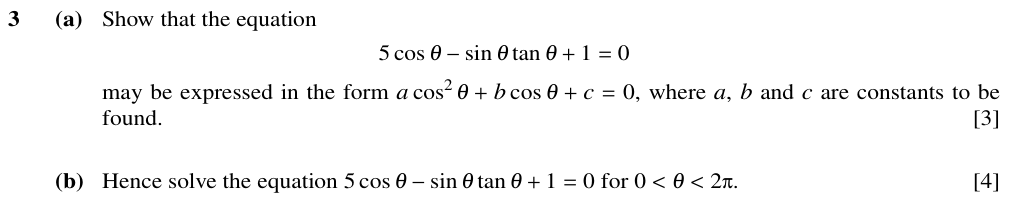
Show the mark scheme
| Part | Answer / working | Marks | Guidance |
|---|---|---|---|
| (a) | multiply by \(\cos\theta\): \(5\cos^2\theta-\sin^2\theta+\cos\theta=0\) | M1 | \(\tan\theta=\tfrac{\sin\theta}{\cos\theta}\) used |
| \(5\cos^2\theta-(1-\cos^2\theta)+\cos\theta=0\) | M1 | \(\sin^2\theta=1-\cos^2\theta\) | |
| \(6\cos^2\theta+\cos\theta-1=0\) | A1 | ||
| (b) | \((3\cos\theta-1)(2\cos\theta+1)=0\) | M1 | factorised or the formula, seen |
| \(\theta=1.23,\ 5.05\) | A1 | from \(\cos\theta=\tfrac13\) | |
| \(\theta=\tfrac{2\pi}3\ (2.09),\ \tfrac{4\pi}3\ (4.19)\) | A1A1FT | from \(\cos\theta=-\tfrac12\); radians, as the interval is | |
| Total: 7 marks | |||

Show the mark scheme
| Part | Answer / working | Marks | Guidance |
|---|---|---|---|
| \(3\cos\theta(2\tan\theta-1)+2(2\tan\theta-1)=0\) | M1 | ||
| \((2\tan\theta-1)(3\cos\theta+2)=0\) | M1 | ||
| \(\theta=26.6°\) | A1 | from \(\tan\theta=\tfrac12\) | |
| \(\theta=131.8°\) | A1 | from \(\cos\theta=-\tfrac23\); no extra answers in range | |
| Total: 4 marks | |||

Show the mark scheme
| Part | Answer / working | Marks | Guidance |
|---|---|---|---|
| \((2\sin^2\theta+7)(2\sin^2\theta-1)=0\) | M1 | a quadratic in \(\sin^2\theta\) solved | |
| \(\sin\theta=\pm\tfrac1{\sqrt2}\) | M1 | both signs | |
| \(45°,\ 135°\) | A1 | ||
| \(225°,\ 315°\) | A1 | and no others in range | |
| Total: 4 marks | |||
Your progress on this note is saved when JavaScript is on.