
Trigonometry
Trigonometric graphs: sketching, reading and transforming
On this page
- What you need to be able to do
- What you should already know
- Where the graphs come from
- The three basic graphs
- y = a sin(bx) + c: what each number does
- Reading a, b and c off a graph
- Sketching: what earns the marks
- How many solutions? Draw the line
- Describing the transformations from sin x
- Case by case
- Key facts at a glance
- How this is examined
- Mark-scheme focus
- Worked examples
- Summary
- Can I do this?
- Quiz
What you need to be able to do
- 1.5Sketch and use the graphs of \(\sin x\), \(\cos x\) and \(\tan x\) in degrees or radians, for angles of any size.
- 1.5Sketch graphs such as \(y=a+b\sin(cx)\): know the greatest and least values, the period and the baseline; read the constants off a given graph.
- 1.5 + 1.2Use a graph to find the number of solutions of an equation; describe the transformations that turn \(y=\sin x\) into another graph.
You need: Exact values and any angle, and Transformations of graphs. Next: Solving trigonometric equations.
Where the trig graphs come from, what each constant in y = a sin(bx) + c does, and how graphs count solutions, with our own examples. Past-paper questions come in Part 2.
What you should already know
Values at the key angles
\(\sin0°=0\), \(\sin90°=1\), \(\sin180°=0\), \(\sin270°=-1\); \(\cos\) is 1, 0, −1, 0 at the same angles (Exact values).
Quick check: \(\cos360°\) and \(\sin(-90°)\)?
\(1\) and \(-1\)
Transformations
\(af(x)\): y-stretch \(a\); \(f(bx)\): x-stretch \(\tfrac1b\); \(f(x)+c\): up \(c\); \(f(x+d)\): left \(d\) (Transformations).
Quick check: what does \(y=f(x-2)\) do?
translation 2 to the right
Radians
\(\tfrac\pi2=90°\), \(\pi=180°\), \(2\pi=360°\).
Quick check: how many degrees is \(\tfrac{2\pi}3\)?
\(120°\)
Where the graphs come from
On the unit circle, \(\sin\theta\) is the height of the point \(P\) and \(\cos\theta\) its distance across (Exact values). As \(P\) goes round, its height rises from 0 to 1 at 90°, falls back to 0 at 180°, down to −1 at 270° and back to 0 at 360°. Plot height against angle and you get the sine wave. One full turn later everything repeats, so the graph repeats every 360°: its period. The cosine wave is the same shape started at the top, because the point starts at \((1,0)\).
The three basic graphs
- sin starts at 0, goes up first: 0 → 1 (90°) → 0 (180°) → −1 (270°) → 0 (360°).
- cos starts at 1, goes down first: 1 → 0 → −1 (180°) → 0 → 1.
- Both repeat every 360° (\(2\pi\)) and stay between −1 and 1.
- tan repeats every 180° (\(\pi\)), passes through 0 at 0°, 180°, 360° and has asymptotes at 90°, 270° (where \(\cos x=0\)).
y = a sin(bx) + c: what each number does
- c moves it up or down: the curve now oscillates about the baseline \(y=c\).
- a stretches it vertically: the amplitude is \(|a|\), so the greatest value is \(c+|a|\) and the least is \(c-|a|\). A negative \(a\) also flips it (reflection in the baseline).
- b squashes it horizontally: the period becomes \(\tfrac{360°}{b}\) or \(\tfrac{2\pi}b\) (tan: \(\tfrac{180°}b\) or \(\tfrac\pi b\)). \(b=2\): two cycles in \(2\pi\); \(b=\tfrac12\): half a cycle in \(2\pi\).
- \(\cos\) instead of \(\sin\): the same rules; it starts at its greatest value (if \(a>0\)) instead of the baseline.
Greatest / least values
\(\sin\) and \(\cos\) run from −1 to 1, so \(y=c+a\sin(bx)\) runs from \(c-|a|\) to \(c+|a|\).
\(y=5\cos3x-1\): greatest \(-1+5=4\), least \(-1-5=-6\).
Don't substitute the end points
Putting \(x=0\) and \(x=4\pi\) into the equation gives the values at the ends, not the greatest and least. The extremes are where sin or cos is ±1.
- Greatest value, least value and period of \(y=3-2\cos4x\)?
Answer
greatest \(5\), least \(1\), period \(\tfrac{2\pi}4=\tfrac\pi2\) - How many complete cycles of \(y=\sin3x\) are there in \(0\le x\le2\pi\)?
Answer
period \(\tfrac{2\pi}3\): 3 cycles
Reading a, b and c off a graph
- c = the middle value: \(\tfrac{\text{greatest}+\text{least}}2=\tfrac{5+(-1)}2=2\).
- a = the distance from the middle to the top: \(5-2=3\). Negative if the curve starts by going the "wrong" way (a sin curve that goes down first, a cos curve that starts at its least value).
- b: count the cycles. One full cycle takes \(\tfrac23\pi\), so the period is \(\tfrac{2\pi}b=\tfrac23\pi\) and \(b=3\) (three cycles in \(2\pi\)). The classic slip is giving \(b\) upside down. Check: is the period shorter (b > 1) or longer (b < 1) than \(2\pi\)?
- Check with one point: \(x=\tfrac\pi6\): \(3\sin\tfrac\pi2+2=5\) ✓ (the first peak).
For \(y=a\tan(x-b)+c\): the "centre" point where the curve changes from bending down to bending up is \((b,\ c)\); then use one more point for \(a\). If the centre is \((\tfrac\pi3, -1)\) and the curve passes through \((\tfrac{7\pi}{12}, 1)\): \(a\tan\tfrac\pi4-1=1\Rightarrow a=2\).
Sketching: what earns the marks
- Work out the greatest and least values and the value at the start (\(x=0\)).
- Work out the period and so the number of cycles in the interval; mark the quarter points (peak, baseline, trough, baseline).
- Draw a smooth curve through them, starting and ending exactly at the ends of the interval. Show the greatest and least values on the y-axis.
- What matters in a sketch: the right number of complete cycles, the right greatest and least values, and a smooth curve that levels off at each peak and trough (not straight lines between points).
How many solutions? Draw the line
- Make the equation curve = something where the curve is the one you've sketched: \(3\cos2x+1=x-1\).
- Draw the other side as a straight line on your sketch: \(y=x-1\) passes through \((0,-1)\) and \((2\pi, 5.28)\).
- Count the crossings inside the interval only: 3. The question wants the number, not the solutions themselves.
- For \(y=kx\) questions, each \(k\) is a line through the origin: steep, shallow or negative.
- How many solutions has \(\sin x=0.3\) for \(0\le x\le2\pi\)?
Answer
the line \(y=0.3\) crosses one cycle twice: 2 - How many solutions has \(\cos2x=-1\) for \(0\le x\le2\pi\)?
Answer
two cycles, each touching \(-1\) once: 2 (\(x=\tfrac\pi2,\tfrac{3\pi}2\))
Describing the transformations from sin x
- Write the target in steps from the inside out: \(y=3\sin(2x+60°)\) = take \(\sin x\), replace \(x\) by \(x+60°\) (translate), then \(x\) by \(2x\) (stretch), then multiply by 3.
- Name each one fully: Translation by the vector \(\binom{-60°}{0}\); stretch, factor ½, in the x-direction; stretch, factor 3, in the y-direction.
- Order matters for the x-changes. Translate first by \(-60°\), then stretch by ½; or stretch first, then translate by \(-30°\) (because \(2x+60°=2(x+30°)\)). The y-stretch can go anywhere.
- Inside the bracket the effect is the opposite: \(2x\) is a stretch by factor ½, not 2; \(x+60°\) moves left.
Case by case
1 Read a, b, c (all positive)
\(y=a\sin(bx)+c\): starts at 2, greatest 6, least −2, three cycles in \(2\pi\).
Askeda, b, cKnowmax 6, min −2, 3 cyclesRoutemiddle, half-height, cycles
- \(c=\tfrac{6-2}2=2\)
- \(a=6-2=4\)
- \(b=3\) (period \(\tfrac{2\pi}3\))
2 The period is longer than 2π
\(y=p\sin(q\theta)+r\): starts at 1, greatest 4 at \(\tfrac{3\pi}2\), least −2 at \(\tfrac{9\pi}2\).
Askedp, q, rKnowa quarter cycle takes 3π/2, so one cycle takes 6πRouteq = 2π ÷ period
- \(r=\tfrac{4+(-2)}2=1\), \(p=4-1=3\)
- period \(6\pi\Rightarrow q=\tfrac{2\pi}{6\pi}=\tfrac13\)
The reciprocal (q = 3 here) is the common wrong answer. Longer period ⇒ q < 1.
3 A tan graph
\(y=a\tan(x-b)+c\), \(0<b<\pi\): centre at \((\tfrac\pi6,-2)\), passes through \((\tfrac{5\pi}{12},1)\).
Askeda, b, cKnowthe centre point is (b, c)Routethen one point for a
- \(b=\tfrac\pi6\), \(c=-2\)
- \(1=a\tan\left(\tfrac{5\pi}{12}-\tfrac\pi6\right)-2=a\tan\tfrac\pi4-2\Rightarrow a=3\)
4 Lines through the origin
\(2\cos2x+3=kx\), \(0\le x\le\pi\): number of solutions for \(k=-1,\ 1.5,\ 4\).
Askednumber of crossingsKnowcurve 5 → 1 → 5Routedraw y = kx for each k
- \(k=-1\): the line is never above 0, the curve never below 1: 0
- \(k=1.5\): crosses on the way down; at \(x=\pi\) the line is only 4.71, under the curve's 5, so it crosses again: 2
- \(k=4\): steep, crosses once on the way down and stays above: 1
5 Describe the transformations
\(y=\sin x\) to \(y=2\sin(3x-45°)\).
Askeda sequence of 3Knowx − 45°, 3x, ×2Routeinside out; check the order
- Translation \(\binom{45°}{0}\), then stretch factor \(\tfrac13\) in the x-direction
- Stretch factor 2 in the y-direction
Or: stretch factor ⅓ in x first, then translation (15°, 0), since 3x − 45° = 3(x − 15°). The usual errors: a stretch factor of 3 instead of ⅓, and the translation in the wrong order.
- \(y=a\cos(bx)+c\) has greatest value 7, least value 1 and period \(4\pi\), with \(a>0\). Find \(a\), \(b\), \(c\).
Answer
\(c=4\), \(a=3\), \(b=\tfrac12\) - Describe \(y=\cos x\to y=\cos(x-30°)+2\).
Answer
translation \(\binom{30°}{2}\)
Key facts at a glance
- \(\sin\) and \(\cos\): between −1 and 1, period \(360°=2\pi\). \(\tan\): period \(180°=\pi\), asymptotes where \(\cos x=0\).
- \(y=a\sin(bx)+c\): baseline \(c\), amplitude \(|a|\), greatest \(c+|a|\), least \(c-|a|\), period \(\tfrac{2\pi}b\).
- Reading a graph: \(c\) = middle, \(a\) = middle to top, \(b\) from the period.
- Number of solutions = number of crossings of the curve and a line, inside the interval.
- Inside the bracket acts the opposite way: \(bx\) is a stretch by \(\tfrac1b\).
How trig graphs are examined, what the mark scheme wants, then real Paper 1 questions worked through slowly.
How this is examined
Sketch schemes over \(0\le x\le2\pi\) give a mark for the right number of complete cycles and marks for the shape: "condone any incorrect x-axis intercepts", the graph "must start to level off" at the ends, and it "needs to be a curve, not straight lines". For "how many solutions" they say "Ignore any graphs drawn" and "Ignore attempts at finding solutions".
From the reports: candidates in degree mode "obtained a straight line" for \(3\cos2x+2\) (November 2020); a large number gave the values at the ends of the interval as the greatest and least (June 2023); giving \(b\) (or a stretch factor) upside down is the classic slip.
Mark-scheme focus
State the greatest and least values, then sketch
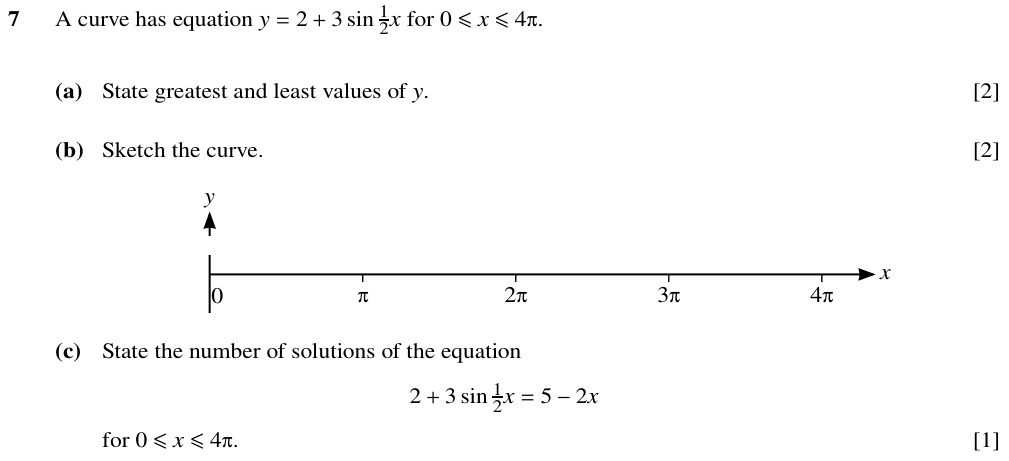
- greatest 5 B1, least −1 B1 ("Condone (−1, 5)")
- "One complete cycle starting and finishing at y = 2. Maximum and minimum in correct quadrants" B1
- max and min shown on the y-axis B1FT (FT their (a))
- (c) 1 B1
- 2 and 2.33: the values at the ends of the interval
- two cycles (period taken as \(2\pi\))
- a curve that doesn't start at y = 2
The report: "Most candidates sketched a sinusoidal curve but the period was often incorrect. Others supplied a non-periodic graph."
From: 9709/11/M/J/23 Q7 and the June 2023 report.
- Graph questions are short and frequent: 1-3 marks each for values, sketch, number of solutions, constants.
- Sketch marks = the right number of cycles, start/end values, greatest and least on the axis, a smooth curve.
- Constants: give values ("a = 4"), not working; the horizontal stretch (b) is the one most often wrong.
Worked examples
Example 1 · Values, sketch and one line (Paper 1, 5 marks) ★ Easy
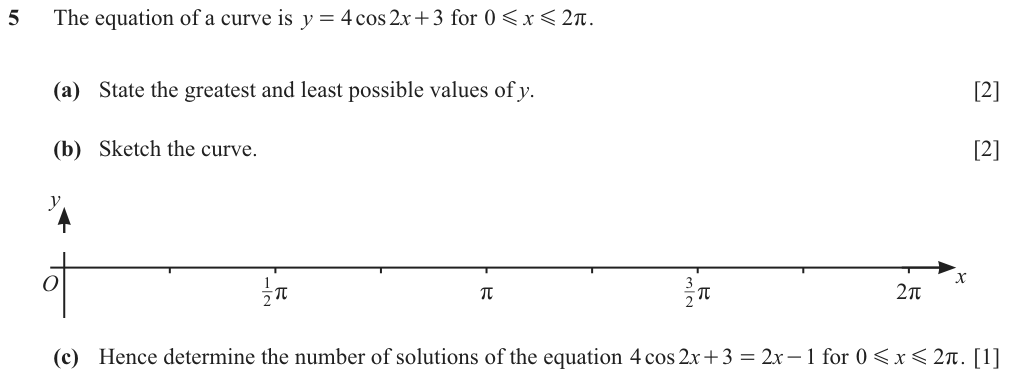
A cos curve stretched to amplitude 4, raised by 3 and squashed so it repeats every \(\pi\). Part (c) says "hence": use your sketch, don't solve.
- greatest and least possible valuesc + |a| and c − |a|
- Hence determine the number of solutionsdraw y = 2x − 1 and count
- (a)greatest, least
- (b)sketch
- (c)number of solutions
- a = 4amplitude
- c = 3baseline
- b = 2period \(\pi\)
- cos starts at its greatest value: \(y(0)=7\).
- (b)sketch
- Cycles\(2\pi\div\pi=2\)
- Starty = 7 at x = 0
- (c)count
- Liney = 2x − 1 from (0, −1)
Where are the minima?
\(2x=\pi,3\pi\Rightarrow x=\tfrac\pi2,\tfrac{3\pi}2\).
Where does the line pass y = 7?
\(x=4\), just past \(\tfrac{5\pi}4\).
5 Now solve it have a go on paper first, then open the worked solution
- (a) greatest 7, least −1 B1 B1
- (b) two complete cycles from (0, 7) down to −1 at \(\tfrac\pi2\), up to 7 at \(\pi\), … ending at 7 at \(2\pi\) B2
- (c) 3 B1
Count again on the picture in section 5: two crossings on the first cycle as the line rises through it, one on the second ✓.
Example 2 · A long graph question with transformations (Paper 1, 11 marks) ★★★ Hard
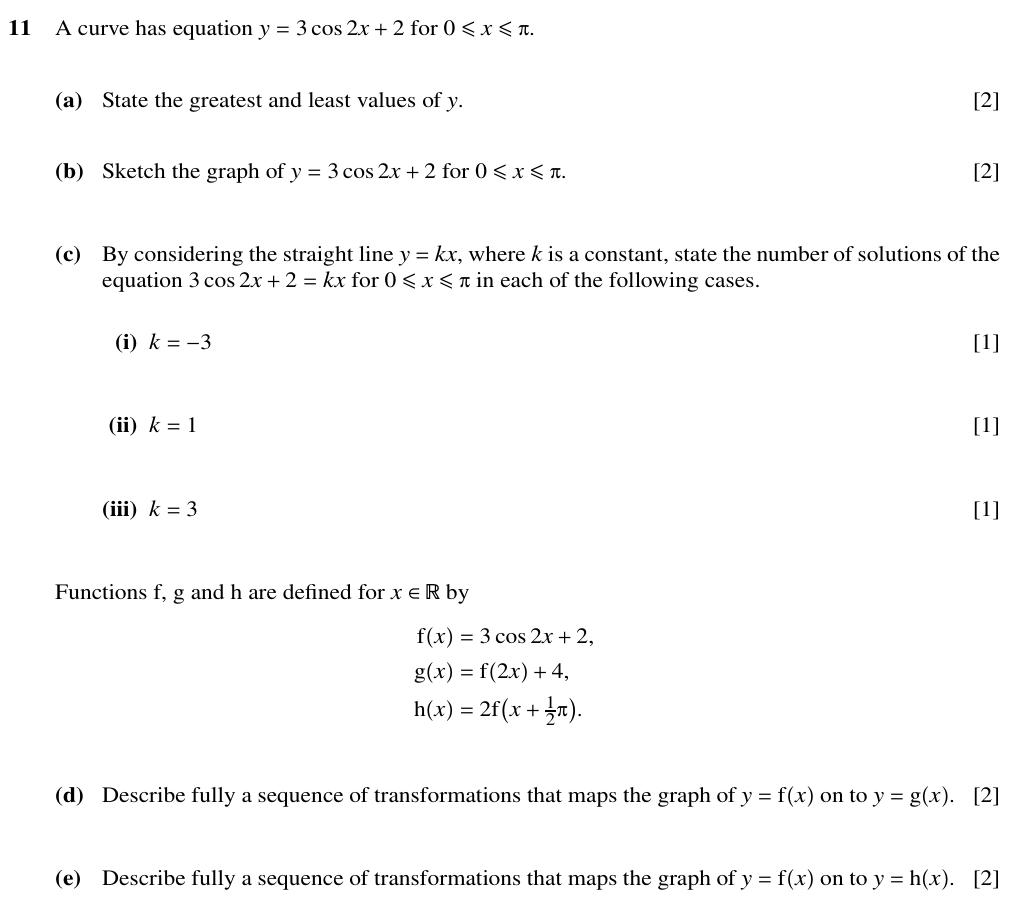
Why it is hard: five parts, and part (c) needs a careful sketch rather than algebra; the report says many omitted parts.
Same type as Example 1 for (a)-(c). (d) and (e) are the transformations from the Functions chapter applied to a trig graph: inside changes act on x (opposite way), outside changes act on y.
- By considering the straight line y = kxlines through the origin
- f(2x)stretch in x, factor ½
- f(x + ½π)translation ½π to the LEFT
- (a)-(c)values, sketch, counts
- (d), (e)two transformations each
- a = 3, c = 2max 5, min −1
- b = 2one cycle on \(0\le x\le\pi\)
- (c)counts
- Sketch5 → −1 at \(\tfrac\pi2\) → 5
- Trapcounting outside 0 ≤ x ≤ π
- (d)/(e)transformations
- gstretch ½ in x, then up 4
- hleft \(\tfrac\pi2\), stretch 2 in y
k = −3: can y = −3x ever reach the curve?
The curve is never below −1; the line reaches −1 at \(x=\tfrac13\) where the curve is 4.4. No.
Which way does f(x + ½π) move?
Left: the opposite of the sign inside.
5 Now solve it have a go on paper first, then open the worked solution
- (a) 5, −1 B1 B1
- (b) one cycle, from 5 down to −1 at \(\tfrac\pi2\) and back to 5 at \(\pi\), levelling off at the ends *B1 DB1
- (c) (i) 0 (ii) 2 (iii) 1 B1 B1 B1
- (d) stretch, factor \(\tfrac12\), parallel to the x-axis B1; translation \(\binom04\) B1
- (e) translation \(\binom{-\pi/2}{0}\) B1; stretch, factor 2, parallel to the y-axis B1
(c)(ii): the line y = x ends at (π, 3.14), below the curve's end value 5, so it must cross back up: 2 ✓.
Example 3 · Constants from a graph, then two lines (Paper 1, 5 marks) ★★ Medium
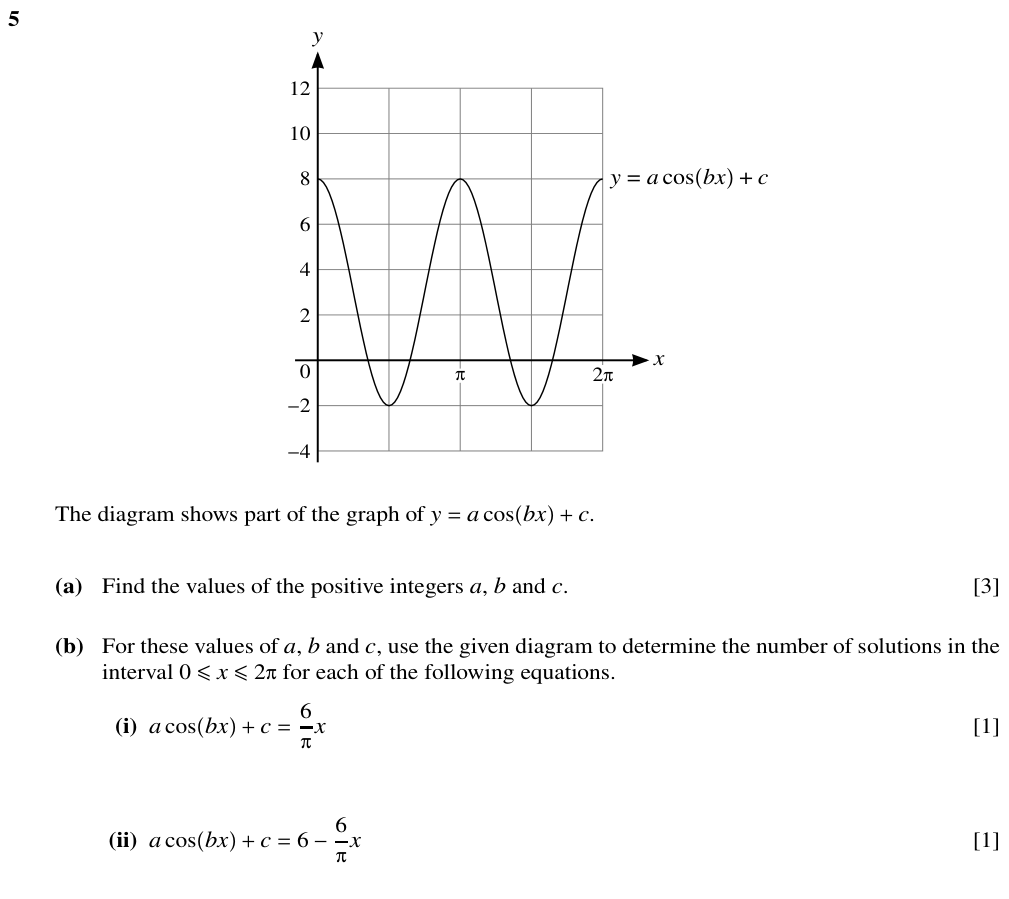
Read the constants exactly as in section 3. Then each equation is "curve = straight line": find two easy points on each line, draw it on the grid, count.
- positive integersno negative a; b is a whole number
- use the given diagramdraw the lines on it
- (a)a, b, c
- (b)two counts
- greatest 8, least −2
- two cycles in \(2\pi\)
- (a)constants
- c(8 − 2)/2
- a8 − c
- bcycles in 2π
- (b)counts
- Line (i)\((0,0)\), \((\pi,6)\), \((2\pi,12)\)
- Line (ii)\((0,6)\), \((\pi,0)\)
c = ?
3: halfway between 8 and −2.
b = ?
2: the period is \(\pi\).
5 Now solve it have a go on paper first, then open the worked solution
- (a) \(a=5\), \(b=2\), \(c=3\) B1 B1 B1
- (b)(i) 3 B1
- (b)(ii) 2 B1
(i) the line rises from 0 to 12: it cuts the first hump twice and the second once before passing y = 8 at x = 4.2 ✓.
Summary
- sin starts at 0 going up, cos at 1 going down; period 360° (2π). tan: period 180° (π), asymptotes at 90°, 270°.
- \(y=a\sin(bx)+c\): baseline c, amplitude |a|, greatest c + |a|, least c − |a|, period 2π / b.
- Read c (middle), a (middle to top), b (count cycles) off a graph; check with a point.
- Number of solutions: sketch, draw the line, count crossings in the interval.
- Transformations: inside = opposite, x-direction; translate then stretch, or stretch then a bigger translation.
| If you see… | do this |
|---|---|
| greatest / least value | \(c\pm|a|\) - never substitute the end points |
| "sketch" | count cycles, start and end values, label greatest and least |
| "number of solutions" / "hence determine" | draw the other side as a line on your sketch |
| \(q\), \(b\) from a graph | \(\tfrac{2\pi}{\text{period}}\) - smaller than 1 if the period is longer than \(2\pi\) |
Can I do this?
- I can sketch sin, cos and tan for any interval in degrees or radians.
- I can state the greatest and least values and the period of y = a sin(bx) + c.
- I can read a, b and c off a given graph (including tan graphs).
- I can find the number of solutions of an equation by drawing a line on a sketch.
- I can describe the transformations from y = sin x in the right order.
Anything unticked: revise that section first. All ticked: take the quiz.
Quiz
The multiple-choice and guided questions need JavaScript. The concept checks and exam practice below work without it.
Concept checks
Answer each one in your head first, then open it.
1Why does \(\tan x\) have asymptotes where \(\cos x=0\)?Show answer
\(\tan x=\tfrac{\sin x}{\cos x}\): dividing by numbers closer and closer to 0 makes it grow without limit.
2Why is the stretch in \(\sin2x\) a factor of \(\tfrac12\), not 2?Show answer
The curve reaches each value at half the x it used to: \(\sin2x\) at \(x=45°\) equals \(\sin x\) at \(90°\). Everything moves towards the y-axis.
3Is the graph of \(\cos x\) a transformation of \(\sin x\)?Show answer
Yes: \(\cos x=\sin(x+90°)\), a translation of 90° to the left.
Exam-style practice
New questions, not used above. Do them on paper, then mark your work against the official mark scheme.
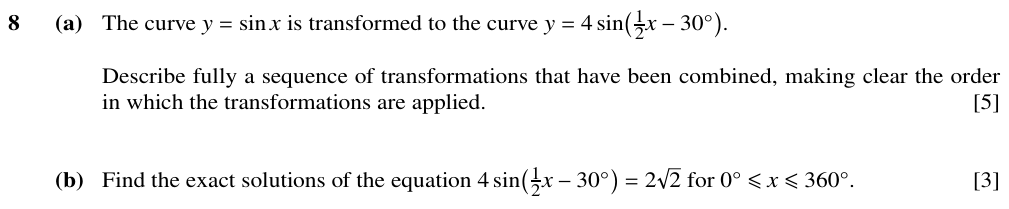
Show the mark scheme
| Part | Answer / working | Marks | Guidance |
|---|---|---|---|
| (a) | translation \(\binom{30°}{0}\) | B2 | B1 for a translation with a wrong or incomplete vector |
| stretch, factor 2, in the x-direction (after the translation) | B2 | or stretch first, then translation \(\binom{60°}{0}\) | |
| stretch, factor 4, in the y-direction | B1 | ||
| (b) | \(\sin\left(\tfrac12x-30°\right)=\tfrac{\sqrt2}2\) | M1 | |
| \(\tfrac12x-30°=45°\) or \(135°\) | M1 | ||
| \(x=150°,\ 330°\) | A1 | both, exact | |
| Total: 8 marks | |||
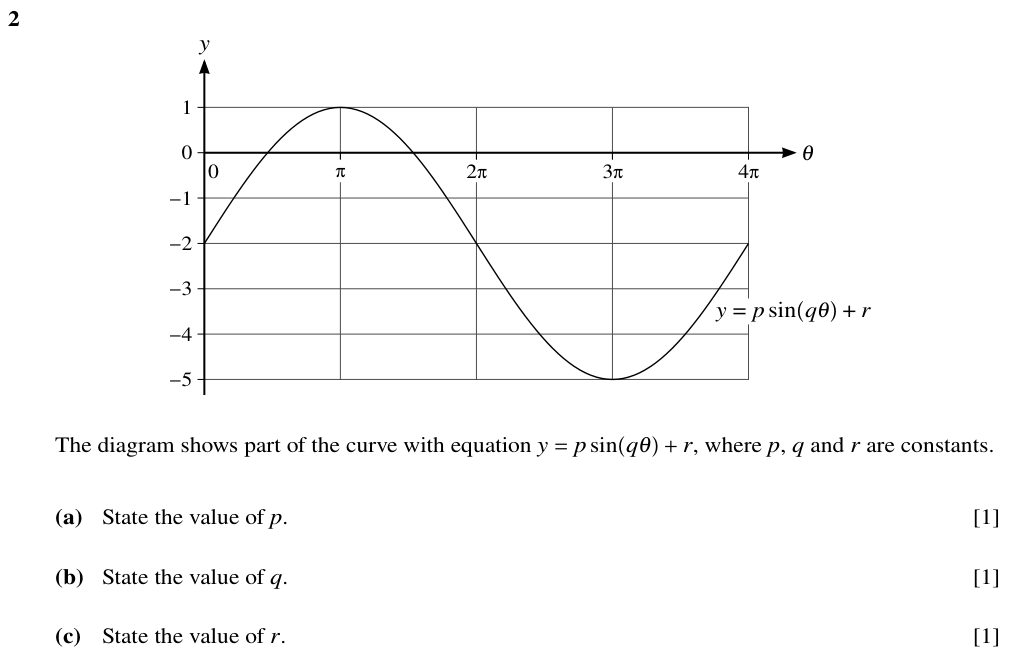
Show the mark scheme
| Part | Answer / working | Marks | Guidance |
|---|---|---|---|
| (a) | \(p=3\) | B1 | |
| (b) | \(q=\tfrac12\) | B1 | the period is 4π |
| (c) | \(r=-2\) | B1 | |
| Total: 3 marks | |||
Your progress on this note is saved when JavaScript is on.