
Functions
Transformations of graphs: translations, reflections and stretches
On this page
- What you need to be able to do
- What you should already know
- One idea behind all of them
- The transformations: what each change does
- Describing a transformation in words
- Combinations, and when the order matters
- Reading transformations off a grid
- Key facts at a glance
- How this is examined
- Mark-scheme focus
- Worked examples
- Summary
- Can I do this?
- Quiz
What you need to be able to do
- 1.2Use the transformations \(y=f(x)+a\), \(y=f(x+a)\), \(y=af(x)\), \(y=f(ax)\) (and reflections) and simple combinations of them.
- 1.2Describe a transformation in the mark scheme's words: translation (with a vector), reflection (in an axis), stretch (factor and direction).
- 1.2Find the equation after a sequence of transformations, read transformations off a graph, and track where a point goes.
Before you start: functions and completing the square. The same rules apply to trig graphs (Trigonometry).
What each change to an equation does to its graph, why changes inside the bracket go the opposite way, and how to describe them, with our own examples. Past-paper questions come in Part 2.
What you should already know
Function notation
\(f(x+2)\) means: put \(x+2\) into \(f\). If \(f(x)=x^2\), \(f(x+2)=(x+2)^2\), \(f(3x)=9x^2\), \(2f(x)=2x^2\), \(f(x)+2=x^2+2\).
Quick check: \(f(x)=x^2-1\): write \(f(x-3)\) and \(f(2x)\)
\((x-3)^2-1\) and \(4x^2-1\)
Column vectors
\(\begin{pmatrix}3\\-2\end{pmatrix}\) means 3 in the \(x\)-direction, then \(-2\) in the \(y\)-direction (down 2).
Quick check: where does \((1,\,5)\) go under \(\begin{pmatrix}-4\\1\end{pmatrix}\)?
\((-3,\,6)\)
Reflections and stretches (O Level)
Reflection in the \(x\)-axis: \((x,y)\to(x,-y)\). In the \(y\)-axis: \((x,y)\to(-x,y)\). A stretch scales distances from a fixed line.
Quick check: reflect \((2,\,-3)\) in the \(y\)-axis
\((-2,\,-3)\)
Key points of y = x²
Vertex \((0,0)\); \((\pm1,\,1)\), \((\pm2,\,4)\). Tracking a few clear points is the easiest way to see a transformation.
Quick check: which points of \(y=x^2\) have \(y=9\)?
\((\pm3,\,9)\)
One idea behind all of them
A transformation changes the equation of a graph in one of two places. A change outside the function (\(f(x)+3\), \(2f(x)\)) acts on the outputs, the \(y\)-values. A change inside the bracket (\(f(x+3)\), \(f(2x)\)) acts on the inputs, the \(x\)-values. Watch \(y=x^2\):
| Equation | Vertex goes to | What happened |
|---|---|---|
| \(y=x^2+3\) | \((0,\,3)\) | every y-value is 3 bigger: up 3 |
| \(y=(x+3)^2\) | \((-3,\,0)\) | the vertex now needs \(x+3=0\), i.e. \(x=-3\): left 3 |
| \(y=2x^2\) | \((0,\,0)\); \((1,1)\to(1,2)\) | every y-value doubled: stretched vertically |
| \(y=(2x)^2\) | \((0,\,0)\); \((2,4)\to(1,4)\) | the value \(4\) is reached at \(x=1\), not \(2\): squashed to half the width |
The second and fourth rows are the surprising ones, and the reason is the same: inside the bracket you need a different input to get the same output, so the graph moves or shrinks the opposite way to the sign you see.
The transformations: what each change does
Grey dashed: \(y=f(x)\), a trapezium through \((0,0),(1,2),(3,2),(4,0)\). Blue: the transformed graph.
| Equation | Transformation (scheme words) | Point (x, y) goes to | Remember |
|---|---|---|---|
| \(y=f(x)+a\) | translation \(\begin{pmatrix}0\\a\end{pmatrix}\) | \((x,\ y+a)\) | outside the bracket: does what it says |
| \(y=f(x+a)\) | translation \(\begin{pmatrix}-a\\0\end{pmatrix}\) | \((x-a,\ y)\) | inside: the opposite way (+a moves LEFT) |
| \(y=af(x)\) | stretch, factor \(a\), parallel to the \(y\)-axis | \((x,\ ay)\) | x-axis invariant |
| \(y=f(ax)\) | stretch, factor \(\tfrac1a\), parallel to the \(x\)-axis | \(\left(\tfrac xa,\ y\right)\) | inside: the reciprocal (2x gives factor ½) |
| \(y=-f(x)\) | reflection in the \(x\)-axis | \((x,\ -y)\) | same as a y-stretch with factor −1 |
| \(y=f(-x)\) | reflection in the \(y\)-axis | \((-x,\ y)\) | same as an x-stretch with factor −1 |
- Describe \(y=f(x-4)\) and \(y=f(3x)\) as transformations of \(y=f(x)\).
Answer
translation \(\begin{pmatrix}4\\0\end{pmatrix}\); stretch, factor \(\tfrac13\), parallel to the \(x\)-axis - \((2,\,6)\) is on \(y=f(x)\). Where does it go on \(y=f(x)+1\), \(y=f(2x)\) and \(y=-f(x)\)?
Answer
\((2,\,7)\); \((1,\,6)\); \((2,\,-6)\)
Describing a transformation in words
Translation
Say translation and give a column vector: \(\begin{pmatrix}3\\0\end{pmatrix}\). Accepted: "3 units in the positive \(x\)-direction / parallel to the \(x\)-axis". "Shift" is condoned. Not accepted: "right", "left", "up", "down", "move" without the axis.
Stretch
Say stretch, the scale factor, and the direction: "stretch, factor 2, parallel to the \(y\)-axis" (or "in the \(y\)-direction", "vertically", "\(x\)-axis invariant"). Not accepted: "squeeze", "compression", "factor 2 upwards".
Reflection
Say reflection and the line: "in the \(x\)-axis". (Also accepted: "stretch, factor −1, parallel to the \(y\)-axis".)
Order
Give them in order ("first … then …"). Two transformations in the same direction usually don't commute; give exactly the number asked for, no extra ones.
Combinations, and when the order matters
Transformations in different directions (one acts on \(x\), one on \(y\)) can be done in either order. Two that both act on \(y\) (or both on \(x\)) give different results in different orders.
1 Two changes outside: reflect then translate
\(y=f(x)\to y=2-f(x)\). Describe the transformations in order.
Askedtwo transformations, in orderKnow\(2-f(x)=-f(x)+2\): a sign change then +2, both on yRouteread it as built up from f(x)
- \(f(x)\to-f(x)\): reflection in the \(x\)-axis
- \(-f(x)\to-f(x)+2\): translation \(\begin{pmatrix}0\\2\end{pmatrix}\)
- Order matters: translating first would give \(-(f(x)+2)=-f(x)-2\)
Translate first only works with the vector (0, −2): −(f(x) − 2) = 2 − f(x). Reflect-then-translate is the natural reading.
2 Build the equation step by step
\(f(x)=x^2+3x-2\): stretch parallel to the \(x\)-axis, factor \(\tfrac12\); then reflection in the \(y\)-axis; then stretch parallel to the \(y\)-axis, factor 2. Find \(g(x)\).
Askedg(x) = ax² + bx + cKnowthree transformations, in orderRouteapply one at a time: replace x, replace x, multiply the whole
- x-stretch \(\tfrac12\): replace \(x\) by \(2x\): \(4x^2+6x-2\)
- reflect in \(y\)-axis: replace \(x\) by \(-x\): \(4x^2-6x-2\)
- y-stretch 2: multiply the whole function: \(g(x)=\mathbf{8x^2-12x-4}\)
Replace EVERY x when the change is inside: (2x)² = 4x², not 2x². A y-stretch multiplies EVERY term.
3 A stretch and a translation in the same direction
Describe \(y=x^2\to y=3(x+2)^2-5\) in order.
Askeda sequenceKnow3 multiplies the square, −5 is added afterRoutex: translation −2; y: stretch 3 then translation −5
- \(x\to x+2\): translation \(\begin{pmatrix}-2\\0\end{pmatrix}\)
- \(\times3\): stretch, factor 3, parallel to the \(y\)-axis
- \(-5\): translation \(\begin{pmatrix}0\\-5\end{pmatrix}\) - this must come after the stretch
The y-stretch must come before the y-translation, or the −5 would be stretched too. Alternative: translate \(\begin{pmatrix}-2\\-\frac53\end{pmatrix}\) first, then stretch by 3, since \(3\left[(x+2)^2-\tfrac53\right]=3(x+2)^2-5\).
4 Undo the transformation to find the original point
\(y=f(x)\to y=f\left(\tfrac12x\right)-4\). \(P(3,\ 2)\) is on the new curve. Find the corresponding point on \(y=f(x)\).
Askedthe ORIGINAL pointKnowforward: (x, y) → (2x, y − 4)Routereverse it: halve x, add 4 to y
- Forward, the rule moves \((x,y)\) to \((2x,\ y-4)\) (an \(x\)-stretch, factor 2, then down 4)
- So \(2x=3\Rightarrow x=\tfrac32\); \(y-4=2\Rightarrow y=6\)
- Original point \(\mathbf{\left(\tfrac32,\ 6\right)}\)
Read which way the question goes. Here the point is on the NEW curve, so you run the transformation backwards.
5 R then T vs T then R
R: reflection in the \(x\)-axis; T: translation \(\begin{pmatrix}-2\\4\end{pmatrix}\). Apply both to \(y=x^2\), in each order, and find the map between the results.
Askedboth equations and the map between themKnoworder matters (both affect y)Routedo it in each order
- R then T: \(-x^2\to g(x)=-(x+2)^2+4\)
- T then R: \((x+2)^2+4\to h(x)=-(x+2)^2-4\)
- \(h(x)=g(x)-8\): translation \(\begin{pmatrix}0\\-8\end{pmatrix}\) maps \(g\) to \(h\)
- Describe \(y=x^2\to y=(x-1)^2+3\).
Answer
translation \(\begin{pmatrix}1\\3\end{pmatrix}\) - Describe \(y=x^2\to y=2x^2+8\) in order.
Answer
stretch, factor 2, parallel to the \(y\)-axis, then translation \(\begin{pmatrix}0\\8\end{pmatrix}\) - \(f(x)=x^2+x\). Find the equation after a reflection in the \(y\)-axis then a translation \(\begin{pmatrix}0\\-1\end{pmatrix}\).
Answer
\((-x)^2+(-x)-1=x^2-x-1\)
Reading transformations off a grid
- Pick two or three clear points (corners, turning points) on \(y=f(x)\) and their images on the new graph.
- Widths: has the horizontal spread changed? That is an \(x\)-stretch (factor = new width ÷ old width). A left-right flip is a reflection in the \(y\)-axis.
- Heights: has the vertical spread changed? That is a \(y\)-stretch (new height ÷ old height); upside down is a reflection in the \(x\)-axis.
- Positions: after the stretches, how far has a point moved? That is the translation (do the stretch first, then measure).
- Check with a second point; then write the equation, e.g. \(y=2f(x)-14\).
Key facts at a glance
- Outside (\(f(x)+a\), \(af(x)\)) acts on \(y\), as you expect. Inside (\(f(x+a)\), \(f(ax)\)) acts on \(x\), the opposite way.
- \(f(x)+a\): translation \(\begin{pmatrix}0\\a\end{pmatrix}\); \(f(x+a)\): translation \(\begin{pmatrix}-a\\0\end{pmatrix}\).
- \(af(x)\): stretch factor \(a\) parallel to the \(y\)-axis; \(f(ax)\): factor \(\tfrac1a\) parallel to the \(x\)-axis.
- \(-f(x)\): reflection in the \(x\)-axis; \(f(-x)\): in the \(y\)-axis.
- Describe with the right word, a vector or factor and direction, in order. Two changes in the same direction don't commute.
How transformations are examined, what the mark scheme wants, then real Paper 1 questions worked through slowly.
How this is examined
A transformations question appears on most Paper 1s (2-5 marks): describe a sequence, build the equation, or read the change off a grid. Schemes do not accept "right", "left", "up", "move", "squeeze" or "compression"; "if 3 or more transformations are given then maximum 2/5"; and "the stretch which must be in the y direction must come before the translation in the y direction".
The November 2021 report: for \(y=3-f(x)\), those who saw a reflection followed by a translation "often scored full marks"; it also found "a significant number applying the transformations to the point given rather than finding the original point". The March 2023 report: the reflection was the hardest step when building an equation; other errors "included squaring 2x incorrectly and multiplying only some of the terms".
The November 2020 report: "The transformations should have been described as stretches and translations and their size and directions clearly indicated. For stretches this is best done by describing which axis it is parallel to as well as the corresponding scale factor, and for translations by use of a column vector."
Mark-scheme focus
Describe fully the two single transformations
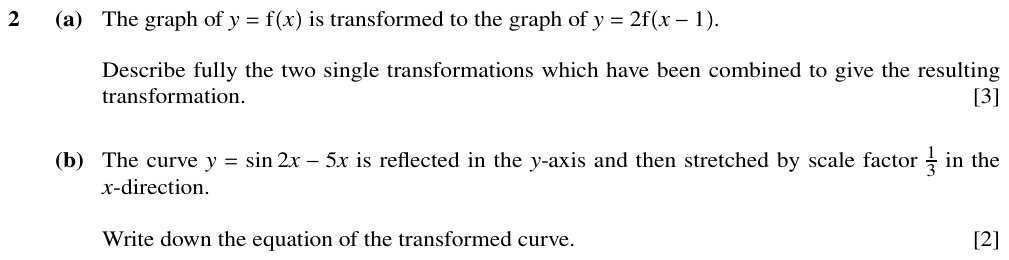
- translation \(\begin{pmatrix}1\\0\end{pmatrix}\) (or "by 1 in the \(x\)-direction / parallel to the \(x\)-axis") B1
- stretch B1, factor 2 in the \(y\)-direction ("or vertically or with x-axis invariant") B1
- either order (one is on x, one on y)
- "Translation by 1 to the right" only: B0
- "With/by factor 2 upwards" only: B0
- factor \(\tfrac12\) for \(2f(x)\)
The scheme wants the type, the size and the axis. Direction words like 'right' and 'upwards' don't name an axis.
"SF" for scale factor; "shift" for translation. (b): y = −sin 6x + 15x (or sin(−6x) + 15x).
From: 9709/12/M/J/21 Q2 and the June 2021 report.
Describe the transformation (x-stretch)
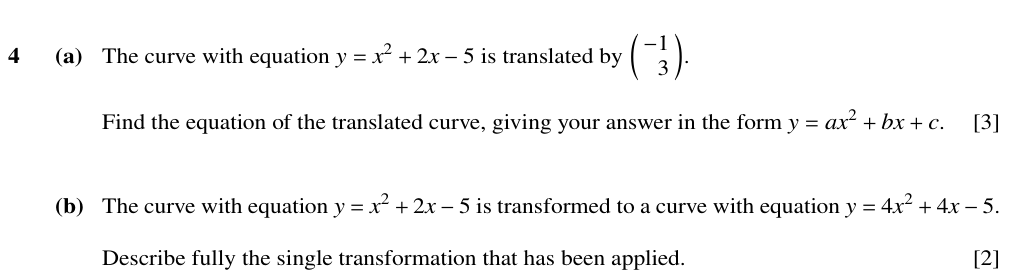
- stretch, \(x\)-direction (horizontally, \(y\)-axis invariant), factor \(\tfrac12\) B2, 1, 0
- factor 2 (the classic inversion)
- a stretch "and a translation": "additional transformation B0"
- "compression" or "squeeze"
4x² + 4x − 5 = (2x)² + 2(2x) − 5 = f(2x): x is replaced by 2x, a stretch with factor ½.
From: 9709/13/M/J/22 Q4(b) and the June 2022 report.
- Describe transformations: most papers, 3-6 marks; B marks for type / size / direction of each, plus order.
- Equation after transformations: 2-4 marks; apply one at a time.
- Grid questions: 4-8 marks 9709/12/M/J/25 Q1, 9709/13/O/N/24 Q5.
- Trig transformations (y = sin x to y = 4 sin(½x − 30°)): on the Trigonometry pages.
Worked examples
Example 1 · Three transformations of y = x² (Paper 1, 5 marks) ★★ Medium

Build \(4(x-3)^2-8\) from \(x^2\) one change at a time: \(x\to x-3\) inside, \(\times4\) outside, \(-8\) outside. The two outside changes both act on \(y\), so their order matters.
- sequenceseveral single transformations
- making clear the order"first … then …"
- x − 3inside: +3 in the x-direction
- each transformation, in order
- \(y=x^2\)start
- \(y=4(x-3)^2-8\)end
- Describethe sequence
- xtranslation \(\begin{pmatrix}3\\0\end{pmatrix}\)
- ystretch factor 4, THEN translation (0, −8)
- Traptranslating by −8 before the stretch gives 4(x − 3)² − 32
What does 4[(x − 3)² − 8] equal?
\(4(x-3)^2-32\): not our curve. So the −8 comes after the ×4.
Can the x-translation go anywhere in the order?
Yes: it acts on x, the others on y.
5 Now solve it have a go on paper first, then open the worked solution
- Stretch, factor 4, parallel to the \(y\)-axis B1
- Translation \(\begin{pmatrix}3\\0\end{pmatrix}\) and translation \(\begin{pmatrix}0\\-8\end{pmatrix}\) (or combined \(\begin{pmatrix}3\\-8\end{pmatrix}\)) B2
- Two translations and a stretch only M1; the \(y\)-stretch before the \(y\)-translation A1
Alternative: translation \(\begin{pmatrix}3\\-2\end{pmatrix}\) first, then the stretch (factor 4, \(y\)-direction).
Vertex check: \((0,0)\to\) stretch \((0,0)\to\) translate \((3,-8)\): the vertex of \(4(x-3)^2-8\) ✓.
Example 2 · Equation after three transformations (Paper 1, 4 marks) ★★ Medium
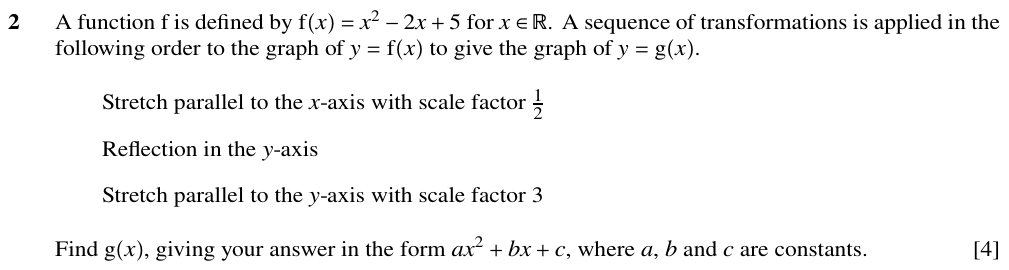
Each transformation is one substitution or one multiplication. x-stretch factor ½ replaces \(x\) by \(2x\); reflection in the \(y\)-axis replaces \(x\) by \(-x\); y-stretch 3 multiplies everything by 3.
- x-stretch factor ½replace \(x\) by \(2x\) (inside: reciprocal)
- reflection in the y-axisreplace \(x\) by \(-x\)
- y-stretch factor 3multiply the whole function by 3
- \(g(x)=ax^2+bx+c\)
- \(f(x)=x^2-2x+5\)
- Findg(x)
- 1\(f(2x)=4x^2-4x+5\)
- 2replace x by −x: \(4x^2+4x+5\)
- 3\(\times3\)
(2x)² = ?
\(4x^2\) - not \(2x^2\).
After replacing x by −x in 4x² − 4x + 5?
\(4x^2+4x+5\).
5 Now solve it have a go on paper first, then open the worked solution
- \(f(2x)=4x^2-4x+5\) M1
- \(4(-x)^2-4(-x)+5=4x^2+4x+5\) M1
- \(3(4x^2+4x+5)\) M1 \(=\mathbf{12x^2+12x+15}\) A1
The vertex of \(f\) is \((1,4)\): x-stretch → \((\tfrac12,4)\), reflect → \((-\tfrac12,4)\), y-stretch → \((-\tfrac12,12)\). And \(12(\tfrac14)-6+15=12\) ✓.
Example 3 · Two transformations read from a grid (Paper 1, 4 marks) ★★ Medium
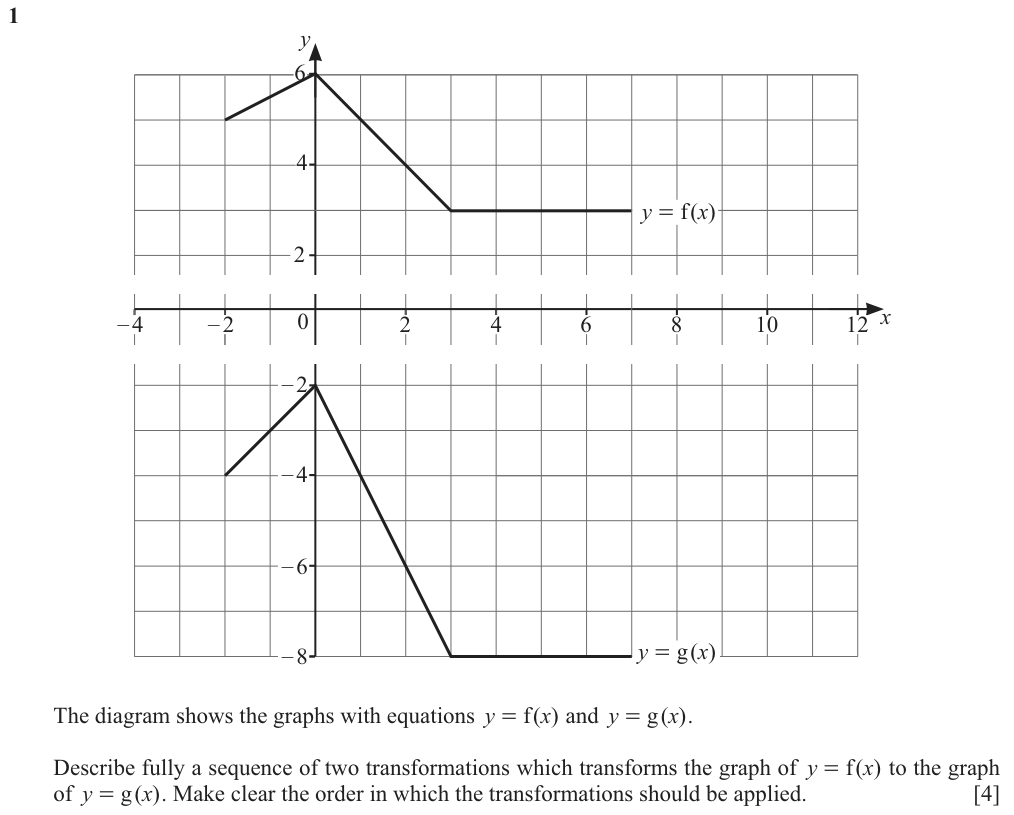
Compare matching corners. The \(x\)-coordinates haven't changed, so every change is vertical. The graph is taller (heights doubled) and lower.
- sequence of twoexactly two transformations
- orderboth act on y, so the order matters
- two transformations in order
- \(f\): \((0,6),(3,3)\)
- \(g\): \((0,-2),(3,-8)\)
- Describef → g
- Stretch?height drop 3 → 6: factor 2 in y
- Then\(2\times6=12\to-2\): translation \(-14\)
Is it a reflection?
No: the shape is the same way up (f falls from x = 0 to 3, so does g).
What if you translate first?
Then you need \((0,-7)\): \(2(6-7)=-2\) ✓.
5 Now solve it have a go on paper first, then open the worked solution
- Stretch, factor 2, parallel to the \(y\)-axis B2,1,0
- then translation \(\begin{pmatrix}0\\-14\end{pmatrix}\) B2,1,0
Or: translation \(\begin{pmatrix}0\\-7\end{pmatrix}\), then stretch factor 2 parallel to the \(y\)-axis.
\((3,3)\to(3,6)\to(3,-8)\) ✓; \((-2,5)\to(-2,10)\to(-2,-4)\) ✓.
Summary
- Outside changes act on y as written; inside changes act on x the opposite way (\(f(x+a)\): left; \(f(ax)\): factor \(\tfrac1a\)).
- Describe: translation + vector; stretch + factor + direction (axis); reflection + axis. No 'up/down/left/right'.
- Same-direction transformations: order matters. Build equations one transformation at a time.
| If you see… | it is |
|---|---|
| \(f(x)+a\) | translation \(\begin{pmatrix}0\\a\end{pmatrix}\) |
| \(f(x+a)\) | translation \(\begin{pmatrix}-a\\0\end{pmatrix}\) |
| \(af(x)\) | y-stretch factor a |
| \(f(ax)\) | x-stretch factor 1/a |
| \(-f(x)\) | reflection in the x-axis |
| \(f(-x)\) | reflection in the y-axis |
| \(a-f(x)\) | reflect in x-axis, then translate (0, a) |
Can I do this?
- I know the effect of f(x) + a, f(x + a), af(x), f(ax), −f(x) and f(−x), including the inside-is-opposite rule.
- I describe transformations in the mark scheme's words (vector, factor, axis).
- I can find the equation after a sequence of transformations and know when order matters.
- I can find where a point goes, and work back to the original point.
- I can read a sequence of transformations from a grid.
Anything unticked: revise that section first. All ticked: take the quiz.
Quiz
The multiple-choice and guided questions need JavaScript. The concept checks and exam practice below work without it.
Concept checks
Answer each one in your head first, then open it.
1Why does \(f(x+3)\) move the graph left, not right?Show answer
At \(x=-3\), \(f(x+3)\) gives \(f(0)\): what used to happen at 0 now happens at −3, i.e. 3 units left.
2Is a stretch with factor −1 the same as a reflection?Show answer
Yes: \(-f(x)\) is a \(y\)-stretch with factor −1 = reflection in the \(x\)-axis. The schemes accept either wording.
3Do \(y\)-direction transformations change the \(x\)-coordinates of points?Show answer
No. Changes outside f act on \(y\) only; inside f, on \(x\) only.
Exam-style practice
New questions, not used above. Do them on paper, then mark your work against the official mark scheme.
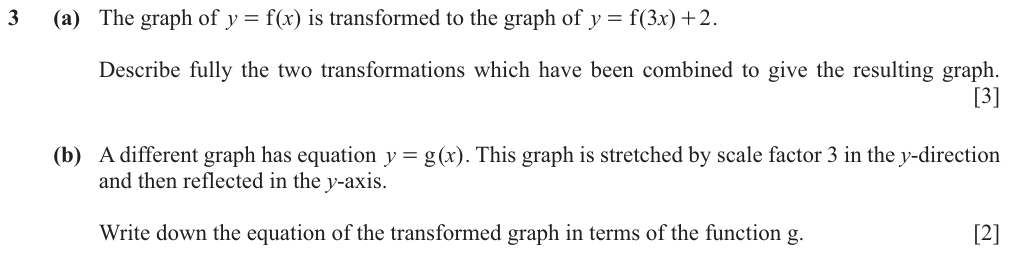
Show the mark scheme
| Part | Answer / working | Marks | Guidance |
|---|---|---|---|
| (a) | translation \(\begin{pmatrix}0\\2\end{pmatrix}\) | B1 | or 2 units in the positive y-direction |
| stretch, factor \(\tfrac13\), parallel to the \(x\)-axis | B2 | B1 with two of: stretch / factor ⅓ / x-direction | |
| (b) | \(y=3g(-x)\) | B2 | B1 for one of the two changes correct |
| Total: 5 marks | |||
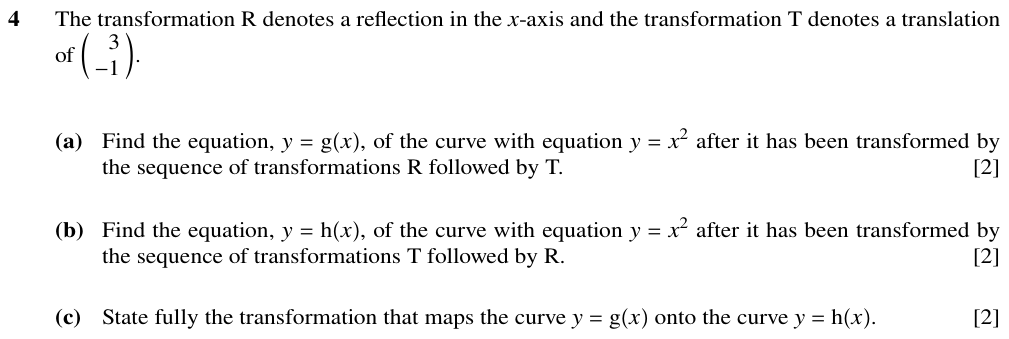
Show the mark scheme
| Part | Answer / working | Marks | Guidance |
|---|---|---|---|
| (a) | \(g(x)=-(x-3)^2-1\) | B1B1 | one for each transformation applied correctly |
| (b) | \(h(x)=-(x-3)^2+1\) | B1B1 | |
| (c) | translation \(\begin{pmatrix}0\\2\end{pmatrix}\) | B2 | B1 for 'translation' with a wrong vector |
| Total: 6 marks | |||
Your progress on this note is saved when JavaScript is on.