
Functions
Inverse functions: the method, the sign of the root and the graphs
What you need to be able to do
- 1.2Know that only a one-one function has an inverse, and find the inverse \(f^{-1}(x)\) of a one-one function.
- 1.2Use domain of \(f^{-1}\) = range of \(f\) and range of \(f^{-1}\) = domain of \(f\), and choose the right sign of a square root.
- 1.2Sketch \(f\) and \(f^{-1}\) as reflections in the mirror line \(y=x\), drawn on the sketch.
Before you start: Domain and range and completing the square. Next: Transformations of graphs.
What an inverse is, why it needs a one-one function, how to find it and how its graph looks, with our own examples. Past-paper questions come in Part 2.
What you should already know
Changing the subject
Undo the operations in reverse order, doing the same to both sides. \(y=\dfrac{x-3}{2}\Rightarrow2y=x-3\Rightarrow x=2y+3\).
Quick check: make \(x\) the subject of \(y=4x+7\)
\(x=\tfrac{y-7}4\)
One-one functions
Each output comes from only one input; a horizontal line meets the graph at most once (Domain and range).
Quick check: is \(x^2\) for \(x\le0\) one-one?
yes: it only decreases there
Reflecting in y = x
Reflecting in the line \(y=x\) swaps the coordinates: \((2,\,5)\to(5,\,2)\). Points on \(y=x\) itself stay put.
Quick check: reflect \((-1,\,4)\) in \(y=x\)
\((4,\,-1)\)
Completed-square form
\(x^2-6x+2=(x-3)^2-7\) (Completing the square). In this form \(x\) appears only once, which is what makes rearranging possible.
Quick check: write \(x^2+4x+9\) in completed-square form
\((x+2)^2+5\)
What an inverse does
The inverse \(f^{-1}\) undoes \(f\): if \(f(3)=10\) then \(f^{-1}(10)=3\). So \(f^{-1}f(x)=x\) and \(ff^{-1}(x)=x\). It only exists when \(f\) is one-one: if \(f(-3)=f(3)=10\), then \(f^{-1}(10)\) would have to be two numbers at once, and a function can't do that.
| f | f⁻¹ | |
|---|---|---|
| Domain | given in the question | the range of f |
| Range | found from the domain | the domain of f |
| Graph | y = f(x) | the reflection of y = f(x) in y = x |
Undo the steps in reverse order. \(f(x)=3x+5\) does two things to \(x\): multiply by 3, then add 5. To undo it you reverse both the steps and their order: subtract 5, then divide by 3. So \(f^{-1}(x)=\dfrac{x-5}{3}\). Check: \(f(2)=11\) and \(f^{-1}(11)=\tfrac{6}{3}=2\) ✓. Rearranging \(y=f(x)\) for \(x\) is exactly this reversal, written as algebra.
Finding f⁻¹(x): the method
- Write \(y=f(x)\). (If the quadratic has a completed-square form, start from that.)
- Rearrange to make \(x\) the subject: undo the operations in reverse order. For a fraction, multiply out first; collect the \(x\) terms; factorise \(x\) out.
- Choose the sign if you took a square root (next section).
- Swap the letters: replace \(y\) by \(x\) and write \(f^{-1}(x)=\dots\) It must be in terms of \(x\): not \(x=\dots\), and not left in \(y\).
- State the domain of \(f^{-1}\): the range of \(f\), written in \(x\).
You may swap the letters at the start instead (\(x=f(y)\), then make \(y\) the subject): both are correct, and swapping first is often tidier for fractions like \(\tfrac{2x}{3x-1}\).
1 Linear in a fraction
\(f(x)=4-\dfrac{6}{x+3}\) for \(x>-3\). Find \(f^{-1}(x)\) and its domain.
Askedf⁻¹(x) and its domainKnowrange of f is f(x) < 4 (the fraction is positive)Routeisolate the fraction, flip, subtract
- \(y=4-\dfrac6{x+3}\Rightarrow\dfrac6{x+3}=4-y\Rightarrow x+3=\dfrac6{4-y}\)
- \(x=\dfrac6{4-y}-3=\dfrac{3y-6}{4-y}\)
- \(f^{-1}(x)=\dfrac{3x-6}{4-x}\), domain \(\mathbf{x<4}\)
2 x on top and bottom
\(f(x)=\dfrac{3x+2}{x-1}\) for \(x<1\). Find \(f^{-1}(x)\) and its domain.
Askedf⁻¹(x)Knowx appears twiceRoutemultiply out, collect the x terms, factorise x out
- \(y(x-1)=3x+2\Rightarrow xy-y=3x+2\)
- \(xy-3x=y+2\Rightarrow x(y-3)=y+2\)
- \(f^{-1}(x)=\dfrac{x+2}{x-3}\); domain = range of \(f\): \(f(x)=3+\dfrac5{x-1}<3\), so \(x<3\)
Collect every term with x on one side before factorising: that is the step weaker answers skip.
3 A square root
\(f(x)=2(x-1)^2+5\) for \(x\ge1\). Find \(f^{-1}(x)\).
Askedf⁻¹(x)Knowx ≥ 1, so x − 1 ≥ 0Routeundo +5, ÷2, square-root (positive), +1
- \(y=2(x-1)^2+5\Rightarrow(x-1)^2=\dfrac{y-5}{2}\)
- \(x-1=+\sqrt{\dfrac{y-5}{2}}\) (positive, because \(x\ge1\))
- \(f^{-1}(x)=1+\sqrt{\dfrac{x-5}{2}}\)
- Find \(f^{-1}(x)\) for \(f(x)=5x-2\).
Answer
\(\tfrac{x+2}5\) - \(f(x)=\dfrac{x+4}{x-2}\) for \(x>2\). Find \(f^{-1}(x)\) and its domain.
Answer
\(x(y-1)=2y+4\): \(f^{-1}(x)=\tfrac{2x+4}{x-1}\); \(f(x)=1+\tfrac6{x-2}>1\), so domain \(x>1\)
The main question: which square root?
Paper 1's favourite functions question: \(f\) is a quadratic, restricted to one side of its vertex so that it is one-one; complete the square; find the inverse. Taking the square root gives \(\pm\), and only one sign is right. Choosing it is the most common mistake on the topic, so decide it from the domain, never by habit.
Domain to the RIGHT of the vertex: \(x\ge a\)
\(f(x)=(x-a)^2+b\), \(x\ge a\): \(x-a\ge0\), so \(x-a=+\sqrt{\ }\).
\(f^{-1}(x)=a+\sqrt{x-b}\).
Domain to the LEFT of the vertex: \(x\le a\)
\(x-a\le0\), so \(x-a=-\sqrt{\ }\).
\(f^{-1}(x)=a-\sqrt{x-b}\). Example: \(f(x)=(x+3)^2-4\), \(x\le-3\) gives \(f^{-1}(x)=-3-\sqrt{x+4}\).
Negative leading coefficient
\(f(x)=-2(x-1)^2+9\), \(x\le-2\): \((x-1)^2=\dfrac{9-y}{2}\), \(x\le-2\Rightarrow x-1<0\): \(f^{-1}(x)=1-\sqrt{\dfrac{9-x}{2}}\): the negative root only.
Never leave ±
An answer with ± isn't a function: it gives two outputs for one input. Choose one sign.
- Write \(y=a(x+p)^2+q\) and isolate the square: \((x+p)^2=\dfrac{y-q}{a}\).
- Look at the domain of f: is \(x+p\) positive or negative there? (Test one value, e.g. the end-point.)
- Take the root with that sign: \(x+p=\pm\sqrt{\dfrac{y-q}{a}}\), then \(x=-p\pm\sqrt{\ }\).
- Check: put a value from the domain of \(f\) through \(f\) and then your \(f^{-1}\): you must get it back.
- \(f(x)=(x-3)^2+1\) for \(x\ge3\). Find \(f^{-1}(x)\).
Answer
\(x-3=+\sqrt{x-1}\): \(f^{-1}(x)=3+\sqrt{x-1}\) - \(f(x)=(x+2)^2-5\) for \(x\le-2\). Find \(f^{-1}(x)\).
Answer
\(x+2\le0\): \(f^{-1}(x)=-2-\sqrt{x+5}\)
Graphs of f and f⁻¹
- Every point \((a,b)\) on \(y=f(x)\) becomes \((b,a)\) on \(y=f^{-1}(x)\).
- Draw the line \(y=x\) on your sketch. Use equal scales, or draw it through points where \(x=y\) (e.g. \((-2,-2)\), \((4,4)\)), not from the origin to a corner of the grid.
- End-points and asymptotes reflect too: a horizontal asymptote \(y=4\) becomes a vertical one \(x=4\).
- If \(f\) and \(f^{-1}\) meet, they meet on \(y=x\): solve \(f(x)=x\) (often easier than \(f(x)=f^{-1}(x)\)).
When can \(f\) and \(f^{-1}\) not meet? If every output of \(f^{-1}\) is negative and every output of \(f\) is positive, the two graphs live in different regions, so \(f(x)=f^{-1}(x)\) has no solution. Saying what the signs are is the explanation.
- \((3,\,10)\) is on \(y=f(x)\). Which point must be on \(y=f^{-1}(x)\)?
Answer
\((10,\,3)\) - \(f(x)=x^2-2\) for \(x\ge0\). Where do \(y=f(x)\) and \(y=f^{-1}(x)\) meet?
Answer
on \(y=x\): \(x^2-x-2=0\), \(x=2\) (\(x\ge0\)): \((2,\,2)\)
Self-inverse functions
A function is self-inverse if \(f^{-1}(x)\equiv f(x)\): its graph is symmetric about \(y=x\). To show it, find \(f^{-1}(x)\) and simplify it to exactly the same expression as \(f(x)\). Example: \(f(x)=\dfrac{3x+1}{2x-3}\). \(y(2x-3)=3x+1\Rightarrow x(2y-3)=3y+1\Rightarrow f^{-1}(x)=\dfrac{3x+1}{2x-3}=f(x)\).
Key facts at a glance
- \(f^{-1}\) undoes \(f\): \(f^{-1}f(x)=x\). It exists only if \(f\) is one-one.
- Domain of \(f^{-1}\) = range of \(f\); range of \(f^{-1}\) = domain of \(f\).
- Method: \(y=f(x)\), make \(x\) the subject, swap letters, state the domain.
- Square root: choose the sign that makes the range of \(f^{-1}\) match the domain of \(f\). Never leave ±.
- Graphs: reflections in \(y=x\) (draw the line). They meet on \(y=x\), if at all.
How inverses are examined, what the mark scheme wants, then real Paper 1 questions worked through slowly.
How this is examined
Paper 1's favourite Functions question: complete the square, restrict the domain, find \(f^{-1}(x)\). The marks: M1 for starting the rearrangement, DM1 for making \(x\) the subject, A1 for \(f^{-1}(x)\) in terms of \(x\) ("not \(x=\dots\)"), B1 for its domain. The wrong square-root sign is the most common error in the examiner reports (March 2020, March 2021, November 2021, November 2022, June 2022); schemes give "A0 for ± in final answer" 9709/11/O/N/25 Q6(b) and say "must be negative square root only" where the domain is left of the vertex.
For fractions, the November 2020 report found swapping the letters first "the more successful strategy". Sketches of \(f\) and \(f^{-1}\) must be "fully correct including the line \(y=x\)" 9709/11/M/J/25 Q10(b).
The June 2023 report on 9709/12/M/J/23 Q8(a): "many candidates seemed to know that a reflection in the line \(y=x\) was required but often they assumed that this line could be plotted by joining the origin to the point in the top right hand corner of the grid" - wrong whenever the axes have different scales.
Why has \(f^{-1}(x)=f(x)\) no solution? (9709/11/M/J/24 Q6(d), \(f(x)=\tfrac{2}{x^2}+4\), \(x<0\)) "\(f^{-1}\) is always negative and \(f\) is always positive, so the curves do not intersect." Also accepted: "f is only defined for negative values of x and \(f^{-1}\) for positive values".
Mark-scheme focus
Find an expression for f⁻¹(x)
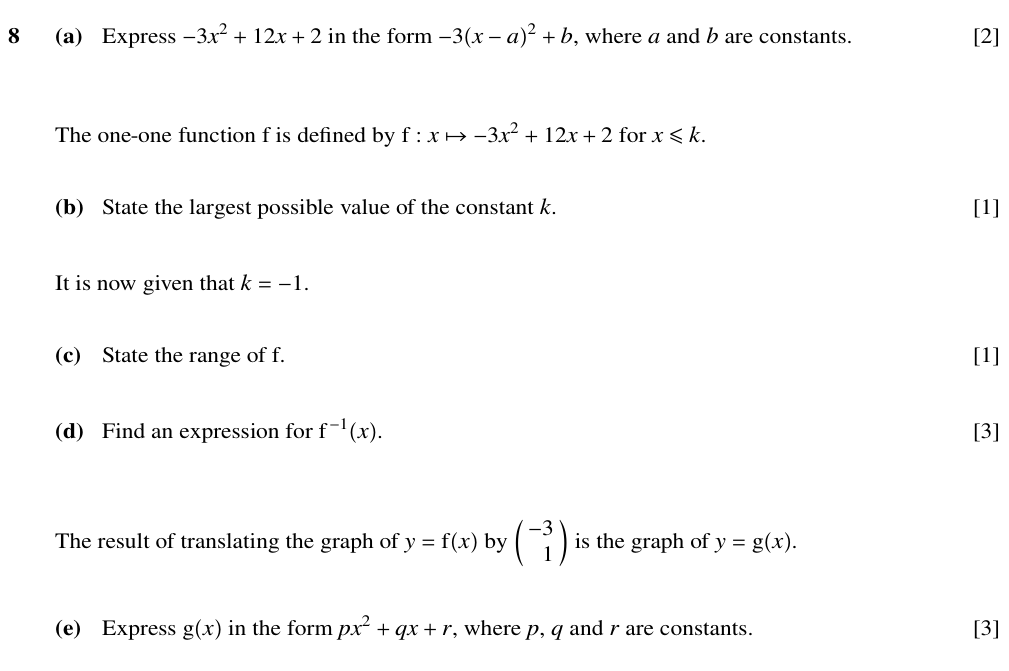
- \((x-2)^2=\dfrac{14-y}{3}\) M1; \(x=2\pm\sqrt{\dfrac{14-y}{3}}\) A1
- \(f^{-1}(x)=2-\sqrt{\dfrac{14-x}{3}}\): "must be x on RHS; must be negative square root only" A1
- \(2\pm\sqrt{\ \ }\) or \(2+\sqrt{\ \ }\)
- the answer left in \(y\), or written "\(x=\dots\)"
- \(f'(x)\) (the derivative) instead of \(f^{-1}(x)\) - named in the June 2021 report
The range of f⁻¹ must be the domain of f, x ≤ −1. 2 + √(…) is always at least 2, so only 2 − √(…) can be ≤ −1.
From: 9709/11/O/N/21 Q8(d) and the November 2021 report.
State the domain of f⁻¹
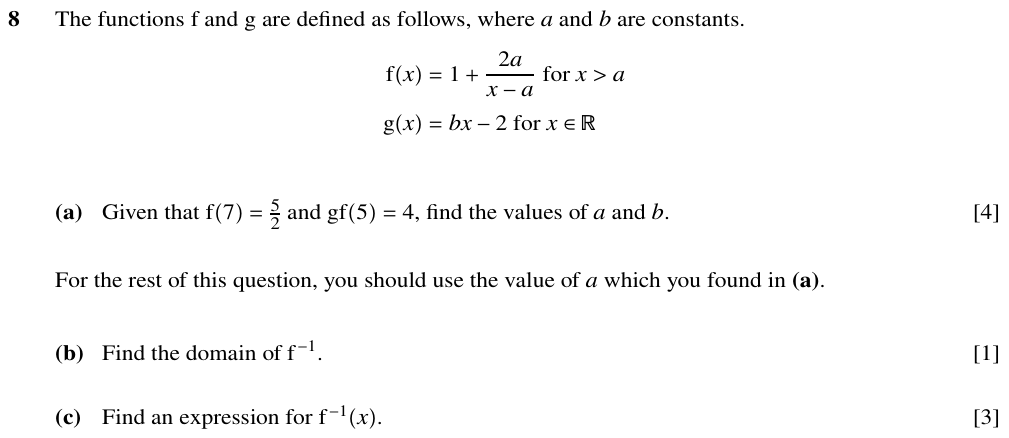
- \(x>1\), or \((1,\infty)\), or \(\{*:\ *>1\}\) B1
- \(f^{-1}(x)>1\), \(f(x)>1\) or \(y>1\) ("B0": a domain is a set of inputs, in \(x\))
- \(x>3\) (the domain of f)
- \(x\ne1\)
Domain of f⁻¹ = range of f, but written as inputs: x > 1. (The range of f, in its own notation, is f(x) > 1.)
From: 9709/11/M/J/23 Q8(b) and the June 2023 report.
- Inverse of a restricted quadratic (the main question): every year, usually 3 marks, A1 for the sign.
- Inverse of a fraction: 3-4 marks with the domain.
- Sketch f⁻¹ with the mirror line: 1-2 marks; the line y = x is a mark on its own.
- Explain: no inverse (not one-one), f⁻¹(x) = f(x) has no solution, self-inverse.
Worked examples
Example 1 · The main question, end to end (Paper 1, 9 marks) ★★ Medium
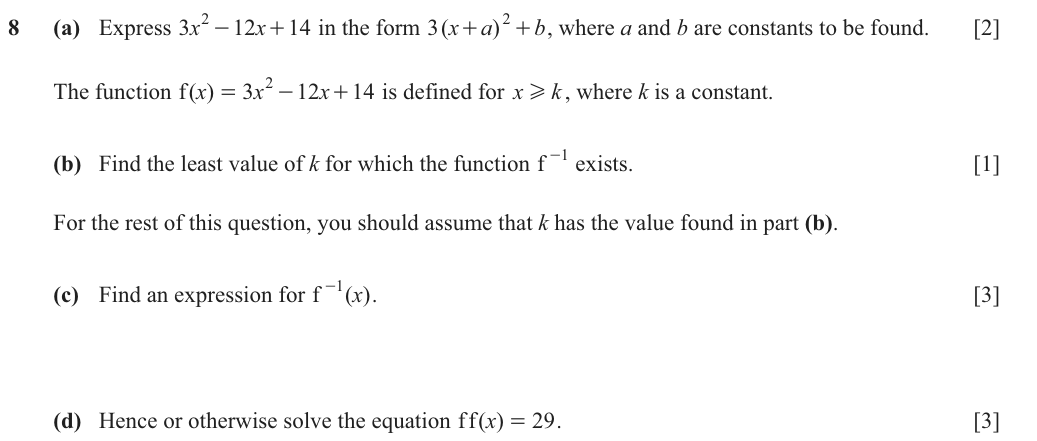
A quadratic restricted to \(x\ge k\). Complete the square to find the vertex; the domain must start at the vertex for \(f\) to be one-one. Then invert (positive root, because \(x\ge2\)) and use the inverse twice to undo \(ff\).
- least value of kthe domain must start at the vertex (or to its right)
- Hence or otherwise\(ff(x)=29\Rightarrow f(x)=f^{-1}(29)\Rightarrow x=f^{-1}(f^{-1}(29))\)
- (a)a, b
- (b)least k
- (c)f⁻¹(x)
- (d)x
- \(f(x)=3x^2-12x+14\)\(x\ge k\)
- after (b), \(x\ge2\): so \(x-2\ge0\)
- (c)f⁻¹(x)
- From (a)\(3(x-2)^2+2\)
- Sign\(x-2\ge0\Rightarrow+\sqrt{\ }\)
- (d)x
- Use\(f^{-1}(29)=5\), then \(f^{-1}(5)=3\)
- Trapsolving the quartic and keeping x = 1
Why can't k be 1?
Then \(f(1)=f(3)=5\): not one-one.
What is f⁻¹(29)?
\(2+\sqrt{\tfrac{27}{3}}=2+3=5\).
5 Now solve it have a go on paper first, then open the worked solution
- (a) \(3(x^2-4x)+14=3(x-2)^2-12+14=\mathbf{3(x-2)^2+2}\) B1 B1
- (b) least \(k=2\) B1FT ("do not accept \(x=2\) or \(x\ge2\)": the answer is a value of k)
- (c) \(y=3(x-2)^2+2\Rightarrow(x-2)^2=\dfrac{y-2}{3}\) M1; \(x=\sqrt{\dfrac{y-2}{3}}+2\) DM1; \(f^{-1}(x)=\sqrt{\dfrac{x-2}{3}}+2\) A1
- (d) \(f(f(x))=29\Rightarrow f(x)=f^{-1}(29)=5\) M1 \(\Rightarrow x=f^{-1}(5)=2+1=\mathbf{3}\) M1 A1
If you solve \(f(x)=5\) directly, \(3(x-2)^2=3\) gives \(x=1\) or \(3\): "if using f(x) method, x = 1 must be discarded" (\(1<2\)).
\(f(3)=3+2=5\), \(f(5)=27+2=29\) ✓.
Example 2 · Negative root, then the inverse of a composite (Paper 1, 7 marks) ★★★ Hard
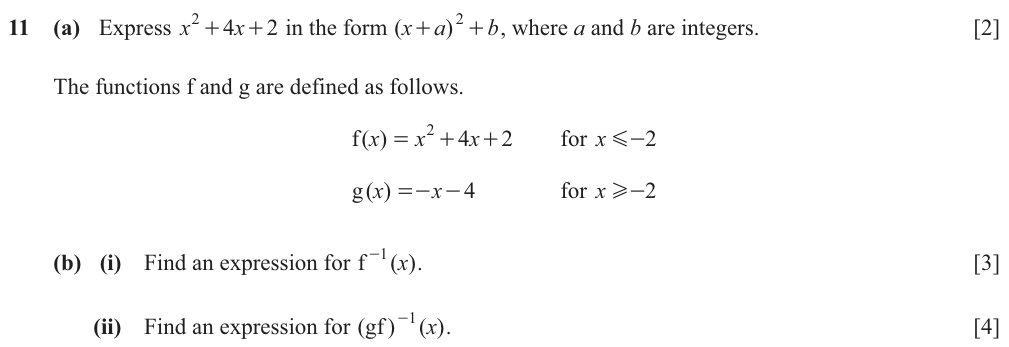
Why it is hard: two inverses with the negative-root decision both times, and (gf)⁻¹ is not g⁻¹f⁻¹.
\(f\) lives to the left of its vertex \(x=-2\), so its inverse takes the negative root. For \((gf)^{-1}\): form \(gf(x)\) (it is another restricted quadratic), then invert it the same way.
- x ≤ −2x + 2 ≤ 0: negative square root
- (gf)⁻¹invert the composite gf - or use (gf)⁻¹ = f⁻¹g⁻¹
- (b)(i)f⁻¹(x)
- (b)(ii)(gf)⁻¹(x)
- \(f(x)=(x+2)^2-2\)x ≤ −2
- \(g(x)=-x-4\)x ≥ −2
- \(gf\) has the same domain as \(f\): \(x\le-2\)
- (i)f⁻¹
- Use\(x+2=-\sqrt{y+2}\)
- (ii)(gf)⁻¹
- First\(gf(x)=-(x+2)^2-2\)
- Then\((x+2)^2=-y-2\), \(x+2=-\sqrt{-y-2}\)
- Trap\(fg\) instead of \(gf\) "scores 0/4"
Simplify gf(x) = −(x² + 4x + 2) − 4.
\(-(x+2)^2+2-4=-(x+2)^2-2\).
Is −y − 2 positive when y is in the range of gf?
Range of gf: \(gf(x)\le-2\), so \(-y-2\ge0\) ✓.
5 Now solve it have a go on paper first, then open the worked solution
- (i) \(y=(x+2)^2-2\Rightarrow y+2=(x+2)^2\) *M1; \(x=\pm\sqrt{y+2}-2\) DM1; \(f^{-1}(x)=-\sqrt{x+2}-2\) A1
- (ii) \(gf(x)=-(x^2+4x+2)-4=-(x+2)^2-2\) *M1 A1
- \(y=-(x+2)^2-2\Rightarrow x=\pm\sqrt{-y-2}-2\) DM1
- \((gf)^{-1}(x)=-\sqrt{-x-2}-2\) A1
Alternative on the scheme: \((gf)^{-1}=f^{-1}g^{-1}\) with \(g^{-1}(x)=-x-4\): \(f^{-1}(-x-4)=-\sqrt{-x-4+2}-2\). The order matters: \(g^{-1}f^{-1}\) scores 0.
Take \(x=-3\): \(gf(-3)=-1-2=-3\); \((gf)^{-1}(-3)=-\sqrt1-2=-3\) ✓.
Example 3 · Inverse of a fraction and its domain (Paper 1, 4 marks) ★★ Medium
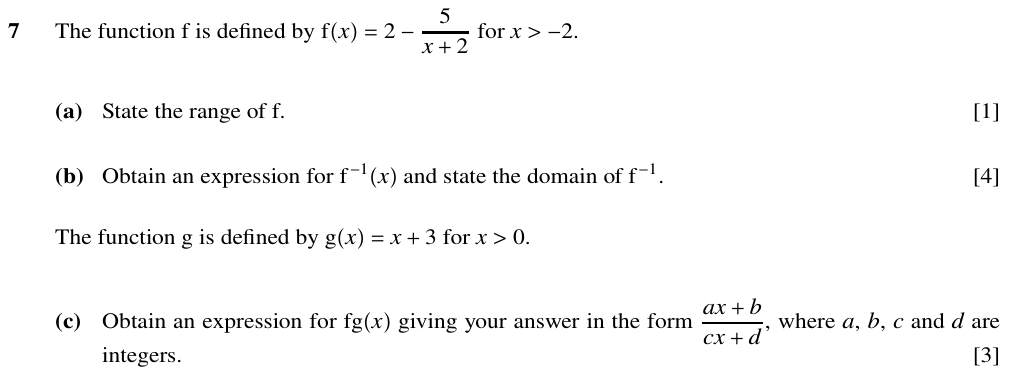
Undo \(f\) step by step: take the 2 away, flip the fraction, take the 2 away again. The domain of \(f^{-1}\) is the range of \(f\), found in part (a): \(f(x)<2\).
- domain of f⁻¹= range of f, in x: \(x<2\)
- (b)f⁻¹(x) and domain
- \(f(x)=2-\dfrac5{x+2}\)x > −2
- range f(x) < 2from (a)
- Findf⁻¹
- Use\(\dfrac5{x+2}=2-y\)
- Then\(x+2=\dfrac{5}{2-y}\)
- Use\(\dfrac5{x+2}=2-y\)
- Domainx < 2
- From(a)
Combine 5/(2 − y) − 2 into one fraction.
\(\dfrac{5-2(2-y)}{2-y}=\dfrac{2y+1}{2-y}\).
Is (2x + 1)/(2 − x) defined at x = 2?
No - and 2 is not in the domain, consistent ✓.
5 Now solve it have a go on paper first, then open the worked solution
- \(y=2-\dfrac5{x+2}\Rightarrow y(x+2)=2(x+2)-5\Rightarrow xy+2y=2x-1\) M1
- \(2y+1=x(2-y)\) DM1 \(\Rightarrow f^{-1}(x)=\dfrac{2x+1}{2-x}\) A1
- Domain \(x<2\) B1FT
\(f(0)=-\tfrac12\); \(f^{-1}(-\tfrac12)=\dfrac{0}{2.5}=0\) ✓.
Example 4 · Sketch the inverse; why the curves never meet (Paper 1, 7 marks) ★★ Medium
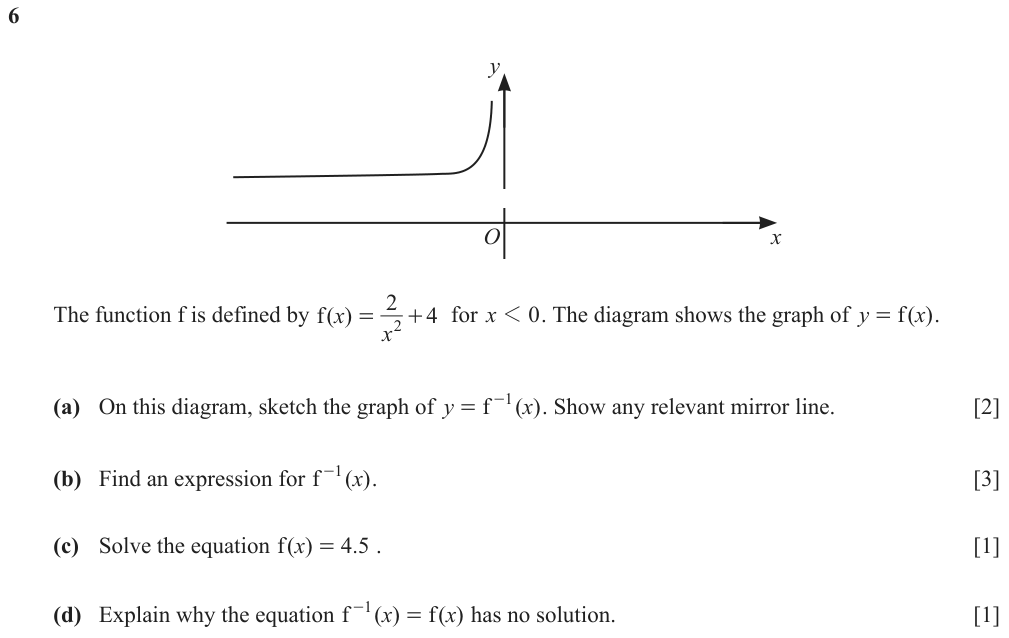
\(f\) lives in the second quadrant (\(x<0\), \(y>4\)), with asymptote \(y=4\). Its reflection in \(y=x\) lives in the fourth quadrant, with asymptote \(x=4\). For the inverse, the outputs must be negative (domain of \(f\)), so take the negative root.
- x < 0f⁻¹ must give negative values
- relevant mirror linedraw y = x
- no solutioncompare where the two graphs live
- (a)sketch
- (b)f⁻¹(x)
- (c)x
- (d)explain
- \(f(x)=\dfrac2{x^2}+4\)x < 0
- (b)f⁻¹
- Use\(y-4=\tfrac2{x^2}\Rightarrow x^2=\tfrac{2}{y-4}\)
- Signx < 0: negative root
- (d)explain
- Usef > 0 always; f⁻¹ < 0 always
Where does the asymptote y = 4 go after reflecting?
To the vertical line x = 4.
Solve f(x) = 4.5.
\(\tfrac2{x^2}=\tfrac12\Rightarrow x^2=4\Rightarrow x=-2\) (x < 0).
5 Now solve it have a go on paper first, then open the worked solution
- (a) reflection in \(y=x\), in the 4th quadrant, approaching \(x=4\); line \(y=x\) drawn B1 B1
- (b) \(x^2=\dfrac{2}{y-4}\) M1 M1; \(f^{-1}(x)=-\sqrt{\dfrac{2}{x-4}}\) A1
- (c) \(x=-2\) B1
- (d) \(f^{-1}\) is always negative and \(f\) is always positive, so the graphs do not intersect B1
\(f(-2)=4.5\); \(f^{-1}(4.5)=-\sqrt{\tfrac{2}{0.5}}=-2\) ✓.
Summary
- Only one-one functions have inverses. Domain of f⁻¹ = range of f; range of f⁻¹ = domain of f.
- y = f(x), make x the subject, swap; answer f⁻¹(x) = … in x, never with ±.
- Square roots: the sign that keeps f⁻¹ inside the domain of f.
- Graphs: reflect in y = x, and draw y = x.
| If you see… | do this |
|---|---|
| \(f(x)=a(x+p)^2+q\) for \(x\le-p\) | negative root |
| … for \(x\ge-p\) | positive root |
| "state the domain of f⁻¹" | the range of f, written in x |
| "sketch f⁻¹" | reflect in y = x and draw y = x |
| "ff(x) = k" | \(x=f^{-1}(f^{-1}(k))\) |
| \((gf)^{-1}\) | invert gf, or \(f^{-1}g^{-1}\) |
| "f⁻¹(x) ≡ f(x)" | simplify f⁻¹ to exactly f |
Can I do this?
- I know an inverse exists only for a one-one function, and how domain and range swap.
- I can find f⁻¹(x) for a fraction, a square root or a quadratic, written in x.
- I can choose the correct sign of the square root from the domain of f.
- I can sketch f⁻¹ as a reflection in y = x, with the mirror line.
- I can show a function is self-inverse and explain when f and f⁻¹ cannot meet.
Anything unticked: revise that section first. All ticked: take the quiz.
Quiz
The multiple-choice and guided questions need JavaScript. The concept checks and exam practice below work without it.
Concept checks
Answer each one in your head first, then open it.
1Why is the domain of \(f\) given as \(x\ge2\) in the main question rather than \(x\in\mathbb R\)?Show answer
So that \(f\) is one-one (the domain starts at the vertex): otherwise there is no inverse.
2Is \(f^{-1}(x)\) the same as \(\dfrac{1}{f(x)}\)?Show answer
No. \(f^{-1}\) undoes \(f\); \(\tfrac1{f(x)}\) is a reciprocal. For \(f(x)=2x\): \(f^{-1}(x)=\tfrac x2\), but \(\tfrac1{f(x)}=\tfrac{1}{2x}\).
3How can you check an inverse quickly?Show answer
Pick a number in the domain of \(f\), apply \(f\), then your \(f^{-1}\): you must get the number back.
Exam-style practice
New questions, not used above. Do them on paper, then mark your work against the official mark scheme.
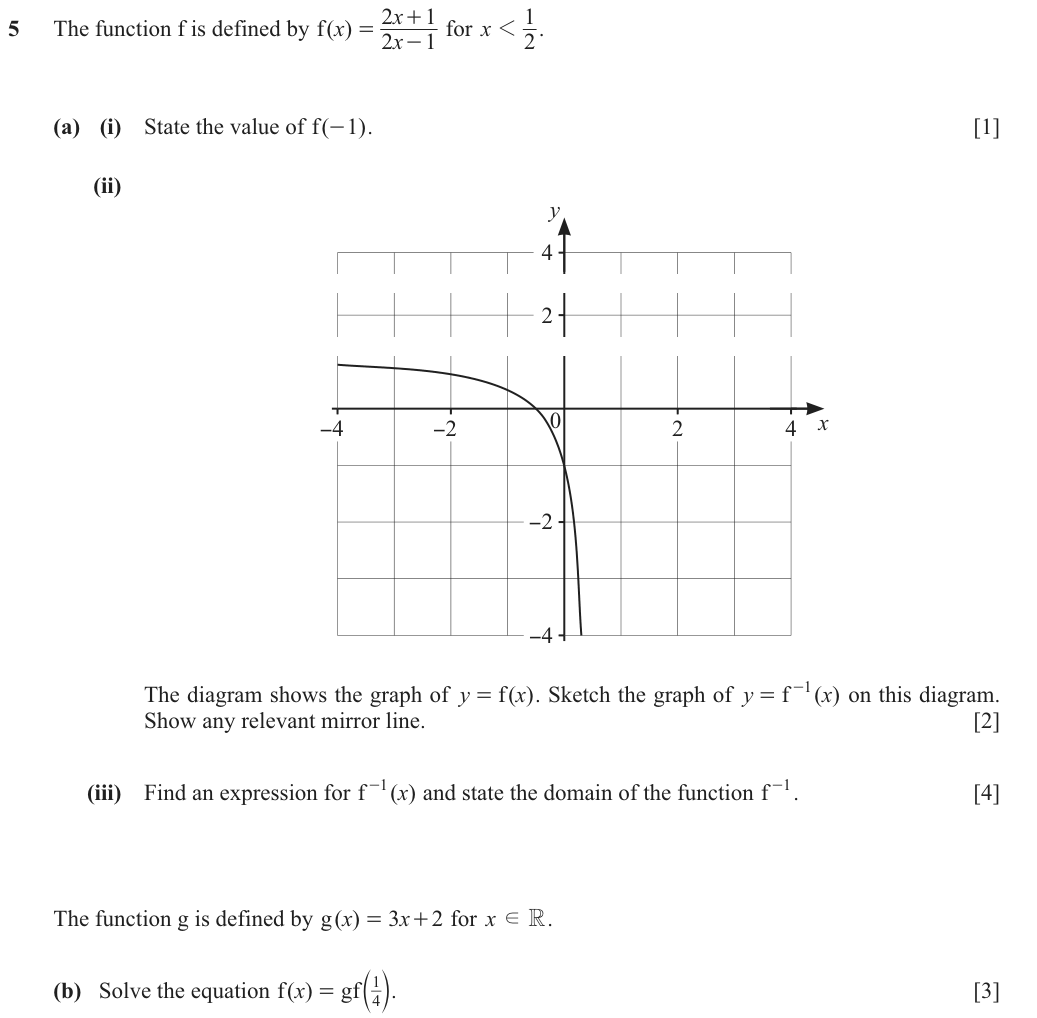
Show the mark scheme
| Part | Answer / working | Marks | Guidance |
|---|---|---|---|
| (a)(iii) | \(2x+1=y(2x-1)\) | M1 | |
| \(2xy-2x=y+1\) | DM1 | x terms collected on one side | |
| \(f^{-1}(x)=\dfrac{x+1}{2(x-1)}\) | A1 | in terms of x | |
| domain \(x<1\) | B1 | the range of f, written in x | |
| Total: 4 marks | |||

Show the mark scheme
| Part | Answer / working | Marks | Guidance |
|---|---|---|---|
| \(\left(y-\tfrac12\right)(ax-3)=2\) | *M1 | clear the fraction | |
| \(ax=\dfrac{4}{2y-1}+3\) | DM1 | x made the subject | |
| \(g^{-1}(x)=\dfrac{4}{a(2x-1)}+\dfrac3a\) | A1 | ||
| \(a=6\): \(\dfrac{4}{6(2x-1)}+\dfrac12=\dfrac{2}{6x-3}+\dfrac12=g(x)\) | A1 | shown to be identical to g(x) | |
| Total: 4 marks | |||
Your progress on this note is saved when JavaScript is on.