
Trigonometry
Trigonometric identities: prove, then hence solve
What you need to be able to do
- 1.5Use the identities \(\tan\theta\equiv\dfrac{\sin\theta}{\cos\theta}\) and \(\sin^2\theta+\cos^2\theta\equiv1\).
- 1.5Prove ("show that") an identity, with every step visible.
- 1.5Use a proved identity to solve an equation ("hence solve") and find every solution in the interval.
You need: Solving trigonometric equations and algebraic fractions (adding, factorising). This is the last page of the chapter.
What an identity is, where the two identities come from, how to prove one and how to use it to solve, with our own examples. Past-paper questions come in Part 2.
What you should already know
Adding algebraic fractions
\(\dfrac1a+\dfrac1b=\dfrac{b+a}{ab}\): common denominator, brackets on the tops.
Quick check: simplify \(\dfrac1{x}-\dfrac1{x+1}\)
\(\dfrac{x+1-x}{x(x+1)}=\dfrac1{x(x+1)}\)
Difference of two squares
\((1-s)(1+s)=1-s^2\). With \(s=\sin\theta\) this becomes \(1-\sin^2\theta=\cos^2\theta\).
Quick check: expand \((1-c)(1+c)\)
\(1-c^2\)
Factorise and cancel
Cancel a common factor, never a term: \(\dfrac{2x+2y}{x+y}=\dfrac{2(x+y)}{x+y}=2\), but \(\dfrac{x+2}{x}\ne2\).
Quick check: simplify \(\dfrac{s+sc}{s}\)
\(1+c\)
Solving trig equations
All solutions in an interval (previous page).
Quick check: solve \(\tan\theta=1\), \(0°\le\theta\le360°\)
\(45°,\ 225°\)
Identity or equation?
An equation such as \(\sin\theta=0.5\) is true only for some angles; you solve it to find them. An identity such as \((\sin\theta+\cos\theta)^2\equiv1+2\sin\theta\cos\theta\) is true for every angle; you prove it. Test it at \(30°\): left side \((0.5+0.866)^2=1.866\); right side \(1+2(0.5)(0.866)=1.866\). Testing values can suggest an identity, but only algebra proves it for every angle.
The only two identities you need
- Pythagoras in the triangle: \(\sin^2\theta+\cos^2\theta=1\), for every angle (the circle works in all four quadrants).
- \(\tan\theta=\dfrac{\text{opposite}}{\text{adjacent}}=\dfrac{\sin\theta}{\cos\theta}\).
- Rearranged forms you will use all the time: \(\sin^2\theta=1-\cos^2\theta\), \(\cos^2\theta=1-\sin^2\theta\), and \(1-\sin^2\theta\) in a denominator is \(\cos^2\theta\).
- Divide \(\sin^2\theta+\cos^2\theta=1\) by \(\cos^2\theta\): \(\tan^2\theta+1=\dfrac1{\cos^2\theta}\). Not on the formula list, but derived in one line - quote the step.
\(\equiv\) means "true for every angle" (where both sides are defined), not just some. An identity is proved; an equation is solved.
How to prove an identity
- Start from the more complicated side (usually the left, with the fractions) and work towards the other side. Don't work on both sides at once, and don't cross-multiply: that assumes what you are trying to prove.
- Combine fractions over a common denominator, with brackets: \(\dfrac{1}{1-\sin\theta}+\dfrac{1}{1+\sin\theta}=\dfrac{(1+\sin\theta)+(1-\sin\theta)}{(1-\sin\theta)(1+\sin\theta)}=\dfrac{2}{1-\sin^2\theta}\).
- Expand, then use the identities: \((1-\sin\theta)(1+\sin\theta)=1-\sin^2\theta=\cos^2\theta\); turn \(\tan\) into \(\tfrac{\sin}{\cos}\) if the target has no tan.
- Factorise and cancel where a bracket appears top and bottom: \(\dfrac{\cos\theta+\cos\theta\sin\theta}{\sin\theta(1+\sin\theta)}=\dfrac{\cos\theta(1+\sin\theta)}{\sin\theta(1+\sin\theta)}=\dfrac{\cos\theta}{\sin\theta}\).
- Finish exactly on the target, written the same way, and say so ("\(\equiv\) RHS"). The answer is given to you, so the proof IS the steps: every one must be seen.
Useful moves
\(\sin\theta\cos\theta\cdot\tan\theta=\sin^2\theta\); \(\dfrac{\tan\theta}{\sin\theta}=\dfrac1{\cos\theta}\); \((\sin\theta+\cos\theta)^2=1+2\sin\theta\cos\theta\); multiplying top and bottom by \(\cos\theta\) clears \(\tan\theta\) from a fraction.
Common slips
Missing brackets in the numerator; sign errors when subtracting fractions; writing \(\sin\theta^2\) for \(\sin^2\theta\); jumping to the answer.
Notation
Writing s, c and t for \(\sin\theta,\ \cos\theta,\ \tan\theta\) in rough work is fine, but be consistent. \(\sin^2\theta\) means \((\sin\theta)^2\).
- Prove \(\dfrac{1-\cos^2\theta}{\sin\theta}\equiv\sin\theta\).
Answer
\(\dfrac{\sin^2\theta}{\sin\theta}=\sin\theta\) - Prove \(\dfrac1{\cos\theta}-\cos\theta\equiv\sin\theta\tan\theta\).
Answer
\(\dfrac{1-\cos^2\theta}{\cos\theta}=\dfrac{\sin^2\theta}{\cos\theta}=\sin\theta\cdot\dfrac{\sin\theta}{\cos\theta}\) - Prove \((\sin\theta-\cos\theta)^2\equiv1-2\sin\theta\cos\theta\).
Answer
\(\sin^2\theta-2\sin\theta\cos\theta+\cos^2\theta=1-2\sin\theta\cos\theta\)
"Hence solve": use what you just proved
- Replace the complicated side by the simple side you proved: \(\dfrac{1}{1-\sin\theta}+\dfrac{1}{1+\sin\theta}=8\) becomes \(\dfrac{2}{\cos^2\theta}=8\).
- Solve the simple equation: \(\cos^2\theta=\tfrac14\Rightarrow\cos\theta=\pm\tfrac12\). Both signs: the negative one is the one people forget.
- If the other side also has a trig term, don't cancel it - factorise: \(2\tan\theta=3\tan^3\theta\Rightarrow\tan\theta(3\tan^2\theta-2)=0\), so \(\tan\theta=0\) is a solution too.
- Find every angle in the interval, as on the previous page.
Case by case
1 Two fractions → one
Prove \(\dfrac{1-\cos\theta}{\sin\theta}+\dfrac{\sin\theta}{1-\cos\theta}\equiv\dfrac2{\sin\theta}\).
Askedthe identityKnowcommon denominator sin θ(1 − cos θ)Routeexpand, sin² + cos² = 1, factorise, cancel
- \(\dfrac{(1-\cos\theta)^2+\sin^2\theta}{\sin\theta(1-\cos\theta)}\)
- \(=\dfrac{1-2\cos\theta+\cos^2\theta+\sin^2\theta}{\sin\theta(1-\cos\theta)}=\dfrac{2-2\cos\theta}{\sin\theta(1-\cos\theta)}\)
- \(=\dfrac{2(1-\cos\theta)}{\sin\theta(1-\cos\theta)}=\dfrac2{\sin\theta}\) ≡ RHS
2 Turn tan into sin and cos
Show \(\dfrac{\tan x+2\sin x}{\tan x-\sin x}=k\) can be written \(\dfrac{1+2\cos x}{1-\cos x}=k\).
Askedthe given formKnowtan x = sin x / cos xRoutemultiply top and bottom by cos x, then cancel sin x
- \(\dfrac{\sin x+2\sin x\cos x}{\sin x-\sin x\cos x}=k\)
- \(\dfrac{\sin x(1+2\cos x)}{\sin x(1-\cos x)}=k\Rightarrow\dfrac{1+2\cos x}{1-\cos x}=k\)
Show the factorised line before cancelling: it is the evidence that sin x really is a common factor.
3 Then make cos x the subject
From \(\dfrac{1+2\cos x}{1-\cos x}=k\), find \(\cos x\) in terms of \(k\), then solve for \(k=4\), \(-\pi<x<\pi\).
Askedcos x, then xKnowmultiply outRoutecollect cos x terms on one side
- \(1+2\cos x=k-k\cos x\Rightarrow\cos x(2+k)=k-1\Rightarrow\cos x=\dfrac{k-1}{k+2}\)
- \(k=4\): \(\cos x=\tfrac36=\tfrac12\Rightarrow x=\pm\tfrac\pi3\)
4 Hence: don't divide by tan
\(\dfrac{1-(\sin\theta-\cos\theta)^2}{\cos^2\theta}\equiv2\tan\theta\); hence solve \(\dfrac{1-(\sin\theta-\cos\theta)^2}{\cos^2\theta}=3\tan^3\theta\), \(-90°<\theta<90°\).
Askedthree anglesKnowthe identity gives 2 tan θRoutefactorise out tan θ
- \(1-(1-2\sin\theta\cos\theta)=2\sin\theta\cos\theta\), and \(\dfrac{2\sin\theta\cos\theta}{\cos^2\theta}=2\tan\theta\) ✓
- \(2\tan\theta=3\tan^3\theta\Rightarrow\tan\theta(3\tan^2\theta-2)=0\)
- \(\tan\theta=0\) or \(\pm\sqrt{\tfrac23}\): \(\theta=0°,\ \pm39.2°\)
5 Hence: both signs
\(\dfrac{\tan^2\theta+1}{\tan^2\theta-1}=-2\), \(0\le\theta\le\pi\), exact.
Askedexact θKnowclear the fractionRoutetan²θ = ⅓ ⇒ tan θ = ±1/√3
- \(\tan^2\theta+1=-2(\tan^2\theta-1)\Rightarrow3\tan^2\theta=1\)
- \(\tan\theta=\pm\tfrac1{\sqrt3}\): \(\theta=\tfrac16\pi,\ \tfrac56\pi\)
tan² θ = ⅓ gives tan θ = +1/√3 AND −1/√3.
- Use \(\tan^2\theta+1\equiv\dfrac1{\cos^2\theta}\) to solve \(\tan^2\theta+1=4\) for \(0°\le\theta\le360°\).
Answer
\(\cos^2\theta=\tfrac14\), \(\cos\theta=\pm\tfrac12\): \(60°,\ 120°,\ 240°,\ 300°\)
Key facts at a glance
- \(\sin^2\theta+\cos^2\theta\equiv1\) (Pythagoras on the unit circle); \(\tan\theta\equiv\dfrac{\sin\theta}{\cos\theta}\).
- Identity: true for every angle, proved. Equation: true for some, solved.
- Prove from the harder side to the easier; combine fractions, expand, use the identities, factorise and cancel; finish on the target.
- Hence: swap in the simple side you proved; factorise, never divide by a trig ratio; both signs of a square root.
How identities are examined, what the mark scheme wants, then real Paper 1 questions worked through slowly.
How this is examined
"Show that" an identity is usually 3-4 marks followed by "hence solve". Schemes only give full marks if both sides end at the same expression with a conclusion; "Do not allow cross multiplication"; "Condone missing brackets if recovered"; "Condone use of s, c and t and omission of θ". The answer is given, so as the report says "the candidate is being asked to show, step-by-step, the path".
From the reports: "the negative alternative was often ignored" (November 2020); most candidates "divided both sides by \(\tan^2\theta\) to obtain an equation with no solutions" (June 2022); some "did not show a visible method for cancelling terms"; some "failed to consider that tan θ could be" negative.
Mark-scheme focus
Prove the identity (answer given)

- a correct common denominator, \(\dfrac{\sin\theta(\sin\theta-\cos\theta)+\cos\theta(\sin\theta+\cos\theta)}{(\sin\theta+\cos\theta)(\sin\theta-\cos\theta)}=\dfrac{\sin^2\theta+\cos^2\theta}{\sin^2\theta-\cos^2\theta}\) *M1
- divide top and bottom by \(\cos^2\theta\) DM1
- \(\dfrac{\tan^2\theta+1}{\tan^2\theta-1}\) AG A1
- working on both sides with no conclusion: "A1 if there is a final conclusion e.g. QED"
- "cross multiplication"
- (b) \(\tfrac\pi3\) only (tan θ = −√3 ignored)
The given answer shows where you must end; the marks are for the path. Dividing by cos²θ is the step that brings in tan.
Working from the right: replace \(\tan^2\theta\) by \(\tfrac{\sin^2\theta}{\cos^2\theta}\), multiply top and bottom by \(\cos^2\theta\), then "convincing use of partial fractions" (harder).
From: 9709/12/O/N/22 Q7 and the November 2022 report.
- Almost every Paper 1 has "prove/show" (2-4 marks) + "hence solve" (2-4 marks) on the same expression.
- Proof marks: M1 common denominator or correct identity used, M1/DM1 simplifying, A1 reaching the given answer with every step.
- Hence marks: M1 using (a) to get one ratio = number, A1 per angle, often A1FT for the second.
Worked examples
Example 1 · Prove, then solve in radians (Paper 1, 6 marks) ★ Easy

(a) Two fractions on the left, one on the right: combine them. After expanding, \(\sin^2\theta+\cos^2\theta\) appears - that's the key. (b) The left side is now just \(\tfrac2{\cos\theta}\), so the equation becomes \(\tfrac2{\cos\theta}=\tfrac3{\sin\theta}\): cross-multiply to get tan.
- Prove the identitystart on the left, end exactly on 2/cos θ
- Henceuse (a)
- 0 ≤ θ ≤ 2πradians, 3 s.f.
- (a)proof
- (b)every θ
- LHStwo fractions
- RHS\(\tfrac2{\cos\theta}\)
- (a)proof
- Combinedenominator \(\cos\theta(1+\sin\theta)\)
- Use\(\sin^2+\cos^2=1\)
- (b)θ
- Use\(2\sin\theta=3\cos\theta\Rightarrow\tan\theta=1.5\)
- Traponly one angle
What is the numerator after combining?
\((1+\sin\theta)^2+\cos^2\theta=2+2\sin\theta\).
Second solution of \(\tan\theta=1.5\)?
\(0.983+\pi=4.12\).
5 Now solve it have a go on paper first, then open the worked solution
- (a) \(\dfrac{(1+\sin\theta)^2+\cos^2\theta}{\cos\theta(1+\sin\theta)}\) M1
- \(=\dfrac{2+2\sin\theta}{\cos\theta(1+\sin\theta)}\) M1 \(=\dfrac2{\cos\theta}\) A1
- (b) \(\dfrac2{\cos\theta}=\dfrac3{\sin\theta}\Rightarrow\tan\theta=1.5\) M1
- \(\theta=0.983\) A1 or \(4.12\) A1FT (FT on the first + π)
\(\theta=0.983\): LHS \(=\tfrac{2}{\cos0.983}=3.61\), RHS \(=\tfrac3{\sin0.983}=3.61\) ✓.
Example 2 · Show that, then the negative root (Paper 1, 6 marks) ★★ Medium

Subtracting fractions: brackets matter. The denominator \((1-\sin\theta)(1+\sin\theta)\) is a difference of two squares, \(1-\sin^2\theta=\cos^2\theta\). (b) \(2\tan^2\theta=8\): square root gives ±.
- Show thatanswer given: show every step
- 0° < θ < 180°tan is + in the 1st quadrant, − in the 2nd
- (a)identity
- (b)θ
- target\(2\tan^2\theta\)
- \((1-\sin\theta)(1+\sin\theta)=1-\sin^2\theta\)
- (a)proof
- Combineone fraction
- Numerator\(2\sin^2\theta\)
- Denominator\(\cos^2\theta\)
- (b)θ
- tan θ±2
- Trapforgetting −2
Numerator?
\(\sin\theta+\sin^2\theta-\sin\theta+\sin^2\theta=2\sin^2\theta\).
\(\tan\theta=-2\) in 0°-180°?
\(180°-63.4°=116.6°\).
5 Now solve it have a go on paper first, then open the worked solution
- (a) \(\dfrac{\sin\theta(1+\sin\theta)-\sin\theta(1-\sin\theta)}{1-\sin^2\theta}\) *M1
- \(=\dfrac{2\sin^2\theta}{\cos^2\theta}\) DM1 \(=2\tan^2\theta\) A1
- (b) \(2\tan^2\theta=8\Rightarrow\tan\theta=\pm2\) B1
- \(\theta=63.4°,\ 116.6°\) B1 B1FT
\(\tan116.6°=-2.0\) ✓, and both angles are inside 0°-180°.
Example 3 · Show, rearrange, solve (Paper 1, 6 marks) ★★ Medium
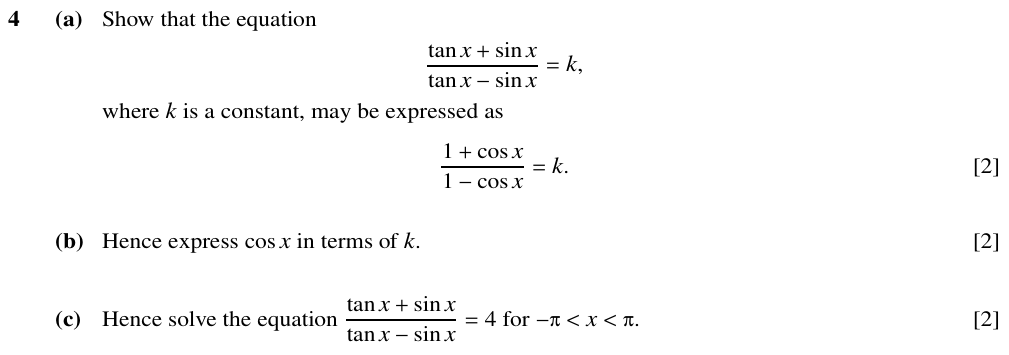
(a) clears tan from a fraction: multiply top and bottom by \(\cos x\), then factorise \(\sin x\) out of both. (b) is GCSE algebra: make \(\cos x\) the subject. (c) puts \(k=4\) into (b).
- may be expressed asshow the steps to the given form
- −π < x < πradians; cos x = c gives ±α
- (a)given form
- (b)cos x in k
- (c)x
- ka constant
- (a)form
- × cos x\(\tfrac{\sin x+\sin x\cos x}{\sin x-\sin x\cos x}\)
- Factorisecancel \(\sin x\)
- (b)cos x
- Collect\(\cos x(1+k)=k-1\)
- (c)x
- From (b)\(\cos x=\tfrac35\)
Why must the factorised line be seen?
The report: cancelling had to be visible.
Solutions of \(\cos x=0.6\) in \(-\pi<x<\pi\)?
\(\pm0.927\).
5 Now solve it have a go on paper first, then open the worked solution
- (a) \(\dfrac{\sin x+\sin x\cos x}{\sin x-\sin x\cos x}=k\) M1; \(\dfrac{\sin x(1+\cos x)}{\sin x(1-\cos x)}=k\Rightarrow\dfrac{1+\cos x}{1-\cos x}=k\) A1
- (b) \(1+\cos x=k-k\cos x\) M1; \(\cos x=\dfrac{k-1}{k+1}\) A1
- (c) \(\cos x=\tfrac35\) M1; \(x=\pm0.927\) A1
\(x=0.927\): \(\cos x=0.6\), \(\tfrac{1.6}{0.4}=4\) ✓.
Summary
- \(\tan\theta\equiv\tfrac{\sin\theta}{\cos\theta}\), \(\sin^2\theta+\cos^2\theta\equiv1\) (and \(1-\sin^2\theta=\cos^2\theta\) etc.).
- Prove: start from the harder side, combine fractions with brackets, use the identities, factorise and cancel, end exactly on the target.
- Hence solve: swap in the simple side; ± square roots; factorise, never divide by a trig ratio.
| If you see… | do this |
|---|---|
| two fractions | one fraction over the product of the denominators |
| \((1-\sin\theta)(1+\sin\theta)\) | \(1-\sin^2\theta=\cos^2\theta\) |
| \(\tan\) in a fraction | \(\tfrac{\sin}{\cos}\), multiply top and bottom by \(\cos\) |
| the target is in \(\tan\) only | divide top and bottom by \(\cos^2\theta\) |
| \(\tan^2\theta=a\) | \(\tan\theta=\pm\sqrt a\) |
Can I do this?
- I know tan θ ≡ sin θ / cos θ and sin²θ + cos²θ ≡ 1 and their rearranged forms.
- I can prove an identity from one side, combining fractions with brackets and showing every step.
- I can use a proved identity to solve an equation, including both signs of a square root.
- I factorise instead of cancelling a trig ratio from both sides.
Anything unticked: revise that section first. All ticked: take the quiz.
Quiz
The multiple-choice and guided questions need JavaScript. The concept checks and exam practice below work without it.
Concept checks
Answer each one in your head first, then open it.
1Why is \(\sin^2\theta+\cos^2\theta=1\) true for obtuse angles too?Show answer
On the unit circle the point at angle \(\theta\) is \((\cos\theta,\sin\theta)\) in every quadrant, and its distance from the centre is 1: \(\cos^2\theta+\sin^2\theta=1\).
2What's the difference between an identity and an equation?Show answer
An identity holds for every angle (you prove it). An equation holds only for certain angles (you solve it). "Hence" turns one into the other.
3Why is cross-multiplying not allowed in a proof?Show answer
It assumes the two sides are already equal - the thing you are trying to show.
Exam-style practice
New questions, not used above. Do them on paper, then mark your work against the official mark scheme.

Show the mark scheme
| Part | Answer / working | Marks | Guidance |
|---|---|---|---|
| (a) | \(\dfrac{1-2\sin^2\theta}{\cos^2\theta}=\dfrac{\cos^2\theta-\sin^2\theta}{\cos^2\theta}\) | M1 | |
| \(=1-\tan^2\theta\) | A1 | answer given: every step seen | |
| (b) | \(2\tan^4\theta+\tan^2\theta-1=0\) | M1 | using (a) |
| \(\tan^2\theta=\tfrac12\) (−1 impossible), \(\tan\theta=\pm\sqrt{0.5}\) | M1 | ||
| \(35.3°,\ 144.7°\) | A1 | ||
| Total: 5 marks | |||

Show the mark scheme
| Part | Answer / working | Marks | Guidance |
|---|---|---|---|
| (a) | \(\dfrac{1-\cos^2x-\cos x-1}{1+\cos x}\) | M1 | \(\sin^2x=1-\cos^2x\) |
| \(=\dfrac{-\cos x(1+\cos x)}{1+\cos x}\) | M1 | factorised | |
| \(=-\cos x\) | A1 | ||
| (b) | \(-\tfrac12\cos x=\tfrac14\Rightarrow\cos x=-\tfrac12\) | M1 | note the 2 + 2cos x |
| \(120°\) | A1 | ||
| \(240°\) | A1FT | ||
| Total: 6 marks | |||
Show the mark scheme
| Part | Answer / working | Marks | Guidance |
|---|---|---|---|
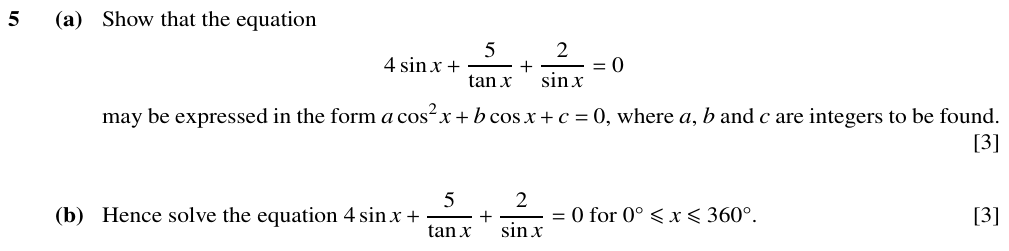
| (a) | multiply by \(\sin x\): \(4\sin^2x+5\cos x+2=0\) | *M1 | |
| \(4(1-\cos^2x)+5\cos x+2=0\) | DM1 | ||
| \(4\cos^2x-5\cos x-6=0\) | A1 | ||
| (b) | \((4\cos x+3)(\cos x-2)=0\) | M1 | \(\cos x=2\) impossible |
| \(138.6°\) | A1 | ||
| \(221.4°\) | B1FT | 360° − their angle | |
| Total: 6 marks | |||
Your progress on this note is saved when JavaScript is on.