
Hardware
The CPU and Von Neumann architecture
In this note
- 3.1.1Understand the role of the CPU and what is meant by a microprocessor.
- 3.1.2aUnderstand the purpose of the components in a CPU with a Von Neumann architecture: ALU, CU, the registers PC, MAR, MDR, CIR, ACC, and the address, data and control buses.
The notes: every idea from the start, with our own examples.
What you should already know
Programs are instructions
A program is a list of instructions. Before it runs it is copied from storage into RAM.
Quick check: where is a program while it is running?
In RAM (main memory).
Everything is binary
Instructions, data and memory addresses are all stored as binary numbers.
Quick check: what is an address?
A number that identifies one location in memory.
The CPU and the microprocessor
The central processing unit (CPU) is the part of the computer that processes instructions and data. It takes the data that is input, processes it by running the program's instructions (the fetch-decode-execute cycle), so that the result can be output.
A microprocessor is a type of integrated circuit on a single chip. In most computers the CPU is a microprocessor; simpler devices (a washing machine, a microwave) have a microprocessor that does one job.
Von Neumann architecture
Almost every computer uses the Von Neumann architecture. Its key idea is that the program instructions and the data are stored together in the same memory (RAM), and the CPU fetches them one at a time to process them.
The two units
| Unit | Purpose |
|---|---|
| Control unit (CU) | sends control signals to manage the flow of data through the CPU and to manage the fetch-decode-execute cycle; it decodes the instructions (using the instruction set) |
| Arithmetic logic unit (ALU) | carries out the calculations (e.g. add, subtract) and the logical operations (e.g. AND, OR, comparing two values); it executes the instructions and stores interim results in the accumulator |
The registers
A register is a tiny, very fast storage location inside the CPU. Each register temporarily stores one item: an address, an instruction or some data, so it can be accessed immediately during the cycle.
| Register | What it stores |
|---|---|
| Program counter (PC) | the address of the next instruction to be fetched |
| Memory address register (MAR) | the address in memory of the instruction or data that is about to be fetched (or the address data is to be written to) |
| Memory data register (MDR) | the data or instruction that has just been fetched from memory (or is waiting to be written to memory) |
| Current instruction register (CIR) | the instruction currently being decoded and executed; it is built into the CU |
| Accumulator (ACC) | the result of a calculation by the ALU (interim results) |
The buses
A bus is a set of parallel wires that transmits data, addresses or signals between the parts of the computer.
| Bus | What it carries | Direction |
|---|---|---|
| Address bus | addresses (e.g. from the MAR to RAM) | one way: CPU → memory |
| Data bus | data and instructions (e.g. from RAM to the MDR) | both ways |
| Control bus | control signals from the control unit (e.g. read, write, clock) | both ways |
Try it yourself
Show answer
Answer Program counter (PC)
Show answer
Answer Arithmetic logic unit (ALU)
Show answer
Answer Address bus
Show answer
Answer To temporarily store data / an instruction / an address so it can be accessed immediately
Summary
- CPU: processes instructions and data (runs the FDE cycle). Microprocessor: integrated circuit on a single chip.
- Von Neumann: instructions and data stored together in the same memory.
- CU: sends control signals, manages the FDE cycle, decodes. ALU: calculations and logical operations.
- PC: address of next instruction. MAR: address about to be fetched. MDR: data / instruction fetched. CIR: current instruction. ACC: results.
- Address bus (one way): addresses. Data bus: data and instructions. Control bus: signals.
If you see …
- "describe the role of the CPU"processes instructions / data · runs the FDE cycle
- "purpose of the ALU"calculations · logical operations · executes instructions · results in the accumulator
- "purpose of a register"temporarily stores data / instruction / address · fast access during the FDE cycle
Question types, what the examiner gives marks for, and real past-paper questions solved.
Ways they test it
Type 1 Role / purpose
"Describe the role of the CPU" [2]; "describe the purpose of the ALU" [3]; "state the purpose of a register" [1]
Spot it "role", "purpose".
- Use the definitions in the tables: one mark per separate point.
Type 2 Name a component
"State the name of the component that sends signals …" [1]; "circle three components built into the CPU" [3]
Spot it "name", "identify", "circle".
- Built into the CPU: CU, ALU, registers, cache, clock. NOT RAM, ROM, HDD, motherboard.
Type 3 Register table
a table of register names and descriptions to complete [6]
Spot it a table.
- Watch for addresses (PC, MAR) vs data (MDR) vs instruction (CIR) vs results (ACC).
Type 4 Buses
"circle three buses" [3]; "describe the address bus" [2]
Spot it "bus".
- Address, data, control: say what each carries.
What the examiner looks for
"Describe the purpose of the ALU" [3]
Marking points (one mark each, up to the marks shown)
- To execute instructions
- To perform calculations // e.g. addition, subtraction
- To perform logical operations // e.g. AND, OR, comparisons
- To store interim results of calculations
- Stores / reads / writes data to / from the accumulator
Keywords calculations logical operations accumulator
Components inside the CPU
- Accumulator (ACC)
- Control unit (CU)
- Program counter (PC)
- RAM or ROM (primary storage, but outside the CPU)
- motherboard (the CPU sits on it)
- HDD, graphics card
RAM is directly accessed by the CPU but it is not built into it.
From: 0478/13/O/N/23 Q3(a) mark scheme
Past-paper questions, solved
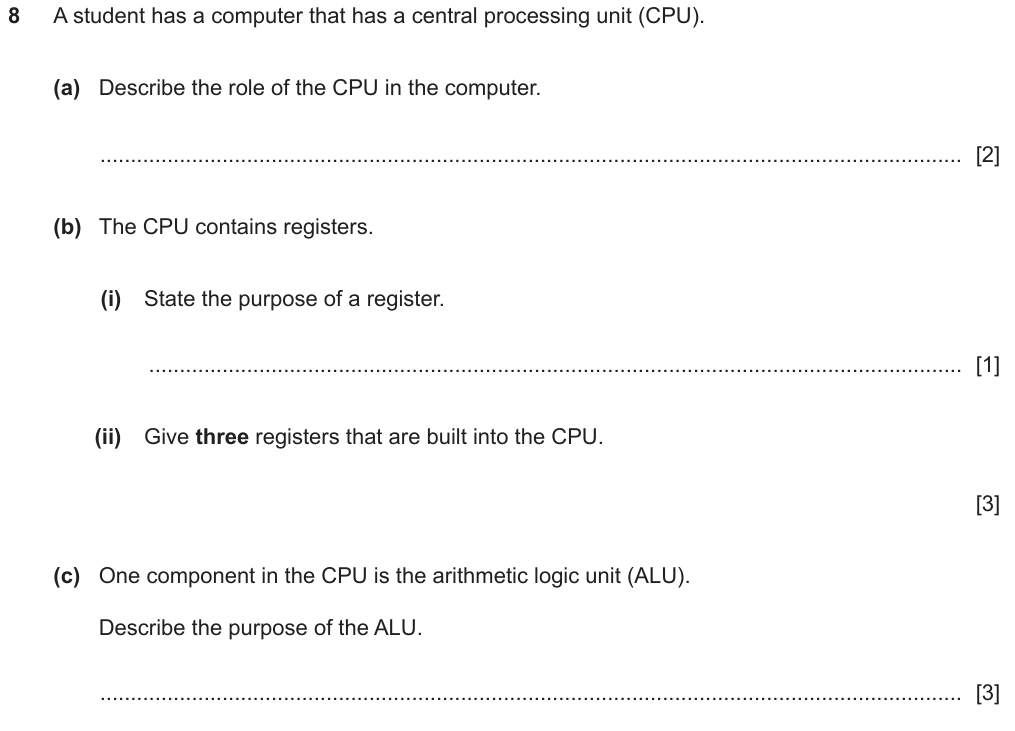
How to start Each part is a definition from the notes. Count the marks: (c) wants three separate points.
Show a full-mark answer and the mark scheme
(a) To process instructions and data, by running the fetch-decode-execute cycle.
(b)(i) To temporarily store data, an instruction or an address. (ii) Program counter, memory address register, accumulator.
(c) To execute instructions: it performs the calculations, such as addition, and the logical operations, such as comparing values, and stores the interim results in the accumulator.
| Part | Answer / working | Marks | Guidance |
|---|---|---|---|
| 8(a) | process instructions / data · run the FDE cycle | B2 | |
| 8(b)(i) | temporarily store data / instruction / address // immediate access during FDE | B1 | |
| 8(b)(ii) | Any three: MAR · MDR · ACC · PC · CIR | B3 | |
| 8(c) | Any three: execute instructions · calculations · logical operations · interim results · accumulator | B3 | |
| Total: 9 marks | |||
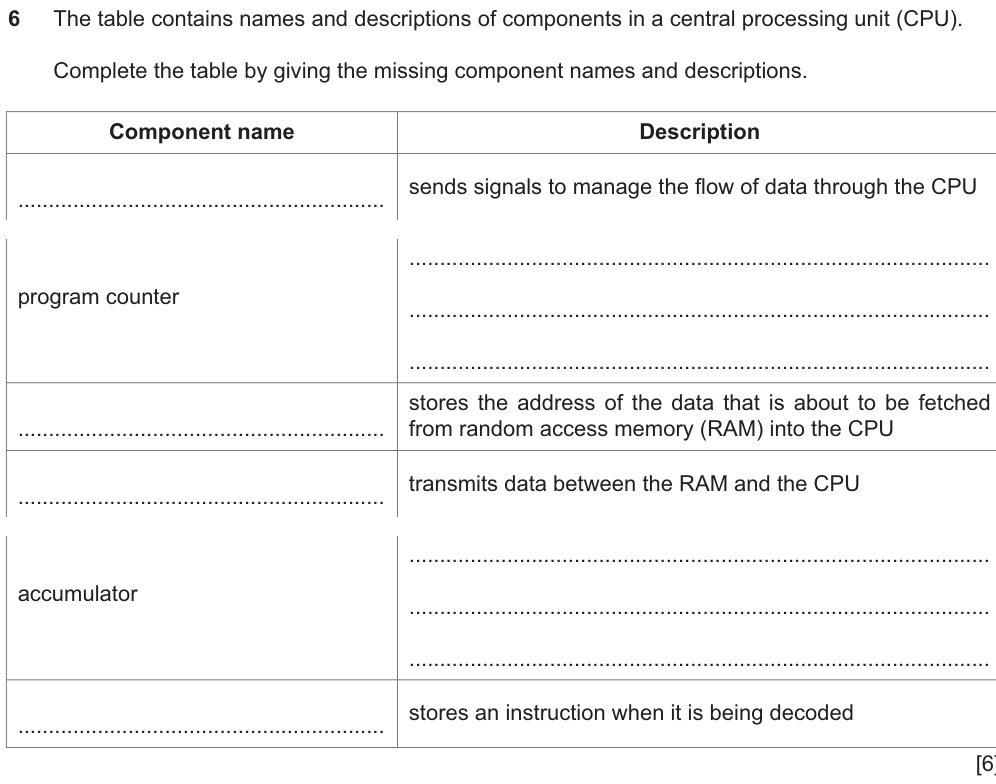
How to start Four rows need a name, two need a description. "Address … about to be fetched" is the MAR; "transmits data" is a bus.
Show a full-mark answer and the mark scheme
Control unit (CU) · program counter: stores the address of the next instruction to be fetched · memory address register (MAR) · data bus · accumulator: stores the interim result of a calculation · current instruction register (CIR)
| Part | Answer / working | Marks | Guidance |
|---|---|---|---|
| 6 | CU · MAR · data bus · CIR; PC: address of the next instruction; ACC: interim result of a calculation | B6 | |
| Total: 6 marks | |||
Common mistakes
- ✗ "The MAR stores instructions"✓ "The MAR stores addresses"
- ✗ "RAM is part of the CPU"✓ "RAM is primary storage outside the CPU"
- ✗ "The CPU stores data"✓ "The CPU processes instructions and data"Storing is memory's job.
- ✗ "The ALU controls the CPU"✓ "The CU sends control signals; the ALU calculates"
Practice
Practice: easy, medium, hard
Easy
Show answer
Answer Memory data register
Show answer
Answer Accumulator (ACC)
Show answer
Answer Address bus, data bus, control bus
Medium
Show answer
Answer An integrated circuit on a single chip
Show answer
Answer Sends control signals to manage the flow of data through the CPU; manages / decodes during the FDE cycle
Show answer
Answer Program instructions and data are stored together in the same memory
Hard
Show answer
Answer PC: the address of the NEXT instruction to be fetched. MAR: the address of the instruction / data being fetched NOW (or written to)
Show answer
Answer The address bus: addresses only go from the CPU to memory
Can I do this?
- I can describe the role of the CPU and define a microprocessor.
- I can give the purpose of the CU and the ALU.
- I can say what each of PC, MAR, MDR, CIR, ACC stores.
- I can describe the three buses.
Anything unticked: revise that section first. All ticked: take the quiz.
Quiz
The multiple-choice and guided questions need JavaScript. The concept checks and exam practice below work without it.
Your progress on this note is saved when JavaScript is on.
⬇️ Download this chapter as a PDF: Full notes