
Practical skills: Paper 4 Alternative to Practical
Mechanics experiments: density, springs, balancing and pendulums
In this note
- AO3Find the density of regular solids, irregular solids and liquids, with the techniques that make it accurate.
- AO3Measure the extension of a spring and find a spring constant from readings or a graph.
- AO3Use a balancing method (moments) to find an unknown mass, including the mass of a metre rule.
- AO3Time a pendulum or oscillating spring accurately (many oscillations, fiducial marker).
- AO3Measure speeds and distances for motion down ramps, rolling and bouncing.
The skills used here: readings, graphs, evaluation.
Rules to learn
Density experiments
| Object | Mass | Volume | Watch out for |
|---|---|---|---|
| regular block | top-pan balance | measure l, w, h with a ruler; \(V=lwh\) | nearest mm; average two places if the sides are uneven |
| ball or cylinder | balance | blocks or set squares either side to find the diameter, \(V=\tfrac{4}{3}\pi r^3\) or the formula given | measure in two directions and average |
| irregular solid (stone, clay) | balance | displacement: \(V_2-V_1\) in a measuring cylinder (or a displacement can) | fully submerged; no air bubbles; read the bottom of the meniscus at eye level; lower gently (no splash) |
| liquid | mass of cylinder with liquid − mass of empty cylinder | read the measuring cylinder | same cylinder for both masses; read at eye level |
| many small objects (beads, coins) | mass of many ÷ number | displacement of many ÷ number | use as many as possible: the readings are larger, so their errors matter less |
Example A block measures 2.0 cm × 3.0 cm × 4.0 cm and has a mass of 64.8 g. Density?
Volume from the sides, then mass ÷ volume.
- \(V=2.0\times3.0\times4.0=24.0\) cm³
- \(\rho=64.8\div24.0=2.70\) g/cm³
Answer 2.70 g/cm³
Example A stone of mass 31.2 g raises the water in a measuring cylinder from 60 cm³ to 72 cm³. Density?
Displacement volume, then divide.
- \(V=72-60=12\) cm³
- \(\rho=31.2\div12=2.6\) g/cm³
Answer 2.6 g/cm³
Try it yourself
Show answer
Answer 8 cm³
Show answer
Answer 2.7 g/cm³
Springs and stretching
Hang the spring from a clamp with a metre rule beside it. Measure the unstretched length \(l_0\), add loads one at a time and measure each new length \(l\). Extension \(e=l-l_0\). Plot load against extension (or the other way round, as the question says); the gradient gives the spring constant.
| Technique | Why |
|---|---|
| ruler clamped vertical (check with a set square) and close to the spring | readings along the spring, not at an angle |
| eye level with the bottom of the spring (or a pointer fixed to it) | no parallax |
| measure to the same point each time (e.g. bottom of the coils, not the hook) | lengths comparable |
| remove the loads and check the spring returns to \(l_0\) | shows it has not passed its limit of proportionality |
Example A load of 2.4 N stretches a spring by 6.0 cm. Spring constant in N/cm?
k = F ÷ e.
- \(k=2.4\div6.0=0.40\) N/cm
Answer 0.40 N/cm
Some questions find k a second way, by timing oscillations of a mass on the spring (then a formula with \(T^2\) is given). The same timing rules as a pendulum apply.
Try it yourself
Show answer
Answer 5.5 cm
Balancing a metre rule (moments)
A metre rule balances on a pivot when the moments on each side are equal. Its own weight acts at its centre of mass (the 50.0 cm mark for a uniform rule). Put a known mass on one side and slide the rule until it balances: then the unknown mass (often the rule itself) can be found.
General methodHow to find a mass by balancing
- Record the pivot position, and the position of the CENTRE of the mass (not its edge).
- Work out each distance FROM THE PIVOT.
- Moments balance: \(m\times a=M\times b\).
- Rearrange for the unknown: \(M=\dfrac{m\times a}{b}\).
Example A 40 g mass is centred on the 5.0 cm mark. The rule balances on a pivot at 35.0 cm. Mass of the rule?
Distances from the pivot, then moments.
- \(a=35.0-5.0=30.0\) cm; \(b=50.0-35.0=15.0\) cm
- \(40\times30.0=M\times15.0\)
- \(M=80\) g
Answer 80 g
| Technique | Why |
|---|---|
| read both edges of the mass and average them (or look through its slot) | you need the position of its centre |
| move the rule in small steps and find the position where it just balances | the exact balance point is hard to judge |
| check the rule alone balances at 50.0 cm | tests that its centre of mass is at the middle |
Try it yourself
Show answer
Answer 60 g
Pendulums and timing oscillations
One complete oscillation is from one side, to the other side, and back. The period T is the time for one oscillation. Time several (10 or 20) and divide.
| Technique | Why |
|---|---|
| time 10 or 20 oscillations, not 1 | reaction-time error becomes a much smaller fraction of the time |
| a fiducial marker at the centre of the swing; start counting from "zero" as the bob passes it | the bob is fastest at the centre, so its passing is easiest to judge |
| small swings (about 10°) | the period is the same for small swings |
| length measured to the centre of the bob; set square to line up the bob with the ruler | the length is defined to the centre; no parallax |
| repeat the timing and average | reduces random error |
Example 20 oscillations take 28.4 s. Period and \(T^2\)?
Divide by 20, then square.
- \(T=28.4\div20=1.42\) s
- \(T^2=2.02\) s²
Answer \(T=1.42\) s, \(T^2=2.02\) s²
Try it yourself
Show answer
Answer 1.56 s
Motion: ramps, rolling and bouncing
| Experiment | Measure | Techniques |
|---|---|---|
| trolley or ball down a ramp | distance with a metre rule; time with a stopwatch; speed = d/t | release from the same marked point; don't push; repeat and average the time |
| distance travelled after a ramp | measuring tape from the bottom of the ramp to where it stops | same surface; same release point |
| bounce height | metre rule held vertically beside the ball | eye level with the top of the bounce; drop, don't throw; repeat |
| falling objects / terminal speed | time between two marks | marks far apart; start timing after the object has reached a steady speed |
Example A trolley rolls 1.20 m in 0.80 s. Average speed?
Distance ÷ time.
- \(1.20\div0.80=1.5\) m/s
Answer 1.5 m/s
From the past papers
Past paper 1
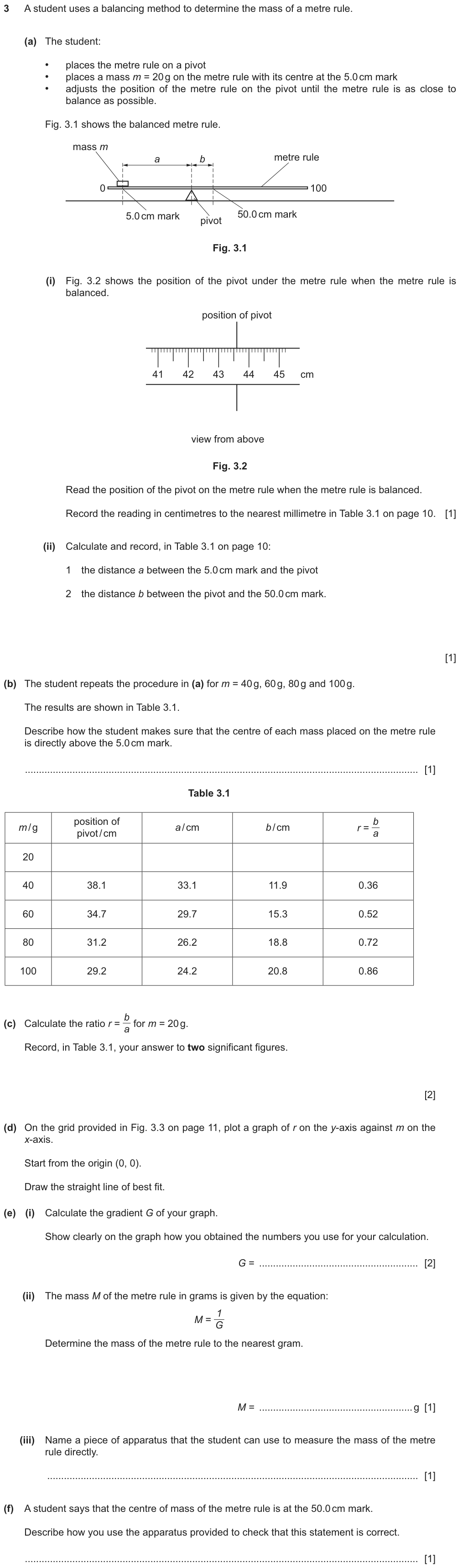
How to start: The pivot scale reads 43.6 cm. a is from the 5.0 cm mark to the pivot, b from the pivot to 50.0 cm. Moments: m × a = M × b, so r = b/a = m/M: a straight line with gradient 1/M.
✓ Show the answer have a go on paper first
- (a)(i) Pivot at 43.6 cm. (ii) \(a=43.6-5.0=38.6\) cm, \(b=50.0-43.6=6.4\) cm.
- (b) Read the scale at both edges of the mass and take the middle (or line the 5.0 cm mark up through the slot in the mass).
- (c) \(r=6.4\div38.6=0.166\to\) 0.17 (2 s.f. as asked).
- (d) Plot r (up) against m (across) from (0, 0); thin straight best-fit line.
r against m: straight, through (almost) the origin; gradient from a large triangle. - (e)(i) Triangle across most of the line: \(G=0.0087\) per g. (ii) \(M=1/G=115\) g (to the nearest gram). (iii) A top-pan balance.
- (f) Put the rule on the pivot at the 50.0 cm mark with nothing on it and see if it balances.
| Part | Answer / working | Marks | Guidance |
|---|---|---|---|
| (a)(i) | 43.6 (cm) | B1 | |
| (a)(ii) | 38.6 (cm) and 6.4 (cm) | B1 | |
| (b) | read the scale at both sides and find the mean / look through the slot / edges equal distances from the 5.0 cm mark | B1 | |
| (c) | 0.166 (any correct value) | B1 | |
| recorded to 2 s.f.: 0.17 | B1 | ||
| (d) | axes labelled, quantity and unit, correct way round | B1 | |
| scales linear, not awkward | B1 | ||
| points plotted to the nearest ½ square | B1 | ||
| thin best-fit straight line | B1 | ||
| (e)(i) | values indicated, ⩾ ½ the line used | B1 | |
| G in the range 0.008 to 0.01 | B1 | ||
| (e)(ii) | M correct from G, to the nearest gram | B1 | |
| (e)(iii) | (top-pan) balance | B1 | |
| (f) | check the rule balances with the pivot at the 50.0 cm mark | B1 | |
| Total: 14 marks | |||
Examiner tip Two marks in (c) for one division: the value and the 2 s.f. the question asked for.
Past paper 2
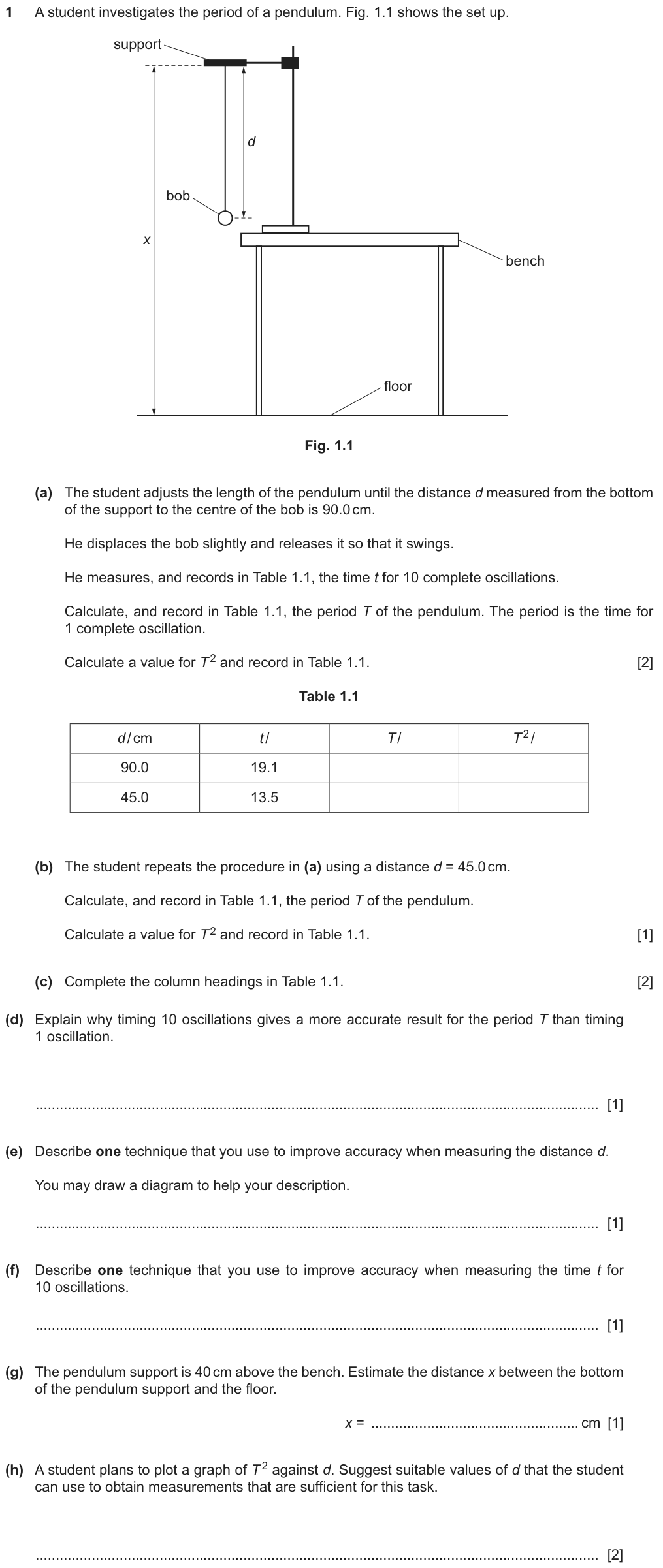
How to start: Two calculations per row (T = t ÷ 10, then T²), then technique questions. Every technique answer names an action and an instrument.
✓ Show the answer have a go on paper first
- (a) \(T=19.1\div10=1.91\) s; \(T^2=3.65\) s².
- (b) \(T=1.35\) s; \(T^2=1.82\) s² - both \(T^2\) values to the same number of s.f. (3.65 and 1.82, or 3.648 and 1.823).
- (c) Headings: t / s, T / s, T² / s².
- (d) The reaction-time error is the same, but spread over 10 oscillations it is a smaller part of the time: less significant.
- (e) Use a set square (horizontal) to line up the centre of the bob with the metre rule, held close to the bob.
- (f) Use a fiducial marker at the centre of the swing and start counting from zero as the bob passes it.
- (g) A bench is about 80-100 cm high: x ≈ 40 + 90 = 130 cm.
- (h) At least 3 more values, all less than x (the pendulum must not hit the floor): e.g. 30, 60, 75, 105 cm.
| Part | Answer / working | Marks | Guidance |
|---|---|---|---|
| (a) | T = 1.91 | B1 | |
| T² = 3.65 (3.6481) | B1 | ||
| (b) | T and T² for 45 cm, AND both T² to 3 OR both to 4 s.f. | B1 | |
| (c) | t and T in s | B1 | |
| T² in s² | B1 | ||
| (d) | (timing) errors (due to reaction time) less significant / error spread over a longer time | B1 | |
| (e) | set square or similar horizontal aid OR metre rule close to bob | B1 | |
| (f) | fiducial point / count from when the pendulum passes the vertical / start counting from zero | B1 | |
| (g) | 100 cm < x < 140 cm | B1 | |
| (h) | at least 3 additional values | B1 | |
| no value greater than x from (g) | B1 | ||
| Total: 11 marks | |||
Examiner tip (g) and (h) test common sense about real apparatus: a bench is roughly a metre high, and a pendulum longer than the gap to the floor cannot swing.
Type 1 Density
"Calculate the density … Give your answer to a suitable number of s.f. with the unit."
Spot it mass + volume readings.
- Volume (formula or V₂ − V₁).
- ρ = m/V.
- 2-3 s.f., g/cm³.
Type 2 Balancing
"Calculate the mass of the metre rule." or a graph of b/a against m
Spot it pivot, metre rule, 50.0 cm.
- Distances from the pivot.
- m a = M b.
- or gradient = 1/M.
Type 3 Pendulum / spring timing
"Calculate T … Explain why timing 20 oscillations is better."
Spot it "oscillations".
- T = t/n.
- Reaction time error shared → smaller effect.
- Fiducial marker.
Type 4 Technique
"Describe one technique to improve accuracy when measuring…"
Spot it "technique".
- Set square / ruler close / eye level / fiducial marker / both edges averaged.
Mistakes to avoid
- ✗ distances measured from the 0 cm end✓ distances from the PIVOTMoments are about the pivot.
- ✗ the edge of the mass as its position✓ the centre of the mass
- ✗ T = 10 ÷ t✓ T = t ÷ 10Seen in reports every year.
- ✗ doubling T to get T²✓ squaring T
- ✗ length to the top of the bob✓ to the centre of the bob
- ✗ volume of a stone with air bubbles on it✓ remove bubbles / lower gentlyBubbles add volume.
Summary
- Density = m/V; irregular volume by displacement V₂ − V₁; liquids by mass difference.
- Extension = l − l₀; k = F/e (gradient); ruler vertical and close, eye level.
- Balancing: distances from the pivot, m a = M b; the rule's weight acts at 50.0 cm.
- Period = time for n oscillations ÷ n; fiducial marker; count from zero.
- Speed = distance ÷ time; same release point; repeat and average.
If you see …
- "oscillations"time many, divide.
- "balanced"moments about the pivot.
- "irregular"displacement.
Practice
Practice: easy, medium, hard
Easy
Show answer
Answer 2.7 g/cm³
Show answer
Answer 1.60 s
Show answer
Answer 3.7 cm
Medium
Guide me
What is it asking? M
What do we know? a = 28.0, b = 12.0
Plan M = m a / b
Show working
- a = 28.0 cm, b = 12.0 cm
- M = 50 × 28.0 ÷ 12.0 = 116.7 g
Answer 116.7 g → 117 g
Guide me
What is it asking? density
What do we know? mass of oil = difference
Plan ÷ volume
Show working
- 130.0 − 84.5 = 45.5 g
- 45.5 ÷ 50.0 = 0.91 g/cm³
Answer 0.91 g/cm³
Guide me
What is it asking? a technique
What do we know? where does the length end?
Plan centre of the bob, set square
Show answer
Answer measure to the centre of the bob, using a set square to line the bob up with a vertical metre rule held close to it
Hard
Show working
- average t = 1.28 s
- 0.90 ÷ 1.28 = 0.703
Answer 0.70 m/s
| Part | Answer / working | Marks | Guidance |
|---|---|---|---|
| average time 1.28 s | B1 | ||
| 0.70 m/s | B1 | ||
| Total: 2 marks | |||
Show working
- a = 28.6 − 5.0 = 23.6
- b = 50.0 − 28.6 = 21.4
- M = 80 × 23.6 ÷ 21.4 = 88.2
Answer a = 23.6 cm, b = 21.4 cm, M = 88 g
| Part | Answer / working | Marks | Guidance |
|---|---|---|---|
| a and b | B1 | ||
| m a = M b | M1 | ||
| 88 g | A1 | ||
| Total: 3 marks | |||
Show answer
Answer 20 oscillations: the reaction-time error is a smaller fraction of the time; marker at the centre: the mass moves fastest there so the moment it passes is clearest; counting from zero avoids counting one oscillation too many
| Part | Answer / working | Marks | Guidance |
|---|---|---|---|
| reaction-time error less significant over 20 oscillations | B1 | ||
| fiducial marker at the centre: clearest point | B1 | ||
| Total: 2 marks | |||
Can I do this?
- I can find the density of a regular solid, an irregular solid and a liquid.
- I can measure extension and find a spring constant.
- I can use m a = M b with distances from the pivot to find a mass.
- I can time oscillations accurately and find T and T².
- I can measure speeds and distances for ramps and rolling objects.
Anything unticked: revise that section first. All ticked: take the quiz.
Quiz
The multiple-choice and guided questions need JavaScript. The concept checks and exam practice below work without it.
Your progress on this note is saved when JavaScript is on.