
Hardware
Memory: RAM, ROM, SRAM, DRAM, EPROM, EEPROM
What you need to be able to do
- 3.1Explain the differences between RAM and ROM, and their use in a range of devices.
- 3.1Explain the differences between Static RAM (SRAM) and Dynamic RAM (DRAM), and why one is used instead of the other.
- 3.1Explain the difference between PROM, EPROM and EEPROM.
You need: Computer systems (primary memory). Next: Monitoring and control.
RAM and ROM
Both are primary memory: the processor can access them directly. They differ in whether the contents can change and whether they survive power-off.
| RAM (Random Access Memory) | ROM (Read Only Memory) | |
|---|---|---|
| Volatile? | volatile: contents are lost when the power is off | non-volatile: contents kept without power |
| Read / write | read and written constantly while the computer runs | read only in normal use (contents set by the manufacturer, or rarely updated) |
| Holds | programs and data currently in use: running software, parts of the OS, open files, sensor readings, user choices | start-up (boot) instructions / BIOS, firmware, the OS kernel loader: data that must not change and must be there at switch-on |
| Size | large (gigabytes) | small |
| Device | Stored in RAM | Stored in ROM |
|---|---|---|
| PC | running programs, open documents, part of the OS | BIOS / bootstrap program |
| Washing machine | the wash program the user chose, sensor readings, time left | the start-up instructions / the wash programs (firmware) |
| CCTV computer | the video currently being processed | bootstrap program, firmware for the cameras, parts of the OS kernel |
| Video doorbell | current motion-sensor reading, recent video, instructions being executed | boot-up instructions |
SRAM and DRAM
| SRAM (Static RAM) | DRAM (Dynamic RAM) | |
|---|---|---|
| How a bit is stored | transistors arranged as flip-flops / latches | a transistor and a capacitor: the bit is a charge on the capacitor |
| Refreshing | does not need refreshing | must be constantly refreshed (the capacitors leak charge) |
| Access speed | faster access time (no refresh) | slower |
| Cost | more expensive per bit (more transistors) | cheaper per unit (simpler design, fewer transistors) |
| Density / capacity | lower density | higher bit density: more data per chip |
| Used for | cache memory (on / near the CPU) | main memory in PCs, buffers, printers, embedded devices |
1 Laptop cache
Why is SRAM used for a laptop's cache?
AskedreasonKnowcache must keep up with the CPURoutespeed
- Faster access time because it does not need to be refreshed
- the small amount needed means the higher cost doesn't matter
2 Printer memory
A 3D printer has 1 GB of DRAM to store print data. Give two advantages of DRAM over SRAM.
Askedtwo advantagesKnowlots of data, cost-sensitiveRoutecost + density
- Lower cost per unit of memory
- Higher bit density: more data stored per chip
- (and a very fast access speed isn't needed for print data)
3 DRAM's drawbacks
Give two disadvantages of DRAM compared with SRAM.
Askedtwo disadvantagesKnowrefresh, speedRoutethe opposite of SRAM's strengths
- Requires constant refresh cycles
- Lower access speed
PROM, EPROM and EEPROM
| PROM | EPROM | EEPROM | |
|---|---|---|---|
| Name | Programmable ROM | Erasable Programmable ROM | Electrically Erasable Programmable ROM |
| Written | once after manufacture (fuses blown) | many times | many times |
| Erased by | cannot be erased | ultraviolet (UV) light | an electrical signal / voltage |
| Removed from the device to erase? | - | yes: removed from the circuit board | no: erased in situ (in the device) |
| How much erased | - | the whole chip | a single byte or the whole chip |
| Typical use | one-off firmware in cheap devices | older firmware development | firmware that can be updated (BIOS, routers, embedded devices, VR headsets); flash memory is a type of EEPROM |
Why EEPROM in an embedded device: the firmware can be updated (new features, bug fixes) without removing the chip, without special equipment, even by a non-technical user, and only the bytes that change need erasing.
Mark-scheme focus
Two differences between EPROM and EEPROM (2 marks)
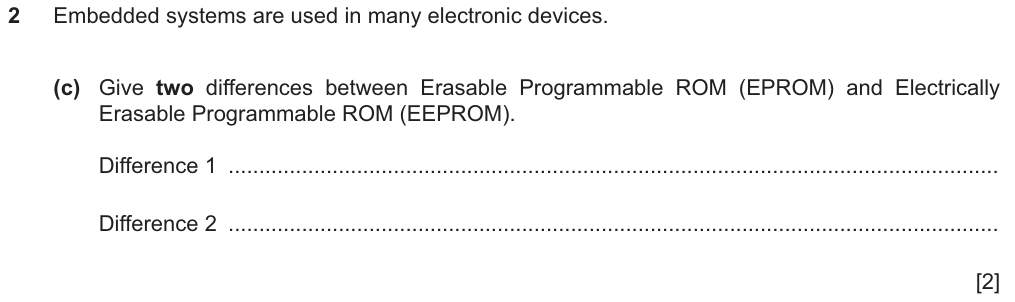
- EPROM uses ultraviolet light to erase data whilst EEPROM uses an electrical signal B1
- EPROM has to be removed from the circuit board to change the data, EEPROM remains in the circuit // EPROM erases all the data, EEPROM can erase parts B1
- “EEPROM is electrically erasable” (repeats the name)
- one-sided statements
From: 9618/12/O/N/24 Q2(c)
Three differences between DRAM and SRAM (3 marks)

- DRAM requires refreshing, SRAM does not; DRAM stores each bit as charge, SRAM uses flip-flops; DRAM is less expensive to manufacture;
- DRAM has slower access speeds; DRAM has higher storage density; DRAM is used in main memory, SRAM in cache B3
- “DRAM is dynamic, SRAM is static”
- “SRAM is better”
From: 9618/11/O/N/25 Q6(c)
Why ROM is used in an embedded system (2 marks)

- To store data that does not change B1
- Data must be stored even when the device has no power // to store boot-up instructions / firmware / BIOS B1
- “ROM is read only”
- a description of embedded systems with nothing about ROM
From: 9618/12/O/N/22 Q3(c)
- Memory in nearly every paper: SRAM vs DRAM (1-3), PROM / EPROM / EEPROM (2-3), ROM / RAM contents (2), often attached to a device.
- Always compare: each difference names both types.
Worked examples
Example 1 · Complete the memory description; three ROM types (Paper 1, 8 marks) ★★ Medium
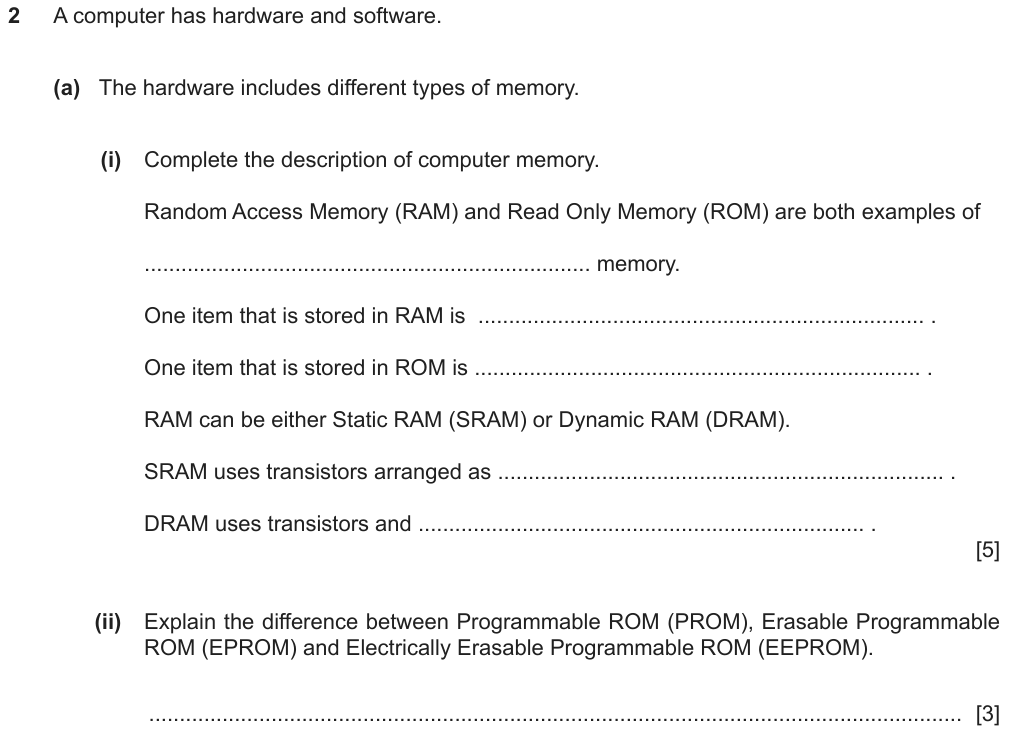
(i) five gaps. (ii) three distinct comparisons across the three ROM types.
- … memorya type of memory, not “computer”
- (a)(i)5 gaps
- (a)(ii)3 differences
What was the commonest wrong first answer?
“computer” - the paragraph is already about computer memory.
5 Now solve it have a go on paper first, then open the worked solution
- (i) primary; RAM: currently running software / data / part of the OS; ROM: start-up / boot-up instructions / BIOS; SRAM: flip-flops / latches; DRAM: capacitors B5
- (ii) PROM can be set once; EPROM and EEPROM can be overwritten many times B1
- EPROM must be removed from the device; EEPROM can be erased in situ B1
- EPROM is erased with UV light, EEPROM with a voltage // EPROM must be entirely erased, EEPROM need not be B1
✓
Example 2 · SRAM in a laptop; EEPROM in a VR headset (Paper 1, 4 marks) ★★ Medium
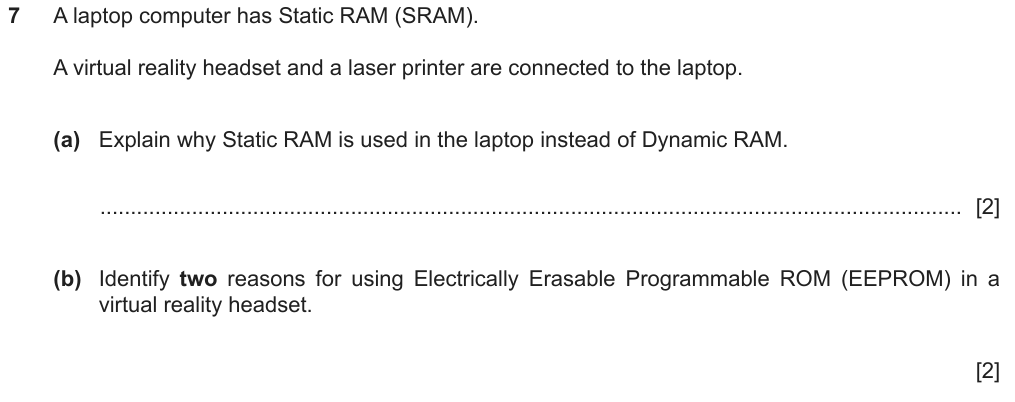
(a) reason + why; (b) two reasons tied to updating the headset's firmware.
- (a)2
- (b)2
5 Now solve it have a go on paper first, then open the worked solution
- (a) SRAM has a faster access time B1 … because it does not need to be refreshed // used for CPU cache B1
- (b) EEPROM allows frequent / multiple read / write / erase operations B1 … so the headset's firmware can be changed easily, without fully erasing it first B1
✓
Example 3 · Two differences between DRAM and SRAM (Paper 1, 2 marks) ★ Easy
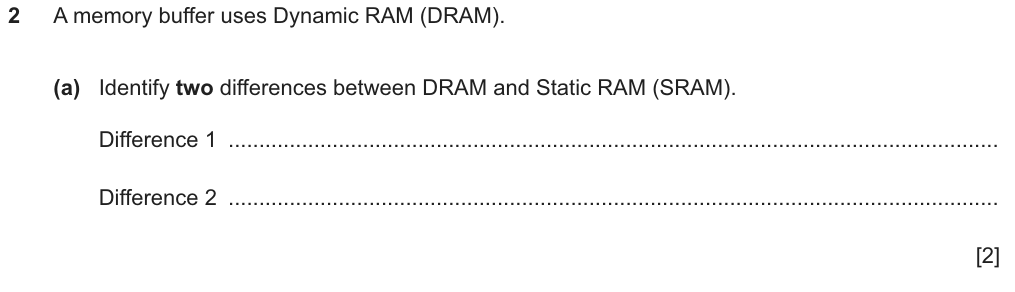
Two different properties, each comparing both.
- (a)2
5 Now solve it have a go on paper first, then open the worked solution
- DRAM requires constant refreshing, SRAM does not B1
- DRAM generally has greater capacity per chip // DRAM has slower access times than SRAM B1
✓
Example 4 · ROM contents and DRAM's advantages in a CCTV computer (Paper 1, 4 marks) ★★ Medium
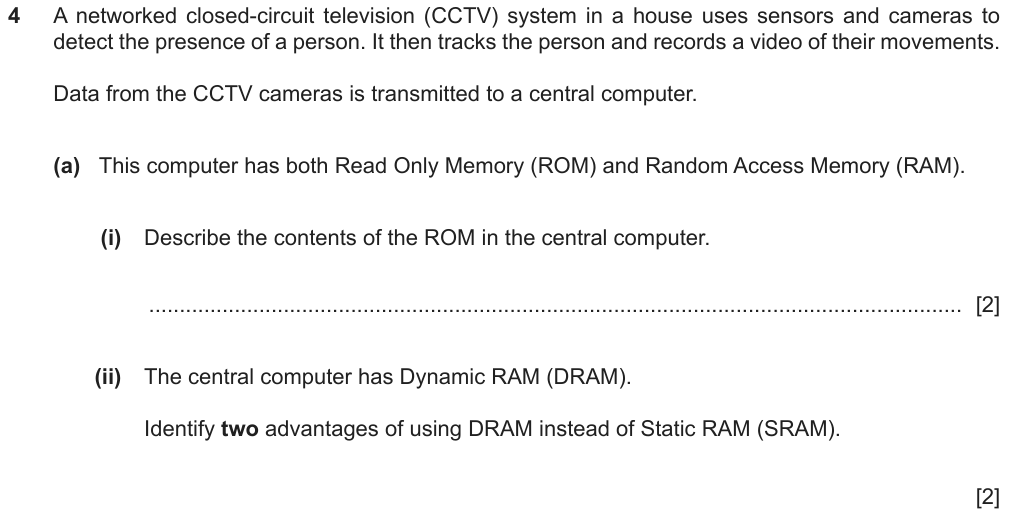
(i) two different things in ROM (computer start-up, CCTV firmware, OS kernel). (ii) precise advantages.
- (a)(i)2
- (a)(ii)2
5 Now solve it have a go on paper first, then open the worked solution
- (i) Bootstrap program / start-up instructions / BIOS B1; start-up instructions / firmware for the CCTV cameras // parts of the OS kernel B1
- (ii) Costs less per unit B1; higher storage density // simple design, fewer transistors B1
The report: vague “DRAM is cheaper” was not credited ✓.
Summary
- RAM: volatile, read / write, data in use. ROM: non-volatile, read only, boot instructions / firmware.
- SRAM: flip-flops, no refresh, fast, expensive, low density → cache. DRAM: capacitor + transistor, refreshed, slower, cheap, dense → main memory.
- PROM once; EPROM UV, removed, whole chip; EEPROM electrical, in situ, byte or whole → updatable firmware.
Can I do this?
- I can compare RAM and ROM and say what each holds in a device.
- I can compare SRAM and DRAM and justify using one.
- I can explain the differences between PROM, EPROM and EEPROM and why EEPROM suits embedded systems.
Anything unticked: revise that section first. All ticked: take the quiz.
Quiz
The multiple-choice and guided questions need JavaScript. The concept checks and exam practice below work without it.
Concept checks
Answer each one in your head first, then open it.
1Is flash memory RAM or ROM?Show answer
A type of EEPROM: non-volatile and electrically erasable in blocks, which is why it is used for SSDs and memory cards.
2Why not build all main memory from SRAM?Show answer
It would be far more expensive and take more space per bit; DRAM gives large capacity cheaply, and a small SRAM cache hides most of its slowness.
Exam-style practice
New questions, not used above. Do them on paper, then mark your work against the official mark scheme.

Show the mark scheme
| Part | Answer / working | Marks | Guidance |
|---|---|---|---|
| (c) | Dynamic RAM has lower cost per unit | B1 | |
| Higher bit density // more data stored per chip // a fast access speed is not needed | B1 | ||
| Total: 2 marks | |||
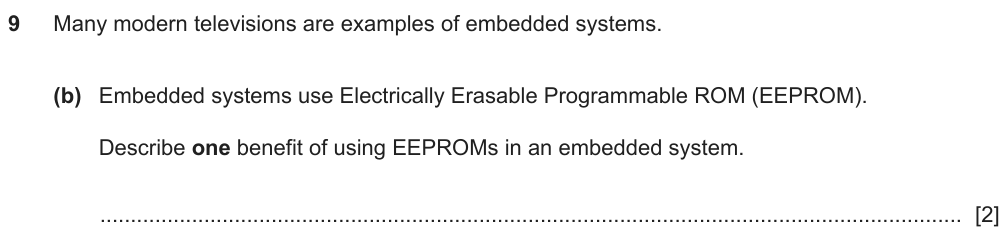
Show the mark scheme
| Part | Answer / working | Marks | Guidance |
|---|---|---|---|
| (b) | Can be erased and reprogrammed several times // possible to reprogram / update | B1 | |
| … so firmware can be updated, without removing it from the device / by non-technical users | B1 | ||
| Total: 2 marks | |||
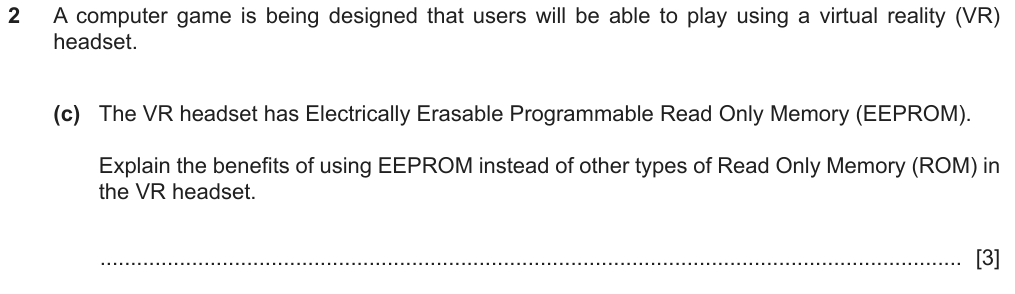
Show the mark scheme
| Part | Answer / working | Marks | Guidance |
|---|---|---|---|
| (c) | EEPROM allows frequent / multiple read / write / erase operations … | B1 | |
| … so the headset can take advantage of new features, without removing the chip / fully erasing the firmware first | B1 | ||
| … the firmware can be changed by the user without technical expertise // cheaper to manufacture | B1 | ||
| Total: 3 marks | |||
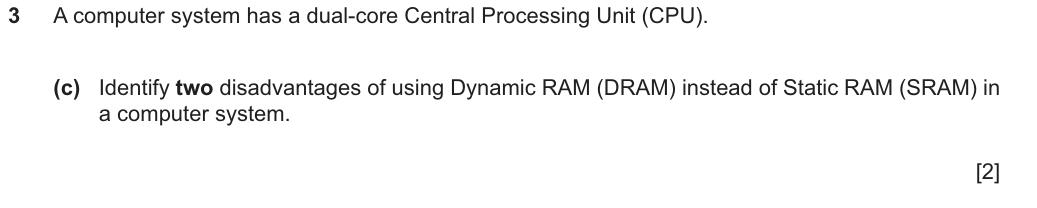
Show the mark scheme
| Part | Answer / working | Marks | Guidance |
|---|---|---|---|
| (c) | DRAM requires constant refresh cycles unlike SRAM | B1 | |
| DRAM has a lower access speed than SRAM | B1 | ||
| Total: 2 marks | |||
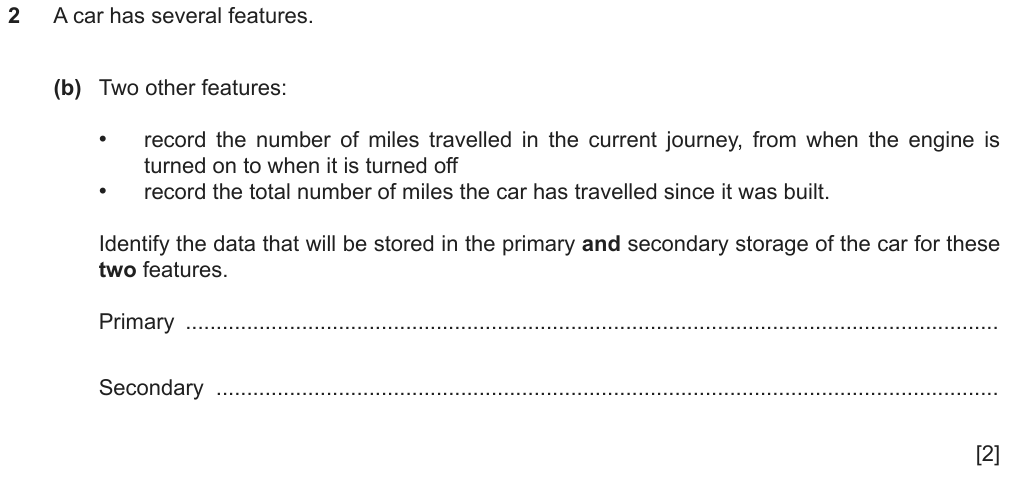
Show the mark scheme
| Part | Answer / working | Marks | Guidance |
|---|---|---|---|
| (b) | Primary: miles travelled in the current journey, before the engine is turned off | B1 | |
| Secondary: total miles travelled since the car was built // miles for the most recent journey after the engine is switched off | B1 | ||
| Total: 2 marks | |||
Your progress on this note is saved when JavaScript is on.