
Hardware
Monitoring and control systems
What you need to be able to do
- 3.1Explain the difference between monitoring and control systems, and justify which a given system is.
- 3.1Describe the use of sensors (temperature, pressure, infra-red, sound …) and actuators in a given system.
- 3.1Explain the importance of feedback in a control system.
You need: Embedded systems (most control systems are embedded).
Monitoring or control?
| Monitoring system | Control system | |
|---|---|---|
| Purpose | observes / records data and may warn (display, alarm, message) | acts autonomously to change the environment to keep it within a set range |
| Actuators | none | uses actuators (motors, valves, heaters, pumps) |
| Feedback | no feedback: its output does not affect the next input | uses feedback: its output affects the next input |
| Examples | hospital patient monitor, weather station, burglar alarm, bridge weight warning sign | air conditioning, greenhouse window, automatic doors, car automatic braking, central heating |
- Ask: does the system's output change the thing the sensor measures?
- Yes (doors open, so the person walks through and the sensor reading changes; brakes slow the car, so the distance changes) → control.
- No (a warning sign lights, a message is sent, the camera records - but the sensor reading is unaffected) → monitoring.
- In the answer, justify: no marks for the word “control”; the marks are for the reasons (feedback, actuator, output affects input).
Feedback
- The sensor measures a physical quantity (e.g. temperature) and sends the reading (via an ADC) to the processor.
- The processor compares the reading with the stored set point / range.
- If it is out of range, the processor sends a signal to an actuator (e.g. switch on the heater, open the window).
- The actuator's action changes the environment, so the next sensor reading is different: the loop repeats continuously.
Sensors and actuators
| Sensor | Measures / detects | Example uses (with the reason) |
|---|---|---|
| Temperature | how hot or cold something is | greenhouse, fridge, 3D printer nozzle (prevent overheating), central heating |
| Pressure | force / weight on a surface | vehicle weight on a bridge, someone sitting in a car seat (alarm), item lifted off a shop shelf, robot bumping into a table |
| Infra-red | a beam being broken / heat from a body / distance | counting products on a conveyor, vehicle height at a bridge, a person near automatic doors, obstacles for a robot, intruders |
| Sound | noise level | car alarm (glass breaking), speech for a voice assistant / robot |
| Light | brightness | street lights, security floodlights at dusk |
| Proximity / ultrasonic | distance to an object | parking sensors, automatic braking |
| Humidity, gas, pH | moisture, gas level, acidity | greenhouses, air-quality monitors, rivers |
Mark-scheme focus
Explain the importance of feedback in a control system (2 marks)

- Feedback ensures that a system operates within set criteria / constraints B1
- … by enabling system output to affect (subsequent) system input // … allowing conditions to be automatically adjusted B1
- feedback from users / reviews
- “feedback tells the computer what happened” (no output → input link)
From: 9618/11/O/N/23 Q9(a)
Differences between a monitoring system and a control system (3 marks)

- Monitoring systems do not take any action; control systems act autonomously to change the environment if values are out of range B1
- Control systems use actuators; monitoring systems do not B1
- Control systems use feedback; monitoring systems do not // output from a control system affects the next input B1
- one-sided statements
- “control systems control things”
From: 9618/11/O/N/25 Q9
- Monitoring vs control in most papers: identify + justify for a given system (2-3), differences (3), feedback (2-3), sensors in context (1-2), actuator role (2).
Worked examples
Example 1 · Why the fridge is a control system (Paper 1, 2 marks) ★ Easy
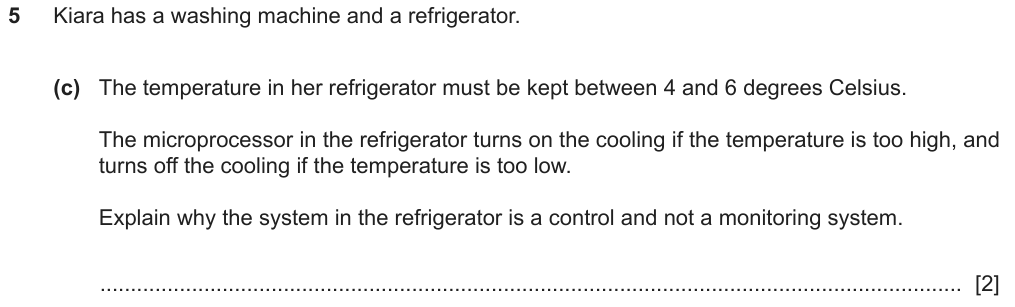
Don't repeat the question (“it turns the cooling off…”); name the features that make it control.
- (c)2 reasons
Does switching the cooling on change the next reading?
Yes: the temperature falls - that is feedback.
5 Now solve it have a go on paper first, then open the worked solution
- The system uses feedback B1
- The system causes the temperature to change // produces an action B1
The report: many answers only repeated the question ✓.
Example 2 · Bridge warning: sensors and system type (Paper 1, 4 marks) ★★ Medium
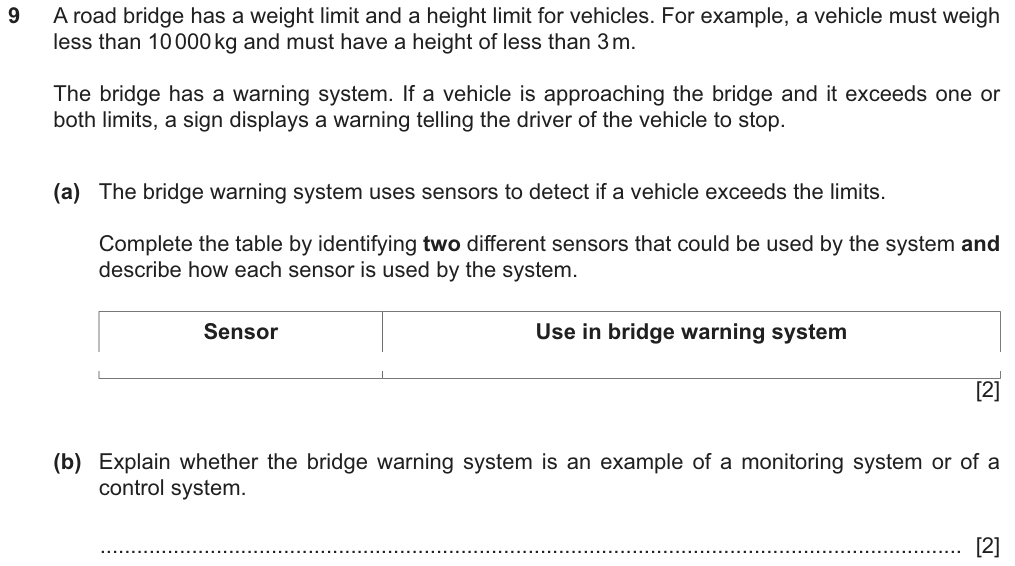
(b): does the sign change the vehicle's weight or height?
- (a)2 sensors + uses
- (b)justify
- (b)Monitoring
- Whysign is only a warning; no actuator; output doesn't change the input
5 Now solve it have a go on paper first, then open the worked solution
- (a) Infra-red: measure / check the height of the vehicle B1; pressure: measure / check the weight B1
- (b) Monitoring (no mark): no feedback - the warning sign is only an indicator B1; the output does not affect the input from the sensors // no actuators B1
✓
Example 3 · Automatic braking is a control system (Paper 1, 3 marks) ★★ Medium
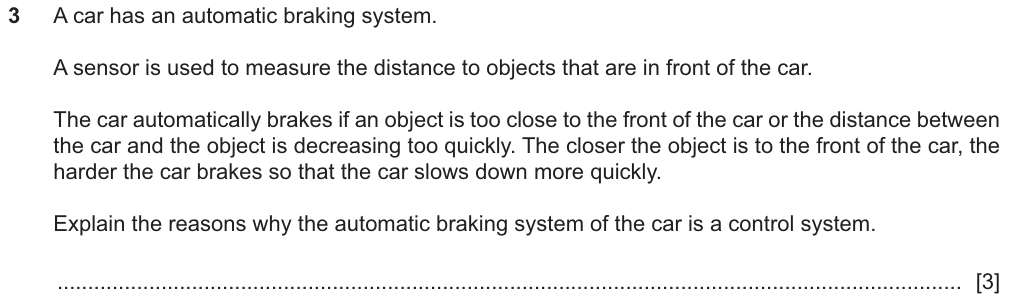
Show the loop: input → brake → new distance → input.
- Whole3 reasons
5 Now solve it have a go on paper first, then open the worked solution
- The system uses feedback and acts independently B1
- Input data causes the car to brake … braking changes the distance to the object B1
- … this new distance is used to decide whether / how hard to brake B1
✓
Example 4 · A counting sensor and a reject actuator (Paper 1, 3 marks) ★ Easy
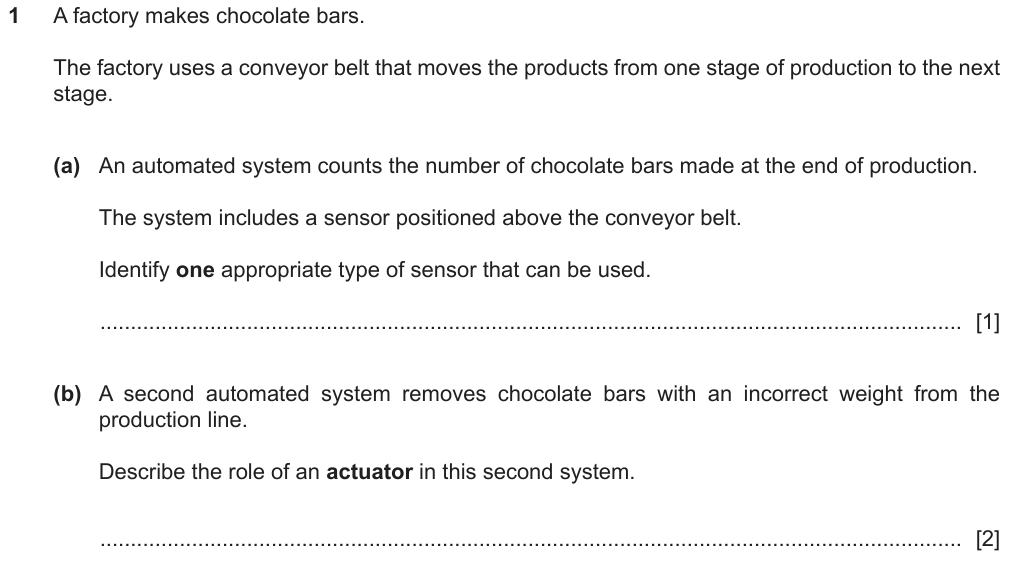
(b): what the actuator converts, and what physical job it does here.
- (a)sensor
- (b)actuator role
5 Now solve it have a go on paper first, then open the worked solution
- (a) infra-red / proximity B1
- (b) Actuator converts electrical energy / a signal into a mechanical force / causes an action B1 … to push an arm / open a trap door to remove the bar with the wrong weight B1
✓
Example 5 · Automatic doors (Paper 1, 3 marks) ★★ Medium
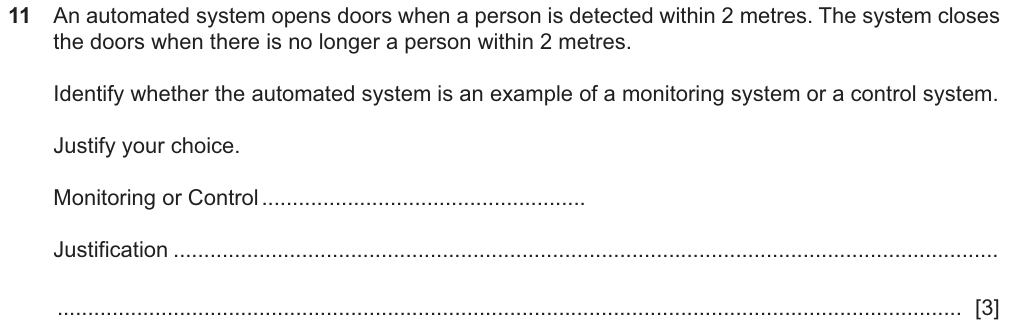
Opening the doors lets the person walk through, which changes what the sensor detects.
- Wholejustification
5 Now solve it have a go on paper first, then open the worked solution
- Control (no mark)
- Uses an actuator to open / close the doors B1
- Opening the doors lets people move, which changes the input to the sensor B1
- Acts autonomously on the feedback from the sensor B1
✓
Summary
- Monitoring: observes / warns; no actuators; output doesn't affect input. Control: acts on the environment through actuators; feedback.
- Feedback: output affects later input, keeping the system within set limits automatically.
- Sensors measure (temperature, pressure, infra-red, sound, light…); actuators turn signals into movement / action.
Can I do this?
- I can say whether a system is monitoring or control and justify it.
- I can explain feedback and the control loop.
- I can choose a sensor for a context and say what it detects; describe an actuator's role.
Anything unticked: revise that section first. All ticked: take the quiz.
Quiz
The multiple-choice and guided questions need JavaScript. The concept checks and exam practice below work without it.
Concept checks
Answer each one in your head first, then open it.
1Can a monitoring system have an alarm?Show answer
Yes: an alarm is an output that warns people, but it doesn't change what the sensor measures, so it is still monitoring.
2Why does a control system need an ADC?Show answer
Sensors produce analogue signals; the processor works with digital data.
Exam-style practice
New questions, not used above. Do them on paper, then mark your work against the official mark scheme.
Show the mark scheme
| Part | Answer / working | Marks | Guidance |
|---|---|---|---|
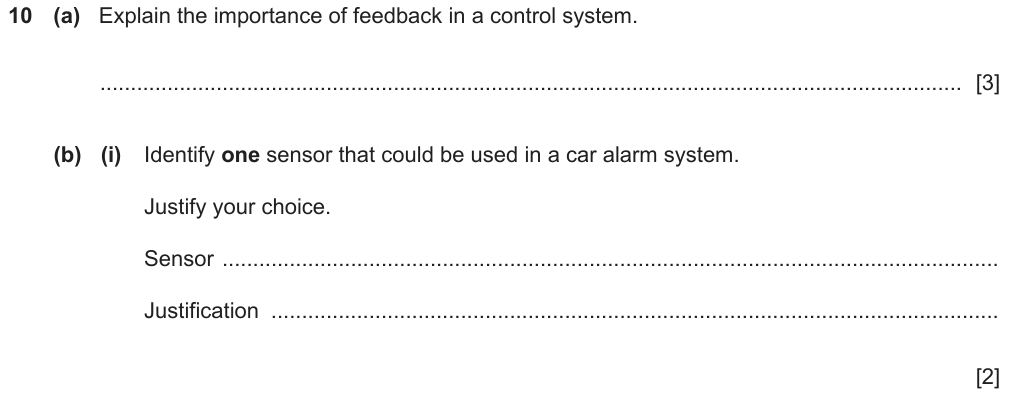
| (a) | To ensure the system operates within the given criteria | B1 | |
| … by enabling system output to affect subsequent system input | B1 | ||
| … thus allowing conditions to be automatically adjusted | B1 | ||
| (b)(i) | e.g. sound / infra-red / pressure sensor | B1 | |
| matching justification: a sound inside the car activates the alarm // senses the heat of a person / beams broken // an intruder sits in the driver's seat | B1 | ||
| Total: 5 marks | |||
Show the mark scheme
| Part | Answer / working | Marks | Guidance |
|---|---|---|---|
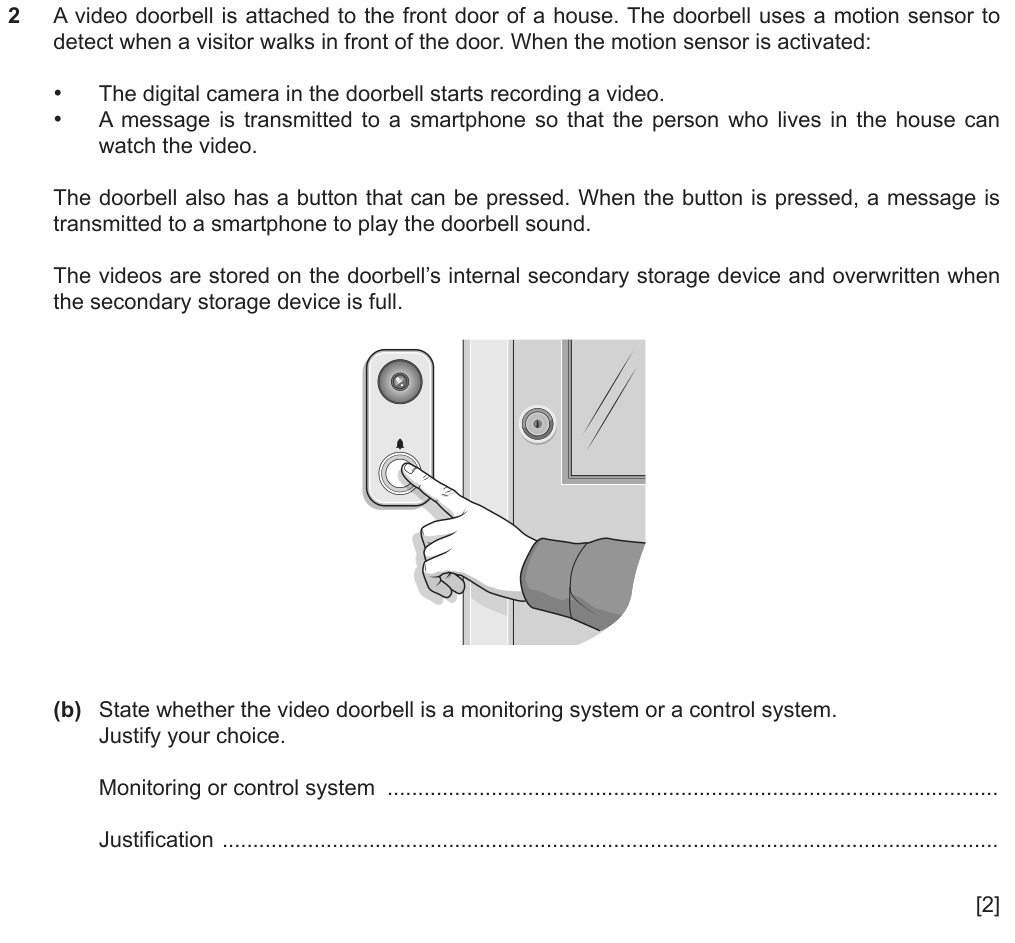
| (b) | No mark for the choice. Monitoring: turning on the camera / sending the video / ringing does not affect the input to the sensor / button | B2 | max 2 |
| or Control: the data is processed, generating a signal to start the camera recording // button / motion causes a signal to be sent to the smartphone | |||
| Total: 2 marks | |||
Show the mark scheme
| Part | Answer / working | Marks | Guidance |
|---|---|---|---|
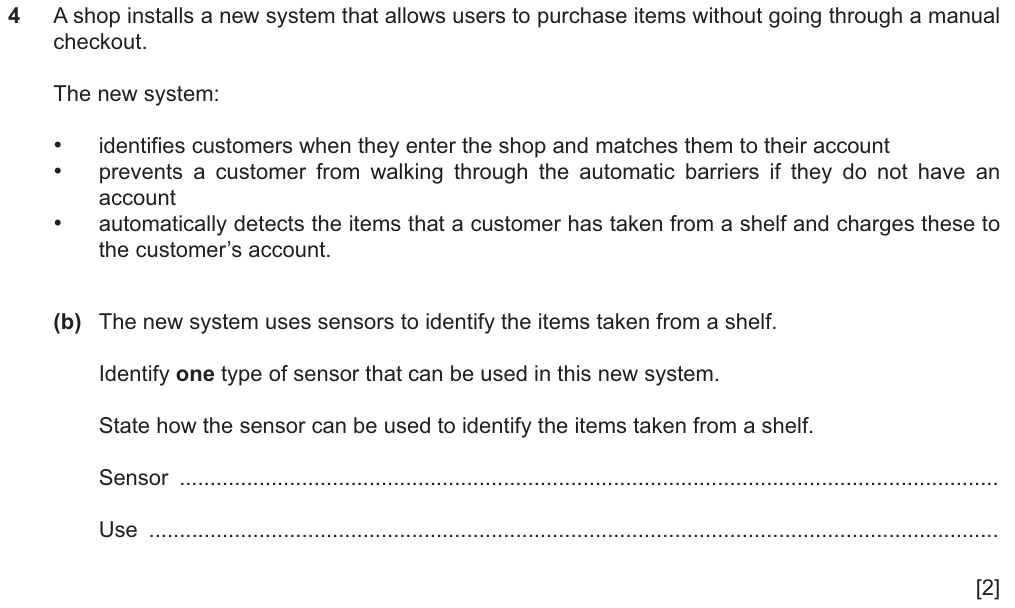
| (b) | Pressure | B1 | |
| Detects when the pressure of an item is removed from / put back on a shelf | B1 | or infra-red: beam broken when an item is removed / added | |
| Total: 2 marks | |||
Your progress on this note is saved when JavaScript is on.