
Hardware
Storage devices: magnetic, solid state, optical
What you need to be able to do
- 3.1Describe the principal operation of a magnetic hard disk, solid state (flash) memory and an optical disc reader / writer.
- 3.1Choose and justify a storage technology for a given use.
You need: Computer systems (secondary storage). Next: Memory: RAM and ROM.
Magnetic hard disk
- One or more platters coated with a material (ferrous oxide) that can be magnetised; both surfaces are used.
- The platters are mounted on a spindle and rotate at high speed (5400-15 000 rpm), inside a sealed case.
- Each surface has a read/write head on an arm, just above the surface; electronic circuits move the arm to the right track.
- The surface is divided into concentric tracks and sectors; one sector of one track is a block, the basic unit of storage.
- Writing: a varying current in the head produces a varying magnetic field that magnetises the surface in one of two directions (1 or 0).
- Reading: as the magnetised areas pass under the head, the changing magnetic field produces a changing current in the head, which is decoded as 1s and 0s.
Solid state (flash) memory
- Flash memory has no moving parts: data is stored as electric charge in cells built from transistors, arranged in a grid.
- The cells are built as NAND or NOR gates (NAND flash is used in SSDs and memory sticks).
- Each cell has two transistors / gates: the floating gate and the control gate.
- The floating gate traps electrons, so the cell keeps its value without power (non-volatile); whether charge is trapped there decides whether the cell holds 1 or 0.
- The control gate controls the flow of current: it allows or stops current passing through when the cell is read or written.
- Data is written and erased in blocks using a voltage; each cell survives only a limited number of write / erase cycles.
Optical disc reader / writer
- The disc is spun at high speed.
- A laser is shone onto the disc from an optical head that moves into position; data is on a single spiral track from the centre outwards.
- Writing: the laser burns pits into the recording layer to represent the data (the flat areas are lands).
- Reading: the laser reflects from the pits and lands; the reflection from a pit and a land is different (a light sensor detects it).
- The differences are interpreted as 1s and 0s.
Comparing and choosing storage
| Magnetic hard disk | Solid state (SSD / flash) | Optical disc | |
|---|---|---|---|
| Access speed | slower (moving head, rotation) | fastest (no moving parts) | slowest |
| Cost per unit of storage | lowest | higher | low per disc, small capacity |
| Capacity | very large | large | small (CD 700 MB, DVD 4.7 GB, Blu-ray 25-100 GB) |
| Durability | moving parts can be damaged by knocks | robust to knocks; but limited write cycles | scratches |
| Many continuous writes | long life span | cells wear out with constant writing | - |
| Power, noise, size | more power, noisy, heavier | low power, silent, small, light | - |
1 CCTV server
A server stores video from cameras that record all day. Magnetic or solid state? Give two reasons.
Askedchoice + reasonsKnowhuge files, constant writingRoutecost and life span
- Magnetic
- lower cost per unit of storage, so the very large capacity needed for many videos is cheaper
- a large number of read / write operations happens continuously, and magnetic storage has a longer life span than flash under constant writing
“Magnetic is cheaper” alone was not enough (June 2023): say cost per unit of storage.
2 A laptop
Why do most laptops now use an SSD?
AskedreasonsKnowportable, battery, speedRouteno moving parts
- faster access, so the laptop boots and loads programs quickly
- no moving parts: not damaged if the laptop is knocked; light, silent, low power for longer battery life
3 Distributing a film
Why might a film be sold on Blu-ray rather than on a hard disk?
AskedreasonsKnowmany cheap copiesRouteoptical
- optical discs are cheap to mass-produce and portable; the film only needs to be written once and read many times
Mark-scheme focus
Describe the principal operations of a magnetic hard disk (5 marks)
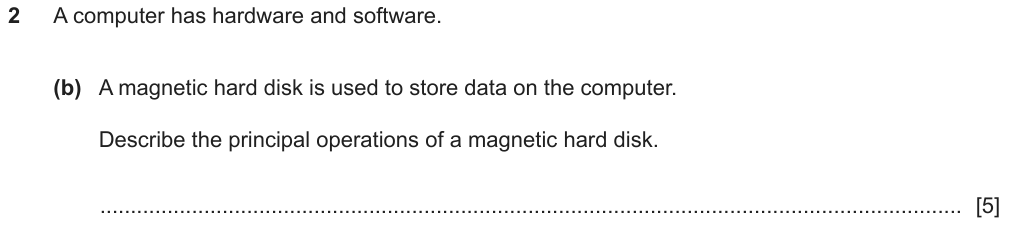
- any five: platters capable of being magnetised; on a spindle; sealed case; rotated at high speed; read/write head on an arm; circuits control the arm; tracks and sectors, a block;
- data as a magnetic pattern; writing: varying current in the head → varying magnetic field on the disk; reading: varying magnetic field → varying current in the head B5
- lasers, pits and lands (optical)
- fewer than five separate points for 5 marks
From: 9618/11/M/J/22 Q2(b)
Two reasons magnetic storage suits the CCTV computer better than solid state (4 marks)
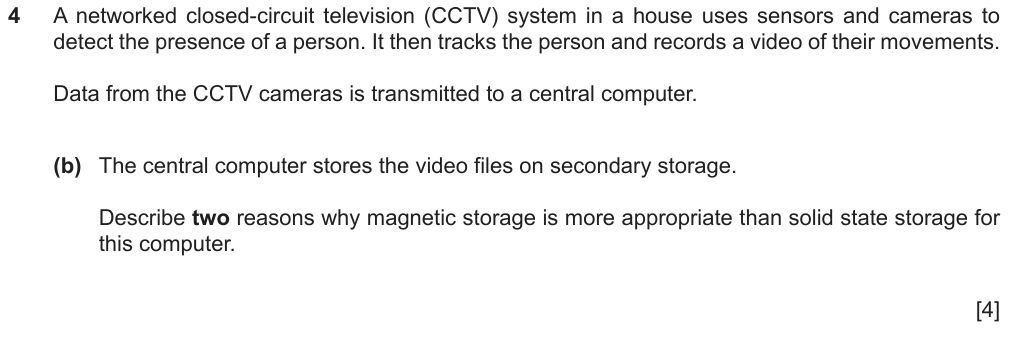
- The computer will have a large number of read/write operations because it works all the time B1 … magnetic storage has more longevity B1
- Magnetic storage costs less per storage unit B1 … videos are large files so a very large capacity is required B1
- “Magnetic storage is cheaper” (per what?)
- “SSDs can't be used for backup” (a misconception)
From: 9618/11/M/J/23 Q4(b)
- Storage device operation: hard disk (4-5), flash (4), optical (4), often as fill-in descriptions.
- Choosing: magnetic vs solid state with reasons applied to the system (4).
Worked examples
Example 1 · Complete the hard disk description (Paper 1, 4 marks) ★ Easy
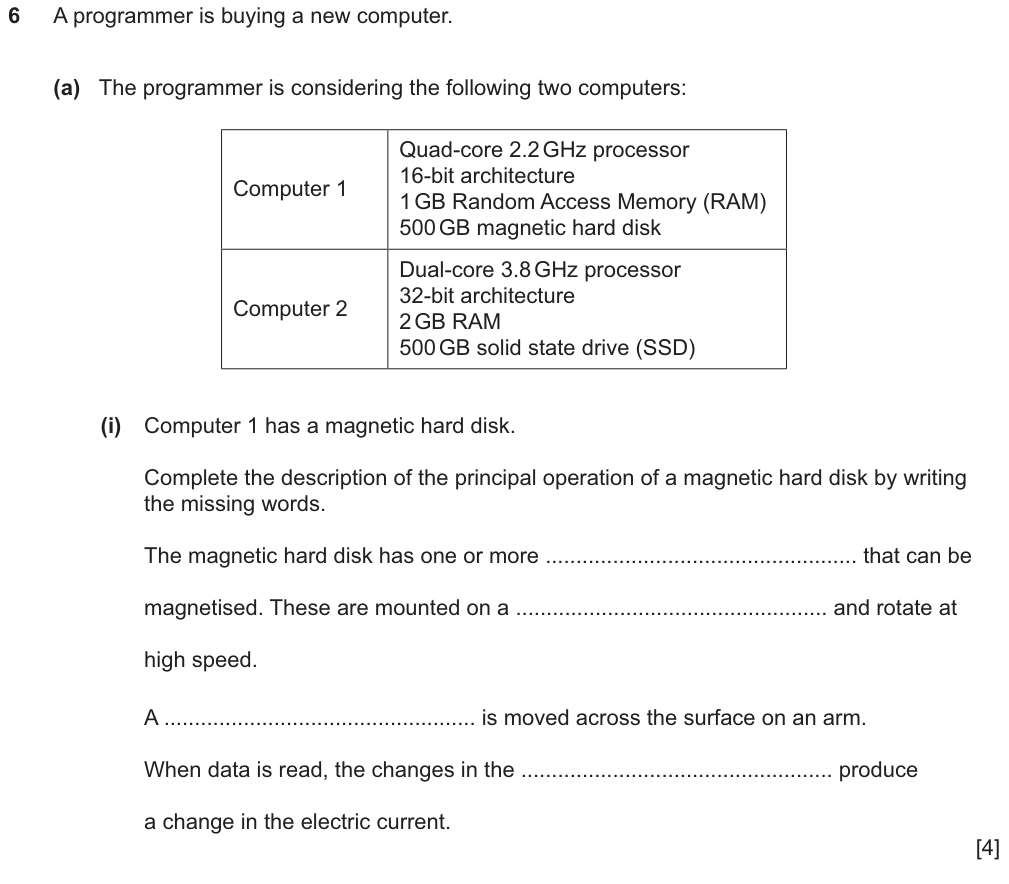
Four technical names in the order the parts appear.
- (a)(i)4 words
5 Now solve it have a go on paper first, then open the worked solution
- platters
- spindle
- read/write head
- magnetic field B4
✓
Example 2 · Inside a flash memory cell (Paper 1, 4 marks) ★★ Medium
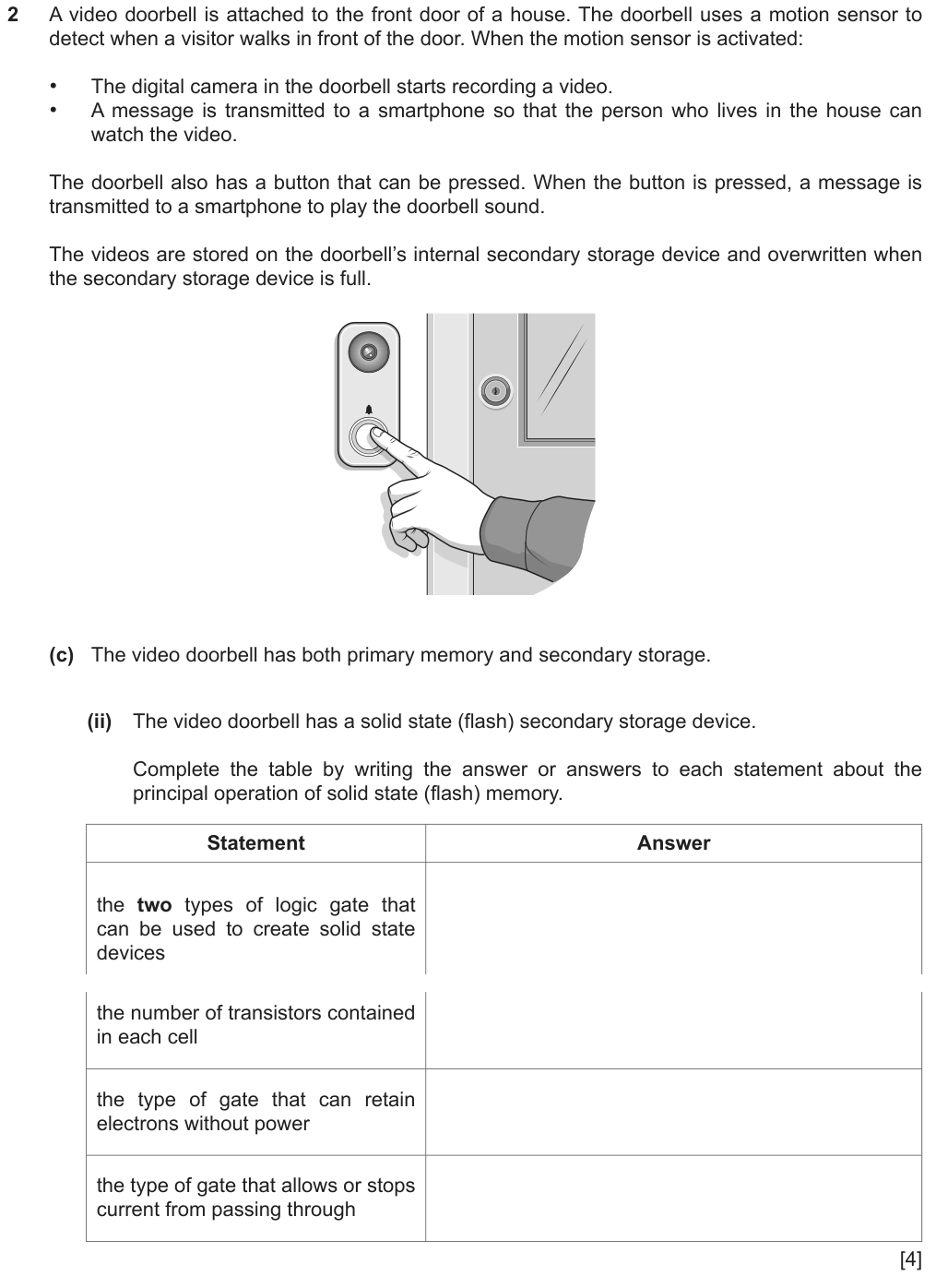
Recall the cell: built as NAND / NOR, two transistors (gates) per cell, one traps charge, one controls current.
- (c)(ii)4 rows
5 Now solve it have a go on paper first, then open the worked solution
- NAND and NOR
- 2
- floating gate
- control gate B4
✓
Example 3 · How an optical disc reader / writer works (Paper 1, 4 marks) ★ Easy
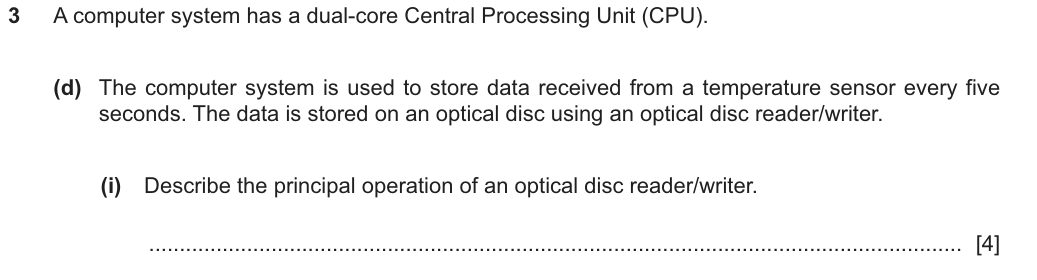
Spin, laser, track, write pits, read reflections.
- (d)(i)4 points
5 Now solve it have a go on paper first, then open the worked solution
- The disc is spun at high speed B1
- A laser is shone onto the disc, positioned by the optical head, following the spiral track from the centre outwards B1
- When writing, the laser burns pits to represent the data B1
- When reading, the reflection from pits and lands is different, interpreted as 1 or 0 B1
✓
Example 4 · Magnetic disks for a video server (Paper 1, 4 marks) ★★ Medium
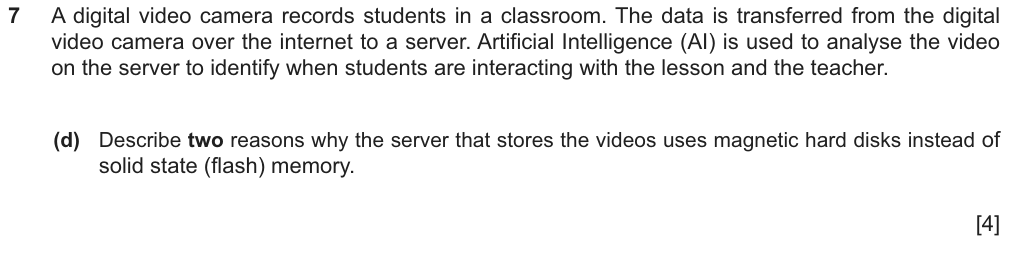
Two reasons, each with its justification in this system.
- (d)2 × (reason + justification)
5 Now solve it have a go on paper first, then open the worked solution
- Lower cost per unit of storage B1 … so the high capacity needed for a large number of video files is less costly B1
- A large number of read/write operations are performed continuously B1 … and magnetic storage is likely to have a longer life span than solid state B1
✓
Summary
- Hard disk: magnetised platters on a spindle, read/write head on an arm, tracks and sectors; current ↔ magnetic field.
- Flash: NAND / NOR cells, 2 transistors, floating gate traps electrons (non-volatile), control gate controls current; no moving parts.
- Optical: spinning disc, laser, spiral track; writing burns pits; reading detects different reflections from pits and lands.
- Choose: SSD for speed / portability / low power; magnetic for cheap huge capacity and constant writing; optical for cheap distribution.
Can I do this?
- I can describe how a magnetic hard disk reads and writes.
- I can describe how flash memory stores data.
- I can describe how an optical disc is written and read.
- I can choose and justify a storage technology for a use.
Anything unticked: revise that section first. All ticked: take the quiz.
Quiz
The multiple-choice and guided questions need JavaScript. The concept checks and exam practice below work without it.
Concept checks
Answer each one in your head first, then open it.
1Why is a hard disk slower than an SSD?Show answer
It must wait for the arm to move to the track and for the right sector to spin under the head; an SSD reads its cells electronically.
2Why do SSDs spread writes across all their cells (wear levelling)?Show answer
Each cell survives a limited number of write / erase cycles, so spreading writes stops any one area wearing out early.
Exam-style practice
New questions, not used above. Do them on paper, then mark your work against the official mark scheme.
Explain why solid state storage is used in a smartphone rather than a magnetic hard disk.
- [3]
Show the mark scheme
| Part | Answer / working | Marks | Guidance |
|---|---|---|---|
| No moving parts, so it is not damaged when the phone is dropped / carried | B1 | ||
| Small and light enough to fit in the phone | B1 | ||
| Low power consumption, so the battery lasts longer // fast access | B1 | ||
| Total: 3 marks | |||
Describe how data is written to and read from a magnetic hard disk.
- [4]
Show the mark scheme
| Part | Answer / working | Marks | Guidance |
|---|---|---|---|
| Platters rotate at high speed; the arm moves the read/write head to the correct track | B1 | ||
| Writing: a current in the head produces a magnetic field that magnetises an area of the surface | B1 | ||
| The direction of magnetisation represents 1 or 0 | B1 | ||
| Reading: the magnetised areas passing the head induce a current, decoded into 1s and 0s | B1 | ||
| Total: 4 marks | |||
Your progress on this note is saved when JavaScript is on.