
Physical quantities and units
Physical quantities and estimates
What you need to be able to do
- 1.1.1Say what every physical quantity is made of: a numerical magnitude and a unit.
- 1.1.2Make sensible estimates of quantities in the syllabus (masses, lengths, volumes, speeds, energies, wavelengths) and pick the right order of magnitude.
Before you start: standard form (\(3.0 \times 10^{8}\)) and the area/volume of rectangles, cylinders and spheres. This is the first page of the course. Next: SI units, prefixes and homogeneity.
What is a physical quantity?
A physical quantity is anything in physics that can be measured: a length, a mass, a time, a force, an energy. When you write one down you need two things, and only two:
Example: the weight of a bag is 7.0 N: magnitude 7.0, unit N (newton).
Why both? "7.0" on its own could be 7.0 N, 7.0 kg or 7.0 seconds. "Newton" on its own doesn't tell you how big. Only the pair is a measurement.
| You see | Physical quantity? | Why |
|---|---|---|
| 7.0 N | Yes | a magnitude and a unit |
| 25 km h−1 | Yes | The unit does not have to be SI, and it does not have to be in base units. |
| 3.0 | No | a number with no unit |
| kilogram | No | a unit with no number |
| 40% | No | a percentage is a number, not a measurement with a unit |
| spring constant | Yes (as a quantity) | It has a magnitude and a unit (N m−1). In 9702/11/M/J/22 Q1 it was the right answer, while "metre" (a unit) and "percentage uncertainty" were not. |
Some quantities are ratios of two quantities with the same unit, such as efficiency or strain, so they have no unit (9702/11/M/J/24 Q18: "Efficiency does not have a unit"). You will not be asked to argue about these. In a "which is a physical quantity?" question, pick the option with a number and a unit.
Standard form and orders of magnitude
Physics deals with numbers from \(10^{-31}\) kg (an electron) to \(10^{30}\) kg (the Sun), so we write them in standard form: a number between 1 and 10 multiplied by a power of ten.
\[ 0.000\,0125\ \text{m} = 1.25 \times 10^{-5}\ \text{m} \qquad 384\,000\,000\ \text{m} = 3.84 \times 10^{8}\ \text{m} \]
In Paper 1 the options of an estimate question are usually 10 to 100 times apart, so you only need the right power of ten, not the exact number. Strictly, a value above about \(3 \times 10^{n}\) is nearer to \(10^{n+1}\) (because \(\sqrt{10} \approx 3.2\)), but don't agonise: pick the option closest to your estimate.
Estimates: the values you should carry in your head
An estimate is a calculation made from sensible rough values. Examiners expect you to know a small set of everyday and physics values. These are the ones that keep coming up in Cambridge questions: learn them.
| Quantity | Rough value |
|---|---|
| Diameter of an atom | \(10^{-10}\) m (so atom volume ≈ \(10^{-30}\) m³) |
| Diameter of a nucleus | \(10^{-14}\) m |
| Wavelength of visible light | 400–700 nm (≈ \(5 \times 10^{-7}\) m); frequency about \(10^{14}\) Hz |
| Wavelength of ultraviolet | \(10^{-8}\) to \(4 \times 10^{-7}\) m |
| Wavelength of microwaves / X-rays | \(10^{-2}\) m / \(10^{-10}\) m |
| Thickness of a sheet of paper | about 0.1 mm (0.05–0.15 mm) |
| Mass of an adult | 60–80 kg, so weight ≈ \(7 \times 10^{2}\) N |
| Volume of an adult | about 0.1 m³ |
| Density of water | 1000 kg m−3 (1 g cm−3); metals 3000–10 000 kg m−3 |
| Mass of a new pencil | 1–20 g |
| Weight of an apple | about 1 N |
| Mass of a raindrop | about \(10^{-5}\) kg |
| Speed of an adult running / a sprinter | about 5 m s−1 / about 10 m s−1 |
| Speed of sound in air | about 330 m s−1 (100 m takes 0.25–0.5 s) |
| Young modulus of a metal | about \(10^{11}\) Pa |
| Resistivity of copper | about \(10^{-8}\) Ω m |
| Body temperature | 310 K (order \(10^{2}\) K, not \(10^{1}\)) |
How to estimate anything in four moves
- Break it into things you know. "Atoms in a phone" = (volume of the phone) ÷ (volume of one atom).
- Pick round values, in SI units. A phone is about 15 cm × 7 cm × 1 cm ≈ 100 cm³ = \(1 \times 10^{-4}\) m³.
- Calculate, keeping the powers of ten. \(\dfrac{10^{-4}}{10^{-30}} = 10^{26}\).
- Check it makes sense and pick the nearest option. 9702/14/M/J/25 Q1 offered \(10^{17}, 10^{26}, 10^{32}, 10^{37}\): the answer is \(10^{26}\).
Methods: two ways to the same estimate
Most estimates can be done two ways. Doing both is a quick check. Here is the same question done both ways. The examiner report for June 2021 shows both methods.

Method A: shape model
Treat the person as a box: height 1.6 m, width 0.4 m, depth 0.2 m.
\[ V \approx 1.6 \times 0.4 \times 0.2 = 0.128\ \text{m}^3 \approx 0.1\ \text{m}^3 \]
Best when the object has an obvious shape (box, cylinder, sphere) and you can guess its size.
Method B: mass ÷ density
A body is mostly water, so its density is about 1000 kg m−3. An adult's mass is about 80 kg.
\[ V = \frac{m}{\rho} \approx \frac{80}{1000} = 0.08\ \text{m}^3 \approx 0.1\ \text{m}^3 \]
Best when you know the mass better than the size (people, cars, rocks).
Both methods land near 0.1 m³ and far from 0.5, 1.0 and 2.0 m³, so the answer is A. When two methods agree to within a factor of 2 or 3, you can trust the order of magnitude.
Mark-scheme focus
What all physical quantities have
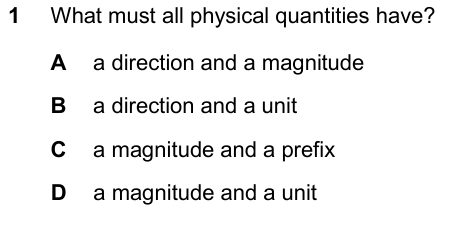
"a numerical magnitude and a unit"
- "a magnitude and a direction"
- "an SI unit and a magnitude"
- "a base unit and a number"
- "a number in standard form and a unit"
Direction belongs to vectors only. 25 km h−1 is a perfectly good physical quantity, so neither "SI" nor "base unit" is required, and 7.0 N needs no standard form. The June 2023 examiner report says some candidates thought a physical quantity must include an SI unit, or a unit in base units.
"a unit and a number" (9702/11/O/N/21 Q1, option B). "Magnitude" and "unit" are also the two properties shared by every scalar and vector (9702/23/M/J/21 Q1(a)(ii): B1 + B1).
From: 9702/12/M/J/25 Q1, 9702/14/O/N/25 Q1, 9702/11/O/N/22 Q1, 9702/13/M/J/23 Q1 and their examiner reports.
Written estimates on Paper 2
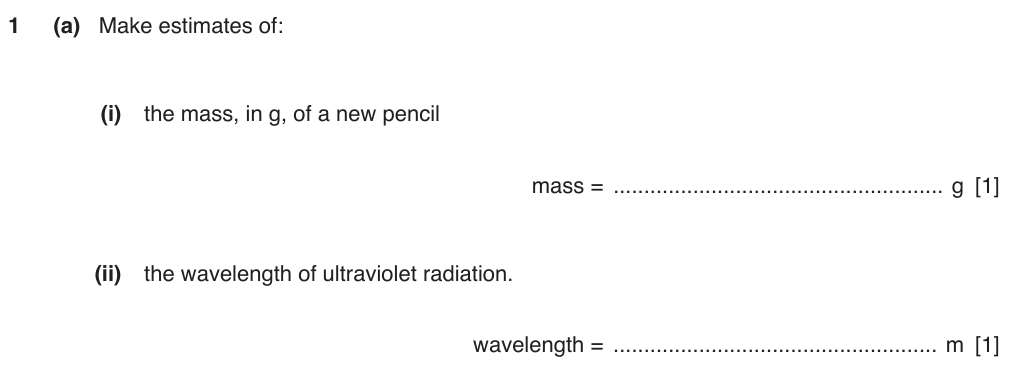
Any value inside the mark scheme's range, with the unit the question asks for. E.g. a new pencil: 1–20 g. Ultraviolet wavelength: \(1\times10^{-8}\) to \(4\times10^{-7}\) m.
A value outside the range, usually from a power-of-ten slip (cm³ ↔ m³, g ↔ kg) or radius/diameter confusion. A value in the wrong unit when the answer line says "g".
The scheme marks one fact: is the number sensible? There is no credit for working, so a slip anywhere gives 0.
Any number of significant figures ("ignore number of significant figures", 9702/23/O/N/10 Q1 mark scheme).
From: 9702/21/O/N/19 Q1(a), 9702/21/M/J/16 Q1(a), 9702/23/O/N/10 Q1.
Command words you meet here
| Command word | What it wants | Example |
|---|---|---|
| Estimate | A sensible value from rough figures and simple working. One number, with its unit. | "Estimate the mass, in g, of a new pencil." → 5 g |
| State | A short answer, no explanation. | "State what all physical quantities have." → a magnitude and a unit |
| Calculate | A numerical answer with working shown. | "Calculate the time for light to travel 150 m and back." → 1.0 μs |
- "What is / must every physical quantity have?" Paper 1, 1 mark. It appeared about 10 times in the 2021–2025 papers, often as Q1.
- Order-of-magnitude estimates: about 30 Paper 1 questions in 2010–2025 (atoms in an object, weight or volume of a person, kinetic energy of a vehicle, mass of a sphere, volume of a page).
- Written estimates on Paper 2: 1 mark each, marked against a range (2010, 2016, 2019).
Worked examples
Example 1 · Counting atoms (Paper 1, 1 mark)

We have a lump of metal of 50 cm³ and need roughly how many atoms are in it. Nothing else is given - we must bring our own estimate of how big an atom is.
- best estimatethe order of magnitude matters, not exact digits - the options differ by powers of ten
- 50 cm³convert to m³: 1 cm³ = 10−6 m³ (cube the prefix too)
- atomsyou need to KNOW an atom's size: diameter ≈ 10−10 m
- number of atoms
- V = 50 cm³ = 5.0 × 10⁻⁵ m³metal
- d ≈ 1 × 10⁻¹⁰ matom - from memory
- FindN
- UseN = total volume ÷ volume of one atom
- Total50 cm³ → m³
- One atom≈ d³ = (10−10)³ = 10−30 m³
- Trapcm³ → m³ is × 10−6, not × 10−2
- UseN = total volume ÷ volume of one atom
How big is an atom? You have to know this one.
About 10−10 m across (0.1 nm). It's one of the sizes worth learning for estimates.
Is there a second way to check?
Yes - mass ÷ mass of one atom. 0.4 kg of metal ÷ about 10−25 kg per atom also gives around 1025.
5 Now solve it have a go on paper first, then open the worked solution
- Convert the volume: \(50\ \text{cm}^3 = 50 \times (10^{-2})^3\ \text{m}^3 = 5.0 \times 10^{-5}\ \text{m}^3\). 1 cm = \(10^{-2}\) m, so 1 cm³ = \(10^{-6}\) m³. Cube the prefix as well as the number.
- Volume of one atom: diameter ≈ \(1.0\times10^{-10}\) m, so volume ≈ \((10^{-10})^3 = 1.0 \times 10^{-30}\ \text{m}^3\). Treating the atom as a little cube of side equal to its diameter is fine for an estimate.
- Divide: \(\dfrac{5.0\times10^{-5}}{1.0\times10^{-30}} = 5.0 \times 10^{25}\). 1 mark: B
\(N = \dfrac{50\times10^{-6}}{(1.0\times10^{-10})^3} = 5\times10^{25}\) → B
Mass ÷ mass of one atom. A metal of density about 8000 kg m−3 gives \(m = 8000 \times 5\times10^{-5} = 0.4\) kg. One atom of about 60 u has mass \(60 \times 1.66\times10^{-27} \approx 1\times10^{-25}\) kg. So \(N \approx 0.4 / 10^{-25} = 4\times10^{24}\). That is within a factor of about 10 of B and more than \(10^{5}\) times away from every other option, so it confirms B. (Real atoms are a little bigger than \(10^{-10}\) m, which is why this method gives a slightly smaller number.)
Option A would mean each atom is about 0.2 μm across, which is the size of a virus. Far too big for an atom.
Example 2 · Written estimates (Paper 2, 2 marks)
Two quick estimates: the mass of a new pencil (in grams), and the wavelength of ultraviolet light. No data - we build each from things we know.
- Make estimatesa sensible value in a range earns the mark; show a quick reason if you like
- in gthe answer line wants grams - give it in grams
- ultravioletjust beyond violet (400 nm) at SHORTER wavelengths
- (i)mass of a pencil
- (ii)wavelength of UV
- pencil ≈ 18 cm × 0.7 cmfrom experience
- wood ≈ 0.6 g cm−3it floats
- violet = 400 nmedge of visible
- (i) Estimatepencil mass
- Usem = density × volume of a cylinder πr²l
- Traphalve the diameter
- Usem = density × volume of a cylinder πr²l
- (ii) EstimateUV wavelength
- Useshorter than violet's 4 × 10⁻⁷ m → about 10−7 m
Which way from violet is ultraviolet - longer or shorter wavelength?
Shorter. 'Ultra' violet is beyond violet, towards X-rays.
What could you compare a pencil's mass with?
A paper clip (about 1 g) and an apple (about 100 g). A pencil is much nearer the paper clip.
5 Now solve it have a go on paper first, then open the worked solution
- (i) A pencil is about 18 cm long and 0.7 cm across: \(V = \pi r^2 l = \pi \times 0.35^2 \times 18 \approx 7\ \text{cm}^3\). Remember to halve the diameter.
- Wood is a little less dense than water (it floats): about 0.6 g cm−3. So \(m \approx 0.6 \times 7 \approx 4\) g. Write mass = 5 g. A1 The scheme accepts 1–20 g, so any sensible value earns the mark.
- (ii) Violet light is 400 nm = \(4\times10^{-7}\) m. Ultraviolet is shorter, so wavelength = \(1 \times 10^{-7}\) m. A1 The scheme accepts \(1\times10^{-8}\) to \(4\times10^{-7}\) m. The examiner report says many candidates gave a value that was too long.
(i) mass = 5 g (ii) wavelength = \(1 \times 10^{-7}\) m
A pencil feels much lighter than a 100 g apple but heavier than a 1 g paper clip, so 5 g is believable.
Example 3 · Two estimates from one question (Paper 2, multi-part)
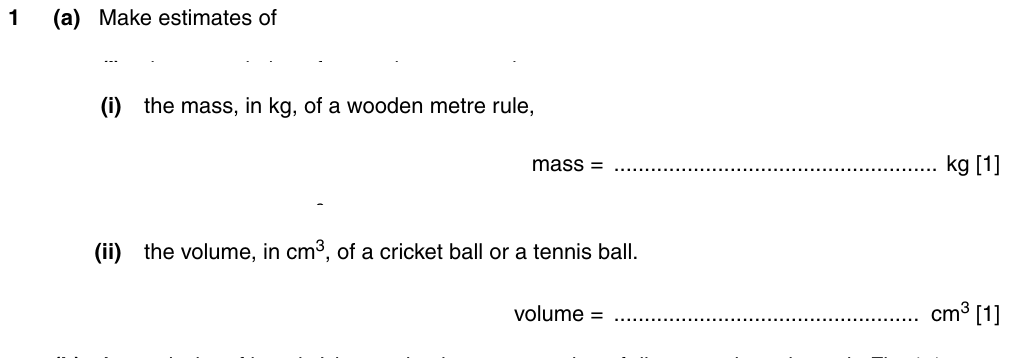
Two more estimates: the mass of a wooden metre rule (in kg) and the volume of a tennis or cricket ball (in cm³). Each needs a volume from rough dimensions.
- in kgwork in g if easier, but convert before writing on the answer line
- volume, in cm³estimate the radius, then 4/3 πr³ - better than guessing
- (i)mass of a metre rule
- (ii)volume of a ball
- rule ≈ 100 × 2.5 × 0.6 cmdimensions
- wood ≈ 0.7 g cm−3
- tennis ball ≈ 6.5 cm across
- (i) Estimatemass
- Usedensity × (length × width × thickness)
- Unitsg → kg on the answer line
- Usedensity × (length × width × thickness)
- (ii) Estimatevolume
- Use4/3 πr³ with r ≈ 3.3 cm
Why is a calculated estimate better than a pure guess?
Guesses for volumes are often out by a factor of 10. A rough radius and a formula keep you in the accepted range.
The rule comes out as 105 g. What goes on the line that says 'kg'?
0.1 kg. Writing 105 with kg on the line loses the mark.
5 Now solve it have a go on paper first, then open the worked solution
- (i) A metre rule is 100 cm × 2.5 cm × 0.6 cm = 150 cm³. With wood at about 0.7 g cm−3, \(m \approx 105\) g.
- Convert to the unit on the answer line: 105 g ≈ 0.1 kg. B1 The scheme accepts 0.05–0.2 kg. Leaving the answer as "105" with the line saying kg loses the mark.
- (ii) A tennis ball is about 6.5 cm across, so \(r \approx 3.3\) cm. \(V = \tfrac{4}{3}\pi r^3 = \tfrac{4}{3}\pi (3.3)^3 \approx 150\ \text{cm}^3\). B1 The scheme accepts 50–300 cm³.
(i) mass = 0.1 kg (ii) volume = 150 cm³
For (ii), a tennis ball floats with most of it above water, so its average density is low. That doesn't help you get the volume, so use the radius method.
150 cm³ is about the volume of a small cup of tea, roughly the size of a tennis ball.
Summary
- Every physical quantity = numerical magnitude × unit. Not SI, not base, not direction.
- Order of magnitude = the nearest power of ten. Estimates only need to be right within a factor of a few.
- Estimate by breaking the problem into known values, working in SI units and keeping the powers of ten.
| If you see… | Do this |
|---|---|
| "Which is a physical quantity?" | Pick the option with a number and a unit. |
| "Number of atoms in…" | Volume (m³) ÷ \(10^{-30}\) m³, or mass ÷ (A × \(1.66\times10^{-27}\) kg). |
| "Reasonable estimate of the weight/volume of a person" | m ≈ 70 kg → W ≈ 700 N; V ≈ m/1000 ≈ 0.07–0.1 m³. |
| "Order of magnitude of the kinetic energy of…" | Convert the speed to m s−1 first, then ½mv². |
| "Estimate, in g / cm³ / kg…" | Answer in exactly that unit. |
Can I do this?
- I can state that every physical quantity has a numerical magnitude and a unit.
- I can say why "3.0", "kilogram" and "40%" are not physical quantities.
- I know that "SI unit", "base unit" and "direction" are NOT required for every quantity.
- I can write a value in standard form and give its order of magnitude.
- I can recall the benchmark values in the table (atom, nucleus, light, adult, water…).
- I can estimate a quantity in four moves, working in SI units.
- I can estimate the same thing two ways (shape model, mass ÷ density) to check.
- I give a written estimate in the unit on the answer line.
Quiz
The multiple-choice and guided questions need JavaScript. The concept checks and exam practice below work without it.
Concept checks
Why can't "metre" be the answer to "which term represents a physical quantity?"
A metre is a unit. A physical quantity needs a magnitude too (e.g. 2.5 m), or must be a measurable thing that has both, such as the spring constant.
Two students estimate the volume of a person: one gets 0.13 m³, the other 0.08 m³. Who is right?
Both. Estimates only need the right order of magnitude. Both are about 0.1 m³ and both rule out 0.5, 1.0 and 2.0 m³.
What if you used the radius of an atom (\(0.5\times10^{-10}\) m) as its size when counting atoms?
The atom's volume would come out 8 times smaller (\(0.5^3 = 1/8\)), so you'd count 8 times more atoms. That is still the same order of magnitude here, but in a "number of layers" question (gold leaf, 9702/12/M/J/18 Q1) using the radius instead of the diameter gives the wrong option (D instead of C).
Why is "a direction" not something all physical quantities have?
Only vectors (force, velocity…) have a direction. Mass, time and energy are scalars and have none. See Scalars and vectors.
Exam-style practice
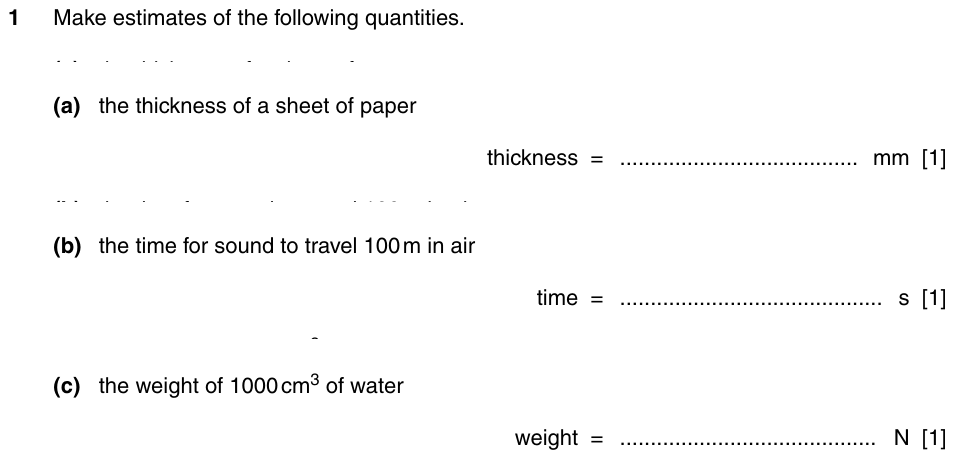
Answers and mark scheme
- (a) 0.1 mm. B1 for 0.05 mm to 0.15 mm.
- (b) \(t = 100/330 \approx 0.3\) s. B1 for 0.25 s to 0.5 s.
- (c) 1000 cm³ of water has mass 1 kg, so W = 1 × 9.81 ≈ 10 N. B1 for 8 N to 12 N.
Significant figures are ignored on this question.
Estimate the kinetic energy of an adult sprinter running a 100 m race. Show your working.
Answer and marks
- Rough values: m ≈ 80 kg, v ≈ 10 m s−1. C1
- \(E_k = \tfrac12 \times 80 \times 10^2 = 4000\ \text{J}\). A1 (any value from about 2000 J to 5000 J)
The June 2021 examiner report (9702/13 Q1) notes candidates estimating an athlete's kinetic energy as 400 J instead of 4000 J. Check your powers of ten.
Your progress on this note is saved when JavaScript is on.