
Physical quantities and units
Scalars and vectors
What you need to be able to do
- 1.4.1Understand the difference between scalar and vector quantities and give examples of each from the syllabus.
- 1.4.2Add and subtract coplanar vectors.
- 1.4.3Represent a vector as two perpendicular components.
Before you start: Physical quantities; right-angled trigonometry (SOH CAH TOA) and Pythagoras' theorem. The syllabus also expects the cosine rule \(a^2 = b^2 + c^2 - 2bc\cos A\) and the sine rule (Mathematical requirements). Next chapter: Kinematics, where every velocity and acceleration is a vector.
Scalars and vectors
A vector quantity has magnitude and direction.
Both have a magnitude (size) and a unit: those are what every physical quantity has. The only thing a vector has that a scalar doesn't is direction. "1 N upwards" is a vector; "2 kg", "3 K cooler" and "4 s later" are scalars 9702/13/M/J/25 Q1.
| Scalars | Vectors |
|---|---|
| distance, speed | displacement, velocity |
| mass, time, volume, density | acceleration (including the acceleration of free fall, g) |
| work, energy, power | force, weight, upthrust, tension, friction, drag |
| temperature, charge, current*, potential difference, resistance | momentum, impulse |
| pressure, stress | electric field strength |
* In this course current is treated as a scalar. Bold = the ones candidates most often get wrong, according to the examiner reports: power and work called vectors (March 2017, March 2018, June 2018, June 2021); upthrust called a scalar (November 2023); weight confused with mass (November 2018).
Adding vectors
A vector is drawn as an arrow: its length shows the magnitude (to a scale) and it points in the direction. To add vectors, take direction into account. 3 N + 4 N can be anything from 1 N to 7 N.
Tip-to-tail (vector triangle)
- Draw the first vector to scale.
- Draw the second vector starting at the tip of the first.
- The resultant goes from the tail of the first to the tip of the last.
The parallelogram method gives the same answer: draw both from one point and the resultant is the diagonal.
| Angle between the vectors | Magnitude of R | Direction |
|---|---|---|
| 0° (same direction) | \(R = A + B\) | the common direction |
| 180° (opposite) | \(R = |A - B|\) | direction of the larger |
| 90° | \(R = \sqrt{A^2 + B^2}\) | \(\tan\phi = B/A\) (angle from A) |
| any other angle θ | \(R^2 = A^2 + B^2 - 2AB\cos(180^\circ - \theta)\), or components | sine rule, or \(\tan^{-1}(\Sigma y / \Sigma x)\) |
In the cosine rule the angle is the one inside the triangle, opposite R. If the vectors make angle θ tail to tail, the triangle's angle is \(180^\circ - \theta\).
Subtracting vectors
The most important case is a change in velocity: \(\Delta\mathbf{v} = \mathbf{v}_{\text{final}} - \mathbf{v}_{\text{initial}}\). Reverse the initial velocity, then add it tip-to-tail to the final one. The June 2022 report: over half of candidates drew the sum of the two velocities instead 9702/12/M/J/22 Q4.
Rearranging works like algebra: if \(\mathbf{X} = \mathbf{Y} - \mathbf{Z}\) then \(\mathbf{Z} = \mathbf{Y} - \mathbf{X}\) (June 2023 report, 9702/13/M/J/23 Q4).
Resolving into perpendicular components
Any vector can be replaced by two perpendicular vectors that add up to it, usually horizontal and vertical, or along and across a slope.
The component next to (adjacent to) the angle uses cos; the component opposite it uses sin. If θ is measured from the vertical, the vertical component is \(F\cos\theta\).
Adding by components works for any number of vectors: resolve each one, add all the x-components (Σx) and all the y-components (Σy), then \(R = \sqrt{(\Sigma x)^2 + (\Sigma y)^2}\). For an object in equilibrium, Σx = 0 and Σy = 0, which is the same as saying the vector triangle (or polygon) of the forces is closed.
Methods: three ways to the same resultant
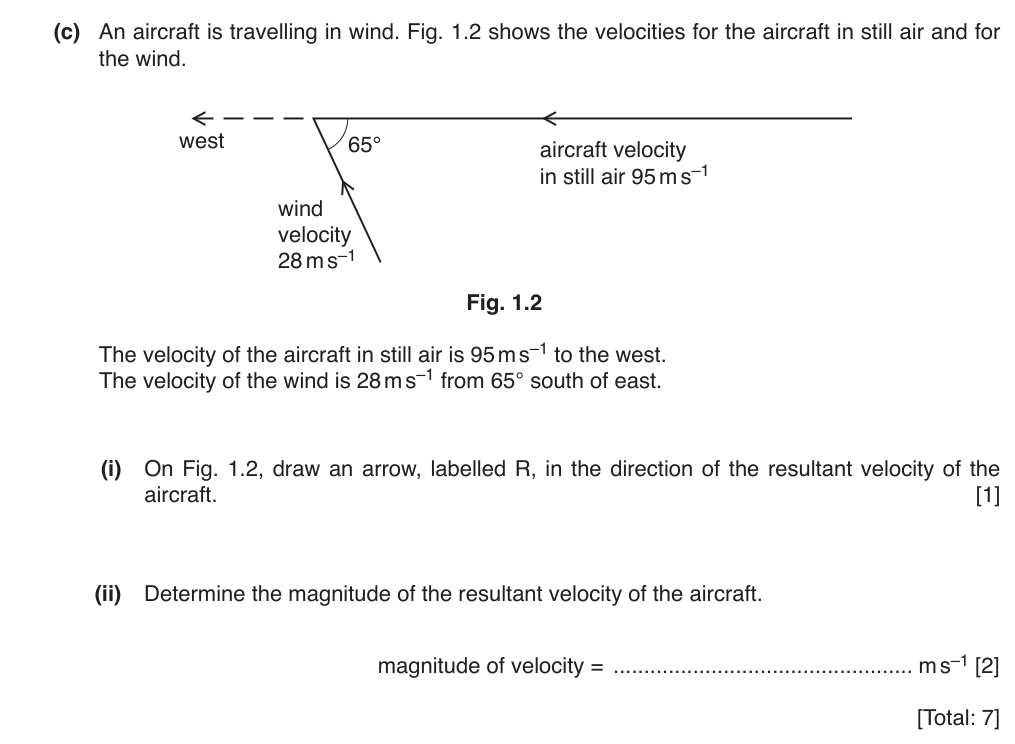
A wind from 65° south of east blows towards 65° north of west. So the two velocities, drawn tail to tail, make 65°. In a tip-to-tail triangle the angle between them is 180° − 65° = 115°.
Method A: scale drawing
- Choose a scale that makes the drawing big (at least half the space): 1 cm : 10 m s⁻¹. Write the scale down.
- Draw the first vector to scale with its arrow: the aircraft, 9.5 cm pointing west.
- From its tip, draw the second vector to scale in its own direction: the wind, 2.8 cm at 65° north of west (use a protractor on the west line).
- Draw the resultant from the start of the first arrow to the tip of the second. Label it R and give it an arrow.
- Measure and convert: R is about 11.0 cm → 11.0 × 10 = 110 m s⁻¹. Measure the angle at the start: about 13° north of west.
Best when the question says "by scale drawing" or gives a grid. The scheme allows 108–112 m s⁻¹, and gives a mark for the triangle itself. The June 2017 report: scale drawings were often too small, with no scale and no arrows.
Method B: cosine rule
- Sketch the tip-to-tail triangle (no need for scale): 95 west, then 28 at 65° north of west, then R joining start to end.
- Find the angle inside the triangle between the two vectors. The wind turns 65° away from west, so the angle between the arrows where they meet is 180° − 65° = 115°.
- Write the cosine rule with that angle: \(R^2 = a^2 + b^2 - 2ab\cos C\).
- Substitute: \(R^2 = 95^2 + 28^2 - 2(95)(28)\cos 115^\circ = 9025 + 784 + 2248 = 12\,057\).
- Square root: \(R = 109.8 \approx\) 110 m s⁻¹.
- Direction (if asked), sine rule: \(\sin\alpha = \dfrac{28 \sin 115^\circ}{109.8}\) → α = 13° north of west.
Best when you have exactly two vectors and know the angle between them. Use the triangle's angle (115°). With 65° you get 87 m s⁻¹, which is wrong.
Method C: components
- Work out which way the wind points. "From 65° south of east" means it comes from there and blows towards the opposite direction: 65° north of west. Draw it starting along west and turned 65° towards north.
- Choose two perpendicular directions: west and north (the aircraft already points west).
- Resolve the wind. The 65° is measured from the west line, so the west component is next to the angle (cos) and the north component is opposite it (sin): west \(28\cos 65^\circ = 11.8\) m s⁻¹; north \(28\sin 65^\circ = 25.4\) m s⁻¹. From the sketch both point west and north, so both are positive.
- Now forget the slanted wind arrow: its two components replace it. The aircraft is 95 west and 0 north.
- Add each direction separately. West: 95 + 11.8 = 106.8 m s⁻¹. North: 0 + 25.4 = 25.4 m s⁻¹.
- Pythagoras for the size (the two totals are at right angles): \(R = \sqrt{106.8^2 + 25.4^2} = 109.8 \approx\) 110 m s⁻¹.
- tan for the direction, measured from west: \(\tan^{-1}\dfrac{\text{north}}{\text{west}} = \tan^{-1}\dfrac{25.4}{106.8} =\) 13° north of west.
Best when there are three or more vectors, or you also need the direction. The direction mark wanted 5° to 20° north of west.
All three give 110 m s⁻¹. The mark scheme lists the cosine rule, components and scale drawing as equally acceptable.
Graphs: components against angle
F cos θ (the component next to the angle) starts at F and falls to 0 at 90°: slowly at first, then faster.
F sin θ (the component opposite the angle) starts at 0 and rises to F at 90°: quickly at first, then more slowly.
At 45° the two are equal, \(F/\sqrt2 \approx 0.71F\) each. However θ changes, \((F\cos\theta)^2 + (F\sin\theta)^2 = F^2\).
Try it
Vector adder
Teaching point: tip-to-tail, parallelogram and components all give the same resultant, and subtracting means adding the reversed vector. It starts on the aircraft question above. Directions are measured anticlockwise from east.
Turn on JavaScript to drag the sizes and directions and step through each method. The aircraft triangle above is the static version.
Resolving a force
Teaching point: the component next to the angle is F cos θ, the one opposite is F sin θ, and together they rebuild F.
Turn on JavaScript to change F and θ. The 20 N, 53° figure above is the static version.
Mark-scheme focus
Defining scalars and vectors

"a scalar has magnitude (only)" B1, "a vector has magnitude and direction" B1
- "a vector has direction" (no magnitude)
- "a scalar has no direction" without saying what it does have
- "a vector can be negative"
A vector still has a size. Saying only "direction" misses half the definition. A negative sign isn't the test either: temperature in °C can be negative and is a scalar 9702/11/O/N/24 Q2.
"size" for magnitude. For "compare scalars and vectors": "both have magnitude" B1 + "a vector has direction (and a scalar does not)" B1.
From: 9702/22/O/N/19 Q1(a), 9702/21/M/J/18 Q1(a), 9702/21/O/N/23 Q1(a), 9702/22/O/N/10 Q1(a)(i).
What vectors have and scalars don't
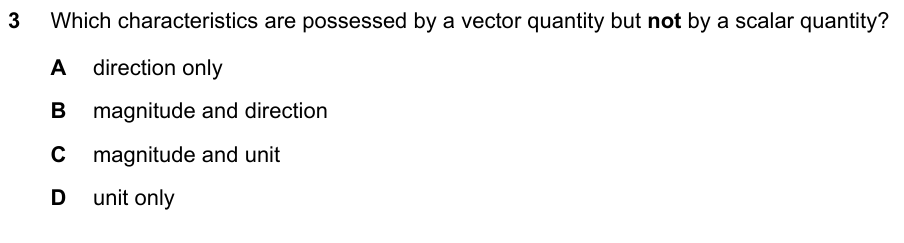
direction only. And what both share: magnitude and unit.
"magnitude and direction" as the difference; "unit" as the difference
Both kinds have a magnitude and a unit, so neither can be the difference. 9702/13/M/J/20 Q3 asks exactly this (answer A, "direction only"). 9702/23/M/J/21 Q1(a)(ii) gives B1 for "magnitude" and B1 for "unit".
The June 2021 report notes most candidates got "magnitude" but far fewer "unit".
From: 9702/13/M/J/20 Q3, 9702/23/M/J/21 Q1(a)(ii), 9702/12/O/N/22 Q4.
Drawing a vector triangle
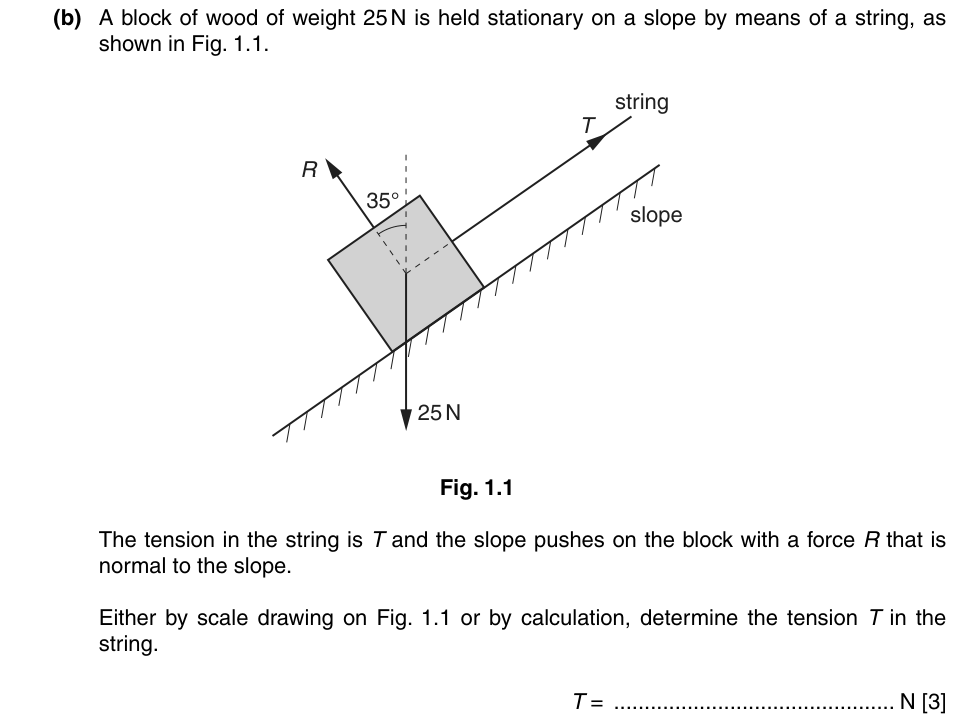
Each force is the side of a triangle in magnitude and direction, arrows joined head to tail; for equilibrium the triangle is closed.
Arrows missing or pointing the wrong way; the resultant unlabelled; a triangle not to scale when a scale drawing was asked for
The arrows carry the directions, and they are where the marks are. "Incorrect arrows loses this mark" (9702/23/M/J/10 mark scheme). The June 2016 report: credit lost for no arrows, or no labelled R.
A parallelogram of the correct shape; resolving instead of drawing, when the question allows "by scale drawing or by calculation".
From: 9702/23/M/J/10 Q2(b)–(c), 9702/22/O/N/10 Q1(b), 9702/23/M/J/15 Q1(e).
How the marks are given
| Question type | Marks | Where the marks go |
|---|---|---|
| Distinguish / compare scalar and vector | 2 | B1 scalar, B1 vector (or B1 "both magnitude", B1 "vector has direction") |
| Classify a list | 1–2 | all correct and no extras; sometimes 2 correct = 1 mark |
| Components | 1 each | A1 each value |
| Resultant magnitude | 2 | C1 method (Pythagoras / cosine rule / components / scale diagram), A1 value (with tolerance for drawing) |
| Angle of the resultant | 2 | C1 correct trig expression, A1 value |
| Vector triangle for equilibrium | 3–4 | M1 correct shape / closed, A1 arrows and labels, A1 each value |
- Classify scalars and vectors (tick, underline, "which is a vector?"): about 20 items, in Paper 1 most sessions and often in Paper 2 Q1(a).
- Define or distinguish scalar and vector: about 15 items, 2 marks in Paper 2.
- Resolve a force or velocity: about 12 items; resultant of two vectors (aircraft and wind, boat and river): about 12 items, 2–4 marks.
- Vector difference diagrams (X = P − Q): about 7 Paper 1 items.
Worked examples
Example 1 · A full question: scalars, vectors, components, resultant (Paper 2, 11 marks)
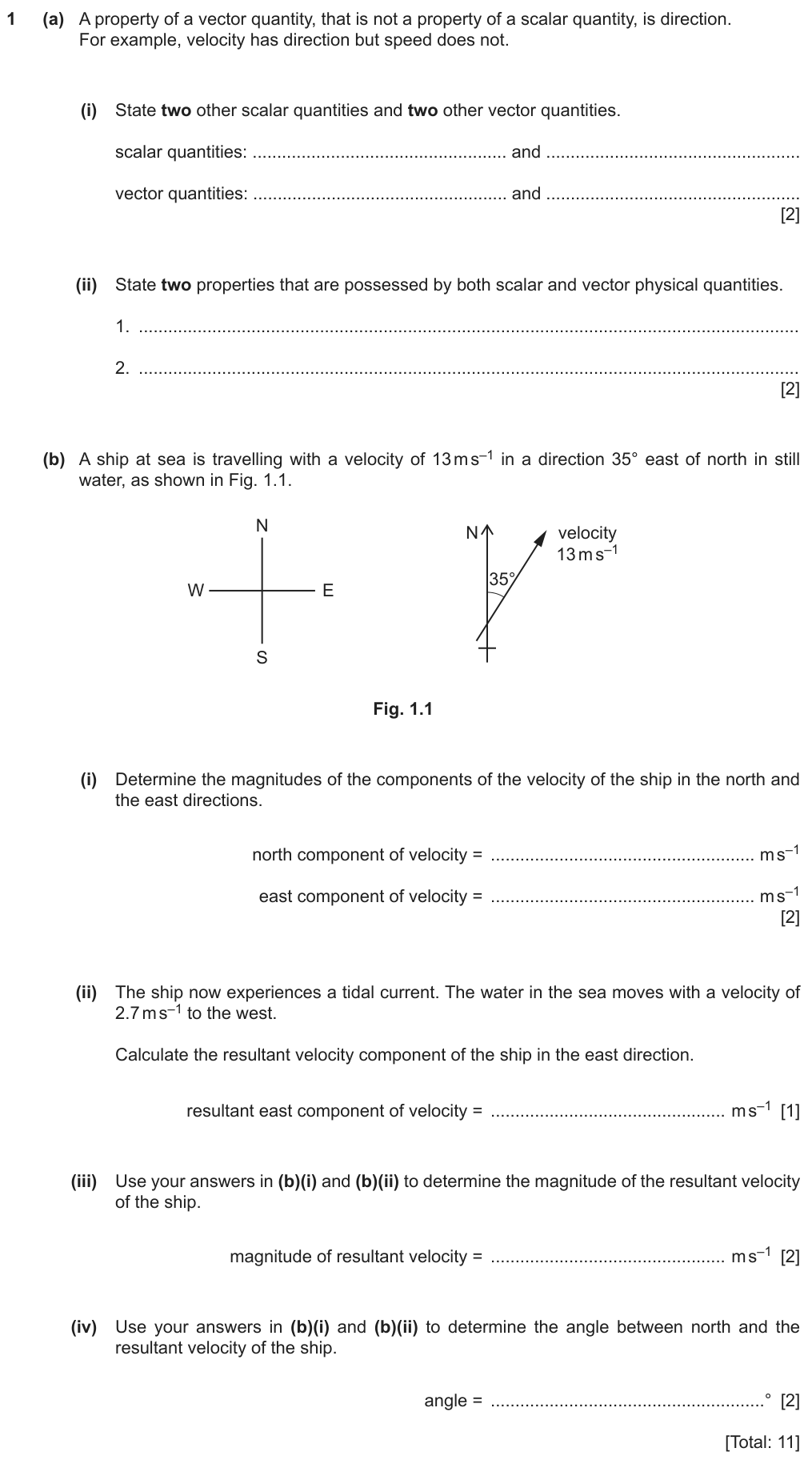
Part (a) is pure recall about scalars and vectors. Part (b): a ship heads 35° east of north at 13 m s−1. We split its velocity into north and east parts, then a current pushes it west, so the east part shrinks. We rebuild the new velocity: size and direction.
- 35° east of northstart facing north, turn 35° towards east: the angle is measured FROM NORTH
- magnitudes of the componentstwo numbers: north part and east part
- current … to the westit only changes the east component (subtract)
- angle between north and the resultanttan⁻¹(east ÷ north)
- (a)examples and shared properties
- (b)(i)north and east components
- (b)(ii)new east component
- (b)(iii)resultant speed
- (b)(iv)angle from north
- 13 m s−1at 35° E of N
- 2.7 m s−1current, west
- (b)(i) Findcomponents
- Usenorth = 13 cos 35°, east = 13 sin 35°
- Trapangle from NORTH, so north takes the cos
- Usenorth = 13 cos 35°, east = 13 sin 35°
- (b)(ii)-(iv) Findnew velocity
- Step 1east: 7.5 − 2.7; north unchanged
- Step 2size by Pythagoras, angle by tan⁻¹(east ÷ north)
The angle is measured from north. Which component is 'next to' the angle?
North - it is the adjacent side, so it gets cos 35°. East is opposite, so sin 35°.
Does a westward current change the north component?
No - it has no north part. Only the east component changes.
5 Now solve it have a go on paper first, then open the worked solution
- (a)(i) Scalars: e.g. mass, time; vectors: e.g. force, acceleration. B1 + B1
- (a)(ii) magnitude B1 and unit B1
- (b)(i) North: 13 cos 35° = 11 m s⁻¹ A1; east: 13 sin 35° = 7.5 m s⁻¹ A1 The June 2021 report: some candidates swapped them.
- (b)(ii) The current is to the west, so subtract from east: 7.5 − 2.7 = 4.8 m s⁻¹. A1
- (b)(iii) The current has no north component, so north is still 11. \(v = \sqrt{11^2 + 4.8^2}\) C1 = 12 m s⁻¹ A1
- (b)(iv) Angle from north: \(\tan^{-1}(4.8/11)\) C1 = 24° A1 Opposite (east) over adjacent (north). Only a minority chose the right trig function (examiner report).
(b)(i) N: 13 cos 35° = 11 m s⁻¹; E: 13 sin 35° = 7.5 m s⁻¹ (ii) 7.5 − 2.7 = 4.8 m s⁻¹ (iii) √(11² + 4.8²) = 12 m s⁻¹ (iv) tan⁻¹(4.8/11) = 24°
The current pushes west, so the ship's heading swings from 35° towards north, and 24° is less than 35°. The speed drops a little, 13 → 12 m s⁻¹.
Example 2 · Components, then two strings holding a weight (Paper 2, 6 marks)
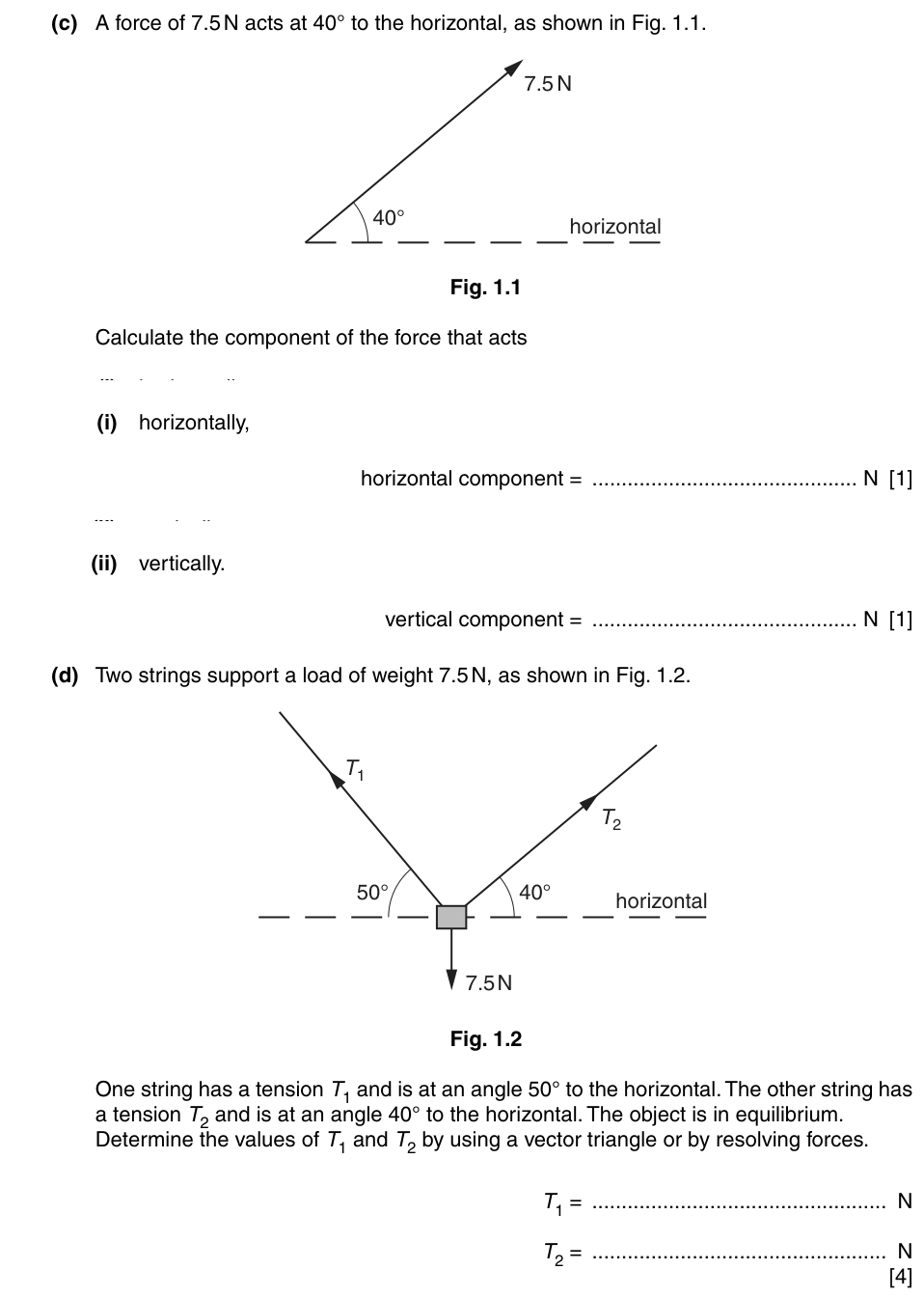
First, split a 7.5 N force at 40° into horizontal and vertical parts. Then a 7.5 N load hangs from two strings at 50° and 40°. It is still, so the forces balance: horizontally and vertically. Two equations, two unknown tensions.
- componentthe part of a force along a direction: F cos θ next to the angle, F sin θ opposite
- in equilibriumresultant force zero: left = right and up = down
- by using a vector triangle or by resolvingeither route is credited - pick one
- (c)horizontal and vertical components
- (d)T₁ and T₂
- 7.5 N at 40°part (c)
- W = 7.5 Nload
- T₁ at 50°to horizontal
- T₂ at 40°to horizontal
- 50° + 40° = 90°: the two strings are at right angles - the vector triangle is right-angled
- (d) FindT₁ and T₂
- Route Aresolve: two equations
- HorizontalT₂ cos 40° = T₁ cos 50°
- VerticalT₁ sin 50° + T₂ sin 40° = 7.5
- Thenmake T₂ the subject, substitute, collect, solve, back-substitute
- Route Bright-angled vector triangle with 7.5 N as hypotenuse
- Route Aresolve: two equations
Which way does each string pull horizontally?
In opposite directions - one left, one right. That is why their horizontal parts are equal.
Why does part (d) give the same numbers as part (c)?
The strings are perpendicular, so the triangle of forces is right-angled with the 7.5 N weight as the hypotenuse - exactly like splitting 7.5 N in part (c).
5 Now solve it have a go on paper first, then open the worked solution
- (c)(i) 7.5 cos 40° = 5.7 N A1 (ii) 7.5 sin 40° = 4.8 N A1 The scheme accepts 5.75 or 5.7, but not 5.8: it was rounded wrongly.
- (d) Resolve horizontally: \(T_2\cos 40^\circ = T_1\cos 50^\circ\). B1
- Resolve vertically: \(T_1\sin 50^\circ + T_2\sin 40^\circ = 7.5\). B1
- Make T₂ the subject of the horizontal equation: \(T_2 = T_1 \times \dfrac{\cos 50^\circ}{\cos 40^\circ} = T_1 \times \dfrac{0.643}{0.766} = 0.839\,T_1\).
- Substitute it into the vertical equation: \(T_1 \sin 50^\circ + (0.839\,T_1)\sin 40^\circ = 7.5\), i.e. \(0.766\,T_1 + (0.839 \times 0.643)\,T_1 = 7.5\).
- Collect the T₁ terms: \(0.766\,T_1 + 0.539\,T_1 = 1.305\,T_1 = 7.5\), so \(T_1 = \dfrac{7.5}{1.305} = 5.75\) → T₁ = 5.7 N A1
- Put T₁ back in: \(T_2 = 0.839 \times 5.75 = 4.82\) → T₂ = 4.8 N A1
- Check in the horizontal equation: \(4.82 \cos 40^\circ = 3.69\) and \(5.75 \cos 50^\circ = 3.69\) ✓
T₂ cos 40° = T₁ cos 50°; T₁ sin 50° + T₂ sin 40° = 7.5 → T₁ = 5.7 N, T₂ = 4.8 N
Vector triangle: the strings are at 50° and 40°, so they are perpendicular (50° + 40° = 90°). The closed triangle of forces is right-angled with the 7.5 N weight as the hypotenuse: T₁ = 7.5 cos 40° = 5.7 N and T₂ = 7.5 sin 40° = 4.8 N. That's the same as part (c), and it explains why. (Allow ± 0.2 N for a scale drawing.)
T₁ (5.7 N) > T₂ (4.8 N): the steeper string carries more of the load. Both are less than 7.5 N because they share it.
Example 3 · Heading into a crosswind (Paper 1, 1 mark)
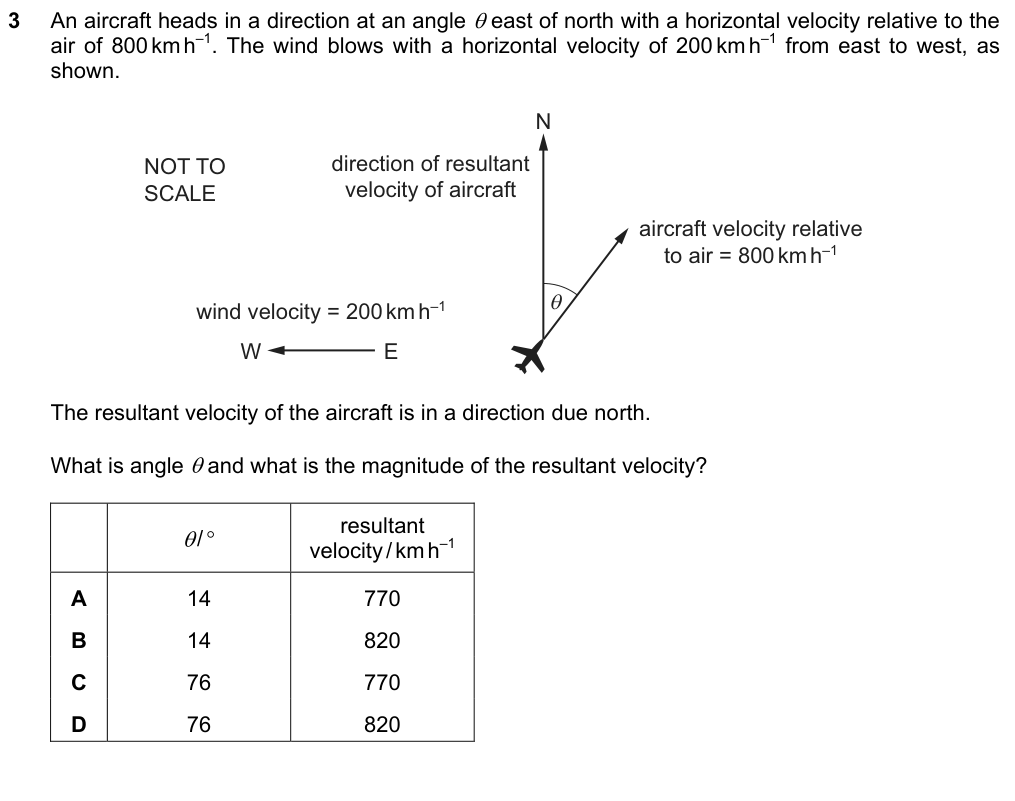
A plane wants to fly due north, but a wind blows from east to west. So the pilot points the nose a little east, so that part of the plane's velocity cancels the wind. We find that angle and the plane's actual speed northwards.
- heads at θ east of norththe plane's own velocity (800) is at θ from north
- relative to the air800 is the plane's speed through the air - the hypotenuse
- from east to westthe wind blows TOWARDS the west
- resultant velocity … due norththe east components cancel: 800 sin θ = 200
- θ and the resultant speed
- 800 km h−1plane, at θ E of N
- 200 km h−1wind, westward
- Findθ
- Useeast parts cancel: 800 sin θ = 200
- Trapsin, not tan: 800 is the hypotenuse
- Useeast parts cancel: 800 sin θ = 200
- Findresultant
- Use800 cos θ (or √(800² − 200²))
Why must the pilot point slightly east?
To cancel the wind pushing west. Pointing east gives the plane an eastward part of 200 km h−1.
Will the plane's speed over the ground be more or less than 800?
Less - part of the 800 is used up cancelling the wind. That rules out B and D at once.
5 Now solve it have a go on paper first, then open the worked solution
- East components cancel: \(800\sin\theta = 200\) → \(\sin\theta = 0.25\) → θ = 14°. sin, not tan: 800 is the hypotenuse. The March 2019 report on a similar question: candidates used tan (option B there) instead of sin.
- Resultant (north) = \(800\cos 14.5^\circ = 775 \approx 770\ \text{km h}^{-1}\). Or \(\sqrt{800^2 - 200^2} = 775\). → A 1
Some of the aircraft's speed is "spent" cancelling the wind, so the speed over the ground must be less than 800. That rules out B and D straight away.
Example 4 · Choose clever axes (Paper 1, 1 mark) ★★★ Hard
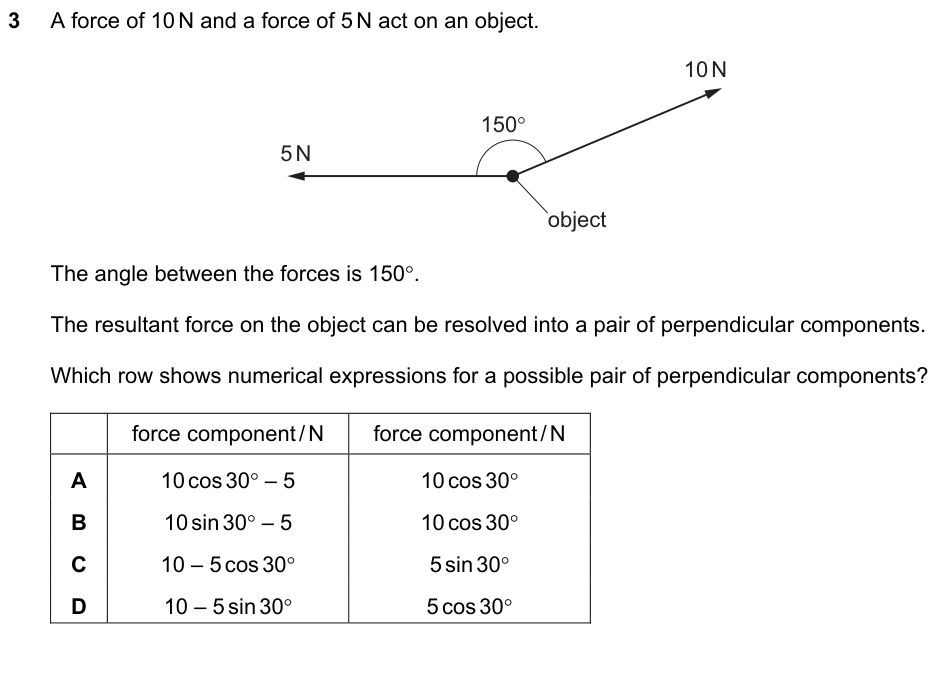
Why it is hard: the June 2021 examiner report says candidates found it difficult. The usual horizontal-and-vertical working gives a correct pair that is not one of the options, so many candidates picked A, the option nearest to their working (or B, with sin and cos swapped).
Two forces, 10 N and 5 N, with 150° between them. We need a pair of perpendicular components of their resultant. The usual horizontal/vertical pair is NOT among the options - the question used different axes.
- a possible pair of perpendicular componentsANY two perpendicular directions are allowed, not just horizontal and vertical
- angle between the forces is 150°the angle between them, measured from one force to the other
- numerical expressionsmatch the form of the options, not just the value
- the row that is a correct perpendicular pair
- 10 N
- 5 Nat 150° to the 10 N
- 150° from one force is 30° from the line of that force, pointing backwards
- Finda valid pair
- Try 1horizontal/vertical: (10 cos 30° − 5, 10 sin 30°) - not offered
- Try 2axes along and across the 10 N force
- Along10 − 5 cos 30°
- Across5 sin 30°
- TrapA looks close to Try 1 but its second part is wrong
If your first pair of components isn't in the options, is your working wrong?
Not necessarily. 'A possible pair' means other axes exist. Turn the axes so one lies along a force - then only the other force needs resolving.
With an axis along the 10 N force, how much of the 10 N lies across it?
None - so only the 5 N force contributes across: 5 sin 30°.
5 Now solve it have a go on paper first, then open the worked solution
Step 1 · The obvious way: horizontal and vertical
- The 5 N force is horizontal (to the left). The angle between the forces is 150°, so the 10 N force is 180° − 150° = 30° above the horizontal.
- Horizontal: \(10\cos 30^\circ - 5 = 3.66\) N. Vertical: \(10\sin 30^\circ = 5.00\) N.
- Look for \((10\cos 30^\circ - 5,\ 10\sin 30^\circ)\) in the options. It isn't there. A has the right horizontal part but 10 cos 30° for the vertical. So the question used different axes.
Step 2 · The clever way: axes along and across the 10 N force
- Axis 1 along the 10 N force, axis 2 perpendicular to it.
- The 10 N force lies on axis 1: it gives 10 along axis 1 and nothing along axis 2.
- The 5 N force is 150° from axis 1, which is 30° from the backwards direction. It gives \(5\cos 30^\circ\) backwards along axis 1 and \(5\sin 30^\circ\) along axis 2.
- Add along each axis: axis 1: \(10 - 5\cos 30^\circ\); axis 2: \(5\sin 30^\circ\). → C 1
Step 3 · Check every option against the resultant
The resultant is the same whatever axes you use. Cosine rule: \(R^2 = 10^2 + 5^2 + 2(10)(5)\cos 150^\circ = 38.4\), so \(R = 6.20\) N. A correct pair must give \(\sqrt{a^2 + b^2} = 6.20\) N:
| Option | Components (N) | \(\sqrt{a^2+b^2}\) | Why it is wrong or right |
|---|---|---|---|
| A | 3.66 and 8.66 | 9.40 N ✗ | Horizontal part right, but the vertical part should be 10 sin 30°, not 10 cos 30°. The most popular wrong answer. |
| B | 0 and 8.66 | 8.66 N ✗ | sin and cos swapped in both parts (angle taken from the vertical, not the horizontal). |
| C | 5.67 and 2.50 | 6.20 N ✓ | Axes along and across the 10 N force. The only option that gives the real resultant. |
| D | 7.50 and 4.33 | 8.66 N ✗ | The right axes, but sin and cos swapped for the 5 N force. |
| (your H/V pair) | 3.66 and 5.00 | 6.20 N ✓ | Also correct, but not offered. |
Both pairs give the same resultant: √(3.66² + 5.00²) = √(5.67² + 2.50²) = 6.2 N. That is how you know C is right.
Summary
- Scalar: magnitude only. Vector: magnitude and direction. Both have a magnitude and a unit.
- Add tip-to-tail; the resultant goes from the first tail to the last tip. Subtract by adding the reversed vector.
- At 90°: Pythagoras + tan. Otherwise: cosine rule with the triangle's angle, or components.
- Components: adjacent = F cos θ, opposite = F sin θ. Equilibrium: Σx = 0, Σy = 0, a closed triangle.
| If you see… | Do this |
|---|---|
| "Distinguish between scalar and vector" | Scalar: magnitude only; vector: magnitude and direction (2 marks) |
| Power, work, energy, pressure, charge in a list | Scalars |
| Weight, upthrust, momentum, acceleration in a list | Vectors |
| Two velocities "from … south of east", "x° to the bank" | Sketch the triangle first; find the angle inside it |
| "Change in velocity" | final − initial: reverse the initial, then add |
| Resultant "due north" / "perpendicular to the bank" | The other component must cancel: sin θ = (cross speed) / (own speed) |
| Object in equilibrium under three forces | Closed vector triangle, or Σx = 0 and Σy = 0 |
Can I do this?
- I can define scalar and vector quantities in mark-scheme words.
- I can classify syllabus quantities (power, work, pressure, charge, weight, upthrust, momentum…).
- I know vectors differ from scalars by direction only, and both have magnitude and unit.
- I can add two vectors tip-to-tail and by the parallelogram method.
- I use Pythagoras only at 90°, and the cosine rule with the triangle's angle otherwise.
- I can subtract vectors and find a change in velocity.
- I can resolve a vector into F cos θ and F sin θ, whichever axis θ is measured from.
- I can add several vectors using components.
- I can find a resultant by scale drawing, the cosine rule and components.
- I can find the angle of a resultant with the right trig ratio.
Quiz
The multiple-choice and guided questions need JavaScript. The concept checks and exam practice below work without it.
Concept checks
Can the resultant of a 3 N and a 4 N force be 8 N?
No. The largest possible resultant is 3 + 4 = 7 N (same direction) and the smallest is 1 N (opposite). Any answer outside 1–7 N is wrong whatever the angle.
Why can't three forces in equilibrium all be horizontal if one of them is a weight?
Horizontal strings have no vertical component, so nothing balances the weight: the triangle can't close. (9702/23/M/J/10 Q2(d): "no vertical force to support the weight".)
Is "rate of change of displacement" a vector or a scalar?
A vector (velocity). Dividing a vector by a scalar (time) keeps the direction.
The temperature can be −5 °C. Does the minus sign make temperature a vector?
No. The sign shows a value below a zero point, not a direction in space. 9702/11/O/N/24 Q2 uses exactly this as a wrong option.
Exam-style practice
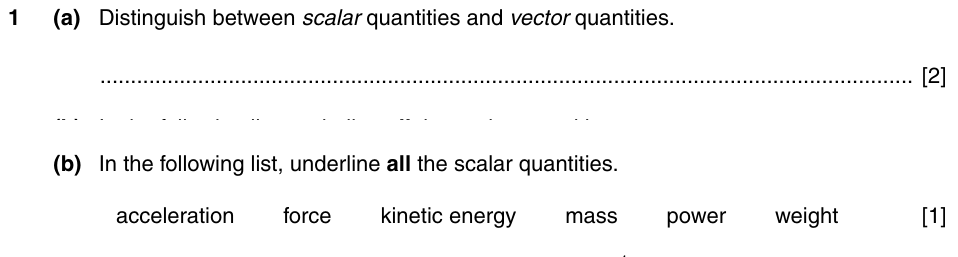

Answers and mark scheme
- (a) A scalar has (only) magnitude B1; a vector has magnitude and direction B1
- (b) kinetic energy, mass, power (all three) B1
- (c) momentum and weight B1
Answer and mark scheme
- Resolve along the slope: the string balances the component of the weight down the slope. C2
- T = 25 sin 35° = 14.3 N A1 (scale drawing: allow ± 0.5 N)
Alternatives in the scheme: R = 25 cos 35° then T = R tan 35°; or a closed triangle of T, R and 25 N.
Your progress on this note is saved when JavaScript is on.