
Kinematics
Describing motion: distance, displacement, speed, velocity, acceleration
What you need to be able to do
- 2.1.1Define and use distance, displacement, speed, velocity and acceleration.
Before you start: Scalars and vectors (adding, subtracting and resolving vectors) and unit conversions from SI units and prefixes. Next: Motion graphs.
The five quantities, in pairs
Kinematics describes how things move, without asking why. Everything is built from five quantities. They come in pairs: a scalar that only says how much, and a vector that also says which way.
| Scalar (size only) | Vector (size and direction) | SI unit |
|---|---|---|
| distance: the length of the whole path travelled | displacement: how far you are from the start, in a straight line, and in which direction | m |
| speed: distance travelled per unit time | velocity: rate of change of displacement | m s−1 |
| (no scalar partner is needed) | acceleration: rate of change of velocity | m s−2 |
Distance and displacement
Run once round a 400 m track and stop where you began: the distance is 400 m, but the displacement is 0. Walk 3 m east and then 4 m north: the distance is 7 m, the displacement is 5 m at 53° north of east (a 3-4-5 triangle). Displacement can also be negative: if east is positive, 20 m west is a displacement of −20 m.
Speed and velocity
Speed is distance travelled per unit time. Speed is the size of the velocity at any instant.
Average speed
\[ \text{average speed} = \frac{\text{total distance}}{\text{total time}} \]
A scalar. Uses the whole path.
Average velocity
\[ \text{average velocity} = \frac{\text{displacement}}{\text{total time}} \]
A vector: give its size and direction. Uses only start and end.
Instantaneous velocity
\[ v = \frac{\Delta s}{\Delta t}\ \text{for a tiny}\ \Delta t \]
The velocity at one moment: the gradient of a displacement–time graph (next page).
Acceleration
- Unit: m s−1 per second = m s−2.
- Acceleration is a vector. A negative acceleration (a deceleration) points against the velocity: the object slows down. Acceleration and velocity do not have to point the same way (November 2023 report).
- Velocity can change in size or in direction. A car going round a bend at a steady 20 m s−1 is accelerating, because its direction is changing.
Change in velocity: a vector subtraction
Change in velocity = final velocity − initial velocity: \(\Delta\mathbf{v} = \mathbf{v} - \mathbf{u}\). Subtract by adding the reversed initial velocity (from Subtracting vectors).
- In a straight line, choose a positive direction. A ball hits a wall at 8 m s−1 to the right and bounces back at 3 m s−1 to the left. Right = +: \(\Delta v = (-3) - (+8) = -11\) m s−1, i.e. 11 m s−1 to the left 9702/12/M/J/24 Q9. Not 5: the direction reversed.
- At an angle, draw \(\mathbf{v}\) then \(-\mathbf{u}\) tip to tail. 4.0 m s−1 right changing to 3.0 m s−1 down: \(\Delta\mathbf{v}\) = 3.0 down + 4.0 left = 5.0 m s−1, pointing down and to the left.
Try it: distance vs displacement
Path and displacement
Teaching point: distance follows the path; displacement is the straight arrow from the start. So average speed and average velocity are different unless the motion is in one straight line.
Turn on JavaScript to play each journey and watch the four quantities change.
Mark-scheme focus
Define velocity

"rate of change of displacement" B1, or "change in displacement / time (taken)" B1
- "rate of change of distance"
- "speed in a particular direction"
- "change in displacement by time" (by = divided or multiplied?)
- "change in displacement in a unit time"
Distance has no direction, so its rate of change is speed. A definition must be in terms of other defined quantities, which "speed in a direction" is not. "By" and "in a unit time" don't say what is divided by what.
Both wordings in the Credited box get the mark. Learn one of them word for word.
From: 9702/23/M/J/25 Q1(a), 9702/21/M/J/24 Q2(a) and the November 2021 and March 2017 examiner reports.
Define acceleration

"rate of change of velocity" B1, or "change in velocity / time (taken)" B1
- "velocity divided by time"
- "rate of change of velocity per unit time"
- "rate of change of speed"
- "force per unit mass"
Velocity ÷ time misses the change: an object at a steady 20 m s⁻¹ has no acceleration. "Rate of change" already means "per unit time", so adding "per unit time" says it twice. Speed has no direction, and a = F/m is Newton's second law, not the definition.
"Change in velocity per unit time" (the correct option in 9702/12/F/M/24 Q7, where "rate of change of speed" and "force per unit mass" were the wrong options).
From: 9702/21/M/J/25 Q1(a), 9702/22/F/M/16 Q2(a), 9702/21/O/N/12 Q1(a) and the November 2018, June 2017 and March 2016 examiner reports.
Define displacement

"distance (from the point) in a straight line in a given direction" B1
- "the distance between two points"
- "the product of velocity and time"
"Distance between two points" has no direction, so it is still a scalar. "Velocity × time" is a way to calculate it (for constant velocity only), not what it is.
Both parts score together: straight line (so it is not the path) and direction (so it is a vector).
From: 9702/23/M/J/24 Q2(a) and the November 2018 examiner report 9702/21/O/N/18 Q1(a)(i).
Command words you meet here
| Command word | What it wants | Example |
|---|---|---|
| Define | The exact definition, in words (or an equation with every symbol named). | "Define acceleration." → rate of change of velocity |
| Calculate | A numerical answer with working. | "Calculate the average speed." → 200 / 27 = 7.4 m s⁻¹ |
| Determine | A value found from given data, often in more than one step; for a vector give the direction too. | "Determine the average velocity and its angle." → 5.3 m s⁻¹ at 34° |
- Define velocity / acceleration / displacement: the first part of most Paper 2 kinematics questions (1 mark, B1).
- Average speed vs average velocity on a curved or two-leg path: Paper 1, about once a year (semicircle, circle, P→Q→R), and in Paper 2 with a vector diagram (2–3 marks).
- Change in velocity when the direction changes: Paper 1 (arrow diagrams, bouncing balls).
Worked examples
Example 1 · Speed or velocity round a curve (Paper 1, 1 mark) ★★ Medium
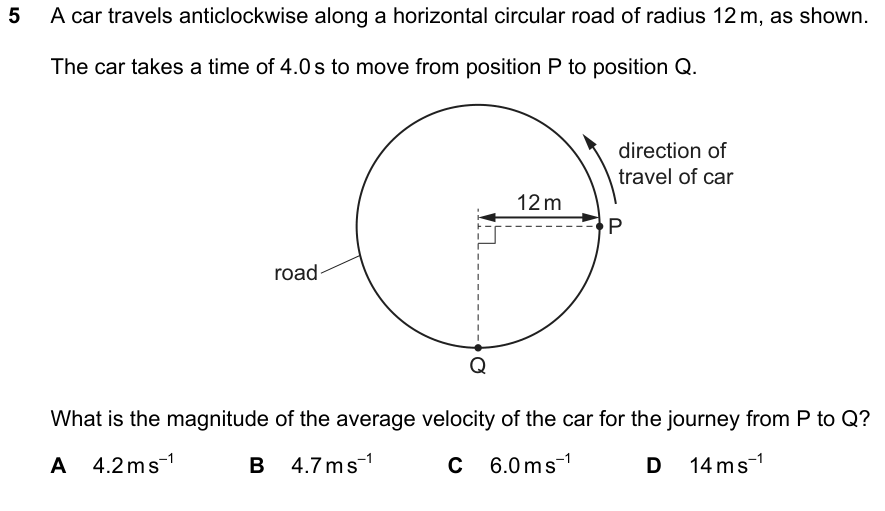
Why it trips people up: the June 2022 report says many chose D. D is the average speed; the question asks for the average velocity.
A car drives three-quarters of the way round a circular road, from P to Q, in 4.0 s. The question wants its average VELOCITY - not its average speed.
- average velocitydisplacement ÷ time: the straight line from P to Q
- magnitudesize only
- anticlockwisetells you the path (¾ of the circle) - but only the start and end points matter for velocity
- radius 12 mP and Q are both 12 m from the centre
- size of the average velocity P → Q
- r = 12 mcircle
- t = 4.0 sP to Q
- 90°angle between OP and OQ (from the figure)
- Findaverage velocity
- Usedisplacement ÷ time
- Work out firstdisplacement PQ: Pythagoras on two 12 m radii at 90°
- Trapthe arc length gives average SPEED (option D)
- Usedisplacement ÷ time
Does it matter which way round the car went?
Not for velocity. Displacement depends only on where it started and finished - the straight line P to Q.
Which should be bigger: average speed or average velocity?
Average speed. The arc is always at least as long as the straight line.
5 Now solve it have a go on paper first, then open the worked solution
- Anticlockwise from P to Q is three-quarters of the circle. That is only needed for the distance.
- Displacement: P and Q are both 12 m from the centre, at right angles, so \(PQ = \sqrt{12^2 + 12^2} = 17.0\) m.
- Average velocity = displacement ÷ time = 17.0 / 4.0 = 4.2 m s−1 → A 1
D comes from the arc: distance = ¾ × 2π × 12 = 56.5 m, and 56.5 / 4.0 = 14 m s−1 is the average speed.
The straight line is shorter than the arc, so the average velocity must be smaller than the average speed: 4.2 < 14.
Example 2 · Half a lap and a whole lap (Paper 1, 1 mark) ★★ Medium
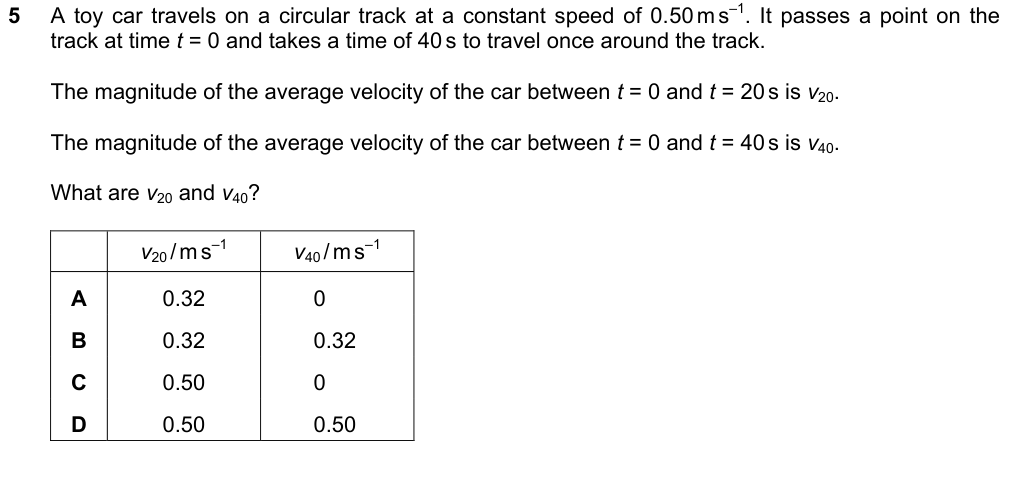
A toy car goes round a circular track at a steady 0.50 m s−1; one lap takes 40 s. We want the average velocity after half a lap (20 s) and after a whole lap (40 s).
- constant speedthe SPEED never changes - but the velocity's direction does
- average velocitydisplacement ÷ time
- once around the trackafter 40 s it is back where it started: displacement zero
- v20 and v40
- v = 0.50 m s−1speed
- T = 40 sone lap
- circumference = 0.50 × 40 = 20 m, so the radius is 20 ÷ 2π
- Findv20
- Usedisplacement after half a lap = the diameter
- Work out firstradius from the circumference
- Usedisplacement after half a lap = the diameter
- Findv40
- Useback at the start: displacement 0 → v40 = 0
After half a lap, how far is the car from where it started, in a straight line?
Right across the circle: one diameter.
Can an object moving the whole time have zero average velocity?
Yes - if it ends where it started. Its average SPEED is still 0.50 m s−1.
5 Now solve it have a go on paper first, then open the worked solution
- Circumference = speed × time for one lap = 0.50 × 40 = 20 m, so the radius is \(20 / 2\pi = 3.18\) m.
- After 20 s the car is half way round: displacement = the diameter = 6.37 m. \(v_{20} = 6.37 / 20 = 0.32\) m s−1.
- After 40 s it is back at the start: displacement = 0, so \(v_{40} = 0\) → A 1
The November 2022 report: many candidates worked out the average speed after 20 s and 40 s instead of the average velocity. The speed is 0.50 m s−1 the whole time (option D); the average velocity is not.
v20 (0.32) is less than the speed (0.50), since the diameter is shorter than the half-circle. v40 = 0 because the displacement is zero.
Example 3 · Change in velocity when the direction changes (Paper 1, 1 mark) ★★★ Hard
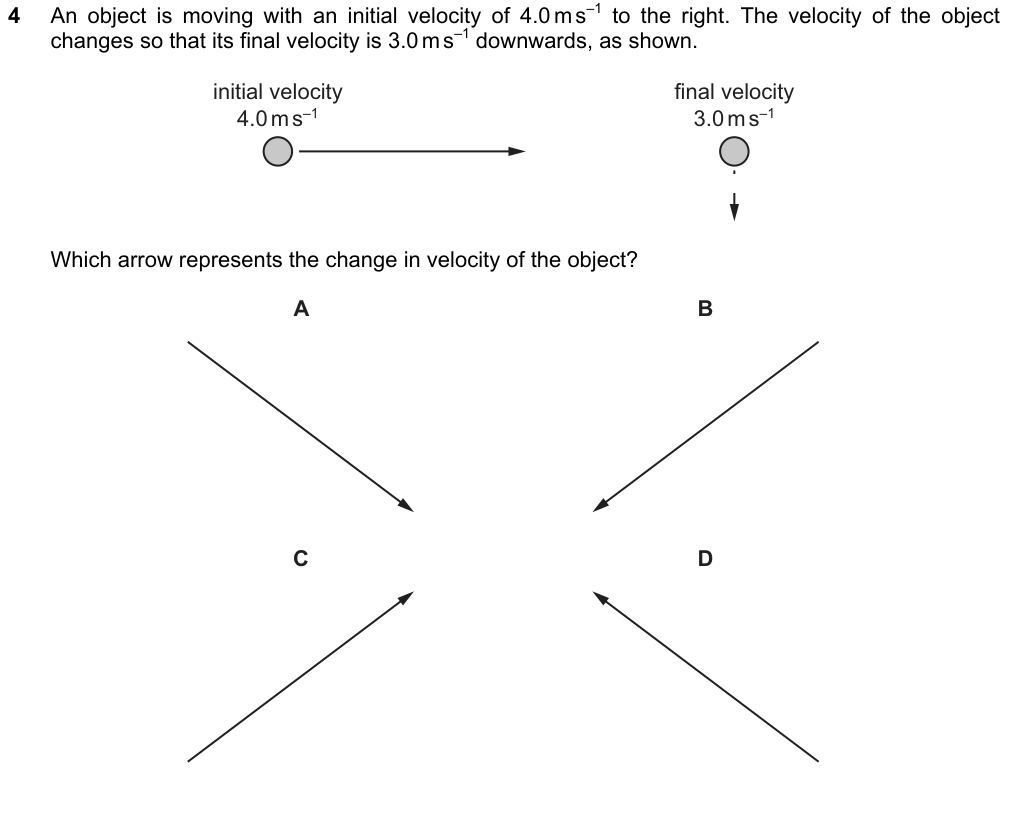
Why it is hard: the June 2022 report says over half of the candidates chose A, the sum of the two velocities. The question asks for the change.
An object starts moving right at 4.0 m s−1 and ends moving down at 3.0 m s−1. Which arrow shows how much its velocity CHANGED?
- change in velocityfinal − initial: Δv = v − u, a vector subtraction
- which arrowonly the DIRECTION matters here
- the arrow for Δv
- u = 4.0 m s−1right
- v = 3.0 m s−1down
- FindΔv
- UseΔv = v + (−u)
- Step 1reverse u: 4.0 to the LEFT
- Step 2add tip to tail: 3.0 down, then 4.0 left
- Trapu + v (down-right) is the sum, not the change
- UseΔv = v + (−u)
How do you subtract a vector?
Add its reverse. v − u is v plus an arrow the same size as u pointing the opposite way.
Starting right and ending down, which way must the 'push' have been?
It had to cancel the rightward motion (push left) and create downward motion (push down): down and to the left.
5 Now solve it have a go on paper first, then open the worked solution
- Change in velocity = final − initial: \(\Delta\mathbf{v} = \mathbf{v} - \mathbf{u} = \mathbf{v} + (-\mathbf{u})\).
- Reverse the initial velocity: −u = 4.0 m s−1 to the left.
- Add tip to tail: 3.0 down, then 4.0 left. The result points down and to the left (5.0 m s−1) → B 1
| Option | Direction | What it is |
|---|---|---|
| A | down-right | u + v: the sum, not the change. The most popular wrong answer. |
| B | down-left | v − u ✓ |
| C | up-right | u − v: initial minus final, the wrong way round. |
| D | up-left | −(u + v): the sum reversed. |
Δv must point partly left - it has to undo the rightward velocity. Only B and D do, and it must point down too, to create the downward velocity: B.
Example 4 · Average speed and average velocity on two legs (Paper 2, 4 marks) ★★ Medium
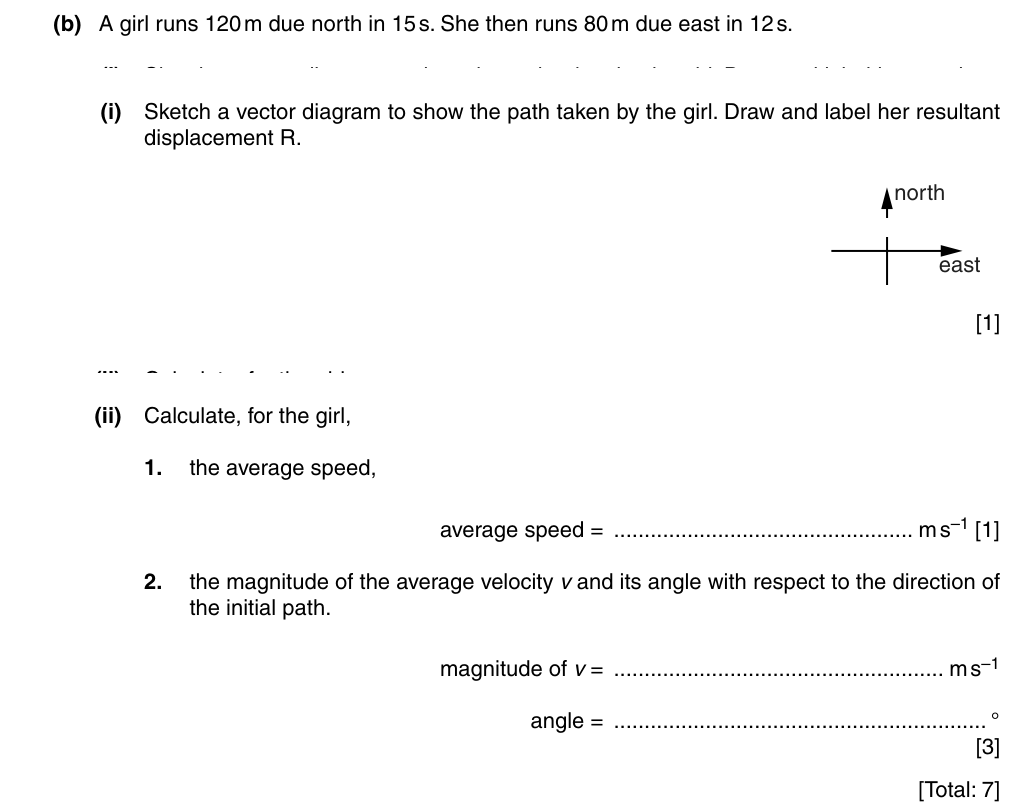
A girl runs north, then east. We sketch her path and find her average speed (whole path) and average velocity (straight line from start to finish, with its direction).
- Sketch a vector diagramarrows tip to tail, then R from start to finish
- average speedtotal DISTANCE ÷ total time
- average velocity … and its angleDISPLACEMENT ÷ time, plus a direction measured from north
- (i)vector diagram with R
- (ii)1average speed
- (ii)2average velocity: size and angle
- 120 m northin 15 s
- 80 m eastin 12 s
- total time is 27 s for both averages
- (ii)1 Findaverage speed
- Use200 m ÷ 27 s
- Trapnot the mean of the two speeds
- Use200 m ÷ 27 s
- (ii)2 Findaverage velocity
- UseR ÷ 27 s
- R√(120² + 80²)
- Angletan⁻¹(80 ÷ 120) from north
- UseR ÷ 27 s
Why can't we average the two speeds (8.0 and 6.7)?
She spends different times on each leg. Average speed must be total distance over total time.
For the angle 'with respect to the initial path', which side is opposite the angle?
The initial path is north (120 m). The angle from north has 80 m (east) opposite it: tan θ = 80 ÷ 120.
5 Now solve it have a go on paper first, then open the worked solution
- (i) Draw 120 m north, then 80 m east from its tip, both with arrows; R joins the start to the finish, labelled R. B1
- (ii) 1. Total distance = 200 m, total time = 15 + 12 = 27 s. Average speed = 200 / 27 = 7.4 m s−1 A1 Not (8.0 + 6.7)/2: the June 2016 report says that method gets no credit.
- (ii) 2. Displacement \(R = \sqrt{120^2 + 80^2} = 144\) m C1
- Average velocity = 144 / 27 = 5.3 m s−1 A1
- Angle from the initial path (north): \(\tan^{-1}(80/120) =\) 34° (east of north) A1
average speed = 200 / 27 = 7.4 m s⁻¹; R = √(120² + 80²) = 144 m; v = 144 / 27 = 5.3 m s⁻¹ at 34° to the initial direction (east of north)
5.3 < 7.4: average velocity can never be bigger than average speed.
Summary
- Distance and speed are scalars; displacement, velocity and acceleration are vectors.
- Velocity = rate of change of displacement. Acceleration = rate of change of velocity = change in velocity ÷ time taken.
- Average speed = total distance ÷ total time. Average velocity = displacement ÷ total time, with a direction.
- Change in velocity = final − initial, done as vectors.
| If you see… | do this |
|---|---|
| "average velocity" on a curved or bent path | straight-line displacement start → end, ÷ time; give a direction |
| "average speed" over several stages | total distance ÷ total time; never the mean of the speeds |
| back at the starting point | displacement = 0, so average velocity = 0 |
| "change in velocity" and the object turns or bounces | final − initial as vectors: reverse u and add |
Can I do this?
- I can say which of distance, displacement, speed, velocity and acceleration are scalars and which are vectors.
- I can define displacement (straight line, given direction).
- I can define velocity as rate of change of displacement, not of distance.
- I can define acceleration as change in velocity ÷ time taken, and give its unit.
- I can find average speed (total distance ÷ total time) and average velocity (displacement ÷ time, with direction).
- I can find a change in velocity when the direction changes.
Anything unticked: revise that section first. All ticked: take the quiz.
Quiz
Your progress on this note is saved when JavaScript is on.