
Kinematics
Equations of motion (suvat) and free fall
What you need to be able to do
- 2.1.6Derive, from the definitions of velocity and acceleration, the equations for uniformly accelerated motion in a straight line.
- 2.1.7Solve problems with these equations, including objects falling in a uniform gravitational field without air resistance.
Before you start: Motion graphs (gradient and area of a v–t graph). Next: Measuring g.
The five quantities and the four equations
| Symbol | Quantity | Unit | Scalar or vector |
|---|---|---|---|
| s | displacement | m | vector |
| u | initial velocity | m s−1 | vector |
| v | final velocity | m s−1 | vector |
| a | acceleration (constant) | m s−2 | vector |
| t | time taken | s | scalar |
1 · no s
\[ v = u + at \]
Not on the formula sheet: comes straight from the definition of acceleration.
2 · no a
\[ s = \tfrac12 (u + v)\,t \]
Not on the formula sheet: average velocity × time.
3 · no v
\[ s = ut + \tfrac12 a t^2 \]
On the formula sheet.
4 · no t
\[ v^2 = u^2 + 2as \]
On the formula sheet.
Deriving the equations
The syllabus asks you to derive them from the definitions. Use a v–t graph for constant acceleration: a straight line from u at time 0 to v at time t.
- From the definition of acceleration: \(a = \dfrac{v - u}{t}\), so \(\;v = u + at\). (Equation 1. This is the only one that needs nothing but the definition: 9702/13/M/J/23 Q5, answer C.)
- From the definition of velocity: displacement = average velocity × time. For constant acceleration the average velocity is \(\tfrac12(u + v)\), so \(\;s = \tfrac12(u + v)\,t\). (Equation 2. It is also the area of the trapezium.)
- Substitute \(v = u + at\) into equation 2: \(s = \tfrac12(u + u + at)\,t = ut + \tfrac12at^2\). (Equation 3: the rectangle \(ut\) plus the triangle \(\tfrac12(at)t\).)
- Eliminate t: from equation 1, \(t = \dfrac{v - u}{a}\). Put it into equation 2: \(s = \tfrac12(u + v)\dfrac{(v - u)}{a} = \dfrac{v^2 - u^2}{2a}\), so \(\;v^2 = u^2 + 2as\). (Equation 4.)
Choosing the right equation
- Draw a quick sketch and choose the positive direction (usually the direction of the first motion, or upwards).
- Write down s, u, v, a, t and fill in the three you know, with signs. Convert to SI units first (km h−1 ÷ 3.6 → m s−1).
- Mark the one you want. The fifth quantity is not in the question: use the equation that leaves it out.
- Rearrange first, then substitute, and write the symbol equation before the numbers (November 2022 report).
- Check: sign, size and unit. Hidden values: "from rest" means u = 0; "comes to rest" or "at the top" means v = 0.
Which equation?
Teaching point: every equation leaves out one of s, u, v, a, t. Mark what you know and what you want, and the one that is missing picks the equation.
| Not in the question | Use |
|---|---|
| s | v = u + at |
| a | s = ½(u + v)t |
| v | s = ut + ½at² |
| t | v² = u² + 2as |
Turn on JavaScript to mark each quantity and see the equation rearranged.
Free fall and signs
Taking up as positive
\[ a = -9.81\ \text{m s}^{-2} \]
Thrown up at 12 m s⁻¹: u = +12. Below the starting point: s is negative.
Taking down as positive
\[ a = +9.81\ \text{m s}^{-2} \]
Handy for drops. Thrown up: u is negative.
- At the top of the flight v = 0, but a is still 9.81 m s−2 downwards.
- Use g = 9.81, not 10: rounding g to one significant figure gave wrong final answers (June 2022 and March 2018 reports).
- Mass does not matter in free fall: a heavier ball has the same acceleration and lands at the same speed (June 2022 report).
- A drop from something moving keeps that velocity at first: a sandbag released from a balloon rising at 3.00 m s−1 starts by moving up at 3.00 m s−1 9702/12/O/N/17 Q6.
Two stages, two objects
Two stages (the acceleration changes)
Solve stage 1, then use its final velocity as the initial velocity of stage 2.
Rocket: stage 1 a = +55 m s⁻² with the engine on; stage 2 a = −9.81 m s⁻² once something falls off it.
Two objects (catch-up, release together)
Write one equation for each object. What they share (the same time, or the same displacement) links them.
Catch-up: both have the same s at the same t.
Mark-scheme focus
The conditions for s = ½at²
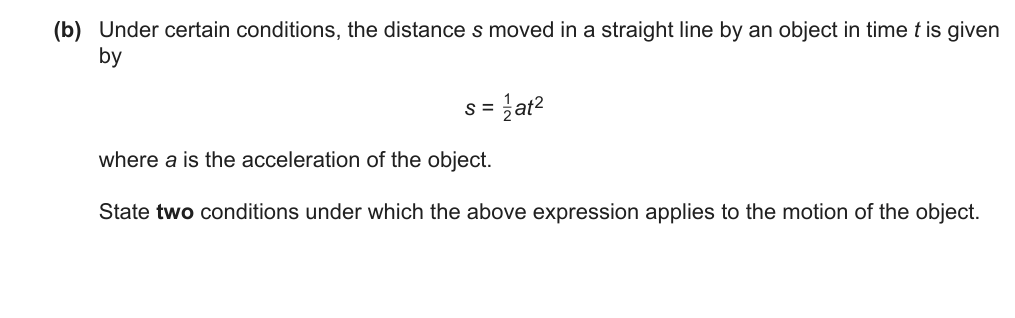
- "initial speed / velocity is zero"
- "(non-zero) acceleration is constant / uniform"
- "moving in a straight line" (already in the question)
- "accelerating at a constant velocity" (contradicts itself)
- "constant speed"
s = ut + ½at² becomes s = ½at² only when u = 0, and the equations only hold for constant acceleration. The November 2023 report: only the strongest candidates gave "initial speed is zero".
Don't repeat information from the stem: "in a straight line" earns nothing when the question already says it.
From: 9702/22/O/N/23 Q1(b) and the November 2023 examiner report.
Does a heavier ball fall faster?
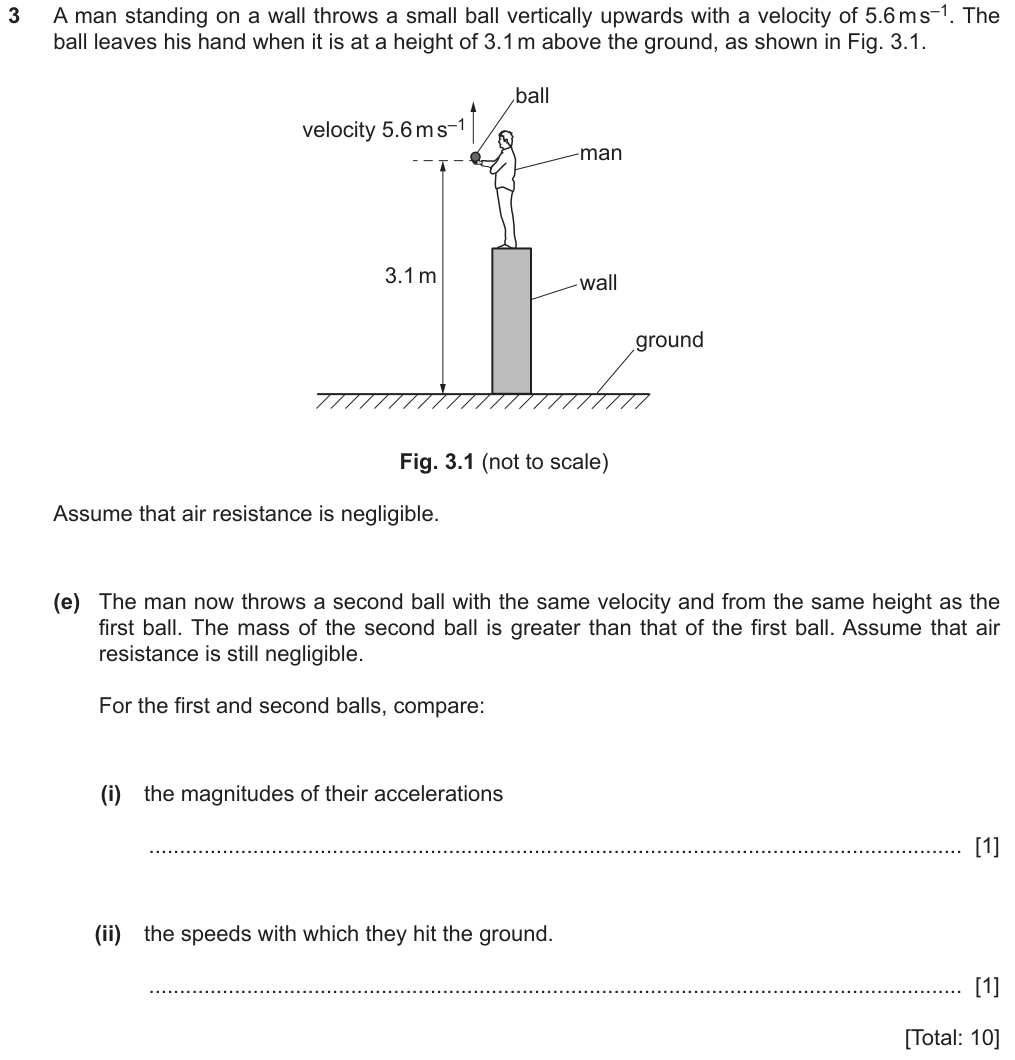
- accelerations "equal / same"
- speeds at the ground "equal / same"
- "the heavier ball has a greater acceleration"
- "the heavier ball has less acceleration" (a misconception the report names)
With no air resistance both balls have acceleration g. Same u, same a, same s, so v² = u² + 2as gives the same v. Mass is not in any of the equations of motion.
With air resistance the answer changes: that is the Dynamics chapter (terminal velocity).
From: 9702/22/M/J/22 Q3(e) and the June 2022 examiner report.
- Vertical throw / drop with suvat (maximum height, time to fall, "show that"): Paper 2, 2–3 marks a part, C1 for the equation with numbers, A1 for the answer.
- Two stages or two objects: Paper 2 most years, and Paper 1 (catch-up, signals and braking).
- Proportion reasoning (u² ∝ s, t ∝ √(1/g)): Paper 1, about once a year.
Worked examples
Example 1 · Thrown up from a wall (Paper 2, 4 marks) ★★ Medium
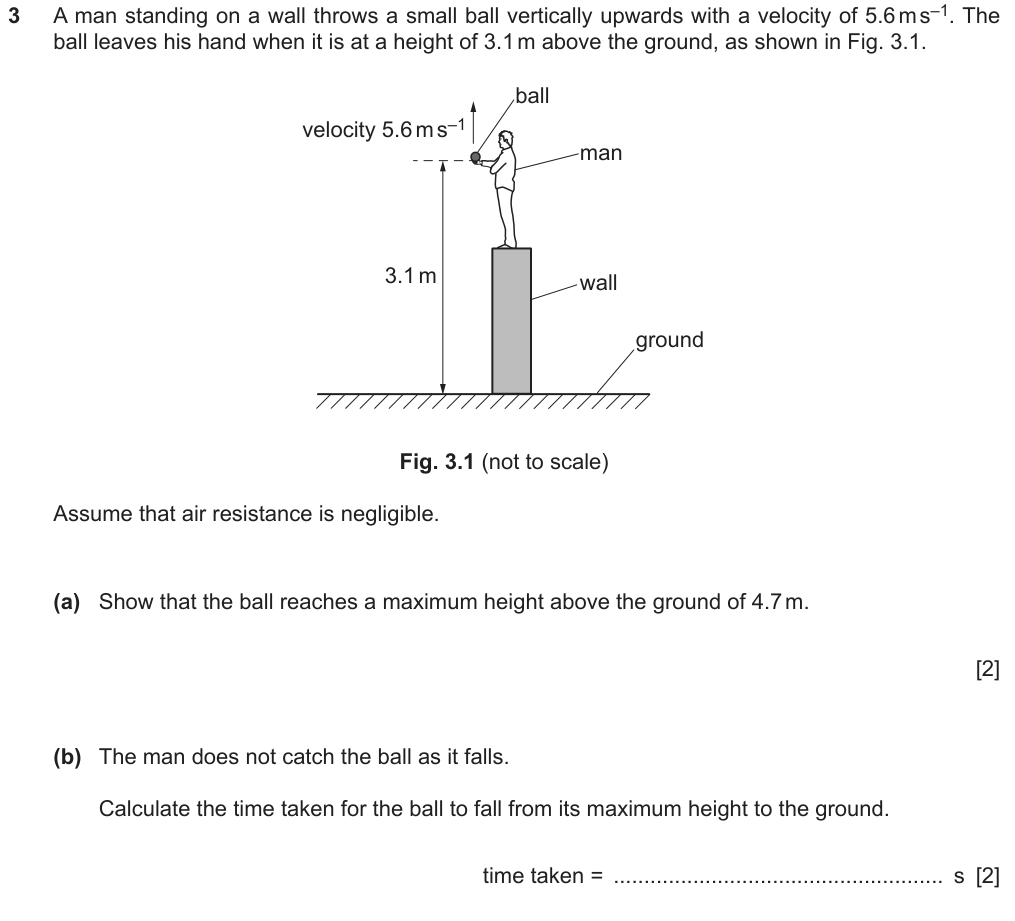
A man on a 3.1 m wall throws a ball straight up. It rises, stops at the top, then falls all the way to the ground (he misses it). Part (a): how high above the GROUND does it get? Part (b): how long does the fall from the top take?
- vertically upwardsone-dimensional: choose up = +, so a = −9.81
- maximum heightat the top v = 0
- above the groundadd the 3.1 m: the throw starts from the wall, not the ground
- from its maximum height to the grounda NEW start: at the top u = 0
- (a)show max height above ground = 4.7 m
- (b)time from the top to the ground
- u = 5.6 m s−1up
- 3.1 mstart above ground
- g = 9.81 m s−2
- at the top: v = 0 - that is the extra number suvat needs
- (a) Show4.7 m
- Usev² = u² + 2as with v = 0 → s above the hand
- Trapthen ADD 3.1 m
- Usev² = u² + 2as with v = 0 → s above the hand
- (b) Findt
- Uses = ut + ½at² with u = 0, s = 4.7 m
- Needs4.7 m from (a)
- Trapu is 0 at the top, not 5.6
- Uses = ut + ½at² with u = 0, s = 4.7 m
Which three of s, u, v, a, t do we know for the way up?
u = 5.6, v = 0, a = −9.81. We want s, and t isn't needed - so v² = u² + 2as.
Why start part (b) at the top rather than at the throw?
From the top the motion is simple: from rest, all the way down 4.7 m. Starting at the throw would need a signed displacement and a quadratic.
5 Now solve it have a go on paper first, then open the worked solution
- (a) Up = +: u = 5.6, v = 0, a = −9.81, s = ? No t, so \(v^2 = u^2 + 2as\).
- \(0 = 5.6^2 + 2(-9.81)s\) → \(s = \dfrac{5.6^2}{2 \times 9.81} = 1.6\) m C1
- Height above the ground = 3.1 + 1.6 = 4.7 m A1 The answer must include the 3.1 m: the 1.6 m is measured from the hand.
- (b) From the top: u = 0 (not 5.6), s = 4.7 m down, a = 9.81 down. \(s = \tfrac12at^2\): \(4.7 = \tfrac12(9.81)t^2\) C1
- \(t = \sqrt{\dfrac{2 \times 4.7}{9.81}} =\) 0.98 s A1
The June 2022 report: some used u = 5.6 m s⁻¹ at the top, some gave t² as the answer (0.96), and g = 10 gave an inaccurate answer.
0.98 s for a 4.7 m drop: a 5 m drop takes about 1 s, so this is right. (Giving 0.96 means t² was left as the answer.)
Example 2 · Two objects, the same fall time (Paper 2, 4 marks) ★★ Medium
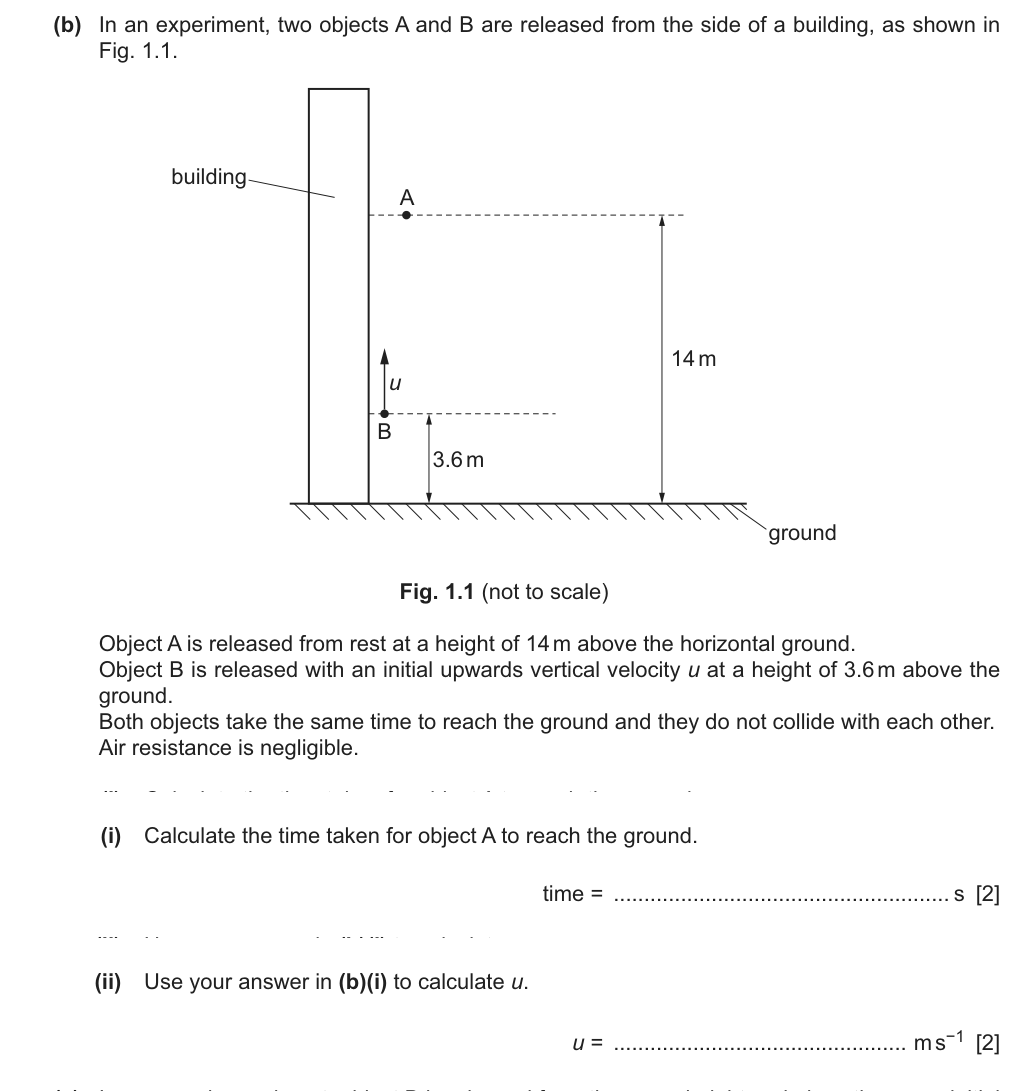
Object A is dropped from 14 m. Object B, lower down at 3.6 m, is thrown UP first. Both hit the ground at the same moment. A's fall gives us the time; that same time then gives B's throwing speed.
- released from restA: u = 0
- initial upwards velocity uB moves up first: with down = +, its starting velocity is −u
- the same timethe link between the two objects: t is shared
- Use your answercarry t from (i) into (ii)
- (i)time for A to fall
- (ii)B's initial speed u
- A: 14 m, u = 0
- B: 3.6 m, initial velocity u upunknown
- g = 9.81 m s−2
- (i) Findt
- Uses = ½at² for A
- (ii) Findu
- Uses = ut + ½at² for B (down = +)
- tfrom (i)
- SignsB's displacement +3.6 down, its starting velocity −u
- Uses = ut + ½at² for B (down = +)
B starts only 3.6 m up but takes as long as A falling 14 m. How?
B is thrown upwards first - it rises, stops, and comes back before it falls the 3.6 m.
Why is B's starting velocity negative?
We chose down = + (the way it ends up going). B starts moving up, the opposite way.
5 Now solve it have a go on paper first, then open the worked solution
- (i) A: u = 0, s = 14 m down, a = 9.81. \(s = \tfrac12at^2\) → \(t = \sqrt{\dfrac{2 \times 14}{9.81}}\) C1 = 1.7 s A1
- (ii) B takes the same 1.7 s. Down = +: s = +3.6 m, a = +9.81, and B starts moving up, so its velocity is −u.
- \(3.6 = -u(1.7) + \tfrac12(9.81)(1.7)^2\) C1
- \(u = \dfrac{14.2 - 3.6}{1.7} =\) 6.2 m s−1 A1 The scheme writes (−)6.2: the size is what's asked.
Other way (also in the scheme): find B's speed at the ground first, \(v = (3.6 + \tfrac12 \times 9.81 \times 1.7^2)/1.7 = 10\) m s⁻¹, then \(10 = -u + 9.81 \times 1.7\) → u = 6.2 m s⁻¹.
u = 6.2 m s−1 up: B then reaches the ground at 10 m s−1, less than A's 17 m s−1 - fits, since B ends up falling from a lower top point.
Example 3 · Rocket, then a falling piece of metal (Paper 2, 6 marks) ★★★ Hard
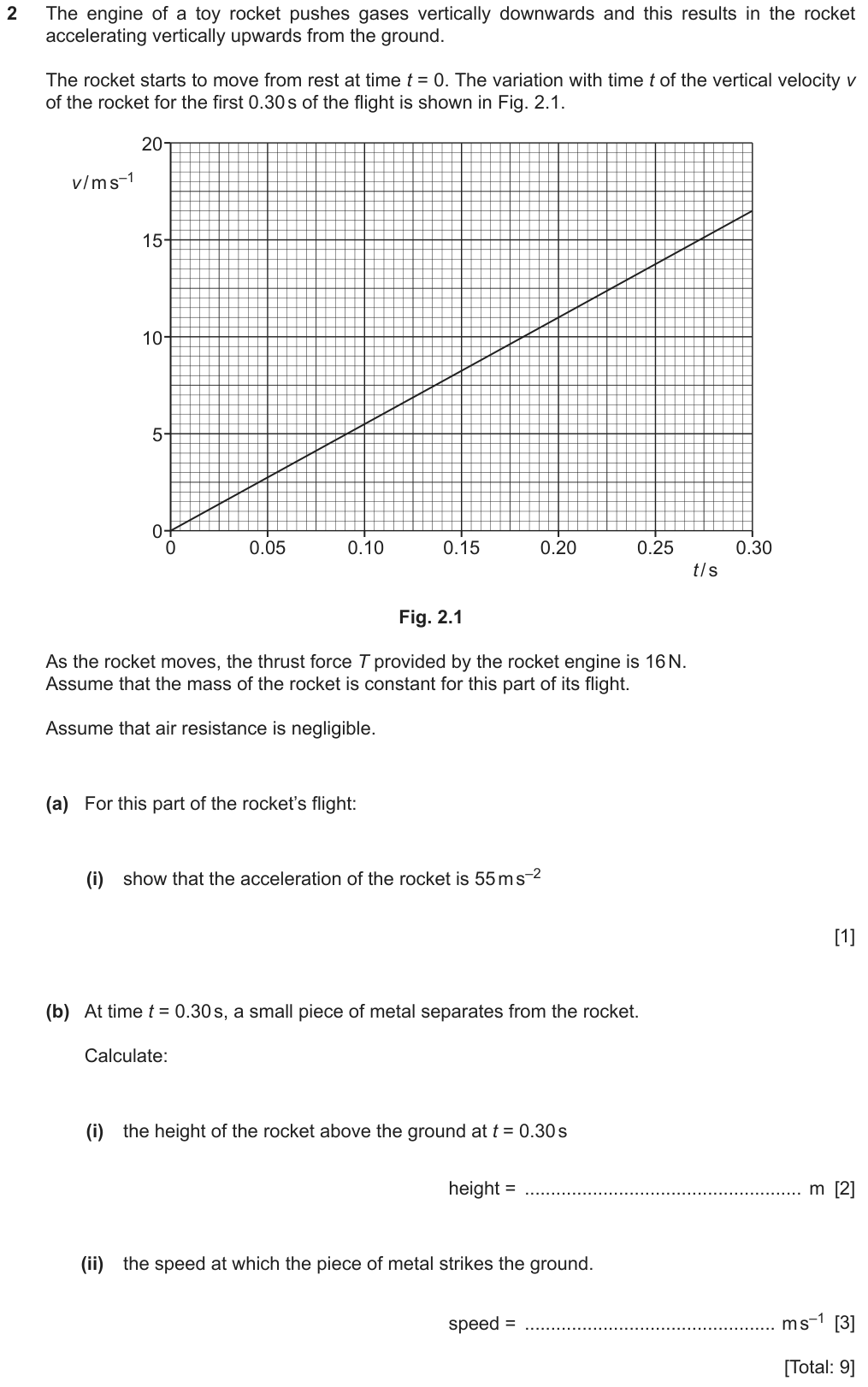
Why it is hard: the November 2022 report says only a minority found the speed in (b)(ii). The usual errors: taking the metal's initial velocity as zero, and using the rocket's acceleration instead of g.
A toy rocket speeds up from rest for 0.30 s. At that moment a piece of metal breaks off. The metal is moving UP at the rocket's speed when it separates; from then on only gravity acts on it. It rises, stops, and falls to the ground.
- velocity rises in a straight lineconstant acceleration = gradient
- separates from the rocketthe metal keeps the rocket's velocity at that instant: 16.5 m s−1 UP
- strikes the groundthe metal's motion is a new stage: a = g, starting 2.5 m up
- (a)(i)show a = 55
- (b)(i)height at 0.30 s
- (b)(ii)speed of the metal at the ground
- v = 16.5 m s−1at t = 0.30 s
- from restat t = 0
- two stages with different accelerations: rocket (55 up), then metal (9.81 down)
- (b)(i) Findheight
- Usestage 1: s = ½at² (or area under v-t)
- (b)(ii) Findspeed at the ground
- Usestage 2: v² = u² + 2as
- u16.5 UP (−16.5 with down = +)
- s2.5 m from (b)(i)
- Trapu is not 0, and a is g - not the rocket's 55
- Usestage 2: v² = u² + 2as
At the moment it breaks off, is the metal at rest?
No - it is moving with the rocket, 16.5 m s−1 upwards. It carries on up for a while before it falls.
After it separates, what acceleration does the metal have?
Only gravity acts on it: 9.81 m s−2 down. The rocket's engine no longer pushes it.
5 Now solve it have a go on paper first, then open the worked solution
- (a)(i) Gradient: \(a = \dfrac{16.5 - 0}{0.30 - 0} = 55\) m s−2 A1
- (b)(i) Stage 1 (rocket): u = 0, a = 55, t = 0.30. \(s = \tfrac12at^2 = \tfrac12 \times 55 \times 0.30^2\) C1 = 2.5 m A1 Or the area under the graph: ½ × 0.30 × 16.5.
- (b)(ii) Stage 2 (metal): it leaves the rocket moving up at 16.5 m s−1, so u = 16.5 m s−1 upwards, not 0 C1. Now only gravity acts: a = 9.81 down.
- Down = +: u = −16.5, s = +2.5, a = +9.81. \(v^2 = u^2 + 2as = 16.5^2 + 2 \times 9.81 \times 2.5\) C1
- v = 18 m s−1 A1
It rises, stops, and falls back past the start at 16.5 m s⁻¹, then falls another 2.5 m, so it must hit the ground a bit faster than 16.5 m s⁻¹: 18 m s⁻¹ fits.
Example 4 · The catch-up (Paper 1, 1 mark) ★★★ Hard
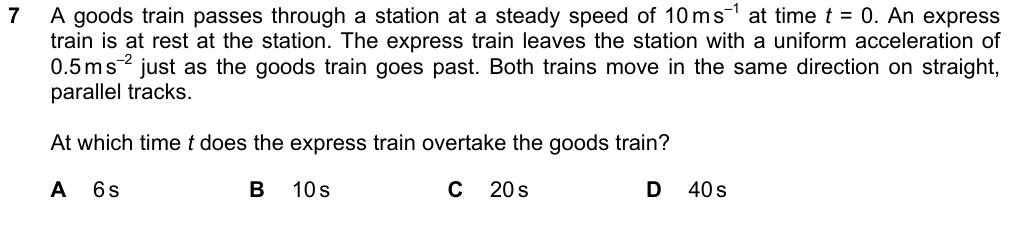
Why it is hard: the November 2022 report says candidates found it difficult. Two objects: one equation each, joined by "same distance at the same time".
A goods train passes a station at a steady 10 m s−1. At that instant an express starts from rest and speeds up. When does the express draw level?
- steady 10 m s−1goods train: s = 10T
- from rest with uniform accelerationexpress: s = ½ × 0.5 × T²
- overtakeboth have covered the SAME distance at the same time
- time T when the express overtakes
- 10 m s−1goods, constant
- a = 0.5 m s−2express, from rest
- FindT
- Usedistance(goods) = distance(express)
- Goods10T
- Express0.25T²
- Trapequal SPEEDS (20 s) is not equal distances
- Usedistance(goods) = distance(express)
At 20 s both trains are going at 10 m s−1. Has the express caught up?
No. Until then it was slower, so it fell behind. It needs more time to make up that gap.
How do you solve 10T = 0.25T²?
Divide both sides by T (T ≠ 0): 10 = 0.25T, so T = 40 s.
5 Now solve it have a go on paper first, then open the worked solution
- Goods train (constant speed): \(s = 10T\).
- Express (from rest): \(s = \tfrac12 \times 0.5 \times T^2\).
- Same s at the overtaking time: \(10T = 0.25T^2\) → \(T = 40\) s → D 1
C (20 s) is the trap: that is when the two trains have the same speed (0.5 × 20 = 10 m s⁻¹). At that moment the express is still behind; it only catches up when the areas under the two v–t graphs are equal.
At 40 s the express is going 20 m s−1, twice the goods train - it has to be faster at the overtaking moment to make up for being slower earlier.
Example 5 · Units first, and keep the 2 (Paper 1, 1 mark) ★★ Medium
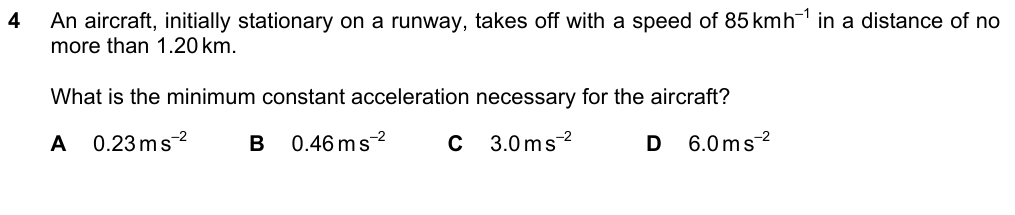
A plane starts from rest and must reach take-off speed, 85 km h−1, within 1.20 km of runway. What is the smallest steady acceleration that does it?
- initially stationaryu = 0
- 85 km h−1convert to m s−1: ÷ 3.6
- no more than 1.20 kms = 1200 m - the longest allowed, so the smallest a
- constant accelerationsuvat applies
- minimum acceleration
- u = 0
- v = 85 km h−1 = 23.6 m s−1
- s = 1.20 km = 1200 m
- no time is given, so use the equation without t
- Finda
- Usev² = u² + 2as → a = v² ÷ 2s
- Unitskm h−1 and km both to SI first
- Trapkeep the 2 in 2as
- Usev² = u² + 2as → a = v² ÷ 2s
How do you turn km h−1 into m s−1?
× 1000 m, ÷ 3600 s - the same as ÷ 3.6. So 85 km h−1 = 23.6 m s−1.
We know u, v and s. Which equation?
v² = u² + 2as - the one without t.
5 Now solve it have a go on paper first, then open the worked solution
- SI units: v = 85 ÷ 3.6 = 23.6 m s−1; s = 1200 m; u = 0.
- No t: \(v^2 = u^2 + 2as\) → \(a = \dfrac{v^2}{2s} = \dfrac{23.6^2}{2 \times 1200}\)
- a = 0.23 m s−2 → A 1
The March 2025 report: the most common error was using 85 without converting (giving C); a minority dropped the 2 in 2as (giving B).
0.23 m s−2 is gentle - it would take about 100 s to reach take-off speed, believable for a 1.2 km run.
Example 6 · Proportion: a 20% faster train (Paper 1, 1 mark) ★★★ Hard
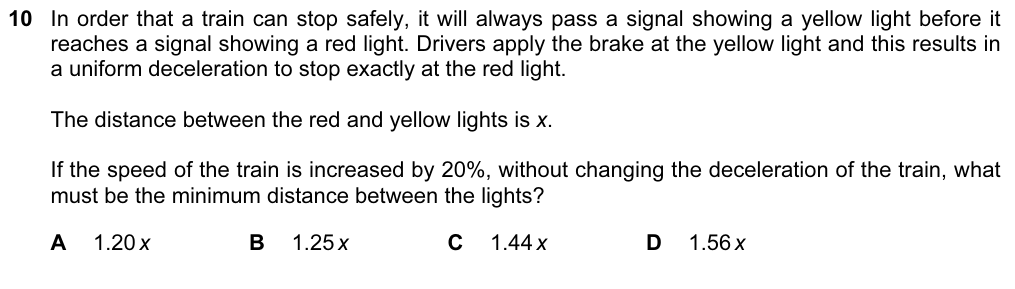
A train brakes steadily from a yellow light to stop exactly at a red light, x away. If it had been going 20% faster with the same braking, how far would it need to stop?
- uniform decelerationa is constant - and the same in both cases
- stop exactlyv = 0
- increased by 20%u becomes 1.20u
- in terms of xa ratio question - no numbers needed
- new stopping distance
- v = 0stops
- asame both times
- u → 1.20u
- Findnew s
- Use0 = u² − 2as → s = u² ÷ 2a
- Sos ∝ u² (a fixed)
- Traps is NOT ∝ u: not 1.20x
- Use0 = u² − 2as → s = u² ÷ 2a
If the speed doubled, what would happen to the stopping distance?
It would go up four times (2²). Stopping distance grows with the SQUARE of the speed.
So for 1.20 times the speed?
1.20² = 1.44 times the distance.
5 Now solve it have a go on paper first, then open the worked solution
- Stopping: v = 0, so \(0 = u^2 - 2as\) → \(s = \dfrac{u^2}{2a}\).
- a is fixed, so \(s \propto u^2\).
- u × 1.20 → s × 1.20² = 1.44x → C 1
The November 2016 report: weaker candidates chose A, assuming s ∝ u.
1.44x is more than 1.20x: a faster train has more speed to lose AND covers more ground every second while losing it.
Summary
- Four equations, constant acceleration only: v = u + at, s = ½(u + v)t, s = ut + ½at², v² = u² + 2as.
- Derive them from a = (v − u)/t and displacement = average velocity × time (or the area of the v–t trapezium).
- Pick a positive direction, give every vector its sign, and use the equation without the quantity you don't know or need.
- Free fall: a = 9.81 m s⁻² down for any mass, even at the top. Stages: the final v of one is the u of the next.
| If you see… | do this |
|---|---|
| "from rest" / "dropped" | u = 0 |
| "maximum height" / "comes to rest" | v = 0 there |
| released from something moving | u = the velocity of that thing |
| "overtakes" / "catches up" | same s at the same t for both |
| "if the speed is doubled…" | write s or t in terms of u and use proportion |
Can I do this?
- I know the four equations, which are on the formula sheet, and that they need constant acceleration.
- I can derive all four from the definitions (or from a v–t graph).
- I can choose the right equation and give every vector a sign.
- I use g = 9.81 m s⁻² downwards for any falling object, including at the top.
- I can solve two-stage and two-object problems.
- I can state the conditions for s = ½at².
Anything unticked: revise that section first. All ticked: take the quiz.
Quiz
Your progress on this note is saved when JavaScript is on.