
Kinematics
Projectiles: motion in two dimensions
What you need to be able to do
- 2.1.9Describe and explain motion due to a uniform velocity in one direction and a uniform acceleration in a perpendicular direction.
Before you start: Resolving vectors and Equations of motion. This is the last page of the chapter.
Two motions at once
A projectile (a thrown ball, a dropped parcel, a water droplet) moves across and up-or-down at the same time. The trick is to treat the two directions separately: they share only the time.
Horizontal: constant velocity
\[ v_x = u\cos\theta \;\;(\text{never changes}) \qquad x = (u\cos\theta)\,t \]
No horizontal force acts (air resistance negligible), so there is no horizontal acceleration.
Vertical: constant acceleration g
\[ v_y = u\sin\theta - gt \qquad y = (u\sin\theta)\,t - \tfrac12 g t^2 \]
The only force is the weight, so a = 9.81 m s⁻² downwards, all the way.
Putting them back together
\[ v = \sqrt{v_x^2 + v_y^2} \qquad \tan\alpha = \frac{v_y}{v_x} \]
The speed and the angle of the velocity at any moment.
Launched horizontally
- Vertical first: find the time. It starts with no vertical velocity, so \(h = \tfrac12 g t^2\) gives \(t = \sqrt{2h/g}\). The horizontal speed has nothing to do with it.
- Horizontal distance = horizontal velocity × that same time: \(x = u\,t\).
- Vertical velocity on landing: \(v_y = gt\) (or \(v_y^2 = 2gh\)).
- Landing speed: \(v = \sqrt{u^2 + v_y^2}\); angle below the horizontal \(\tan^{-1}(v_y / u)\).
Launched at an angle
- Split the launch velocity: across \(u\cos\theta\), up \(u\sin\theta\). The June 2023 report: wrong answers mostly came from using the whole 12 m s⁻¹ as the vertical component instead of 12 sin 50° 9702/11/M/J/23 Q6. The November 2023 report: some used the given horizontal component as if it were the whole velocity.
- Top of the path: \(v_y = 0\) (but \(v_x\) is not). Time to the top \(t = \dfrac{u\sin\theta}{g}\); maximum height above the launch point \(\dfrac{(u\sin\theta)^2}{2g}\).
- Back to the launch height: the flight is symmetric, total time \(\dfrac{2u\sin\theta}{g}\) and range \(R = u\cos\theta \times \dfrac{2u\sin\theta}{g} = \dfrac{2u^2\sin\theta\cos\theta}{g}\) 9702/12/M/J/21 Q7.
- Landing somewhere else (a wall, a cliff): use the horizontal distance to find t first, then put that t into the vertical equation.
Speed by energy
Since 2024, Paper 2 also asks for a landing speed "by considering energy". Kinetic energy at launch + gravitational potential energy lost = kinetic energy at landing:
\[ \tfrac12 m v^2 = \tfrac12 m u^2 + m g h \quad\Longrightarrow\quad v^2 = u^2 + 2gh \]
The mass cancels, and so does the direction of the launch. Same launch speed and same drop in height → same landing speed, whatever the angle 9702/13/M/J/25 Q7, 9702/21/M/J/25 Q1(c)(ii). A faster launch → a faster landing 9702/23/M/J/25 Q1(c)(ii).
Graphs of a projectile
| Quantity against time | Shape | Why |
|---|---|---|
| horizontal velocity | horizontal line | no horizontal force |
| vertical velocity | straight line sloping down (gradient −g) | constant acceleration |
| acceleration | horizontal line at g | only the weight acts |
| speed | dips to a minimum at the top, not to zero, then rises again | vx never vanishes |
| horizontal distance | straight line through the origin | constant vx |
| height | upside-down parabola | y = (u sin θ)t − ½gt² |
With air resistance there is a horizontal force (backwards), so the horizontal velocity falls, and the downward acceleration is less than g. A ball thrown horizontally then lands with a smaller horizontal velocity and takes longer to land (9702/12/F/M/19 Q9, answer A). The path is shorter and steeper on the way down. In this chapter, always assume no air resistance unless told.
Try it: launch a projectile
Projectile launcher
Teaching point: the horizontal velocity (blue) never changes; the vertical velocity (pink) changes by 9.81 m s⁻¹ every second. Add them to get the velocity (green).
Turn on JavaScript to change the launch speed, angle and height.
Mark-scheme focus
Why the horizontal velocity stays constant
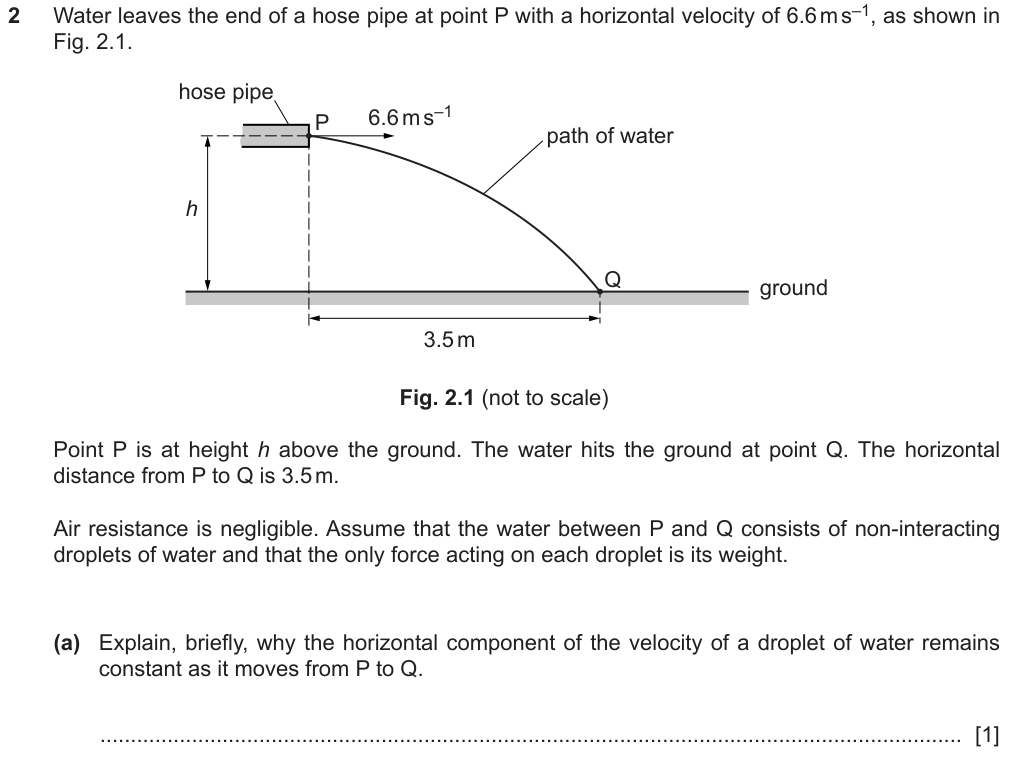
"force (on the droplet) in the horizontal direction is zero" B1
- "there is no resultant force" (there is: the weight)
- an answer that doesn't say horizontal
The March 2022 report: the explanation must separate the horizontal from the vertical motion. The resultant force is the weight, so "no resultant force" is wrong; it is the horizontal force that is zero.
No horizontal force → no horizontal acceleration → constant horizontal velocity.
From: 9702/22/F/M/22 Q2(a) and the March 2022 examiner report.
Sketching the path of a dropped parcel
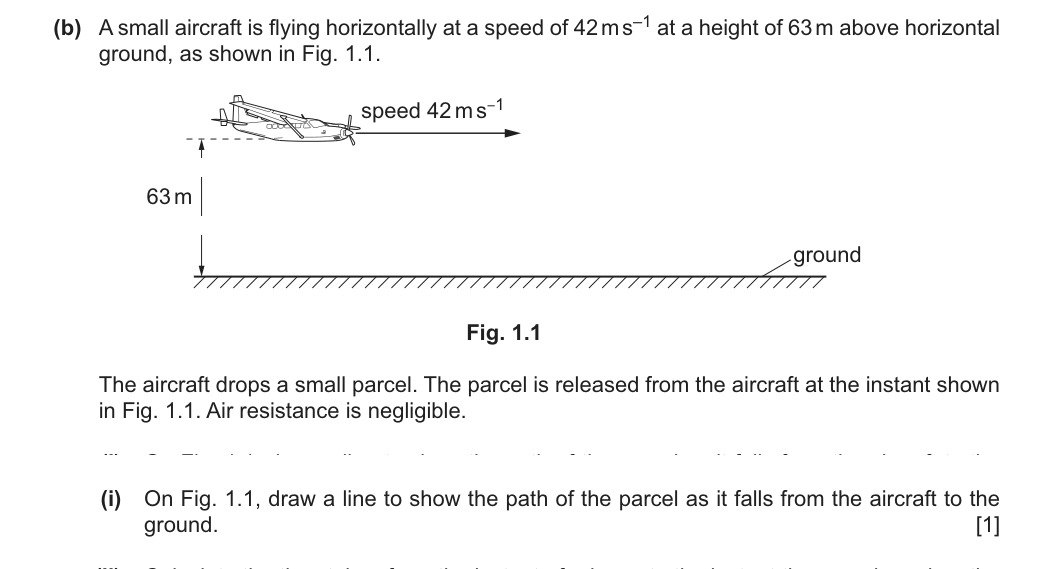
a curved path from the aircraft to the ground, starting horizontal and getting steeper as it falls B1
- a straight sloping line
- a line straight down from the aircraft
- a curve that starts off pointing downwards
The parcel leaves with the aircraft's horizontal velocity and no vertical velocity, so its path starts horizontal; the vertical velocity then grows, so the path bends down more and more.
Relative to the ground it moves forward as it falls; it does not drop straight down.
From: 9702/23/O/N/24 Q1(b)(i) mark scheme.
- Projectile calculation (components, time, height, range, landing speed and angle): the most common Paper 2 kinematics question since 2016, 7–11 marks.
- "By considering energy" and compare-and-explain parts: new since 2024, B1 for the comparison + B1 for the reason.
- Paper 1: which graph (speed, components), which statement is correct, range or height from given values.
Worked examples
Example 1 · A parcel dropped from an aircraft (Paper 2, 6 marks) ★★ Medium
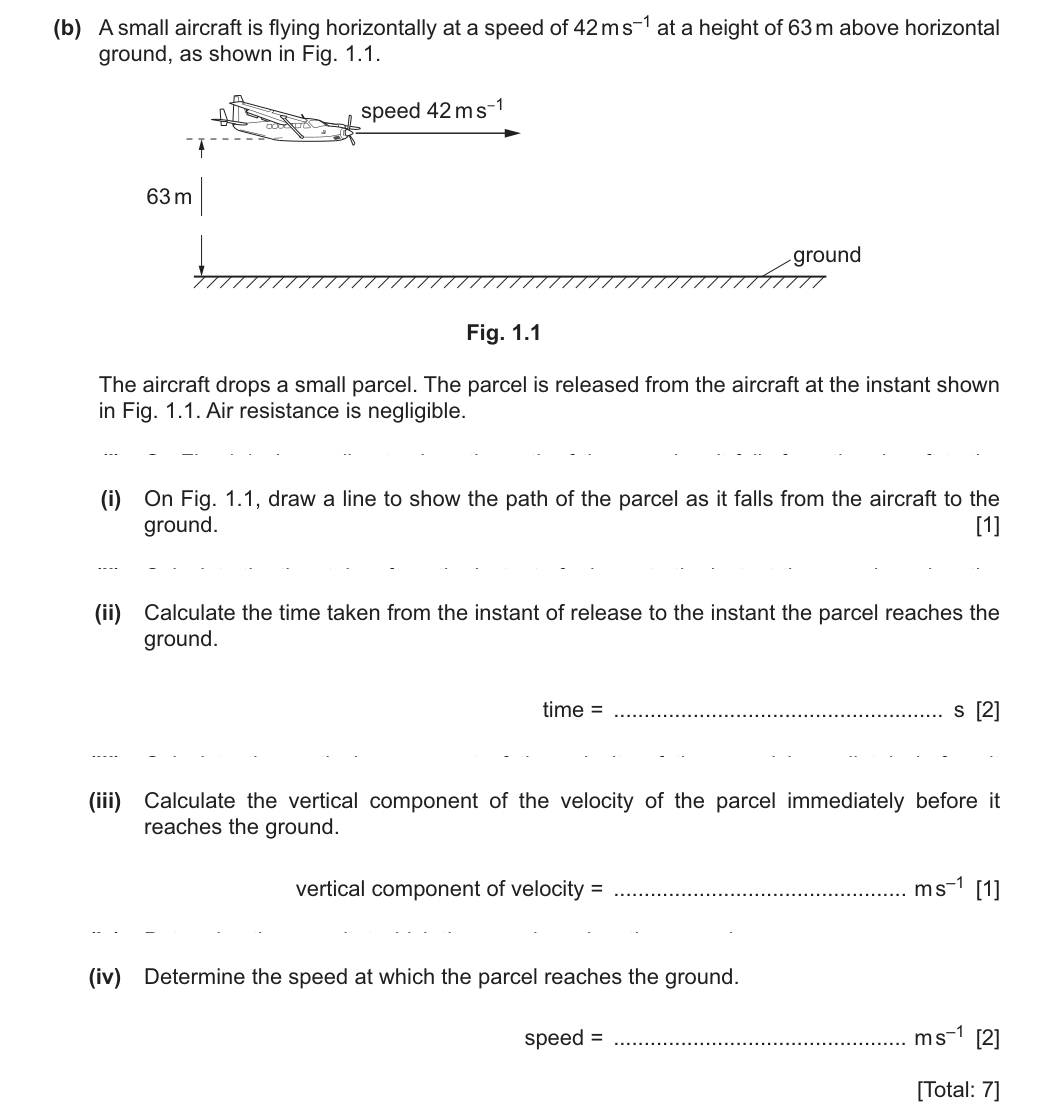
A plane flying level drops a parcel. The parcel keeps the plane's forward speed (nothing slows it sideways) while gravity pulls it down from rest. Two independent motions: steady sideways, accelerating downwards.
- flies horizontally … dropsat release the parcel's VERTICAL velocity is 0; its horizontal velocity is 42 m s−1
- air resistance negligiblehorizontal velocity stays 42 m s−1 all the way
- vertical componentonly the downward part of the velocity
- speed at which it reaches the groundcombine both components with Pythagoras
- (ii)time to the ground
- (iii)vertical velocity at the ground
- (iv)landing speed
- vx = 42 m s−1constant
- uy = 0dropped
- h = 63 m
- g = 9.81 m s−2
- (ii) Findt
- Usevertical only: 63 = ½ × 9.81 × t²
- Trap42 m s−1 has nothing to do with the time
- Usevertical only: 63 = ½ × 9.81 × t²
- (iii) Findvy
- Usev = u + at, vertical
- Needst from (ii)
- Usev = u + at, vertical
- (iv) Findspeed
- Use√(vx² + vy²)
- Needsvy from (iii)
- Use√(vx² + vy²)
Would the parcel take longer to land if the plane flew faster?
No. The time depends only on the vertical motion: dropping 63 m from zero vertical speed.
Why can't we just add 35 and 42 for the speed?
They are at right angles. Perpendicular components combine by Pythagoras, not by adding.
5 Now solve it have a go on paper first, then open the worked solution
- (i) The path: a curve that starts horizontal and gets steeper (see the card above). B1
- (ii) Vertical: u = 0, s = 63 m, a = 9.81. \(63 = \tfrac12 \times 9.81 \times t^2\) C1 → t = 3.6 s A1 The 42 m s⁻¹ plays no part in the time.
- (iii) \(v_y = 0 + 9.81 \times 3.6 =\) 35 m s−1 A1 Or \(v_y^2 = 2 \times 9.81 \times 63\).
- (iv) The horizontal velocity is still 42 m s⁻¹: speed² = 35² + 42² C1 → speed = 55 m s−1 A1
Bigger than both components (35 and 42) but less than their sum (77): it is the hypotenuse.
Example 2 · Over a wall (Paper 2, 6 marks) ★★ Medium
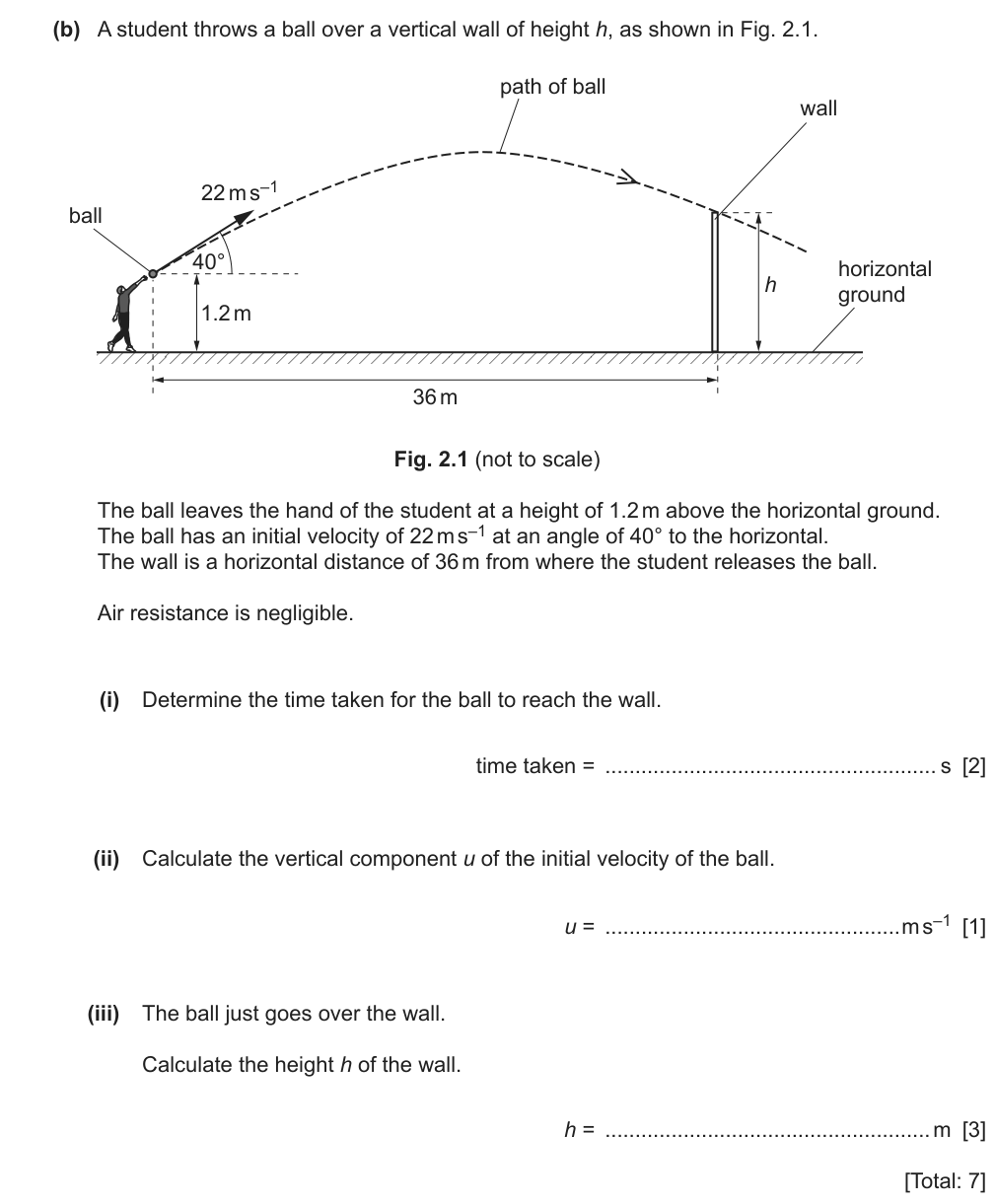
A ball is thrown at 40° above the horizontal and just clears a wall 36 m away. The horizontal motion tells us when it reaches the wall; the vertical motion tells us how high it is at that moment.
- at 40° to the horizontalsplit 22 m s−1: horizontal 22 cos 40°, vertical 22 sin 40°
- 36 m away horizontallyhorizontal distance = horizontal velocity × time
- just goes over the wallits height at that time = the wall's height
- 1.2 m above the groundthe vertical displacement is measured from the hand - add 1.2 m at the end
- (i)time to reach the wall
- (ii)initial vertical velocity
- (iii)height of the wall h
- 22 m s−1 at 40°launch
- x = 36 mto the wall
- 1.2 mlaunch height
- (i) Findt
- Uset = 36 ÷ (22 cos 40°)
- (iii) Findh
- Uses = ut + ½at² vertically, up = +
- u22 sin 40° from (ii)
- tfrom (i)
- Trapthen add 1.2 m
- Uses = ut + ½at² vertically, up = +
Which motion tells us WHEN the ball reaches the wall?
The horizontal motion - it is steady, so time = distance ÷ horizontal speed.
Is the ball still rising when it reaches the wall?
No: it reaches the top at 14 ÷ 9.81 = 1.4 s, so at 2.1 s it is already on the way down. The equation handles that automatically.
5 Now solve it have a go on paper first, then open the worked solution
- (i) Horizontal velocity = 22 cos 40° C1 = 16.9 m s⁻¹; time = 36 / 16.9 = 2.1 s A1
- (ii) u = 22 sin 40° = 14 m s−1 A1
- (iii) Vertical, up = +: \(s = ut + \tfrac12at^2 = (14 \times 2.1) + \tfrac12(-9.81)(2.1)^2\) C1 = 7.8 m above the hand C1
- Height of the wall = 7.8 + 1.2 = 9.0 m A1 Add the 1.2 m: s is measured from the hand.
The scheme also accepts a two-step route: time to the top (14/9.81 = 1.43 s), maximum height 9.99 m above the hand, then fall for the remaining 0.67 s (2.2 m): 9.99 − 2.2 = 7.8 m.
h = 9.0 m is below the ball's highest point (about 11.2 m above the ground) - right, since it is already falling.
Example 3 · Landing on a slope (Paper 2, 10 marks) ★★★ Hard
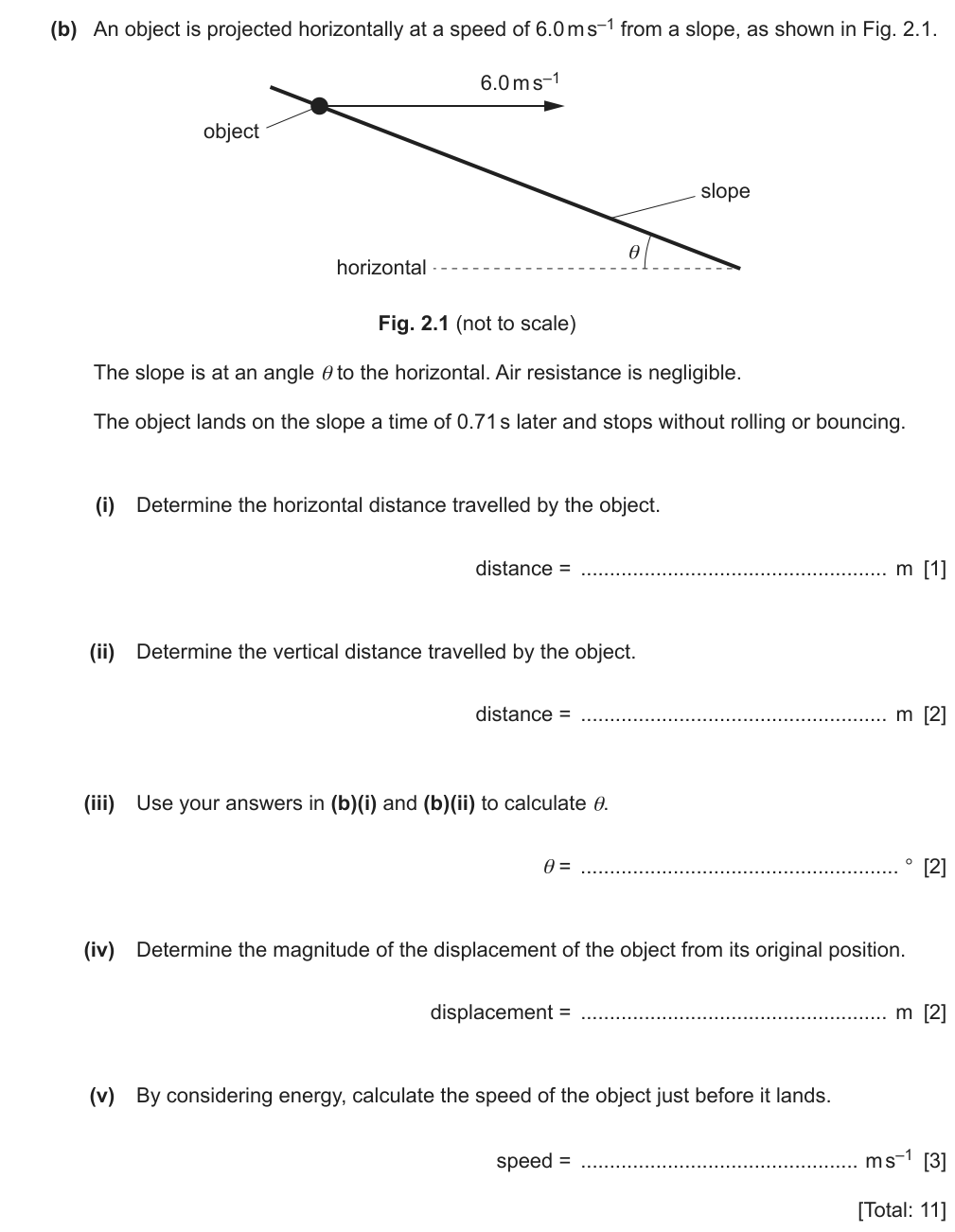
An object is fired horizontally off a slope and lands further down the same slope 0.71 s later. The horizontal and vertical distances it covers form a right-angled triangle whose angle is the slope's angle. Finally, energy gives the landing speed.
- projected horizontallyvertical velocity starts at 0
- lands on the slopethe landing point is on the slope: the two distances fit its angle
- magnitude of the displacementthe straight line from launch to landing (Pythagoras)
- by considering energyKE at start + GPE lost = KE at landing - the method is required
- (i)horizontal distance
- (ii)vertical distance
- (iii)θ
- (iv)displacement
- (v)landing speed, by energy
- ux = 6.0 m s−1
- uy = 0
- t = 0.71 s
- (iii) Findθ
- Usetan θ = vertical ÷ horizontal
- Horizontal6.0 × 0.71
- Vertical½ × 9.81 × 0.71²
- Usetan θ = vertical ÷ horizontal
- (v) Findlanding speed
- Use½mu² + mgh = ½mv² (m cancels)
- hvertical drop from (ii)
- Use½mu² + mgh = ½mv² (m cancels)
Which angle of the triangle is the slope's angle θ?
The one at the launch point between the horizontal and the slope: opposite side vertical, adjacent side horizontal, so tan θ = 2.5 ÷ 4.3.
Why does the mass not matter in part (v)?
Every term (½mu², mgh, ½mv²) has m in it, so it cancels.
5 Now solve it have a go on paper first, then open the worked solution
- (i) Horizontal: 6.0 × 0.71 = 4.3 m A1
- (ii) Vertical from rest: \(\tfrac12 \times 9.81 \times 0.71^2\) C1 = 2.5 m A1
- (iii) The two distances are the sides of a right-angled triangle on the slope: tan θ = 2.5 / 4.3 C1 → θ = 30° A1
- (iv) Displacement = \(\sqrt{4.3^2 + 2.5^2}\) C1 = 5.0 m (4.9 accepted) A1
- (v) Energy: initial KE + GPE lost = final KE C1: \(\tfrac12 m(6.0)^2 + m(9.81)(2.5) = \tfrac12 m v^2\) C1
- m cancels: \(v^2 = 36 + 49.1\) → v = 9.2 m s−1 A1
Check by components: \(v_y = 9.81 \times 0.71 = 7.0\) m s⁻¹, so \(v = \sqrt{6.0^2 + 7.0^2} = 9.2\) m s⁻¹. Same answer, but the question said "by considering energy", so the energy route is what scores.
Components give the same: vy = 9.81 × 0.71 = 7.0, √(6.0² + 7.0²) = 9.2 m s−1 ✓. Landing speed is bigger than 6.0 - it gained energy falling.
Example 4 · Same speed, new angle: explain (Paper 2, 4 + 4 marks) ★★★ Hard
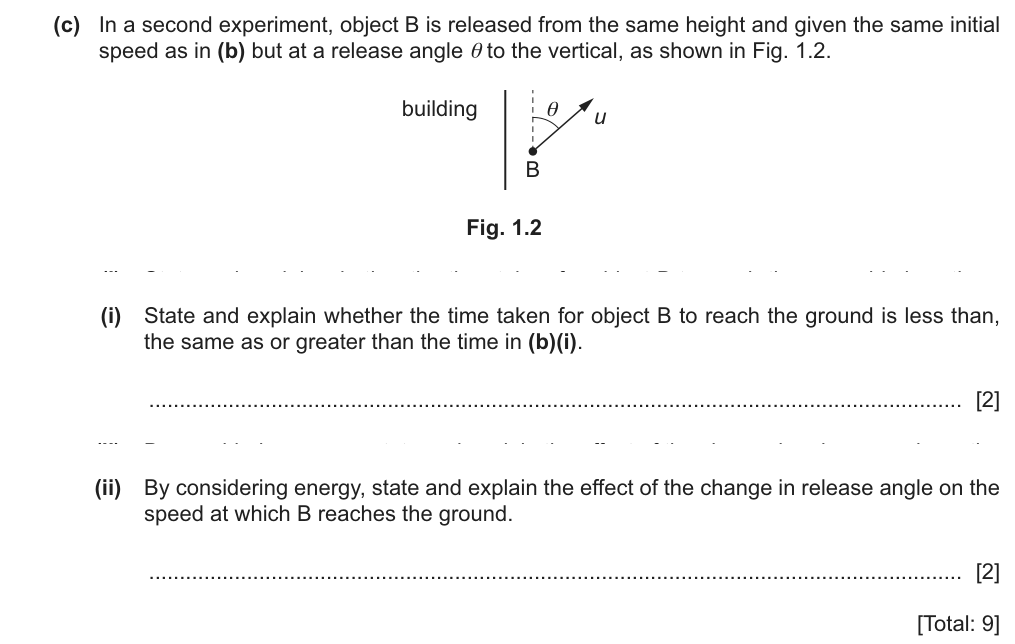
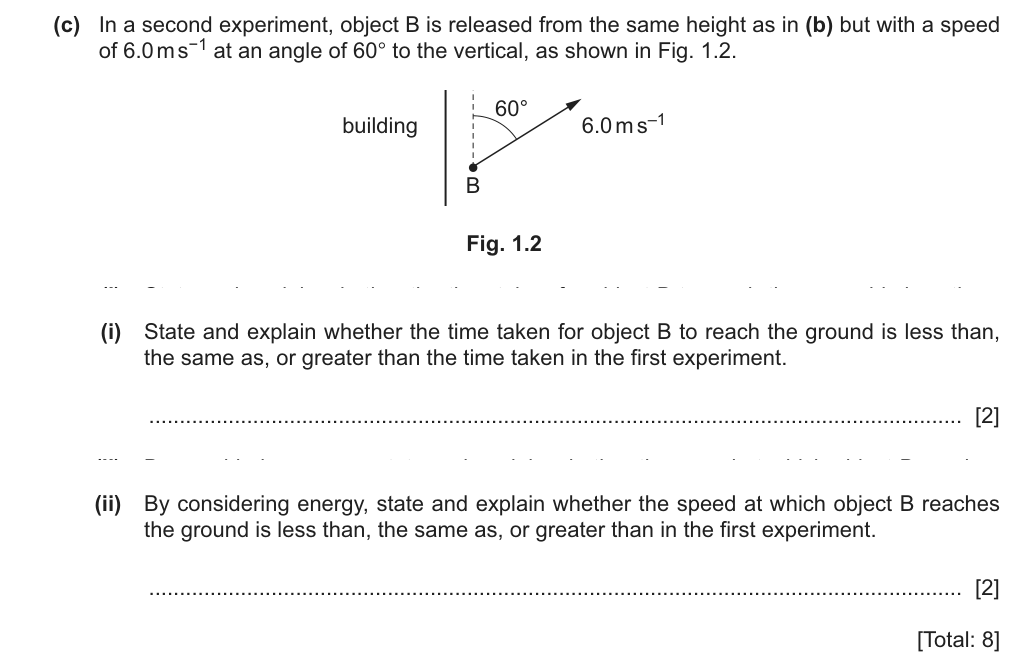
The same object is launched again from the same height, but in a different direction (and, in the second paper, faster). We have to compare the time to reach the ground and the landing speed - with reasons, not calculations.
- State and explaina comparison (less / same / greater) AND the reason - each is a mark
- time to reach the grounddecided only by the VERTICAL motion
- By considering energylanding speed comes from starting KE + GPE lost - direction doesn't matter
- (i)time: less, same or greater?
- (ii)landing speed: effect
- same heightsame GPE lost
- launch speedsame (21/M/J/25) or doubled (23/M/J/25)
- new directionchanges the vertical component
- (i) Comparetime
- Usecompare the initial VERTICAL velocities
- Less upward speeddoesn't rise as high → less time
- Usecompare the initial VERTICAL velocities
- (ii) Comparelanding speed
- Useenergy: starting KE + mgh = final KE
- Same heightsame GPE lost
- Sosame launch speed → same landing speed; bigger → bigger
- Useenergy: starting KE + mgh = final KE
Does the horizontal part of the launch velocity change how long it takes to land?
No - horizontal and vertical motions are independent. Only the vertical part matters for the time.
Why does the direction of the launch not affect the landing speed?
Kinetic energy depends on speed, not direction. Same starting KE plus the same GPE lost gives the same final KE.
5 Now solve it have a go on paper first, then open the worked solution
| 9702/21/M/J/25: same speed, now at angle θ | 9702/23/M/J/25: 6.0 m s⁻¹ at 60° to the vertical (was 3.0 m s⁻¹ straight up) | |
|---|---|---|
| initial vertical velocity | u cos θ: smaller than u | 6.0 cos 60° = 3.0 m s⁻¹: the same |
| (i) time to the ground | less time B1 because the initial vertical velocity is smaller (it doesn't rise as high) B1 | the same B1 because the initial vertical velocity is the same B1 |
| (ii) landing speed | initial (kinetic) energy the same B1 and the change in GPE is the same, so the speed is the same B1 | initial (kinetic) energy greater B1; the change in GPE is the same, so the speed is greater B1 |
Each part needs both a comparison and its reason. "The speed is the same" alone gets one mark.
Each answer has both parts: what changes AND why. 'The speed is the same' on its own only gets one of the two marks.
Example 5 · Speed after 9 s on the Moon (Paper 1, 1 mark) ★★★ Hard
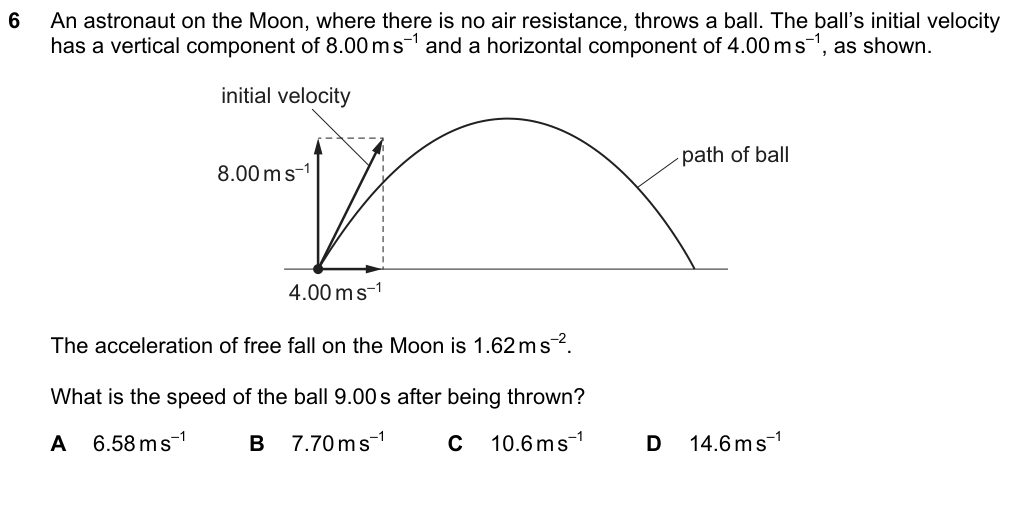
On the Moon a ball is thrown with an upward component 8.00 and a sideways component 4.00 m s−1. Moon gravity is weak. After 9.00 s, how fast is it going?
- vertical component … horizontal componentalready split for you: handle each separately
- g on the Moon is 1.62use 1.62, not 9.81
- speedcombine the two components with Pythagoras at 9.00 s
- speed at t = 9.00 s
- uy = 8.00 m s−1up
- vx = 4.00 m s−1constant
- g = 1.62 m s−2down
- t = 9.00 s
- Findspeed
- Use√(vx² + vy²)
- vx4.00, unchanged
- vy8.00 − 1.62 × 9.00 (up = +)
- Trapdon't add 4.00 and 6.58
- Use√(vx² + vy²)
vy comes out negative. What does that mean?
The ball has passed the top and is now moving down. For the speed only the size (6.58) matters.
Does the horizontal speed change?
No - nothing acts sideways, so it stays 4.00 m s−1.
5 Now solve it have a go on paper first, then open the worked solution
- Horizontal: no change, \(v_x = 4.00\) m s⁻¹.
- Vertical: \(v_y = u + at = 8.00 - 1.62 \times 9.00 = -6.58\) m s⁻¹ (now moving down).
- Speed = \(\sqrt{4.00^2 + 6.58^2} =\) 7.70 m s−1 → B 1
| Option | Where it comes from (November 2023 report) |
|---|---|
| A 6.58 | only the vertical component |
| B 7.70 | both components combined by Pythagoras ✓ |
| C 10.6 | adding the sizes 4.00 + 6.58: components at right angles don't add like numbers |
| D 14.6 | only the change in the vertical velocity, 1.62 × 9.00 |
7.70 is bigger than each component (4.00 and 6.58) but smaller than their sum (10.6): exactly how a hypotenuse behaves.
Summary
- Horizontal: no force, constant velocity, x = (u cos θ)t. Vertical: constant acceleration g, like a dropped or thrown ball.
- The two directions share only the time: find t from one, use it in the other.
- At the top vy = 0 but vx isn't, so the speed is not zero.
- Landing speed: Pythagoras on the components, or energy (v² = u² + 2gh), which doesn't depend on the angle.
| If you see… | do this |
|---|---|
| "projected horizontally" | vertical u = 0; time from the height alone |
| a launch angle | split: across u cos θ, up u sin θ |
| a horizontal distance given (wall, gap) | t = distance ÷ horizontal velocity, then use t vertically |
| "by considering energy" | ½mu² + mgh = ½mv² |
| "state and explain" | comparison + reason, one mark each |
Can I do this?
- I can explain why the horizontal velocity is constant and the vertical acceleration is g.
- I can solve a horizontal launch: time from the height, then distance and landing speed.
- I can split a launch velocity and find the time, maximum height and range.
- I can find a landing speed by energy and explain why the angle doesn't change it.
- I can pick the right graphs of speed, components and distance against time.
Anything unticked: revise that section first. All ticked: take the quiz.
Quiz
Your progress on this note is saved when JavaScript is on.