
Dynamics
Newton's laws, mass, weight and F = ma
On this page
- What you need to be able to do
- The one idea behind this chapter
- Mass and weight
- Newton's first law
- Newton's second law and F = ma
- Newton's third law
- How to solve any F = ma question
- Case by case: the F = ma situations that come up
- The lift (elevator) and bathroom scales
- Mark-scheme focus
- Worked examples
- Summary
- Can I do this?
- Quiz
What you need to be able to do
- 3.1.1Understand that mass is the property of an object that resists change in motion.
- 3.1.2Recall F = ma and solve problems with it, knowing that acceleration and resultant force are always in the same direction.
- 3.1.5State and apply each of Newton's three laws of motion.
- 3.1.6Describe weight as the effect of a gravitational field on a mass, and recall W = mg.
Before you start: Scalars and vectors (resolving forces) and Equations of motion. Next: Momentum and force.
The one idea behind this chapter
Forces do not keep things moving. Forces change motion. A puck sliding on ice keeps going on its own; it only speeds up, slows down or turns when a resultant (unbalanced) force acts on it. Newton's three laws are three ways of saying this precisely:
First law: no resultant force
The velocity does not change: the object stays at rest, or keeps moving at a constant speed in a straight line.
Second law: a resultant force
The momentum changes, at a rate equal to the resultant force. For a fixed mass this is \(F = ma\).
Third law: forces come in pairs
If A pushes or pulls B, then B pushes or pulls A back with an equal and opposite force.
The word that matters most in the whole chapter is resultant: the single force that has the same effect as all the forces on the object added together as vectors. Most lost marks in Dynamics come from using one of the forces where the resultant was needed.
Mass and weight
A large mass is hard to get moving and hard to stop: a loaded lorry needs a far bigger force than a bicycle to reach the same acceleration. That "reluctance to change motion" is what mass measures; it is often called inertia.
| Mass | Weight | |
|---|---|---|
| What it is | a property: resistance to change in motion | a force: the pull of gravity |
| Unit | kg | N |
| Scalar or vector | scalar | vector (towards the planet's centre) |
| On the Moon | unchanged | about one sixth (g is smaller) |
| In deep space | unchanged | nearly zero |
Newton's first law
"Constant velocity" means constant speed and constant direction. So the law works both ways:
- Resultant force = 0 → velocity constant (at rest, or a straight line at steady speed). The forces can be large; they just cancel.
- Velocity constant → resultant force = 0. A car cruising at a steady 30 m s−1 on a straight road has driving force = resistive force. The resultant is zero, not "equal to the driving force" (9702/11/M/J/22 Q7, answer D).
- An object moving in a circle at steady speed is not at constant velocity (its direction changes), so a resultant force must act on it 9702/11/O/N/19 Q7.
Newton's second law and F = ma
Momentum is mass × velocity (next page). If the mass does not change, the rate of change of momentum is \(m\,\dfrac{\Delta v}{\Delta t} = ma\). With SI units chosen so the constant is 1 (that is how the newton is defined: 1 N = 1 kg m s−2):
\[ F = ma \]
| Symbol | Meaning | Unit |
|---|---|---|
| F | resultant force (vector sum of all the forces on the object) | N |
| m | mass of the object (or of the whole system you chose) | kg |
| a | acceleration, in the same direction as F | m s−2 |
Rearranged: \(a = F/m\), \(m = F/a\). It only works with the resultant force, and only when the mass is constant (a rocket losing fuel needs the momentum form, or F = ma with the mass at that instant).
Newton's third law
The two forces of a third-law pair always:
- act on two different bodies (one on A, one on B), so they can never cancel each other out;
- are the same type of force (both gravitational, both contact/electric, both magnetic);
- are equal in size and opposite in direction, at every instant, even while the bodies accelerate or collide.
How to find the partner of any force, in two steps:
- Say the force as a sentence: "A pulls/pushes B (type)". The weight of a box = "the Earth pulls the box (gravitational)".
- Swap A and B, keep the type, reverse the direction: "the box pulls the Earth (gravitational), upwards". That is the partner.
How to solve any F = ma question
Every force-and-acceleration question, from a box on a slope to a rocket, is solved with the same six steps. Write them out every time; the C1 marks are for steps 4 and 5.
- Choose the object. Decide which body (or group of bodies moving together) you are applying the law to. Only forces acting on it count.
- Draw a free-body diagram. A dot or box with every force on it as an arrow: weight (always), contact/normal force (if it touches a surface), friction or drag (opposing the motion), tension (strings), thrust or applied forces.
- Choose a positive direction: the direction of the acceleration if you know it, otherwise the direction of motion.
- Resolve any slanted force into components along and perpendicular to that direction (on a slope: along the slope uses mg sin θ, perpendicular uses mg cos θ).
- Write the resultant force along the line of motion, with signs: forces in the positive direction minus forces against it. Then F = ma.
- Solve and check: is a in the direction of the resultant? Is the size sensible (less than g for most everyday things)? Right unit?
Case by case: the F = ma situations that come up
Each case is the six steps above with a different free-body diagram. Spot which case you have, then follow it.
1 Pulled along a rough floor (friction)
A block's resultant force is 1.5 N forwards. The friction on it is 2.0 N. Find the pulling force X. 9702/21/M/J/23 Q3(b)
Askedthe pulling force XKnowthe resultant (1.5 N) and the friction (2.0 N)Routeresultant = X − friction, so X = resultant + friction
- Forwards = +: resultant = X − friction.
- 1.5 = X − 2.0
- X = 3.5 N. Add the friction: the pull has to beat friction and provide the resultant. (The June 2023 report: many subtracted.)
2 Down (or up) a slope
A 65 kg box accelerates down a 20° slope at 2.6 m s−2. Find the resistive force R. 9702/22/M/J/14 Q3
Askedthe resistive force R on a slopeKnowm, the angle, the accelerationRouteresolve the weight along the slope (mg sin θ), then mg sin θ − R = ma
- Down the slope = +. Forces along the slope: mg sin 20° (down), R (up). The normal force and mg cos 20° are perpendicular and cancel.
- mg sin 20° = 65 × 9.81 × sin 20° = 218 N
- 218 − R = 65 × 2.6 = 169
- R = 49 N
3 Vertical: lift, rocket, anything going up or down
A water rocket of mass 0.64 kg has a thrust of 30 N upwards. Find its acceleration. 9702/23/O/N/18 Q3(b)(iv)
Askedthe rocket's accelerationKnowthrust up, massRoutetake the weight off first: (thrust − mg) ÷ m
- Up = +. Forces: thrust 30 N up, weight 0.64 × 9.81 = 6.3 N down.
- Resultant = 30 − 6.3 = 23.7 N up.
- a = 23.7 / 0.64 = 37 m s−2 upwards. (Not 30 / 0.64: the weight must come off.)
4 Constant velocity: find a missing force
An aircraft flies level at a constant 90 m s−1. The drag is 2400 N. What is the thrust? 9702/12/F/M/21 Q18
Askedthe thrustKnowconstant velocity, the dragRouteconstant velocity → resultant = 0 → thrust = drag
- Constant velocity → a = 0 → resultant force = 0 (first law).
- Thrust − drag = 0
- Thrust = 2400 N. The weight is vertical and plays no part in the horizontal balance.
5 Two bodies joined by a string (connected bodies)
A 2.0 kg block on a frictionless table is tied by a string over a pulley to a hanging 1.0 kg mass. Find the acceleration. 9702/11/O/N/12 Q13
Askedthe acceleration of two tied massesKnowboth masses, one hangsRoutewhole system: hanging weight ÷ total mass (tension cancels)
- Whole system (both masses move together, same a): the only force that drives it is the hanging weight, 1.0 × 9.81 = 9.81 N. The tension is internal and cancels.
- Total mass = 3.0 kg → a = 9.81 / 3.0 = 3.27 m s−2.
- Check with each body: block: T = 2.0a. Hanging mass: 9.81 − T = 1.0a. Add them: 9.81 = 3.0a. Same answer, and T = 6.5 N (less than the weight 9.81 N, so the hanging mass accelerates down).
6 Objects falling together (in a vacuum)
Block X (weight 2w) sits on block Y (weight w) as they fall freely in a vacuum. What force does X exert on Y? 9702/11/O/N/15 Q14
Askedthe force X exerts on YKnowboth fall freely in a vacuumRouteboth have a = g, so each one's weight alone gives it that: the contact force is 0
- Both fall with acceleration g, with no air resistance.
- Object X: resultant = 2w − (push from Y) = mXg = 2w.
- So the push is zero. In free fall nothing presses on anything (that is why astronauts in orbit feel weightless).
The lift (elevator) and bathroom scales
Scales do not measure your weight. They measure the contact force they push up on you with (and show it divided by g). That force only equals your weight when you are not accelerating.
- Up = +. Forces on you: contact force N from the scales (up), weight mg (down).
- N − mg = ma, so N = m(g + a).
- Reading more than your mass → a is upwards: moving up and speeding up, or moving down and slowing down.
- Reading less → a is downwards: moving down and speeding up, or moving up and slowing down.
- Reading your real mass → a = 0: at rest or at constant velocity, whichever way it moves.
Mark-scheme focus
Define force
Define force.
- "rate of change of momentum"
- "mass × acceleration" / "F = ma"
- "a push or a pull"
- "change of momentum" (no "rate of")
The definition must hold in every case, including when the mass changes. ma is only a way to calculate the resultant force for a constant mass. The March 2025 report: "a significant number gave 'mass times acceleration' which is ... not the definition of force".
From: 9702/22/F/M/25 Q3(b)(i), 9702/22/M/J/23 Q3(a)(i) and their reports. Paper 1 asks it too: 9702/12/F/M/24 Q15 (answer C).
State Newton's second law

- "(resultant) force is proportional to / equal to the rate of change of momentum"
- "force = mass × acceleration" (named in the 2016, 2017, 2018 and 2023 reports)
- "force is proportional to the change in momentum" (no rate)
- "the relationship between force and acceleration"
The November 2018 report: F = ma "is a special case of the second law, but is not a complete statement and as such is too imprecise to be given credit".
"force = change in momentum / time taken" 9702/22/O/N/12 Q2(a).
From: 9702/23/O/N/18 Q3(a), 9702/21/M/J/23 Q3(a), 9702/23/M/J/17 Q2(a) and their reports.
State Newton's first law
State Newton's first law of motion.
- "a body continues (at rest or) at constant velocity unless acted on by a resultant force"
- "... unless a force acts on it" (any force, not the resultant)
- "... continues at constant speed" (speed is not velocity)
Forces act on almost everything; what matters is whether they add up to zero. And a body moving at constant speed round a bend is acted on by a resultant force.
State Newton's third law

- "force on body A (by body B) is equal (in magnitude) to force on body B (by body A)"
- "... is opposite (in direction) ..."
- "action and reaction are equal and opposite" (no bodies named)
- "every force has an equal and opposite force" (could be two forces on the same body)
The November 2019 report: "it should be made clear that the forces act on different objects. Vague and incomplete statements such as 'action and reaction are equal and opposite' should be avoided."
A 3-mark version 9702/22/M/J/10 Q3 gave a third mark for "the forces are of the same kind".
From: 9702/22/O/N/19 Q3(a), 9702/22/M/J/10 Q3(a)(ii) and the November 2019 report.
Why is the normal contact force equal to the weight?
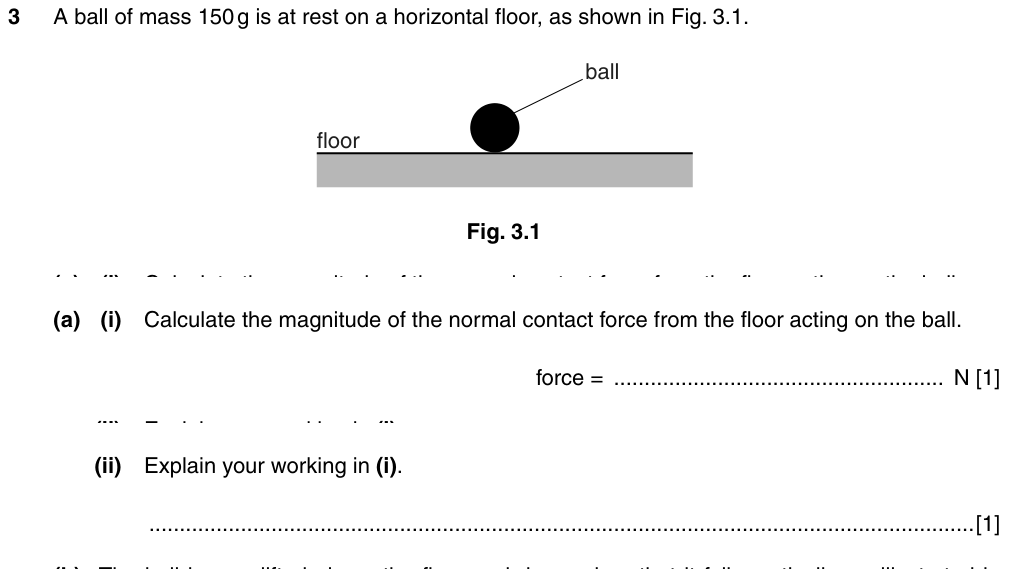
- (i) mg = 0.15 × 9.81 = 1.5 N
- (ii) "resultant force (on ball) is zero so normal contact force = weight"
- "by Newton's third law, the reaction equals the weight"
The June 2016 report: "an explanation based on Newton's third law is incorrect because the weight and the normal contact force act on the same body. A widespread misconception was that the normal contact force was the 'reaction force' to the ball's weight."
From: 9702/21/M/J/16 Q3(a) and the June 2016 report.
What is meant by mass?

- "the property (of a body) resisting changes in motion"
- "the quantity of matter (in a body)"
- "amount of substance" (that is the mole), "the number of molecules / atoms"
- "weight divided by g", "density × volume" (those define g and density)
From: 9702/21/M/J/18 Q3(a) and the June 2018 report; Paper 1: 9702/12/M/J/23 Q7, 9702/12/O/N/21 Q8.
- State a law / define force: opens most Paper 2 Dynamics questions, 1 mark each (third law 2).
- Third-law pairs: Paper 1 about once a year, usually "which force pairs with the weight?".
- F = ma with friction, a slope or several forces: Paper 2, 2–3 marks, C1 for the resultant force written out, A1 for the answer.
Worked examples
Example 1 · Box sliding down a slope (Paper 2, 8 marks) ★★ Medium
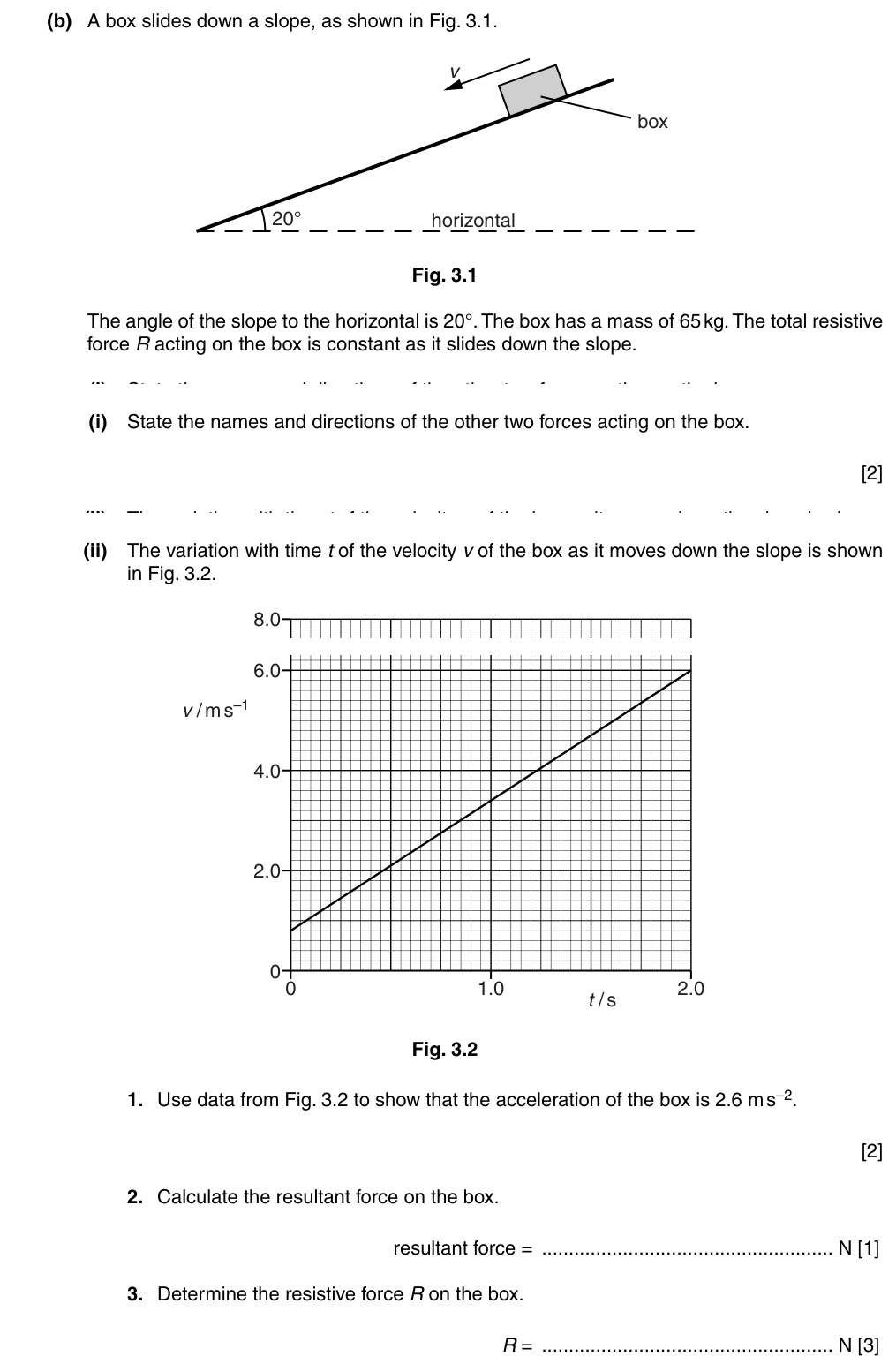
A box slides down a slope. Something resists the motion (friction and air together, called R). A speed-time graph tells us how fast it speeds up. The question walks us from naming the forces, to the acceleration, to the resultant force, and finally to R - each part feeds the next.
- State the names and directionstwo marks = two forces, each with a name AND a direction
- velocity-time graph … straight lineconstant acceleration = the gradient of the line
- Show that … 2.6write the two readings you used and the calculation, not just 2.6
- resultant forcethe single force that causes the acceleration: F = ma
- 20° to the horizontalthe weight must be split: only its component ALONG the slope pulls the box down it
- (i)the other two forces and their directions
- (ii)1show a = 2.6
- (ii)2resultant force on the box
- (ii)3the resistive force R
- m = 65 kgbox
- θ = 20°slope angle
- v = 0.8 m s−1 at t = 0from the graph
- v = 6.0 m s−1 at t = 2.0 sfrom the graph
- g = 9.81 m s−2data sheet
- R acts UP the slope (it opposes the motion), the weight's component acts DOWN the slope
- (i) Namethe other two forces
- Thinkwhat touches the box? the slope (normal force); what pulls it? the Earth (weight)
- (ii)1 Showa = 2.6
- Usea = gradient = Δv ÷ Δt
- From the graph(6.0 − 0.8) ÷ 2.0
- Usea = gradient = Δv ÷ Δt
- (ii)2 Findresultant force
- UseF = ma
- Needsa from (ii)1
- UseF = ma
- (ii)3 FindR
- Useresultant = (weight down the slope) − R
- Work out firstmg sin 20°, the weight's component along the slope
- Already foundresultant from (ii)2
- Trapsin, not cos: the slope angle sits between the weight and the normal
- Useresultant = (weight down the slope) − R
Which way should we call positive?
Down the slope - the way the box accelerates. Then the resultant is positive and R is simply subtracted.
Why does the normal force not appear in the equation for R?
It is perpendicular to the slope, so it has no component along the slope. It balances mg cos 20° instead.
5 Now solve it have a go on paper first, then open the worked solution
- (i) weight, vertically downwards B1; normal (contact / reaction) force, perpendicular to the slope B1
- (ii)1 a = gradient = (6.0 − 0.8) / (2.0 − 0) C1 = 2.6 m s−2 M1 A "show that": write the readings you used, not just 2.6.
- (ii)2 F = ma = 65 × 2.6 = 169 N (170 N) A1
- (ii)3 Component of the weight down the slope = mg sin 20° = 65 × 9.81 × sin 20° = 218 N C1 sin, because the slope angle is between the weight and the normal to the slope.
- Resultant down the slope: 218 − R = 169 C1
- R = 49 N A1
R (49 N) is much less than the weight component (218 N), which fits a box that is speeding up.
R (49 N) is much smaller than the weight component (218 N): that fits a box that is still speeding up. If R had come out bigger, the box would be slowing down - a sign of a slip.
Example 2 · Stopping force, three ways (Paper 2, 3 marks) ★★ Medium
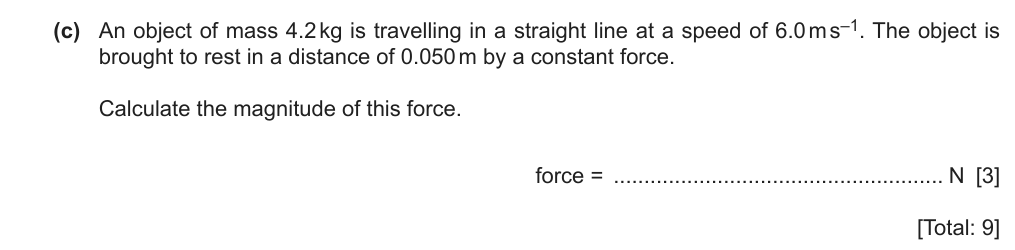
A 4.2 kg object moving at 6.0 m s−1 is stopped in just 5 cm by a steady force. We need how big that force is.
- brought to restfinal velocity v = 0
- constant forceconstant acceleration, so the suvat equations are allowed
- in a distance of 0.050 mwe get a distance, not a time - pick the equation without t
- magnitudesize only: drop the minus sign at the end
- the size of the stopping force
- m = 4.2 kgobject
- u = 6.0 m s−1start
- v = 0brought to rest
- s = 0.050 mstopping distance
- no time is given - so v = u + at and F = Δp/t can't be used straight away
- FindF
- UseF = ma
- Havem = 4.2 kg
- Work out firsta
- Usesuvat without t: v² = u² + 2as
- UseF = ma
We know u, v and s. Which suvat equation has exactly those and a, but no t?
v² = u² + 2as. It is the go-to equation whenever the time is not given.
Is there a way to skip the acceleration completely?
Yes - energy. All the kinetic energy (½mu²) is removed by the force over 0.050 m, so F × 0.050 = ½ × 4.2 × 6.0². The solution shows this as Method B.
5 Now solve it have a go on paper first, then open the worked solution
Method A: suvat, then F = ma
- No t: v² = u² + 2as → a = (0 − 6.0²) / (2 × 0.050) = −360 m s−2 C1
- F = ma C1 = 4.2 × 360
- = 1500 N A1
Method B: work done = kinetic energy lost (chapter 5)
- EK = ½mv² = ½ × 4.2 × 6.0² = 76 J C1
- All of it is removed by the force over 0.050 m: force = work done / distance C1
- = 76 / 0.050 = 1500 N A1
Method C: time first, then F = Δp / t (next page)
- a = −360 m s−2 (as in A), so t = (v − u)/a = 6.0 / 360 = 0.0167 s C1
- F = Δp / t C1 = (4.2 × 6.0) / 0.0167
- = 1500 N A1
Which to use? Method A is quickest when you are given a distance. Method C is best when you are given a time. Method B is the one to choose once you know energy, because it needs no acceleration at all.
1500 N is large, but the object stops in only 5 cm - a short stopping distance always needs a big force. All three methods agree.
Example 3 · Resultant of two forces, then a third force (Paper 2, 3 marks) ★★ Medium
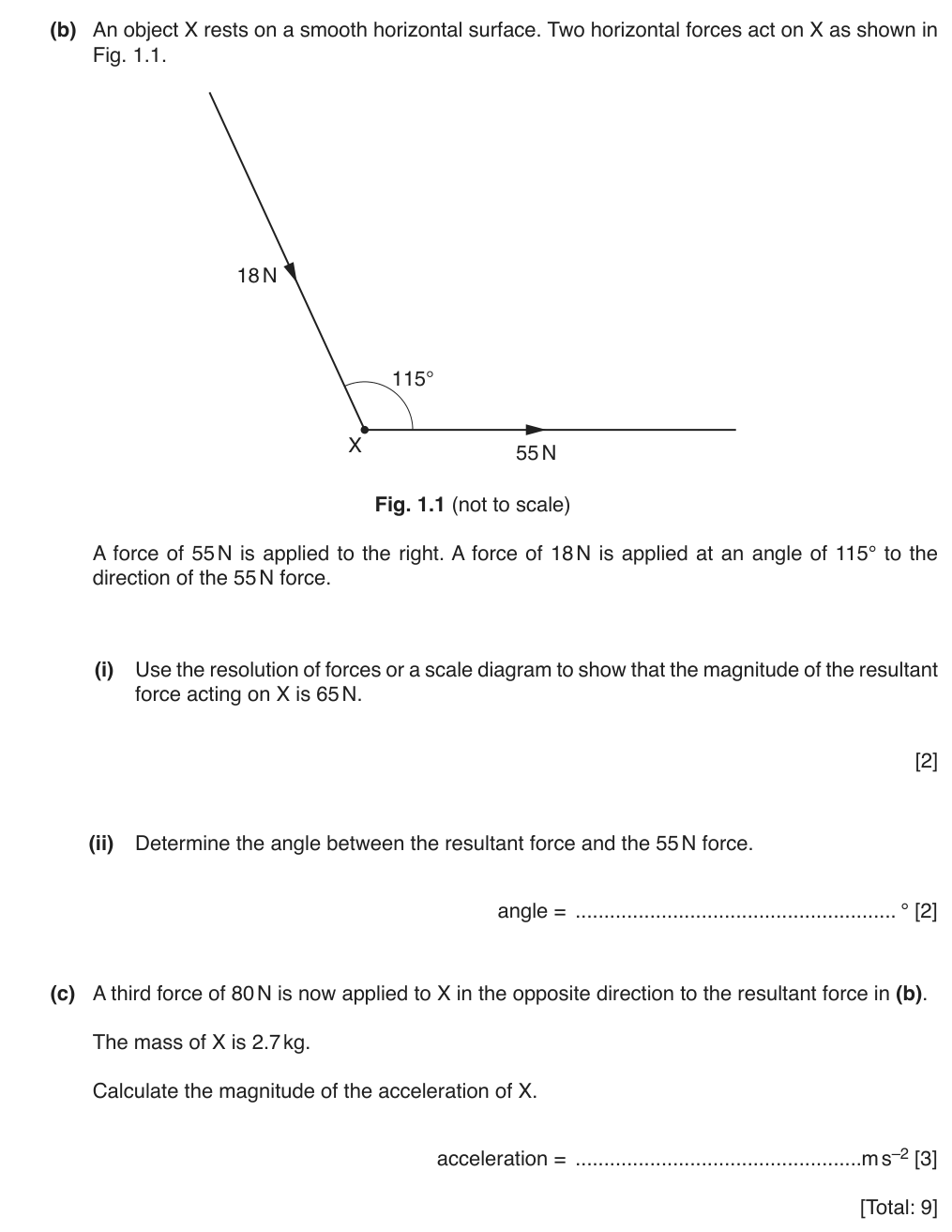
Two forces pull object X on a smooth surface: 55 N to the right and 18 N at an angle. Part (b) adds them as vectors. Part (c) then adds a third, bigger force pointing exactly the opposite way to that resultant and asks for the acceleration.
- smoothno friction - only the forces drawn act
- at 115° to itthe angle between the two LINES; check the arrowhead to see which way the 18 N really points
- in the opposite direction to the resultantthe 80 N and the 65 N lie on one line: just subtract
- magnitude of the accelerationsize only, from F = ma with the NEW resultant
- (b)(i)show the resultant is 65 N
- (b)(ii)angle between resultant and the 55 N force
- (c)acceleration of X after the 80 N is added
- F₁ = 55 Nto the right
- F₂ = 18 Nat 115° to F₁
- F₃ = 80 Nopposite to the resultant
- m = 2.7 kgX
- the 18 N points 180° − 115° = 65° below the 55 N direction
- (b) Findresultant of 55 N and 18 N
- Useresolve along and across the 55 N, then Pythagoras + tan⁻¹
- Angleuse 65°, the angle between the 18 N force and the 55 N direction
- Useresolve along and across the 55 N, then Pythagoras + tan⁻¹
- (c) Finda
- UseF = ma with the NEW resultant
- Work out firstnew resultant = 80 − 65 (same line, opposite ways)
- Trap80 N on its own is NOT the resultant
- UseF = ma with the NEW resultant
Why can we just subtract 65 from 80 in part (c)?
Because the 80 N acts exactly opposite to the 65 N resultant - they lie on the same line, so they combine like ordinary numbers.
Which way does X accelerate in (c)?
In the direction of the 80 N - the bigger force wins, and the acceleration is always in the direction of the resultant.
5 Now solve it have a go on paper first, then open the worked solution
- (b) Look at the arrowhead: the 18 N force points into X, down and to the right. Its line makes 115° with the 55 N force, so the force itself is 180° − 115° = 65° below the 55 N direction.
- Components: along the 55 N force 55 + 18 cos 65° = 62.6 N; at right angles 18 sin 65° = 16.3 N (downwards in the figure).
- R = √(62.6² + 16.3²) = 65 N; angle = tan−1(16.3 / 62.6) = 15° below the 55 N force.
- (c) The 80 N acts exactly opposite the 65 N resultant, so the new resultant is along the same line: 80 − 65 = 15 N (in the direction of the 80 N) C1
- F = ma C1: a = 15 / 2.7 = 5.6 m s−2 A1
The June 2017 report: some candidates used 80 N as the resultant, or added 80 N to 65 N. Always find the resultant before you use F = ma.
15 N on 2.7 kg gives about 5.6 m s−2. Using 80 N or 145 N would give 30 or 54 m s−2 - the June 2017 report's typical slips.
Example 4 · A sudden extra force (Paper 1, 1 mark) ★★★ Hard
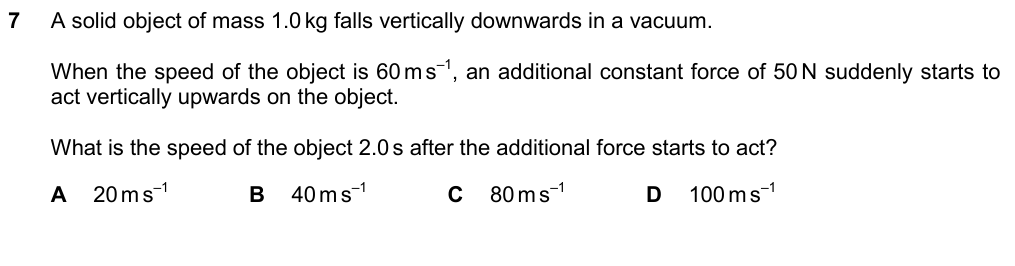
Why it is hard: the object is moving down while its acceleration is up, so it slows, stops and comes back up within the 2.0 s. You have to keep the signs straight.
An object is falling in a vacuum at 60 m s−1. Suddenly a steady 50 N push acts upwards. It is still moving down, but now the net force points up - so it slows down, stops, and starts going back up. Where is it after 2.0 s?
- in a vacuumno air resistance: only the weight and the 50 N
- additionalthe weight is still there - the 50 N is extra
- vertically upwardsopposite to the motion: it will slow the object
- speedsize only - the answer can be moving up OR down
- speed after 2.0 s
- m = 1.0 kgobject
- u = 60 m s−1downwards
- F = 50 Nupwards
- t = 2.0 s
- weight = mg = 9.81 N downwards still acts
- Findspeed after 2.0 s
- Usev = u + at (constant force → constant a)
- Haveu = +60 (down = +), t = 2.0
- Work out firsta
- Usea = resultant ÷ m
- Resultant50 − 9.81 = 40.2 N UP
- Usea = resultant ÷ m
- Trapa is up while u is down: a = −40.2 when down is +
- Usev = u + at (constant force → constant a)
Which way is the resultant force, and which way is the object moving?
The resultant (40.2 N) is UP, but the object is moving DOWN. So it is slowing down - and after it stops, it will speed up upwards.
v comes out as −20. What does the minus mean?
With down = +, a negative velocity means it is now moving UP. The speed is 20 m s−1.
5 Now solve it have a go on paper first, then open the worked solution
- Free-body: 50 N up, weight 1.0 × 9.81 = 9.81 N down. Resultant = 40.2 N up.
- a = 40.2 / 1.0 = 40.2 m s−2 up (same direction as the resultant).
- Down = +: u = +60, a = −40.2, t = 2.0. v = u + at = 60 − 40.2 × 2.0 = −20.4 m s−1.
- Negative means it is now moving up, at a speed of 20 m s−1 → A
| Option | Where it comes from |
|---|---|
| A 20 m s⁻¹ | Correct: resultant (50 − 9.81) N up, v = 60 − 40.2 × 2.0, then the size. |
| B 40 m s⁻¹ | Ignores the weight: a = 50, v = 60 − 100 = −40. |
| C 80 m s⁻¹ | Adds the 20 m s⁻¹ change the wrong way. |
| D 100 m s⁻¹ | Treats the 50 N as speeding it up: 60 + 20 × 2. |
It takes 60 ÷ 40.2 ≈ 1.5 s to stop, so after 2.0 s it has had about 0.5 s of speeding up upwards: 0.5 × 40 = 20 m s−1. Consistent.
Example 5 · Connected bodies (Paper 1, 1 mark) ★★ Medium
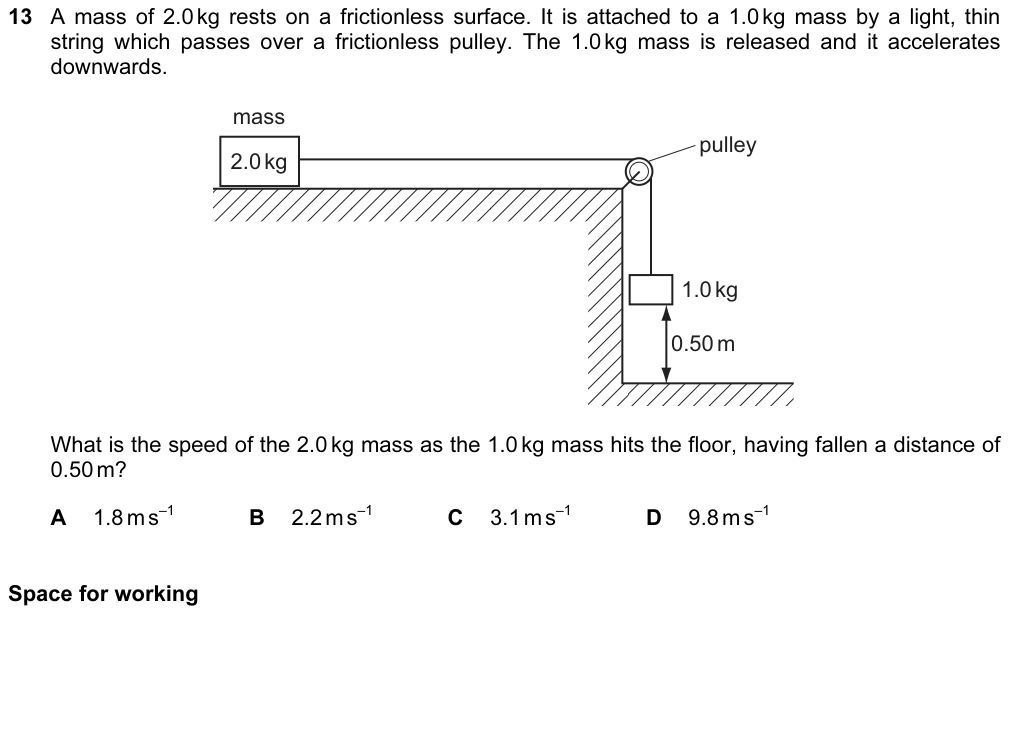
A 2.0 kg block on a smooth table is tied by a string over a pulley to a 1.0 kg mass hanging off the edge. The hanging mass falls 0.50 m and drags the block along. How fast is the block going when the hanging mass hits the floor?
- frictionless … frictionless pulleynothing resists - the only driving force is the hanging weight
- light stringthe string's own mass is ignored; both masses move with the SAME speed and acceleration
- releasedstarts from rest: u = 0
- falling 0.50 mthe block also moves 0.50 m
- speed of the 2.0 kg block when the 1.0 kg mass lands
- m₁ = 2.0 kgon the table
- m₂ = 1.0 kghanging
- s = 0.50 mdistance fallen
- u = 0released
- the weight of the hanging mass has to accelerate BOTH masses: 3.0 kg in total
- Findv
- Usev² = u² + 2as
- Haveu = 0, s = 0.50 m
- Work out firsta
- Usetreat both masses as ONE system: a = (1.0 × 9.81) ÷ 3.0
- Trapa is NOT 9.81 - the hanging mass is not falling freely
- Usetreat both masses as ONE system: a = (1.0 × 9.81) ÷ 3.0
- Usev² = u² + 2as
Why don't we need the tension in the string?
Treat both masses as one system. The tension pulls the block forward and the hanging mass back by the same amount - it is internal and cancels.
Which force accelerates the whole system?
Only the weight of the hanging 1.0 kg mass (9.81 N). The block's weight is balanced by the table.
5 Now solve it have a go on paper first, then open the worked solution
- Whole system, mass 3.0 kg. Only unbalanced force: the weight of the 1.0 kg mass, 9.81 N. (Tension is internal to the system.)
- a = 9.81 / 3.0 = 3.27 m s−2 (both masses, because the string doesn't stretch).
- From rest over 0.50 m: v² = 2as = 2 × 3.27 × 0.50 → v = 1.8 m s−1 → A
C (3.1 m s⁻¹) is what you get with a = 9.81: as if the 1.0 kg mass were falling freely, forgetting it also has to drag the 2.0 kg block.
1.8 m s−1 is less than the 3.1 m s−1 a freely falling mass would reach in 0.50 m - right, because it also has to drag the block.
Example 6 · The lift (Paper 1, 1 mark) ★★★ Hard
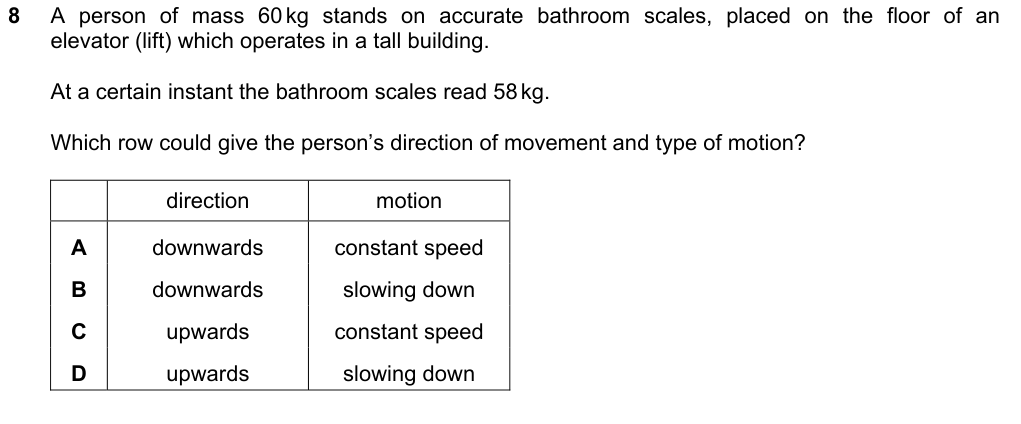
Why it is hard: the March 2020 report says roughly equal numbers chose each option. Most candidates look at the direction of motion; what matters is the direction of the acceleration.
A 60 kg person stands on scales in a lift, but the scales read only 58 kg. So the scales push up on the person with less than their weight. Which motion of the lift could cause that?
- scales read 58 kgthe upward push of the scales is 58g, less than the weight 60g
- direction of movement and type of motionthe options mix the direction of MOTION with speeding up / slowing down - the physics needs the direction of ACCELERATION
- the row that fits a reading of 58 kg
- m = 60 kgperson
- weight = 60gdown
- scale force = 58gup
- the reading is less than the weight, so the resultant force - and the acceleration - is DOWNWARDS
- Findthe motion
- Step 1resultant = 60g − 58g = 2g DOWN → acceleration down
- Step 2what motions have a downward acceleration?
- Eithermoving down and speeding up
- Ormoving up and slowing down
- Trapconstant speed means NO acceleration: the scales would read 60 kg
- Step 2what motions have a downward acceleration?
- Step 1resultant = 60g − 58g = 2g DOWN → acceleration down
What does the reading tell us: the direction of motion, or of acceleration?
Only the acceleration. The scales read less than the weight whenever the acceleration is downwards, whichever way the lift is moving.
A lift going UP and slowing down - which way is its acceleration?
Downwards. Slowing down means the acceleration is opposite to the velocity.
5 Now solve it have a go on paper first, then open the worked solution
- Scales push up with 58g N. Weight = 60g N down.
- Resultant = 60g − 58g = 2g N downwards, so the acceleration is downwards.
- Downward acceleration = moving down and speeding up, or moving up and slowing down.
- Only D fits → D
| Option | Acceleration | Scales read |
|---|---|---|
| A down, constant speed | zero | 60 kg |
| B down, slowing down | upwards | more than 60 kg |
| C up, constant speed | zero | 60 kg |
| D up, slowing down | downwards | less than 60 kg ✓ |
Constant speed (A, C) would read exactly 60 kg; moving down and slowing (B) needs an upward acceleration - a reading above 60 kg. Only D is left.
Summary
- Mass resists changes in motion (kg, scalar, same everywhere). Weight is the gravitational force W = mg (N, vector).
- First law: zero resultant force ⇔ constant velocity. Second law: resultant force = rate of change of momentum; F = ma for a constant mass, with a in the direction of F. Third law: equal and opposite forces of the same type on two different bodies.
- Method: choose the object → free-body diagram → positive direction → resolve → resultant = ma → check.
| If you see… | do this |
|---|---|
| "constant velocity" / "steady speed in a straight line" | resultant force = 0: forwards forces = backwards forces |
| a slope | along the slope use mg sin θ; perpendicular use mg cos θ |
| moving vertically with another force (thrust, scales, rope) | resultant = that force − mg (up = +) |
| two bodies tied together | whole system first (tension cancels), then one body for the tension |
| "which force pairs with the weight?" | the object's gravitational pull on the Earth |
| "define force" / "state the second law" | "rate of change of momentum", never "mass × acceleration" |
Can I do this?
- I can say what mass is and how it differs from weight, and use W = mg.
- I can state the first law and use "constant velocity ⇔ zero resultant force".
- I can state the second law in terms of momentum, and know a is in the direction of the resultant force.
- I can state the third law and find the partner of any force (same type, other body).
- I can draw a free-body diagram and solve F = ma in six steps.
- I can handle friction, slopes, vertical motion, constant velocity and connected bodies.
- I can explain scale readings in a lift from the direction of the acceleration.
Anything unticked: revise that section first. All ticked: take the quiz.
Quiz
Your progress on this note is saved when JavaScript is on.