
Dynamics
Collisions and explosions in two dimensions
What you need to be able to do
- 3.3.2Apply the principle of conservation of momentum to elastic and inelastic interactions in two dimensions.
- 3.3.3–3.3.4Decide whether a two-dimensional collision is elastic by comparing total kinetic energies.
Before you start: Conservation of momentum in one dimension and Scalars and vectors (resolving, vector triangles).
The idea: conserve each component separately
Momentum is a vector, so "total momentum before = total momentum after" is really two equations on a flat surface: one for each perpendicular direction.
Along the original line (x)
total x-momentum before = total x-momentum after
At right angles to it (y)
total y-momentum before = total y-momentum after. If everything started along x (or at rest), the y-momenta after must add to zero.
Two equations means you can find two unknowns (two speeds, a speed and an angle, a mass and a speed). Adding the momenta as plain numbers (mu = mv + MV) ignores their directions and is never right in 2D (9702/12/M/J/16 Q11; 9702/12/F/M/25 Q7: adding the magnitudes gave the popular wrong answer).
Method 1: components
- Choose the axes: x along the original direction of motion (or along the line the question names, e.g. "line AB"); y at right angles.
- Resolve every momentum (mass × velocity, not velocity alone) into x and y parts. The component next to the angle uses cos, the one opposite uses sin. Give a sign to anything pointing the "negative" way.
- Write the y equation first when nothing moved along y before: it is usually the simpler one (it equals zero). C1
- Write the x equation: total before = total after. C1
- Solve: make one unknown the subject of one equation → substitute into the other → solve → back-substitute. A1 A1
- Check: a speed after can't be absurd (larger momentum than the whole system had); if asked about energy, compare total KE using the full speeds, not components.
Method 2: the momentum vector triangle
Total momentum after = total momentum before, so the momentum vectors after, drawn tip to tail, must reach from the start to the end of the momentum vector before. For an explosion from rest, the momenta after must form a closed shape (they add to zero).
- Work out each momentum (mass × speed): 21M, 12M, 12M.
- Draw them tip to tail with the right angles between them; from rest they must close.
- Solve the triangle: right-angled → Pythagoras / trig; otherwise the cosine or sine rule; or a scale drawing (marks for ±1°).
- Draw a momentum triangle, not a velocity triangle: the masses are different (the June 2023 report names this mistake).
Case by case
1 A glancing collision: find an angle, then the initial speed
A (4.0 kg) hits stationary B (12 kg). After: A at 6.0 m s−1 at θ to its path, B at 3.5 m s−1 at 30° on the other side. Find θ and A's initial speed v. 9702/23/O/N/17 Q3(b)
Askedθ and A's initial speedKnowboth speeds after, B's angle; B at restRouteacross: the two cross-wise momenta cancel → θ; along: total before = total after → v
- Across (y): 4.0 × 6.0 sin θ − 12 × 3.5 sin 30° = 0 → 24 sin θ = 21 → θ = 61°
- Along (x): 4.0v = 4.0 × 6.0 cos 61° + 12 × 3.5 cos 30° = 11.6 + 36.4 = 48 → v = 12 m s−1
- KE before ½ × 4.0 × 12² = 290 J; after ½ × 4.0 × 6.0² + ½ × 12 × 3.5² = 72 + 74 = 150 J → inelastic
2 Two bodies meet at an angle and stick
0.20 kg at 0.50 m s−1 (x) and 0.30 kg at 0.40 m s−1 (y) collide and stick. Direction afterwards? 9702/13/M/J/18 Q9
Askeddirection after stickingKnowboth momenta, at right anglesRouteadd the MOMENTA as vectors: tan θ = py ÷ px
- px = 0.20 × 0.50 = 0.10; py = 0.30 × 0.40 = 0.12 N s (these don't change).
- tan θ = py/px = 1.2 → θ = 50° to the x-direction.
- Use momenta, not velocities: tan−1(0.40/0.50) = 39° is a trap answer.
3 Unknown mass from the perpendicular components
Y (0.25 kg) leaves at 3.7 m s−1, 27° to PQ; Z leaves at 5.5 m s−1, 44° on the other side; Z was at rest. Find mZ. 9702/22/O/N/23 Q4(a)
AskedZ's massKnowboth speeds and angles after; Z at restRouteacross PQ: Y's perpendicular momentum = Z's, solve for mZ
- Y's perpendicular momentum = 0.25 × 3.7 × sin 27° = 0.42 N s (sin: the angle is with PQ).
- Nothing moved perpendicular before, so Z's must cancel it: mZ × 5.5 × sin 44° = 0.42
- mZ = 0.11 kg
4 "Which diagram is not possible?"
A nucleus hits a stationary nucleus. Which set of paths afterwards is impossible? 9702/13/M/J/25 Q11, 9702/13/M/J/19 Q9
Askedwhich set of paths is impossibleKnowthe target is at restRouteno momentum across the line before → one particle each side after
- Before: momentum only along the incoming line; none across it.
- After: the cross-wise momenta must cancel, so one particle must go to each side of the line (or both along it).
- Both particles going off on the same side is impossible.
Mark-scheme focus
Components of momentum, not velocity
By considering the components of momentum at right-angles to the direction of the initial path of ball A, calculate θ.
- C1: p = mv
- M1: "(4.0 × 6.0 × sin θ) − (12 × 3.5 × sin 30°) = 0"
- A1: θ = 61°
- 6.0 sin θ = 3.5 sin 30° (velocity components: "this method is not valid", November 2017 report)
- cos components when the question says "at right-angles to the initial path"
Momentum is conserved, velocity isn't: the two balls have different masses.
From: 9702/23/O/N/17 Q3(b)(i) and the November 2017 report.
- 2D collision or explosion: Paper 2 about once a year since 2016, 3–4 marks (C1 per component equation, A1 per answer), often followed by a KE comparison (2–3 marks).
- Paper 1: one or two a year: a component, an angle, an impossible diagram, or a vector diagram.
Worked examples
Example 1 · Two unknown speeds (Paper 2, 4 marks) ★★★ Hard
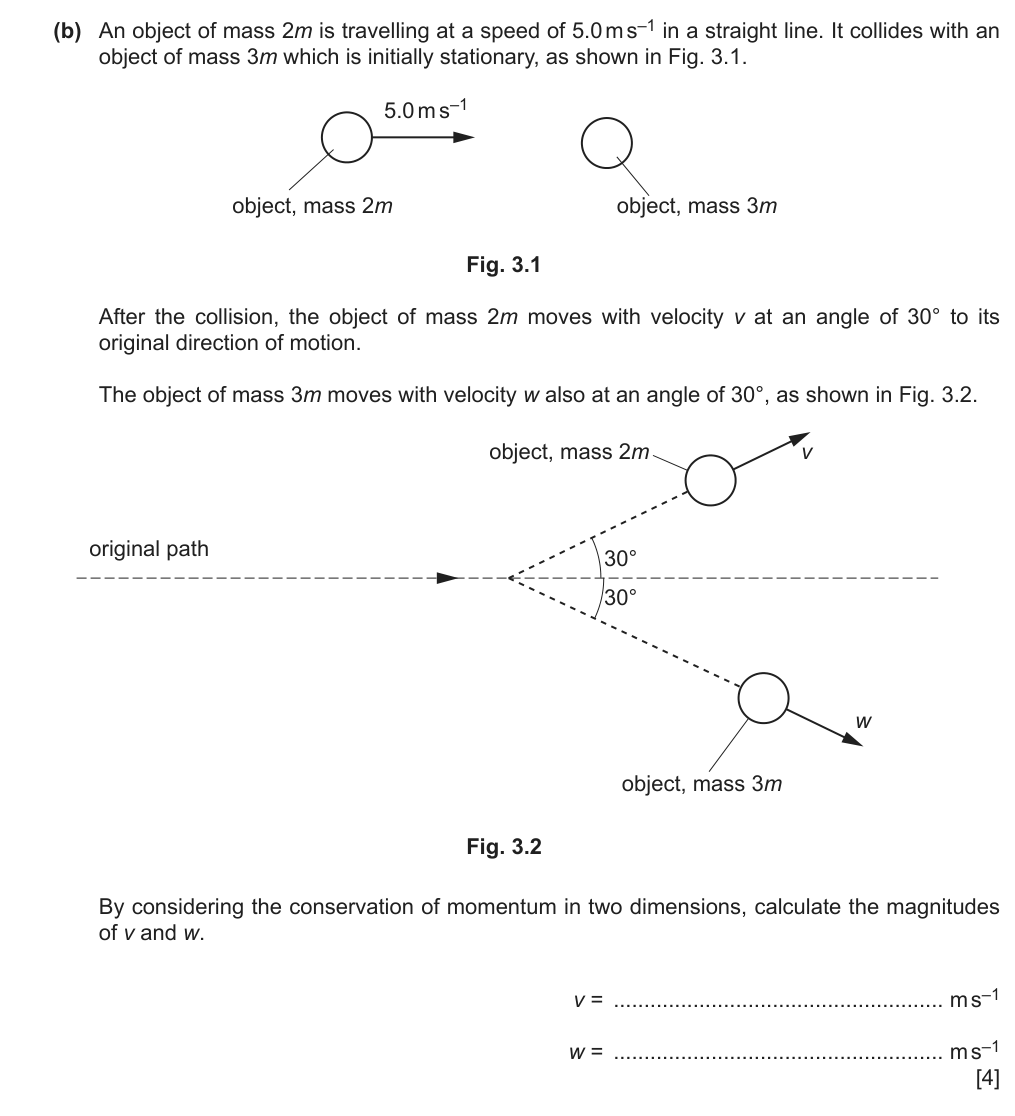
Why it is hard: two unknowns means simultaneous equations, and the masses are only given as 2m and 3m. (No examiner report exists for June 2024.)
An object (2m) moving at 5.0 m s−1 hits an object (3m) at rest. They fly off at 30° on opposite sides of the original line. Two speeds are unknown, so we need two equations - one from each direction.
- in two dimensionsmomentum is conserved ALONG the original line and ACROSS it, separately
- stationary3m has no momentum before
- on the other sidethe two cross-wise momenta point opposite ways, so they must cancel
- 2m and 3mno number for m - it cancels in both equations
- v (speed of 2m) and w (speed of 3m)
- 2mmoving object
- u = 5.0 m s−1before
- 3mat rest before
- 30°each, either side of the line
- nothing moved across the line before, so the total momentum across it after is zero
- Findv and w
- Usetwo equations, two unknowns
- Across2m v sin 30° = 3m w sin 30° → v = 1.5w
- Along2m × 5.0 = 2m v cos 30° + 3m w cos 30°
- Thensubstitute v = 1.5w into the 'along' equation, solve, back-substitute
- Usetwo equations, two unknowns
Why is the 'across' equation so useful to start with?
Its total is zero, and sin 30° and m cancel - it gives the simple link v = 1.5w straight away.
Along the line: cos or sin?
cos 30°: the angles are measured FROM the original line, so the part along it is the adjacent side.
5 Now solve it have a go on paper first, then open the worked solution
- Across the line (nothing before): 2m v sin 30° = 3m w sin 30° C1
- Cancel m and sin 30°: 2v = 3w → v = 1.5w
- Along the line: 2m × 5.0 = 2m v cos 30° + 3m w cos 30° → 10 = (2v + 3w) cos 30° C1
- Substitute v = 1.5w: 10 = (3w + 3w) × 0.866 = 5.20w
- w = 1.9 m s−1 A1; back-substitute: v = 1.5 × 1.92 = 2.9 m s−1 A1
Check along the line: 2(2.89)(0.866) + 3(1.92)(0.866) = 5.0 + 5.0 = 10 ✓.
Put the answers back in: along the line 2(2.89)(0.866) + 3(1.92)(0.866) = 10.0 ✓. The lighter 2m moves faster than 3m, as the 'across' equation demands.
Example 2 · Two balls meet at angles and stick (Paper 2, 5 marks) ★★ Medium
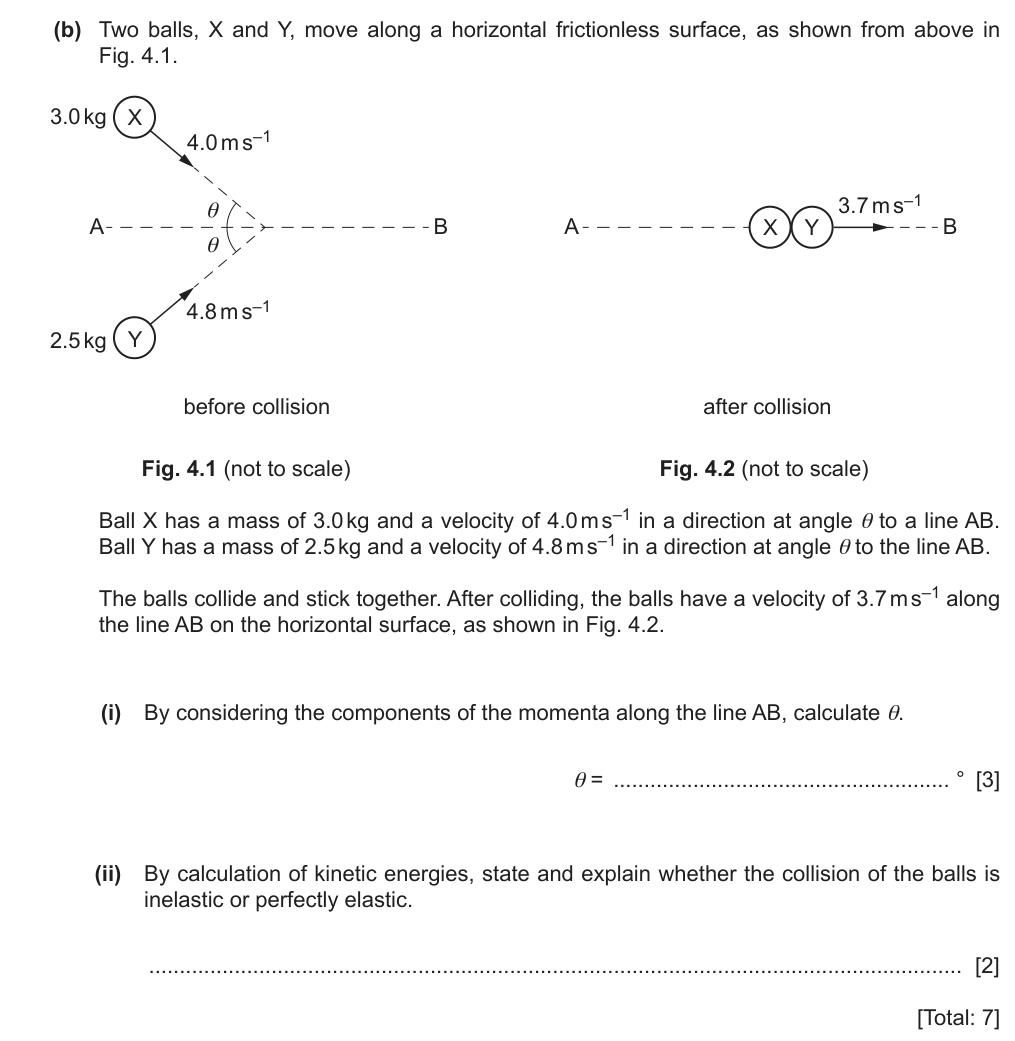
Two balls approach at the same angle θ from either side of a line AB, collide, stick, and move off together ALONG AB. We find θ from momentum, then check the kinetic energy to decide the type of collision.
- By considering the components … along ABonly the components along AB go in the equation
- stick togetherone combined mass (5.5 kg), one velocity
- By calculation of kinetic energiesfind total KE before and after, then compare
- inelastic or perfectly elasticKE lost → inelastic; KE the same → perfectly elastic
- (i)the angle θ
- (ii)inelastic or perfectly elastic, with KE values
- X: 3.0 kg, 4.0 m s−1at θ to AB
- Y: 2.5 kg, 4.8 m s−1at θ to AB, other side
- 5.5 kg at 3.7 m s−1after, along AB
- (i) Findθ
- Usemomentum along AB before = after
- Before3.0 × 4.0 cos θ + 2.5 × 4.8 cos θ
- After5.5 × 3.7
- Usemomentum along AB before = after
- (ii) Decidetype of collision
- UseKE = ½mv² with the FULL speeds
- Trapdon't use only the component along AB for KE - KE is a scalar
- UseKE = ½mv² with the FULL speeds
Why do the cross-wise momenta not appear in the equation?
X has 12 sin θ one way and Y has 12 sin θ the other - they cancel, which is why the joined balls move straight along AB.
For kinetic energy, do we use 4.0 m s−1 or 4.0 cos θ?
The full 4.0. Kinetic energy depends on the actual speed, not one component of it.
5 Now solve it have a go on paper first, then open the worked solution
- (i) Components along AB: 3.0 × 4.0 cos θ, 2.5 × 4.8 cos θ, 5.5 × 3.7 C1
- 12 cos θ + 12 cos θ = 20.35 C1 → cos θ = 0.848 → θ = 32° A1
- Check across AB: 12 sin θ up and 12 sin θ down cancel, as they must, since the combined ball moves along AB.
- (ii) KE before = ½ × 3.0 × 4.0² + ½ × 2.5 × 4.8² = 24 + 29 = 53 J; KE after = ½ × 5.5 × 3.7² = 38 J C1
- KE decreases, so inelastic A1
The June 2022 report: the common mistakes were the wrong trig function, "total velocity is conserved", and calculating the initial KE from only the component of velocity along AB.
θ = 32° makes cos θ about 0.85, so each ball keeps most of its momentum along AB - sensible. KE falls from 53 J to 38 J, so energy was lost: inelastic, as sticking always is.
Example 3 · A firework explodes into three pieces (Paper 2, 9 marks) ★★★ Hard
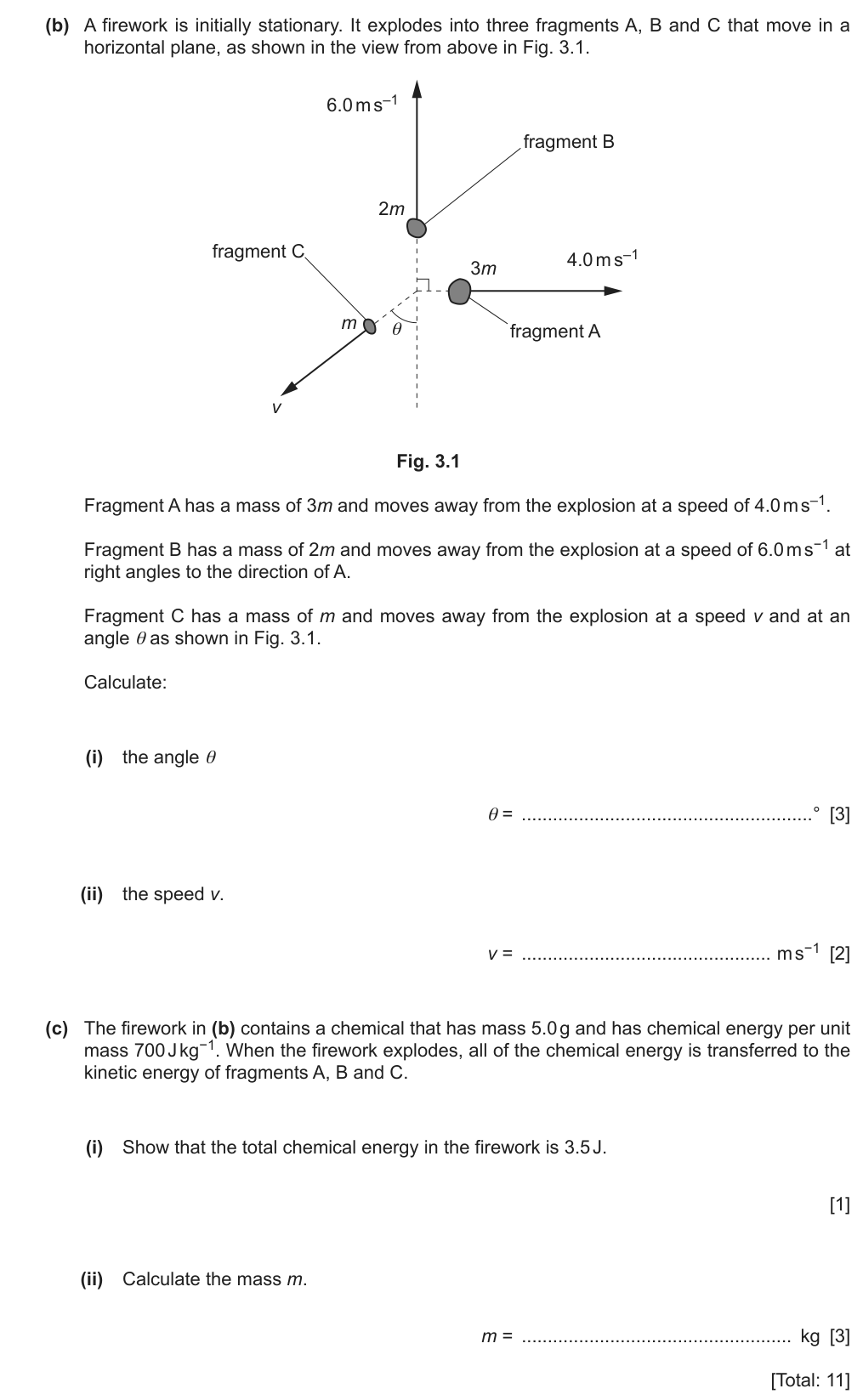
A firework at rest explodes into three pieces flying off in a flat plane. A and B go at right angles to each other; we need C's direction and speed. Then the chemical energy that became kinetic energy lets us find the mass m.
- stationary … explodestotal momentum zero before → the three momenta must add to zero after
- at right angles to AA's and B's momenta make two sides of a right-angled triangle
- all becomes kinetic energychemical energy = total KE of A + B + C
- 700 J kg−1energy per kilogram: multiply by the mass of chemical (in kg)
- (b)(i)θ, C's direction
- (b)(ii)v, C's speed
- (c)(i)show the energy is 3.5 J
- (c)(ii)the mass m
- A: 3m, 4.0 m s−1
- B: 2m, 6.0 m s−1at 90° to A
- C: m, v at θunknown
- 5.0 g = 0.0050 kgchemical
- 700 J kg−1energy per kg
- A's momentum (12m) and B's momentum (12m) are equal in size
- (b) Findθ and v
- UseC's momentum cancels A's and B's
- Componentsm v sin θ = 12m, m v cos θ = 12m → tan θ = 1
- Size(mv)² = (12m)² + (12m)²
- UseC's momentum cancels A's and B's
- (c)(ii) Findm
- Use3.5 J = ½(3m)4.0² + ½(2m)6.0² + ½(m)v²
- Needsv from (b)(ii)
- Have3.5 J from (c)(i)
- Use3.5 J = ½(3m)4.0² + ½(2m)6.0² + ½(m)v²
Why must C's momentum point 'backwards' between A and B?
The total started at zero. A and B together have momentum in one direction, so C must carry the same amount the exact opposite way.
Do we draw a triangle of velocities or of momenta?
Momenta. The pieces have different masses, so a velocity triangle doesn't close - the June 2023 report names this mistake.
5 Now solve it have a go on paper first, then open the worked solution
- (b)(i) From rest, so C's momentum must cancel A's and B's. Along A's line: 3m × 4.0 = m v sin θ (= 12m) C1; along B's line: 2m × 6.0 = m v cos θ (= 12m) C1
- Divide: tan θ = 1 → θ = 45° A1
- (b)(ii) (mv)² = (12m)² + (12m)² C1 → v = 12√2 = 17 m s−1 A1
- (c)(i) 0.0050 × 700 = 3.5 J A1
- (c)(ii) 3.5 = ½(3m)(4.0²) + ½(2m)(6.0²) + ½(m)(17²) C1 C1 = 24m + 36m + 144m = 204m → m = 0.017 kg A1
Vector triangle instead: A's 12m and B's 12m are at 90°, so C's momentum closes a right-angled isosceles triangle: 12√2 m at 45°. The June 2023 report: some drew a velocity triangle by mistake.
C is the lightest piece and gets the biggest speed (17 m s−1) - expected. m = 0.017 kg makes the whole firework 6m ≈ 0.10 kg, a sensible size.
Summary
- In 2D, conserve momentum separately along two perpendicular directions: two equations, two unknowns.
- Resolve momenta (m × v), with sin/cos chosen from where the angle is; across the original line, the momenta after add to zero.
- Or draw the momentum vector triangle (closed for an explosion from rest).
- Elastic? Compare total KE using the full speeds.
| If you see… | do this |
|---|---|
| one body at rest, the other moving along a line | across the line: the two momenta after cancel |
| two unknown speeds | across-equation gives a ratio; substitute into the along-equation |
| "explodes" from rest into pieces | momenta after add to zero: components or a closed triangle |
| "by calculation of kinetic energies" | ½mv² with the full speeds, every body, before and after |
Can I do this?
- I know momentum is conserved separately along each direction.
- I can resolve momenta and solve the two equations for two unknowns.
- I can use a momentum vector triangle, closed for an explosion from rest.
- I can find an angle, a mass, or spot an impossible outcome.
Anything unticked: revise that section first. All ticked: take the quiz.
Quiz
Your progress on this note is saved when JavaScript is on.