
Forces, density and pressure
Moments, centre of gravity, couples and torque
What you need to be able to do
- 4.1.1Understand that the weight of an object may be taken as acting at a single point, its centre of gravity.
- 4.1.2Define and apply the moment of a force.
- 4.1.3Understand that a couple is a pair of forces that produces rotation only.
- 4.1.4Define and apply the torque of a couple.
Before you start: Scalars and vectors (resolving a force). Next: Equilibrium of forces.
Centre of gravity
Every particle of an object is pulled by gravity. Instead of drawing thousands of tiny forces, we draw one arrow, the whole weight, from one point. For moments this single arrow gives exactly the same turning effect as all the tiny ones.
- Uniform object (same material and thickness throughout): the centre of gravity is at the geometric centre. A uniform beam's weight acts at its middle, not at an end — the most common error in moment questions 9702/12/M/J/23 Q12, 9702/13/O/N/23 Q12, 9702/22/F/M/25 Q2.
- Non-uniform object: the question tells you where it is, or you find it from a balance.
- An object hanging freely from a pivot comes to rest with its centre of gravity directly below the pivot: only then does the weight's line of action pass through the pivot, so the weight has no moment 9702/23/O/N/19 Q1(b)(ii).
The moment of a force
The line of action is the force arrow extended both ways as a long straight line. The perpendicular distance is the shortest distance from the point to that line — it meets the line at 90°. It is not the distance to where the force is applied, unless the force pushes at 90° to the object.
Two ways to get the moment of a slanted force
When a force is not at 90° to the rod, there are two equivalent ways. Both give the same number — pick whichever the question's diagram makes easier, and say which you used.
Way 1 · perpendicular distance
Moment = F × (d sin θ). Best when the diagram already shows the perpendicular distance, or the force is vertical (weight) and the rod is tilted.
Way 2 · perpendicular component
Moment = (F sin θ) × d. The component along the rod (F cos θ) passes through the pivot and has no moment. Best for strings and wires at an angle.
- Find θ: the angle between the force and the rod (not the horizontal, unless the rod is horizontal).
- The part of the force at 90° to the rod is F sin θ (the side opposite θ). If the question gives the angle to the vertical or to the other line, you may need cos instead — sketch the right-angled triangle.
- Multiply by the distance along the rod from the pivot to where the force acts.
- Check: a force pointing straight at the pivot has zero moment; a force at 90° to the rod has the biggest.
Couples and torque
- The torque of a couple is the same about every point, so you can take it about the centre, an end, anywhere.
- The two forces must not act along the same line (then they just cancel), and need not be the same type of force.
- A couple alone means no equilibrium: the resultant force is zero but the resultant torque isn't 9702/21/O/N/13 Q4(b)(iv), 9702/21/O/N/11 Q2(b)(ii).
- When a couple is used to hold something still, it must be opposite to the moment it cancels 9702/24/O/N/25 Q2(c)(i).
Mark-scheme focus
Define the moment of a force
Define the moment of a force.
- "force × perpendicular distance (of line of action of force) to / from a point"
- "force × distance" / "force × the distance of the line of action from a point" (no "perpendicular")
- "the turning effect of a force"
- a definition of momentum
The November 2017 report: "it is insufficient to define the moment ... as the product of a force and the distance of the line of action ... as this does not refer to the perpendicular distance". "Force × distance" alone is also the start of the definition of work.
From: 9702/22/O/N/17 Q2(a), 9702/23/M/J/21 Q3(a), 9702/24/M/J/25 Q1(a) and their reports.
Define the torque of a couple
Define the torque of a couple.
- M1: "product of (one) force and distance"
- A1: "perpendicular distance between the (lines of action of the two) forces"
- "force × perpendicular distance from the pivot" (that's a moment)
- "sum of the moments of the two forces" with no distance between them
From: 9702/24/O/N/25 Q2(a), 9702/21/O/N/13 Q4(a), 9702/21/O/N/11 Q2(a).
State what is meant by the centre of gravity
State what is meant by the centre of gravity of an object.
- "the point where (all) the weight (of the object) is taken to act" (also "seems / is considered to act")
- "the point where the weight acts" (it really acts everywhere)
- "where all the mass is concentrated" (mass, not weight)
- "the balance point" / "the centre of the object"
Named in the 2017, 2019, 2022 and 2023 reports: "a common misconception was that the centre of gravity ... is the point where all the weight actually acts, rather than the point where all the weight is taken to act".
From: 9702/22/M/J/23 Q2(a), 9702/21/M/J/22 Q2(a), 9702/22/O/N/22 Q3(a) and their reports.
- Define moment / torque / centre of gravity: opens a Paper 2 question most years, 1–2 marks.
- Perpendicular component of a weight on a tilted rod: Paper 2 every year or two (A1 for W sin θ or W cos θ, then moments).
- Couples: Paper 1 two or three times a year — "which diagram is a couple?", "what is the torque?".
Worked examples
Example 1 · A trapdoor held at an angle (Paper 2, 3 marks) ★★ Medium
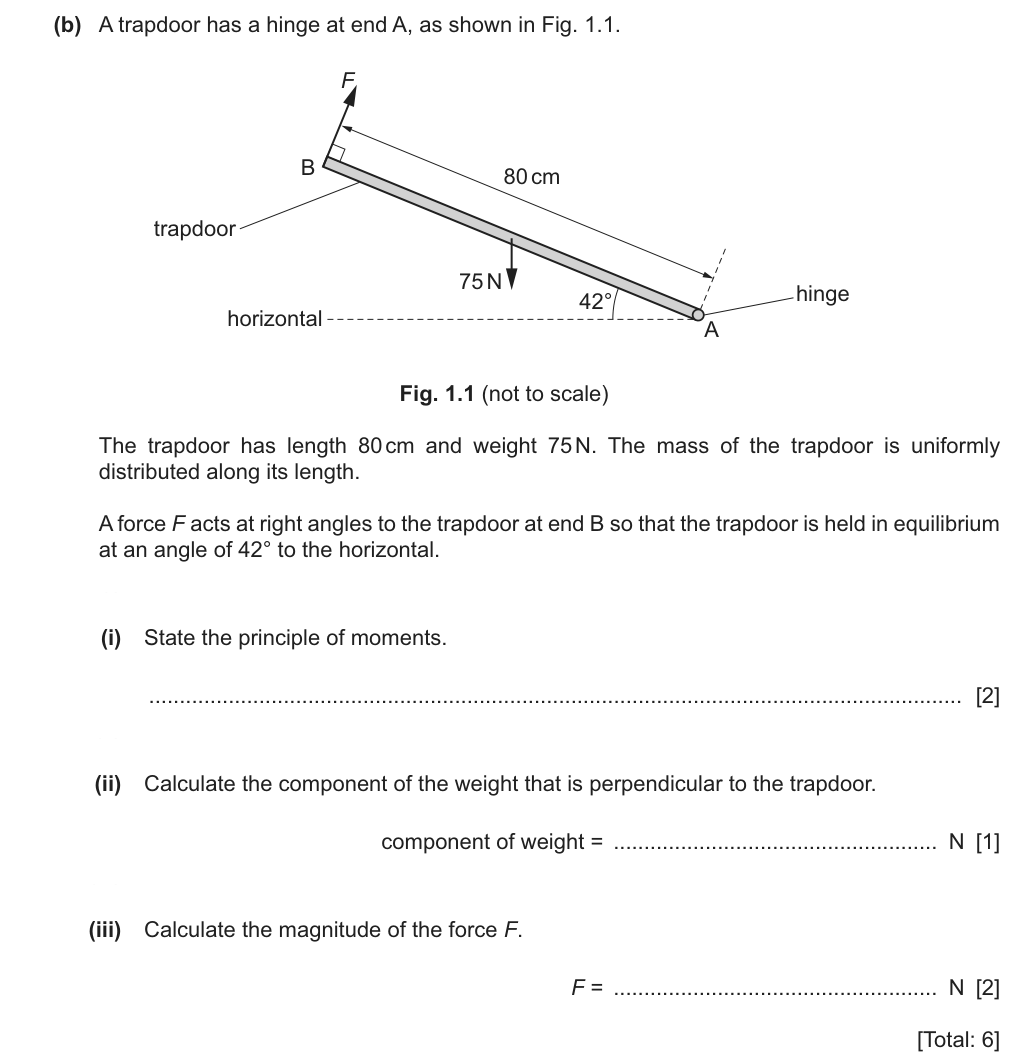
A trapdoor is hinged at one end and held open at 42° by a force F pushing at right angles at the far end. Its weight tries to close it; F holds it up. Balancing the turning effects about the hinge gives F.
- uniformthe weight acts at the middle: 40 cm from the hinge
- hinged at Atake moments about A - the hinge force then has no moment and drops out
- at right angles to itF's moment is simply F × 80 cm
- component of the weight perpendicular to the trapdooronly that part of the weight turns the door
- (ii)perpendicular component of the weight
- (iii)the force F
- W = 75 Nat the middle
- L = 80 cmso W acts 40 cm from A
- 42°trapdoor to horizontal
- F ⟂ doorat B, 80 cm from A
- (ii) FindW⟂
- UseW cos 42°
- Trapcos, not sin: find the angle between W and the perpendicular to the door
- UseW cos 42°
- (iii) FindF
- Usemoments about A: F × 80 = W⟂ × 40
- NeedsW⟂ from (ii)
- Haveboth distances along the door
- Usemoments about A: F × 80 = W⟂ × 40
Why take moments about the hinge?
The hinge pushes on the door with a force we don't know. Its distance from A is zero, so it has no moment about A and disappears.
If the door were horizontal, would F be bigger or smaller?
Bigger: all of the weight would be perpendicular (75 N), so F = 37.5 N. Tilting the door up reduces the turning effect of the weight.
5 Now solve it have a go on paper first, then open the worked solution
- (ii) The weight is vertical; the trapdoor is 42° from the horizontal, so the angle between the weight and the line at 90° to the trapdoor is 42°. Component = 75 cos 42° = 56 N A1
- (iii) Moments about the hinge A. The weight acts at the middle: 56 × 40 (cm). F is already perpendicular: F × 80 C1
- F × 80 = 56 × 40 → F = 28 N A1
Way 1 instead: the weight's perpendicular distance from A is 40 cos 42° = 29.7 cm, so 75 × 29.7 = F × 80 → F = 28 N. Same answer. (No examiner report exists for June 2025.)
F (28 N) is a bit over a third of the weight: F has twice the lever arm of W, and only 56 N of W turns the door. 56 × 40 ÷ 80 = 28 ✓.
Example 2 · A fishing rod (Paper 2, 4 marks) ★★ Medium
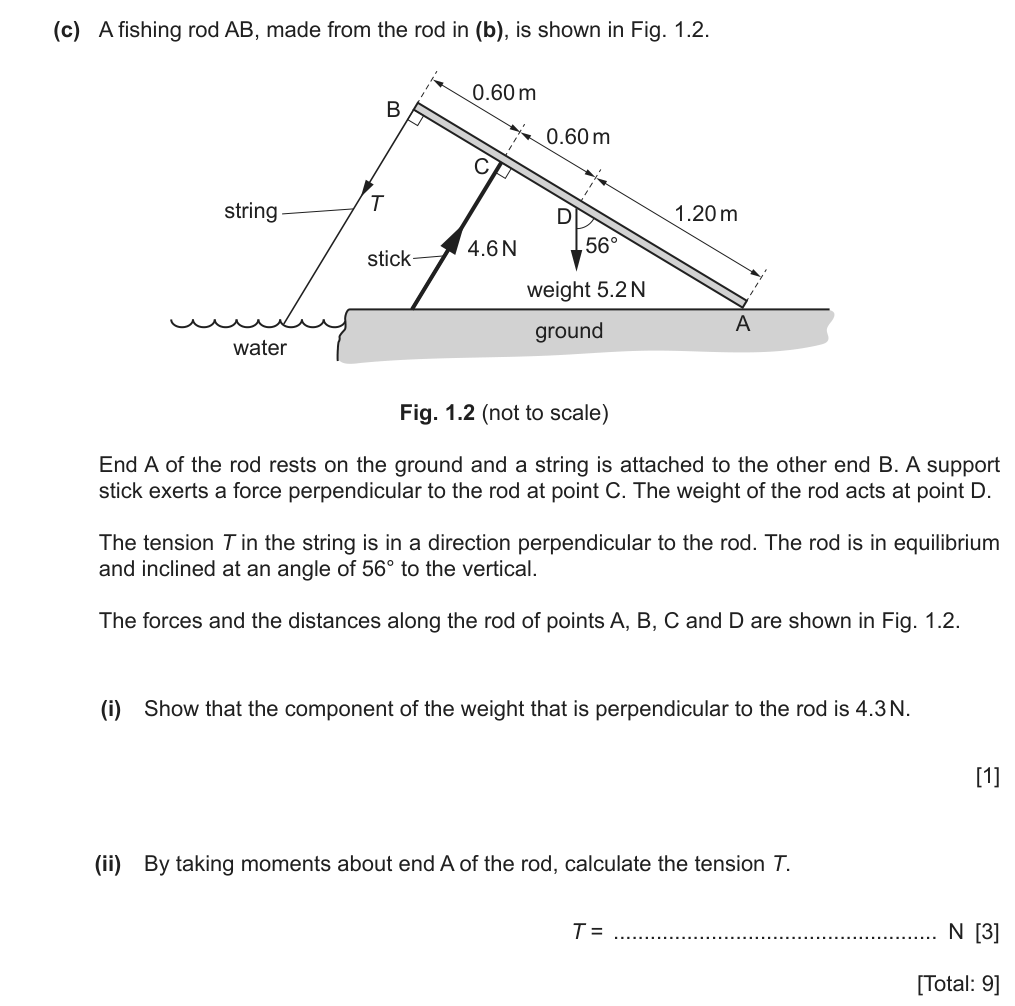
A fishing rod rests with its end A on the ground, propped up by a stick. Three forces turn it about A: the stick's push, the rod's weight and the string's pull T. It is in equilibrium, so the clockwise and anticlockwise moments balance.
- inclined at 56° to the verticalthe weight (vertical) makes 56° with the rod
- perpendicular to the rodthe stick force and T need no resolving: moment = force × distance along the rod
- By taking moments about Athe ground's force at A drops out
- Show that … 4.3 Nwrite 5.2 sin 56° and its value
- (i)show the perpendicular weight component = 4.3 N
- (ii)the tension T
- L = 2.4 mT acts at B
- 4.6 N at C1.8 m from A
- W = 5.2 N at D1.2 m from A
- 56°rod to vertical
- (i) ShowW⟂ = 4.3 N
- UseW sin 56° (angle between W and the rod is 56°)
- (ii) FindT
- Useclockwise moments = anticlockwise moments about A
- Decidewhich forces turn which way - from the figure
- One sidestick: 4.6 × 1.8
- Other sideT × 2.4 + 4.3 × 1.2
- Useclockwise moments = anticlockwise moments about A
Which forces turn the rod the same way?
From the figure, T and the weight both turn it one way; the stick's push turns it the other way. That decides which side of the equation each goes.
Why sin 56° for the weight?
The angle between the weight and the ROD is 56°. The perpendicular part is opposite that angle: W sin 56°.
5 Now solve it have a go on paper first, then open the worked solution
- (i) The rod is 56° from the vertical, so the weight (vertical) makes 56° with the rod: perpendicular component = 5.2 sin 56° = 4.3 N A1
- (ii) All three forces now act at 90° to the rod, so each moment about A is force × distance along the rod: T × 2.4, 4.3 × 1.2, 4.6 × 1.8 C1
- Decide which way each turns (from the figure: the stick pushes one way, T and the weight the other): T × 2.4 + 4.3 × 1.2 = 4.6 × 1.8 C1
- T = (8.28 − 5.16) / 2.4 = 1.3 N A1
T (1.3 N) is small because the stick's moment (8.28 N m) is only a little bigger than the weight's (5.16 N m).
Example 3 · A couple on a disc (Paper 2, 4 marks) ★★★ Hard
Why it is hard: the November 2017 report: most found (ii) challenging (cos instead of sin, r instead of r/2), and in (iii) many did long calculations when the answer is one line about translational equilibrium.
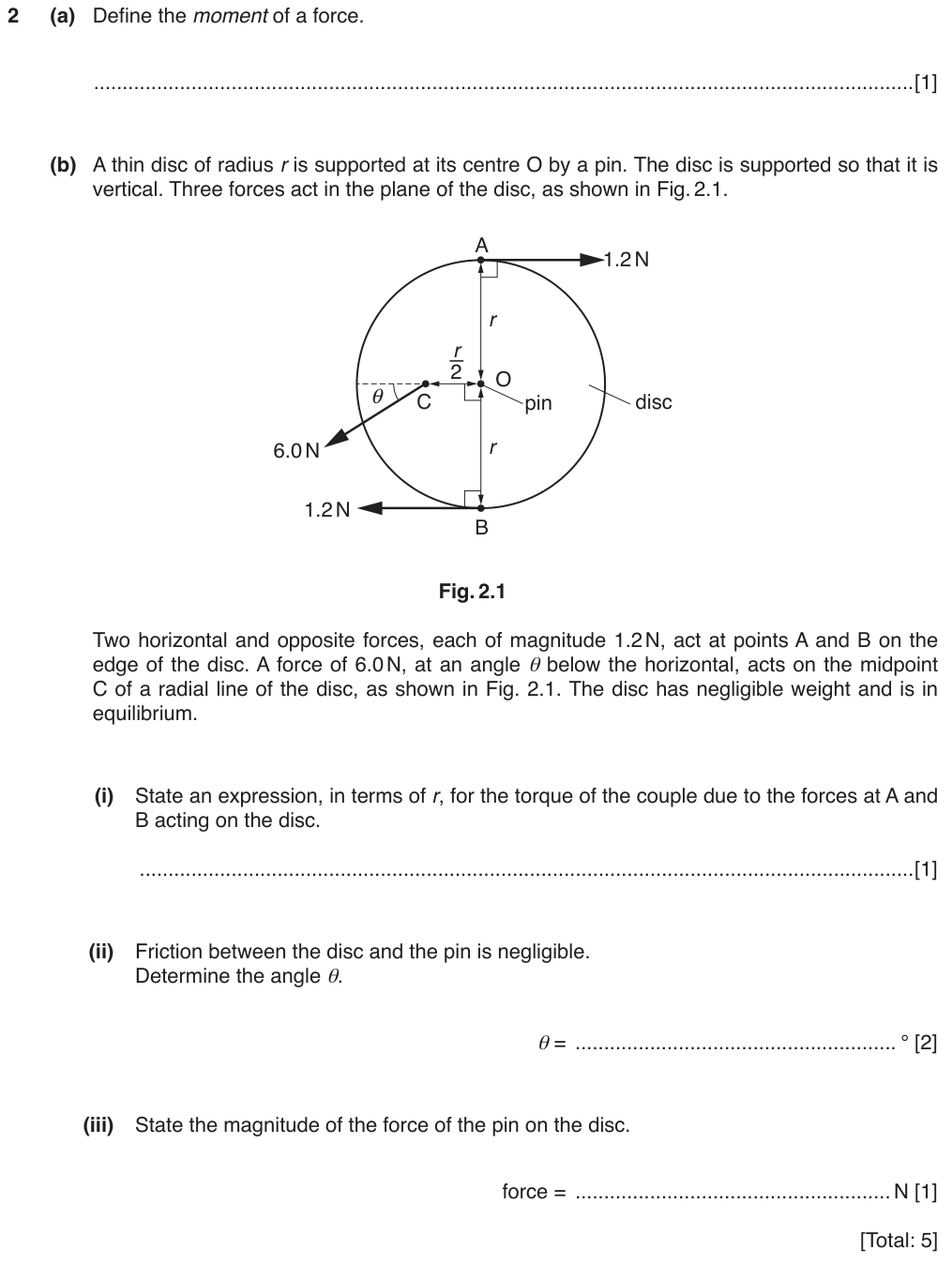
A disc can turn about a pin at its centre. Two equal, opposite 1.2 N forces at the top and bottom form a couple that tries to spin it. A 6.0 N force pulling at an angle at C stops it turning. We find the couple's torque, the angle, and the pin's force.
- torque of the coupleone force × the perpendicular distance BETWEEN the two forces (2r here)
- midpoint of a horizontal radiusC is r/2 from O
- at angle θ below the horizontalonly the vertical component (6.0 sin θ) has a moment about O
- in equilibriumno resultant moment AND no resultant force
- (b)(i)torque of the couple
- (b)(ii)the angle θ
- (b)(iii)force of the pin on the disc
- 1.2 N + 1.2 Ncouple, at A and B, 2r apart
- 6.0 N at Cr/2 from O, at θ below horizontal
- (i) Findtorque
- UseF × separation = 1.2 × 2r
- Trapnot 1.2 × r
- UseF × separation = 1.2 × 2r
- (ii) Findθ
- Usemoment of 6.0 N about O = torque of the couple
- Moment6.0 sin θ × r/2
- Trapsin (vertical part) and r/2, not cos and r
- Usemoment of 6.0 N about O = torque of the couple
- (iii) Findpin force
- Useresultant force = 0; the couple's forces cancel each other
Which part of the 6.0 N force can turn the disc about O?
C is on a horizontal line through O, so the horizontal part points straight at O (no moment). Only the vertical part, 6.0 sin θ, turns it.
Does part (iii) need any calculation?
No. The two 1.2 N forces cancel, so the pin must exactly cancel the 6.0 N force: 6.0 N.
5 Now solve it have a go on paper first, then open the worked solution
- (b)(i) The forces are 2r apart: torque = 1.2 × 2r = 2.4r A1 (1.2r was the common wrong answer)
- (ii) The 6.0 N force acts at C, r/2 from O along a horizontal line. Only its vertical component, 6.0 sin θ, has a moment about O: 6.0 sin θ × r/2 C1
- Equilibrium: 6.0 × (r/2) sin θ = 2.4r → sin θ = 0.80 → θ = 53° A1
- (iii) The couple's forces cancel each other. The only other forces are the 6.0 N and the pin's force, so the pin pushes with 6.0 N (equal and opposite) A1
sin θ = 0.80 is less than 1, so the 6.0 N force is just strong enough - an answer with sin θ above 1 would mean a slip with r or r/2.
Example 4 · Resultant moment from two thrusters (Paper 2, 3 marks) ★★ Medium
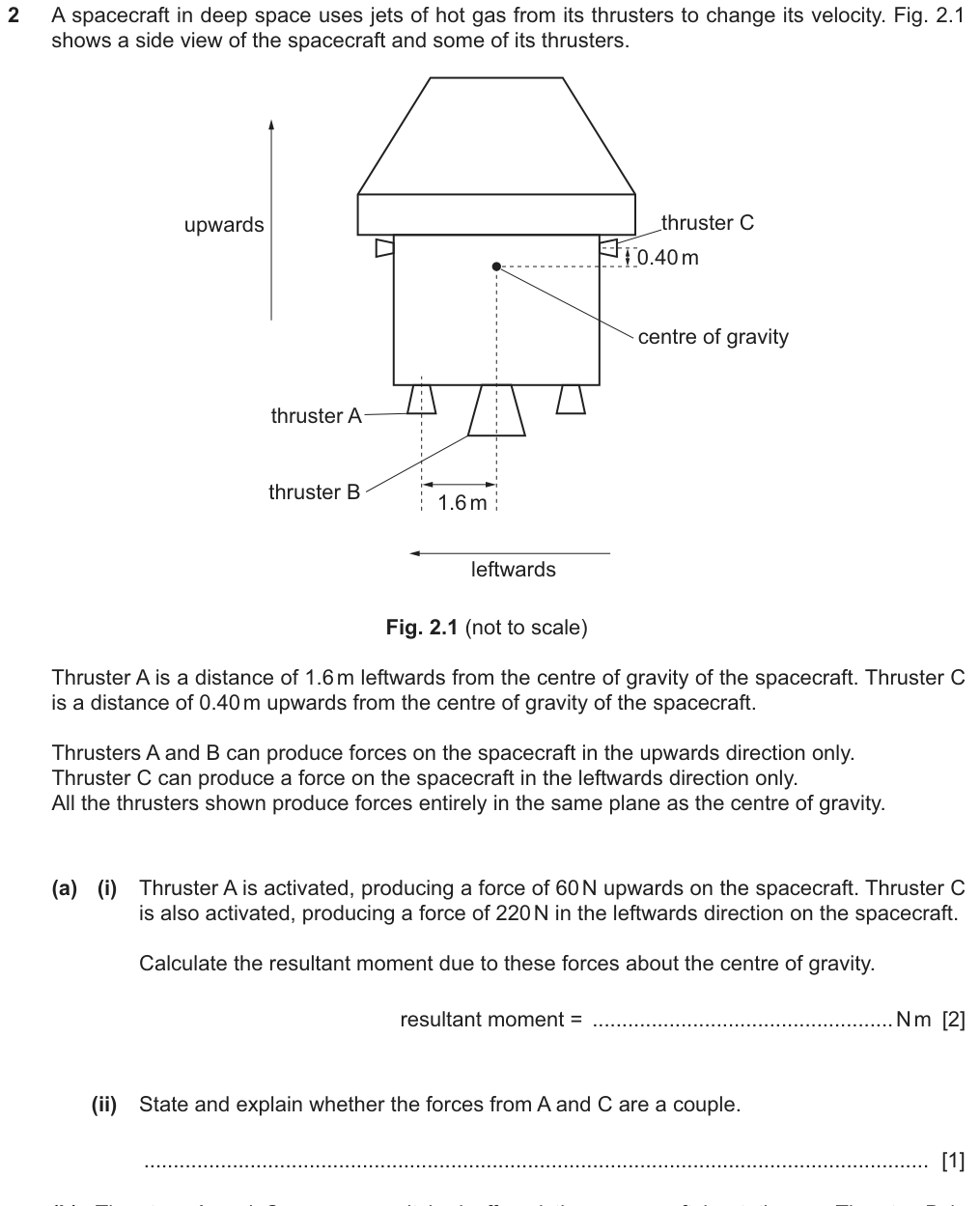
Two thrusters push on a spacecraft at different points: A pushes up, to the left of the centre of gravity; C pushes left, above it. Each makes the craft turn. We find the overall turning effect and decide if the pair is a couple.
- about the centre of gravitymeasure each perpendicular distance from the centre of gravity
- resultant momentadd moments in one sense, subtract those in the other
- coupletwo forces EQUAL in size, OPPOSITE in direction, PARALLEL but not in line
- (i)resultant moment about the centre of gravity
- (ii)couple or not, with a reason
- A: 60 N up1.6 m left of c.g.
- C: 220 N left0.40 m above c.g.
- (i) Findresultant moment
- Usemoment = F × perpendicular distance for each
- A60 × 1.6
- C220 × 0.40
- Sensecheck the figure: they turn opposite ways, so subtract
- Usemoment = F × perpendicular distance for each
- (ii) Decidecouple?
- Testequal, opposite, parallel?
For thruster C, which distance is the perpendicular one?
C pushes horizontally, so the perpendicular distance from the centre of gravity is the vertical gap: 0.40 m.
Why does it matter that the forces are not equal and parallel?
Only a couple gives pure turning with zero resultant force. These forces also push the spacecraft sideways.
5 Now solve it have a go on paper first, then open the worked solution
- (i) A: 60 × 1.6 = 96 N m; C: 220 × 0.40 = 88 N m C1 — from the figure they turn in opposite senses.
- Resultant = 96 − 88 = 8.0 N m A1
- (ii) Not a couple: the forces are not equal, not opposite and not parallel (any one reason), so their resultant force isn't zero B1
The two moments are close (96 and 88 N m), so a small resultant (8.0 N m) is expected.
Example 5 · A card swinging on a pin (Paper 2, 4 marks) ★★ Medium
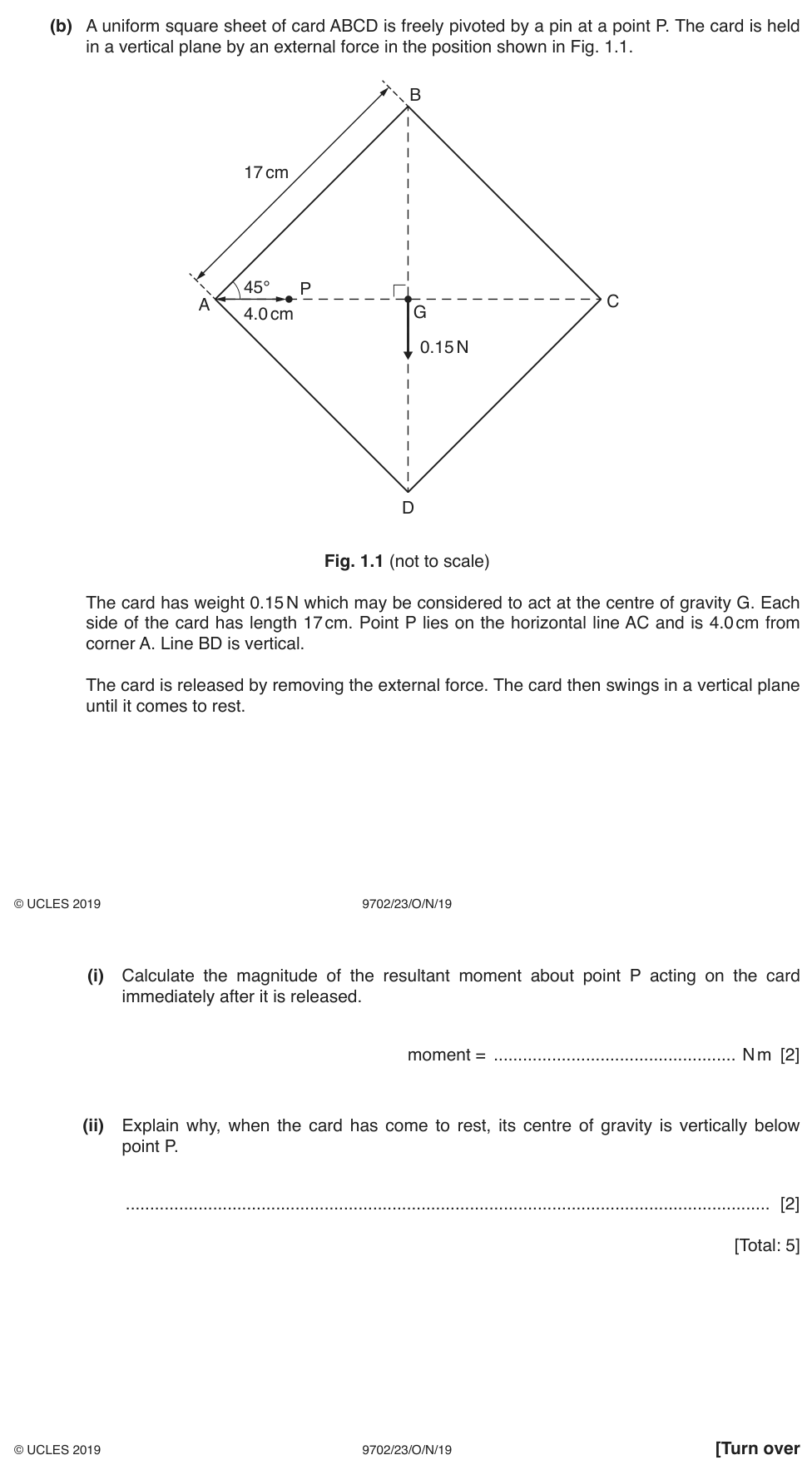
A square card hangs on a pin that is NOT at its centre. When it is let go, its weight (acting at the centre G) has a turning effect about the pin, so the card swings. It finally stops with G straight below the pin.
- uniform squareG is at the centre: halfway along the diagonal AC
- diagonal AC horizontal, BD verticalthe weight's perpendicular distance from P is the horizontal gap PG
- just after releasestill in that starting position
- Explain why … vertically below Pat rest the resultant moment is zero → weight passes through P
- (i)resultant moment about P just after release
- (ii)why G ends below P
- side = 17 cmsquare
- W = 0.15 Nat G
- AP = 4.0 cmalong AC
- half the diagonal: AG = 17 cos 45° = 12.0 cm
- (i) Findmoment about P
- UseW × perpendicular distance PG
- Work out firstPG = AG − AP = 12.0 − 4.0 cm
- Units8.0 cm = 0.080 m
- UseW × perpendicular distance PG
- (ii) ExplainG below P
- Chainat rest → no resultant moment → weight's line passes through P → zero distance
Where exactly is G, measured from A along the diagonal?
Half the diagonal. The diagonal of a 17 cm square is 17√2 = 24 cm, so AG = 12.0 cm.
In (ii), what makes the moment of the weight zero?
Its perpendicular distance from P becoming zero - the weight's line of action passes through P.
5 Now solve it have a go on paper first, then open the worked solution
- (i) G is at the middle of the diagonal AC: AG = 17 cos 45° = 12.0 cm, so GP = 12.0 − 4.0 = 8.0 cm horizontally C1
- The weight is vertical, so its perpendicular distance from P is this 8.0 cm: moment = 0.15 × 0.080 = 1.2 × 10⁻² N m A1 Convert cm to m (the November 2019 report: power-of-ten errors).
- (ii) At rest the resultant moment is zero, so the weight's line of action must pass through P B1 — zero perpendicular distance, so no moment about P B1
1.2 × 10⁻² N m is small, as you'd expect for a 0.15 N card and an 8 cm lever arm. Giving 1.2 N m means the cm were not converted.
Summary
- Centre of gravity: the point where all the weight is taken to act (the middle of a uniform object).
- Moment = force × perpendicular distance from the point to the line of action (or perpendicular component × distance along the rod).
- Couple: equal, opposite, parallel forces on different lines → rotation only. Torque = one force × perpendicular separation.
| If you see… | do this |
|---|---|
| "uniform" beam / rod / sign | weight at the middle |
| a slanted force on a straight rod | F sin θ × d, θ = angle between force and rod |
| a tilted rod and its weight | perpendicular component W cos(tilt from horizontal), or perpendicular distance (L/2) cos(tilt) |
| equal, opposite forces on a wheel or bar | torque = F × distance between them (often the diameter) |
| "hangs freely" / "comes to rest" | centre of gravity directly below the pivot |
Can I do this?
- I can define the centre of gravity and place it for uniform objects.
- I can define the moment of a force with "perpendicular distance" and "line of action".
- I can find the moment of a slanted force both ways and pick sin or cos correctly.
- I can define a couple and its torque and calculate it.
Anything unticked: revise that section first. All ticked: take the quiz.
Quiz
Your progress on this note is saved when JavaScript is on.