
Forces, density and pressure
Density, pressure and hydrostatic pressure Δp = ρgΔh
What you need to be able to do
- 4.3.1Define and use density.
- 4.3.2Define and use pressure.
- 4.3.3Derive, from the definitions of pressure and density, Δp = ρgΔh.
- 4.3.4Use Δp = ρgΔh.
Before you start: SI units and prefixes (cm³ → m³, cm² → m²). Next: Upthrust and Archimedes' principle.
Density
- Anything that sinks in water has a density above 1000 kg m−3 (9702/12/M/J/23 Q1; sand ≈ 2 × 10³ kg m−3, 9702/12/F/M/21 Q1).
- Use ρ for density, not d (d looks like diameter — named in two 2017 reports).
- Volumes you must know: cuboid l × w × h; cylinder πr²L; sphere \(\tfrac43\pi r^3\) (the 2022 reports: weaker candidates couldn't recall the sphere).
Mixtures: never average the densities
- Find the total mass (add the masses; if you're given volumes, mass = ρV for each part).
- Find the total volume (add the volumes; if you're given masses, V = m/ρ for each part).
- Density of the mixture = total mass ÷ total volume.
Pressure
- Find the normal force: for an object resting on a horizontal surface, its weight mg. On a slope, only the part of the weight perpendicular to the slope: mg cos θ 9702/21/O/N/15 Q4(b).
- Find the contact area in m² (cm² × 10−4, mm² × 10−6). Shared between several feet or legs? Divide the force between them.
- Divide. Maximum pressure = resting on the smallest face.
Deriving Δp = ρgΔh
The syllabus asks you to derive it; Paper 2 has asked for exactly this (3 marks) in 2012, 2016, 2017 and 2023.
- Volume of the column: V = Ah. B1 (with the next line)
- Mass (definition of density): m = ρV = ρAh.
- Weight: W = mg = ρAhg. B1
- Pressure (definition): p = F/A = W/A = ρAhg / A. B1
- A cancels: p = ρgh. Between two depths, Δp = ρgΔh.
Using p = ρgh
\[ \Delta p = \rho g \Delta h \qquad p_{\text{total}} = p_{\text{atm}} + \rho g h \]
ρ is the density of the liquid (not of the object in it), h the vertical depth below the surface. The shape and width of the container don't matter: two vessels of different shapes with liquid to the same depth have the same pressure on the base if the liquids are the same 9702/12/O/N/22 Q16.
Pressure due to the liquid
ρgh only. "Pressure on the submarine due to the sea water" at 260 m is twice that at 130 m, so the difference is p itself 9702/11/M/J/25 Q16.
Total pressure
Add atmospheric pressure (≈ 1.0 × 10⁵ Pa), which presses on the surface. That's why ρgh "does not give the total pressure on the base" 9702/21/M/J/23 Q4(b).
1 Two liquids, one on top of the other
9.0 cm of water (1000 kg m⁻³) under 5.0 cm of oil (800 kg m⁻³). Pressure on the base due to the liquids? 9702/11/M/J/21 Q14
Askedpressure on the base from both liquidsKnoweach layer's depth and densityRouteadd a ρgh for each layer (depths in m)
- Each layer adds its own ρgh: oil 800 × 9.81 × 0.050 = 392 Pa; water 1000 × 9.81 × 0.090 = 883 Pa.
- Total = 1300 Pa (in m, not cm).
2 Diving with atmospheric pressure
A bird dives 1.50 m into a lake; atmospheric pressure 101 kPa. Pressure at that depth? 9702/11/O/N/21 Q14
Askedtotal pressure at 1.50 mKnowdepth, water density, atmospheric pressureRouteρgh for the water, then ADD atmospheric pressure
- ρgh = 1000 × 9.81 × 1.50 = 14.7 kPa.
- Total = 101 + 14.7 = 116 kPa. (14.7 kPa on its own is "pressure due to the water".)
3 U-tube with two liquids
Liquid P stands 2x above the interface on one side; liquid Q stands x above that level on the other. Ratio of densities? 9702/13/O/N/24 Q16
Askedratio of densitiesKnowcolumn heights above the interface levelRoutesame level in one liquid → equal pressures: ρPg(2x) = ρQgx
- At the same level in the same continuous liquid (the interface level) the pressures are equal.
- ρP g (2x) = ρQ g (x)
- ρP/ρQ = 1/2: the less dense liquid needs the taller column.
4 Air pressure and height
Why is the drop in air pressure up a mountain not proportional to the height gained? 9702/23/M/J/12 Q3(b)
Askedwhy the pressure drop isn't ∝ heightKnowp = ρghRouteρgh is linear only if ρ is constant; air thins with height
- p = ρgh is proportional to h only if ρ is constant.
- Air's density decreases with height.
- So equal height gains give smaller and smaller pressure drops.
Pressure–depth graphs
- Read the axes: power of ten on the pressure axis (×10⁴, ×10⁵ Pa) and depth units (cm → m).
- Take a large gradient triangle, not a single point: a single point gives total pressure ÷ depth, which includes the atmosphere (June 2016 report: "the majority used a one-point solution").
- ρ = gradient / g (many forgot the g, 2016 and 2023 reports).
- Two liquid layers: two straight sections; each gradient gives its own liquid's density 9702/23/O/N/17 Q2(c).
Mark-scheme focus
Define pressure
Define pressure.
- "(normal) force per (unit cross-sectional) area"
- "force × area", "force on an area"
- "mass per unit area" / "weight per unit volume" (Paper 1 distractors: 9702/11/M/J/23 Q14, 9702/13/O/N/23 Q14)
The 2014 scheme insists on "clear ratio essential": force divided by area.
Show that p = ρgh
By using the definitions of pressure and density, show that p = ρgh, where p is the pressure due to the liquid on the base of the beaker.
- "ρ = m / V" or ρ = m / Ah
- "p = F / A" or p = W / A
- algebra leading to p = ρgh, e.g. p = ρAhg / A
- F = ma for the force on the base
- a base-units check
- symbols that appear from nowhere
From: 9702/21/M/J/23 Q4(a), 9702/23/O/N/17 Q2(a), 9702/22/M/J/16 Q2(a) and their reports.
- Derive p = ρgh: Paper 2 every few years, 3 marks.
- Density from a pressure–depth graph: Paper 2, 2 marks (C1 Δp = ρgΔh with numbers, A1).
- Density of mixtures, maximum pressure of a block, layers of liquid, U-tubes: Paper 1, two or three a year.
Worked examples
Example 1 · Derive, explain, read a graph (Paper 2, 8 marks) ★★ Medium
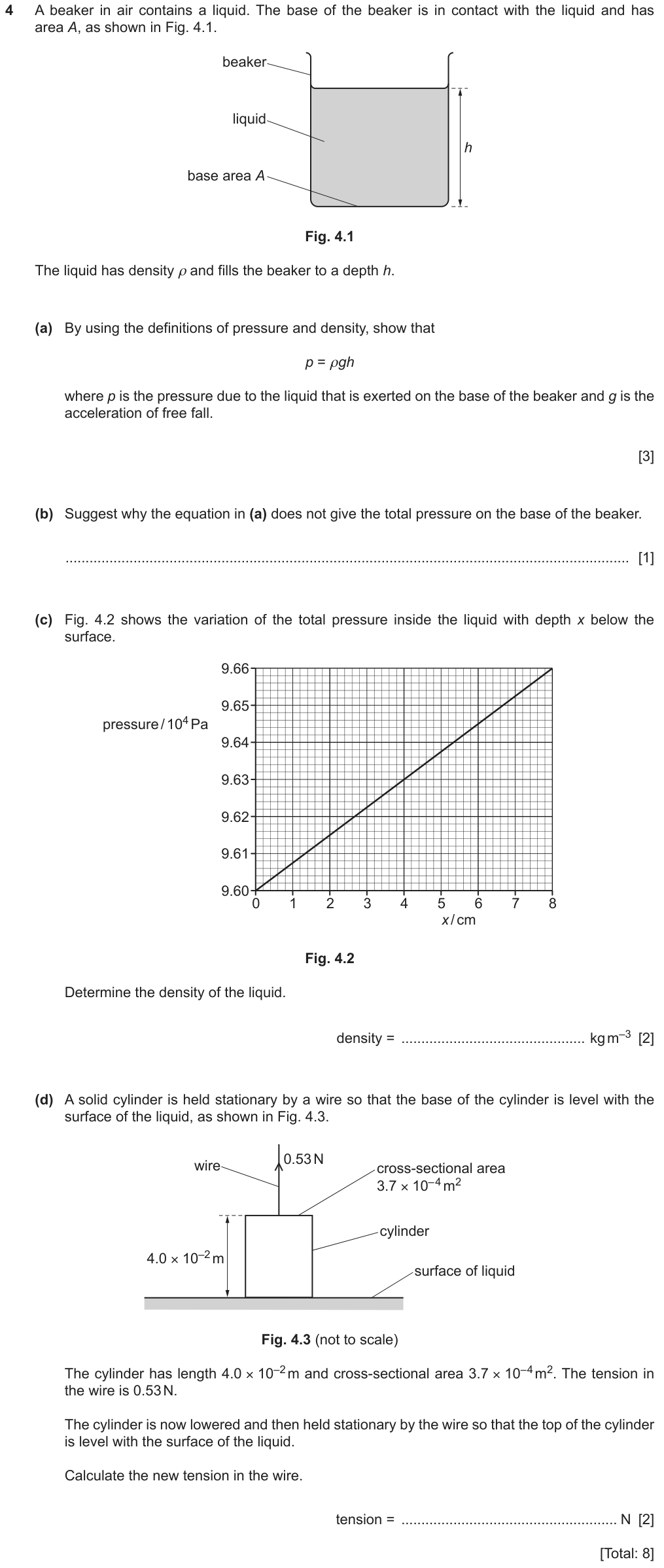
Liquid in a beaker. First we prove p = ρgh from scratch. Then a graph shows the TOTAL pressure (air + liquid) rising with depth - its slope gives the density. Finally a cylinder hanging on a wire is lowered into the liquid and feels an upthrust.
- Show that p = ρgha derivation: weight of liquid → mass → volume → divide by area; every line written
- total pressureatmospheric pressure is ALSO pushing on the surface
- Determine the densityuse the CHANGE in pressure over the change in depth
- lowered until its top is at the surfacenow fully under: it gets an upthrust ρgV, so the wire holds less
- (a)derive p = ρgh
- (b)why it is not the total pressure
- (c)density of the liquid
- (d)new tension in the wire
- p = 9.60 × 10⁴ Paat the surface
- p = 9.66 × 10⁴ Paat 8.0 cm = 0.080 m
- L = 4.0 × 10⁻² mcylinder
- A = 3.7 × 10⁻⁴ m²cylinder
- T = 0.53 Nbefore lowering
- the pressure at the surface (9.60 × 10⁴ Pa) IS the atmosphere
- (c) Findρ
- UseΔp = ρgΔh
- Δp(9.66 − 9.60) × 104 = 600 Pa
- Δh0.080 m
- Trap9.66 × 104 ÷ (g × 0.080) includes the air
- UseΔp = ρgΔh
- (d) Findnew tension
- UseTnew = T − upthrust
- UpthrustρgV with V = 3.7 × 10−4 × 4.0 × 10−2
- ρfrom (c)
- UseTnew = T − upthrust
Why must we use the CHANGE in pressure in (c)?
ρgh only gives the pressure due to the liquid. The graph's values include atmospheric pressure, which is the same at every depth and cancels in the difference.
Is the new tension the upthrust?
No - the upthrust helps hold the cylinder, so the wire holds LESS: 0.53 − upthrust.
5 Now solve it have a go on paper first, then open the worked solution
- (a) The five-line derivation above B1 B1 B1
- (b) There is atmospheric pressure on the liquid's surface as well B1
- (c) Δp = ρgΔh: (9.66 − 9.60) × 104 = ρ × 9.81 × 8.0 × 10−2 C1
- ρ = 600 / 0.785 = 760 kg m−3 (760–770 accepted) A1 Use the change in pressure: 9.66 × 10⁴ / 0.080 would include the atmosphere (the June 2023 report's common mistake).
- (d) Fully under, the cylinder gets an upthrust (next page): ρgV = 760 × 9.81 × (3.7 × 10−4 × 4.0 × 10−2) = 0.11 N C1
- New tension = 0.53 − 0.11 = 0.42 N A1 (not 0.11 N — the report says some gave the upthrust as the tension)
760 kg m−3 is a little less than water - like an oil or alcohol, sensible. The tension drops only a little (to 0.42 N) because the cylinder is small.
Example 2 · Two liquids and the atmosphere on one graph (Paper 2, 3 marks) ★★ Medium
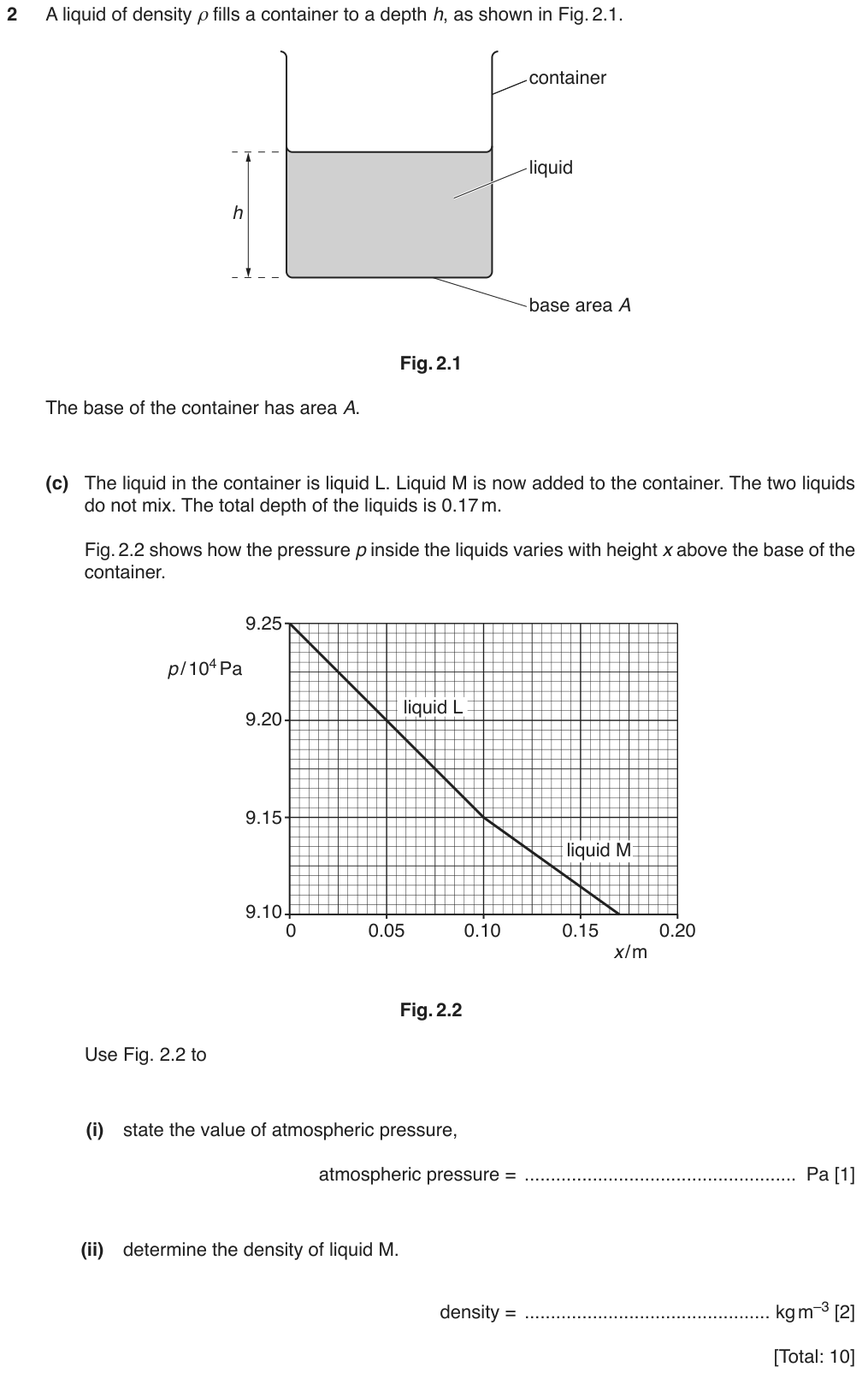
Two liquids that don't mix: M floats on top of L. A graph shows the pressure against HEIGHT above the base. At the top surface only the air presses; going down through each liquid the pressure rises at a rate set by its density.
- height x above the basenot depth! pressure FALLS as x rises
- atmospheric pressurethe pressure at the very top surface, where there is no liquid above
- density of liquid Muse only the section of the graph across M (x = 0.10 to 0.17 m)
- (i)atmospheric pressure
- (ii)density of M
- 9.25 × 10⁴ Pax = 0 (base)
- 9.15 × 10⁴ Pax = 0.10 m (top of L)
- 9.10 × 10⁴ Pax = 0.17 m (surface)
- (i) Readatmospheric pressure
- Graphvalue at the surface, x = 0.17 m
- (ii) FindρM
- Useρ = Δp ÷ (gΔh) across M only
- Δp9.15 − 9.10 (× 104) = 500 Pa
- Δh0.17 − 0.10 = 0.07 m
- Useρ = Δp ÷ (gΔh) across M only
Which liquid is on top, and how can the graph tell you it's less dense?
M is on top. Across M the pressure changes less per metre (a shallower slope), so M is less dense than L - that's why it floats.
Why is the top value the atmospheric pressure?
At the surface there is no liquid above, so only the air presses there.
5 Now solve it have a go on paper first, then open the worked solution
- (i) At the top surface (x = 0.17 m) only the air presses: 9.10 × 10⁴ Pa A1
- (ii) Across liquid M (x = 0.10 to 0.17 m): Δp = (9.15 − 9.10) × 104 = 500 Pa over 0.07 m C1
- ρ = 500 / (9.81 × 0.07) = 730 kg m−3 A1
Here x is height above the base, not depth: pressure falls as x rises. Read the axis label before you read the gradient.
ρM (730 kg m−3) is less than L's (Δp 1000 Pa over 0.10 m → about 1000 kg m−3) - consistent with M floating on L.
Example 3 · Pressure on a slope (Paper 2, 5 marks) ★★★ Hard
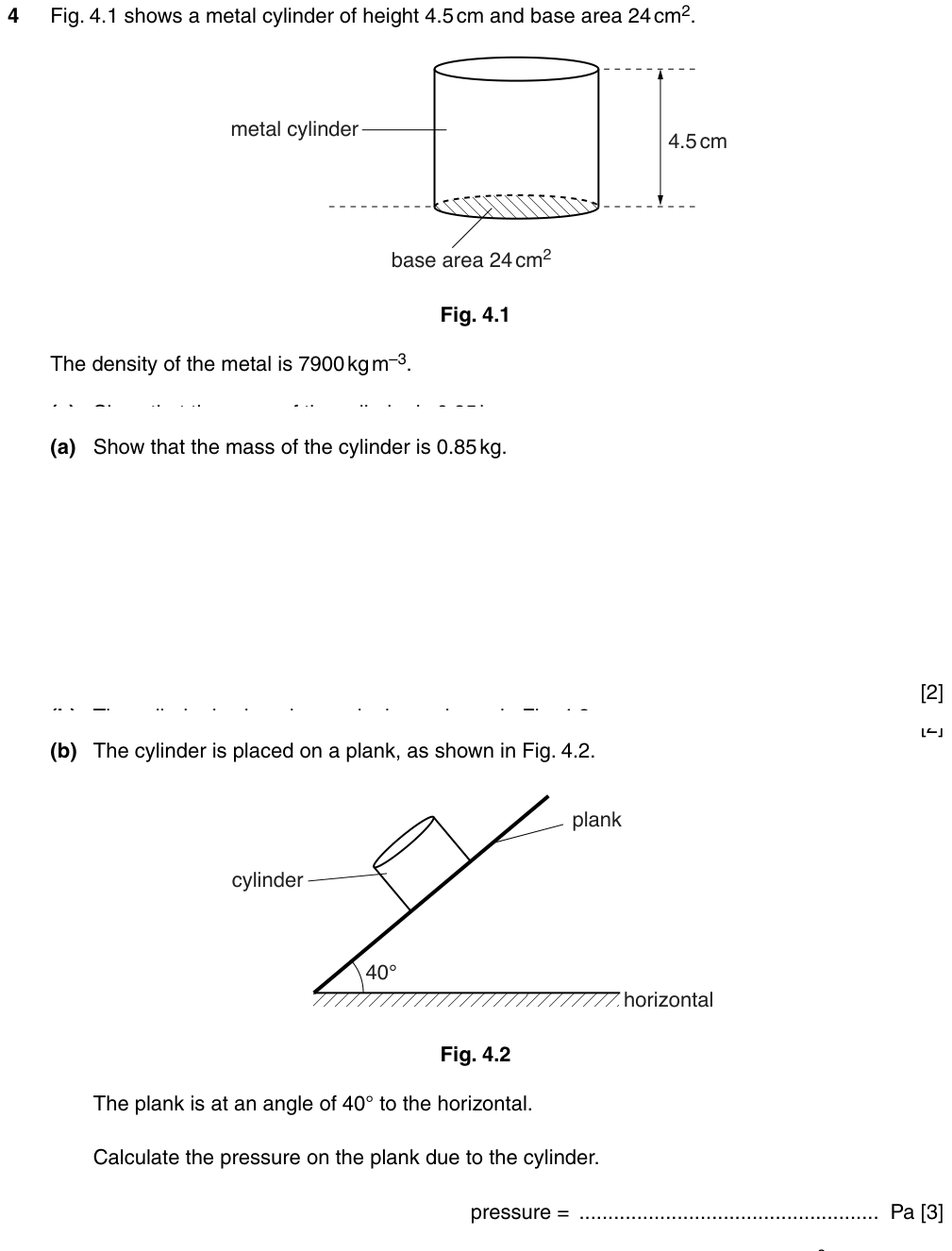
Why it is hard: pressure uses the force normal to the surface. On a slope that is only part of the weight.
A metal cylinder stands on a sloping plank. We first find its mass from its density and size, then the pressure it puts on the plank. On a slope only part of the weight presses INTO the plank.
- Show that … 0.85 kgm = ρV, with the volume in m³ - write the working
- cm, cm²convert: cm³ → m³ is × 10−6, cm² → m² is × 10−4
- 40° to the horizontalthe force normal to the plank is W cos 40°
- pressure on the planknormal force ÷ contact area
- (a)show m = 0.85 kg
- (b)pressure on the plank
- h = 4.5 cmcylinder
- A = 24 cm² = 24 × 10−4 m²base
- ρ = 7900 kg m−3metal
- 40°plank
- (a) Showm = 0.85 kg
- Usem = ρV, V = 4.5 × 24 cm³ → m³
- (b) Findp
- Usep = F⟂ ÷ A
- F⟂mg cos 40° - the part of the weight into the plank
- Trapnot the whole weight; not sin 40°
- Usep = F⟂ ÷ A
Which part of the weight presses into the plank?
The component perpendicular to the plank: W cos 40°. The other part (W sin 40°) acts along the plank and is held by friction.
On a flat table, would the pressure be bigger or smaller?
Bigger: the whole weight would press down. Tilting reduces the normal force.
5 Now solve it have a go on paper first, then open the worked solution
- (a) m = ρV = 7900 × (4.5 × 24 × 10−6) = 0.85 kg C1 M1 (cm³ → m³: × 10−6)
- (b) p = F / A C1, with F = W cos 40° (the component of the weight into the plank) C1
- p = (0.85 × 9.81 × cos 40°) / (24 × 10−4) = 2.7 × 10³ Pa A1
2.7 × 10³ Pa is less than mg ÷ A on a flat surface (3.5 × 10³ Pa), by the factor cos 40° = 0.77 ✓.
Example 4 · Density and maximum pressure of a slab (Paper 2, 5 marks) ★ Easy
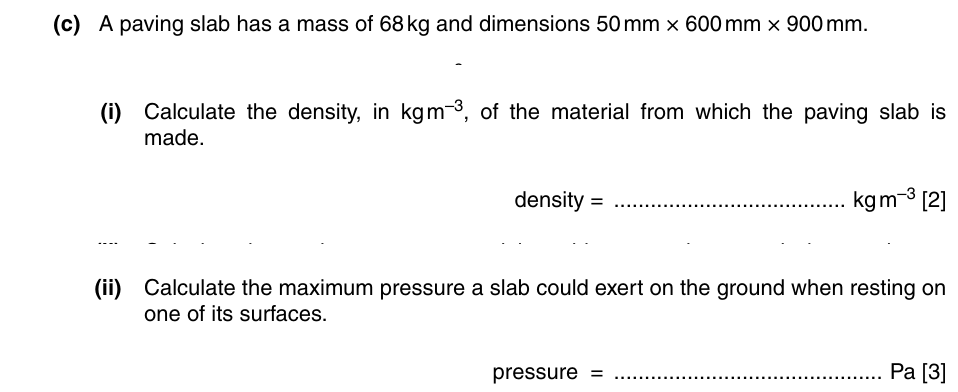
A concrete paving slab: we know its mass and size. Find its density, then the BIGGEST pressure it could put on the ground - which depends on which face it stands on.
- 50 mm × 600 mm × 900 mmconvert to metres before multiplying
- maximum pressuresame weight, so the SMALLEST face gives the biggest pressure
- resting on one of its surfacesthe force is the whole weight, mg
- (i)density
- (ii)maximum pressure
- m = 68 kgslab
- 0.050 m × 0.600 m × 0.900 mdimensions
- (i) Findρ
- Useρ = m ÷ V
- (ii) Findpmax
- Usep = mg ÷ A
- Choosesmallest face: 0.050 × 0.600 m²
- Usep = mg ÷ A
Which face gives the biggest pressure?
The smallest one (50 mm × 600 mm). Pressure = force ÷ area, and the force (the weight) is the same on every face.
Can you check the answer another way?
Standing on that face the slab is 0.900 m tall, so p = ρgh = 2520 × 9.81 × 0.900 - the same 2.2 × 10⁴ Pa.
5 Now solve it have a go on paper first, then open the worked solution
- (i) V = 0.050 × 0.600 × 0.900 = 0.027 m³; ρ = 68 / 0.027 = 2500 kg m−3 C1 A1
- (ii) Maximum pressure → smallest face: 0.050 × 0.600 = 0.030 m² C1
- p = 68 × 9.81 / 0.030 C1 = 2.2 × 10⁴ Pa A1 (check: ρgh = 2520 × 9.81 × 0.900 = 2.2 × 10⁴ Pa ✓)
ρ = 2500 kg m−3 is right for concrete. The two routes for the pressure agree.
Summary
- ρ = m/V; mixtures: total mass ÷ total volume.
- p = F/A with the normal force; maximum pressure on the smallest face.
- Derive: V = Ah, m = ρAh, W = ρAhg, p = W/A = ρgh.
- Δp = ρgΔh uses the liquid's density and vertical depth; add atmospheric pressure for the total.
- p–depth graph: gradient ρg, intercept atmospheric pressure.
| If you see… | do this |
|---|---|
| "mixed" liquids | add masses, add volumes, then divide |
| "maximum pressure" of a block | smallest face (or ρgh with the largest height) |
| "due to the liquid" | ρgh only; "total" → add atmospheric |
| layers of different liquids | add ρgh for each layer |
| U-tube | equal pressures at the same level in the same liquid |
| pressure–depth graph | density = gradient / g |
Can I do this?
- I can define and use density, including for mixtures.
- I can define pressure and use the normal force and the right area.
- I can derive p = ρgh from the definitions.
- I can use Δp = ρgΔh with layers, atmospheric pressure and U-tubes.
- I can get a density and atmospheric pressure from a pressure–depth graph.
Anything unticked: revise that section first. All ticked: take the quiz.
Quiz
Your progress on this note is saved when JavaScript is on.