
Forces, density and pressure
Upthrust and Archimedes' principle
What you need to be able to do
- 4.3.5Understand that the upthrust on an object in a fluid is due to a difference in hydrostatic pressure.
- 4.3.6Calculate the upthrust with F = ρgV (Archimedes' principle).
Before you start: Density and pressure (Δp = ρgΔh) and Terminal velocity.
Where upthrust comes from
Pressure in a fluid increases with depth. An object in the fluid has its bottom deeper than its top, so the fluid pushes up on the bottom harder than it pushes down on the top. The difference is the upthrust.
From pressure difference to F = ρgV
- Pressure difference between bottom and top: Δp = ρgh (ρ = density of the fluid, h = height of the object).
- Upthrust = Δp × A = ρghA (A = area of the top/bottom face).
- hA is the volume of fluid pushed aside (displaced), V: F = ρgV.
- ρV is the mass of fluid displaced, so ρgV is its weight: upthrust = weight of fluid displaced (Archimedes' principle).
\[ F = \rho g V \]
| Symbol | Meaning | Trap |
|---|---|---|
| ρ | density of the fluid | not the object's density 9702/11/O/N/25 Q16 |
| V | volume of fluid displaced = the object's volume below the surface | for a floating object, only the submerged part |
Two consequences that Paper 1 tests again and again:
- Upthrust doesn't depend on depth once fully submerged: the top and bottom pressures both rise, their difference doesn't (9702/12/F/M/24 Q10; a submerged cylinder's string tension is the same at any depth, 9702/12/M/J/17 Q10).
- Upthrust doesn't depend on what the object is made of: equal volumes fully submerged get equal upthrust, heavy or light, tall or wide 9702/12/O/N/23 Q14, 9702/11/M/J/22 Q14.
The four situations
Every upthrust question is one of these. In each, draw the forces and use up = down (or F = ma if it accelerates).
1 Floating
A ball (0.50 kg, volume 1.3 × 10⁻³ m³) floats on water. What percentage of its volume is above the surface? 9702/11/M/J/23 Q15
Asked% of the ball above the surfaceKnowmass, volume, water densityRoutefloating: U = W gives Vunder; then take it from 100% (read which part is asked)
- Floating: upthrust = weight → ρw g Vunder = mg.
- Vunder = 0.50 / 1000 = 5.0 × 10⁻⁴ m³ = 38% of the ball.
- Above the surface: 62%. (38% was the popular wrong answer — read which part is asked.)
General rule: fraction submerged = ρobject / ρfluid. A sphere with 21% under sea water has density 0.21 × 1050 = 220 kg m⁻³.
2 Hanging on a string / newton meter, fully under
A cylinder weighs 5.3 N in air and 4.8 N on a spring balance in oil. Find the upthrust. 9702/23/M/J/16 Q4
Askedthe upthrustKnowweight in air, reading in oilRouteT + U = W → U = the 'loss of weight'
- Forces on the cylinder: tension up, upthrust up, weight down.
- T + U = W → U = 5.3 − 4.8 = 0.5 N.
- The "loss of weight" in the liquid is the upthrust; use F = ρgV to get the oil's density or the volume.
3 Released under water: it accelerates
A sphere (density 220 kg m⁻³) is held fully under sea water (1050 kg m⁻³) and released. Initial acceleration? 9702/23/M/J/23 Q2(b)(i)
Askedinitial acceleration after releaseKnowboth densitiesRoutev = 0 so no drag: a = (U − W) ÷ m; V cancels
- At release v = 0, so no drag. Resultant = U − W = (1050 − 220)Vg, upwards.
- a = resultant / mass = (1050 − 220)Vg / (220V).
- a = 830 × 9.81 / 220 = 37 m s⁻² upwards. (Using U alone ignores the weight — named in the report.)
4 Falling through a liquid at terminal velocity
A sphere falls at constant velocity through a liquid. How are the forces related? 9702/22/O/N/24 Q1(b)(ii)
Askedhow the forces are relatedKnowconstant velocity in a liquidRouteresultant zero: W = U + D
- Three forces: weight down; upthrust and drag up.
- Constant velocity → resultant zero.
- W = U + D. The weight is the largest force (9702/13/M/J/21 Q11: in air, upthrust ≪ drag ≈ weight).
Mark-scheme focus
Explain how hydrostatic pressure produces an upthrust
Explain how hydrostatic pressure results in an upthrust force acting on a solid object immersed in a liquid.
- "(due to difference in depth there is a) difference in pressure between top and bottom"
- "force on bottom of ball is greater (than downwards force on top, so resultant force is upwards)"
- "the water is denser than the object" (true for floating, but not the origin of the force)
- quoting Archimedes' principle ("upthrust = weight of liquid displaced")
- "the object pushes down on the water so the water pushes back up" (a third-law muddle, 2017 report)
The June 2018 report: "a common misconception is that the upthrust is caused by the density of the water being greater than the density of the sphere". The question asks for the cause: pressures and forces.
From: 9702/21/O/N/25 Q2(a)(ii), 9702/23/M/J/18 Q2(b)(ii), 9702/22/F/M/17 Q1(b)(iii), 9702/21/M/J/17 Q3(c)(i).
State the forces on a sphere falling at constant velocity, and how they relate
A small solid sphere falls with constant velocity through the liquid. State 1. the names of the three forces acting on the sphere, 2. a word equation that relates the magnitudes of these forces.
- "weight, upthrust, drag / viscous force"
- "weight = upthrust + viscous force"
- "air resistance" (it's in a liquid), "normal reaction", "pressure"
- the same force twice ("weight and gravity", "upthrust and buoyancy")
- symbols when the question says "word equation"; F = ma
From: 9702/23/O/N/17 Q2(b)(i) and the November 2017 report.
- Upthrust with F = ρgV, then a balance or F = ma: Paper 2 most years (often inside a moments or terminal-velocity question).
- Origin of upthrust: Paper 2 every year or two, 1–2 marks.
- Floating fractions, newton-meter readings, "same upthrust?": Paper 1 two or three a year.
Worked examples
Example 1 · Floating sphere, then released under water (Paper 2, 8 marks) ★★ Medium
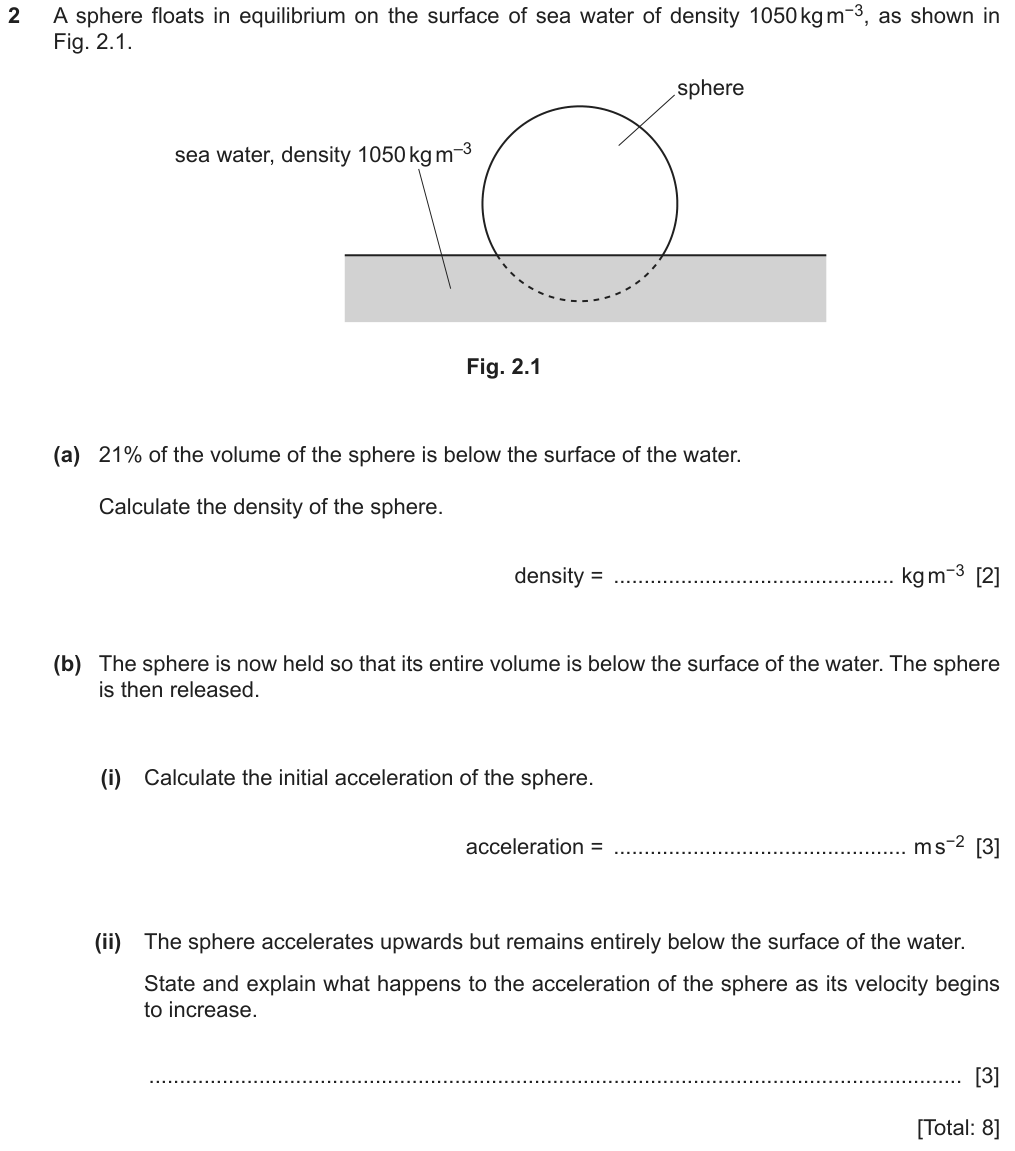
A light sphere floats with only 21% of it under the sea. From that we find its density. Then it is pushed right under and let go: the full upthrust is now much bigger than its weight, so it shoots up - and as it speeds up, drag joins in.
- floatsupthrust = weight (it is in equilibrium)
- 21% of its volume below the surfacethe upthrust comes from 0.21V of water, the weight from all of V
- held fully under and releasednow the upthrust uses the whole V; at release v = 0, so no drag yet
- State and explainwhat happens to the acceleration AND the chain of reasons
- (a)density of the sphere
- (b)(i)initial acceleration
- (b)(ii)how the acceleration changes as it speeds up
- ρsea = 1050 kg m−3
- 0.21Vunder water when floating
- V is never given - it cancels in both parts
- (a) Findρsphere
- Usefloating: ρsea g (0.21V) = ρ g V
- (b)(i) Finda
- Usea = (U − W) ÷ m
- U1050 g V (fully under now)
- W and mfrom ρ in (a): 220 V g and 220 V
- Trapdon't use U alone - the weight still pulls down
- Usea = (U − W) ÷ m
- (b)(ii) Explaina as v rises
- Chainspeed ↑ → drag (down) ↑; U and W constant → resultant ↓ → a ↓
Without a value for V, how can we find a density?
Write upthrust = weight with V in both: 1050 × g × 0.21V = ρ × g × V. V and g cancel, leaving ρ = 0.21 × 1050.
At the instant of release, which forces act?
Only upthrust (up) and weight (down). It isn't moving yet, so there is no drag.
5 Now solve it have a go on paper first, then open the worked solution
- (a) Upthrust = weight: 1050 × g × 0.21V = ρ × g × V C1 → ρ = 220 kg m−3 A1
- (b)(i) U = 1050 gV, W = 220 gV C1; (1050 − 220)gV = 220V × a C1
- a = 37 m s−2 A1 — V cancels, so you never need it.
- (ii) The (downward) drag increases with speed M1; upthrust and weight are constant, so the resultant force decreases M1; the acceleration decreases A1
The June 2023 report: many couldn't link the weight to an upthrust on only 21% of the volume, and in (b)(ii) many stated "acceleration decreases" with no explanation — "state and explain" needs both.
ρ = 220 kg m−3 is about 21% of 1050 - matches 'floats with 21% under'. a = 37 m s−2 is big, which fits a very light object held under water.
Example 2 · Upthrust from a pressure difference (Paper 2, 5 marks) ★★ Medium
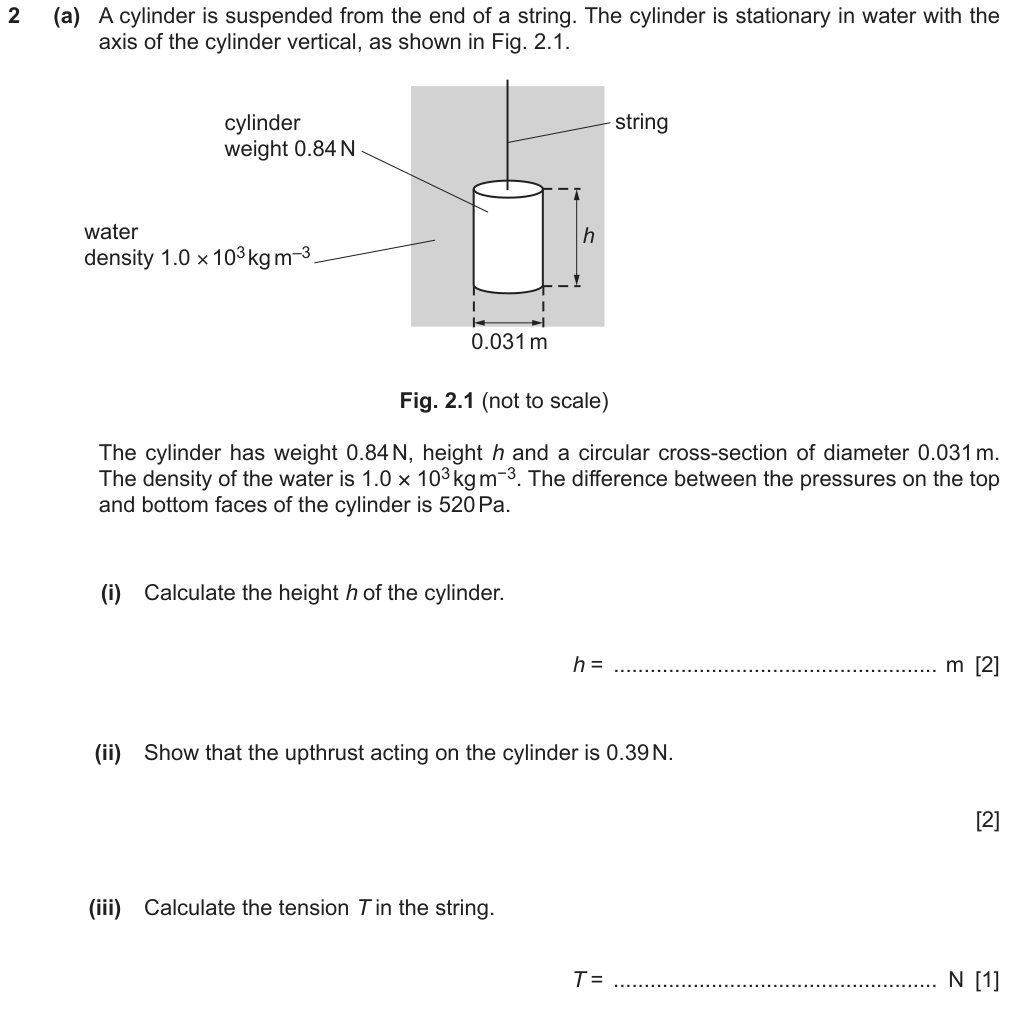
A cylinder hangs on a string, fully in water. The water pushes harder on its bottom than its top - that pressure difference IS the upthrust. We find the cylinder's height, the upthrust, and the tension left in the string.
- pressure difference between top and bottomΔp = ρgh where h is the cylinder's height
- diameter 0.031 mhalve it: r = 0.0155 m, area = πr²
- Show that the upthrust is 0.39 Nforce = Δp × area of a face
- (i)height h
- (ii)show U = 0.39 N
- (iii)tension T
- W = 0.84 Ncylinder
- d = 0.031 mdiameter
- Δp = 520 Pabottom − top
- ρ = 1000 kg m−3water
- (i) Findh
- UseΔp = ρgh
- (ii) ShowU
- UseU = Δp × A
- TrapA = π(d/2)², not πd²
- UseU = Δp × A
- (iii) FindT
- UseT + U = W
- NeedsU from (ii)
- UseT + U = W
Why does the water push up more than it pushes down?
The bottom face is deeper, and pressure increases with depth. The difference in force is the upthrust.
Which forces act on the hanging cylinder?
Tension (up), upthrust (up) and weight (down). The two upward forces share the job of holding the weight.
5 Now solve it have a go on paper first, then open the worked solution
- (i) Δp = ρgΔh: 520 = 1000 × 9.81 × h C1 → h = 0.053 m A1
- (ii) Upthrust = Δp × A = 520 × π(0.031/2)² C1 = 0.39 N A1 (diameter → radius!)
- (iii) T + U = W → T = 0.84 − 0.39 = 0.45 N A1
Other way for (ii): F = ρgV = 1000 × 9.81 × π(0.0155)² × 0.053 = 0.39 N. Both are the same idea.
T (0.45 N) is less than W (0.84 N) - the water takes some of the load. ρgV gives the same 0.39 N, a good check.
Example 3 · Terminal velocity in a liquid: find the mass (Paper 2, 4 marks) ★★ Medium
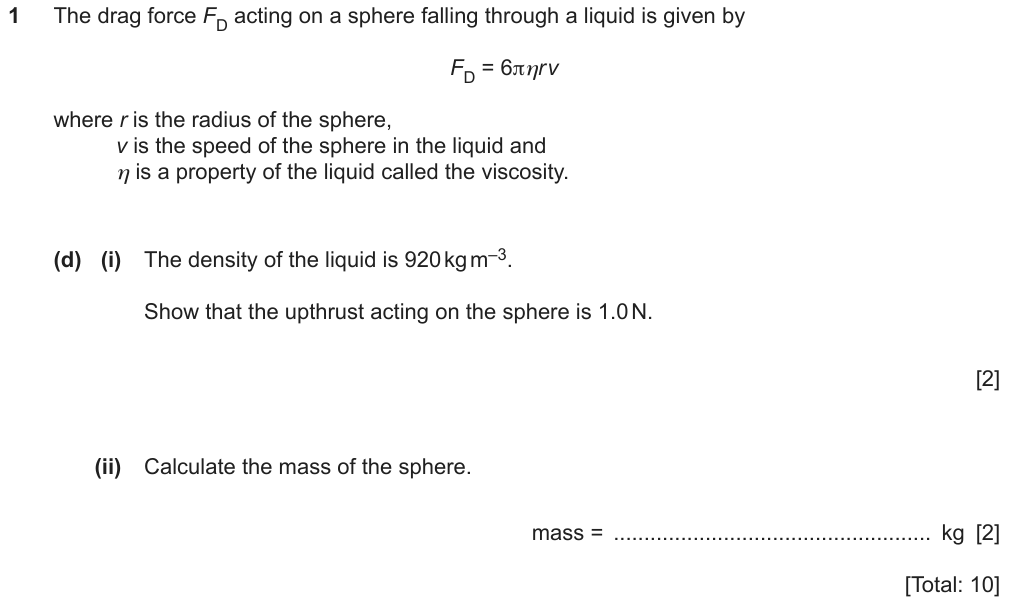
A sphere sinks through a liquid at a steady speed. Three forces: weight down, upthrust and drag up. Steady speed means they balance, so the weight - and the mass - can be found from the other two.
- terminal velocityconstant velocity: resultant force zero
- radius 3.0 cm0.030 m; volume of a sphere = 4/3 πr³
- Show that the upthrust is 1.0 NU = ρliquid g V - write it out
- (i)show U = 1.0 N
- (ii)mass of the sphere
- r = 3.0 cm = 0.030 m
- ρ = 920 kg m−3liquid
- D = 0.096 Ndrag
- (i) ShowU = 1.0 N
- UseU = ρgV, V = 4/3 πr³
- (ii) Findm
- UseW = U + D, then m = W ÷ g
- NeedsU from (i)
- UseW = U + D, then m = W ÷ g
Which way does the drag act on a sinking sphere?
Upwards - drag always opposes the motion, and the sphere moves down.
Why is W = U + D, not W = U − D?
Both U and D push up. At constant velocity the total up equals the total down.
5 Now solve it have a go on paper first, then open the worked solution
- (i) V = \(\tfrac43\pi r^3\) C1; U = \(\tfrac43\pi\)(0.030)³ × 920 × 9.81 = 1.0 N A1
- (ii) Terminal: W = U + D = 1.0 + 0.096 = 1.096 N C1
- m = 1.096 / 9.81 = 0.11 kg A1
m = 0.11 kg: a 3 cm-radius sphere of that mass has density about 970 kg m−3, a bit denser than the liquid - so it sinks, slowly. Consistent.
Example 4 · Upthrust inside a moments problem (Paper 2, 9 marks) ★★★ Hard
Why it is hard: the March 2025 report: many put the beam's weight at 6.0 m or 5.0 m instead of 3.0 m, skipped the working for the cylinder's weight, or used F = ρgV without the area of the cylinder.
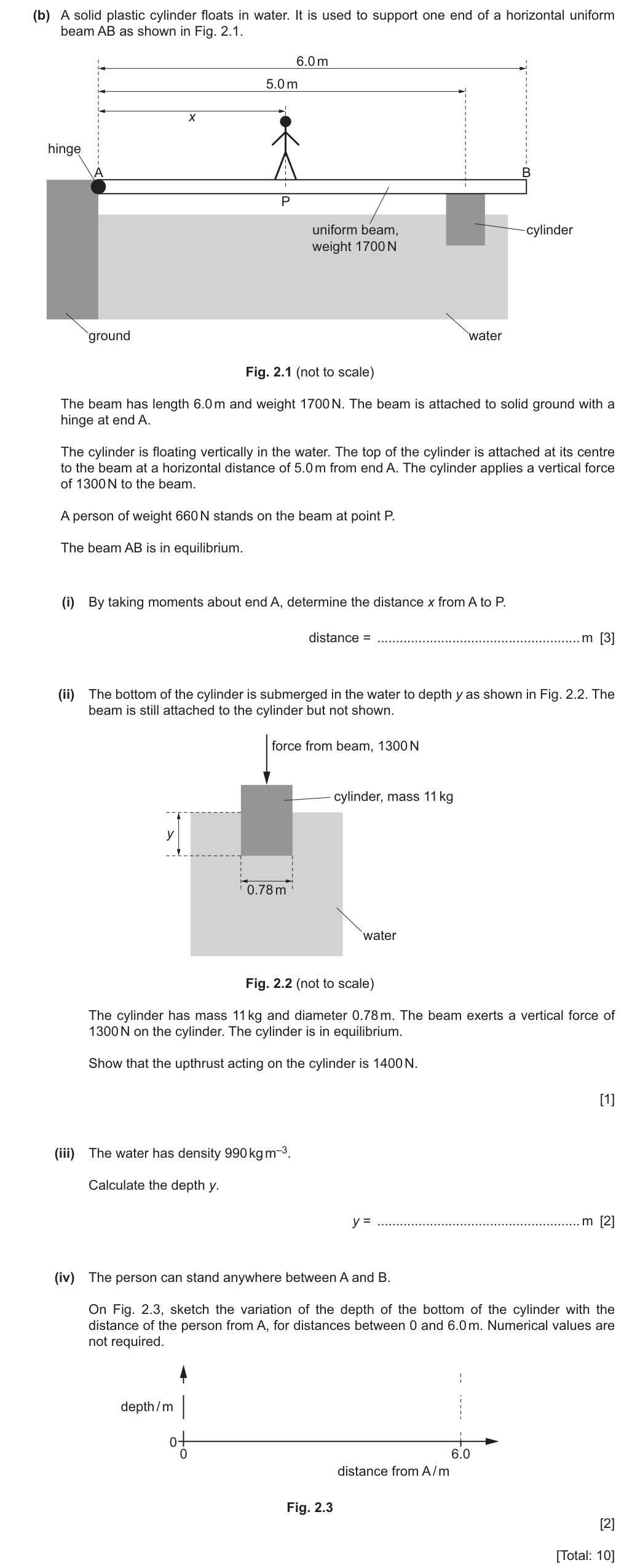
A long beam is hinged at one end and held up near the other end by a floating cylinder pushing up. A person stands on it. We use moments to find where the person is, then switch to the cylinder: its upthrust holds the beam's push plus its own weight, and that tells us how deep it sits.
- uniform beamits weight acts at the middle: 3.0 m from A
- By taking moments about Athe hinge force drops out
- in equilibrium with the beam pushing down 1300 Nthird law: the cylinder pushes the beam up with 1300 N, so the beam pushes it down with 1300 N
- diameter 0.78 mradius 0.39 m; submerged volume = πr² × y
- (i)the person's distance x
- (ii)show U = 1400 N
- (iii)submerged depth y
- (iv)sketch: depth against the person's position
- beam 6.0 m, 1700 Nhinged at A
- 1300 N upfrom the cylinder, 5.0 m from A
- person 660 Nat x
- cylinder 11 kg, d = 0.78 m
- ρ = 990 kg m−3water
- (i) Findx
- Use1700 × 3.0 + 660x = 1300 × 5.0
- Trapbeam's weight at 3.0 m, not 5.0 or 6.0
- Use1700 × 3.0 + 660x = 1300 × 5.0
- (ii) ShowU = 1400 N
- Useforces on the CYLINDER: U = its weight (11 × 9.81) + 1300
- (iii) Findy
- UseU = ρg × (πr²y)
- NeedsU from (ii), r = 0.39 m
- UseU = ρg × (πr²y)
- (iv) Sketchdepth vs position
- Chainperson further out → bigger moment → cylinder pushes harder → more U → deeper
In part (ii), which object are we looking at?
The cylinder alone. Down on it: its own weight (108 N) and the beam's push (1300 N). Up: the upthrust.
When the person stands at A, is the depth zero?
No - the cylinder still has to help hold up the beam's own weight, so it is still partly under.
5 Now solve it have a go on paper first, then open the worked solution
- (i) Moments about A: (1700 × 3.0) + (660 × x) = (1300 × 5.0) C1 C1 → x = 1400 / 660 = 2.1 m A1
- (ii) On the cylinder: upthrust up; weight 11 × 9.81 = 108 N and the beam's 1300 N down. U = 108 + 1300 = 1400 N A1
- (iii) U = ρgV with V = (area) × y: y = 1400 / (990 × 9.81 × π × 0.39²) C1 = 0.30 m A1
- (iv) Person at A: the cylinder still holds part of the beam, so the depth is not zero B1. Moving the person towards B increases their moment about A, so the cylinder must push harder → more upthrust → deeper: a line whose gradient is always positive B1
y = 0.30 m for a 0.78 m-wide cylinder carrying about 140 kg-worth of load - a reasonable float. x = 2.1 m is within the 6.0 m beam.
Example 5 · A cube on a spring, lowered into water (Paper 2, 12 marks) ★★★ Hard
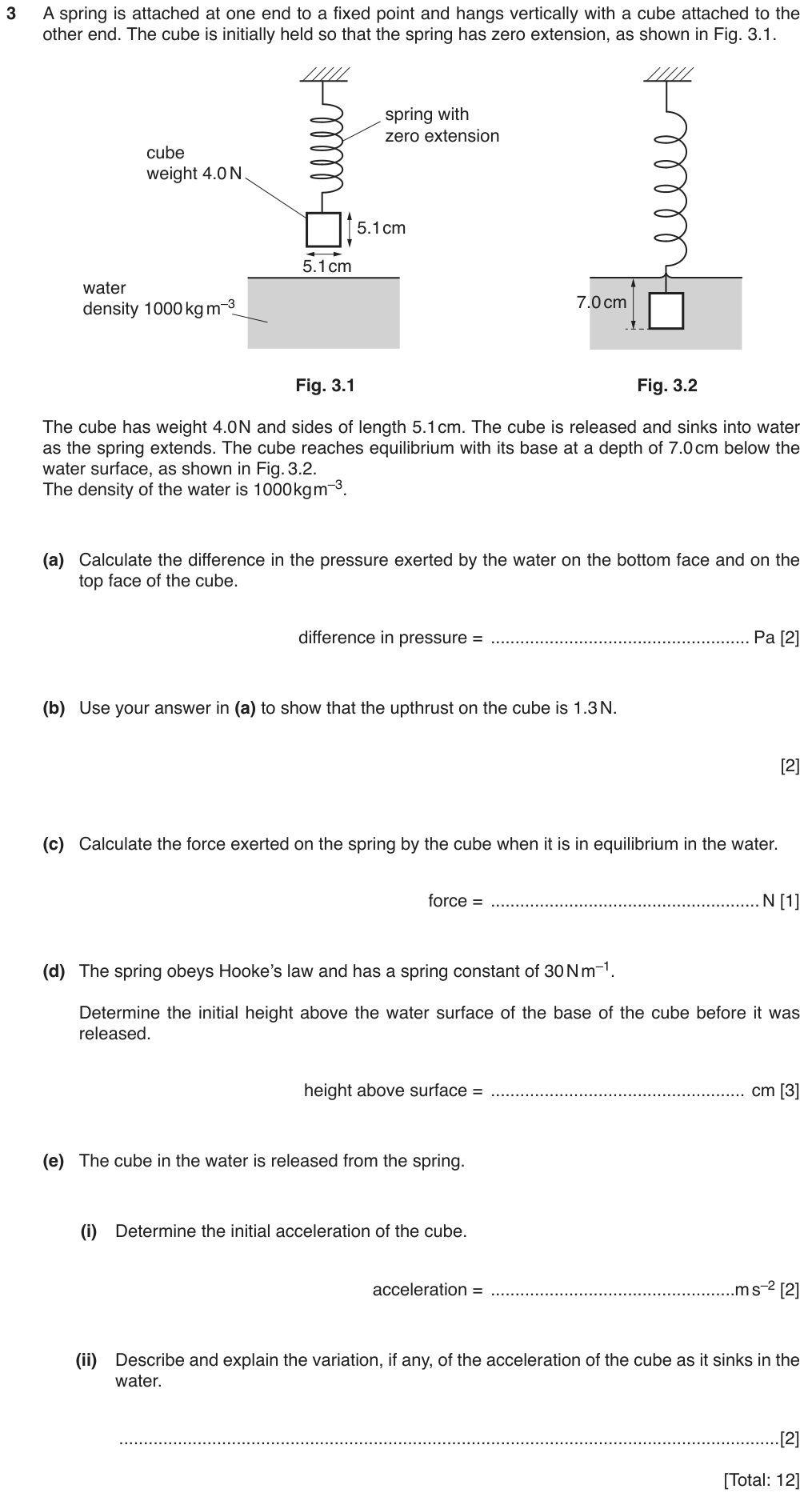
Why it is hard: the November 2017 report: many took the spring force as the upthrust or the weight, struggled to turn the extension into a starting height, and ignored the upthrust when finding the acceleration.
A cube hangs from an unstretched spring and is let down into water. It settles with its base 7.0 cm under the surface. Then the upthrust and the spring share the job of holding its weight. We use pressure for the upthrust, the spring force to get the stretch, and the stretch to work out where it started. Finally the spring is removed and it sinks.
- side 5.1 cmthe cube's height: the pressure difference is ρg × 0.051
- spring … zero extensionat the start the spring holds nothing; its stretch later = how far the cube moved down
- in equilibriumspring force + upthrust = weight
- Describe and explain how the acceleration variesdrag grows with speed → resultant falls → a falls
- (a)pressure difference, bottom − top
- (b)show U = 1.3 N
- (c)force on the spring
- (d)starting height of the base above the water
- (e)(i)acceleration once released
- (e)(ii)how it varies as it sinks
- W = 4.0 Ncube
- side = 5.1 cm = 0.051 m
- k = 30 N m−1spring
- base 7.0 cm below surfaceat equilibrium
- the cube is fully under (7.0 cm > 5.1 cm), so the pressure difference uses its full height
- (b) ShowU
- UseU = Δp × area of a face
- Δpfrom (a): ρg × 0.051
- UseU = Δp × area of a face
- (c) Findspring force
- UseF + U = W → F = 4.0 − 1.3
- (d) Findstarting height
- Step 1extension = F ÷ k
- NeedsF from (c)
- Step 2the base moved down by the extension and ended 7 cm under: start = extension − 7 cm
- Step 1extension = F ÷ k
- (e)(i) Finda
- Use(W − U) ÷ m, m = 4.0 ÷ 9.81
- Trapdon't forget the upthrust
- Use(W − U) ÷ m, m = 4.0 ÷ 9.81
The spring started unstretched. What does its final extension tell us?
How far the cube moved down. If it moved 9 cm and ended 7 cm under, it started 2 cm above the surface.
Once the spring is cut, what is the resultant force at that instant?
Weight minus upthrust: 4.0 − 1.3 = 2.7 N down - the same force the spring had been holding.
5 Now solve it have a go on paper first, then open the worked solution
- (a) The cube is 5.1 cm tall: Δp = 1000 × 9.81 × 0.051 = 500 Pa C1 A1 (or 1000 × 9.81 × (0.070 − 0.019))
- (b) U = Δp × A = 500 × (0.051)² = 1.3 N C1 A1
- (c) Spring force + U = W → spring force = 4.0 − 1.3 = 2.7 N A1
- (d) Extension = 2.7 / 30 = 0.09 m = 9 cm C1 C1. The base moved down 9 cm to end 7 cm below the surface, so it started 2 cm above A1
- (e)(i) Without the spring: resultant = W − U = 2.7 N down; a = 2.7 / (4.0/9.81) = 6.6 m s−2 C1 A1
- (e)(ii) Viscous force increases as it speeds up M1; weight and upthrust constant, so the acceleration decreases (to zero) A1
a (6.6 m s−2) is less than g, because the upthrust still helps hold the cube. The starting height (2 cm) is small and positive - sensible.
Example 6 · A balance with a partly submerged cylinder (Paper 2, 8 marks) ★★ Medium
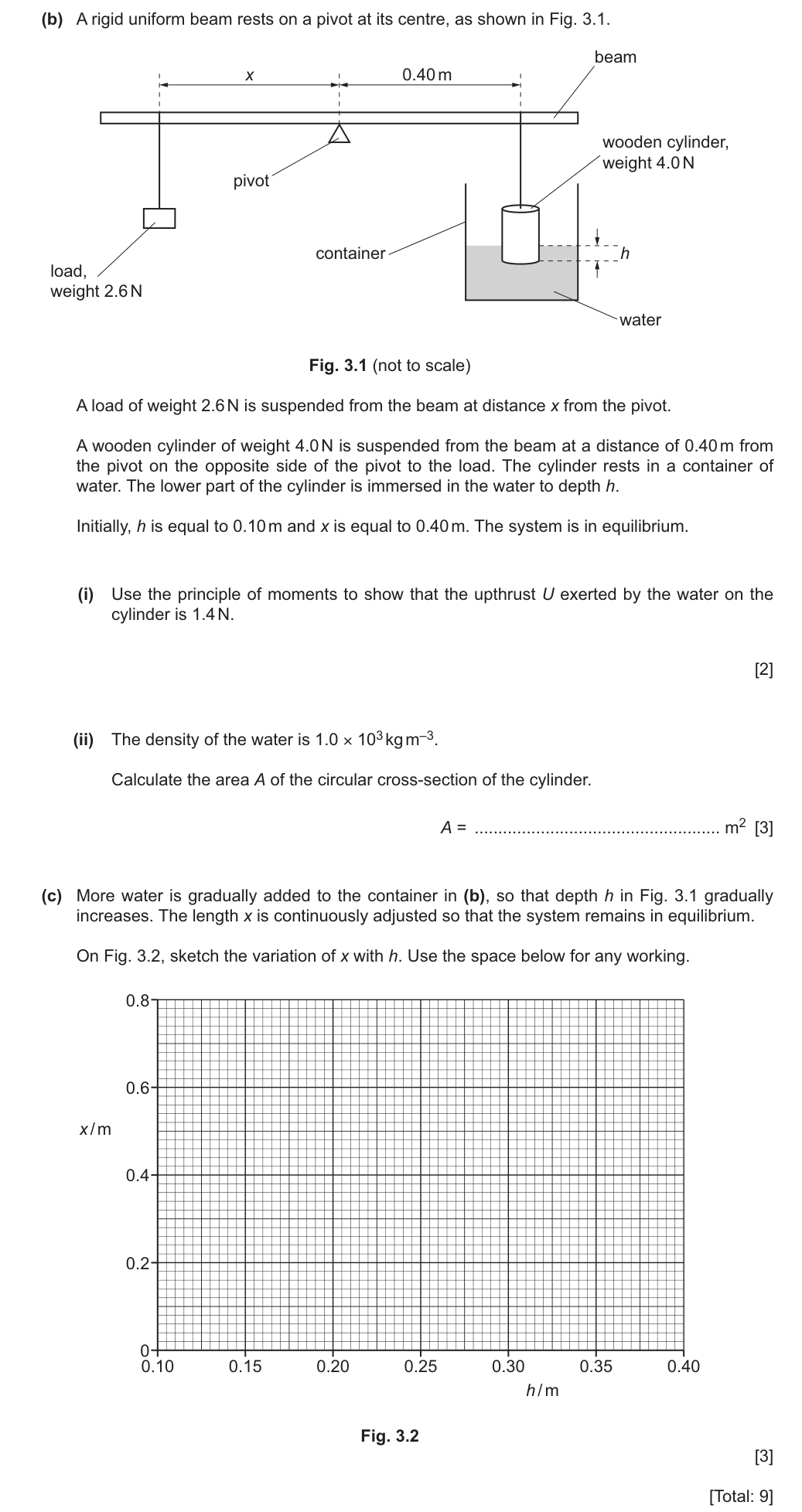
A beam balances on a central pivot: a load on one side, a wooden cylinder dipping into water on the other. The water's upthrust takes some of the cylinder's weight, so its string pulls the beam less. As more water is added, the load has to move closer in.
- pivoted at its centrethe beam's own weight has no moment about the pivot
- Use moments to showfirst find the string's pull on the cylinder side, then the upthrust
- partly in water to depth hsubmerged volume = A × h
- x is adjustedkeep the moments equal as the pull from the cylinder side changes
- (b)(i)show U = 1.4 N
- (b)(ii)cross-sectional area A
- (c)sketch x against h
- load 2.6 Nat x = 0.40 m
- cylinder 4.0 Nat 0.40 m other side
- h = 0.10 mdepth under water
- ρ = 1000 kg m−3
- (b)(i) ShowU = 1.4 N
- Step 1moments: 2.6 × 0.40 = F × 0.40 → F = 2.6 N
- Step 2on the cylinder: F + U = 4.0
- (b)(ii) FindA
- UseU = ρg(A h)
- NeedsU from (b)(i)
- UseU = ρg(A h)
- (c) Sketchx vs h
- Chainh ↑ → U ↑ → string pull (4.0 − U) ↓ → x ↓, in a straight line
- Endx = 0 when U = 4.0 N
Is the force on the beam from the cylinder's string equal to the cylinder's weight?
No - the water's upthrust holds part of the weight. The string only pulls 4.0 − U.
Why is the x-h graph a straight line?
U = ρgAh is proportional to h, so the pull (4.0 − U) falls linearly, and x is proportional to that pull.
5 Now solve it have a go on paper first, then open the worked solution
- (b)(i) Moments about the pivot: 2.6 × 0.40 = F × 0.40, where F is the string's pull from the cylinder side → F = 2.6 N C1. On the cylinder: F + U = 4.0 → U = 1.4 N A1
- (ii) U = ρgV with V = Ah: A = 1.4 / (1000 × 9.81 × 0.10) C1 C1 = 1.4 × 10⁻³ m² A1
- (c) Pull from the cylinder side = 4.0 − U = 4.0 − ρgAh, which falls in a straight line as h rises; x = (4.0 − ρgAh) × 0.40 / 2.6. Straight line with negative gradient from (0.10, 0.40) B1 B1 to x = 0 when U = 4.0 N, i.e. h = 4.0 / (1000 × 9.81 × 1.43 × 10−3) = 0.29 m B1
A = 1.4 × 10⁻³ m² is a cylinder about 4 cm across - a believable size. At h = 0.10 m the line passes through x = 0.40 m, the starting point ✓.
Summary
- Upthrust exists because pressure increases with depth: the push up on the bottom beats the push down on the top.
- F = ρgV: fluid density × g × volume displaced (submerged volume) = weight of fluid displaced.
- Same submerged volume → same upthrust, whatever the depth or the object's material.
- Floating: U = W. On a string: T + U = W. Released: a = (U − W)/m. Terminal: W = U + D.
| If you see… | do this |
|---|---|
| "floats" | upthrust = weight; fraction under = ρobject/ρfluid |
| newton meter reading in a liquid | reading = weight − upthrust |
| "released" under water | no drag yet: a = (U − W)/m |
| constant velocity in a liquid | W = U + D |
| "explain the origin of the upthrust" | pressure difference top/bottom → bigger force on the bottom |
Can I do this?
- I can explain the origin of upthrust using pressure difference.
- I can derive and use F = ρgV with the fluid's density and the submerged volume.
- I can solve floating, string/newton meter, released and terminal-velocity problems.
Anything unticked: revise that section first. All ticked: take the quiz.
Quiz
Your progress on this note is saved when JavaScript is on.