
Dynamics
Air resistance, drag and terminal velocity
On this page
- What you need to be able to do
- Resistive forces: friction and drag
- Falling with air resistance: three stages
- The skydiver and the parachute
- Thrown upwards with air resistance
- Comparing two falling objects
- How to write a "describe and explain" answer
- Mark-scheme focus
- Worked examples
- Summary
- Can I do this?
- Quiz
What you need to be able to do
- 3.2.1Show a qualitative understanding of frictional forces and viscous / drag forces, including air resistance (a simple model: drag increases as speed increases; no coefficients needed).
- 3.2.2Describe and explain qualitatively the motion of objects falling in a uniform gravitational field with air resistance.
- 3.2.3Understand that objects moving against a resistive force may reach a terminal (constant) velocity.
Before you start: Newton's laws and F = ma and Motion graphs (gradient of a v–t graph). Next: Conservation of momentum.
Resistive forces: friction and drag
A resistive force always acts against the motion (against the velocity relative to the surface or the fluid). There are two kinds you need:
Friction
Between two solid surfaces that slide (or try to slide) over each other. Acts along the surface, opposing the sliding. At AS treat it as constant for a given pair of surfaces; no coefficient of friction is needed.
Drag (viscous force)
On an object moving through a fluid (a liquid or a gas). Air resistance is drag in air. Zero when the object is at rest relative to the fluid, and it increases as the speed increases.
Drag on an object is larger when:
- its speed is larger (the one that matters most in questions: as speed changes, drag changes);
- its cross-sectional area facing the flow is larger (an open parachute, a snowflake compared with a raindrop of the same mass);
- the fluid is denser or more viscous (oil compared with water, water compared with air).
Drag on a sphere depends on its size and speed, not on its mass. Two balls of the same size moving at the same speed feel the same drag, whatever they are made of. That one fact answers most "compare two objects" questions.
Falling with air resistance: three stages
Drop an object from rest in air. Only two forces act on it: its weight mg (constant, down) and air resistance D (up, growing with speed). Follow the chain at each stage:
- At release: v = 0, so there is no air resistance. Resultant = mg, so a = g = 9.81 m s−2.
- Speeding up: as v increases, air resistance D increases. Resultant = mg − D gets smaller, so the acceleration a = (mg − D)/m gets smaller. It still speeds up, but more and more slowly.
- Terminal velocity: D has grown until D = mg. Resultant force = 0, so a = 0 and the velocity stays constant (first law). This constant velocity is the terminal velocity.
On graphs, the same story:
| Graph against time | Shape | Why |
|---|---|---|
| velocity v | rises from 0, gradient decreasing, levels off at the terminal velocity | gradient = a, which falls from g to 0 |
| acceleration a | starts at g, falls (curving) to 0 | resultant falls to zero |
| air resistance D | starts at 0, rises and levels off at mg | D grows with v; v levels off |
| resultant force | starts at mg, falls to 0 | mg − D |
| distance fallen | curve getting steeper, then a straight line | gradient = v, which becomes constant |
In a liquid there is a third force, the upthrust (chapter 4), which is constant. At terminal velocity: weight = drag + upthrust. The story is otherwise identical.
The skydiver and the parachute
| Stage | Forces | Resultant and acceleration | Motion |
|---|---|---|---|
| A: falling, parachute closed | D < W, D increasing | downwards, decreasing from mg; a decreasing from g | speeding up |
| B: terminal velocity v₁ | D = W | zero | constant velocity |
| C: parachute opens | much bigger area → D ≫ W at first; D decreases as v falls | upwards, largest just after opening, decreasing to zero | slowing down (still moving down!) |
| D: terminal velocity v₂ | D = W again | zero | constant, lower velocity |
Thrown upwards with air resistance
Now the air resistance points down on the way up (against the motion) and up on the way down. The sign of the drag flips at the top.
- Going up: weight and drag both act down. Resultant = mg + D, so the deceleration is greater than g. As it slows, D falls, so the resultant (and the deceleration) decreases (9702/12/M/J/24 Q3, answer A; 9702/21/M/J/22 Q1(c)).
- At the top: v = 0, so D = 0 and the acceleration is exactly g.
- Coming down: drag acts up. Resultant = mg − D, so a is less than g and falling.
- Consequences: it reaches a lower height, takes less time to go up than to come down, and lands slower than it was thrown (energy has been transferred to the air as thermal energy).
Comparing two falling objects
For any "which falls faster / reaches the higher terminal velocity" question, use \(a = g - \dfrac{D}{m}\) and the rule that terminal velocity is reached when D = mg.
1 Same size and shape, different mass
A stone and a foam ball of the same size fall from rest. 9702/12/M/J/22 Q9
Askedwhich falls faster, stone or foam ballKnowsame size and shape, different massRoutesame drag at a given speed; bigger weight needs a higher speed before drag = weight
- At the start both have a = g (D = 0): the v–t graphs start with the same gradient.
- At any speed both feel the same drag, but the heavier stone has the bigger weight, so it needs a larger speed before D = mg.
- The stone reaches a higher terminal velocity, and is always ahead (answer B). Dropped from a tall tower, the densest, smallest ball lands first (9702/12/M/J/21 Q9: mass 4M, diameter D).
2 Same mass, different drag
A snowflake and a raindrop have the same mass; at any speed the snowflake's drag is bigger. 9702/11/O/N/22 Q9
Askedwhich reaches terminal velocity soonerKnowsame mass, snowflake has more dragRoutesame weight; more drag reaches drag = weight at a lower speed, sooner
- Same weight; the snowflake reaches D = mg at a lower speed.
- So the snowflake has the lower terminal velocity and reaches it sooner; the raindrop keeps accelerating for longer.
- Answer: the raindrop takes more time to reach its terminal velocity (A), but less time to reach the ground.
3 Double the mass and double the drag
Parachutist Y has twice the mass of X and, at this moment, twice the air resistance. Compare the accelerations. 9702/12/O/N/21 Q9
Askedcompare the two accelerationsKnowY has 2× the mass and 2× the dragRoutea = g − D/m for each: D/m is the same, so a is the same
- aX = g − D/m.
- aY = g − 2D/2m = g − D/m.
- The same acceleration (answer B). Ratios of forces don't matter; D/m does.
4 Energy at terminal velocity
A parachutist falls at constant velocity. Where does the lost gravitational potential energy go? 9702/11/M/J/25 Q20
Askedwhere the lost GPE goesKnowconstant velocityRouteKE is constant, so all lost GPE becomes work against air resistance
- Speed is constant, so the parachutist's kinetic energy does not change.
- All the GPE lost goes into the air (thermal energy and kinetic energy of the air) and some thermal energy of the parachutist: work done against air resistance.
- "GPE → KE of the parachutist" is the false statement (answer B).
How to write a "describe and explain" answer
These answers are marked as a chain of cause and effect: one mark for the change in the resistive force with its cause (the speed), one for its effect on the resultant force and the acceleration. Write the chain in this order every time:
- Speed changes (increases / decreases) →
- drag / air resistance changes the same way (it depends on speed) →
- resultant force changes (say how: weight − drag, or weight + drag) →
- acceleration changes (a = F/m), and say where it ends (to zero, at terminal velocity).
Falling from rest: as the speed increases, the air resistance increases, so the resultant force decreases (the weight is constant) and the acceleration decreases, until air resistance = weight, the resultant is zero and the velocity is constant (terminal velocity).
Parachute open, slowing down: as the speed decreases, the drag decreases, so the (upward) resultant force decreases and the magnitude of the deceleration decreases to zero.
Moving upwards: as the speed decreases, the viscous force decreases; the weight is constant, so the resultant force decreases.
Mark-scheme focus
The resultant force on a rock moving up through an atmosphere
In practice, the planet in (b) does have an atmosphere that causes a viscous force to act on the moving rock. State and explain the variation, if any, in the resultant force acting on the rock as it moves vertically upwards.
- "speed / velocity decreases so viscous force decreases"
- "viscous force decreases (and weight constant) so resultant force decreases"
- "the resultant force increases because there is now air resistance" (true compared with no atmosphere, but the question asks how it varies as the rock rises)
- "the viscous force decreases" with no reason
Both forces point down on the way up, so resultant = weight + drag. The weight is fixed; the drag shrinks with the speed. Each step needs its reason.
From: 9702/21/M/J/22 Q1(c) mark scheme.
The gradient of a speed–time graph with air resistance
A ball is thrown downwards. In practice, air resistance is not negligible. State and explain the variation, if any, with time t of the gradient of the speed–time graph.
- "air resistance increases"
- "resultant force / acceleration decreases so gradient (of curve) decreases"
- "the gradient decreases because of air resistance" (no chain)
- "the gradient becomes zero" (it only levels off at terminal velocity, which a short fall may never reach)
From: 9702/22/M/J/21 Q2(e) mark scheme.
The skydiver after the parachute opens
The parachute is fully open at time t₂. At a later time t₃ the skydiver reaches a constant velocity of 5.7 m s⁻¹. Describe and explain the variation with time of the magnitude of her acceleration between time t₂ and time t₃.
- "drag force decreases (as speed decreases)"
- "(as speed decreases) resultant force decreases so (magnitude of) acceleration decreases (to zero)"
- "the drag increases because the parachute is open" (that happened before t₂)
- "she accelerates upwards" / "she moves up"
From: 9702/22/M/J/24 Q2(c)(i) mark scheme.
- Describe and explain motion with air resistance: Paper 2 about once a year as the last part of a kinematics or momentum question, 2 marks (B1 B1).
- Terminal velocity and parachute graphs: Paper 1, one or two a year (forces at each stage, a–t from v–t, comparing objects).
- Reading a v–t graph with air resistance: terminal velocity, a tangent for the acceleration, the area for the distance.
Worked examples
Example 1 · Skydiver: terminal velocity, tangent and parachute (Paper 2, 10 marks) ★★ Medium
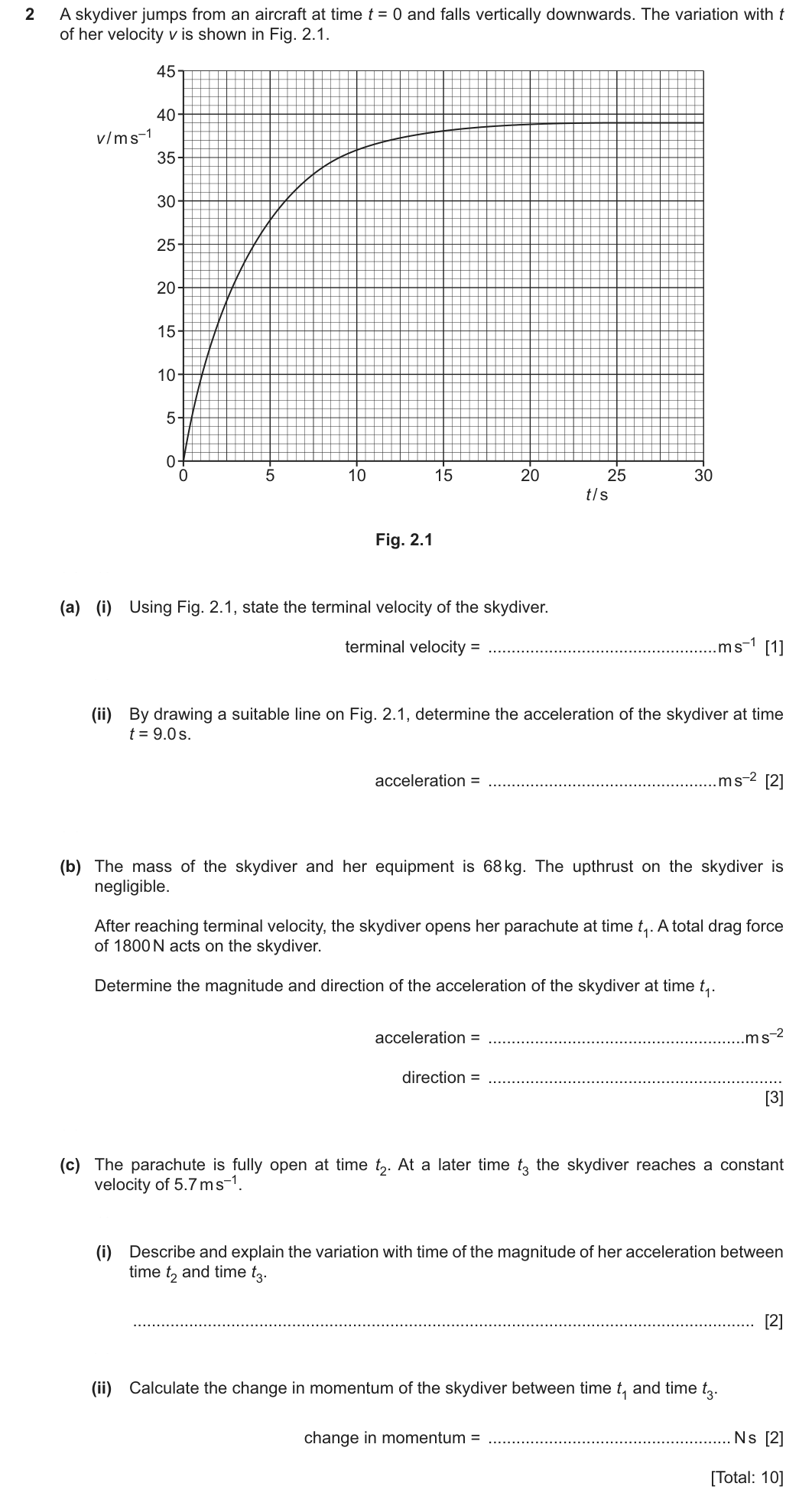
A skydiver falls; her speed rises quickly at first, then more slowly, until it stops changing at 39 m s−1. Then she opens her parachute: the drag suddenly jumps to 1800 N, she slows down, and finally falls steadily at 5.7 m s−1. Each part zooms into one stage of that story.
- terminal velocitythe constant speed where the graph levels off
- By drawing a suitable linea TANGENT at t = 9.0 s; its gradient is the acceleration
- upthrust negligibleonly two forces: weight down, drag up
- magnitude and directiontwo answers: a number and 'up' or 'down'
- Describe and explainsay what happens (acceleration decreases) AND why (drag falls as speed falls)
- (a)(i)terminal velocity
- (a)(ii)acceleration at 9.0 s
- (b)acceleration when the parachute opens
- (c)(i)how the acceleration changes from t₂ to t₃
- (c)(ii)change in momentum from t₁ to t₃
- m = 68 kgskydiver
- drag = 1800 Nat t₁
- v = 39 m s−1at t₁ (terminal)
- v = 5.7 m s−1at t₃
- at t₁ she is still moving at 39 m s−1 DOWN - the parachute has only just opened
- (a)(ii) Finda at 9.0 s
- Usegradient of the tangent at 9.0 s
- Trapa chord from the origin gives an average, not the value at 9.0 s
- Usegradient of the tangent at 9.0 s
- (b) Finda at t₁
- Usea = resultant ÷ m
- Resultantweight (68 × 9.81) − drag (1800)
- Directiondrag > weight, so the resultant is UP
- Usea = resultant ÷ m
- (c)(i) Explaina from t₂ to t₃
- Chainspeed ↓ → drag ↓ → resultant ↓ → a ↓ (to 0)
- (c)(ii) FindΔp
- Usem(v − u)
- Haveu = 39, v = 5.7
- Usem(v − u)
At the moment the parachute opens, is she moving up or down? Which way is her acceleration?
Still moving DOWN at 39 m s−1, but the acceleration is UP because drag (1800 N) beats weight (667 N). She is slowing down.
Why does her deceleration get smaller as she slows down?
Drag depends on speed. As she slows the drag falls towards the weight, so the resultant force - and the acceleration - shrinks to zero.
5 Now solve it have a go on paper first, then open the worked solution
- (a)(i) Where the graph levels off: 39 m s−1 A1
- (a)(ii) Draw the tangent at t = 9.0 s, as long as the grid allows C1. Gradient, e.g. (44 − 26)/(18 − 0) = 1.0 m s−2 (0.9 to 1.1 accepted) A1
- (b) Forces at t₁: weight 68 × 9.81 = 667 N down, drag 1800 N up. Down = +: resultant = 667 − 1800 = −1133 N C1
- a = −1133 / 68 = −17 → 17 m s−2 A1, direction upwards B1 She is still moving down; she is slowing down.
- (c)(i) As speed decreases, the drag decreases B1, so the resultant force decreases and the magnitude of the acceleration decreases (to zero at t₃) B1
- (c)(ii) Δp = m(v − u) C1 = 68 × (5.7 − 39) = (−)2300 N s A1 At t₁ she is still at 39 m s⁻¹.
17 m s⁻² is bigger than g: an opening parachute is a hard jolt. Check the drag is bigger than the weight before you say "upwards".
17 m s−2 upwards is bigger than g - an opening parachute is a hard jolt, so that is believable. Δp is negative: she lost momentum.
Example 2 · A rock thrown up on another planet (Paper 2, 9 marks) ★★ Medium
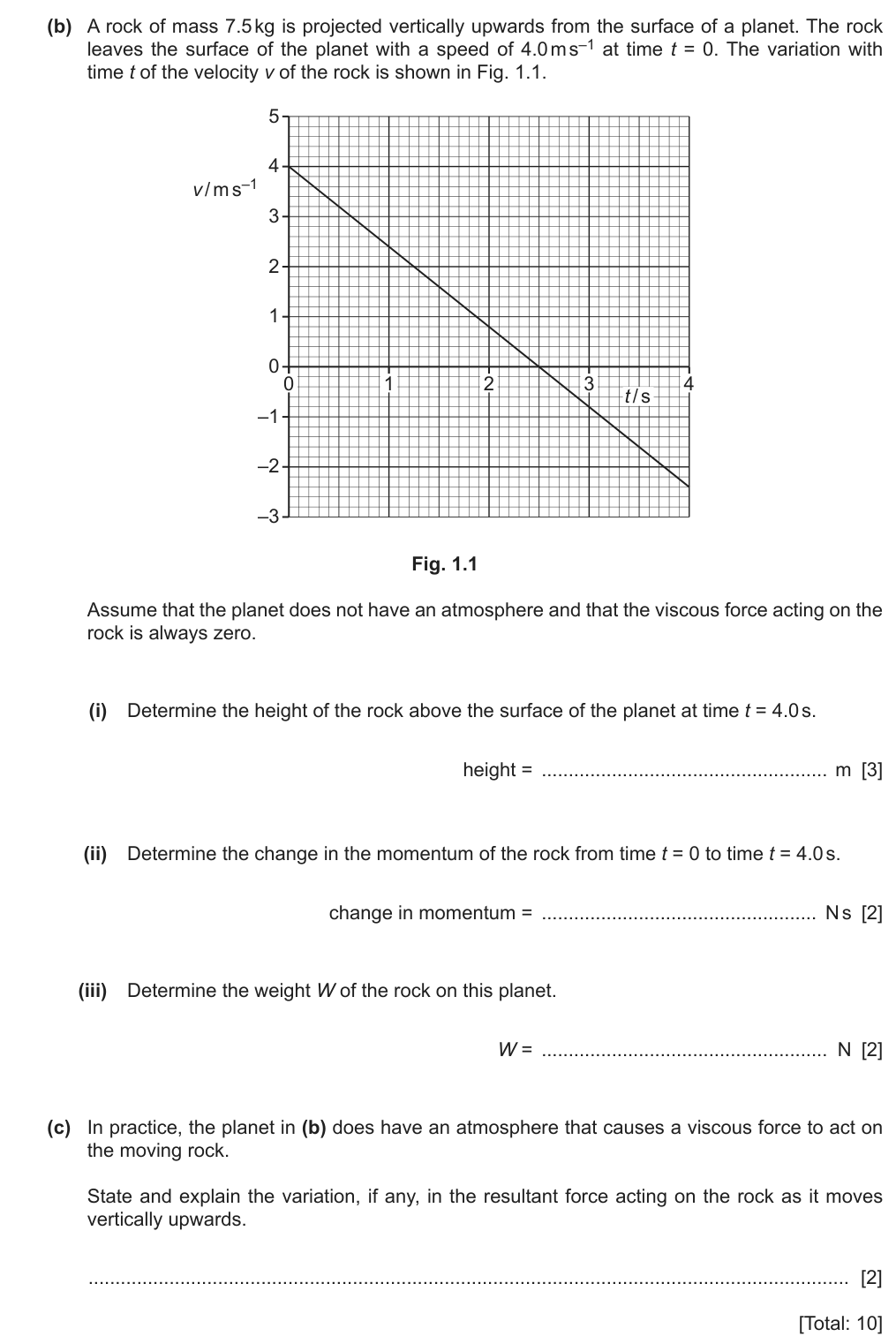
A rock is thrown straight up on another planet. Its velocity falls in a straight line, passes zero at the top (2.5 s), and becomes negative as it falls back. No air, so the only force is the rock's weight - but g is NOT 9.81 here.
- on another planetdon't use 9.81 - get the acceleration from the graph
- height at t = 4.0 sdisplacement = area under the v-t graph (above minus below the axis)
- change in momentumvelocity goes from +4.0 to −2.4: the sizes add
- no atmospherethe weight is the ONLY force, so it equals the resultant
- State and explain the variationwith air: what happens to the drag as the rock slows, and so to the resultant
- (b)(i)height at 4.0 s
- (b)(ii)change in momentum, 0 to 4.0 s
- (b)(iii)weight on this planet
- (c)how the resultant changes going up (with air)
- m = 7.5 kgrock
- u = +4.0 m s−1t = 0
- v = 0t = 2.5 s (top)
- v = −2.4 m s−1t = 4.0 s, read off the graph
- the line is straight, so the acceleration (and the force) is constant
- (b)(i) Findheight at 4.0 s
- Usearea under v-t
- Uptriangle ½ × 2.5 × 4.0
- Downtriangle ½ × 1.5 × 2.4
- TrapSUBTRACT the part below the axis
- Usearea under v-t
- (b)(ii) FindΔp
- Usem(v − u) = 7.5 × (−2.4 − 4.0)
- (b)(iii) Findweight
- Useonly force = weight = Δp ÷ Δt
- NeedsΔp from (b)(ii)
- Useonly force = weight = Δp ÷ Δt
- (c) Explainresultant with air, going up
- Chainspeed ↓ → air resistance ↓; weight constant → resultant ↓
Why is the height at 4.0 s less than the maximum height?
After 2.5 s the rock is coming back down. The area below the axis is that downward motion, so it is taken away.
How can Δp give us the weight?
With no air, the weight is the resultant force, and resultant = Δp ÷ Δt. So W = 48 ÷ 4.0.
5 Now solve it have a go on paper first, then open the worked solution
- (b)(i) Displacement = area under the v–t graph C1. Read v at 4.0 s: −2.4 m s−1 C1
- Height = area above the axis − area below = ½ × 2.5 × 4.0 − ½ × 1.5 × 2.4 = 5.0 − 1.8 = 3.2 m A1 Subtract the area below the axis: it is motion downwards. The June 2022 report: some added them; some assumed g = 9.81 on this planet.
- (b)(ii) Δp = 7.5 × (−2.4 − 4.0) C1 = (−)48 N s A1 Velocity reverses, so the speeds add.
- (b)(iii) The only force is the weight, so W = Δp / Δt C1 = 48 / 4.0 = 12 N A1 (or W = m × gradient = 7.5 × 1.6)
- (c) Speed decreases so the viscous force decreases B1; weight constant, so the resultant force decreases B1
The weight (12 N) gives g = 12 ÷ 7.5 = 1.6 m s−2, which matches the graph's gradient (4.0 ÷ 2.5) - two routes agree. A small g like that fits a small planet or moon.
Example 3 · "Explain why this force cannot be air resistance" (Paper 2, 10 marks) ★★★ Hard
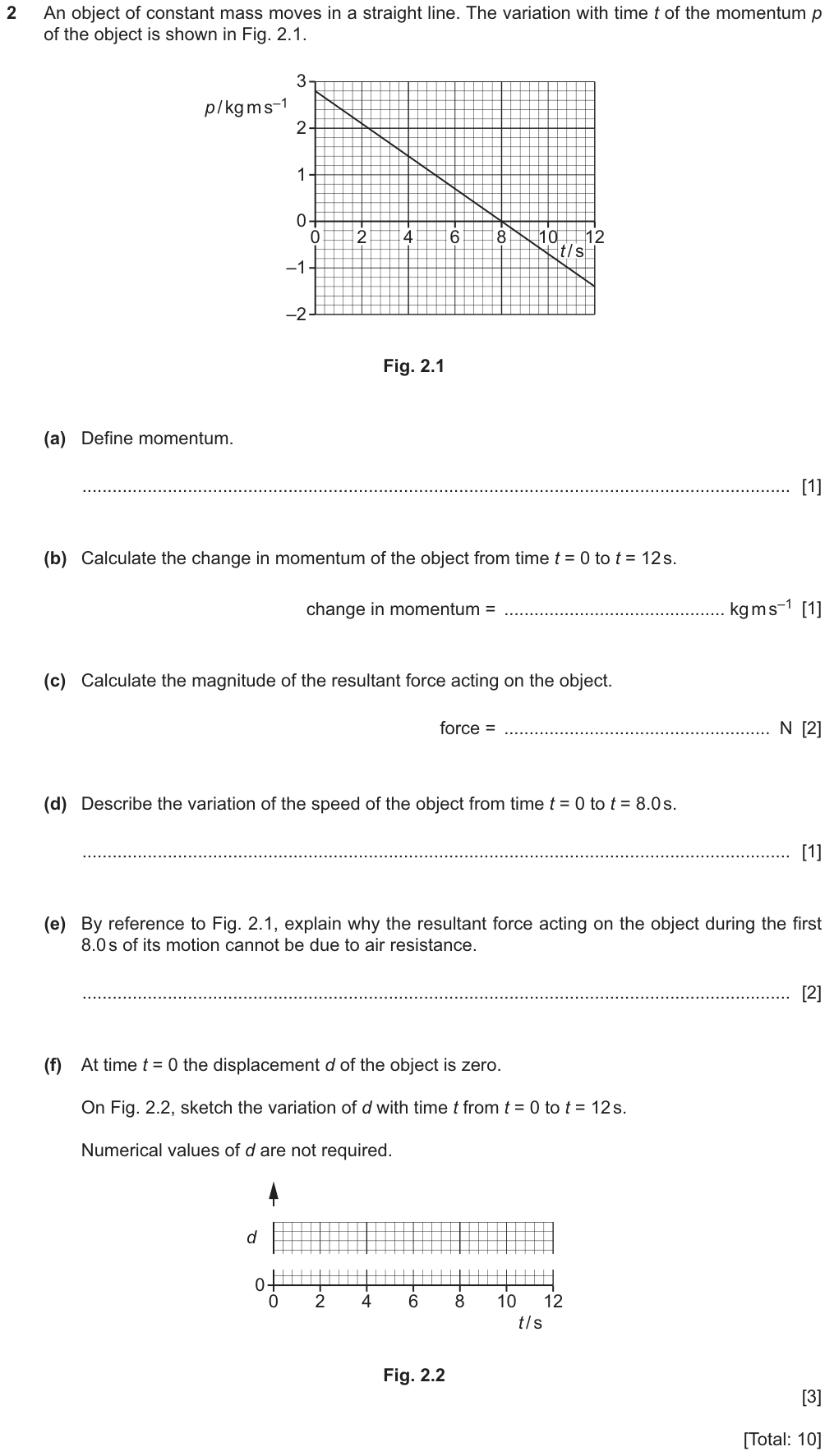
Why it is hard: part (e) needs you to turn the graph into a statement about the force, and compare it with what air resistance would do. (No examiner report exists for June 2025.)
We get a momentum-time graph that is a straight line falling from +2.8 through zero (at 8 s) to −1.4. So the object slows down steadily, stops, then moves back the other way. We find Δp, the force, describe the speed, argue why the force can't be air resistance, and sketch the displacement.
- Define momentummass × velocity
- constant massthe graph's shape is the velocity's shape
- resultant forcegradient of the p-t graph
- By reference to Fig. 2.1, explainuse what the GRAPH shows (straight line, non-zero at 8 s) in your reasons
- Sketch the displacementrises while p is positive, peaks where p = 0, then falls
- (b)change in momentum, 0-12 s
- (c)size of the resultant force
- (d)how the speed changes, 0-8 s
- (e)why it can't be air resistance
- (f)displacement-time sketch
- p = +2.8 N st = 0
- p = 0t = 8.0 s
- p = −1.4 N st = 12 s
- (c) Findforce
- Usegradient = Δp ÷ Δt
- NeedsΔp from (b): −1.4 − 2.8
- Usegradient = Δp ÷ Δt
- (e) Explainnot air resistance
- Comparewhat the graph shows vs what drag would do
- Graphstraight line → force constant; force still there at v = 0
- Dragwould fall as speed falls, and be zero at zero speed
- Comparewhat the graph shows vs what drag would do
- (f) Sketchd against t
- Usegradient of d-t = velocity ∝ p
- Somax d at 8.0 s, then back down
- Usegradient of d-t = velocity ∝ p
What does a straight line on a p-t graph say about the force?
The gradient is the resultant force, so a straight line means the force is constant.
What would air resistance be when the object is momentarily at rest?
Zero - drag only exists while moving. But the graph keeps changing at 8.0 s, so a force is still acting. It can't be drag.
5 Now solve it have a go on paper first, then open the worked solution
- (a) "product of mass and velocity" B1
- (b) Δp = (−1.4) − (+2.8) = (−)4.2 kg m s−1 A1
- (c) F = Δp/Δt = gradient = 4.2 / 12 C1 = 0.35 N A1
- (d) The speed decreases at a constant rate to zero B1 (straight line → constant force → constant deceleration).
- (e) Any two B2: the straight line shows the resultant force is constant; air resistance would decrease as the speed decreases; and at 8.0 s the speed is zero but the force is not zero (air resistance would be zero at zero speed, and the object would not then move back).
- (f) From the origin with decreasing positive gradient B1; maximum at 8.0 s where the gradient becomes negative B1; then a negative gradient of increasing size, with d still positive at 12 s B1
The test for "is this force air resistance?": air resistance always opposes the motion, changes with speed and is zero at zero speed. A constant force that keeps acting through v = 0 is something else.
The force (0.35 N) is constant all the way, which is exactly why the momentum carries on through zero and goes negative.
Example 4 · Distance from a curved v–t graph (Paper 1, 1 mark) ★★ Medium
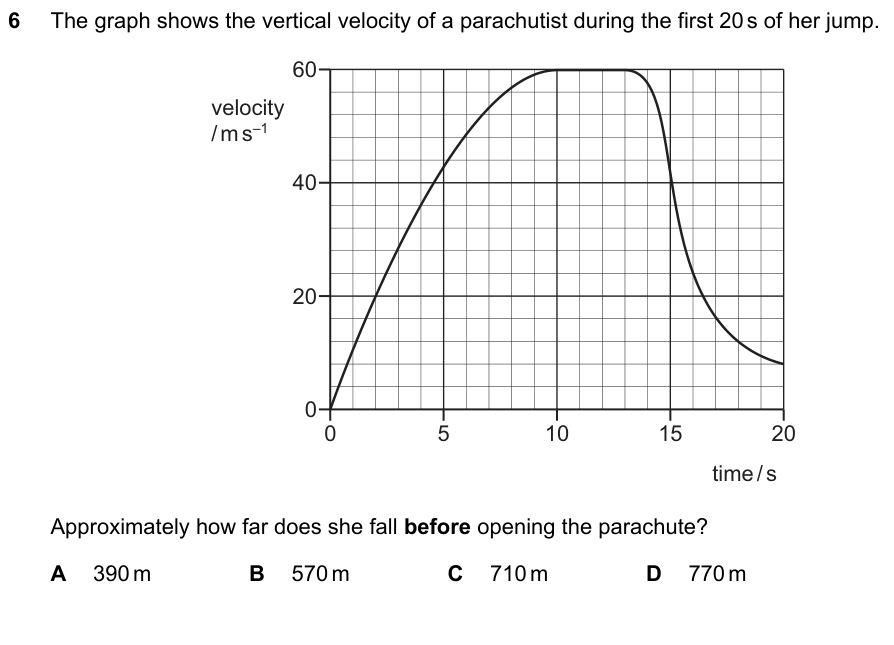
A parachutist's speed rises along a curve to 60 m s−1, stays there for a while, then drops sharply when the parachute opens. We want roughly how far she fell BEFORE it opened.
- Approximately how fardistance = area under the v-t graph - count squares, estimates are expected
- before she opens the parachutestop at the moment v starts to fall (about 13.5 s), not at the end of the graph
- distance fallen before the parachute opens
- 0 → 60 m s−1curve, 0 to about 10 s
- 60 m s−1constant, 10 to about 13.5 s
- one large square is 5 s × 20 m s−1 = 100 m of distance
- Finddistance
- Usearea under v-t up to 13.5 s
- Curved partcount squares 0-10 s (~3.6 squares)
- Flat partrectangle 3.5 s × 60 m s−1
- Trapa triangle under the curve under-counts - it bulges above the straight line
- Usearea under v-t up to 13.5 s
What is one large grid square worth in metres?
Width × height in the graph's units: 5 s × 20 m s−1 = 100 m.
Where do we stop counting?
Where the parachute opens - the moment the velocity starts to fall - about 13.5 s.
5 Now solve it have a go on paper first, then open the worked solution
- Distance = area under the v–t graph up to the moment the parachute opens (when v starts to fall, about 13.5 s).
- Value of one large square: 5 s × 20 m s−1 = 100 m.
- Count the squares under the curve: about 3.6 from 0 to 10 s, plus 3.5 s × 60 m s−1 = 210 m (2.1 squares) from 10 s to 13.5 s.
- Total ≈ 5.7 × 100 = 570 m → B
Stop counting where the parachute opens (where v starts to fall), not at 20 s. And don't treat 0–10 s as a triangle (300 m): the curve bulges above a straight line, so a triangle under-counts.
A triangle 0-10 s would give 300 m, and the curve must be MORE than that; 570 m is the only option that fits a careful count.
Summary
- Friction (solid surfaces) and drag (fluids) oppose motion. Drag is zero at rest and increases with speed (and with area and fluid density).
- Falling from rest: a = g at first; drag grows, resultant falls, a falls; terminal velocity when drag = weight (+ upthrust in a liquid), resultant zero.
- Parachute opens: drag ≫ weight, resultant upwards, slows down; drag falls with speed until drag = weight at a lower terminal velocity.
- Thrown up: drag and weight both down, deceleration > g; coming down, a < g; lands slower than thrown.
- Explain answers: speed → drag → resultant → acceleration, each change with its reason.
| If you see… | do this |
|---|---|
| "terminal velocity" / "constant velocity" while falling | drag (+ upthrust) = weight; resultant = 0 |
| "parachute opens" | drag > weight, acceleration upwards, still moving down |
| "moving upwards with air resistance" | weight and drag both down; resultant = mg + D, decreasing |
| two objects of the same size | same drag at the same speed; heavier → higher terminal velocity |
| "acceleration at time t" on a curve | draw a long tangent, find its gradient |
| "describe and explain" | speed → drag → resultant → acceleration |
Can I do this?
- I can describe friction and drag, and what makes drag bigger.
- I can explain the three stages of falling from rest and sketch v–t, a–t and force–t graphs.
- I can explain what happens when a parachute opens, and why the drag at both terminal velocities is the same.
- I can describe the motion of an object thrown upwards with air resistance.
- I can compare the falls of two objects using a = g − D/m.
- I can write a full describe-and-explain answer as a cause-and-effect chain.
Anything unticked: revise that section first. All ticked: take the quiz.
Quiz
Your progress on this note is saved when JavaScript is on.