
Dynamics
Conservation of momentum: collisions, explosions, elastic and inelastic
What you need to be able to do
- 3.3.1State the principle of conservation of momentum.
- 3.3.2Apply it to solve problems, including elastic and inelastic interactions (this page: one dimension; next page: two dimensions). No coefficient of restitution.
- 3.3.3Recall that for an elastic collision total kinetic energy is conserved and the relative speed of approach equals the relative speed of separation.
- 3.3.4Understand that momentum is always conserved in interactions, but some kinetic energy may change into other forms.
Before you start: Momentum and force (signs, Δp). Next: Collisions in two dimensions.
The principle of conservation of momentum
Two words do the work:
- System: the group of bodies you choose (the two trolleys, the ball and the bat, the firework and all its pieces). Forces between them are internal.
- External force: a force from something outside the system (friction from the track, the weight of a falling ball, a push from your hand). If the resultant external force is zero — or the collision is so short that external forces can't change the momentum noticeably — the total momentum can't change.
Why it is true (Newton's third and second laws)
- Third law: the force on A by B is equal and opposite to the force on B by A, at every instant.
- Both forces act for the same time Δt (they start and stop at the moment of contact).
- Second law: change in momentum = force × time. So ΔpA = −ΔpB: equal and opposite changes.
- Total change ΔpA + ΔpB = 0: the total momentum is unchanged.
How to solve a one-dimensional collision
- Sketch before and after with an arrow and a value (or a letter) for every velocity.
- Choose a positive direction (usually to the right). Every velocity the other way gets a minus sign. An unknown velocity: write it as +v and let the sign of the answer tell you its direction.
- Total momentum before = m1u1 + m2u2 (with signs). C1
- Total momentum after = m1v1 + m2v2 (bodies that stick together: (m1 + m2)v). C1
- Set them equal and solve. Masses can stay in grams, or as M and 3M, as long as both sides use the same units: they cancel. A1
- If asked about energy, find the total kinetic energy before and after (½mv² for each body, speeds squared) and compare.
Case by case
1 Bodies stick together
A (4.0 kg, 6.0 m s−1) hits B (2.0 kg, 3.0 m s−1, same direction); they join. Find v. 9702/23/M/J/25 Q4(b)(i)
Askedv after two bodies joinKnowboth masses and both velocities beforeRoutemomentum before = (m₁ + m₂)v after
- Before: 4.0 × 6.0 + 2.0 × 3.0 = 30 kg m s−1
- After: (4.0 + 2.0)v = 6.0v
- v = 5.0 m s−1
2 Moving towards each other (signs!)
A (3M, 0.40 m s−1 right) meets B (M, 0.25 m s−1 left). After, A moves right at 0.20 m s−1. Find B's velocity v. 9702/21/M/J/18 Q3(b)(ii)
AskedB's velocity afterKnowall velocities but one; B moves LEFT beforeRoutechoose right = +, give B −0.25, momentum before = after, M cancels
- Right = +. Before: 3M(0.40) + M(−0.25) = 0.95M
- After: 3M(0.20) + Mv = 0.60M + Mv
- v = 0.95 − 0.60 = +0.35 m s−1 (to the right). M cancels.
The June 2018 report: the common error was giving B's initial momentum the wrong sign.
3 An explosion or a release from rest
Two blocks (4.0 kg and 6.0 kg) at rest are pushed apart by a spring. Relate their speeds. 9702/22/F/M/17 Q2
Askedhow the two speeds compareKnowmasses; both start at restRoutetotal momentum 0 before → equal and opposite momenta after
- Total momentum before = 0.
- After: 4.0vA + 6.0(−vB) = 0 (they fly apart in opposite directions).
- 4.0vA = 6.0vB: equal and opposite momenta; the lighter block is faster (vA = 1.5vB).
4 Find an unknown mass
X (50 g) +4.5 → −1.8 m s−1; Y (M) −2.8 → +1.4 m s−1. Find M. 9702/21/M/J/15 Q3(a)
Askedthe unknown mass MKnowevery velocity before and afterRoutemomentum before = after with M as the unknown, then collect the M terms
- Before: 50(4.5) + M(−2.8)
- After: 50(−1.8) + M(1.4)
- 225 − 2.8M = −90 + 1.4M → 315 = 4.2M → M = 75 g
5 Total momentum zero before
Two objects move towards each other, collide, stick and stop. What must be true? 9702/11/O/N/23 Q10
Askedwhat must be true beforeKnowafter the collision nothing movesRoutemomentum after = 0 → momentum before = 0 → equal and opposite momenta
- After: total momentum = 0 (nothing moves).
- So before it was also zero: m1u1 = m2u2 in size.
- Equal momenta — not necessarily equal masses or equal speeds (answer B).
6 A ball bouncing off the floor or a wall
A ball bounces off the floor. Is momentum conserved? 9702/21/M/J/16 Q3(b)(iii)
Askedis momentum conserved for a bouncing ball?Knowthe floor pushes on the ballRouteask: which SYSTEM? ball alone (external force) or ball + Earth (no external force)
- For the ball alone: no. The floor exerts an external force; the ball's momentum changes.
- For the system ball + floor (Earth): yes. The Earth gains a change in momentum equal and opposite to the ball's.
- The Earth's mass is so huge that its velocity change is far too small to notice.
The June 2016 report: "only a small minority understood that the change in momentum of the floor is equal and opposite to the change in momentum of the ball".
Elastic and inelastic collisions
| Total momentum | Total kinetic energy | Total energy | Relative speeds | |
|---|---|---|---|---|
| Perfectly elastic | conserved | conserved | conserved | approach = separation |
| Inelastic | conserved | decreases (→ thermal energy, sound, deformation) | conserved | separation < approach |
| Stick together (completely inelastic) | conserved | decreases the most it can | conserved | separation = 0 |
| Explosion | conserved | increases (from chemical or elastic energy) | conserved | — |
Relative speeds, done safely
- Relative speed = how fast the gap between them closes (approach) or opens (separation).
- Opposite directions: add the speeds. 5 m s−1 towards 15 m s−1 → approach at 20 m s−1.
- Same direction: subtract. 20 m s−1 catching 12 m s−1 → approach at 8 m s−1.
- With signed velocities (right = +), approach = u1 − u2 and separation = v2 − v1 (body 1 starts on the left). For elastic: u1 − u2 = v2 − v1.
Solving an elastic collision with two unknowns
Use momentum and relative speeds as two simultaneous equations. This is much quicker than the kinetic-energy equation (which has squares) — and works when the masses aren't given 9702/22/O/N/23 Q4(b).
✓ m at 9.0 m s−1 hits 2m at rest, elastically. Find the velocity of 2m. 9702/11/O/N/25 Q10
Askedvelocity of 2m after an elastic collisionKnowm at 9.0 m s⁻¹, 2m at rest, elasticRoutetwo equations: momentum + (approach = separation), then add them to remove v₁
- Momentum: m(9.0) = m v1 + 2m v2 → 9.0 = v1 + 2v2
- Relative speeds: approach 9.0 = separation v2 − v1
- Add the equations (v1 cancels): 18 = 3v2 → v2 = 6.0 m s−1 (D)
- Back-substitute: v1 = 6.0 − 9.0 = −3.0 m s−1: the light object bounces back.
- Check KE: before ½m(81) = 40.5m; after ½m(9) + ½(2m)(36) = 4.5m + 36m = 40.5m ✓
Equal masses, elastic, one at rest
They swap velocities: the moving one stops, the other moves off at the same speed 9702/12/O/N/18 Q10, 9702/12/F/M/20 Q10. "Both move at v/2" conserves momentum but halves the KE: that's an inelastic collision.
Elastic bounce off a fixed wall
Same speed back: Δp = 2mu, ΔKE = 0 9702/11/M/J/15 Q11.
Kinetic energy in collisions and explosions
- Total KE before = sum of ½mu² for each body; total KE after = sum of ½mv². Square the speeds (directions don't matter for KE).
- Loss of KE = before − after. Percentage transferred = loss / before × 100.
- For a body with momentum p: \(E_K = \dfrac{p^2}{2m}\) (from ½mv² and p = mv). So when two bodies fly apart with equal momenta, the lighter one has the larger kinetic energy, in the ratio of the masses the other way up (9702/21/M/J/10 Q3, 9702/22/F/M/17 Q2: EA/EB = mB/mA = 1.5).
- The "lost" KE is never lost energy: it becomes thermal energy, sound and the work of deforming the bodies. Total energy is always conserved 9702/11/O/N/21 Q15.
Mark-scheme focus
State the principle of conservation of momentum

- M1: "sum / total momentum (of a system of bodies) is constant" or "total momentum before = total momentum after"
- A1: "for an isolated system / no (resultant) external force"
- "momentum is conserved" (repeats the question: the 2010 scheme says "do not accept 'conserved'")
- "momentum before = momentum after" without "total" (suggests one body)
- "... in elastic collisions"; confusing moment with momentum
The A1 is for the condition and is the mark most often lost (June 2023 report). The November 2017 report: "A correct statement requires an explanation of what conservation means in this context."
From: 9702/23/M/J/25 Q4(a), 9702/21/M/J/24 Q3(a), 9702/23/O/N/24 Q2(a), 9702/23/O/N/10 Q7(b)(i) and the 2017, 2018, 2022, 2023 reports.
Explain what is meant by an elastic collision
Two particles A and B collide elastically. Explain what is meant by the particles colliding elastically.
- "the total kinetic energy before (the collision) is equal to the total kinetic energy after"
- "kinetic energy is conserved" (whose? the report wants "total")
- "energy is conserved" (total energy is conserved in every collision)
- "momentum is conserved" (true for every collision)
"relative speed of approach equals relative speed of separation" 9702/23/M/J/13 Q3(a)(ii).
From: 9702/23/M/J/16 Q5(b)(i) and the June 2016 report.
Use Newton's third law to explain why the changes in momentum are equal and opposite
Use Newton's third law to explain why, during the collision, the change in momentum of block A is equal and opposite to the change in momentum of block B.
- "force on A (by B) equal and opposite to force on B (by A)"
- "force is rate of change of momentum and time (of contact) is same"
- "action and reaction are equal and opposite, so the momenta are equal and opposite"
- leaving out the equal contact time
The June 2018 report: "candidates often did not make it clear that the force on A is equal and opposite to the force on B or that force is the rate of change of momentum". The third law gives equal forces; you need F = Δp/Δt and the same time to turn that into equal Δp.
From: 9702/21/M/J/18 Q3(b)(i), 9702/21/M/J/15 Q3(c), 9702/23/O/N/14 Q4(d), 9702/23/M/J/17 Q2(c)(ii).
State and explain whether the collision is elastic
Use your answers in (i) (the relative speeds of approach and separation) to state and explain whether the collision is elastic or inelastic.
- "speed of separation less than / not equal to speed of approach and so inelastic"
- an answer about kinetic energy, when the question says "use your answers in (i)"
- "inelastic because momentum is not conserved"
- "inelastic" with no reason
The November 2018 report: "An explanation that was based only on the change of total kinetic energy did not answer the question that had been asked." With no instruction, either a KE comparison or relative speeds earns the mark 9702/22/M/J/25 Q4(a).
From: 9702/21/O/N/18 Q2(b)(ii), 9702/21/M/J/18 Q3(b)(iv), 9702/23/M/J/17 Q2(c)(iii) and their reports.
- State the principle: almost every Paper 2 momentum question, M1 A1.
- 1D collision, then KE before and after: Paper 2 most years (C1 C1 A1, then C1 C1 A1).
- Elastic or inelastic? / relative speeds: Paper 2 often (1–2 marks); Paper 1 two or three times a year (RSA = RSS with signs).
- Newton's third law and equal and opposite Δp: Paper 2 every year or two, B1 B1.
Worked examples
Example 1 · Two objects join: velocity and energy transferred (Paper 2, 4 marks) ★ Easy
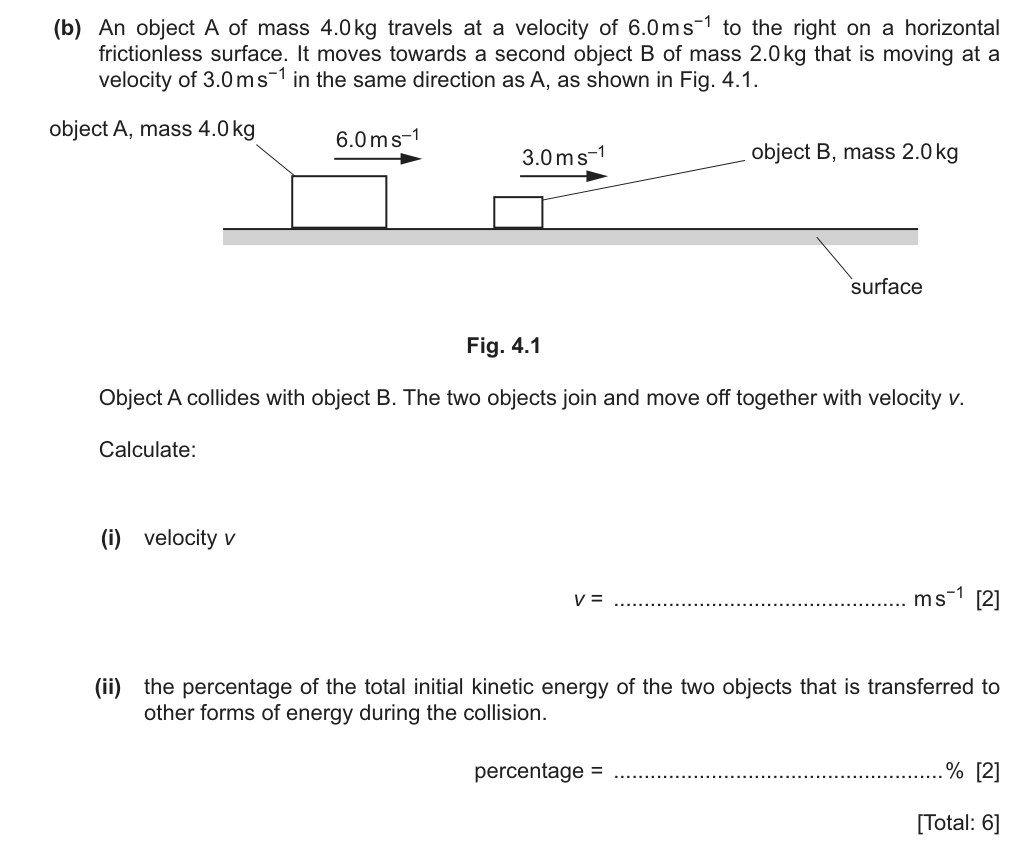
Two blocks slide the same way on a surface with no friction. A is faster, so it catches B up. They stick and move off as one object. Part (i) wants that shared velocity; part (ii) wants to know how much of the movement energy was lost in the crash.
- frictionlessnothing outside the two blocks pushes them, so total momentum is conserved
- join / move off togetherafter the collision there is one mass, 4.0 + 2.0 = 6.0 kg, with one velocity v
- in the same directionboth velocities before are positive - no minus signs
- percentage … transferred to other forms(KE lost ÷ KE before) × 100: the energy that became heat and sound
- (i)v, the velocity of the joined blocks
- (ii)% of the starting kinetic energy that is lost
- mA = 4.0 kgblock A
- uA = 6.0 m s−1A, before
- mB = 2.0 kgblock B
- uB = 3.0 m s−1B, before, same way
- after they join, the moving mass is 6.0 kg
- (i) Findv after they join
- Usemomentum before = momentum after (no friction)
- Before4.0 × 6.0 + 2.0 × 3.0 - all given
- After(4.0 + 2.0) × v - only v is unknown
- Usemomentum before = momentum after (no friction)
- (ii) Find% of KE lost
- Use% = (KE before − KE after) ÷ KE before × 100
- KE before½mu² for A + ½mu² for B - given
- KE after½ × 6.0 × v² - needs v from part (i)
- Use% = (KE before − KE after) ÷ KE before × 100
Why not use kinetic energy to find v in part (i)?
Because kinetic energy is NOT conserved when objects stick together - some becomes heat and sound. Momentum is the only quantity we can trust to be the same before and after.
In part (ii), do we add the two kinetic energies before?
Yes. Kinetic energy is a scalar and never negative, so the total is simply KE of A + KE of B.
5 Now solve it have a go on paper first, then open the worked solution
- (i) p = mv: (4.0 × 6.0) + (2.0 × 3.0) = 6.0v C1
- v = 30 / 6.0 = 5.0 m s−1 A1
- (ii) KE before = ½ × 4.0 × 6.0² + ½ × 2.0 × 3.0² = 72 + 9 = 81 J; KE after = ½ × 6.0 × 5.0² = 75 J C1
- Percentage = (81 − 75) / 81 × 100 = 7% A1
v = 5.0 m s−1 lies between 3.0 and 6.0: the joined pair must be slower than A and faster than B, so it is reasonable. KE after (75 J) is less than KE before (81 J), as it must be when objects stick.
Example 2 · Head-on collision and relative speeds (Paper 2, 8 marks) ★★ Medium
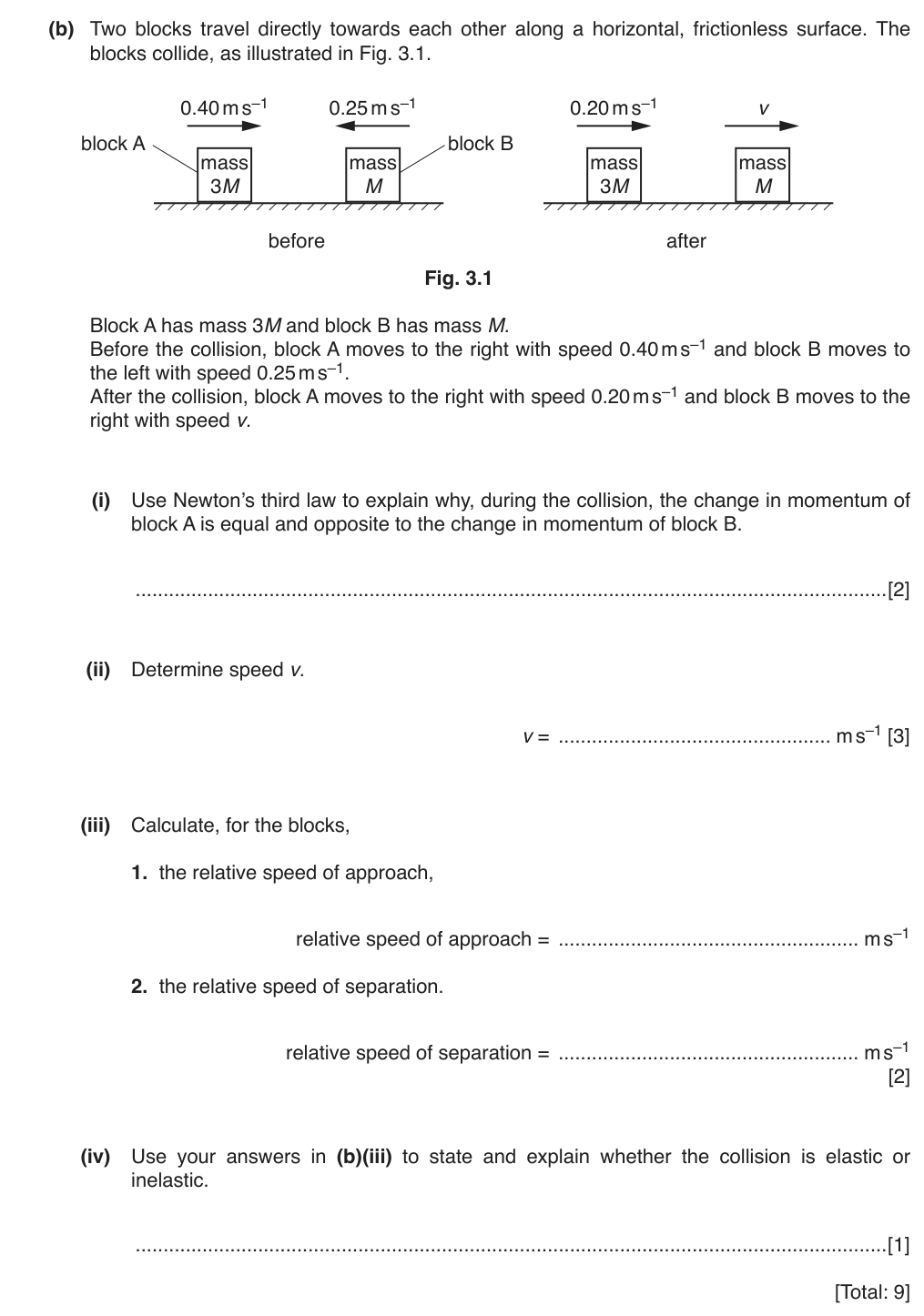
A heavy block A (3M) moving right meets a light block B (M) moving left. They bounce off each other: A keeps going right but slower, and B is knocked back so it now moves right at speed v. The question then asks: why are the momentum changes equal and opposite, what is v, and was the collision elastic?
- Use Newton's third law to explainstart from the FORCES the blocks exert on each other, then link force to momentum
- to the leftwith right as positive, B's velocity before is −0.25
- relative speed of approachhow fast the gap between them closes before the collision
- relative speed of separationhow fast the gap opens after the collision
- elasticthe test the question wants: approach speed = separation speed
- (i)explain why Δp of A = −Δp of B
- (ii)v, B's velocity after
- (iii)the two relative speeds
- (iv)elastic or not, with a reason
- mA = 3MA
- uA = +0.40 m s−1A before, right
- vA = +0.20 m s−1A after, right
- mB = MB
- uB = −0.25 m s−1B before, LEFT
- vB = vB after, right - unknown
- M has no number, but every momentum term contains it, so it will cancel
- (i) ExplainΔpA = −ΔpB
- Step 1Newton's third law: force on A by B = − force on B by A
- Step 2force = rate of change of momentum, and both feel the force for the same time
- Step 1Newton's third law: force on A by B = − force on B by A
- (ii) Findv
- Usetotal momentum before = total after (right = +)
- SignB moves left before: −0.25, not +0.25
- Restall other velocities given; M cancels
- Usetotal momentum before = total after (right = +)
- (iii) Findapproach and separation speeds
- Approachopposite directions → ADD the speeds
- Separationsame direction (both right) → SUBTRACT
- Needsv from part (ii)
- (iv) Decideelastic?
- Testelastic only if approach = separation
M has no value. Can we still find v?
Yes. Every term in the momentum equation has an M in it, so divide the whole equation by M and it disappears.
Why add the speeds for the approach?
They move towards each other, so each second the gap closes by 0.40 m from A's side AND 0.25 m from B's side: 0.65 m every second.
5 Now solve it have a go on paper first, then open the worked solution
- (i) Force on A by B is equal and opposite to force on B by A B1; force = rate of change of momentum and the contact time is the same B1
- (ii) Right = +: (3M × 0.40) − (M × 0.25) C1 = (3M × 0.20) + Mv C1
- v = 1.20 − 0.25 − 0.60 = 0.35 m s−1 A1
- (iii) Approach: opposite directions, add: 0.40 + 0.25 = 0.65 m s−1; separation: both right, B faster, subtract: 0.35 − 0.20 = 0.15 m s−1 A1 A1
- (iv) Separation ≠ approach (it is less), so inelastic B1
The June 2018 report: common errors were subtracting the approach speeds and adding the separation speeds, and in (iv) using kinetic energy or "momentum isn't conserved".
After the collision B (0.35) is faster than A (0.20) and both move right, so B is in front and pulling away - A cannot pass through B. Separation (0.15) is less than approach (0.65): kinetic energy was lost, which matches 'inelastic'.
Example 3 · KE change, then the force and the third law (Paper 2, 9 marks) ★★ Medium
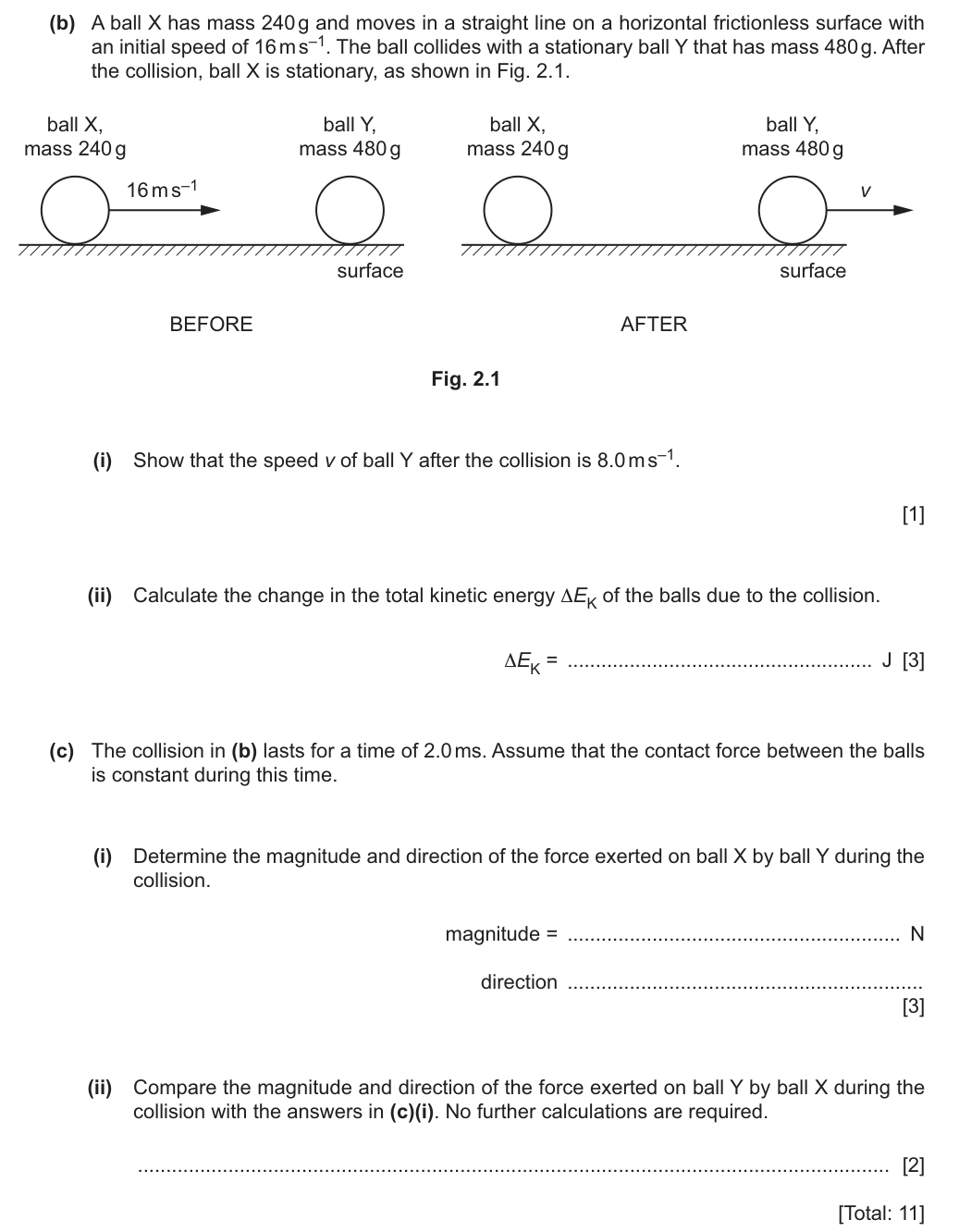
Ball X rolls into ball Y, which is standing still. X stops dead, so all its momentum has been handed to Y. Part (b) is about the speed of Y and the energy lost. Part (c) zooms into the 2 ms crash itself: how hard did Y push X, and how does that compare with X's push on Y?
- stationary (Y before, X after)velocity = 0, so that momentum term is 0
- Show that8.0 is given: write the equation and the working that leads to it, then the answer
- constant forceF = Δp ÷ Δt works directly - no average needed
- force on X by Ylook only at X: the force that changed X's momentum
- Comparesay how the SIZE compares and how the DIRECTION compares
- (b)(i)show vY = 8.0
- (b)(ii)change in total kinetic energy
- (c)(i)force on X by Y: size AND direction
- (c)(ii)force on Y by X compared with (c)(i)
- mX = 240 g = 0.240 kgX
- uX = 16 m s−1X before
- vX = 0X after
- mY = 480 g = 0.480 kgY
- uY = 0Y before
- Δt = 2.0 ms = 2.0 × 10⁻³ scollision time
- energy in joules and force in newtons need kilograms - convert the grams before (b)(ii) and (c)(i)
- (b)(i) ShowvY = 8.0
- Usemomentum before = after: 0.240 × 16 = 0.480 vY
- (b)(ii) FindΔKE
- UseKE before − KE after, with KE = ½mv²
- Beforeonly X moves: ½ × 0.240 × 16²
- Afteronly Y moves: ½ × 0.480 × vY² - vY from (b)(i)
- UseKE before − KE after, with KE = ½mv²
- (c)(i) Findforce on X
- UseF = ΔpX ÷ Δt
- ΔpX0.240 × (0 − 16): X's momentum change only
- DirectionX was moving right and was stopped, so the force on it points LEFT
- UseF = ΔpX ÷ Δt
- (c)(ii) Compareforce on Y by X
- UseNewton's third law pair
Why could we leave the masses in grams in (b)(i), but not in (b)(ii)?
In (b)(i) grams appear on both sides of the equation and cancel. A kinetic energy in joules only comes out right with kg and m s−1.
For the force on X, whose momentum change do we use - X's, Y's or the total?
X's. The force on X is what changed X's momentum. (The total momentum doesn't change at all, so it would give zero.)
5 Now solve it have a go on paper first, then open the worked solution
- (b)(i) 240 × 16 = 480v → v = 8.0 m s−1 A1 Grams can stay: they cancel.
- (b)(ii) EK = ½mv² C1; ΔEK = ½[(0.24 × 16²) − (0.48 × 8.0²)] C1 = ½(61.4 − 30.7) = 15 J (a loss) A1 Here kg are needed: J needs SI units.
- (c)(i) F = Δp/Δt = (0.24 × 16) / (2.0 × 10⁻³) C1 = 1900 N A1, direction to the left (it stops X, which was moving right) B1
- (c)(ii) Equal magnitude B1, opposite direction B1 (Newton's third law)
The force comes out about 1900 N - large, but it acts for only 2 ms, so the momentum change (3.84 N s) is small. KE fell from 30.7 J to 15.4 J: a loss, which fits a collision where nothing says 'elastic'.
Example 4 · Blocks pushed apart by a spring (Paper 2, 7 marks) ★★★ Hard
Why it is hard: the March 2017 report says most answers to (ii)1 were only partially correct, a minority assumed the energy is shared equally (0.24 J each), and very few realised the force on A is zero when the spring reaches its natural length.
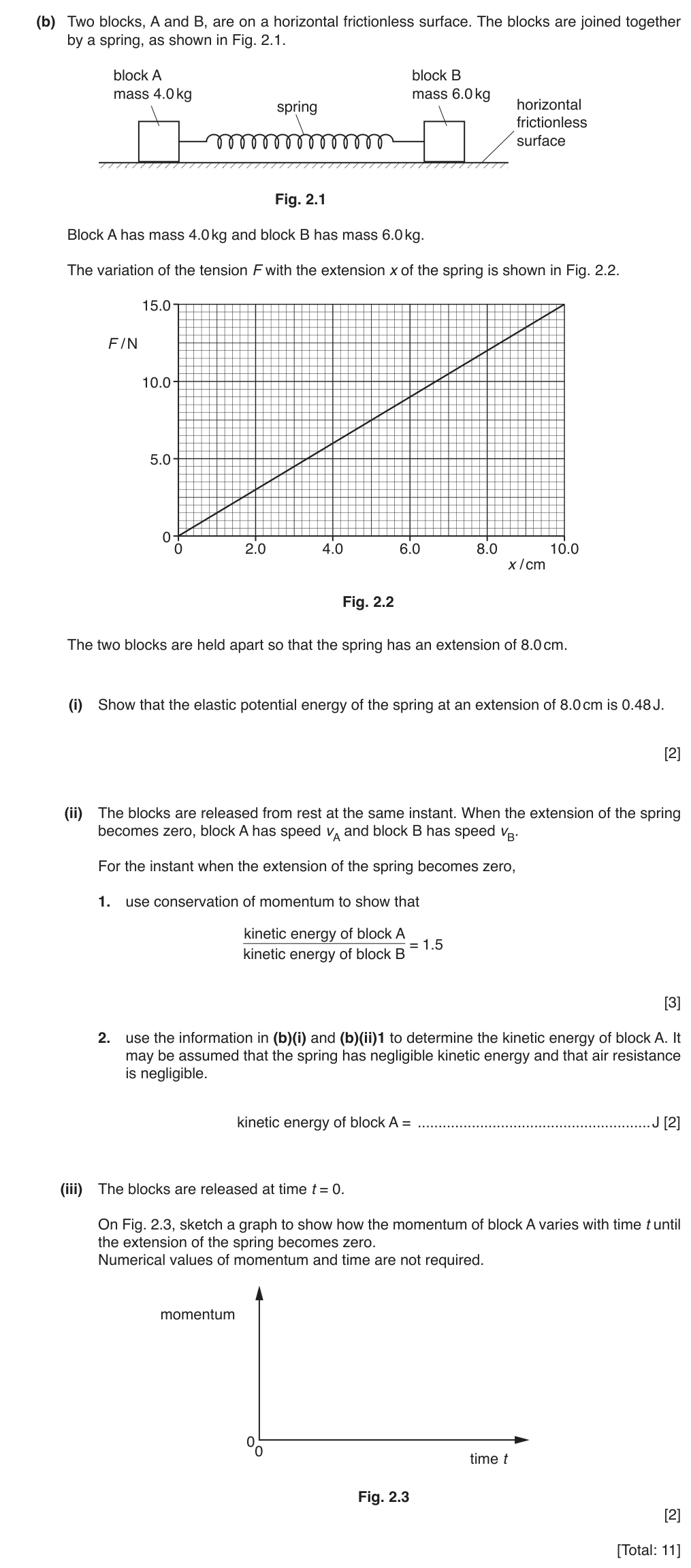
Two blocks are joined by a stretched spring and held still. When they are let go, the spring pulls them in: A goes one way, B the other, both speeding up until the spring is back to its natural length. The energy stored in the spring has become the blocks' kinetic energy - but it is NOT shared equally.
- tension rises linearlythe force-extension graph is a straight line from the origin, so the stored energy is a triangle's area
- held … and released from resttotal momentum before is ZERO, so afterwards the two momenta are equal and opposite
- frictionlessno outside force: momentum is conserved
- Show that … = 1.51.5 is given - your working must arrive at it
- Sketch … until the extension is zerothink about the FORCE on A (the gradient of a p-t graph) as the spring relaxes
- (i)show the stored energy is 0.48 J
- (ii)1show KEA ÷ KEB = 1.5
- (ii)2KE of A
- (iii)shape of A's momentum against time
- mA = 4.0 kgA
- mB = 6.0 kgB
- F = 12.0 Nat the start
- x = 8.0 cm = 0.080 mextension at the start
- u = 0both, at release
- all the 0.48 J of spring energy ends up as kinetic energy of A plus kinetic energy of B
- (i) ShowEPE = 0.48 J
- Useenergy = area under F-x graph = ½Fx
- (ii)1 ShowKEA ÷ KEB = 1.5
- Step 1momentum zero before → 4.0 vA = 6.0 vB, so vA = 1.5 vB
- Step 2write KE = ½mv² for each and divide, then substitute vA
- (ii)2 FindKEA
- Use0.48 = KEA + KEB
- NeedsKEB = KEA ÷ 1.5 from (ii)1
- Trapit is NOT 0.24 J each
- Use0.48 = KEA + KEB
- (iii) SketchpA against t
- Usegradient of p-t = force on A
- Soforce falls to zero as the extension does: the curve flattens out
- Usegradient of p-t = force on A
The blocks have equal momentum. Do they have equal kinetic energy?
No. KE = p² ÷ 2m, so with the same p the LIGHTER block has MORE kinetic energy. A (4.0 kg) gets more than B (6.0 kg).
What is the force on A at the moment the spring reaches its natural length?
Zero - the tension is zero at zero extension. So A's momentum stops increasing: the graph ends flat.
5 Now solve it have a go on paper first, then open the worked solution
- (i) EPE = area under the F–x graph = ½Fx C1 = ½ × 12.0 × 8.0 × 10−2 = 0.48 J A1
- (ii)1 Momentum zero before, so 4.0vA = 6.0vB C1. EK = ½mv² C1
- Ratio = (½ × 4.0 × vA²) / (½ × 6.0 × vB²) with vA = 1.5vB: = (4.0 × 2.25) / 6.0 = 1.5 A1 Quicker: equal p, E = p²/2m, so the ratio is 6.0/4.0.
- (ii)2 0.48 = EA + EA/1.5 = (5/3)EA C1 → EA = 0.29 J A1
- (iii) Starts at the origin with a decreasing gradient M1 and ends with zero gradient A1 (gradient = force from the spring, which falls to zero as the extension does).
KEA + KEB = 0.29 + 0.19 = 0.48 J ✓, and the lighter block A has the bigger share, as expected. The ratio 0.29 ÷ 0.19 ≈ 1.5 ✓.
Example 5 · A quarter of its kinetic energy (Paper 1, 1 mark) ★★★ Hard
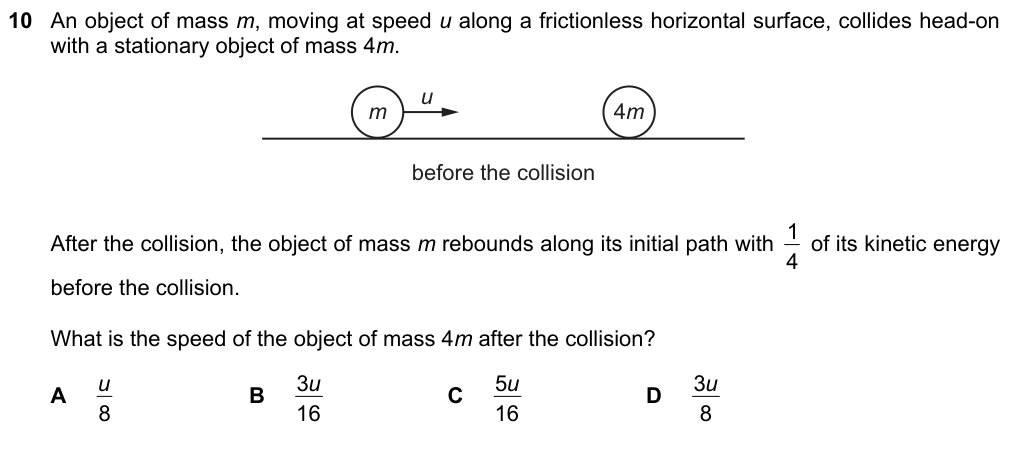
Why it is hard: the June 2023 report calls it "very challenging". Two steps hide in it: turning a KE fraction into a speed, and remembering the rebound is negative.
A small mass m hits a big mass 4m that is standing still, head on. The small one bounces back with only a quarter of its kinetic energy. We need the speed the big one moves off with.
- head-oneverything happens on one line: one dimension, use + and −
- rebounds along its initial pathit reverses: its velocity after is NEGATIVE
- 1/4 of its kinetic energya quarter of the ENERGY, not of the speed - KE goes with v²
- speed of the 4m object after, in terms of u
- m, speed usmall mass before
- 4m, at restbig mass before
- KE after = ¼ KE beforesmall mass
- FindV, the speed of 4m
- Usemomentum: mu = m × vm + 4m × V
- Need firstvm, the small mass's velocity after
- From¼ of the KE → √¼ = ½ of the speed: u/2
- Signit bounced back: vm = −u/2
- Need firstvm, the small mass's velocity after
- Usemomentum: mu = m × vm + 4m × V
If an object keeps a quarter of its kinetic energy, what fraction of its speed does it keep?
Half. KE ∝ v², so v ∝ √KE and √¼ = ½.
Why does the minus sign matter so much here?
Momentum is a vector. Bouncing back means the small mass now has momentum −mu/2, so the big mass has to carry MORE than mu: mu + mu/2 = 3mu/2.
5 Now solve it have a go on paper first, then open the worked solution
- KE ∝ v², so ¼ of the KE means ½ of the speed: m rebounds at u/2, i.e. velocity −u/2.
- Momentum: mu = m(−u/2) + 4mv
- 4v = 3u/2 → v = 3u/8 → D
| Option | Where it comes from |
|---|---|
| A u/8 | Forgot the rebound is backwards: mu = m(u/2) + 4mv. |
| B 3u/16 | Took ¼ of the KE as ¼ of the speed (u/4) and forgot the rebound: 4v = 3u/4. |
| C 5u/16 | ¼ of the speed, with the rebound sign right: 4v = 5u/4. |
| D 3u/8 | Correct. |
V = 3u/8 is less than u, and the big mass carries momentum 4m × 3u/8 = 1.5mu - more than the mu we started with, which is right because the small mass now carries −0.5mu.
Example 6 · Loss of kinetic energy with zero total momentum (Paper 1, 1 mark) ★★★ Hard
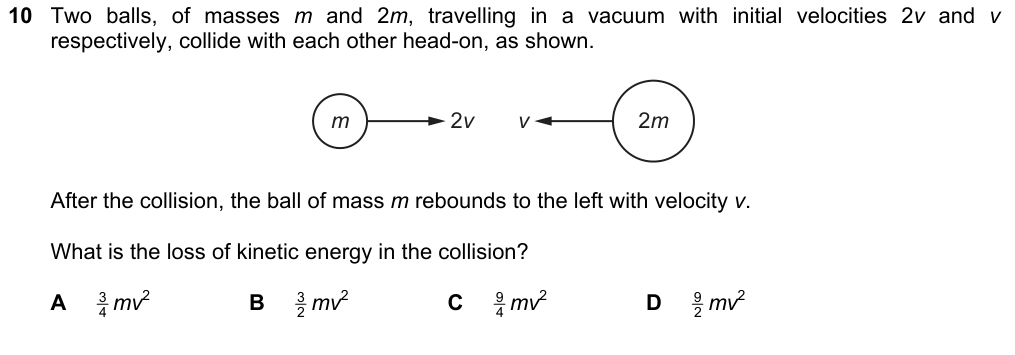
Why it is hard: B was the most popular wrong answer (November 2023 report). The key is spotting that the total momentum is zero.
Ball m moves right at 2v and ball 2m moves left at v; they hit head on. Afterwards ball m bounces back to the left at v. We need how much kinetic energy disappeared in the collision.
- head-on, towards each otheropposite directions: one velocity + and one −
- rebounds to the left with velocity vm's velocity after is −v (right = +)
- loss of kinetic energyKE before − KE after (add both balls each time)
- loss of kinetic energy, in terms of m and v
- m: +2v → −vball m, before → after
- 2m: −v → ?ball 2m, after unknown
- work out the total momentum before: m(2v) + 2m(−v) = 0
- Findloss of KE
- UseKE before − KE after
- KE before½m(2v)² + ½(2m)v² - all given
- KE afterneeds the velocity V of ball 2m
- Frommomentum: total before is 0, so total after is 0
- UseKE before − KE after
Work out the total momentum before. What do you notice?
m(2v) + 2m(−v) = 0. So after the collision the two momenta must cancel too: m(−v) + 2mV = 0, giving V = v/2 to the right.
Why must we find ball 2m's velocity before anything else?
The kinetic energy after needs the speed of BOTH balls, and only ball m's is given. Momentum is the only law that can give us the other one.
5 Now solve it have a go on paper first, then open the worked solution
- Right = +: before, m(2v) + 2m(−v) = 0.
- After: m(−v) + 2m(V) = 0 → V = v/2 to the right.
- KE before = ½m(2v)² + ½(2m)v² = 2mv² + mv² = 3mv²
- KE after = ½mv² + ½(2m)(v/2)² = ½mv² + ¼mv² = ¾mv²
- Loss = 3 − ¾ = 9/4 mv² → C
Total KE before is 3mv², and the loss (9/4 mv²) is less than that - you can never lose more energy than you had. About ¾ of it is lost, a very inelastic collision.
Summary
- Total momentum of a system is constant if no resultant external force acts. It follows from Newton's third law + F = Δp/Δt with equal contact times.
- Method: sketch → choose + → total before = total after (signs!) → solve.
- Momentum is conserved in every collision and explosion; kinetic energy only in elastic collisions. Total energy is always conserved.
- Elastic: total KE before = after, and relative speed of approach = relative speed of separation (add for opposite directions, subtract for the same direction).
| If you see… | do this |
|---|---|
| "stick together" / "join" / "embedded" | one velocity after: (m₁ + m₂)v; inelastic |
| "explodes" / "released from rest" / "pushed apart" | total momentum 0: equal and opposite momenta |
| "perfectly elastic" with unknown velocities | momentum + (approach = separation) as simultaneous equations |
| "elastic or inelastic?" | compare total KE, or relative speeds (use what the question tells you to) |
| "fraction of its kinetic energy" | convert to a speed first: KE ∝ v² |
| "use Newton's third law to explain" | equal and opposite forces, same time, force = rate of change of momentum |
Can I do this?
- I can state the principle with "total" and the condition, and explain it with Newton's laws.
- I can solve a 1D collision with a sign convention.
- I can handle sticking, explosions, unknown masses and choosing the system (ball + Earth).
- I can define an elastic collision and use relative speeds of approach and separation.
- I can calculate kinetic energy changes and know total energy is always conserved.
Anything unticked: revise that section first. All ticked: take the quiz.
Quiz
Your progress on this note is saved when JavaScript is on.