
Dynamics
Momentum, and force as rate of change of momentum
On this page
What you need to be able to do
- 3.1.3Define and use linear momentum as the product of mass and velocity.
- 3.1.4Define and use force as rate of change of momentum.
Before you start: Newton's laws and F = ma. Next: Air resistance and terminal velocity.
Momentum
Momentum measures "how much motion" something has: how hard it is to stop. A slow lorry and a fast bullet can have the same momentum. Because it is a vector, the sign matters as soon as anything changes direction: a ball moving right at 4 m s−1 and a ball moving left at 4 m s−1 have momenta of +4m and −4m.
Force is the rate of change of momentum
How this gives F = ma. If the mass is constant, \(\Delta p = m\,\Delta v\), so \(F = m\dfrac{\Delta v}{\Delta t} = ma\). The momentum form is the more general one: it still works when the mass changes (a rocket throwing out gas, water leaving a hose) and when you only know momenta, not velocities.
Use F = Δp / Δt when…
you are given a contact time (a collision, a kick, a bounce), a momentum–time graph, or a stream of fluid.
Use F = ma when…
the mass is fixed and you know (or want) the acceleration.
Finding a change in momentum
Nearly every calculation in this subtopic needs Δp first. Do it the same way every time:
- Choose a positive direction (usually the first direction of motion).
- Write both momenta with signs: initial p1 = mu, final p2 = mv. A velocity the other way is negative.
- Δp = p2 − p1 (final minus initial). Keep the sign: it tells you the direction of the resultant force.
- Then the force: F = Δp / Δt, where Δt is the time the force acts (the contact time), not the time of the whole journey.
1 Brought to rest
A bullet of mass 8.0 g at 300 m s−1 stops in 100 µs. Average force? 9702/12/O/N/16 Q12
Askedthe average stopping forceKnowmass, speed, stopping timeRouteΔp = m × (0 − u), then F = Δp ÷ t (grams → kg, µs → s)
- Δp = 0 − 0.0080 × 300 = −2.4 N s
- F = 2.4 / (100 × 10−6) = 24 000 N (against the motion)
2 Rebounds along the same line (the trap)
A 200 g ball hits a wall at 20 m s−1 and rebounds at 10 m s−1, contact 0.10 s. Average force? 9702/11/O/N/23 Q8
Askedthe average force from the wallKnowspeeds in and out, contact timeRoutetowards the wall = +, so v is negative: Δp = m(v − u), then ÷ t
- Towards the wall = +: u = +20, v = −10.
- Δp = 0.200 × (−10 − 20) = −6.0 N s (size 0.200 × 30, not × 10)
- F = 6.0 / 0.10 = 60 N, away from the wall
Subtracting the speeds (0.200 × 10) is the most named error in this whole chapter: it appears in the 2016, 2017, 2019, 2021, 2022 and 2023 reports.
3 Same speed back (elastic bounce)
A molecule of mass m hits a wall at speed u and rebounds at the same speed. Change in momentum? 9702/11/M/J/11 Q10, 9702/11/M/J/19 Q11
Askedthe change in momentumKnowsame speed in and outRoutevelocity reverses: Δp = m(−u) − m(u) = −2mu, never zero
- Δp = m(−u) − m(+u) = −2mu
- Not zero: the speed is unchanged but the velocity has reversed. (Over half the candidates chose "zero" in 2019.)
4 Bounces off at an angle
A ball hits a surface with momentum p at angle θ to it and leaves with the same p at θ. Average force in time t? 9702/12/F/M/21 Q8
Askedthe average force for an angled bounceKnowsame p, same angle in and outRoutesplit p: along the surface no change, perpendicular changes by 2p sin θ
- Split p into components. Along the surface: p cos θ before and after → no change.
- Perpendicular: +p sin θ (towards) then −p sin θ (away) → Δp = 2p sin θ.
- F = 2p sin θ / t, perpendicular to the surface. ("Zero" was a common wrong answer: the size of p is unchanged, but its direction is not.)
5 Turns through 90°
A 0.20 kg ball changes from 0.40 m s−1 to 0.30 m s−1 at right angles. Magnitude of Δp? 9702/12/F/M/23 Q4
Askedthe size of Δp for a 90° turnKnowboth momenta, at right anglesRouteΔp is a vector subtraction: Pythagoras on p₁ and p₂
- p1 = 0.080, p2 = 0.060 N s, at 90°.
- Δp = p2 − p1 is a vector subtraction: draw p2 and reversed p1 tip to tail → a right-angled triangle.
- |Δp| = √(0.080² + 0.060²) = 0.10 N s. (0.020 is "the change in the magnitude", the most common wrong answer.)
Momentum–time and force–time graphs
| You are given… | You want… | Do this |
|---|---|---|
| p–t graph | resultant force | gradient (a tangent if curved): Δp / Δt |
| p–t graph + the friction | the applied force | applied = resultant + friction |
| F–t graph | change in momentum | area under the line (a triangle: ½ × base × height; mind ms → s) |
| F–t graph + mass | final speed | Δv = area / m, then add to the initial velocity (with signs) |
| a force that is constant | sketch p–t | straight line, no sudden jumps (momentum can't change instantly) |
The force from the floor (or ceiling) during a bounce
Δp / Δt gives the resultant force on the ball. During the contact, two forces act on it: the contact force from the surface and its weight. If a question asks for the force exerted by the floor, you need one more step.
- Find Δp (speeds add for a rebound) and the resultant force Fres = Δp / Δt.
- Draw the two forces on the ball during contact (contact force and weight).
- Write resultant = (forces one way) − (forces the other way) and solve for the contact force.
- By the third law, the force of the ball on the floor is the same size as the floor's force on the ball (9702/21/O/N/20 Q3(b)(iv): both 4.8 N).
Streams of fluid: hoses, jets, propellers
When a machine pushes a fluid (water from a hose, air through a fan or propeller, gas from a rocket), it changes the momentum of the fluid every second. The force on the fluid is that rate; by the third law the fluid pushes back equally on the machine.
\[ F = \frac{\Delta m}{\Delta t}\,v \]
\(\Delta m / \Delta t\) is the mass per second (kg s−1) and v the speed the fluid is given (it starts at rest). If the fluid already moves at u, use \((\Delta m/\Delta t)(v - u)\). To get the mass from a jet: mass = density × volume = ρ × (area × speed × time).
- Mass per second in kg s−1. "90 kg per minute" is 1.5 kg s−1 — not converting gives 1800 N instead of 30 N 9702/11/O/N/18 Q7, 9702/13/O/N/21 Q8.
- Momentum given each second = (mass per second) × (change in speed). This is the force on the fluid.
- Third law: the fluid pushes the machine with the same force in the opposite direction.
- Balance or F = ma for the machine: a hovering drone needs the total push = its weight; a rocket accelerates with (thrust − weight) / mass.
Mark-scheme focus
Define momentum
Define momentum.
- "product of mass and velocity" / "mass × velocity"
- "mass × speed" (momentum is a vector)
- "a force that a moving object has"
- a statement of conservation of momentum
The November 2021 report: "some of the weakest candidates held the misconception that momentum was a type of force". The June 2019 report: some gave the principle of conservation instead of the definition.
From: 9702/24/M/J/25 Q2(a), 9702/21/O/N/24 Q2(a), 9702/21/O/N/21 Q2(a), 9702/21/M/J/19 Q2(a).
How does Newton's third law apply to this collision?
A ball is thrown vertically downwards and hits the ground. State how Newton's third law applies to the collision between the ball and the ground.
- "(magnitude of) force on ball (by ground) equal to force on ground (by ball)"
- "(direction of) force on ball (by ground) opposite to force on ground (by ball)"
- a general statement of the law that never mentions the ball and the ground
- "the ball and the ground have equal and opposite forces" (which force on which?)
- directions that are "different" rather than "opposite"
The June 2021 report: "a significant proportion ... did not make it clear that there were two separate forces, one acting on the ball and the other acting on the ground". Name both bodies in each force: "force on X by Y".
From: 9702/22/M/J/21 Q2(b), 9702/23/M/J/18 Q3(d), 9702/22/O/N/18 Q3(b)(iii) and their reports.
- Change in momentum + average force for a bounce or rebound: the most common Dynamics calculation on Paper 2 (2015–2025 almost every year), C1 A1 then A1. Paper 1 most years too.
- Momentum–time graph: Paper 2 most years since 2019: find the resultant force from the gradient, or sketch p–t / F–t.
- Force from the surface = resultant ± weight: Paper 2 every few years, usually the hardest mark in the question.
- Fluid streams (hose, drone, propeller, water rocket): Paper 1 and 2, every year or two.
Worked examples
Example 1 · A block rebounds from a barrier (Paper 2, 3 marks) ★ Easy
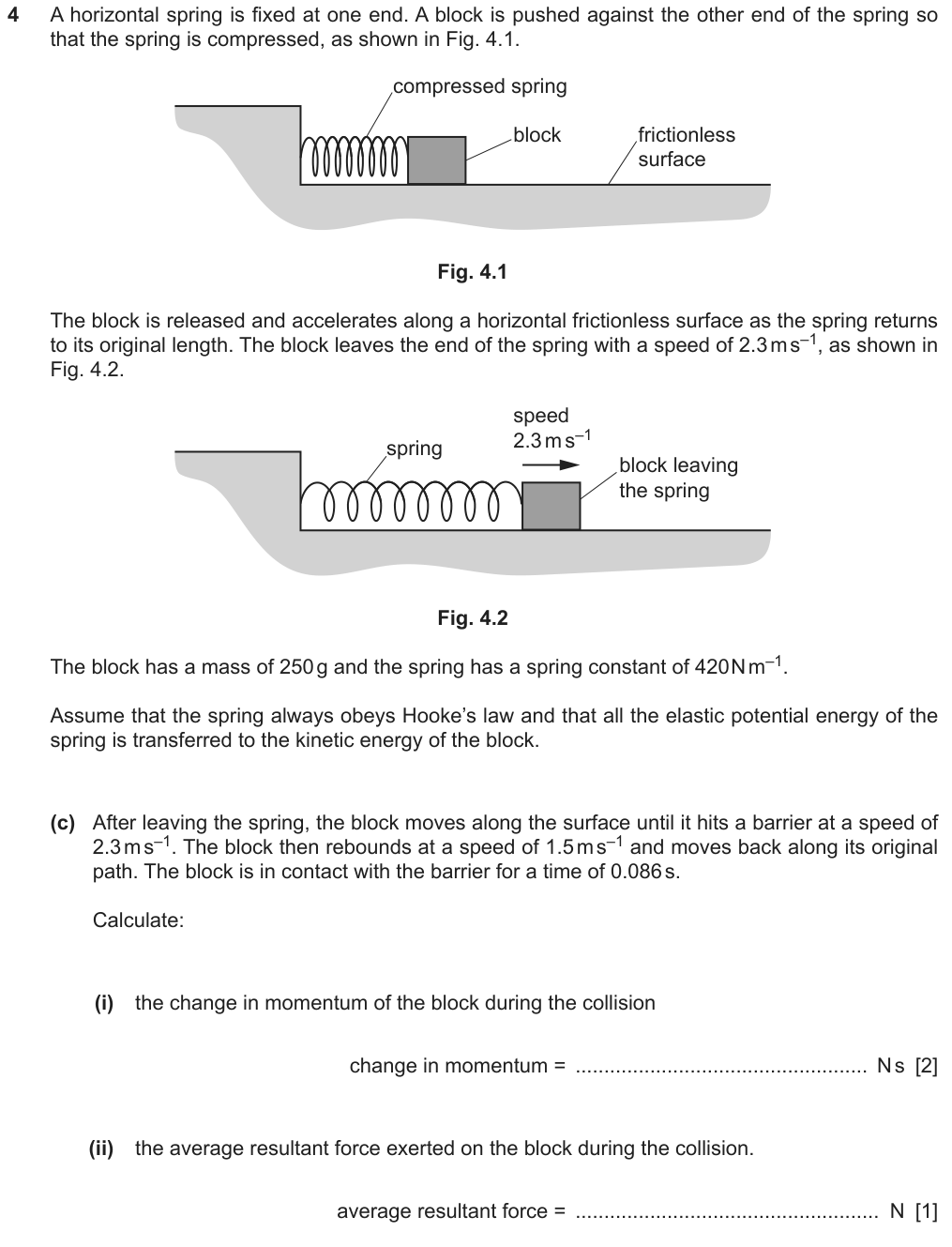
A small block hits a barrier and bounces straight back, a bit slower. The barrier touched it for 0.086 s. We need how much its momentum changed, and then the average force that caused that change.
- rebounds … along its original pathit reverses: the velocity after has the OPPOSITE sign
- change in momentumfinal momentum − initial momentum, with signs - a bounce makes it big
- average resultant forceF = Δp ÷ Δt over the contact time
- (i)change in momentum
- (ii)average resultant force
- m = 250 g = 0.25 kgblock
- u = 2.3 m s−1towards the barrier
- v = 1.5 m s−1away from it
- Δt = 0.086 scontact time
- towards the barrier = +, so the rebound velocity is −1.5
- (i) FindΔp
- UseΔp = m(v − u)
- Signsv = −1.5, u = +2.3: the sizes ADD to 3.8
- UseΔp = m(v − u)
- (ii) FindF
- UseF = Δp ÷ Δt
- NeedsΔp from (i)
- HaveΔt = 0.086 s
- UseF = Δp ÷ Δt
The block goes in at 2.3 and out at 1.5. Is the change in velocity 0.8?
No - that ignores direction. It goes from +2.3 to −1.5, a change of 3.8 m s−1. This is the most named mistake in the examiner reports for this chapter.
Why must the mass be in kg?
Momentum in N s (kg m s−1) and force in N only come out right with SI units.
5 Now solve it have a go on paper first, then open the worked solution
- (i) p = mv: 0.25 × 2.3 or 0.25 × 1.5 C1 Mass in kg: 250 g = 0.25 kg.
- Towards the barrier = +: Δp = 0.25 × (−1.5 − 2.3), size 0.25 × (2.3 + 1.5) = 0.95 N s A1
- (ii) F = 0.95 / 0.086 = 11 N A1
The November 2022 report: "a common mistake was to then calculate the change in momentum by subtracting the magnitudes". Some also gave the rate of change of momentum in (i).
0.95 N s ÷ 0.086 s ≈ 11 N. Using 0.8 instead of 3.8 would give only 2.3 N - far too small for a bounce.
Example 2 · The force from the ground (Paper 2, 5 marks) ★★★ Hard
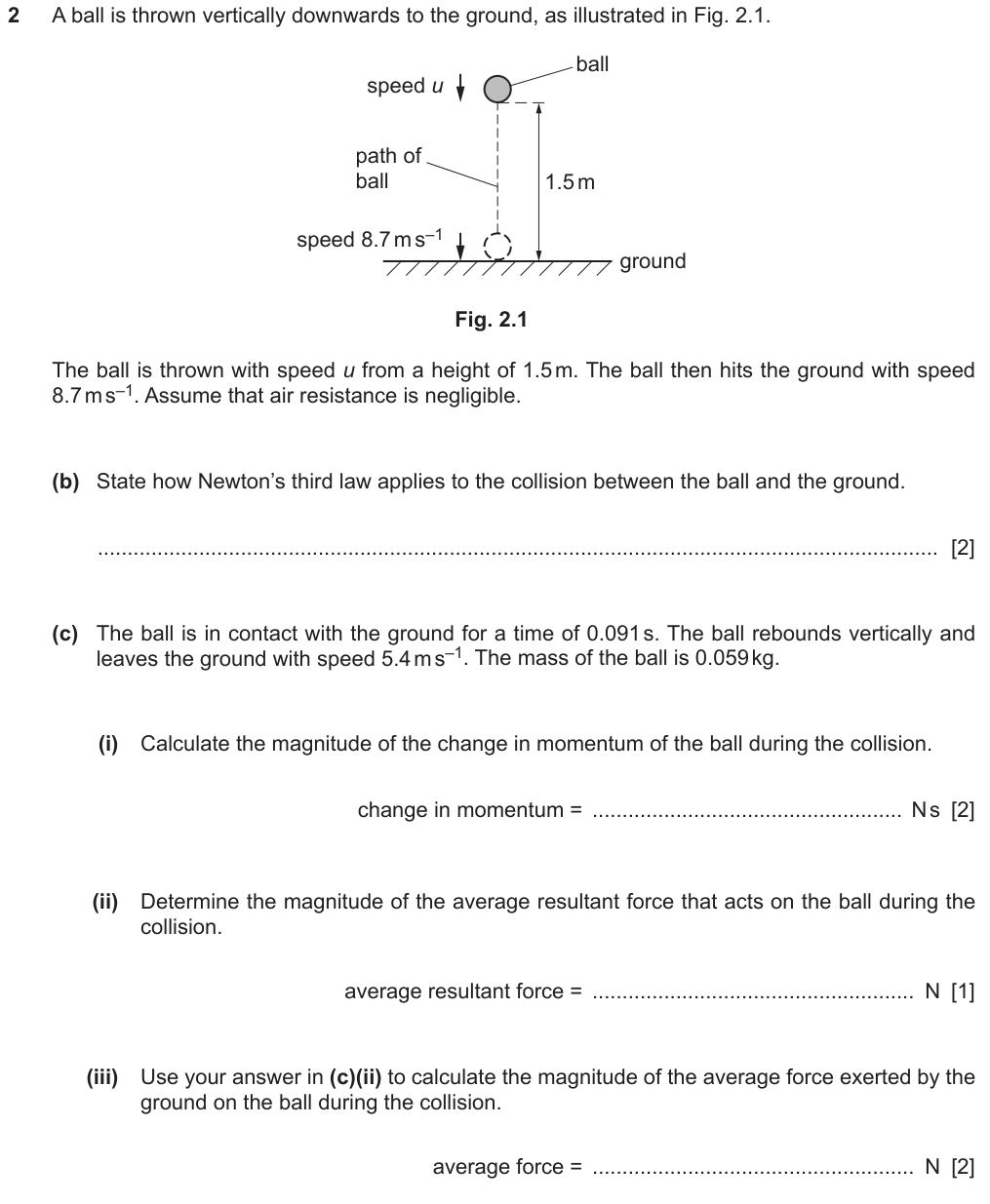
Why it is hard: the June 2021 report says most candidates found (c)(iii) challenging: the resultant force and the weight act in opposite directions, so they must be added; many subtracted, or gave the resultant force as the ground's force.
A ball falls, hits the ground and bounces straight up. While it is touching the ground two forces act on it: the ground pushing up and its weight pulling down. The question wants Δp, then the RESULTANT force, then the ground's force alone.
- Newton's third law … collisionball pushes ground, ground pushes ball: equal size, opposite direction, same type
- rebounds verticallydirection reverses: down then up - add the speeds for Δp
- average resultant forceΔp ÷ Δt - the NET force, not the ground's force
- force exerted by the groundone of the two forces that make up the resultant
- (b)how the third law applies
- (c)(i)change in momentum
- (c)(ii)average resultant force
- (c)(iii)average force by the ground
- m = 0.059 kgball
- u = 8.7 m s−1down
- v = 5.4 m s−1up
- Δt = 0.091 scontact
- the weight (mg) acts downwards the whole time the ball is on the ground
- (c)(i) FindΔp
- Usem × (8.7 + 5.4): the direction reverses
- (c)(ii) FindFres
- UseΔp ÷ Δt
- NeedsΔp from (c)(i)
- UseΔp ÷ Δt
- (c)(iii) FindN, the ground's force
- UseN − W = Fres (up = +)
- Work out firstW = mg
- TrapADD the weight: N = Fres + W
- UseN − W = Fres (up = +)
Draw the forces on the ball while it is touching the ground. How many are there?
Two: the normal force N from the ground (up) and the weight W (down). Their difference is the resultant force.
Why must the ground push harder than the resultant force?
Part of its push is used just to hold up the ball's weight. Only what is left over changes the momentum.
5 Now solve it have a go on paper first, then open the worked solution
- (c)(i) p = 0.059 × 8.7 or 0.059 × 5.4 C1; Δp = 0.059 × (8.7 + 5.4) = 0.83 N s A1
- (c)(ii) Fres = 0.83 / 0.091 = 9.1 N (upwards: the ball's momentum changes from down to up) A1
- (c)(iii) Forces on the ball: N up, weight down. W = 0.059 × 9.81 = 0.58 N C1
- N − W = Fres → N = 9.1 + 0.58 = 9.7 N A1
The ground must push harder than the resultant, because part of its push just holds up the weight. On a ceiling 9702/23/M/J/18 Q3(f) the weight helps the contact force, so it is taken away: 6.47 − 0.55 = 5.9 N.
N (9.7 N) is a little bigger than Fres (9.1 N), by exactly the weight (0.58 N). If it came out smaller, the weight was subtracted.
Example 3 · Momentum–time graph with friction (Paper 2, 6 marks) ★★ Medium
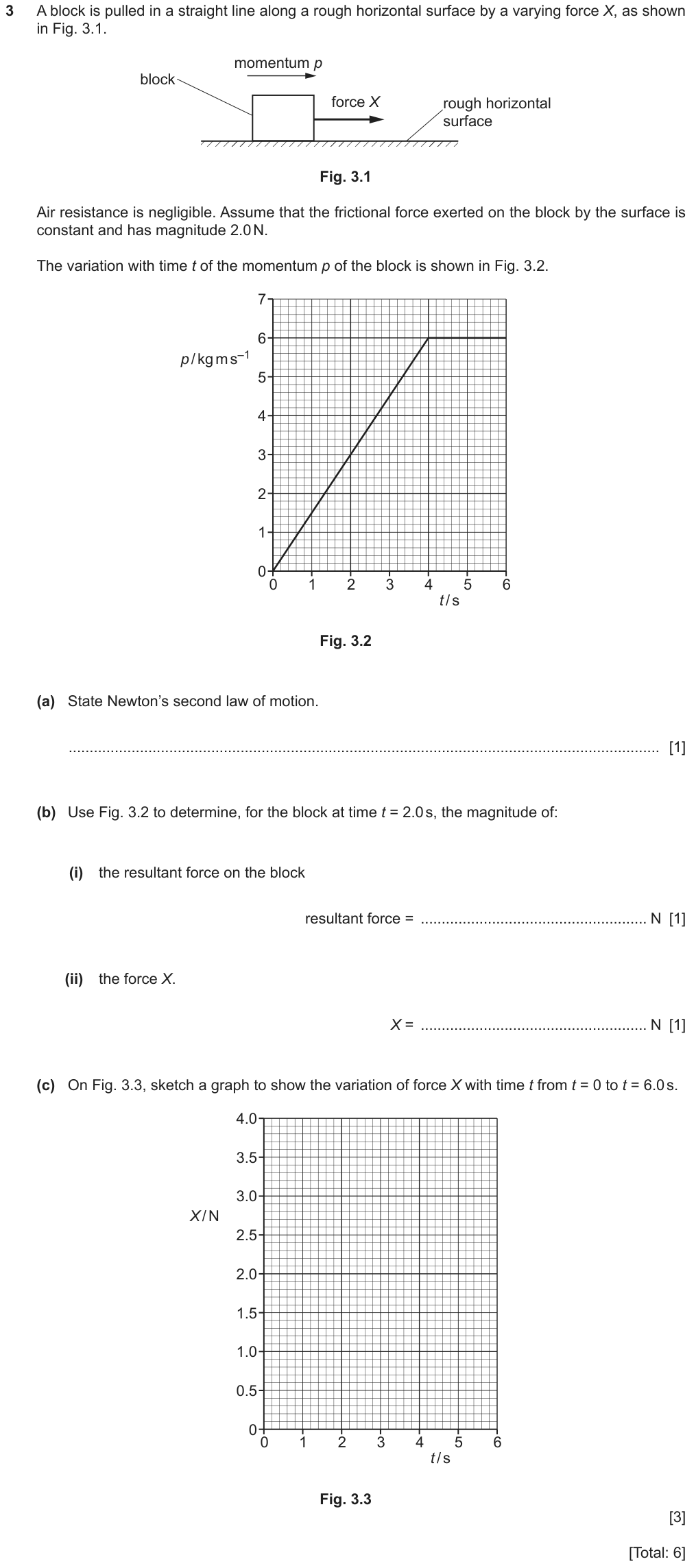
A block is pulled across a rough floor. Its momentum graph rises in a straight line for 4 s, then goes flat. Friction is a steady 2.0 N. From the graph we read the resultant force, work out the pull X, and sketch how X changes.
- State Newton's second lawin terms of momentum: force ∝ rate of change of momentum
- momentum-time graphits GRADIENT is the resultant force
- friction is constant at 2.0 NX has to beat friction AND supply the resultant
- Sketch the variation of Xtwo flat sections - one for each part of the graph
- (a)Newton's second law
- (b)(i)resultant force at t = 2.0 s
- (b)(ii)force X at t = 2.0 s
- (c)sketch of X from 0 to 6.0 s
- p: 0 → 6.0 N sover 0-4.0 s, straight line
- p = 6.0 N sconstant 4.0-6.0 s
- friction = 2.0 Nconstant
- (b)(i) Findresultant
- Usegradient of p-t
- Read6.0 ÷ 4.0
- Usegradient of p-t
- (b)(ii) FindX
- UseX − friction = resultant
- Trapadd the friction, don't subtract
- UseX − friction = resultant
- (c) SketchX against t
- 0-4 sconstant gradient → X constant at 3.5 N
- 4-6 sflat p → resultant 0 → X = friction = 2.0 N
What does a FLAT momentum graph tell you about the forces?
Momentum is not changing, so the resultant force is zero: X exactly balances the friction.
Why is X bigger than the resultant?
Friction pulls backwards. X must cancel that 2.0 N first, then provide the 1.5 N resultant on top.
5 Now solve it have a go on paper first, then open the worked solution
- (a) "(resultant) force is proportional to the rate of change of momentum" B1
- (b)(i) Resultant = gradient = 6.0 / 4.0 = 1.5 N A1
- (b)(ii) X − friction = resultant → X = 1.5 + 2.0 = 3.5 N A1 The June 2023 report: a common mistake was to subtract.
- (c) 0–4.0 s: constant gradient → constant resultant → X is a horizontal line B1 at 3.5 N B1
- 4.0–6.0 s: momentum constant → resultant zero → X = friction: horizontal line at 2.0 N B1
X (3.5 N) is bigger than friction while the block speeds up, and equal to friction once it moves steadily - exactly what Newton's first and second laws predict.
Example 4 · Area under a force–time graph (Paper 2, 7 marks) ★★ Medium
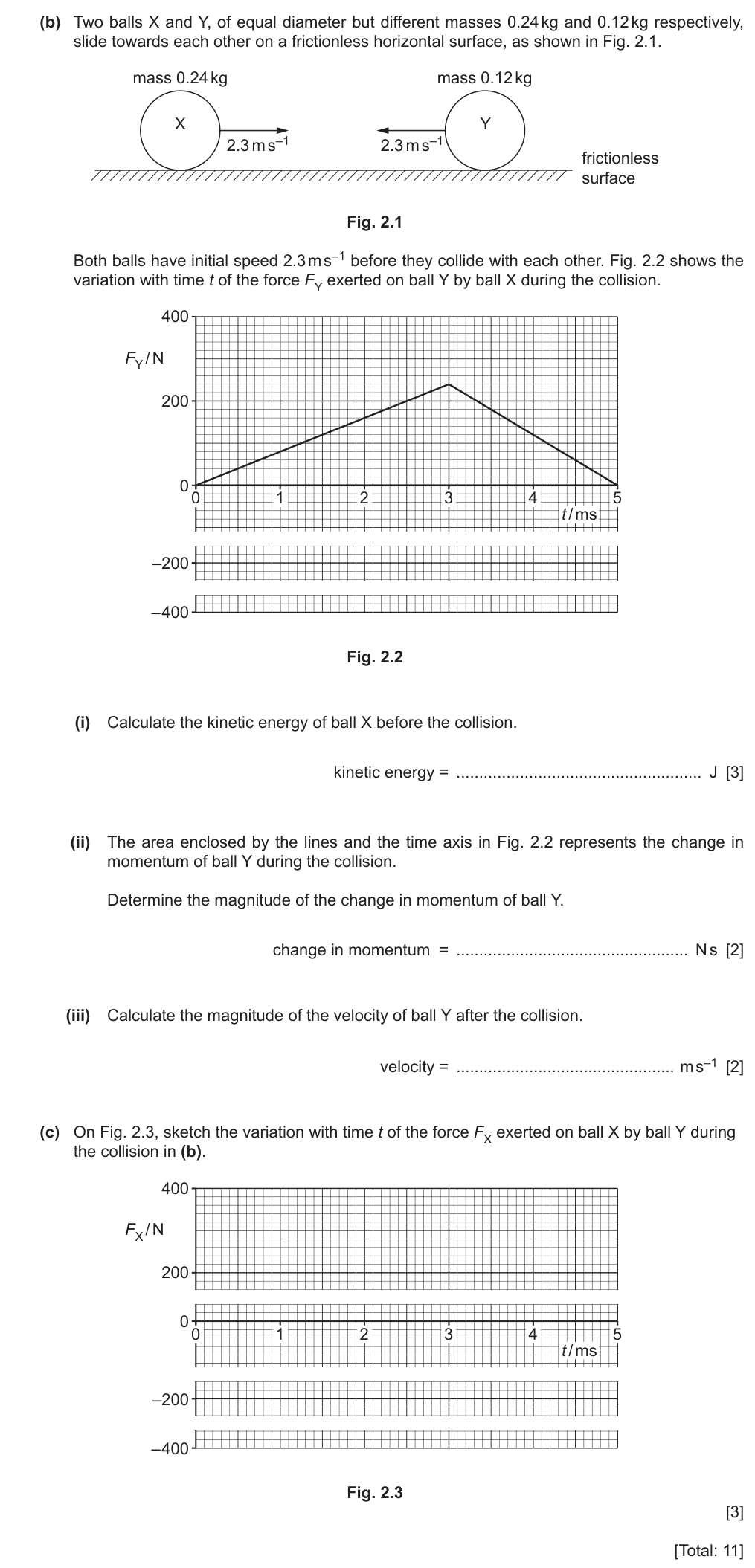
Two balls slide towards each other at the same speed and collide. A graph shows the force on Y during the 5 ms collision: a triangle. We find X's kinetic energy, then use the triangle's area to get Y's momentum change and new speed, and finally sketch the force on X.
- area under the graph is the change in momentumimpulse: area of the F-t triangle = Δp of Y
- msmilliseconds: × 10−3 before multiplying
- towards each otherY starts moving AGAINST the force X puts on it
- force FX on X by YNewton's third law: same shape, same times, opposite sign
- (i)KE of X before
- (ii)change in momentum of Y
- (iii)speed of Y after
- (c)sketch of FX
- mX = 0.24 kgX
- mY = 0.12 kgY
- u = 2.3 m s−1each, towards each other
- peak F = 240 Nat 3.0 ms
- Δt = 5.0 ms = 5.0 × 10⁻³ stotal contact
- (i) FindKE of X
- Use½mv²
- (ii) FindΔp of Y
- Usearea of triangle = ½ × base × height
- Units5.0 ms = 5.0 × 10⁻³ s
- Usearea of triangle = ½ × base × height
- (iii) FindY's speed after
- Step 1Δv = Δp ÷ mY
- NeedsΔp from (ii)
- Step 2Y started at 2.3 the OTHER way: final = Δv − 2.3
- Step 1Δv = Δp ÷ mY
- (c) SketchFX
- Usethird law: FX = −FY at every instant
Y's velocity changes by 5.0 m s−1. Why is its final speed not 5.0?
Y was already moving at 2.3 m s−1 the opposite way. The first 2.3 of the change just stops it; the rest (2.7) sends it back.
How should FX look compared with FY?
A mirror image below the axis: the same triangle, peak −240 N at 3.0 ms, back to zero at 5.0 ms.
5 Now solve it have a go on paper first, then open the worked solution
- (i) EK = ½mv² C1 = ½ × 0.24 × 2.3² C1 = 0.63 J A1
- (ii) Area of the triangle = ½ × 240 × 5.0 × 10−3 C1 = 0.60 N s A1 ms → s, or you are out by 1000.
- (iii) Δv of Y = 0.60 / 0.12 = 5.0 m s−1 C1. Y was moving at 2.3 m s−1 against the force, so its final velocity = 5.0 − 2.3 = 2.7 m s−1 A1
- (c) Third law: FX = −FY at every instant. Same shape and times (0 → peak at 3.0 ms → 0 at 5.0 ms) B1, peak size 240 N B1, wholly negative B1
The November 2021 report: the most common sketch error was drawing FX positive; the stem's hint about the area was missed by weaker candidates.
Y is the lighter ball, so the same impulse changes its velocity a lot (5.0 m s−1) - it is the one that bounces back.
Example 5 · Water rocket: a stream of fluid (Paper 2, 10 marks) ★★★ Hard
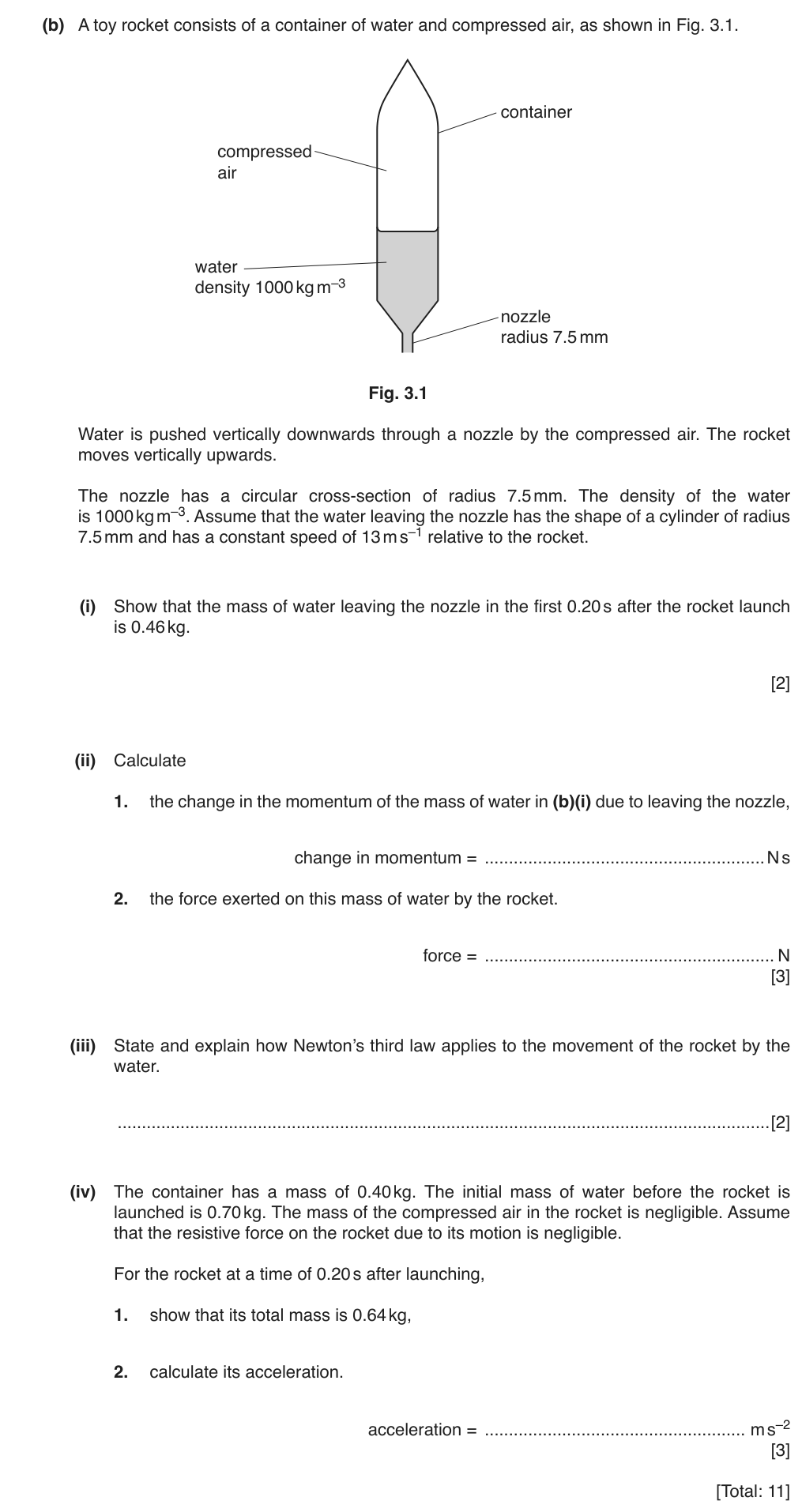
Why it is hard: four ideas in one question: mass of a jet, F = Δp/Δt for a fluid, the third-law pair, and F = ma for a body whose mass changes. The November 2018 report: many equated the force on the water to its weight, and many stated the third law without applying it.
A toy rocket squirts water down out of a narrow nozzle. Pushing the water down means the water pushes the rocket up (third law). We work out how much water leaves in 0.20 s, the force needed to give it that momentum, and then the rocket's acceleration with its new, lighter mass.
- radius 7.5 mmconvert to metres; the water leaves as a cylinder of area πr²
- relative to the rocketthe water's speed is 13 m s−1; in 0.20 s it forms a column 13 × 0.20 m long
- force on this water by the rocketF = Δp ÷ Δt for the water - NOT its weight
- State and explain how Newton's third law appliesname the pair: force on water by rocket, force on rocket by water
- at 0.20 suse the mass AT that instant: water has already left
- (i)show the mass of water = 0.46 kg
- (ii)1change in momentum of this water
- (ii)2force on the water
- (iii)third law, applied
- (iv)1show total mass = 0.64 kg
- (iv)2acceleration of the rocket
- r = 7.5 mm = 7.5 × 10⁻³ mnozzle
- v = 13 m s−1water
- ρ = 1000 kg m−3water
- Δt = 0.20 s
- 0.40 kgcontainer
- 0.70 kgwater at start
- the water starts at rest inside the rocket, so its Δp is simply (mass) × 13
- (i) Showm = 0.46 kg
- Usem = ρV, V = πr² × (length = 13 × 0.20)
- (ii) FindΔp and F on water
- UseΔp = Δm × v, then F = Δp ÷ Δt
- (iv)2 Finda of the rocket
- Usea = (thrust − weight) ÷ mass
- Thrust30 N up - third law partner of (ii)2
- Mass0.64 kg from (iv)1
- Trapdon't forget the weight 0.64 × 9.81
- Usea = (thrust − weight) ÷ mass
How long is the 'cylinder' of water that leaves in 0.20 s?
Distance = speed × time = 13 × 0.20 = 2.6 m. Its volume is πr² × 2.6.
Where does the upward force on the rocket come from?
The rocket pushes the water down with 30 N, so by Newton's third law the water pushes the rocket up with 30 N.
5 Now solve it have a go on paper first, then open the worked solution
- (i) ρ = m/V C1. In 0.20 s the water forms a cylinder of length 13 × 0.20 = 2.6 m: m = 1000 × π(7.5 × 10−3)² × 2.6 = 0.46 kg A1
- (ii)1 Δp = (Δm)v C1 = 0.46 × 13 = 6.0 N s A1
- (ii)2 F = 6.0 / 0.20 = 30 N (downwards on the water) A1
- (iii) "force on water (by rocket) equal to force on rocket (by water)" M1 "in the opposite direction" A1, so the rocket is pushed up with 30 N.
- (iv)1 0.40 + 0.70 − 0.46 = 0.64 kg A1
- (iv)2 a = (30 − 0.64 × 9.81) / 0.64 C1 = 37 m s−2 A1 Use the mass at that instant, and take the weight away from the thrust.
Thrust (30 N) is much bigger than the weight (6.3 N), so a large upward acceleration (37 m s−2) makes sense for a water rocket.
Example 6 · Average force from a curved p–t graph, state and explain (Paper 2, 4 marks) ★★★ Hard
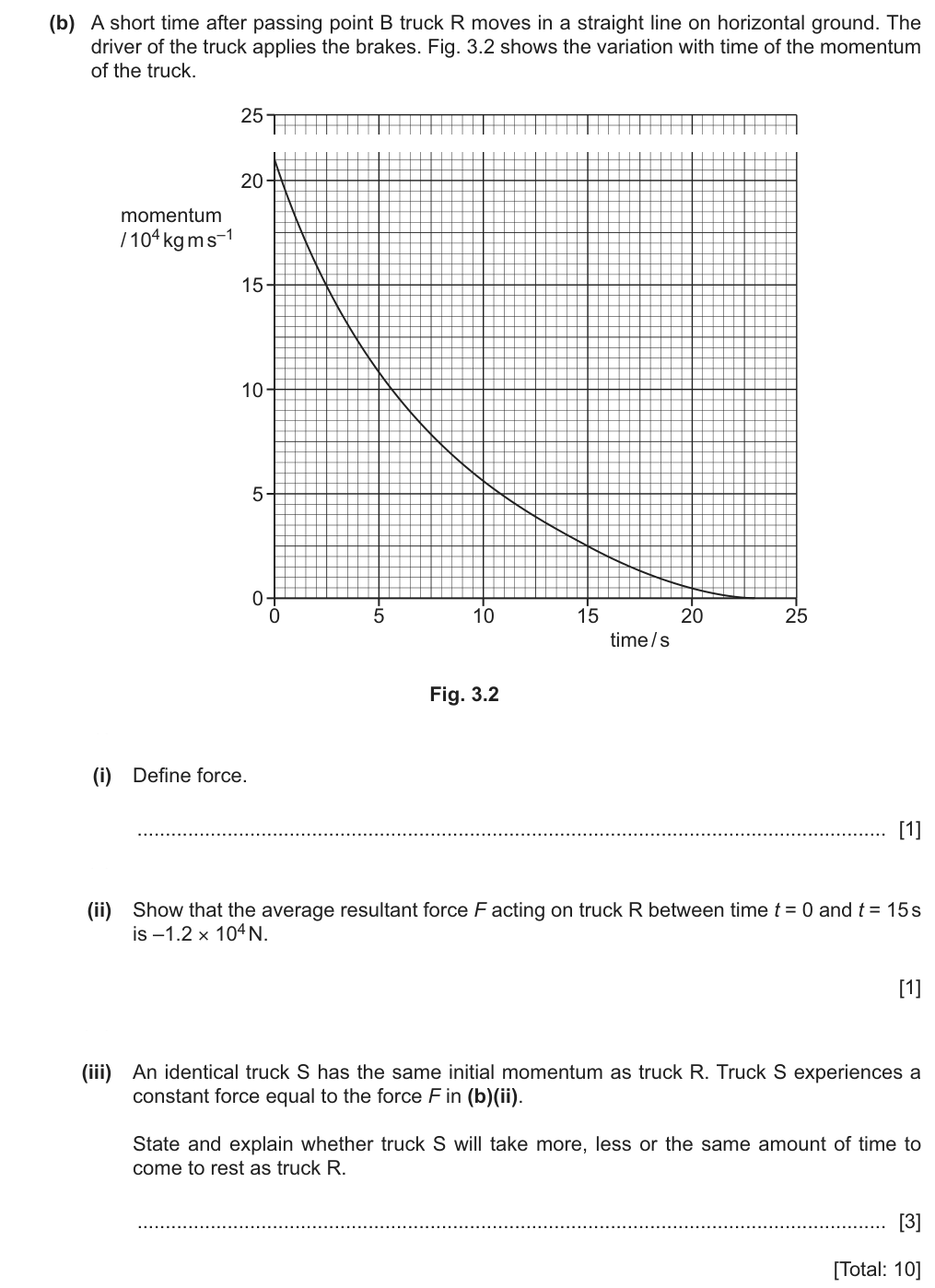
A braking truck's momentum falls along a curve and reaches zero after about 23 s. We define force, find the average force over the first 15 s, and then compare with a second truck that brakes with a CONSTANT force of that size.
- Define forcethe definition with momentum: rate of change of momentum
- average resultant force between 0 and 15 sΔp ÷ Δt using the two readings - not a tangent
- × 104keep the power of ten in every reading
- State and explain … more, less or the same timecompare average forces for the SAME total Δp
- (i)define force
- (ii)show average force = −1.2 × 10⁴ N
- (iii)does S stop sooner, later or at the same time?
- p = 21 × 104 N sat t = 0
- p = 2.5 × 10⁴ N sat t = 15 s
- p = 0at t ≈ 23 s (R)
- both trucks start with the same momentum and end at zero: the same total Δp
- (ii) Showaverage F = −1.2 × 10⁴ N
- Use(p₂ − p₁) ÷ (t₂ − t₁)
- (iii) Comparestopping times
- Usetime = Δp ÷ F (same Δp)
- R's average force21 × 104 ÷ 23 over its whole stop
- S's force1.2 × 104 N, constant
- Sobigger average force → stops sooner
- Usetime = Δp ÷ F (same Δp)
Why can't we compare the trucks just by looking at the first 15 s?
R's force changes - it is strongest at the start and weaker later. We must compare over the WHOLE stop.
If both lose the same momentum, what decides which stops first?
The average force. Time = Δp ÷ F, so a bigger average force means a shorter time.
5 Now solve it have a go on paper first, then open the worked solution
- (i) "rate of change of momentum" B1
- (ii) Average force = Δp / Δt = (2.5 × 10⁴ − 21 × 104) / 15 = −1.2 × 10⁴ N A1 Write the readings with their powers of ten: the March 2025 report says many dropped the 10⁴ or wrote 10⁻⁴.
- (iii) Both trucks lose the same change in momentum (21 × 104 N s to zero) B1
- R takes 23 s, so R's average force over the whole stop = 21 × 104 / 23 = 0.91 × 10⁴ N, less than S's 1.2 × 10⁴ N B1 (or: S takes 21 × 104 / 1.2 × 104 = 17.5 s)
- So S comes to rest in less time than R B1
The method for every "more, less or the same time?" question: same Δp, so time = Δp / F; the bigger average force stops it sooner.
S stops in 21 ÷ 1.2 ≈ 17.5 s, less than R's 23 s - consistent with S's force (1.2 × 10⁴ N) being bigger than R's average (0.91 × 10⁴ N).
Summary
- p = mv (vector, kg m s⁻¹ = N s). Force = rate of change of momentum: F = Δp / Δt; Δp = FΔt.
- Δp = final − initial, with signs: a rebound adds the speeds; at an angle, work in components or draw the vector triangle.
- p–t gradient = resultant force; F–t area = change in momentum.
- Bounce: Δp/Δt is the resultant; the floor's force = resultant + weight (ceiling: − weight).
- Streams: F = (mass per second) × (speed given); the third law gives the push on the machine.
| If you see… | do this |
|---|---|
| "rebounds", "bounces back" | Δp = m(u + v) using the two speeds |
| "contact time" / "in contact for" | F = Δp / contact time |
| "force exerted by the floor / ground" | resultant + weight (ceiling: resultant − weight) |
| momentum–time graph | gradient = resultant force; add friction to get the applied force |
| force–time graph | area = Δp (convert ms) |
| "kg per minute", nozzle radius, density | mass per second in kg s⁻¹, then F = (Δm/Δt) v |
Can I do this?
- I can define momentum and use p = mv as a vector.
- I can define force as rate of change of momentum and link it to F = ma.
- I can find a change in momentum for a stop, a rebound and a bounce at an angle.
- I can use the gradient of a p–t graph and the area under an F–t graph.
- I can find the force from the floor or ceiling during a bounce.
- I can find the force from a stream of fluid and use the third law with it.
Anything unticked: revise that section first. All ticked: take the quiz.
Quiz
Your progress on this note is saved when JavaScript is on.