
Physical quantities and units
SI units, prefixes and homogeneity
What you need to be able to do
- 1.2.1Recall the SI base quantities and their units: mass (kg), length (m), time (s), current (A), temperature (K).
- 1.2.2Express derived units as products or quotients of the base units (e.g. the newton is kg m s−2).
- 1.2.3Use base units to check whether an equation is homogeneous, and to find the units of an unknown constant.
- 1.2.4Recall and use the prefixes pico (p) to tera (T).
Before you start: Physical quantities and estimates, and index laws (\(x^a \times x^b = x^{a+b}\), \(1/x^a = x^{-a}\)). You will also use the definitions of force, work, power, pressure, charge and potential difference.
The SI base quantities
The SI system is built on a few base quantities. Every other quantity is defined from them. At AS Level you need five:
| Base quantity | Base unit | Symbol |
|---|---|---|
| mass | kilogram | kg |
| length | metre | m |
| time | second | s |
| (electric) current | ampere | A |
| (thermodynamic) temperature | kelvin | K |
Two more SI base quantities exist. Amount of substance (unit: mole, mol) appears later in the 9702 syllabus, in topic 15 (ideal gases). Luminous intensity (unit: candela, cd) is not in 9702 at all. Mark schemes have accepted both when a question asks for "other base quantities/units", but the five in the table are the safe answers.
Derived units in base units
A derived quantity is defined by an equation that links base quantities. Its unit follows from that equation. Substitute the base units of each quantity and simplify with the index laws.
| Quantity | Defining equation | Derived unit | In SI base units |
|---|---|---|---|
| velocity | \(v = \Delta s/\Delta t\) | m s−1 | m s−1 |
| acceleration | \(a = \Delta v/\Delta t\) | m s−2 | m s−2 |
| force | \(F = ma\) | N | kg m s−2 |
| momentum | \(p = mv\) | N s | kg m s−1 |
| work, energy | \(W = Fs\) | J (= N m) | kg m2 s−2 |
| power | \(P = W/t\) | W (= J s−1) | kg m2 s−3 |
| pressure, stress, Young modulus | \(p = F/A\) | Pa (= N m−2) | kg m−1 s−2 |
| density | \(\rho = m/V\) | kg m−3 | kg m−3 |
| frequency | \(f = 1/T\) | Hz | s−1 |
| charge | \(Q = It\) | C | A s |
| potential difference | \(V = W/Q\) | V | kg m2 s−3 A−1 |
| resistance | \(R = V/I\) | Ω | kg m2 s−3 A−2 |
| resistivity | \(\rho = RA/L\) | Ω m | kg m3 s−3 A−2 |
| electric field strength | \(E = F/Q\) | N C−1 | kg m s−3 A−1 |
| intensity | \(I = P/A\) | W m−2 | kg s−3 |
| specific heat capacity | \(c = E/(m\Delta\theta)\) | J kg−1 K−1 | m2 s−2 K−1 |
Pure numbers such as ½, 2, π and 4π have no units. So do ratios of two quantities with the same unit, such as strain, efficiency and refractive index.
You don't need to memorise the right-hand column. You need to be able to build any row from the definition in a few lines. Use the builder below to watch it happen.
Prefixes
A prefix multiplies a unit by a power of ten. Learn these ten (syllabus 1.2.4):
| Prefix | Symbol | Multiplier | Prefix | Symbol | Multiplier | |
|---|---|---|---|---|---|---|
| pico | p | \(10^{-12}\) | deci | d | \(10^{-1}\) | |
| nano | n | \(10^{-9}\) | kilo | k | \(10^{3}\) | |
| micro | μ | \(10^{-6}\) | mega | M | \(10^{6}\) | |
| milli | m | \(10^{-3}\) | giga | G | \(10^{9}\) | |
| centi | c | \(10^{-2}\) | tera | T | \(10^{12}\) |
Converting: replace the prefix with its power of ten. \(85\ \mu\text{m} = 85 \times 10^{-6}\ \text{m} = 8.5 \times 10^{-5}\ \text{m}\). Capitals matter: M (mega, \(10^{6}\)) and m (milli, \(10^{-3}\)) differ by a factor of \(10^{9}\).
How to convert any prefix to any other
| Symbol | Meaning |
|---|---|
| \(a\) | power of ten of the prefix you have (mm → −3) |
| \(b\) | power of ten of the prefix you want (m → 0, km → 3) |
| \(n\) | power on the unit: 1 for m, 2 for m², 3 for m³ |
- Swap the prefix for its power of ten. 450 mm = 450 × 10−3 m.
- If the unit is squared or cubed, raise that power of ten too. 2.5 cm³ = 2.5 × (10−2)³ m³ = 2.5 × 10⁻⁶ m³.
- Going to another prefix (not the plain SI unit)? Divide by the new prefix's power of ten, raised the same way. 3.2 GHz = 3.2 × 10⁹ Hz = 3.2 × 10⁹ ÷ 106 MHz = 3200 MHz.
- Sense check: a smaller prefix needs a bigger number (3.2 GHz = 3200 MHz), a bigger prefix a smaller number (450 mm = 0.45 m).
| Convert | a, b, n | Working | Answer |
|---|---|---|---|
| 450 mm → m | −3, 0, 1 | 450 × 101(−3−0) = 450 × 10−3 | 0.45 m |
| 2.5 cm³ → m³ | −2, 0, 3 | 2.5 × 10³(−2−0) = 2.5 × 10⁻⁶ | 2.5 × 10⁻⁶ m³ |
| 3.2 GHz → MHz | 9, 6, 1 | 3.2 × 101(9−6) = 3.2 × 10³ | 3200 MHz |
| 0.80 mm² → cm² | −3, −2, 2 | 0.80 × 10²(−3+2) = 0.80 × 10⁻² | 0.0080 cm² |
| 7.9 g cm−3 → kg m−3 | g → kg: 0, 3, 1; cm−3 → m−3: −2, 0, −3 | 7.9 × 10−3 × 106 | 7900 kg m−3 |
Now try it: pick a value, a prefix and the power on the unit, and the converter shows each step.
Prefix converter
Teaching point: changing prefix multiplies by a power of ten, and for m² or m³ that power is doubled or tripled.
- p10⁻¹²
- n10⁻⁹
- μ10⁻⁶
- m10⁻³
- c10⁻²
- d10⁻¹
- 110⁰
- k10³
- M10⁶
- G10⁹
- T10¹²
Turn on JavaScript to convert values between prefixes, including mm², cm³ and so on.
Homogeneity of equations
Check \(s = ut + \tfrac12 at^2\): \(s\) is m; \(ut\) is m s−1 × s = m; \(at^2\) is m s−2 × s² = m. Every term is in metres, so the equation is homogeneous. (The ½ has no units and plays no part.)
- If an equation is not homogeneous, it is definitely wrong.
- If it is homogeneous, it may be correct, but it can still be wrong. \(s = ut + at^2\) is homogeneous but wrong: the ½ is missing, and pure numbers have no units, so a units check can never find them.
- Terms that are added or subtracted must have the same units. That is why \((p_2 - p_1)\) has the units of pressure.
Three exam uses
- Find the base units of a constant: rearrange to make the constant the subject, then substitute units. This is the most common Paper 2 task in this chapter.
- Show that a constant has no units: the units must cancel completely.
- Find an unknown power: match the power of each base unit on both sides (e.g. \(\rho = Mr^n/(kL)\) gives \(n = -2\), 9702/21/O/N/21 Q1(c)(i)).
Methods: finding the base units of a constant
One real question, three ways. The examiner reports keep praising answers that set the work out as "discrete steps".
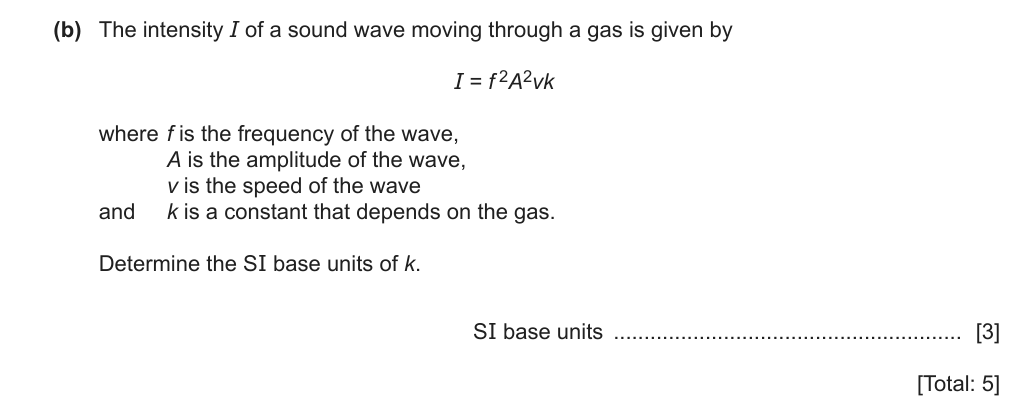
Whatever the method, start by listing the units of every symbol. Intensity is power per unit area: \(I\): kg m² s−3 ÷ m² = kg s−3. \(f\): s−1. \(A\) (an amplitude, a length): m. \(v\): m s−1.
Method A: rearrange, then substitute
\[ k = \frac{I}{f^2A^2v} \;\Rightarrow\; \frac{\text{kg s}^{-3}}{(\text{s}^{-1})^2\,(\text{m})^2\,(\text{m s}^{-1})} = \frac{\text{kg s}^{-3}}{\text{m}^3\,\text{s}^{-3}} = \text{kg m}^{-3} \]
Best when the constant is easy to isolate. This is the mark scheme's route: C1 (units of \(I\)) + C1 (units of \(f\), \(A\), \(v\)) + A1 (kg m−3).
Method B: substitute, then solve for [k]
Write \([k]\) for "the units of \(k\)" and put units straight into the original equation:
\[ \text{kg s}^{-3} = (\text{s}^{-1})^2 (\text{m})^2 (\text{m s}^{-1})\,[k] = \text{m}^3\,\text{s}^{-3}\,[k] \;\Rightarrow\; [k] = \text{kg m}^{-3} \]
Best when rearranging is messy (roots, constants inside brackets). You never have to move a square root around.
Method C: power-bookkeeping table
Track the power of each base unit. For \(k = I f^{-2} A^{-2} v^{-1}\), subtract the powers of \(f^2\), \(A^2\) and \(v\) from the powers of \(I\):
| base unit | \(I\) | \(f^2\) | \(A^2\) | \(v\) | \(k = I - f^2 - A^2 - v\) |
|---|---|---|---|---|---|
| kg | 1 | 0 | 0 | 0 | 1 |
| m | 0 | 0 | 2 | 1 | −3 |
| s | −3 | −2 | 0 | −1 | 0 |
Best when there are many quantities, or you keep slipping with negative powers. It is a good way to check A or B.
All three give kg m−3, the units of density. That makes sense: \(k\) "depends on the gas".
Mark-scheme focus
Base quantity or base unit?
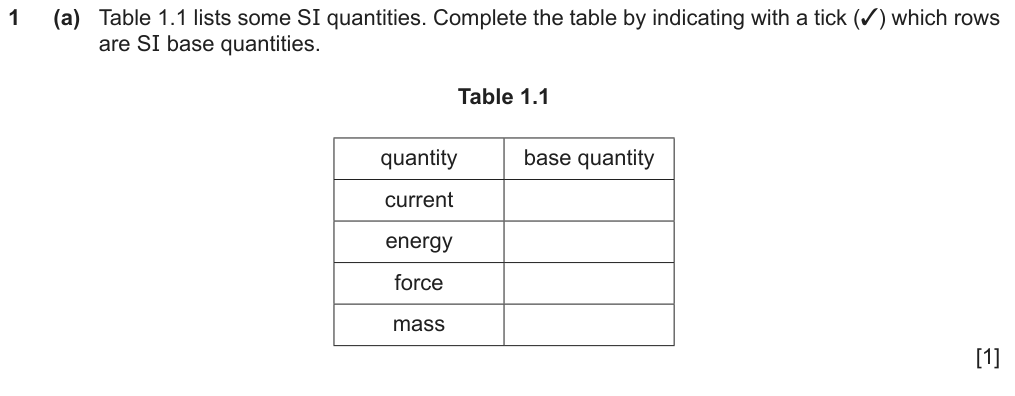
Asked for base quantities: "time", "(electric) current", "temperature".
Asked for base units: "kilogram / kg", "kelvin / K", "ampere".
Units when quantities were asked for (or the reverse); "charge" or "coulomb"; "newton", "joule", "volt", "ohm"; "degree Celsius"; "gram".
Charge (\(Q = It\)) and the newton are derived. The examiner reports for November 2018 and March 2020 note candidates giving base units instead of the requested quantities. March 2019 says it was "inappropriate to give both". Most-missed in recent lists: coulomb (November 2021, March 2023), degree Celsius (June 2022), charge (November 2023).
"amount of substance / mole" and "luminous intensity / candela" when "other base quantities/units" are asked (9702/22/F/M/20 and 9702/22/F/M/19 mark schemes).
From: 9702/22/F/M/24 Q1(a), 9702/22/M/J/24 Q1(a), 9702/22/F/M/23 Q1(a), 9702/22/M/J/22 Q1(a), 9702/21/O/N/22 Q1(a) and examiner reports.
The base units of charge
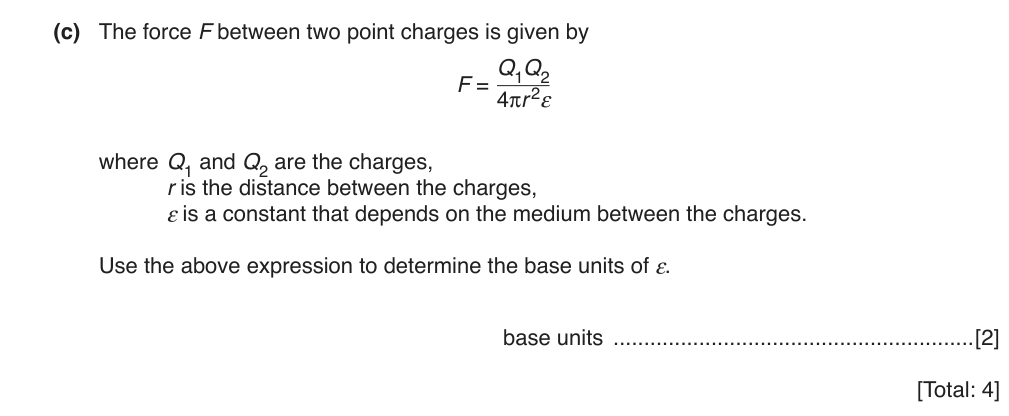
A s (from \(Q = It\))
"C" (a derived unit, not base units); "A s−1" (that would be charge ÷ time)
Charge = current × time, so its units multiply: A × s. This slip appears in the examiner reports for June 2018, March 2019, June 2019 and November 2019, and usually costs both the C1 and the A1.
"A s" written as "s A".
From: 9702/22/M/J/18 Q1(c), 9702/22/F/M/19 Q1(b), 9702/22/O/N/19 Q1(b) and examiner reports.
"Determine the SI base units of…"

An answer made only of kg, m, s, A, K with powers, e.g. kg m−1 s−2.
N m−2, J s−1, Pa, W, Hz, °C: any named derived unit, or a temperature in °C
These are SI units, but not base units. The examiner reports for June 2017, March 2022 and November 2022 all name "leaving the newton" in the answer. Thermodynamic temperature is in K; frequency is s−1, not Hz (June 2023).
The base units in any order (kg s−3 K−4 or K−4 kg s−3), and negative powers written as fractions, e.g. kg / m³ (9702/23/O/N/13 mark scheme).
From: 9702/21/M/J/17 Q1(a), 9702/22/F/M/22 Q1(a), 9702/22/O/N/22 Q1(b), 9702/23/O/N/17 Q1(b)(i) and examiner reports.
"Show that the SI base units of power are kg m² s⁻³"

A correct equation for the quantity and the base units substituted: "P = W/t: kg m² s⁻² / s = kg m² s⁻³"
Writing the equation and then just the given answer; using an equation that isn't about power
The answer is given, so the mark is for the working. The June 2023 report notes candidates who "stated the appropriate symbol equation for power, but did not substitute the base units".
Any correct route: \(P = Fs/t\), \(P = Fv\), \(P = \tfrac12mv^2/t\), \(P = VI\) (9702/23/O/N/17 Q1(a)(ii) mark scheme).
A difference has the units of what it is a difference of
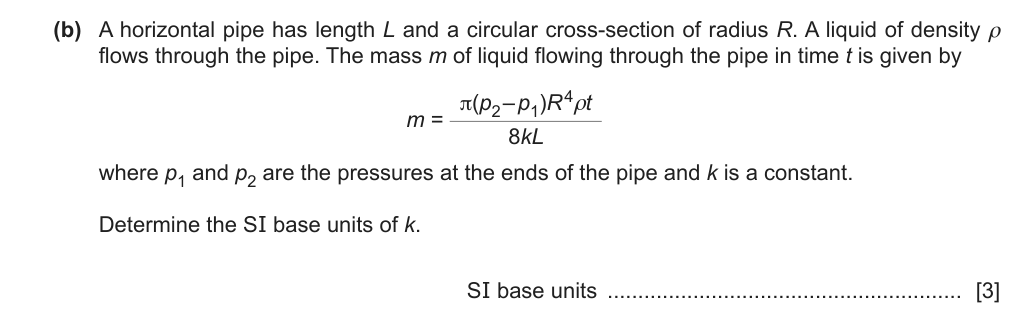
\((p_2 - p_1)\): kg m⁻¹ s⁻² (the units of pressure)
Treating \((p_2 - p_1)\) or \((T_1 - T_2)\) as having no units
You can only subtract like from like, so a difference of two pressures is a pressure. The June 2023 examiner report names this exact mistake.
For temperature differences, K for each of \(T_1\) and \(T_2\) (9702/23/O/N/21 Q2(c): "T₁: K and T₂: K").
How the marks are given
| Question type | Typical marks | Where the marks go |
|---|---|---|
| Name / tick / underline base quantities or units | 1–2 | B1 each, or one mark for "all correct and no others" |
| Show that a quantity has base units … | 1–2 | (C1 correct equation) + A1 substitution shown |
| Determine the base units of a constant | 2–3 | C1 units of the given quantities, C1 correct substitution / rearrangement, A1 final base units |
| Show that a constant has no units / find a power | 2–3 | M1 units of each term, A1 cancelling / matching powers |
| Prefix table or conversion | 1–2 | B1 each entry |
Command words
| Command word | What it wants here |
|---|---|
| State | "State two SI base units other than kg, m, s" → ampere, kelvin |
| Determine | Work it out with the steps shown: "Determine the SI base units of k" → list units, rearrange, simplify |
| Show that | The answer is given, so every step must be visible: equation → substitution → result |
| Use … to | You must use the thing named: "Use the definition of power" means start from \(P = W/t\), not some other formula |
- Base units of a constant in a given equation: in many Paper 2 Question 1s since 2014, 2–3 marks, and often in Paper 1 (about 40 items in 2010–2025).
- Base units of a named quantity (power, pressure, energy, stress, p.d., resistance, resistivity, field strength): about 45 items, usually as the lead-in to the constant question.
- Identify base quantities or units in a list: about 35 items, almost every year.
- Prefixes: about 20 items, mostly Paper 1 conversions, sometimes a Paper 2 prefix table (2 marks).
Worked examples
Example 1 · Base quantities, power and a cm² conversion (Paper 2, 6 marks)
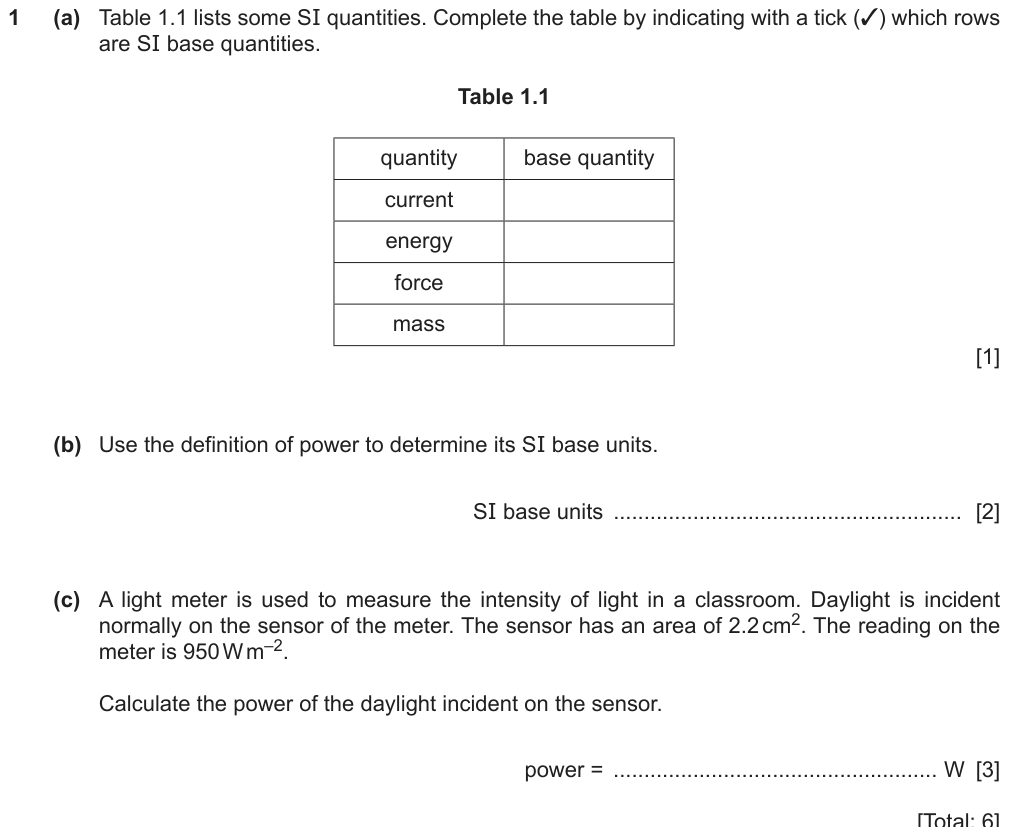
Three short jobs: spot the SI base quantities in a list; build the base units of power from its definition; and use a light meter reading (power per square metre) on a small sensor to find the power that lands on it.
- SI base quantitiesonly five here: mass, length, time, current, temperature (and amount of substance)
- Use the definition of powerstart from P = work done ÷ time, then break J into base units
- 950 W m−2intensity = power per unit area
- 2.2 cm²convert to m²: × (10−2)² = × 10−4
- (a)tick the base quantities
- (b)base units of power
- (c)power on the sensor
- I = 950 W m−2meter reading
- A = 2.2 cm² = 2.2 × 10⁻⁴ m²sensor
- (b) Findunits of power
- UseP = W ÷ t
- Units of Jfrom W = Fs: kg m s−2 × m
- UseP = W ÷ t
- (c) FindP
- UseP = I × A
- Trapcm² → m² squares the prefix: 10−4
- UseP = I × A
Energy and force are in the list. Are they base quantities?
No - they are derived (J and N are built from kg, m and s). Only current and mass are base quantities here.
Why does 1 cm² equal 10−4 m², not 10−2 m²?
1 cm² is 1 cm × 1 cm = 10−2 m × 10−2 m. The prefix is squared along with the unit.
5 Now solve it have a go on paper first, then open the worked solution
- (a) Tick current and mass only. A1 Energy and force are derived (J, N).
- (b) Power = work done / time, so the units are J s−1. C1 Start from the definition, as the question tells you to.
- J = kg m² s−2 (from \(W = Fs\)), so power = kg m² s−2 / s = kg m² s−3. A1
- (c) power = intensity × area. C1
- Area: \(2.2\ \text{cm}^2 = 2.2 \times (10^{-2})^2 = 2.2 \times 10^{-4}\ \text{m}^2\). So power = \(950 \times 2.2\times10^{-4}\). C1 Square the centi: \(10^{-4}\), not \(10^{-2}\).
- = 0.209 W ≈ 0.21 W. A1 2 s.f., matching the data (2.2 cm²).
(a) current ✓, mass ✓ (b) P = W/t → kg m² s⁻² / s = kg m² s⁻³ (c) P = IA = 950 × 2.2 × 10⁻⁴ = 0.21 W
A 2 cm² sensor is tiny, so a fraction of a watt is sensible. Using \(10^{-2}\) would give 21 W, enough to power a lamp from a fingernail-sized patch of daylight.
Example 2 · Pressure, then a constant with a pressure difference in it (Paper 2, 5 marks)
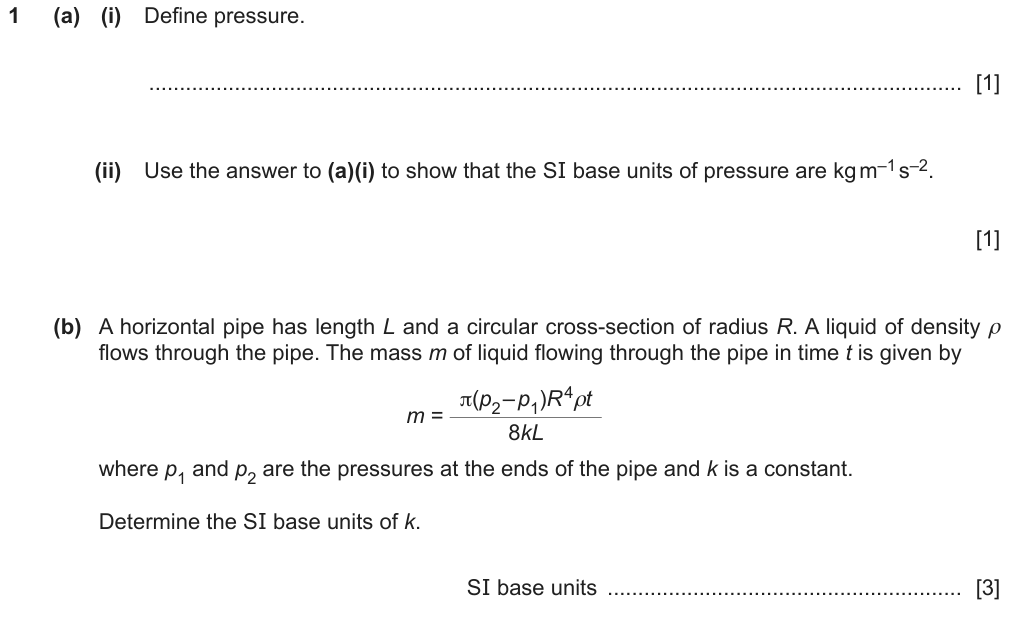
Define pressure and turn its definition into base units. Then a long formula for liquid flowing through a pipe contains an unknown constant k. Every other symbol has known units, so we can make k the subject and work out its units.
- Define pressureforce per unit area (normal to the force)
- Use the answer to (a)(i)p = F ÷ A, then kg m s−2 ÷ m²
- π, 8pure numbers - no units
- (p₂ − p₁)a difference of pressures is still a pressure
- (a)(i)define pressure
- (a)(ii)show base units kg m−1 s−2
- (b)base units of k
- m: kg, t: s
- R, L: m
- ρ: kg m−3
- p: kg m−1 s−2from (a)
- (b) Find[k]
- Step 1make k the subject: k = π(p₂ − p₁)R⁴ρt ÷ 8mL
- Step 2replace each symbol by its units; drop π and 8
- Step 3add the powers of kg, m and s separately
- Step 1make k the subject: k = π(p₂ − p₁)R⁴ρt ÷ 8mL
Why rearrange for k before putting units in?
So the units of k come out directly, with nothing left to divide across. It also keeps the signs of the powers clear.
What happens to the R⁴?
R is in m, so R⁴ is m⁴ - the power multiplies.
5 Now solve it have a go on paper first, then open the worked solution
- (a)(i) Pressure is force per unit area (normal to the force). B1
- (a)(ii) \(p = F/A\): kg m s−2 / m² = kg m−1 s−2. A1
- (b) Units: \(R\): m, \(L\): m, \(t\): s, \(m\): kg C1 and \(\rho\): kg m−3. C1 \(\rho = m/V\) gives kg m−3.
- Rearrange: \(k = \dfrac{\pi(p_2 - p_1)R^4\rho t}{8mL}\), so \([k] = \dfrac{(\text{kg m}^{-1}\text{s}^{-2})(\text{m}^4)(\text{kg m}^{-3})(\text{s})}{(\text{kg})(\text{m})}\).
- Collect powers: kg: 1 + 1 − 1 = 1; m: −1 + 4 − 3 − 1 = −1; s: −2 + 1 = −1. So kg m−1 s−1. A1
(b) R, L: m; t: s; ρ: kg m⁻³; (p₂ − p₁): kg m⁻¹ s⁻²
k = (kg m⁻¹ s⁻² × m⁴ × kg m⁻³ × s) / (kg × m) = kg m⁻¹ s⁻¹
Method C (the power table) catches sign slips: put kg, m and s in rows and the quantities in columns.
kg m−1 s−1 is the unit of viscosity (Pa s), which makes sense for flow along a pipe. You won't be asked that, but it is reassuring.
Example 3 · A hard one: the base units of C in \(E = Q^2/2C\) (Paper 2, 4 marks)
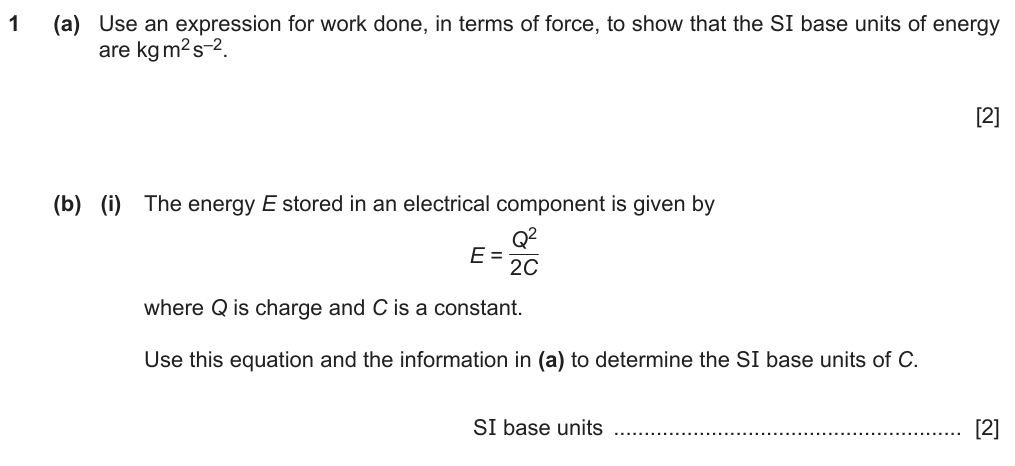
Show the base units of energy from work = force × distance. Then an equation for energy stored in a component contains a charge Q and a constant C. Make C the subject and use base units for everything - including charge, which is A s.
- Use an expression for work doneW = F × s - start there
- Q is chargeQ = It, so its base units are A s (not 'C')
- determine the SI base units of Crearrange for C, then substitute units
- (a)show energy is kg m² s−2
- (b)(i)base units of C
- E: kg m² s−2from (a)
- Q: A sQ = It
- 2a number - no units
- (b)(i) Find[C]
- UseC = Q² ÷ 2E
- Q²(A s)² = A² s²
- Ekg m² s−2 from (a)
- Trapdividing by s−2 multiplies by s²: s² × s² = s⁴
- UseC = Q² ÷ 2E
What are the base units of charge?
Charge = current × time, so A s. The coulomb is a derived unit, not a base unit.
How do you divide by kg m² s−2?
Flip every power: kg−1 m−2 s+2, then multiply.
5 Now solve it have a go on paper first, then open the worked solution
- (a) work = force × displacement. C1
- Units: kg m s−2 × m = kg m² s−2. A1
- (b)(i) Units of \(Q\): A s. C1 \(Q = It\). Not C, not A s−1.
- \(C = \dfrac{Q^2}{2E}\) → \(\dfrac{(\text{A s})^2}{\text{kg m}^2\text{s}^{-2}} = \text{A}^2\,\text{s}^2 \times \text{kg}^{-1}\,\text{m}^{-2}\,\text{s}^{2} = \textbf{kg}^{-1}\,\textbf{m}^{-2}\,\textbf{s}^{4}\,\textbf{A}^{2}\). A1 Dividing by s−2 is multiplying by s+2, so s² × s² = s⁴.
Q: A s C = Q²/2E → (A s)² / (kg m² s⁻²) = kg⁻¹ m⁻² s⁴ A²
Method B: kg m² s⁻² = (A² s²) / [C], so [C] = A² s² / (kg m² s⁻²) = kg⁻¹ m⁻² s⁴ A². Same answer.
This is the farad (capacitance), which you meet in A Level topic 19. Its base units really are kg⁻¹ m⁻² s⁴ A².
Example 4 · A prefix table and base units (Paper 2, 3 marks)
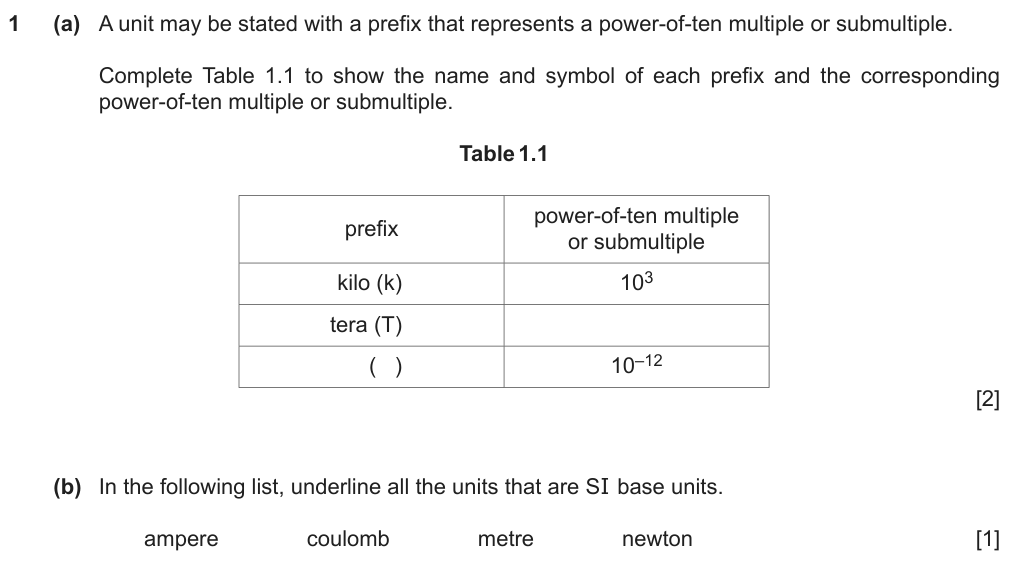
Recall: fill in a prefix table (tera, and the prefix for 10−12), then pick out which units in a list are SI base units.
- prefixa power-of-ten multiplier written in front of a unit
- underline all the units that are SI base unitsunderline every base unit - and nothing else
- (a)tera's power, and the name + symbol for 10−12
- (b)the base units in the list
- kilo = 10³given as an example
- ampere, coulomb, metre, newtonlist
- (a) Recallprefixes
- LearnT = 10¹², p (pico) = 10−12
- (b) Decidebase units
- Testis it one of kg, m, s, A, K, mol?
- Trapcoulomb (A s) and newton (kg m s−2) are derived
- Testis it one of kg, m, s, A, K, mol?
Is the coulomb a base unit? It's the unit of charge.
No. Charge is current × time, so the coulomb is A s - derived from the ampere and the second.
What happens if you underline one unit too many?
You lose the mark. 'All the units that are base units' means exactly the right set.
5 Now solve it have a go on paper first, then open the worked solution
- tera (T) → 1012. B1
- 10−12 → pico (p). B1 The examiner report notes weaker candidates misspelt "pico".
- (b) Underline ampere and metre only. B1 Coulomb (A s) and newton (kg m s−2) are derived. One extra underline loses the mark.
10¹² pico, p ampere, metre
Two underlines (ampere and metre) - both appear in the list of base units; the other two can each be written in base units, so they can't be base units themselves.
Example 5 · Homogeneity to find a power (Paper 2, 2 marks)
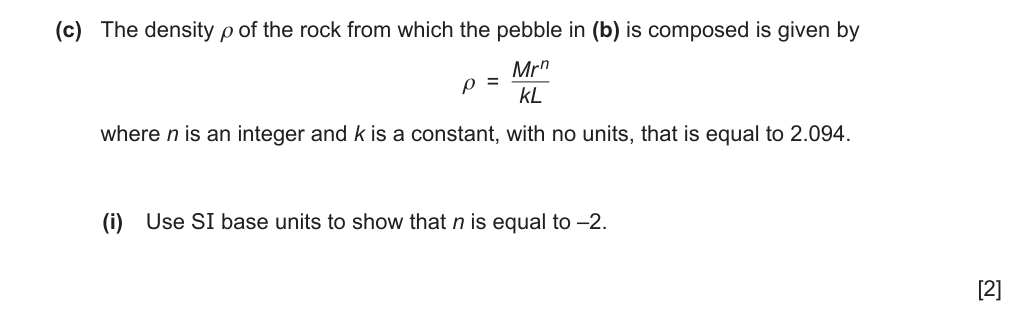
A formula for a rock's density has an unknown power n on a length. The two sides of a correct equation must have the same units, so matching the powers of metres gives n.
- Use SI base unitsreplace every symbol by its base units
- k … with no unitsit drops out of the units check
- show that n = −2set up the units equation and solve for n
- show n = −2
- ρ: kg m−3
- M: kg
- r, L: m
- k: no units
- Shown = −2
- Useunits on the left = units on the right
- Leftkg m−3
- Rightkg × mⁿ ÷ m = kg mn−1
- Thenmatch the powers of m: −3 = n − 1
- Useunits on the left = units on the right
Why can we compare the powers of m on each side?
A correct physics equation is homogeneous: the units on both sides must be identical, power by power.
Do the kg powers also have to match?
Yes - and they do (1 on each side). If they didn't, the formula would be wrong whatever n is.
5 Now solve it have a go on paper first, then open the worked solution
- Substitute units: kg m−3 = kg × mn / m (= kg mn−1). M1
- Match the powers of m: −3 = n − 1, so n = −2. A1
kg m⁻³ = kg × mⁿ × m⁻¹ → −3 = n − 1 → n = −2
Check the kg powers match too (1 = 1). They must, or the equation couldn't be right whatever \(n\) is.
Summary
- Five AS base units: kg, m, s, A, K. Know which word is a quantity and which is a unit.
- Derived units come from defining equations. Build them; don't memorise them.
- Prefixes: p n μ m c d | k M G T. Square or cube the prefix along with the unit.
- Homogeneous = every term has the same base units. Not homogeneous means wrong; homogeneous means only possibly right.
| If you see… | Do this |
|---|---|
| "Determine the SI base units of k" | List every symbol's base units → rearrange for k → substitute → collect powers. |
| Charge Q in the equation | Write A s. |
| Temperature T or (T₁ − T₂) | K (for each term), never °C. |
| A difference (p₂ − p₁) | It has the units of p. |
| "Show that … has no units" | Substitute everything and show every unit cancelling. |
| mm², cm², cm³ in the data | ×10⁻⁶, ×10⁻⁴, ×10⁻⁶ to get m², m², m³. |
| "Which is an SI base quantity/unit?" | Is it in the list of five (as a quantity or as a unit, whichever was asked)? |
Can I do this?
- I can list the five AS base quantities and their units.
- I give base quantities when asked for quantities and base units when asked for units.
- I can derive the base units of force, energy, power, pressure, charge, p.d., resistance and resistivity.
- I always write charge as A s, temperature in K and frequency as s⁻¹.
- My base-unit answers never contain N, J, W, Pa, C, V or Ω.
- I can find the base units of a constant in a given equation, showing each step.
- I can check whether an equation is homogeneous and use it to find an unknown power.
- I can explain why a homogeneous equation can still be wrong.
- I can recall all ten prefixes from pico to tera.
- I can convert squared and cubed units (mm² → m², cm³ → m³).
Quiz
The multiple-choice and guided questions need JavaScript. The concept checks and exam practice below work without it.
Concept checks
Why can't a units check tell you whether a formula should have 2π in it?
2π is a pure number with no units, so it vanishes from any units check. \(T = \sqrt{m/k}\) and \(T = 2\pi\sqrt{m/k}\) are equally homogeneous. Only one is right.
The kilogram already has a prefix. Why is it the base unit and not the gram?
That is how the SI system was set up: mass is defined in kilograms. So in base units, mass is always kg, and grams must be converted (÷ 1000) before you substitute.
Is \(v^2 = u^2 + as\) homogeneous? Is it correct?
Homogeneous: every term is m² s−2 (as: m s−2 × m). But it is wrong: the correct equation is \(v^2 = u^2 + 2as\). The March 2025 examiner report notes candidates using exactly this wrong version and losing the factor 2.
Why does \(I = f^2A^2vk\) tell you \(k\) has the units of a density?
Working out the units gives kg m−3. Units are a clue to meaning: a constant "that depends on the gas" turning out to have density units suggests \(k\) is (proportional to) the gas's density.
Exam-style practice
Answers and mark scheme
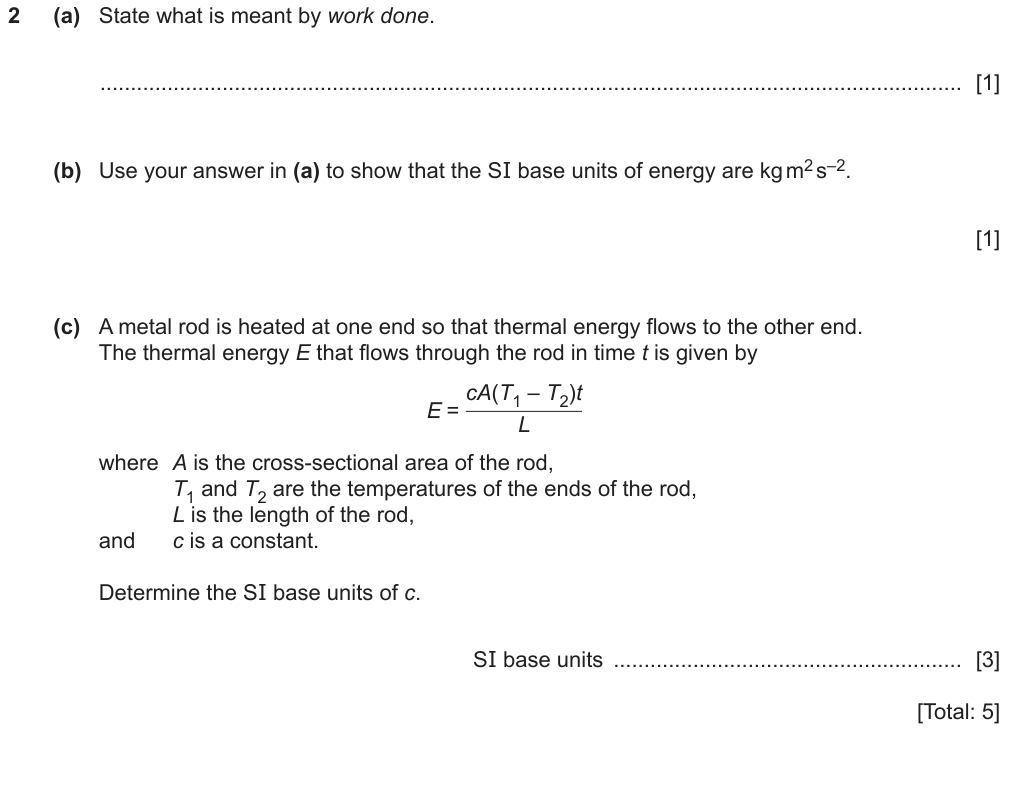
- (a) force × displacement in the direction of the force B1
- (b) kg m s−2 × m = kg m² s−2 A1
- (c) T₁: K and T₂: K C1; A: m², t: s and L: m C1; c = EL / (A(T₁ − T₂)t) = (kg m² s⁻² × m) / (m² × K × s) = kg m s−3 K−1 A1
Answers and mark scheme
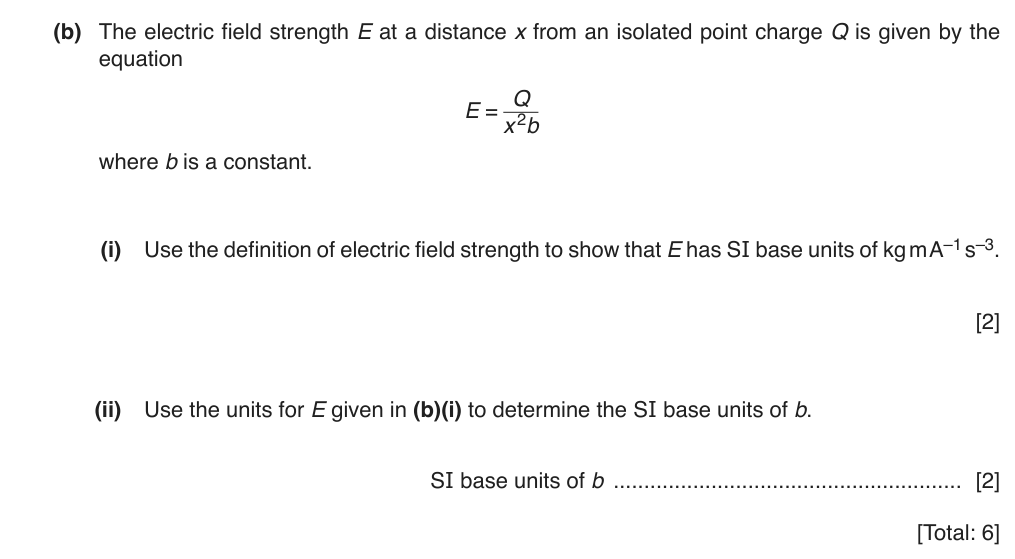
- (i) E = F/Q C1; = kg m s−2 / A s = kg m A−1 s−3 A1
- (ii) b = Q / (x²E) = A s / (m² × kg m A−1 s−3) C1 = A² s⁴ kg−1 m−3 A1
The examiner report: "The most common mistakes were incorrectly transposing the given equation and assuming that the base units of charge are A s−1 (instead of A s)."
Your progress on this note is saved when JavaScript is on.