
Kinematics
Measuring the acceleration of free fall, g
What you need to be able to do
- 2.1.8Describe an experiment to determine the acceleration of free fall using a falling object.
Before you start: Equations of motion (s = ut + ½at²) and Errors and uncertainties. This page covers the experiment the way Papers 1 and 2 ask about it. Next: Projectiles.
The experiment: drop a ball and time it
- Set up: an electromagnet holds a small steel ball above a trapdoor. Opening a switch releases the ball and starts an electronic timer; the ball hitting the trapdoor stops it. So the ball starts from rest (u = 0) and the time t is measured without reaction time.
- Measure the height h the ball actually falls: from the bottom of the ball to the trapdoor, with a metre rule (use a set square to read it level).
- Measure the time t. Repeat 3 times for this height and take the mean.
- Change the height and repeat, for at least 5 heights over as large a range as possible (e.g. 0.20 m to 1.00 m).
- Plot h against t² and draw the line of best fit. Since \(h = \tfrac12 g t^2\), the line is straight and g = 2 × gradient.
One drop
\[ g = \frac{2h}{t^2} \]
From \(h = ut + \tfrac12gt^2\) with u = 0 (9702/13/O/N/14 Q6: answer D).
Graph of h against t²
\[ h = \left(\tfrac12 g\right) t^2 \;\Rightarrow\; g = 2 \times \text{gradient} \]
A straight line through the origin (9702/13/M/J/21 Q7: a = 2G).
Uncertainty in g
\[ \%g = \%h + 2 \times \%t \]
The time is squared, so its % counts twice. Mass is not needed at all.
Light gates are the other common timer: two gates a measured distance apart, or a card of known length falling through one gate. The ball is already moving at the first gate, so u is not zero there: use \(s = ut + \tfrac12gt^2\) with both terms 9702/11/O/N/15 Q7.
Errors and how to spot them
| Error | Type | Effect on g | How to deal with it |
|---|---|---|---|
| h measured from the electromagnet (top of the ball), not the bottom of the ball | systematic | h too big → g too big | subtract the diameter, or plot a graph: the intercept shows it 9702/11/O/N/23 Q3, 9702/23/O/N/10 Q4 |
| timer starts before the ball lets go (the magnet takes time to release it) | systematic | t too big → g too small | graph: the points shift to the right and the line misses the origin; start the timer with the release (same switch) |
| air resistance | systematic | the ball accelerates less than g → g too small | use a small, dense ball and short drops |
| scatter in the timer readings, reading h | random | values spread either side | repeat and average; use bigger heights so % uncertainties are smaller |
Try it: find g from a graph
Drop, time, plot
Teaching point: plotting d against t² gives a straight line with gradient g/2. A systematic error in d moves the line off the origin but leaves the gradient the same, so the graph still gives g.
Turn on JavaScript to drop the ball yourself and add systematic errors.
Describing the experiment for marks
Describe an experiment to determine the acceleration of free fall g using a falling object. Include the measurements you would take and how you would use them to find g.
• Steel ball held by an electromagnet; switching it off releases the ball from rest and starts an electronic timer; the ball hits a trapdoor which stops the timer.
• Measure the height h fallen (bottom of the ball to the trapdoor) with a metre rule, and the time t on the timer.
• Repeat for the same h and average t; repeat for several different h.
• Plot h against t²; the gradient is g/2, so g = 2 × gradient (or g = 2h/t² for each height).
• A small dense ball keeps air resistance negligible.
This model answer is written in past-paper style: recent Paper 2s ask about the experiment through data and graphs (as in the examples below) rather than for a full description, but the syllabus says "describe", so be ready for it.
Mark-scheme focus
Why the graph has a non-zero intercept
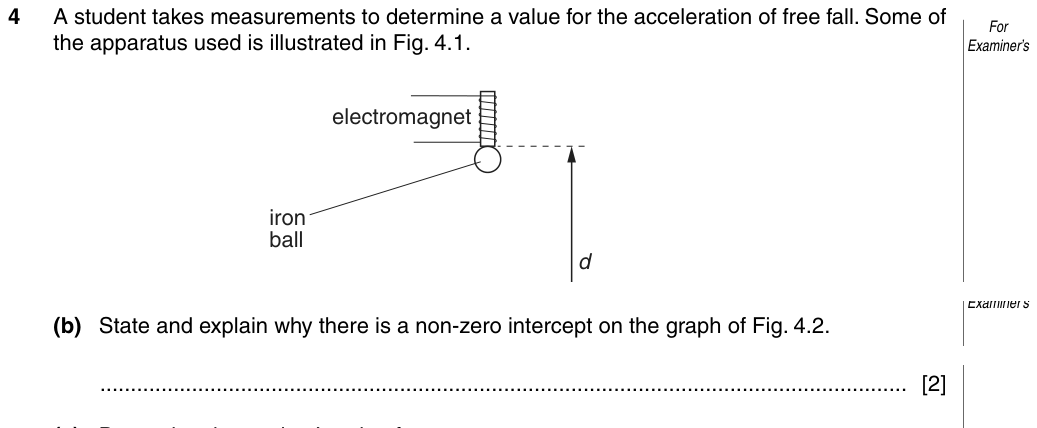
- "the distance fallen is not d" C1
- "d is the distance fallen plus the diameter of the ball" A1
- "d is not measured to the bottom of the ball" scores both marks
- "reaction time" (an electronic timer has none)
- "air resistance" (that changes the gradient, not the intercept)
- "random error"
An intercept means every reading of d is off by the same amount: a systematic error. The ball falls only from its bottom edge to the bench, which is d minus one diameter.
The intercept on the d axis is the size of that error: here the diameter, about 1.5 cm (the scheme allowed 1.5 ± 0.5 cm).
From: 9702/23/O/N/10 Q4(b) and (c)(i) mark scheme.
- Paper 1: g from a graph (gradient × 2), percentage uncertainty in g (%h + 2%t), which error makes g too large, which measurement is not needed (mass).
- Paper 2: read the gradient and intercept of an h–t² graph, explain the intercept, describe the method.
Worked examples
Example 1 · Gradient, intercept and g from a real graph (Paper 2, 7 marks) ★★★ Hard
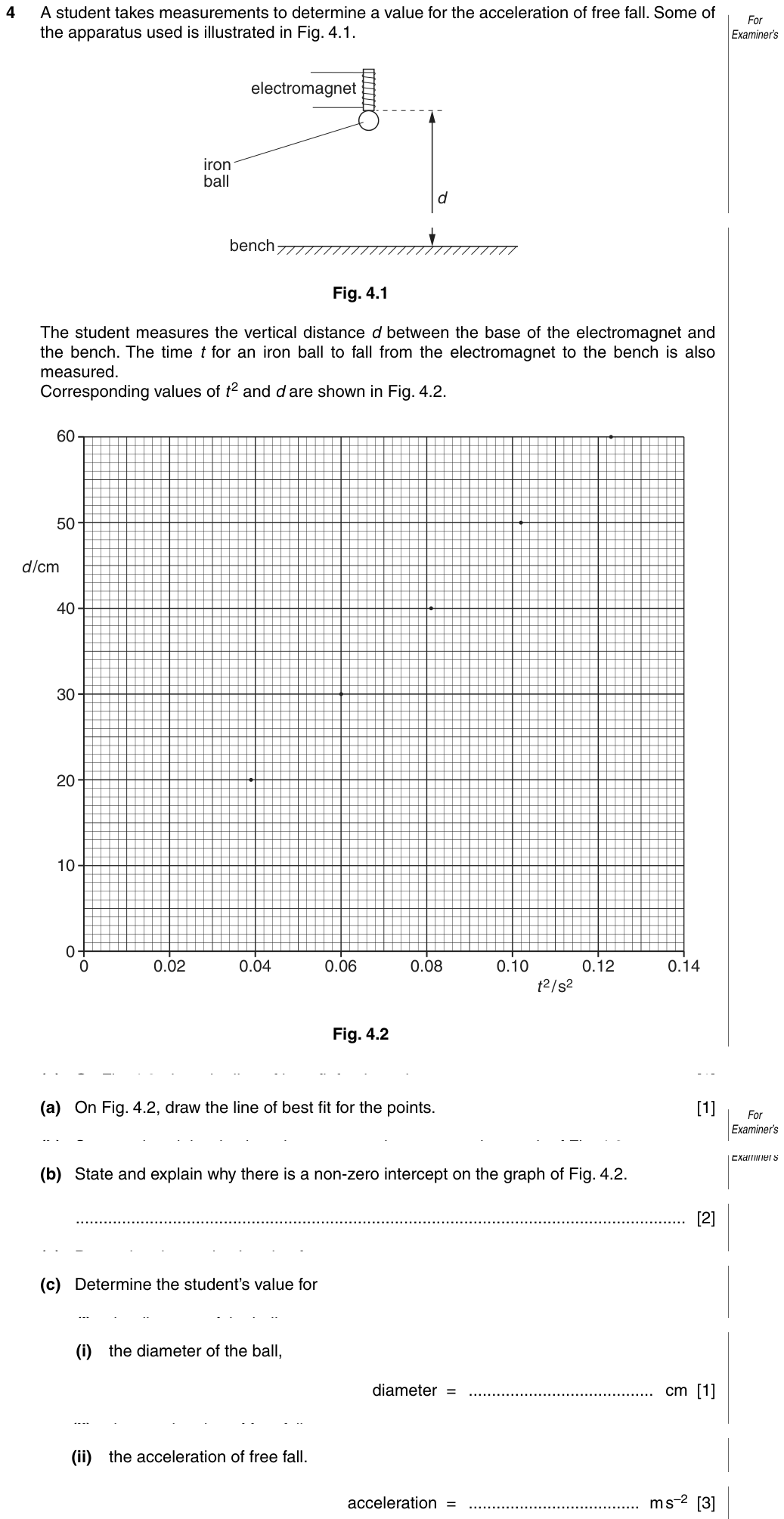
A student drops an iron ball from an electromagnet and times the fall for several heights d. Plotting d against t² gives a straight line that does NOT pass through the origin. We explain why, read the ball's size off the graph, and get g from the gradient.
- line of best fita ruled straight line through the trend, extended to the axis
- non-zero interceptd is not exactly the distance fallen - something is added every time
- diameter of the ballthat 'something': read it as the intercept
- acceleration of free fallcompare d = ½gt² + c with y = mx + c: gradient = g/2
- (b)why the intercept isn't zero
- (c)(i)the ball's diameter
- (c)(ii)g
- (0.039, 20) … (0.123, 60)t² in s², d in cm
- from restu = 0
- d is measured from the electromagnet (ball's TOP) - the ball's bottom only falls d minus its diameter
- (c)(i) Finddiameter
- Useintercept on the d axis (t² = 0)
- (c)(ii) Findg
- Usegradient = g/2 → g = 2 × gradient
- Gradienttwo far-apart points ON the line
- Trapnot from the origin; cm → m
- Usegradient = g/2 → g = 2 × gradient
Write the motion as an equation. What does it look like next to y = mx + c?
d = ½g t² + (diameter). y = d, x = t², m = ½g, c = diameter.
Why must we not use (0, 0) to find the gradient?
The line doesn't go through the origin. Using it would give the wrong slope.
5 Now solve it have a go on paper first, then open the worked solution
- (a) The points lie on a straight line: draw it with a ruler, touching every point, and extend it to the d axis. B1
- (b) The distance fallen is not d C1: d is the distance fallen plus the diameter of the ball A1
- (c)(i) Read the intercept on the d axis: about 1.5 cm = the diameter A1 Allowed 1.5 ± 0.5 cm. No error carried forward from (a).
- (c)(ii) Gradient from points far apart, not using the origin: \(\dfrac{60 - 20}{0.123 - 0.039} = 476\) cm s−2 = 4.76 m s−2 C1
- Gradient = g/2 C1, so g = 2 × 4.76 = 9.5 m s−2 A1
The scheme wants "evidence that the origin has not been used" for the gradient: the line does not go through (0, 0), so a gradient from the origin would be wrong.
g = 9.5 m s−2 is close to 9.81 - a reasonable experimental value. A 1.5 cm iron ball is a sensible size.
Example 2 · Gradient of h against t² (Paper 1, 1 mark) ★★ Medium
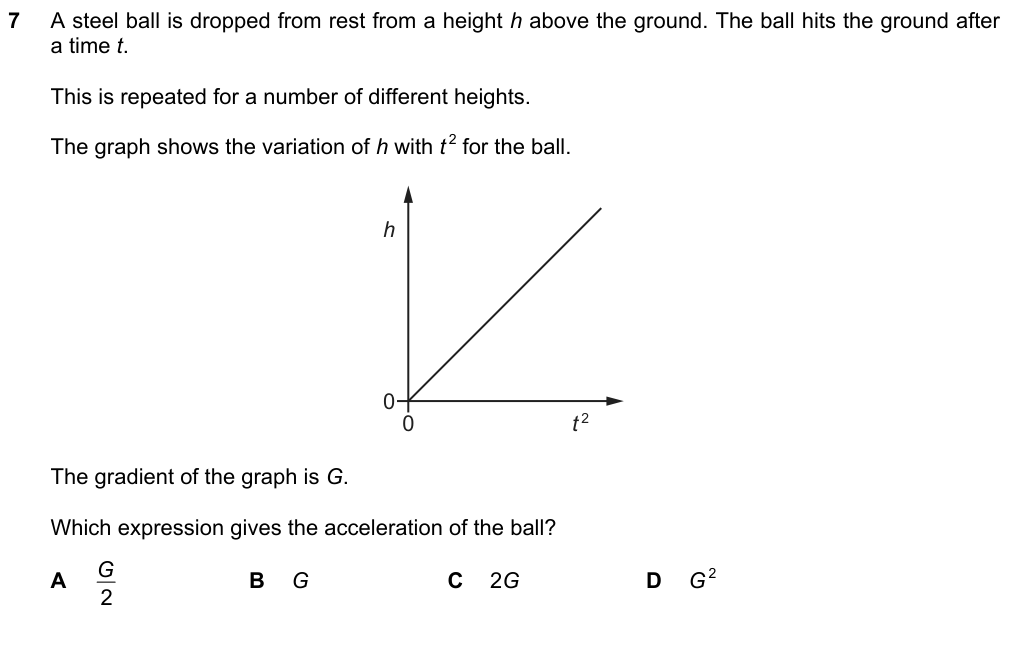
A ball is dropped from different heights and timed. A graph of h against t² is a straight line with gradient G. How do we get the acceleration from G?
- dropped from restu = 0, so h = ½at²
- h against t²h is y, t² is x: match with y = mx
- acceleration in terms of G
- gradient = Gof h vs t²
- Finda
- Useh = ½a t² ↔ y = m x
- SoG = ½a → a = 2G
- Useh = ½a t² ↔ y = m x
In h = ½at², which part plays the role of m in y = mx?
Everything multiplying t²: ½a. So the gradient G equals ½a.
Why does plotting against t² (not t) help?
h is proportional to t², so h-t² is a straight line; h-t would be a curve.
5 Now solve it have a go on paper first, then open the worked solution
- From rest: \(h = \tfrac12 a t^2\).
- Compare with y = mx: plotting h (y) against t² (x), the gradient is G = ½a.
- So a = 2G → C 1
The June 2021 report: many candidates found this difficult. Write the equation in the form y = mx first and match the parts.
For a free fall a ≈ 9.81, so G should come out about 4.9 m s−2 - half of g, consistent with a = 2G.
Example 3 · Which error, which fix? (Paper 1, 1 mark) ★★ Medium
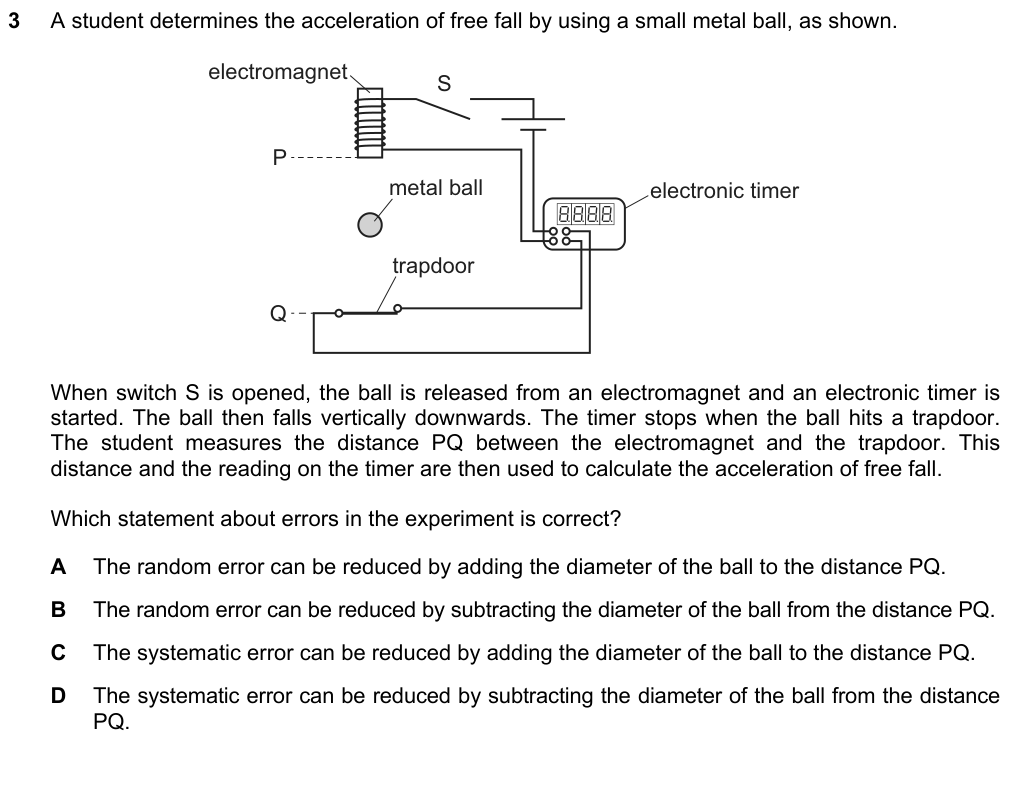
The timer starts when the ball leaves the electromagnet at P and stops when it hits the trapdoor at Q. The student measures PQ. We have to say what kind of error this set-up has, and how to correct it.
- random errorscatter that changes from reading to reading - reduced by repeating
- systematic errorthe same offset every time - corrected by adding or subtracting a fixed amount
- adding / subtracting the diameterthink: does the ball actually fall MORE or LESS than PQ?
- the correct statement
- PQelectromagnet to trapdoor
- ball diameterfixed
- the ball hangs BELOW P: its bottom edge only has PQ − diameter to fall
- Decidetype of error + fix
- Step 1same mistake every drop → systematic
- Step 2true fall distance is smaller → subtract the diameter
Does this mistake change from one drop to the next?
No - the ball's size is the same every time, so the error is always the same: systematic.
How far does the bottom of the ball actually fall before it hits the trapdoor?
PQ minus one diameter, because the ball hangs below P.
5 Now solve it have a go on paper first, then open the worked solution
- PQ runs from the electromagnet (the top of the ball) to the trapdoor. The ball's bottom edge only falls PQ − one diameter.
- That mistake is the same for every drop: a systematic error (A and B are out: you can't fix random error by adding or subtracting a fixed amount).
- The true distance is smaller, so subtract the diameter → D 1
A fixed amount can only correct a systematic error (A and B are out). The distance must get smaller, so D.
Example 4 · Percentage uncertainty in g (Paper 1, 1 mark) ★★ Medium
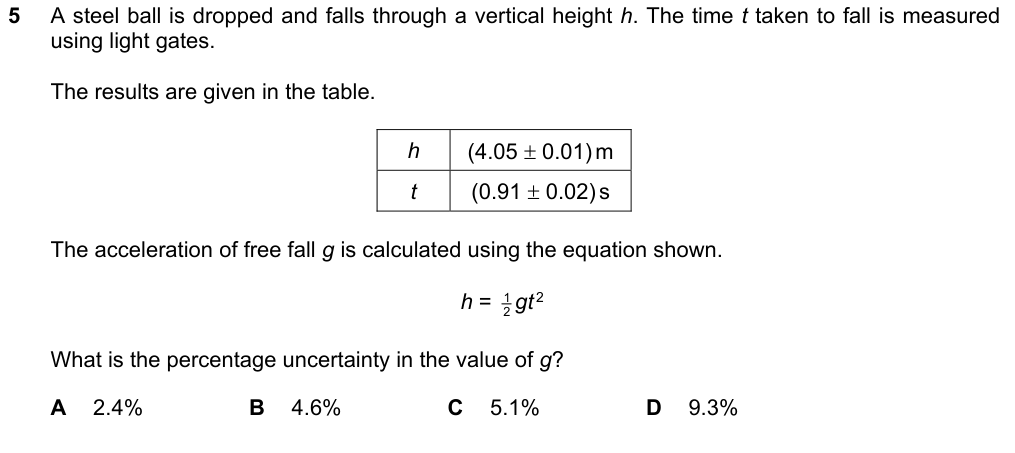
g is worked out from h = ½gt², with h and t each measured with an uncertainty. We combine the uncertainties to get g's.
- percentage uncertaintyabsolute uncertainty ÷ value × 100
- h = ½gt²rearrange first: g = 2h ÷ t²
- t²a power of 2 doubles t's percentage uncertainty
- % uncertainty in g
- h = 4.05 ± 0.01 m
- t = 0.91 ± 0.02 s
- Find%g
- Useg = 2h/t² → %g = %h + 2 × %t
- %h0.01 ÷ 4.05 × 100
- %t0.02 ÷ 0.91 × 100
- Trapthe exact 2 has no uncertainty; the power of t doubles %t
- Useg = 2h/t² → %g = %h + 2 × %t
Does the '2' in g = 2h/t² add any uncertainty?
No - it is an exact number. Only measured quantities carry uncertainty.
Why multiply %t by 2?
t is squared. t² = t × t, so its percentage uncertainty is %t + %t.
5 Now solve it have a go on paper first, then open the worked solution
- Rearrange: \(g = \dfrac{2h}{t^2}\), so \(\%g = \%h + 2\,\%t\) (the 2 in front is exact).
- \(\%h = \dfrac{0.01}{4.05} \times 100 = 0.25\%\); \(\%t = \dfrac{0.02}{0.91} \times 100 = 2.2\%\)
- \(\%g = 0.25 + 2 \times 2.2 = 4.6\%\) → B 1
A (2.4%) forgets that t is squared. See Case by case for every type of uncertainty question.
The timing dominates (4.4% of the 4.6%): t is short and its uncertainty is relatively large, so improving the timing would help most.
Summary
- Release from rest (electromagnet), time electronically (no reaction time), measure h from the bottom of the ball.
- Several heights, repeats averaged; plot h against t²; g = 2 × gradient.
- A non-zero intercept = a systematic error in every reading; the gradient still gives g.
- %g = %h + 2%t. Mass is not needed.
Can I do this?
- I can describe the electromagnet-and-timer method, including what is measured and how.
- I know that a graph of h against t² has gradient g/2.
- I can explain a non-zero intercept as a systematic error and say which way an error moves g.
- I can find the percentage uncertainty in g from those in h and t.
Anything unticked: revise that section first. All ticked: take the quiz.
Quiz
Your progress on this note is saved when JavaScript is on.