
The Internet and its Uses
Digital currency and blockchain
In this note
- 5.2.1Understand the concept of a digital currency and how digital currencies are used.
- 5.2.2Understand the process of blockchain and how it is used to track digital currency transactions.
Before this: Locating web pages and cookies. Next: Cyber security threats.
The notes: every idea from the start, with our own examples.
What you should already know
Encryption
Encryption scrambles data so that only someone with the key can read it.
Quick check: why encrypt a payment?
So it is meaningless if intercepted.
Digital currency
A digital currency is money that only exists electronically: there are no coins or notes. It can be used to pay for goods and services online and to transfer value between people. Some digital currencies are centralised (controlled by one organisation, like a bank), others are decentralised (no single organisation controls them; cryptocurrencies such as Bitcoin). Transactions are usually encrypted.
Blockchain
A blockchain, in its basic form, is a digital ledger: a time-stamped series of records that cannot be altered. Each new transaction is added to a block; each block is linked to the previous block, forming a chain. A copy of the chain is kept on many computers, so there is no single place to attack.
General methodHow a digital currency payment is tracked by blockchain
- The payer's device encrypts the payment data and sends it to the digital ledger.
- The transaction is recorded with a time-stamp (and a digital signature) and stored in a block with other transactions.
- Each block has its own hash (unique identifier) and stores the hash of the previous block.
- When the block is full it is added to the blockchain on every computer that holds a copy.
- Records cannot be altered, only new ones added, so every transaction can be traced.
Try it yourself
Show answer
Answer No: only electronically
Show answer
Answer Blockchain
Show answer
Answer The hash of the previous block
Summary
- Digital currency: only exists electronically; may be centralised or decentralised; usually encrypted.
- Blockchain: a digital ledger, a time-stamped series of records that cannot be altered.
- Blocks of transactions, each with its own hash and the previous block's hash; copies on many computers.
If you see …
- "draw and annotate a diagram to show a payment using digital currency and blockchain" [4]device encrypts · sent to ledger · recorded with time-stamp · stored in a block · block hash · added to the chain on every device
Question types, what the examiner gives marks for, and real past-paper questions solved.
Ways they test it
Type 1 Features
"Give two other features of digital currency" [2]; "identify the process that uses a digital ledger" [1]
Spot it "digital currency".
- only electronic · centralised / decentralised · encrypted; blockchain
Type 2 Cloze
"A digital currency does not exist …, … digital ledgers called …" [4]
Spot it a word list.
- physically · blockchains · time-stamp · traced
Type 3 Diagram
"Draw and annotate a diagram to show how a payment is made using digital currency and blockchain" [4]
Spot it "diagram".
- Follow the method; label the block hash.
Past-paper questions, solved
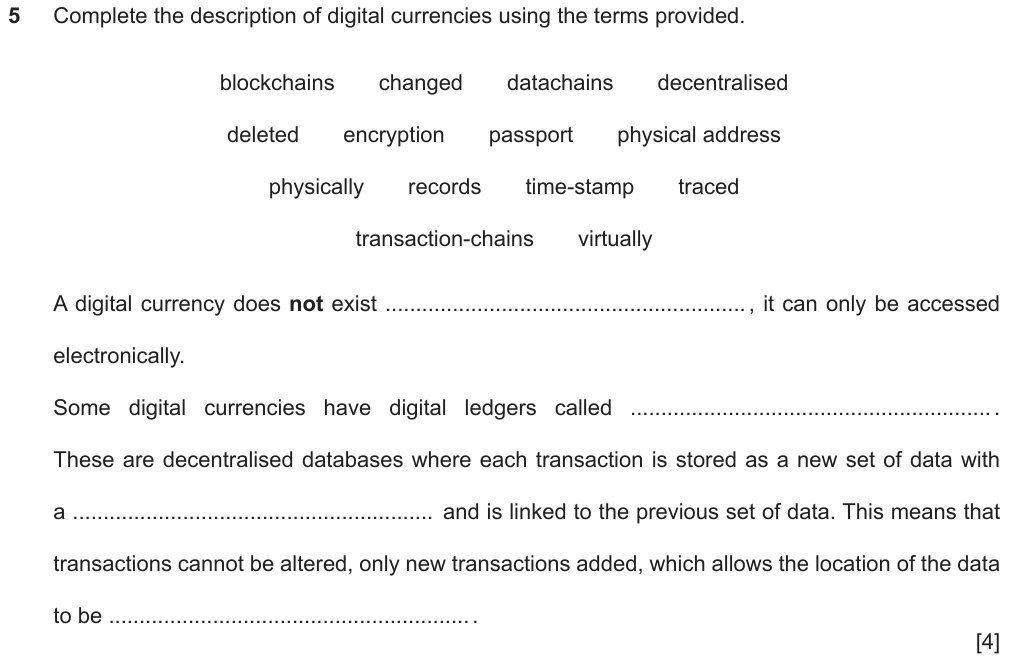
How to start Four gaps: one from each line of the definition.
Show a full-mark answer and the mark scheme
A digital currency does not exist physically, it can only be accessed electronically. Some digital currencies have digital ledgers called blockchains. These are decentralised databases where each transaction is stored as a new set of data with a time-stamp and is linked to the previous set of data. This means that transactions cannot be altered, only new transactions added, which allows the location of the data to be traced.
| Part | Answer / working | Marks | Guidance |
|---|---|---|---|
| 5 | physically · blockchains · time-stamp · traced | B4 | |
| Total: 4 marks | |||
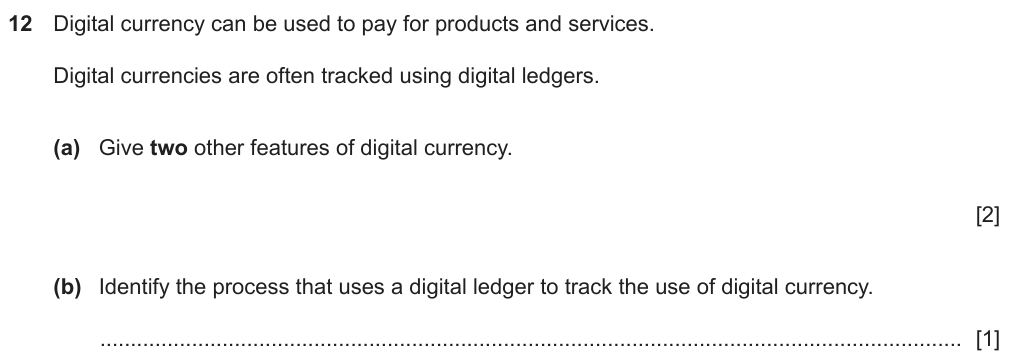
How to start The question already says digital ledger, so choose two other features.
Show a full-mark answer and the mark scheme
(a) It only exists electronically; it is usually encrypted.
(b) Blockchain.
| Part | Answer / working | Marks | Guidance |
|---|---|---|---|
| 12(a) | Any two: only exists electronically · decentralised · centralised · usually encrypted | B2 | |
| 12(b) | Blockchain | B1 | |
| Total: 3 marks | |||
Common mistakes
- ✗ "Records in a blockchain can be edited"✓ "Records cannot be altered, only added"
- ✗ "Digital currency is money in a bank account"✓ "Digital currency only exists electronically"Bank balances back real notes.
Practice
Practice: easy, medium, hard
Easy
Show answer
Answer e.g. Bitcoin (a cryptocurrency)
Medium
Show answer
Answer Each block holds the previous block's hash, so changing one breaks the chain; copies are held on many computers
Hard
Show answer
Answer Every transaction is stored, time-stamped, in a block that cannot be altered; following the chain shows the history
Can I do this?
- I can explain what a digital currency is and how it is used.
- I can describe how blockchain tracks transactions.
Anything unticked: revise that section first. All ticked: take the quiz.
Quiz
The multiple-choice and guided questions need JavaScript. The concept checks and exam practice below work without it.
Your progress on this note is saved when JavaScript is on.
⬇️ Download this chapter as a PDF: Full notes