
Hardware
The fetch-decode-execute cycle
In this note
- 3.1.2bDescribe the fetch-decode-execute (FDE) cycle, including the role of each component in the process: storing data and addresses in registers, using buses to transmit them, using the units to fetch, decode and execute.
Before this: The CPU and Von Neumann architecture. Next: CPU performance and embedded systems.
The notes: every idea from the start, with our own examples.
What you should already know
The registers
PC: address of the next instruction. MAR: address being fetched. MDR: data fetched. CIR: current instruction. ACC: results.
Quick check: which register holds the address of the next instruction?
The program counter (PC).
The buses
Address bus: addresses. Data bus: data and instructions. Control bus: signals.
Quick check: which bus brings the instruction from RAM?
The data bus.
The cycle
The CPU runs every program by repeating three stages over and over, billions of times a second: fetch the next instruction from RAM, decode it to work out what it means, then execute it. This is the fetch-decode-execute (FDE) cycle.
1 Fetch
General methodThe fetch stage
- The program counter (PC) holds the address of the next instruction. This address is copied to the MAR.
- The PC is incremented (increased by 1) so it holds the address of the instruction after this one.
- The address in the MAR is sent to RAM along the address bus.
- The control unit sends a read signal along the control bus.
- The instruction stored at that address is sent from RAM to the MDR along the data bus.
- The instruction is copied from the MDR to the CIR (in the control unit).
2 Decode
General methodThe decode stage
- The instruction is in the CIR, in the control unit.
- The control unit decodes the instruction using the instruction set (the list of machine code commands the CPU understands).
- The instruction is split into the opcode (what to do, e.g. ADD) and the operand (what to do it to: data or an address).
3 Execute
General methodThe execute stage
- The control unit sends control signals to the parts that are needed to carry out the instruction.
- If the instruction needs data from memory, its address goes to the MAR and the data comes back into the MDR.
- If it is a calculation or comparison, the ALU carries it out and the result goes to the accumulator (ACC).
- The cycle then starts again with the next fetch.
| Stage | Registers used | Buses used |
|---|---|---|
| Fetch | PC, MAR, MDR, CIR | address bus (MAR → RAM), data bus (RAM → MDR), control bus (read signal) |
| Decode | CIR (in the CU) | data bus (MDR → CIR) |
| Execute | ACC, MAR, MDR (if more data is needed) | any, depending on the instruction |
Try it yourself
Show answer
Answer Program counter (PC)
Show answer
Answer Address bus
Show answer
Answer The instruction set
Summary
- Fetch: PC → MAR; PC + 1; MAR → RAM (address bus); instruction RAM → MDR (data bus); MDR → CIR.
- Decode: the CU decodes the instruction in the CIR using the instruction set (opcode + operand).
- Execute: the CU sends signals; the ALU calculates; results in the ACC. Then the cycle repeats.
If you see …
- "registers used in the fetch stage"PC · MAR · MDR · CIR
- "describe the decode stage"MDR → CIR / CU · data bus · split into opcode and operand · CU decodes · instruction set
Question types, what the examiner gives marks for, and real past-paper questions solved.
Ways they test it
Type 1 Fetch paragraph
"Complete the paragraph about fetching an instruction" [7]
Spot it a word list.
- Follow the fetch method in order: address · MAR · RAM · MDR · data · CIR · CU.
Type 2 Registers per stage
"Give two registers used in the fetch stage" [2]; "one register used in the execute stage" [1]
Spot it "stage".
- Fetch: PC, MAR, MDR, CIR. Execute: ACC (also MAR, MDR).
Type 3 Describe a stage
"Describe what happens at the decode stage" [3]
Spot it "decode".
- MDR → CIR on the data bus; split into opcode and operand; CU decodes using the instruction set.
Type 4 Diagram
"Complete and annotate the diagram to show how the data is decoded" [4]; draw the fetch stage [4]
Spot it "annotate".
- Boxes for each register, arrows in order, and label each arrow with the bus.
Type 5 Correct the statement
"Two statements are not correct. Suggest a corrected statement" [4]
Spot it "incorrect".
- Typical traps: "MAR stores instructions" (addresses), "MDR gets data from the PC" (from RAM via the data bus).
What the examiner looks for
"Describe what happens at the decode stage of the cycle" [3]
Marking points (one mark each, up to the marks shown)
- The CIR / CU receives the instruction from the MDR …
- … using the data bus
- The instruction is separated into opcode and operand
- The control unit decodes the instruction …
- … using an instruction set
Keywords CIR control unit opcode operand instruction set
The fetch stage drawn as a diagram [4]
Marking points (one mark each, up to the marks shown)
- The registers MAR, MDR and PC shown
- Address sent from PC to MAR; PC is incremented
- Address sent from MAR to RAM … using the address bus
- Data / instruction sent from RAM to MDR … using the data bus
- Data / instruction sent from MDR to CIR / CU
- Control unit sending a control signal … using the control bus
Keywords PC MAR address bus MDR data bus CIR
Past-paper questions, solved
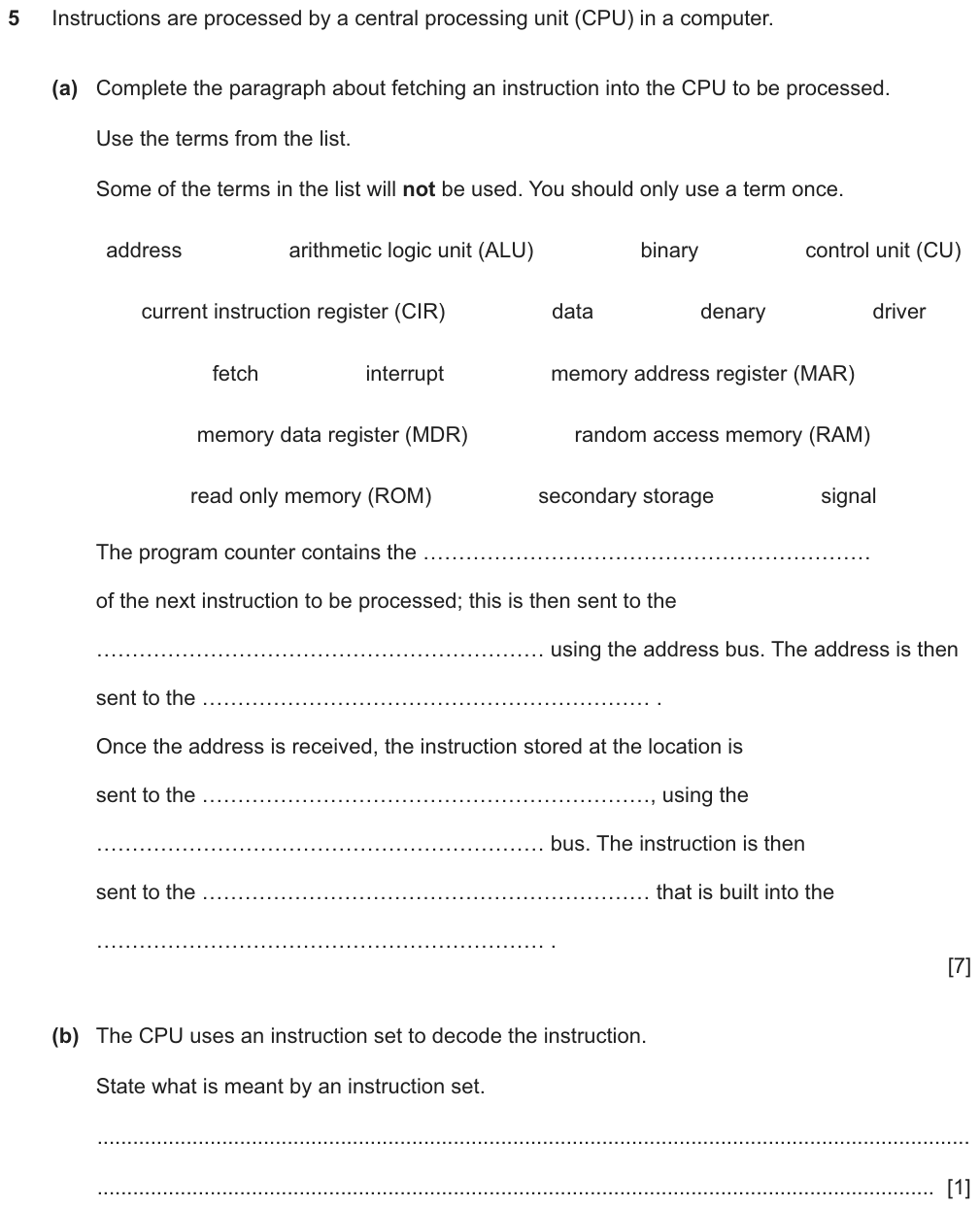
How to start Walk through the fetch method: what does the PC hold, where does it go, which bus, where does the instruction land?
Show a full-mark answer and the mark scheme
(a) address · memory address register (MAR) · random access memory (RAM) · memory data register (MDR) · data · current instruction register (CIR) · control unit (CU)
(b) A list of all the machine code commands that can be processed by the CPU.
| Part | Answer / working | Marks | Guidance |
|---|---|---|---|
| 5(a) | address · MAR · RAM · MDR · data · CIR · CU, one mark each in the correct place | B7 | |
| 5(b) | a list of (machine code) commands that can be processed by the CPU | B1 | |
| Total: 8 marks | |||
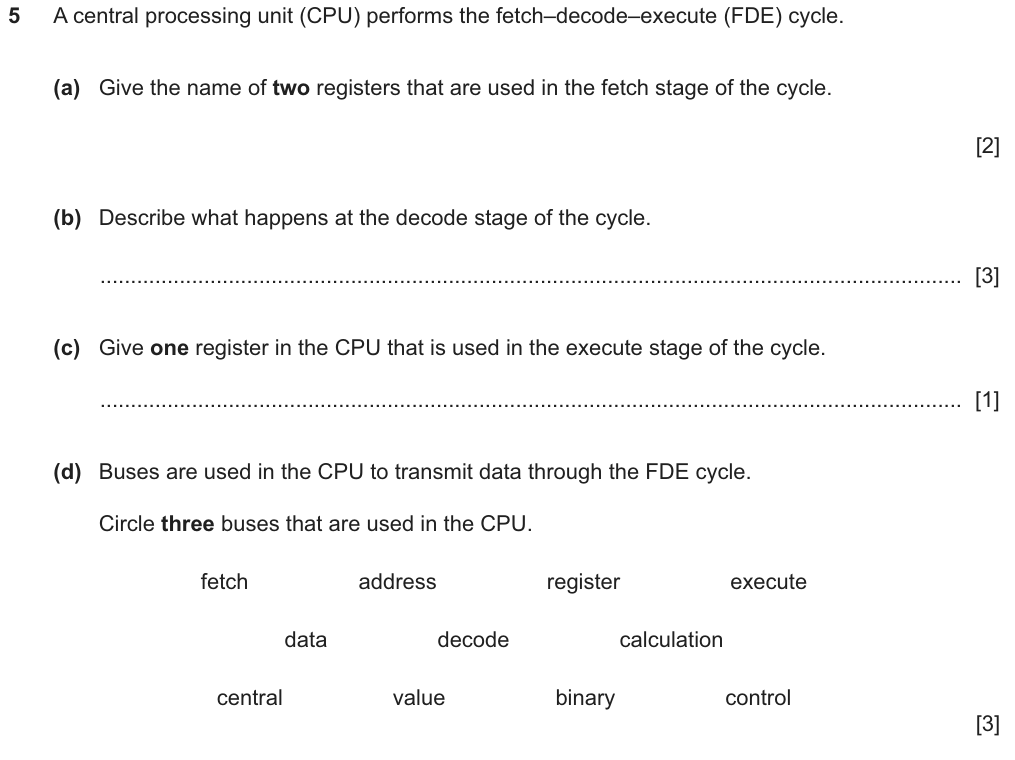
How to start (b) is the decode method: three points. (d) circle the three real bus names.
Show a full-mark answer and the mark scheme
(a) Program counter (PC); memory address register (MAR).
(b) The instruction is sent from the MDR to the CIR in the control unit along the data bus. It is split into the opcode and the operand, and the control unit decodes it using the instruction set.
(c) Accumulator (ACC).
(d) address · data · control
| Part | Answer / working | Marks | Guidance |
|---|---|---|---|
| 5(a) | Any two: PC · MAR · MDR · CIR | B2 | |
| 5(b) | Any three: MDR → CIR / CU · data bus · opcode and operand · CU decodes · instruction set | B3 | |
| 5(c) | Any one: ACC · MAR · MDR | B1 | |
| 5(d) | data · address · control | B3 | |
| Total: 9 marks | |||
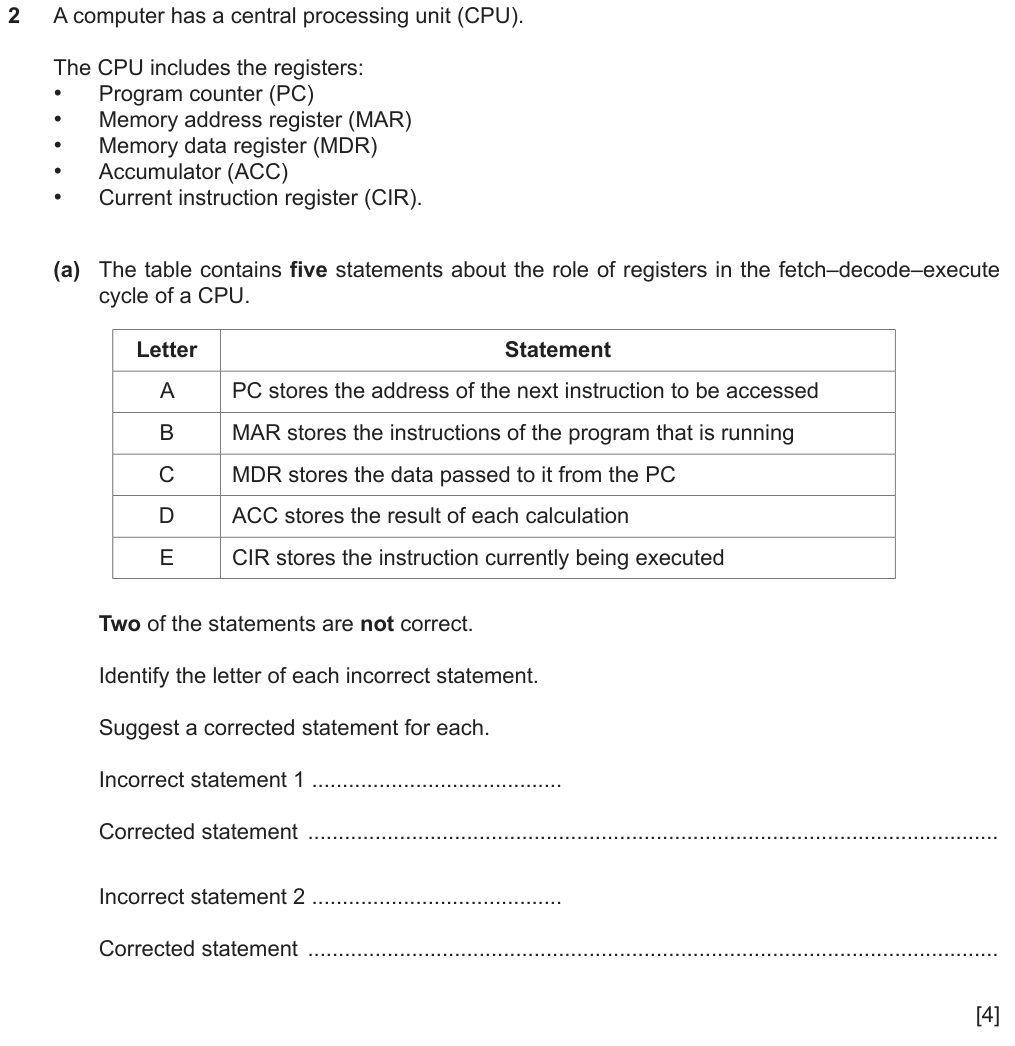
How to start Check each statement against the register table: who holds addresses, who holds data, where does data come from?
Show a full-mark answer and the mark scheme
Incorrect statement 1: B. Corrected: the MAR stores the address of the instruction / data to be fetched, not the instructions.
Incorrect statement 2: C. Corrected: the MDR stores data passed to it from RAM along the data bus (from the address in the MAR), not from the PC.
| Part | Answer / working | Marks | Guidance |
|---|---|---|---|
| 2(a) | B … MAR stores addresses, not instructions · C … data comes from RAM / the address in the MAR (data bus), not the PC | B4 | |
| Total: 4 marks | |||
Common mistakes
- ✗ "The PC sends the instruction to the MAR"✓ "The PC's ADDRESS is copied to the MAR"The PC never holds an instruction.
- ✗ "The address goes on the data bus"✓ "Addresses go on the address bus"
- ✗ Forgetting the PC is incremented✓ "PC + 1" in the fetch stageIt earns a mark in diagrams.
- ✗ "The ALU decodes the instruction"✓ "The control unit decodes it using the instruction set"
Practice
Practice: easy, medium, hard
Easy
Show answer
Answer Fetch, decode, execute
Show answer
Answer MDR (memory data register)
Show answer
Answer CIR (current instruction register)
Medium
Show answer
Answer PC address copied to MAR; PC incremented; address sent to RAM on the address bus; instruction returned to MDR on the data bus; copied to CIR
Show answer
Answer Opcode and operand
Hard
Show answer
Answer CU sends signals; address 50 goes to the MAR → RAM; the value returns to the MDR on the data bus; the ALU adds it to the ACC; result stored in the ACC
Show answer
Answer So it holds the address of the next instruction, ready for the next cycle
Can I do this?
- I can describe the fetch stage step by step with registers and buses.
- I can describe the decode and execute stages.
- I can draw and annotate the fetch stage.
Anything unticked: revise that section first. All ticked: take the quiz.
Quiz
The multiple-choice and guided questions need JavaScript. The concept checks and exam practice below work without it.
Your progress on this note is saved when JavaScript is on.
⬇️ Download this chapter as a PDF: Full notes