
Communication
Cloud computing
What you need to be able to do
- 2.1Explain what cloud computing is, including public and private clouds.
- 2.1Give the benefits and drawbacks of cloud computing, in a given context.
You need: Client-server (the cloud is client-server over the internet).
What cloud computing is
What can be provided: storage (files and backups), software run in a browser (email, word processing, spreadsheets, games, databases), and processing power / whole servers rented by the hour. The provider owns and runs the hardware; you pay (or use a free allowance) for what you use.
Public and private clouds
| Public cloud | Private cloud | |
|---|---|---|
| Who provides it | a third-party provider, over the public internet | the organisation itself, or a provider dedicated to it; over the internet or a private internal network |
| Who can use it | open to anyone with the right equipment / software / log-in (credentials) | only the organisation's selected users: a dedicated / bespoke system |
| Infrastructure | shared with other customers (cheaper) | not shared; tailored to the organisation |
| Control | provider controls security, backups, updates | greater control over security, privacy and backups |
| Cost | pay-as-you-go, no hardware to buy | more expensive (own hardware / dedicated service, staff) |
Benefits and drawbacks
| Benefits | Drawbacks |
|---|---|
| Access from any computer / anywhere with an internet connection | Only available with an internet connection (not just “a network connection” - June 2021) |
| No need to buy / install / maintain your own servers, storage or software | Reliance on a third party for security, backups and up-time; the provider may have downtime / technical problems |
| Backups and disaster recovery usually included | possibly no backups / no control over backups |
| Easy to share and collaborate: several people on one document | Uploading / downloading large files takes time |
| Capacity can be increased quickly and easily (scalable) | Recurring cost: subscriptions may cost more in the long term; limited free storage |
| Free for small amounts of storage | data privacy / security concerns (data held by someone else, possibly in another country) |
1 A school's homework
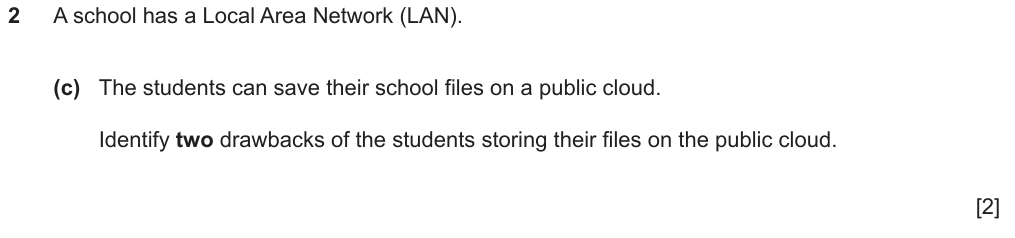
Students save homework to a public cloud. Give two drawbacks.
Askedtwo drawbacksKnowpublic cloud, students at homeRouteinternet + third party + limits
- Students can't access their files without a reliable internet connection
- The free space may be limited, so they may have to pay for more
- they have no control over the backup / security of their work: they depend on the provider
2 A design company
A design company chooses a private cloud for its work. Why?
Askedbenefits over publicKnowconfidential designsRoutecontrol
- Not reliant on a third party, so greater control over security / privacy of confidential designs
- greater control over backups
- storage tailored / scaled to the company's needs
3 An online course provider
A company sells courses to students worldwide. Why use a public cloud?
AskedreasonsKnowglobal customersRouteavailable on the internet, shared cost
- The courses must be available to anyone, on the internet
- sharing the provider's infrastructure is more economical than running its own servers
Mark-scheme focus
Define cloud computing; public and private cloud (3 marks)
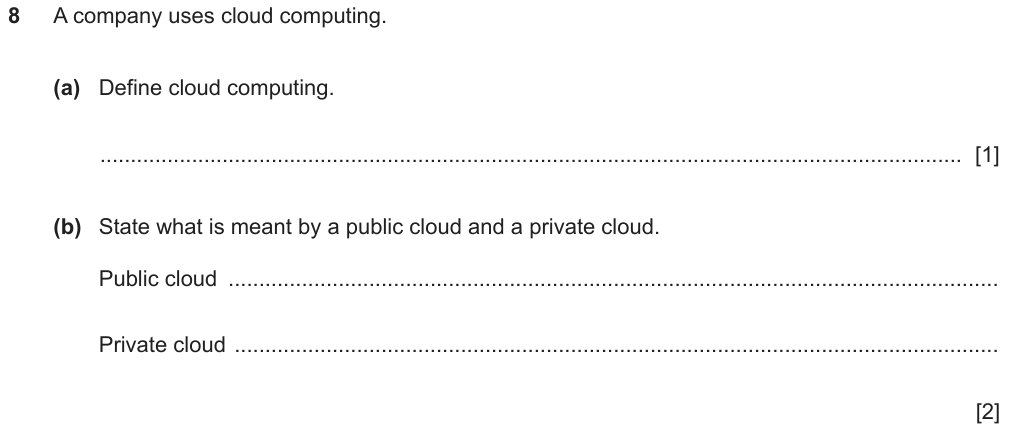
- (a) Accessing a service / files / software on a remote server B1
- (b) Public: computing services offered by a third-party provider over the public internet // open to anyone with the appropriate equipment / credentials B1
- Private: only available to select users // a dedicated / bespoke system only accessible to the organisation B1
- (a) “computing in the cloud”; answers that fit any client-server set-up
- (b) “anyone can see your data” / “only one person can use it”
The cloud is the service; who can use the service decides public or private.
From: 9618/13/M/J/22 Q8(a), (b)
Two drawbacks of using cloud computing (2 marks)
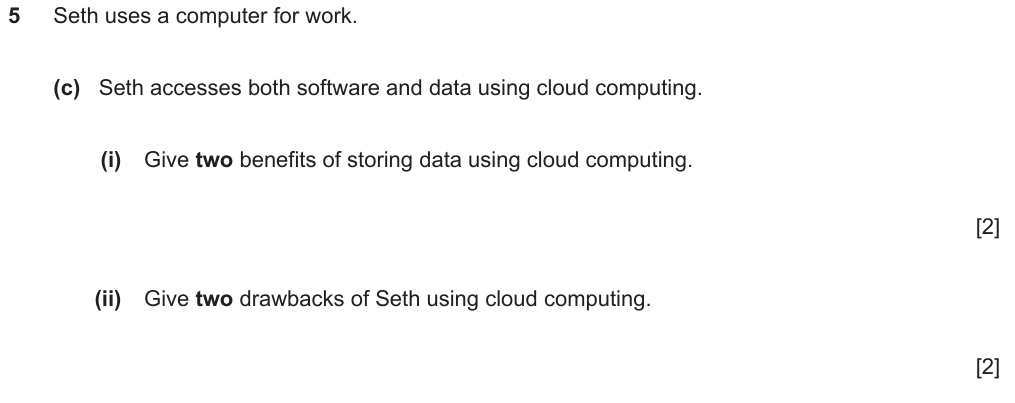
- (i) e.g. access data from any computer with internet access; in-built backup / disaster recovery; no need for separate storage devices; easily increase capacity; easy sharing B2
- (ii) e.g. can only access the cloud with internet access; no control over security / backups; uploads / downloads take a long time; more expensive in the long term; storage limit unless paid for B2
- “It needs a network connection” (must be the internet)
- Drawbacks that apply to any storage (e.g. “files can get corrupted”)
From: 9618/12/M/J/21 Q5(c)
- Cloud questions in about one paper in two: define (1), public / private (2), benefits and drawbacks (2-4), often in a context.
- Context matters: drawbacks “to the students”, benefits “to the company” - use the scenario.
Worked examples
Example 1 · Private cloud: define it, then its benefits (Paper 1, 4 marks) ★ Easy
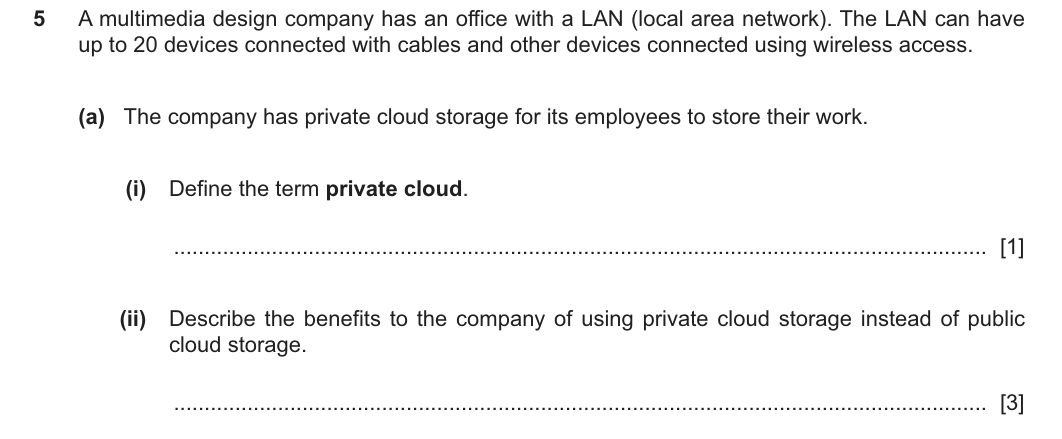
(ii) compares private with public: what does the company gain by not sharing a third party's service?
- instead of publicbenefits relative to public
- describebenefit + why
- (a)(i)definition
- (a)(ii)benefits
- (ii)
- Third partynot reliant on one
- Controlsecurity / privacy / backup
- Tailoredstorage fits its needs
5 Now solve it have a go on paper first, then open the worked solution
- (i) Dedicated / bespoke services / storage on a remote server only available to the company B1
- (ii) Not reliant on a third party B1 … gives greater control over security / privacy B1 … and over backup; storage can be tailored / scaled to the company's requirements B1
Every benefit is something a public cloud would not give the company ✓.
Example 2 · Why a public cloud, and two disadvantages against a LAN server (Paper 1, 6 marks) ★★ Medium
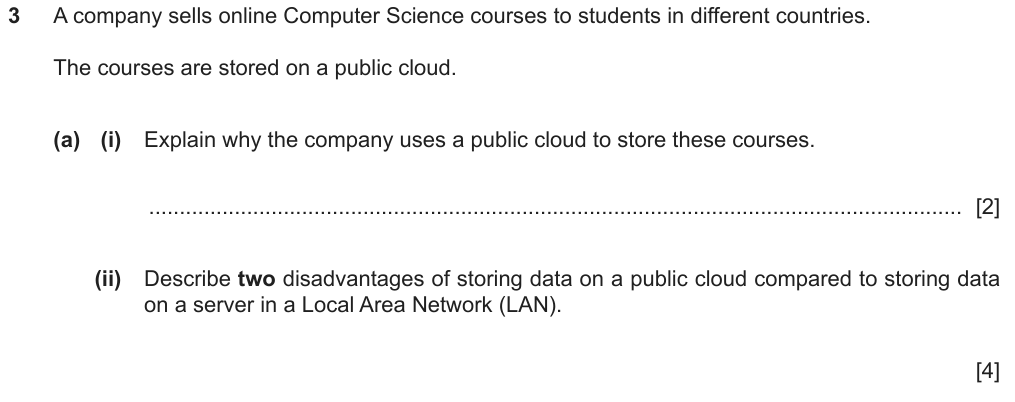
(ii) is 4 marks for 2 disadvantages: each needs its expansion, compared with a server the company would own on its LAN.
- explain whyreasons from the scenario: students worldwide
- compared to … a LANwhat the LAN server would avoid
- (a)(i)reasons
- (a)(ii)2 described disadvantages
- (ii)
- Controldata on someone else's infrastructure
- Internetaccess depends on a reliable connection
- Costrecurring charges vs one-off LAN cost
5 Now solve it have a go on paper first, then open the worked solution
- (i) Courses must be available to anyone, on the internet B1; sharing infrastructure with other companies is more economical B1
- (ii) Possible loss of control unlike the LAN B1 … because the data is on remote / someone else's infrastructure, relying on them for backups and security B1
- Requires a reliable internet connection B1 … to reach the remote data, unlike a LAN server B1
Also credited: increased recurring costs … provider charges must keep being paid, while a LAN costs once ✓.
Example 3 · Name the parts of a cloud set-up (Paper 1, 3 marks) ★ Easy
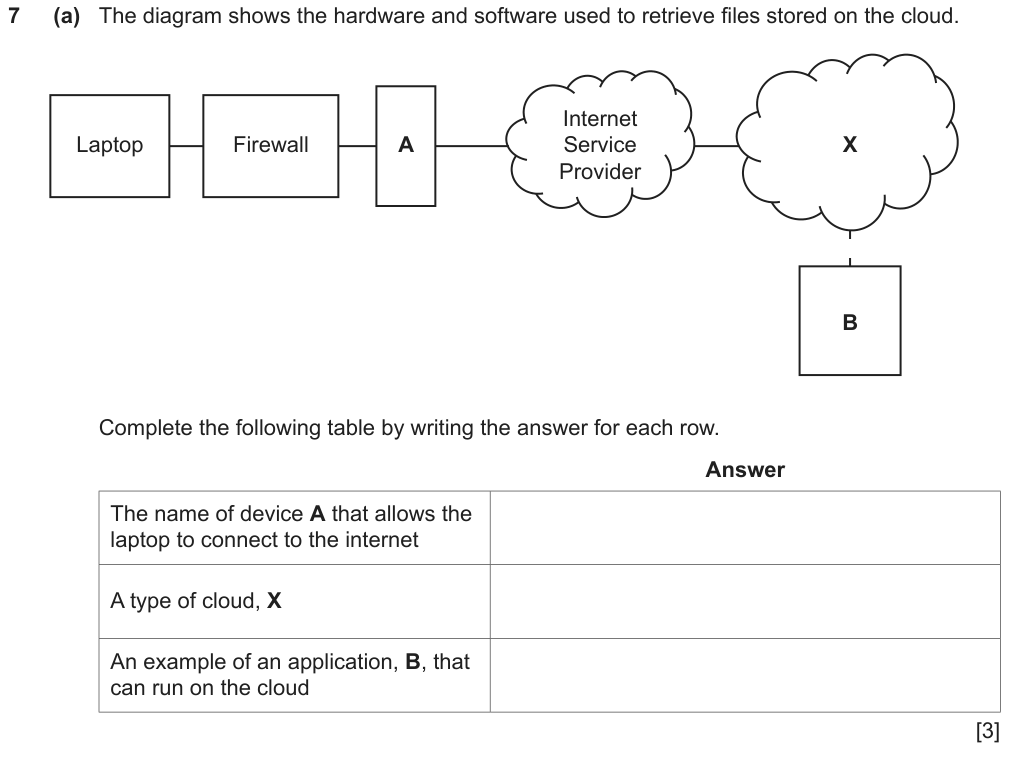
Read the diagram left to right: laptop → A → ISP → firewall → the cloud X running application B. Brand names are not credited.
- type of cloudpublic or private
- example of an applicationa generic type, not a product name
- Adevice
- Xtype of cloud
- Bapplication
5 Now solve it have a go on paper first, then open the worked solution
- A: router B1
- X: public (cloud) B1 (reached through an ISP, over the internet)
- B: email / word processor / spreadsheet / database / game … B1
The report: brand names (e.g. a named office suite) are not credited.
Summary
- Cloud computing = using services / storage / software on remote servers over the internet.
- Public: third-party service over the internet, shared infrastructure, open to anyone with credentials. Private: dedicated to one organisation, more control.
- Benefits: anywhere access, no hardware to buy, backups, sharing, scalable. Drawbacks: needs internet, reliance on a third party, transfer time, ongoing cost.
| If you see… | do this |
|---|---|
| “define cloud computing” | remote server, accessed over the internet |
| “public / private” | who the service is offered to |
| “benefits / drawbacks” | cloud-specific, applied to the people in the question |
Can I do this?
- I can define cloud computing and say what it can provide.
- I can describe public and private clouds and compare them.
- I can give cloud-specific benefits and drawbacks in a context.
Anything unticked: revise that section first. All ticked: take the quiz.
Quiz
The multiple-choice and guided questions need JavaScript. The concept checks and exam practice below work without it.
Concept checks
Answer each one in your head first, then open it.
1Is cloud storage client-server?Show answer
Yes: your device (client) sends requests over the internet to the provider's servers, which store and return the data.
2Why is “cloud data is less secure” not automatically true?Show answer
Security depends on the provider: a large provider may secure data better than a small business could; the real issue is that you rely on them.
3What would happen to a cloud-based till system if the restaurant's internet went down?Show answer
It couldn't reach the software or data in the cloud, so it would stop working unless it had an offline mode.
Exam-style practice
New questions, not used above. Do them on paper, then mark your work against the official mark scheme.
Show the mark scheme
| Part | Answer / working | Marks | Guidance |
|---|---|---|---|
| (c) | The students cannot access their files without a reliable internet connection | B1 | |
| The free space may be limited so students may have to pay for more // students have no control over the backup / security of their work, dependent on a third party | B1 | ||
| Total: 2 marks | |||
A charity is deciding whether to store its volunteers' records on a public cloud or on a server in its office LAN.
Give one benefit of the public cloud and two drawbacks of it for the charity.
- [3]
Show the mark scheme
| Part | Answer / working | Marks | Guidance |
|---|---|---|---|
| Benefit: no server / hardware to buy and maintain // volunteers can access records anywhere with internet // backups provided | B1 | ||
| Drawback: records only accessible with an internet connection | B1 | ||
| Drawback: reliant on the provider for security / backups // recurring subscription cost // data stored by a third party (privacy) | B1 | ||
| Total: 3 marks | |||
Your progress on this note is saved when JavaScript is on.