
Communication
LAN hardware and routers
What you need to be able to do
- 2.1Describe the hardware used to support a LAN: switch, server, NIC, WNIC, WAP, cables, bridge, repeater.
- 2.1Describe the role and function of a router in a network.
You need: Network topologies. Next: Ethernet and CSMA/CD.
The devices in a LAN
| Device | Purpose (credited wording) |
|---|---|
| NIC (network interface card) | hardware that lets a device connect to a (wired) network; it has a unique MAC address that identifies the device on the network |
| WNIC (wireless NIC) | provides the interface to a wireless network, acting as an antenna; receives analogue radio waves and converts them to digital (and digital → radio waves to send); checks incoming transmissions for its MAC address and ignores the rest; encrypts / decrypts the data; gives the device a unique MAC address (not an IP address) |
| Switch | the central connection point of a star; stores the MAC addresses of the devices connected to it; receives packets and forwards them only to the intended recipient |
| Hub (older) | connects devices like a switch, but sends every packet to every device; more collisions, less secure |
| Server | a powerful computer that provides a service to the clients: file storage, printing, email, web pages, log-ins and security |
| WAP (wireless access point) | allows wireless devices to connect to a wired network, sending and receiving radio / Wi-Fi signals between the central device and the nodes |
| Cables | the wired transmission medium: copper (Ethernet twisted pair) or fibre-optic |
| Bridge | connects two LANs / segments that use the same protocol so they act as one network; it passes on only the packets meant for the other side |
| Repeater | restores (regenerates) the digital signal so it can be transmitted over greater distances: signals fade along a cable |
The router
- It receives packets from the devices on the LAN or from the internet.
- It analyses the destination IP address in each packet's header.
- It looks up its routing table to find the most efficient route to the destination, and forwards the packet towards it (to the next router, or to the device on the LAN).
- It maintains / updates the routing table as routes change.
- On a home or office LAN it also: allocates private IP addresses to the devices (DHCP); gives the whole LAN one public IP address and translates between them (Network Address Translation, NAT); keeps a table of MAC and IP addresses; acts as a gateway and converts the packet format / protocol for the next network; and may run a firewall.
| A router DOES | A router does NOT |
|---|---|
| receive packets and forward them towards the destination | send each packet to every device (a hub does that) |
| store the IP and / or MAC addresses of the devices attached to it | find the IP address of a URL (that is the DNS server's job) |
| hold a routing table and choose efficient routes | store websites |
Mark-scheme focus
Describe the functions of a WNIC (4 marks)
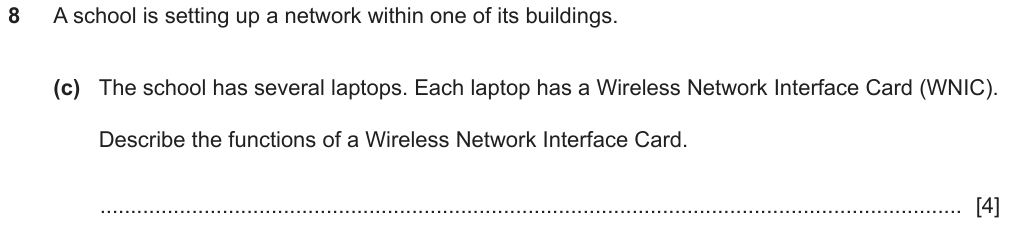
- Provides an interface to the wireless network … as an antenna B1 B1
- Receives analogue radio waves … converts them to digital / binary B1 B1
- Checks incoming transmissions for the correct MAC / IP address … ignores transmissions not intended for it // encrypts / decrypts the data // converts digital to analogue waves and sends them via the antenna
- “A WNIC functions like a NIC but wirelessly”
- “It provides an IP address” (it provides a MAC address)
- Generic NIC descriptions
From: 9618/11/O/N/21 Q8(c)
Complete the table of network devices (4 marks)
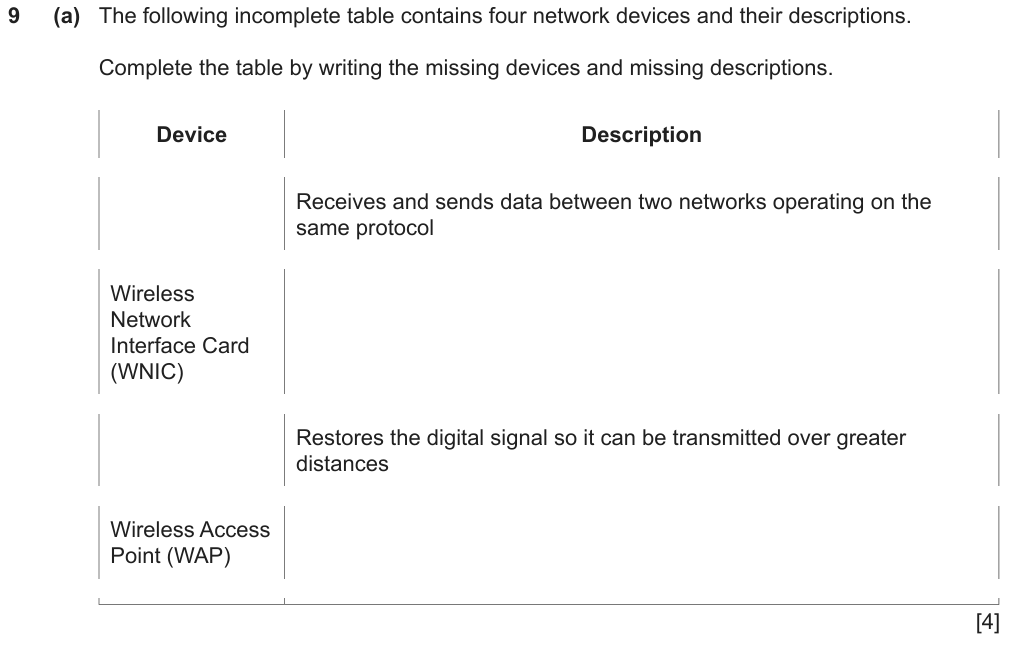
- Receives and sends data between two networks on the same protocol → router (a bridge fits the same description) B1
- WNIC → hardware that allows a device to connect to a wireless network // provides a MAC address to identify the device on the wireless network B1
- Restores the digital signal → repeater B1
- WAP → hardware that provides radio communication from the central device to nodes on the network (and vice versa) B1
- WAP: “provides a wireless access point”
- Descriptions only about connecting to the internet
From: 9618/12/M/J/22 Q9(a)
Describe the role and function of the router (3 marks)
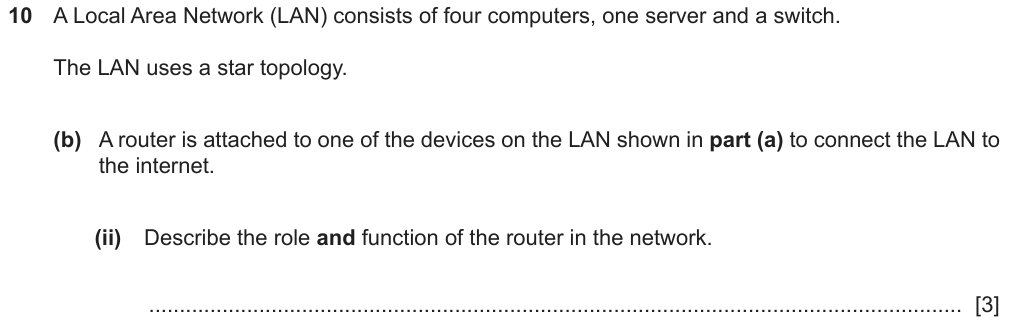
- Receive packets from devices / the internet; find the destination of packets using the IP address; forward packets to the destination B1 B1 B1
- or: assign private IP addresses to devices on the LAN; store / update a routing table; find the most efficient path; maintain a table of MAC and IP addresses; provide the LAN with a public IP address; act as a gateway / protocol conversion / firewall
- “The router connects the LAN to the internet” (in the question)
- “package” / “data” instead of packet
- Router role / functions: in most papers (2-3 marks): receive packets → read destination IP → routing table → forward; plus LAN jobs (private IPs, public IP, NAT).
- Device tables: complete a device / purpose table (3-4 marks): switch, WAP, bridge, repeater, WNIC.
Worked examples
Example 1 · A school's router, switch, WAP and bridge (Paper 1, 6 marks) ★ Easy
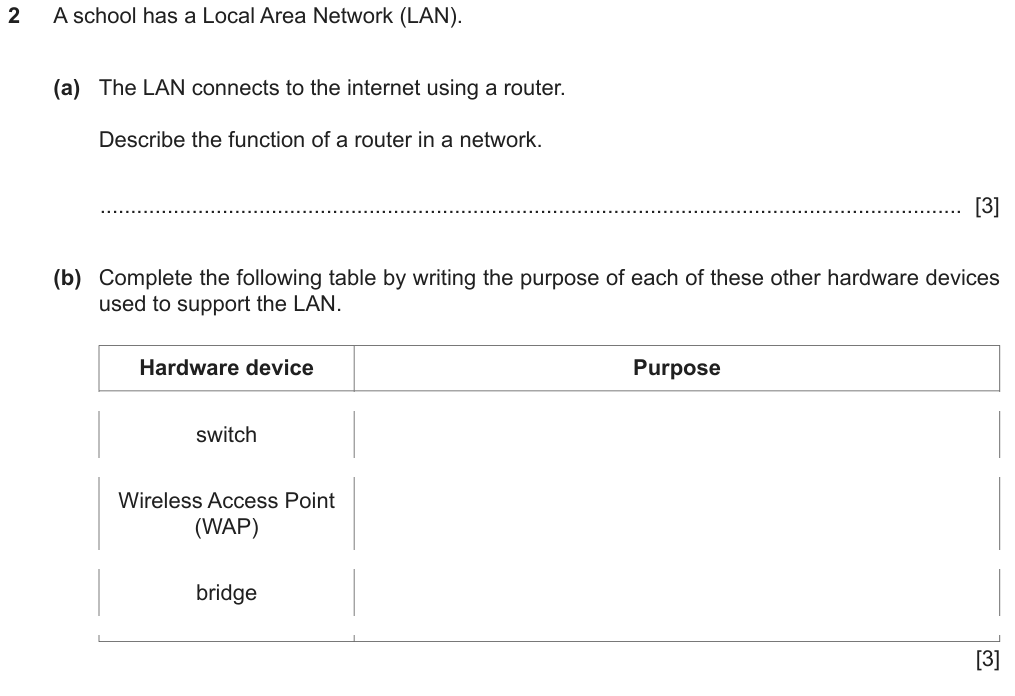
(a) three separate router jobs. (b) one purpose each - say what the device does, not what its name means.
- function of a routerwhat it does with packets
- purposewhy the device is there
- (a)three functions
- (b)three purposes
- (a)
- 1receives packets
- 2reads destination IP
- 3forwards via routing table
- (b)
- Switchforwards to destination
- WAPradio link to wired network
- Bridgejoins two LANs, same protocol
5 Now solve it have a go on paper first, then open the worked solution
- (a) Receives packets from the internet / external network B1; analyses the destination IP address of each packet B1; forwards the packet towards its destination using the routing table B1
- (b) Switch: receives transmissions and forwards them to their destination // connects devices so they can communicate B1
- WAP: allows wireless-enabled devices to connect to a wired network using radio / Wi-Fi signals B1
- Bridge: connects two LANs / segments with the same protocol B1
No answer just expands an acronym ✓.
Example 2 · What does a router do - and not do? (Paper 1, 2 marks) ★ Easy
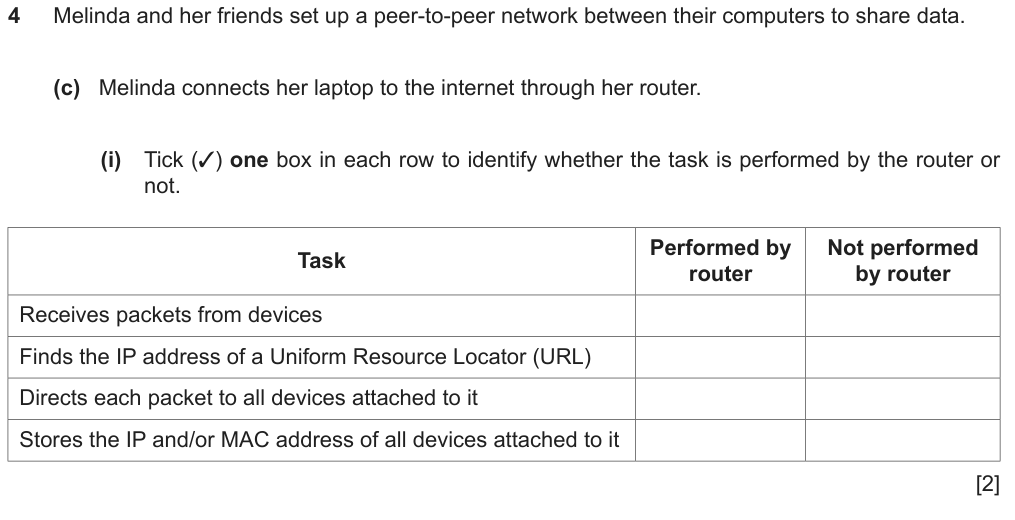
Four tasks; two belong to other devices. Who finds the IP address of a URL? Who sends a packet to everyone?
- finds the IP address of a URLDNS
- directs to all deviceshub / bus
- (c)(i)four ticks
5 Now solve it have a go on paper first, then open the worked solution
- Receives packets from devices: performed
- Finds the IP address of a URL: not performed (DNS server)
- Directs each packet to all devices: not performed (it forwards to the destination)
- Stores the IP and / or MAC addresses of attached devices: performed B2
1 mark for the first two rows correct, 1 for the last two ✓.
Example 3 · Three functions of a home router (Paper 1, 3 marks) ★★ Medium
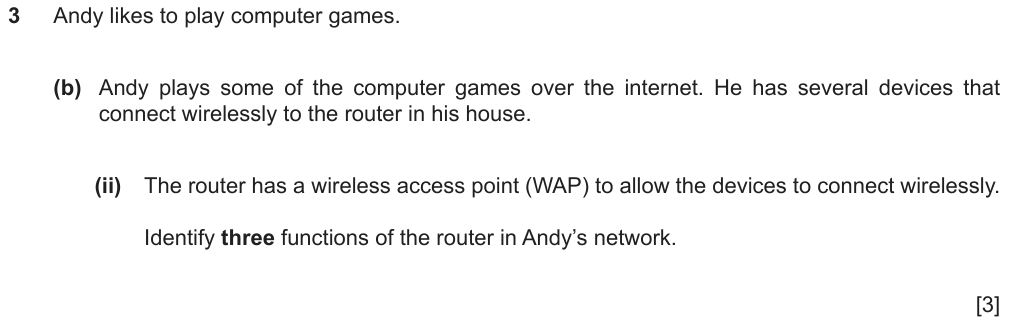
Functions of the router (not the WAP) in Andy's home network.
- of the routernot the WAP's radio job
- in Andy's networkhome LAN context
- (b)(ii)three functions
Is “lets his devices connect to the internet” enough?
No: it repeats the question.
5 Now solve it have a go on paper first, then open the worked solution
- Receive packets from devices or the internet B1
- Forward / route packets to their destination (using the destination address / routing table) B1
- Assign private IP addresses to Andy's devices // maintain a table of MAC and IP addresses // find the most efficient path B1
None of the three is a WAP job ✓.
Example 4 · The role of a switch (Paper 1, 3 marks) ★ Easy
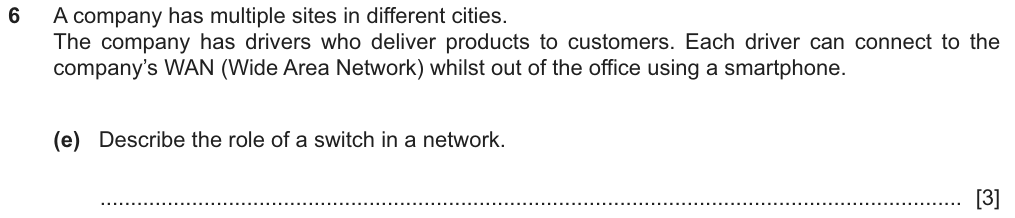
Three things a switch does with packets and addresses.
- (e)three points
5 Now solve it have a go on paper first, then open the worked solution
- Stores the MAC addresses of devices connected to it B1
- Receives packets from devices B1
- Forwards packets directly to the intended recipient // central point of connection, enabling devices to communicate B1
“Directly to the recipient” is what separates a switch from a hub ✓.
Summary
- NIC / WNIC: connect a device (wired / wireless); unique MAC address; WNIC converts radio ↔ digital and ignores other MACs.
- Switch: central point, stores MACs, forwards only to the destination. WAP: wireless devices onto a wired network. Bridge: joins two LANs with the same protocol. Repeater: regenerates the signal.
- Router: receives packets, reads destination IP, routing table, forwards; on a LAN also allocates private IPs, public IP / NAT, gateway, firewall.
| If you see… | do this |
|---|---|
| “describe a device” | what it does, not what the letters stand for |
| “role of a router” | packets + IP addresses + routing table (+ LAN jobs in context) |
| “WNIC” | antenna, radio ↔ digital, MAC address check, encryption |
Can I do this?
- I can describe the purpose of a NIC, WNIC, switch, server, WAP, bridge and repeater.
- I know MAC addresses come from the NIC and IP addresses are separate.
- I can describe the role and functions of a router, including on a home LAN.
- I know what a router does not do (find a URL's IP, broadcast to all).
Anything unticked: revise that section first. All ticked: take the quiz.
Quiz
The multiple-choice and guided questions need JavaScript. The concept checks and exam practice below work without it.
Concept checks
Answer each one in your head first, then open it.
1Why does a switch need MAC addresses but a router uses IP addresses?Show answer
A switch delivers within one LAN, where each device's hardware (MAC) address is known; a router moves packets between networks, where logical IP addresses describe where a network is.
2Why can a laptop have the same MAC address everywhere but a different IP address on each network?Show answer
The MAC is fixed in its network card; the IP address is given by whichever network it joins.
3Why does a home router give out private IP addresses?Show answer
There aren't enough public IPv4 addresses for every device; the LAN shares one public address and the router translates (NAT).
Exam-style practice
New questions, not used above. Do them on paper, then mark your work against the official mark scheme.
A long corridor in a school needs a network cable 180 m long, and two classroom LANs must be joined into one network.
- (a)Identify the device needed for the long cable and describe its purpose.[2]
- (b)Identify the device used to join the two classroom LANs.[1]
Show the mark scheme
| Part | Answer / working | Marks | Guidance |
|---|---|---|---|
| (a) | Repeater | B1 | |
| Restores / regenerates the digital signal so it can travel further | B1 | ||
| (b) | Bridge (same protocol) // switch | B1 | |
| Total: 3 marks | |||
Describe three functions of a router in a home network.
- [3]
Show the mark scheme
| Part | Answer / working | Marks | Guidance |
|---|---|---|---|
| Receives packets from devices / the internet and forwards them to their destination | B1 | ||
| Allocates private IP addresses to the devices on the LAN | B1 | ||
| Provides the LAN with a public IP address / NAT // maintains a routing table // acts as a firewall | B1 | ||
| Total: 3 marks | |||
Your progress on this note is saved when JavaScript is on.