
Communication
The internet, WWW and bit streaming
What you need to be able to do
- 2.1Explain the difference between the internet and the World Wide Web (WWW).
- 2.1Describe the hardware that supports the internet: modems, PSTN, dedicated lines, the cell phone network.
- 2.1Explain bit streaming, real-time and on-demand, and the importance of bit rates and broadband speed.
You need: LAN hardware and routers. Next: IP addresses.
The internet and the World Wide Web
| The internet | The World Wide Web (WWW) | |
|---|---|---|
| What it is | the global network of interconnected networks: the infrastructure (cables, routers, satellites, protocols such as TCP/IP) | a collection of websites / web pages (and other resources) accessed via the internet, linked by hyperlinks |
| Made of | hardware + communication protocols | information: pages written in HTML, held on web servers, identified by URLs |
| Used by | the WWW, email, file transfer, video calls, online games, IoT devices… | web browsers using HTTP / HTTPS |
So the WWW runs on the internet; email sent from an app is internet without the WWW, while reading a web page uses both.
Hardware that supports the internet
| Hardware | What it does |
|---|---|
| Modem (modulator-demodulator) | converts digital data into analogue signals for transmission down telephone lines, and converts analogue back to digital at the other end |
| PSTN (Public Switched Telephone Network) | the traditional telephone network: many different types of communication lines, so digital data may need converting to analogue; data is sent in both directions at once (duplex); connections pass through switching centres / ISPs. Dial-up and DSL broadband use it |
| Dedicated (leased) line | a direct, private connection between two sites, rented from a telecoms company, not shared, so it provides faster, more reliable and more secure transmission; expensive |
| Cell phone network | the land is split into cells, each with a tower (base station) and antenna that receives and transmits data; data travels between the tower and the phone wirelessly using low-power radio signals; many devices can communicate with the same tower at once; as a phone moves, it is handed over to the next cell; the towers are linked to the wider network by cables or microwave links |
Bit streaming
- The video / audio is compressed and uploaded to a media server.
- The server sends the data continuously as a series of bits.
- On arrival the data goes into a buffer (temporary memory) on the user's device.
- The buffer stores data from the server until the device can play it; it smooths out differences between the transmission speed and the playback speed.
- The player plays the bit stream from the buffer. If the buffer empties (the connection is too slow), playback stops: buffering.
| Real-time streaming | On-demand streaming | |
|---|---|---|
| Source | live, direct from the source as it happens (a live match, a video call, a concert) | pre-recorded, stored on the server, watched whenever the user chooses |
| Control | cannot be paused / rewound / skipped ahead beyond what has happened | can be paused, rewound, fast-forwarded, re-watched |
| Delivery | plays continually: the data is sent as it is produced; must keep up with real time | the file is sent in sections / blocks; playback can wait for the next block |
| Compression | usually lossy and fast, so it keeps up | can be compressed in advance, at several qualities |
Bit rates and broadband speed
The bit rate of a stream is how many bits per second it needs (e.g. HD video about 5 Mbps). The broadband speed is how many bits per second the connection can deliver. For smooth streaming, the broadband speed must be at least the stream's bit rate (with spare for other users on the same connection); otherwise the buffer empties and the video pauses. Services adapt by sending a lower-quality (lower bit rate) stream when the connection is slow.
1 Can this connection stream it?
A film streams at 8 Mbps. A home connection gives 6 Mbps. What happens?
AskedoutcomeKnowneeds 8, gets 6Routecompare bit rate and speed
- Data arrives slower than it is played, so the buffer empties
- playback pauses to buffer, or the service switches to a lower-quality (lower bit rate) stream
2 Data used by a stream
A user streams a 5 Mbps video for 1 hour. How many gigabytes is that?
AskedGBKnowbit rate × timeRoutebits → bytes → GB
- 5 Mbps × 3600 s = 18 000 megabits
- ÷ 8 = 2250 megabytes = 2.25 GB
3 Download time
How long does a 1.5 GB file take to download at 20 Mbps?
AskedsecondsKnowbytes vs bitsRoute× 8 then ÷ rate
- 1.5 GB = 1500 MB = 12 000 megabits
- 12 000 ÷ 20 = 600 s (10 minutes)
Broadband speeds are in bits per second; file sizes in bytes. Multiply by 8 before dividing.
Mark-scheme focus
Define bit streaming; two differences between real-time and on-demand (3 marks)
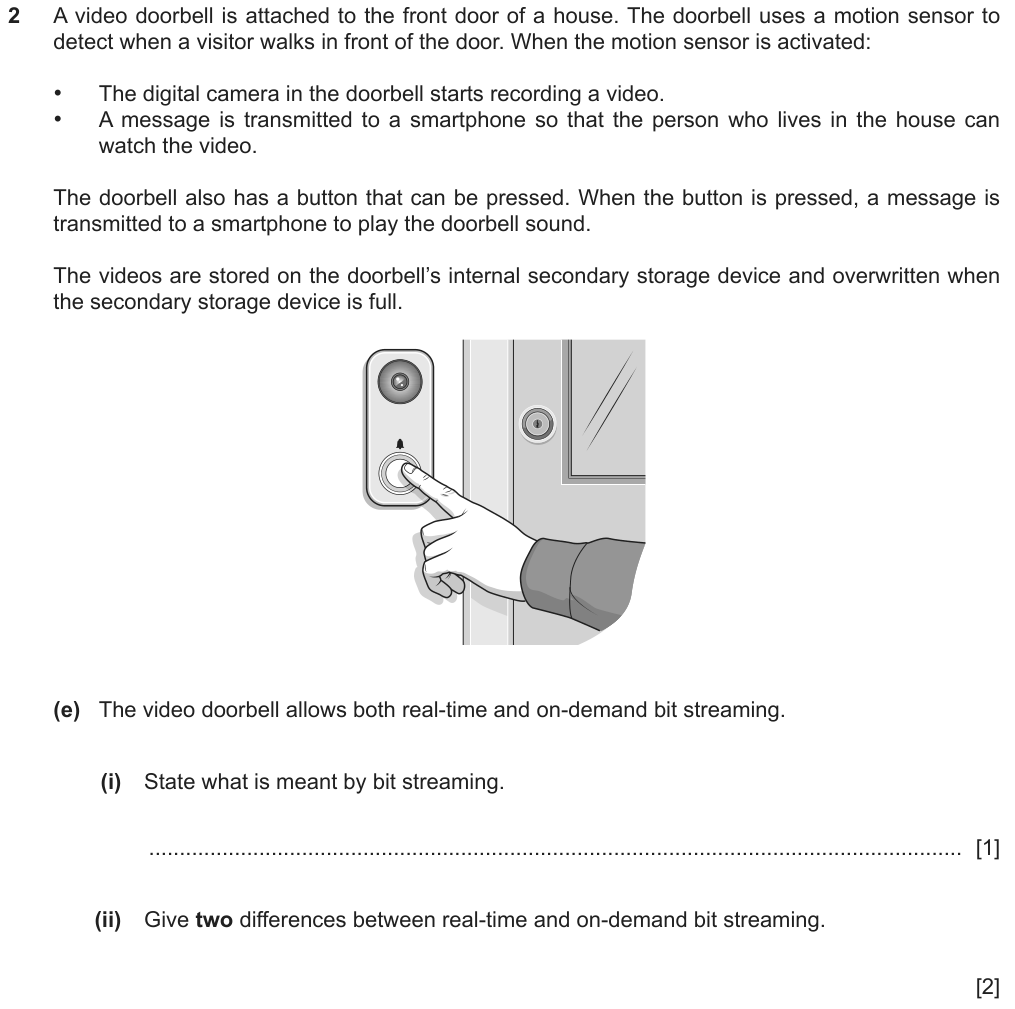
- (i) Continuous ordered flow of bits over a communication path B1
- (ii) Real-time is direct from source, on-demand is pre-recorded / downloaded to view later B1; real-time cannot be re-watched, on-demand can be paused / re-watched // real-time plays continually, on-demand downloads blocks B1
- (i) “streaming bits” / “watching videos online”
- (ii) one-sided statements (“real-time is live”) with no comparison
From: 9618/11/M/J/24 Q2(e)
Internet, WWW or both? (3 marks)
- Both B1
- Internet: sending data on the infrastructure B1
- WWW: accessing a website (stored on the webmail's web server) that is part of the WWW B1
- “Because her email account is accessed through a website” (repeats the question)
- “Both” with only one part justified
From: 9618/11/M/J/21 Q4(d)
- Bit streaming: define (1), real-time vs on-demand (2), explain how it works in a video conference (4).
- Internet hardware: modems / dedicated lines (2), PSTN (2), cell network (4).
Worked examples
Example 1 · Real-time streaming in a video conference; modems and dedicated lines (Paper 1, 6 marks) ★★ Medium
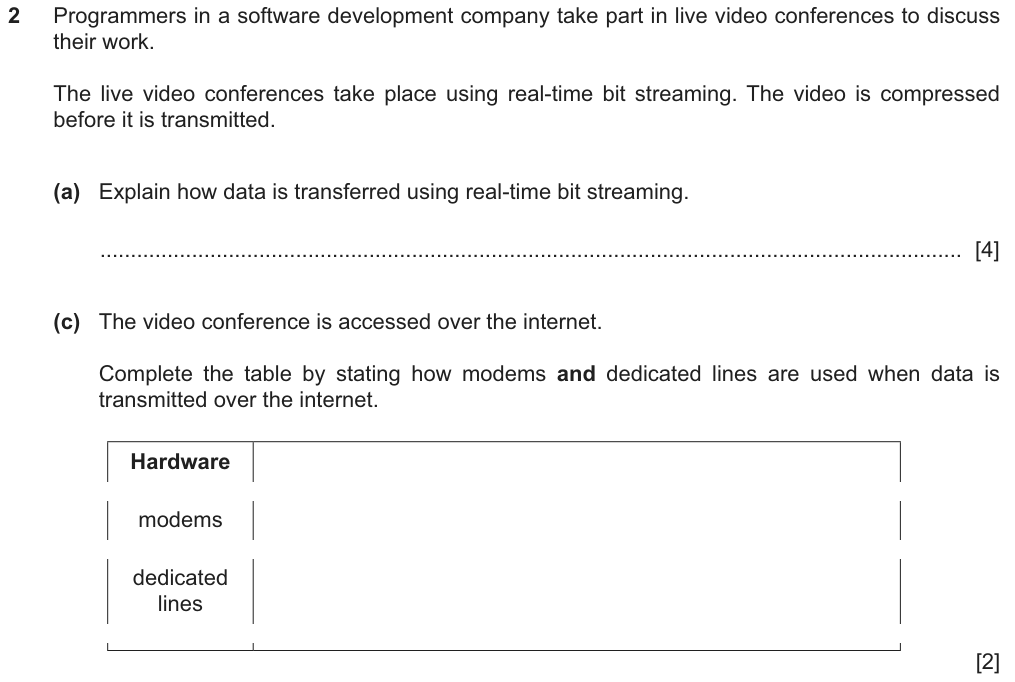
(a) the streaming story: continuous bits → media server → buffer → viewer. (c) one use for each piece of hardware.
- real-time bit streaminglive, continuous
- how … usedwhat each device does to the data
- (a)4 steps
- (c)modem, dedicated line
- (a)
- 1transmitted continuously as bits
- 2media server
- 3buffer on the device
- 4viewer plays from the buffer
Why the buffer?
Transmission and playback speeds differ; it stores data until the device can use it.
5 Now solve it have a go on paper first, then open the worked solution
- (a) Video is transmitted continuously as a series of bits B1; it is uploaded to a media server and users download from the media server B1
- The server sends the data to a buffer on the user's device B1; the buffer stores data until the recipient can receive it (speeds differ) and the recipient views the bit stream from the buffer B1
- (c) Modems: convert digital data to analogue for transmission down phone lines (and back) B1; dedicated lines: a direct / private connection, so faster transmission B1
(a) is in time order, source to screen ✓.
Example 2 · Bit streaming in a video conference (Paper 1, 4 marks) ★ Easy
The same chain as Example 1 - and compression is credited here as the first step.
- (c)4 points
5 Now solve it have a go on paper first, then open the worked solution
- Data is compressed before transmitting B1
- The video and audio are transmitted continuously as a series of bits B1
- On download, the media server sends the data to a buffer B1
- The buffer stores data until the receiving device can process it; the device receives the bit stream from the buffer B1
Each point is one link in the chain ✓.
Example 3 · How the cell phone network carries data (Paper 1, 4 marks) ★★ Medium
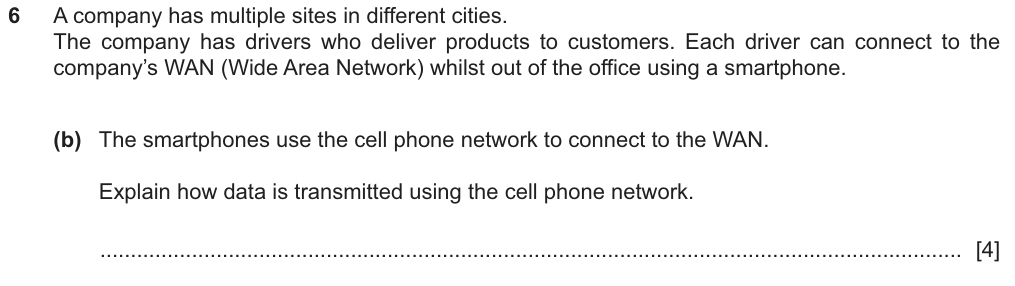
Cells, towers, radio, many users per tower.
- (b)4 points
5 Now solve it have a go on paper first, then open the worked solution
- Land is split into cells (designed for maximum line of sight) B1
- Each cell has a tower with an antenna which receives and transmits data B1
- Data is transmitted between the tower and the phone wirelessly using low-power radio signals B1
- Multiple devices can communicate simultaneously with the same tower B1
Four separate facts, none repeating “it uses the cell network” ✓.
Example 4 · The role of the PSTN (Paper 1, 2 marks) ★ Easy
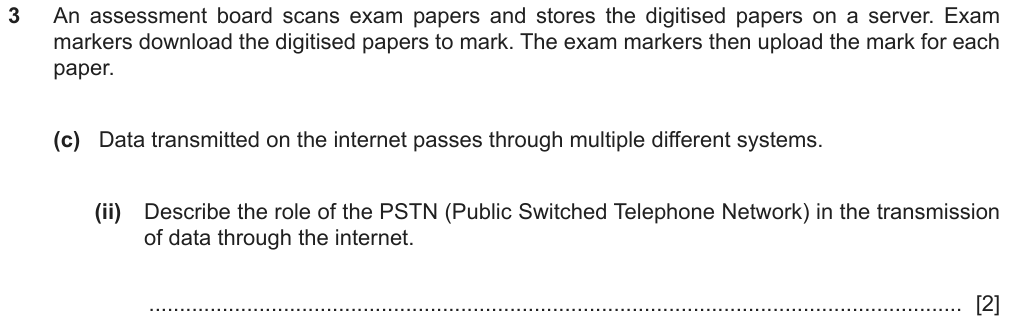
What the telephone network does to internet data as it passes through.
- (c)(ii)2 points
5 Now solve it have a go on paper first, then open the worked solution
- The PSTN consists of many different types of communication lines B1 … so digital data may need to be converted to analogue B1
- (also: duplex - both directions at once; passes through different switching centres / ISPs)
✓
Summary
- Internet = the infrastructure (network of networks). WWW = websites and web pages accessed over it.
- Modem: digital ↔ analogue. PSTN: telephone network, switching centres, duplex. Dedicated line: private, fast. Cell network: cells, towers, low-power radio.
- Bit streaming: continuous flow of bits via a media server into a buffer. Real-time (live, no rewind) vs on-demand (pre-recorded, pause / rewind). Broadband speed must exceed the bit rate.
| If you see… | do this |
|---|---|
| “internet or WWW?” | infrastructure vs websites, justify both parts |
| “explain bit streaming” | compress → continuous bits → media server → buffer → play |
| “real-time vs on-demand” | live / pre-recorded; no rewind / rewind; continual / blocks |
| Mbps and MB | × 8 or ÷ 8 between bits and bytes |
Can I do this?
- I can explain the difference between the internet and the WWW, and justify which a task uses.
- I can describe modems, the PSTN, dedicated lines and the cell phone network.
- I can explain how bit streaming works, including the buffer.
- I can compare real-time and on-demand streaming and explain why bit rate matters.
Anything unticked: revise that section first. All ticked: take the quiz.
Quiz
The multiple-choice and guided questions need JavaScript. The concept checks and exam practice below work without it.
Concept checks
Answer each one in your head first, then open it.
1Does a video call use the WWW?Show answer
Not necessarily: a video-call app uses the internet's infrastructure and protocols without web pages; a browser-based call uses both.
2Why can't you skip ahead in a live stream?Show answer
The future part hasn't been recorded yet: the data is sent as it is produced.
3Why do streaming services drop the quality when your connection slows?Show answer
A lower quality needs a lower bit rate, which the slower connection can keep up with, so the buffer doesn't run dry.
Exam-style practice
New questions, not used above. Do them on paper, then mark your work against the official mark scheme.
A sports club streams its matches live, and also puts recordings online to watch later.
- (a)Give two differences between the live stream and the recordings.[2]
- (b)Explain the purpose of the buffer on a viewer's device.[2]
Show the mark scheme
| Part | Answer / working | Marks | Guidance |
|---|---|---|---|
| (a) | Live is direct from the source as it happens; recordings are pre-recorded | B1 | |
| Live can't be paused / re-watched (beyond the present); recordings can be paused / rewound | B1 | ||
| (b) | Temporarily stores data received from the server … | B1 | |
| … until the device can play it, because the transmission speed and playback speed differ / so playback is smooth | B1 | ||
| Total: 4 marks | |||
Explain the difference between the internet and the World Wide Web.
- [2]
Show the mark scheme
| Part | Answer / working | Marks | Guidance |
|---|---|---|---|
| The internet is the global network of interconnected networks / the infrastructure | B1 | ||
| The WWW is the collection of websites / web pages accessed using the internet | B1 | ||
| Total: 2 marks | |||
Your progress on this note is saved when JavaScript is on.